The Thirty-Third AAAI Conference on Artificial Intelligence (AAAI-19)
Concurrency Debugging with MaxSMT
Miguel Terra-Neves,
1Nuno Machado,
2Inˆes Lynce,
1Vasco Manquinho
1 1INESC-ID / Instituto Superior T´ecnico, Universidade de Lisboa, Portugal2Teradata Spain and HASLab - INESC TEC / Universidade do Minho, Portugal
{neves, ines, vmm}@sat.inesc-id.pt [email protected]
Abstract
Current Maximum Satisfiability (MaxSAT) algorithms based on successive calls to a powerful Satisfiability (SAT) solver are now able to solve real-world instances in many applica-tion domains. Moreover, replacing the SAT solver with a Sat-isfiability Modulo Theories (SMT) solver enables effective MaxSMT algorithms. However, MaxSMT has seldom been used in debugging multi-threaded software.
Multi-threaded programs are usually non-deterministic due to the huge number of possible thread operation schedules, which makes them much harder to debug than sequential pro-grams. A recent approach to isolate the root cause of concur-rency bugs in multi-threaded software is to produce a report that shows the differences between a failing and a non-failing execution. However, since they rely solely on heuristics, these reports can be unnecessarily large. Hence, reports may con-tain operations that are not relevant to the bug’s occurrence. This paper proposes the use of MaxSMT for the generation of minimal reports for multi-threaded software with concur-rency bugs. The proposed techniques report situations that the existing techniques are not able to identify. Experimental results show that using MaxSMT can significantly improve the accuracy of the generated reports and, consequently, their usefulness in debugging the root cause of concurrency bugs.
1
Introduction
Nowadays, multicore and multiprocessor architectures have become the dominant platforms. To take full advantage of these computer architectures, one has to resort to parallel and concurrent programming. However, multi-threaded pro-grams are much more challenging to develop than sequen-tial programs, as they typically allow a huge diversity of thread operation schedules that can yield different outcomes. Among the many possible schedules, some may result in un-desirable behavior, like a crash or incorrect output (Lu et al. 2008). Suchfailing schedules(i.e. schedules that cause the program to fail) are typically non-deterministic and hard to reproduce, which renders the debugging of multi-threaded programs notoriously difficult.
A concurrency bug occurs when some shared memory is incorrectly changed due to a specific schedule of oper-ations of concurrent threads being executed. A large body
Copyright c⃝2019, Association for the Advancement of Artificial Intelligence (www.aaai.org). All rights reserved.
of work has focused on the ability to reproduce concur-rency bugs in multi-threaded programs, namely determin-istic execution (Berger et al. 2009; Devietti et al. 2010; Olszewski, Ansel, and Amarasinghe 2009) anddeterministic record and replay(Lee et al. 2009; Altekar and Stoica 2009; Huang, Zhang, and Dolby 2013). However, simply replicat-ing a failreplicat-ing schedule does not provide any special insight into the reason why the program has failed. As a result, find-ing the bug in the code that allows the failure to surface can still be a daunting task.
One way to ease the diagnosis of concurrency bugs is to report the differences between a failing execution and a non-failing execution. Given a failing schedule and a failure condition, some systems try to produce a similarnon-failing schedule by systematically reordering pairs of thread events in the failing execution. For each alternative schedule result-ing from a thread event swappresult-ing, a Satisfiability Modulo Theories (SMT) model is built that encodes the program’s logic and synchronization constraints of the original execu-tion and a condiexecu-tion representing the absence of the failure. Next, an SMT solver is used to check if there is an alternate, non-failing schedule that satisfies the constraints. After find-ing a feasible non-failfind-ing schedule, a report is generated that highlights the differences between the original failing sched-ule and the non-failing. Hence, the programmer only needs to focus on the differences in order to fix the bug.
Although effective in some cases, this technique has sev-eral limitations. In particular, if more than two pairs of oper-ations need to be reordered simultaneously in order to pre-vent the failure, then there is no guarantee that a non-failing schedule will be generated.
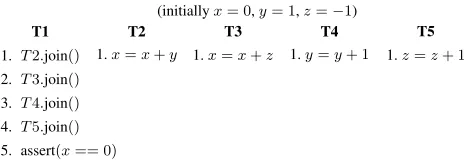
con-(initiallyx= 0,y= 1,z=−1)
T1
1.T2.join()
2.T3.join()
3.T4.join()
4.T5.join()
5. assert(x== 0)
T2
1.x=x+y
T3
1.x=x+z
T4
1.y=y+ 1
T5
1.z=z+ 1
Figure 1: Schedule dependent bug in multi-thread program.
currency bug in a multi-threaded program can be obtained by maximizing the similarities between the failing sched-ule and non-failing schedsched-ules. Hence, the main contribu-tions of this paper are as follows: (i) three complementary metrics for measuring schedule similarity and a MaxSMT model that optimizes these metrics in order to produce a re-port with a minimal explanation of a concurrency bug; (ii) a novel approximation algorithm that considerably speeds up the MaxSMT model solving procedure by exploiting domain knowledge, and (iii) an extensive experimental evaluation, with benchmark and real-world concurrency bugs, showing that the proposed model produces more accurate reports than the previous approaches based on heuristics.
The rest of the paper is organized as follows: Section 2 provides background on concurrency bugs, SMT and other concepts necessary for this work. Section 3 exemplifies lim-itations of current systems for concurrency debugging. Sec-tion 4 reviews MaxSMT and describes the model for obtain-ing minimal reports. Section 5 evaluates the contributions of the paper and discusses the results of the experiments. Fi-nally, Section 6 concludes the paper.
2
Background
This section defines the concepts used in the remainder of the paper. First, we review concurrency bugs. Next, we intro-duce the Satisfiability Modulo Theories formalism. Finally, two types of reports on concurrency bugs are described.
2.1
Concurrency Bugs
A concurrency bug is an error in multi-threaded code that may cause the program to fail depending on the order in which thread operations are executed. An operation is ei-ther a read/write of a variable or a synchronization primitive (e.g. lock, unlock, fork, etc). As an example, consider the multi-threaded program with five threads (T1–T5) shown in Figure 1. The program has three shared variables:x,yand
z. Variablexis accessed by T1, T2 and T3,yis accessed by T2 and T4, andzby T3 and T5. T1 simply waits for all other threads to terminate and then checks ifxis 0.
This program can fail under two different scenarios, as the assertionx == 0is violated when T4 executes before T2 or T5 before T3, but not otherwise. For instance, a fail-ing schedule can occur if the sequence of execution is:<T4, T5, T2, T3>, since the value ofxis 2 when the assertion is tested. In this case, the failure is caused by two concurrency bugs, namely a data race onybetween T2 and T4 and a data race onzbetween T3 and T5. Adata raceoccurs when two
different threads access the same variable without synchro-nization, and at least one of the accesses is a write.1
For this data race, T2 reads the value ofy concurrently with the write on y by T4. Since the execution is non-deterministic, one may observe a schedule where T4 incre-mentsybefore T2 addingytox, thus causingxto be greater than 0 at the end of the program. However, if T2 increments
xprior to T4 settingyto 2 (and T5 also executes before T3 settingzto 0), thenx= 0at the end of the execution and the program satisfies the assertion. In this example, each thread executes the exact same sequence of operations in both the failing and non-failing executions. Hence, since the differ-ence between the executions concerns only the thread inter-leaving, the bug is said to be strictlyschedule dependent.
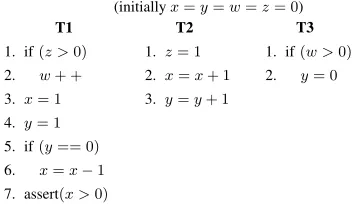
However, not all concurrency bugs are strictly schedule-dependent. For example, consider the multi-threaded pro-gram in Figure 2, which has three threads (T1-T3) and four shared variables (x,y,zandw). The program will fail ifx
is not greater than 0 at the end of T1’s execution.
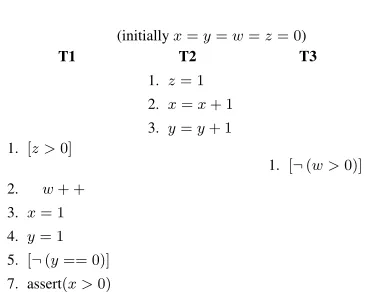
As depicted in Figure 3, it may be the case that T2 runs before T1, causingwto be incremented at line 2 of T1, and T3 setsy = 0in-between lines 4 and 5 of T1, i.e. after T1 incrementsw but before checking if y == 0. This inter-leaving will causexto be decremented to 0 at line 6 of T1 and, consequently, violate the assertion at line 7. Notice that the failing and non-failing executions of this program neces-sarily differ in their control-flow paths. As such, the bug is deemedpath-schedule dependent.
2.2
Satisfiability Modulo Theories
A propositional formula φ in Conjunctive Normal Form
(CNF), defined over a set X of n Boolean variables
{x1, . . . , xn}, is a conjunction of clauses, where a clause is a disjunction of literals. A literal is either a variablexior its complement¬xi. The Propositional Satisfiability (SAT) problem consists of deciding whether there exists an assign-ment to the variables inX such that the formulaφis satis-fied. For ease of explanation, we often use the set notation to represent the conjunction of clauses and formulas.
As an example, consider the CNF formulaφ={(¬x1∨ x2),(x1∨x2∨x3),(¬x2∨ ¬x3)}. In this case, a possible satisfying assignment would bex1 = 0, x2 = 0, x3 = 1, since it satisfies all clauses inφ.
The Satisfiability Modulo Theories (SMT) problem is a generalization of SAT. Given a decidable first order theory T, aT-atom is a ground atomic formula inT. AT-literal is either aT-atomtor its complement¬t. AT-formula is similar to a propositional formula, but aT-formula is com-posed ofT-literals instead of propositional literals. Given a T-formulaφ, the SMT problem consists of deciding if there exists a total assignment over the variables ofφsuch thatφ
is satisfied. Depending on the theoryT, the variables can be of type integer, real, Boolean, etc.
Using SMT to encode multi-threaded executions.Some debugging systems represent multi-threaded executions as SMT formulations over symbolic variables (Huang, Zhang,
1
(initiallyx=y=w=z= 0)
T1
1. if(z >0)
2. w+ +
3. x= 1
4. y= 1
5. if(y== 0)
6. x=x−1
7. assert(x >0)
T2
1. z= 1
2. x=x+ 1
3. y=y+ 1
T3
1. if(w >0)
2. y= 0
Figure 2: A multi-threaded program with a path and schedule-dependent bug.
(initiallyx=y=w=z= 0)
T1
1. [z >0]
2. w+ +
3. x= 1
4. y= 1
5. [y== 0]
6. x=x−1
7. assert(x >0)
T2
1. z= 1
2. x=x+ 1
3. y=y+ 1
T3
1. [w >0]
2. y= 0
Figure 3: Failing schedule for program in Figure 2.
and Dolby 2013; Machado, Lucia, and Rodrigues 2015; Machado, Lucia, and Rodrigues 2016). The constraints of a concurrent execution are composed by a set of sub-formulae that encode, respectively, the path conditions, the program order of operations in each individual thread, the read-write linkages of shared variables, the synchronization points, and the failure condition.
Letvart,ldenote the value of a shared variablevarat line
l of threadt. Consider the initial values of the variables as having line and thread equal to 0. Moreover, let theorder variablesRt,l(Wt,l) denote the execution order of the read (write) operation at linelof threadt. A concrete instance of the SMT formula for the multi-threaded program in Figure 2 is as follows.2
Path Constraints. Let us assume an execution path in which the branch condition at line 1 of thread T1 evaluates totrue, whereas the branch conditions at lines 5 and 1 of threads T1 and T3, respectively, evaluate tof alse. The path constraints are then encoded as:
(z1,1>0)∧ ¬(y1,5= 0)∧ ¬(w3,1>0)
Program Order Constraints.The following SMT formula
2
Since the program in Figure 2 does not have synchronization points, we do not consider this type of constraints in the model description for the example.
enforces the schedule of operations in a particular thread:
(R1,1< W1,2< W1,3< W1,4< R1,5< R1,7)∧ (W2,1< W2,2< W2,3)∧(R3,1< W3,2)
Read-Write Constraints.To encode all possible data-flows over shared variables due to reads and writes performed by the three threads along their execution paths, one would add the following conjunction of constraints to the system:
(x0,0= 0)∧(y0,0= 0)∧(w0,0= 0)∧(z0,0= 0)
initial values
((z1,1=z0,0∧R1,1< W2,1)∨ (z1,1=z2,1∧R1,1> W2,1))∧(z2,1= 1)
reads/writes onz (w1,2=w0,0+ 1)∧
((w3,1=w0,0∧R3,1< W1,2)∨(w3,1=w1,2∧R3,1> W1,2))
reads/writes onw (y1,4= 1)∧
((y1,5=y1,4∧(R1,5< W2,3∨W1,4> W2,3))∨ (y1,5=y2,3∧R1,5> W2,3∧W2,3> W1,4))∧
((y2,3=y0,0+ 1∧R2,3< W1,4)∨(y2,3=y1,4+ 1∧R2,3> W1,4))
reads/writes ony
(x1,3= 1)∧
((x1,7=x1,3∧(R1,7< W2,2∨W1,3> W2,2))∨
(x1,7=x2,2∧R1,7> W2,2∧W2,2> W1,3))∧
((x2,2=x0,0+ 1∧R2,2< W1,3)∨(x2,2=x1,3+ 1∧R2,2> W1,3))
reads/writes onx
Note that each conjunct expresses the possible values re-turned by a read operation on a shared variable by encoding the most-recent write to that variable. For instance, the con-straints (x2,2 = x0,0 + 1 ∧ R2,2 < W1,3) ∨(x2,2 = x1,3+ 1∧R2,2> W1,3)indicate that the read onxby T2 at line 2 either returns the result of adding 1 to the initial value (therefore, readR2,2happens before writeW1,3) or the re-sult of T1’s write at line 3 (hence, writeW1,3happens before readR2,2and is the most recent write tox).
Failure Constraint.Finally, to force the solver to produce a failing schedule, one adds a constraint encoding the nega-tionof the assertion:¬(x1,7>0).
In contrast, to obtain a non-failing schedule, one would add the original assertion to the formulation instead of the constraint above. Furthermore, one would also need to add constraints limiting the order variables to have all distinct integer values within the range[1, n], wherenis the number of operations of the program. In this example, the Linear Integer Arithmetic (LIA) theory is being used asT.
programs. ConcBugAssist (Khoshnood, Kusano, and Wang 2015) extends BugAssist to handle concurrency bugs and automatically generate fixes by casting the binate covering problem as a constraint formulation. Finally, SMT has also been extensively used in testing (Huang 2015; Farzan et al. 2013) of concurrent programs.
2.3
Differential Schedule Projections
In the context of root cause isolation using SMT solving, the SYMBIOSISdebugging tool (Machado, Lucia, and Ro-drigues 2015) introduced the notion of Differential Sched-ule Projection (DSP). Like the name suggests, a DSP is built by projecting a failing schedule onto an alternate schedule (which is a non-failing variant of the failing schedule). The DSP prunes out the common operations in the projection and reports solely the subset of thread events that differ between the schedules. These events correspond to read-write link-ages that cause the failure in the failing schedule.
More formally, let us define an execution schedule as a 3-tuple(V, Es, Edf), corresponding to a directed acyclic graph (DAG) with a setV of vertices, representing thread operations in the execution, and two sets of directed edges connecting the vertices:schedule edges(Es) anddata-flow edges(Edf). A schedule edge links a pair of operations, be-longing to the same thread or not, according to the execution order given by the schedule. In turn, a data-flow edge con-nects a write operationwto a read operationr, thus indicat-ing thatrreads the value written bywduring the execution.
Consider now that F = (V, EF
s, EdfF) and A =
(V, EsA, EdfA)denote the DAGs of the failing and alternate schedules, respectively. The portions of the schedules rel-evant to the bug’s root cause are obtained by computing the union of the edges exclusive to both schedules:Ep
s =
(EsF∪EsA)\(EsF∩EsA)andEpdf = (EdfF∪EdfA)\(EFdf∩EdfA). The DSP is then given by the pair(Fp, Ap), whereFp =
(Vp, EF
s ∩Esp, EdfF∩E p df),A
p= (Vp, EA
s ∩Eps, EdfA∩E p df), andVpis the set of vertices (i.e. operations) appearing in the edges in bothEp
s andE p df.
By highlighting the data-flow variations between the schedules, the DSP allows obviating most of the execution’s complexity (which is often irrelevant for the failure to occur) and steer the programmer’s focus to the bug’s root cause.
2.4
Differential Path-Schedule Projections
When the manifestation of the failure depends on the threads’ execution path, an alternate, non-failing schedule will necessarily exhibit a variation in the program’s control-flow with respect to the failing schedule. To handle such path-schedule dependent bugs, CORTEX(Machado, Lucia, and Rodrigues 2016) introduced Differential Path-Schedule Projections (DPSPs), which are an extension of DSPs that highlight differences in the control-flow, in addition to dif-ferences in the data-flow.
However, since a change in the control-flow of a multi-threaded program is, in practice, the result of a variation in the schedule of the thread operations that changes the data-flow on shared variables and causes a given branch condition
to evaluate differently, in the rest of the paper we will use the term DSP to refer to both a DSP and a DPSP.
It should also be noted that the accuracy of DSPs is heav-ily determined by the similarity between the schedules. The more different the thread interleaving of the failing schedule is from that of the alternate schedule, the fewer common por-tions their projection will exhibit and the longer the resulting DSP will be. An unnecessarily long DSP will contain events from the original execution that are not related to the bug’s root cause and, consequently, hinder the debugging task. It is thus of paramount importance to obtain failing and alter-nate schedules as identical as possible, in order to generate an accurate and useful differential projection.
3
S
YMBIOSISand C
ORTEXShortcomings
This section describes systems SYMBIOSIS’ and CORTEX’s approaches for generating Differential Schedule Projections (DSPs), and highlights their key shortcomings.
3.1
Swapping One Operation Pair is not Enough
SYMBIOSIS leverages symbolic execution and SMT con-straint solving to produce DSPs that isolate concurrency bugs. SYMBIOSIS receives as input a set of lightweight per-thread path profiles recorded from an original failing execution. Next, it performs a guided symbolic execution along the thread path profiles with the goal of generating per-thread traces with symbolic information. The symbolic traces are used to generate an SMT constraint formulation encoding the failure condition, as described in Section 2.2. Afterwards, SYMBIOSIS resorts to an SMT solver to solve the constraint system and output a failure-inducing ordering of operations, i.e. the failing schedule.
After obtaining the failing schedule, SYMBIOSIS has to devise an alternate, non-failing schedule in order to be able to compute the DSP and pinpoint the bug’s root cause. The generation of the alternate schedule is done by applying the following heuristic:
1. Select a pair of events in the failing schedule, prioritizing pairs whose events are closer in the execution;
2. Generate a candidate alternate schedule by swapping the order of the two events in the failing schedule;
3. Check the satisfiability of the candidate alternate schedule by solving an SMT formula like the one used to produce the failing schedule, but modified to have the failure con-straint inverted and new concon-straints enforcing the order of operations given by the candidate alternate schedule;
4. If the SMT formula is satisfiable, return the non-failing schedule. Otherwise, repeat steps 1 to 3 until a feasible alternate schedule is found, or until all possible event pairs have been reordered (in which case, SYMBIOSISfails).
Once a feasible alternate schedule is found, SYMBIOSIS
As an example of this limitation, recall the buggy pro-gram in Figure 1. Note that it suffices that T4 runs before T2 or T5 runs before T3 for the program to fail. Consider the failing schedule of operations <T4, T5, T2, T3>for Figure 1. SYMBIOSISwill attempt to generate an alternate schedule by reordering the following pairs of instructions:
(R1,5, W3,1),(R1,5, W2,1),(R3,1, W2,1),(R3,1, W5,1), and
(R2,1, W4,1). Swapping the former two event pairs renders the model unsatisfiable because it violates the synchroniza-tion semantics of the program, which state that the end of a thread must happen before thejoinoperation by the parent thread. In turn, inverting the order of the remaining pairs will fix one of the two problematic data-flows (z=z+ 1before
x=x+zory =y+ 1beforex=x+y), but never both simultaneously. For that reason, SYMBIOSISwill fail to find a feasible alternate schedule.
3.2
The Disregard for Minimality
Conversely to SYMBIOSIS, CORTEXaims at exposing and isolating concurrency bugs incorrectexecutions. CORTEX
starts from a set of per-thread path profiles collected from one or more executions and produces a non-failing sched-ule using symbolic execution and SMT constraint solving. In fact, the model built by CORTEXis similar to the one em-ployed by SYMBIOSISto obtain the initial failing schedule.
Afterwards, CORTEX systematically explores the state space of the program in an attempt to unveil a schedule that leads to a failure. More concretely, CORTEXinverts branch conditions in the original non-failing schedule, starting from branches that are closer to the assertion point. For each new combination of thread symbolic traces, CORTEXbuilds an SMT formula encoding the failure condition and checks its satisfiability. If the formula is satisfiable, then CORTEX ob-tains the failing schedule and proceeds to the computation of the DSP. Otherwise, CORTEX flips a different branch con-dition, synthesizes new thread traces via symbolic execu-tion, and repeats the procedure until a maximum number of branch flips is reached.
Using this approach, CORTEX is able to generate fail-ing schedules for failures that are path-schedule dependent. Then, an alternate schedule is produced through an SMT solver, as in SYMBIOSIS. Branch conditions are flipped and new thread traces synthesized if necessary. Unfortunately, the alternate schedule found by the SMT solver does not come with any guarantees in terms of similarity to the initial non-failing schedule. In fact, CORTEXsimply uses the first alternate schedule produced by the solver.
To better illustrate this limitation, recall the program in Figure 2. Figure 3 shows a possible failing schedule for this program. Recall that the failure occurs because T3 setsyto
0before the evaluation of the branch condition in line 5 of T1, which causesxto be decremented to 0 at line 6 and, consequently, the violation of the assertion. For the purpose of this example, let us consider that CORTEXstarts from the failing schedule in Figure 3 and aims at finding an alternate schedule that allows computing the DSP. Since this failure is path-schedule dependent, CORTEXneeds to synthesize new execution traces in order to find a feasible alternate schedule. Suppose that CORTEXsynthesizes an execution that flips
(initiallyx=y=w=z= 0)
T1
1. [z >0]
2. w+ +
3. x= 1
4. y= 1
5. [¬(y== 0)]
7. assert(x >0)
T2
1. z= 1
2. x=x+ 1
3. y=y+ 1
T3
1. [¬(w >0)]
Figure 4: Possible alternate schedule for Figure 3.
(initiallyx=y=w=z= 0)
T1
1. [z >0]
2. w+ +
3. x= 1
4. y= 1
5. [¬(y== 0)]
7. assert(x >0)
T2
1. z= 1
2. x=x+ 1
3. y=y+ 1
T3
1. [¬(w >0)]
Figure 5: An alternate schedule for Figure 3 that results in a smaller DPSP than the one in Figure 4.
the path conditions of lines 1 and 5 of T3 and T1, respec-tively. The alternate schedules depicted in Figures 4 and 5 are two possible interleavings found by the SMT solver for this scenario. The DSPs generated for these two alternate schedules would differ. The alternate schedule in Figure 5 is more similar to the failing schedule, as they share a longer common prefix (namely all the instructions executed by T2). Since the common prefix is irrelevant to the occurrence of the bug, it can be discarded when computing the DSP.
4
Generating DSPs with MaxSMT
This section proposes an approach based on Maximum Sat-isfiability to address the limitations in SYMBIOSISand COR
-TEXpresented in Section 3.
4.1
Maximum Satisfiability in SMT
sat-isfied and the number of satsat-isfied soft clauses is maximized. One can also define the Maximum Satisfiability prob-lem in SMT formulas. TheMaxSMTproblem is similar to MaxSAT, except thatφh, as well asφscontainT-formulas instead of propositional clauses. In MaxSMT, the goal is to find an assignment that satisfies all T-formulas inφh and maximizes the number of satisfied softT-formulas inφs.
Example 4.1. Consider the MaxSMT formulaφ=φh∪φs where φh = {(x1 ≥ 0),(x1 ≤ 4)} and φs = {(x2 ≥ −1),(x2≤0),(x1+x2= 5)}. Here,T is the Linear Integer Arithmetic (LIA) theory. An optimal solution would bex1=
4, x2= 1, where soft constraint(x2≤0)is not satisfied.
Observe that algorithms to solve MaxSAT that use itera-tive calls to a SAT solver can be adapted to solve MaxSMT. In MaxSMT, an SMT solver is used instead of a SAT solver. For instance, the SMT solver Z3 (de Moura and Bjørner 2008) is able to solve MaxSMT formulas (Bjørner and Nar-odytska 2015). In the last decade, SMT solvers became able to solve much larger problem instances than previously. As a result, concurrency debuggers such as CLAP (Huang, Zhang, and Dolby 2013), SYMBIOSIS and CORTEX have successfully used SMT constraint solving to achieve their goals. However, these tools rely on heuristic procedures with no guarantee of approximation to the optimum.
One should note that soft formulas encode objectives or preferences. It is well-known that any linear objective func-tion can be easily encoded by using a set of soft formulas in MaxSAT or MaxSMT. However, there exists a vast number of applications where there is more than one objective func-tion to optimize. When there are multiple objectives, one can define a different set of soft formulas for each individual ob-jective. Moreover, if those objectives can be sorted accord-ing to some criteria, then each objective (encoded as a set of soft formulas) can be optimized in order by using lexico-graphic optimization (Marques-Silva et al. 2011).
4.2
Finding an Optimal DSP
In this section, we propose using MaxSMT to compute al-ternate schedules as similar as possible to the correspond-ing failcorrespond-ing schedules. Those alternate schedules can then be used to generate simpler and more informative DSPs than the ones currently produced by the SYMBIOSIS and COR
-TEXsystems. We consider threeDSP qualitycriteria when measuring schedule similarity:
• Number of data-flow variations. This corresponds to the amount of data-flows that appear in the alternate schedule
but not in the failing schedule, i.e.
⏐ ⏐ ⏐E
A df∩E
p df
⏐ ⏐ ⏐.
• Number of broken segments. Let a segment S = o1o2. . . ok be a maximal sequence of operations in the failing schedule such that alloibelong to the same thread
T and for allo′ not belonging toT we have thato′ oc-curs before o1 or afterok.S is consideredbrokenif, in the alternate schedule, some operation of a threadT′̸=T
appears aftero1but beforeok.
• Number of context switch variations. This accounts for the context switches in the failing schedule that do not
occur in the alternate schedule, i.e., contiguous pairs of operationsoiojin the failing schedule such thatoiandoj belong to different threads and, in the alternate schedule, some other operationokappears in-betweenoiandoj.
The rationale for the aforementioned DSP quality crite-ria stems from the observation that most real-world concur-rency bugs can be triggered by only a few thread context switches (Musuvathi et al. 2008). By generating an alternate schedule that minimizes the variation in the data-flow and context switching with respect to the failing sequence of op-erations, one is able to reduce the cardinality of the projec-tion edge setsEdfp andEspand thus produce a DSP that ac-curately isolates the bug’s root cause.
The soft formulas in our MaxSMT model encode the min-imization of these criteria, while constraints presented in section 2.2 are considered as hard formulas. For each data-flow edge(w, r) ∈ EF
df, we add a soft formula stating that operation rmust read the value written byw. Given some operation o, we denote its order variable asO. Therefore, letRandW be the order variables ofrandwrespectively. For every data-flow edge (w, r), the MaxSMT model con-siders, as a soft formula, the conjunction of W < Rwith
W′ < W ∨W′ > R for all w′ ̸= w such thatw′ is a write operation on the variable read byr. To encode the bro-ken segments criteria, we consider every possible maximal sequenceS =o1o2...okof operations, in the failing sched-ule, belonging to the same thread, and add the soft formula
Ok−O1=k−1. Finally, in order to minimize the number of context switch changes, for each schedule edge(oi, oj) such that oi andoj belong to different threads, the model considers the soft formulaOi=Oj−1.
We can look at this schedule computation problem as a multi-objective problem with three different sets of soft for-mulasφdf
s ,φbss andφcss, representing the data-flows, broken segments and context switches criteria respectively. We con-sider two types of MaxSMT models: one where all crite-ria are equally significant (i.e.,φs =φdfs ∪φbss ∪φcss ) and one lexicographic model that optimizes φdf
s first, followed byφbs
s and thenφcss. By prioritizing the optimization of the data-flows, one ensures that the specific interleaving of oper-ations that causes the bug is the most accurate possible. Hav-ing that, the optimization of the other criteria is mainly to allow pruning out additional thread segments that, although differing in the two executions, are not relevant to the failure.
Differential Path-Schedule Projections.Recall from sec-tion 2.4 that, if the failure is path dependent, CORTEX syn-thesizes execution traces that follow a different control-flow than the one in the original non-failing schedule. As a result, some operations in the original schedule may not appear in new traces and vice-versa. When building φdfs , we ignore data-flow edges containing at least one operation that does not appear in the synthesized traces. Same goes for operation sequences (pairs) considered when buildingφbs
s (φcss ).
4.3
Approximating an Optimal DSP
Algorithm 1: Progressive algorithm for computing an alternate schedule.
Input:F
1 Sa←AssertSegment(F)
2 OPf ix←Operations(F)\Sa
3 Sf ←Sa;Sl←Sa
4 A←nil
5 do
6 Sf ←PreviousSegment(F,Sf)
7 Sl←NextSegment(F,Sl)
8 OPf ix←OPf ix\(Sf∪Sl)
9 A←FindAltSchedule(F,OPf ix)
10 whileA=nil∧OPf ix̸=∅;
11 returnA
does not necessarily have to find the alternate schedule that is the most similar to the failing schedule in order to produce a DSP that is sufficiently short and accurate.
State-of-the-art MaxSMT algorithms rely on multiple calls to an SMT oracle and compute intermediate sub-optimal solutions during the search process (Bjørner and Phan 2014). Internally, modern SMT solvers apply an adap-tation of the conflict-driven DPLL procedure used in state-of-the-art SAT solvers (Sebastiani 2007). A simple approach is to terminate the search early if the number of conflicts crosses a fixed threshold. In such case, the MaxSMT solver returns the best solution it was able to find. If no solution was found, the formula is assumed to be unsatisfiable.
A better approach is to generate simpler MaxSMT mod-els by first focusing on the operations close to the assertion and progressively expanding until an alternate schedule is found. This is the idea behind Algorithm 1, which receives a failing scheduleFas input and outputs an alternate sched-ule A. Recall that a failing schedule is a sequence of op-erations that results in a failure and segments are maximal sequences of operations belonging to the same thread. The assertion segmentSais the segment that includes the failing assertion. Algorithm 1 starts by settingOPf ixto all opera-tions except those inSa(line 1). At each iteration, the order of the operations inOPf ix is fixed. The algorithm then re-trieves the segments immediately before (Sf) and after (Sl) the assertion segment (lines 6 and 7). Next, it unfixes the cor-responding operations fromOPf ix(line 8) and attempts to compute an alternate schedule by solving a MaxSMT model (line 9). If an alternate schedule is found, then that schedule is returned. Otherwise, the algorithm keeps removing oper-ations fromOPf ixuntil it either finds an alternate schedule or the set of fixed operations becomes empty (line 10). Note that conflict thresholds can also be used in algorithm 1 in the computation of the alternate schedule in order to avoid getting stuck solving hard MaxSMT formulas.
5
Experimental Evaluation
In order to evaluate the proposed MaxSMT-based ap-proaches, the MaxSMT models and algorithms were inte-grated in the publicly available versions of SYMBIOSIS3and
3
http://github.com/nunomachado/symbiosis
CORTEX4 tools. The experimental evaluation is mainly fo-cused on assessing theperformance and thequality of the DSPsproduced by our MaxSMT-based approaches with re-spect to the base versions of SYMBIOSISand CORTEX. The performance criterion is measured in terms of constraint solving time. For the latter criterion, we assume that reduc-ing the size of the DSPs and the values of the metrics dis-cussed in section 4.2 improves the quality of the DSP and the productivity of the programmer when fixing the bug.
For the comparison, we resorted to several buggy multi-threaded programs commonly used in the literature. We con-sider two sets of test cases. The first includes several C/C++ and Java applications with strictly schedule-dependent bugs, such as shared buffer implementation or an adapted paral-lel file scanner (Elmas et al. 2013). The second set includes programs with path-schedule dependent bugs from the IBM ConTest benchmark suite, as well as theExMCRbenchmark. In our experiments, Z3 (Bjørner and Phan 2014) (ver-sion 4.6.0) was used as the MaxSMT solver. Z3 has na-tive support for lexicographic optimization and implements MaxSMT algorithms MaxRes and WMax.
5.1
Performance Comparison
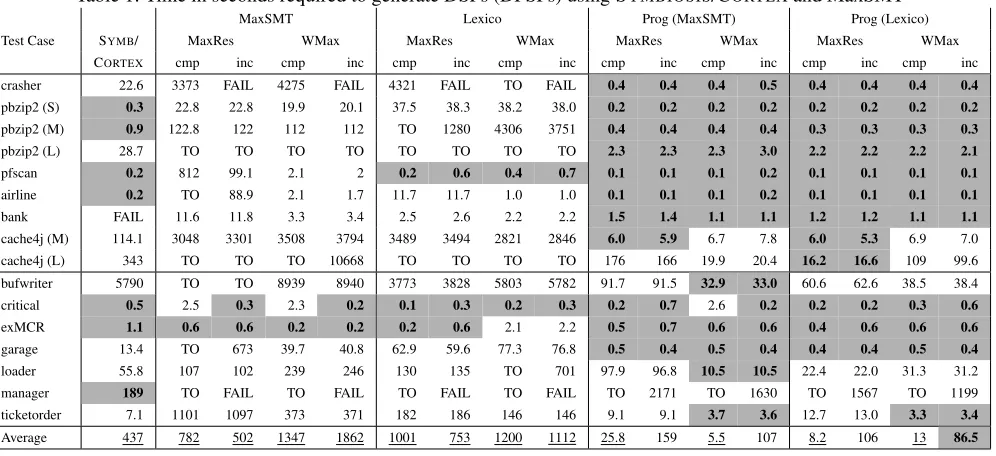
Table 1 shows the execution times of the heuristics of SYMBIOSIS/CORTEXand the MaxSMT-based approaches. Columns ’MaxSMT’ and ’Lexico’ correspond to the full MaxSMT and lexicographic models respectively. The ’Prog (X)’ columns correspond to the progressive algorithm (Al-gorithm 1), where X stands for the type of MaxSMT model used. The ’cmp’ (complete) sub-column indicates that no conflict threshold was imposed. For the ’inc’ (incomplete) sub-column, a conflict threshold of 200000 was used. Each line corresponds to a different test case and the best entries for each test case are highlighted. A time limit of 3 hours was imposed for each execution on a particular test case. En-tries with ’TO’ indicate that the algorithm timed out, while entries with ’FAIL’ indicate that the algorithm terminated within the time limit, but failed to find an alternate schedule. The results in Table 1 show that algorithms using the full MaxSMT model require, in general, more time to generate the DSPs. However, the progressive algorithm is always as fast or much faster than all remaining approaches, includ-ing the heuristic of SYMBIOSIS/CORTEX. In particular, for thebufwritertest case, all configurations of the progressive algorithm generate the DPSP at least 60 times faster than the heuristic. The only exception is themanagertest case, but our approach is able to produce a much improved DPSP (see Table 2). The ’Average’ line shows the average exe-cution time for each algorithm only considering solved in-stances. However, some algorithms are not able to solve all instances within the time limit. These entries are underlined. Nevertheless, the average execution time of the progressive algorithm is much smaller than the remaining approaches.
5.2
DSP Quality Comparison
Table 2 shows the quality of the DSPs found by the orig-inal version of SYMBIOSIS/CORTEX and by the proposed
4
Table 1: Time in seconds required to generate DSPs (DPSPs) using SYMBIOSIS/CORTEXand MaxSMT
Test Case
MaxSMT Lexico Prog (MaxSMT) Prog (Lexico)
SYMB/ MaxRes WMax MaxRes WMax MaxRes WMax MaxRes WMax
CORTEX cmp inc cmp inc cmp inc cmp inc cmp inc cmp inc cmp inc cmp inc
crasher 22.6 3373 FAIL 4275 FAIL 4321 FAIL TO FAIL 0.4 0.4 0.4 0.5 0.4 0.4 0.4 0.4
pbzip2 (S) 0.3 22.8 22.8 19.9 20.1 37.5 38.3 38.2 38.0 0.2 0.2 0.2 0.2 0.2 0.2 0.2 0.2
pbzip2 (M) 0.9 122.8 122 112 112 TO 1280 4306 3751 0.4 0.4 0.4 0.4 0.3 0.3 0.3 0.3
pbzip2 (L) 28.7 TO TO TO TO TO TO TO TO 2.3 2.3 2.3 3.0 2.2 2.2 2.2 2.1
pfscan 0.2 812 99.1 2.1 2 0.2 0.6 0.4 0.7 0.1 0.1 0.1 0.2 0.1 0.1 0.1 0.1
airline 0.2 TO 88.9 2.1 1.7 11.7 11.7 1.0 1.0 0.1 0.1 0.1 0.2 0.1 0.1 0.1 0.1
bank FAIL 11.6 11.8 3.3 3.4 2.5 2.6 2.2 2.2 1.5 1.4 1.1 1.1 1.2 1.2 1.1 1.1
cache4j (M) 114.1 3048 3301 3508 3794 3489 3494 2821 2846 6.0 5.9 6.7 7.8 6.0 5.3 6.9 7.0
cache4j (L) 343 TO TO TO 10668 TO TO TO TO 176 166 19.9 20.4 16.2 16.6 109 99.6
bufwriter 5790 TO TO 8939 8940 3773 3828 5803 5782 91.7 91.5 32.9 33.0 60.6 62.6 38.5 38.4
critical 0.5 2.5 0.3 2.3 0.2 0.1 0.3 0.2 0.3 0.2 0.7 2.6 0.2 0.2 0.2 0.3 0.6
exMCR 1.1 0.6 0.6 0.2 0.2 0.2 0.6 2.1 2.2 0.5 0.7 0.6 0.6 0.4 0.6 0.6 0.6
garage 13.4 TO 673 39.7 40.8 62.9 59.6 77.3 76.8 0.5 0.4 0.5 0.4 0.4 0.4 0.5 0.4
loader 55.8 107 102 239 246 130 135 TO 701 97.9 96.8 10.5 10.5 22.4 22.0 31.3 31.2
manager 189 TO FAIL TO FAIL TO FAIL TO FAIL TO 2171 TO 1630 TO 1567 TO 1199
ticketorder 7.1 1101 1097 373 371 182 186 146 146 9.1 9.1 3.7 3.6 12.7 13.0 3.3 3.4
Average 437 782 502 1347 1862 1001 753 1200 1112 25.8 159 5.5 107 8.2 106 13 86.5
Table 2: Quality of the DSPs (DPSPs), generated by SYMBIOSIS/CORTEXand MaxSMT, measured using the number of oper-ations (OP), data-flow varioper-ations (DF), broken segments (BS) and context switch varioper-ations (CTX)
Test Case SYMB/ CORTEX MaxSMT Lexico Prog (MaxSMT) Prog (Lexico)
OP DF BS CTX OP DF BS CTX OP DF BS CTX OP DF BS CTX OP DF BS CTX
crasher 9 1 1 2 9 1 1 2 9 1 0 3 9 1 1 2 9 1 0 3
pbzip2 (S) 7 1 2 1 7 1 1 1 7 1 1 1 7 1 1 1 7 1 1 1
pbzip2 (M) 4 1 2 1 3 1 1 1 TO 3 1 0 2 3 1 0 2
pbzip2 (L) 7 1 2 1 TO TO 7 1 1 1 7 1 1 1
pfscan 27 1 2 1 27 1 1 1 27 1 0 2 27 1 0 2 27 1 0 2
airline 11 2 2 1 3 1 1 1 3 1 1 1 8 2 1 1 8 2 1 1
bank FAIL 6 1 1 2 6 1 1 2 54 2 2 1 54 2 1 2
cache4j (M) 14 1 1 2 3 1 1 2 3 1 0 3 43 1 1 2 3 1 0 3
cache4j (L) 5 1 2 1 TO TO 3 1 1 2 3 1 1 2
bufwriter 724 88 7 6 197 1 2 1 35 1 1 2 221 8 3 3 221 8 3 3
critical 9 4 3 4 7 4 2 2 7 4 2 2 7 4 2 2 7 4 2 2
exMCR 22 8 8 12 21 7 6 8 21 7 5 9 21 7 6 8 21 7 5 9
garage 5 2 1 2 3 1 2 1 3 1 1 2 5 2 0 3 5 2 0 3
loader 267 22 18 18 48 21 3 2 47 21 2 3 48 21 4 2 47 21 3 3
manager 120 46 58 147 TO TO 78 33 34 109 57 32 9 70
ticketorder 178 4 5 5 46 4 1 2 46 4 1 2 47 4 2 1 46 4 1 2
Average (%) - - - - 61 82 67 70 57 80 34 92 89 91 47 102 68 91 28 109
MaxSMT-based approaches. We consider the number of op-erations, data-flow variations, broken segments and context switch variations in the DSP. Results are shown only for a representative set of configurations (see Table 3) which ex-hibit better performance. The ’Average’ line shows the aver-age relative DSP quality improvement/degradation with re-spect to SYMBIOSIS/CORTEX. For example, 61% in the OPs column for ’MaxSMT’ indicates that the alternate schedule found produces, on average, a DSP with 100% - 61% = 39% fewer operations than that of SYMBIOSIS/CORTEX.
In general, using the full MaxSMT model results in higher
Table 3: Representative configurations per type of approach
Approach MaxSMT Algorithm Conflict Threshold
MaxSMT WMax No
Lexico MaxRes No
Prog (MaxSMT) WMax Yes
Prog (Lexico) WMax Yes
6
Conclusions
This paper proposes the use of Maximum Satisfiability Mod-ulo Theories (MaxSMT) to generate minimal Differential Schedule Projections (DSPs) that automatically provide an explanation of a concurrency bug in a multi-threaded pro-gram. Also, in cases where solving the MaxSMT model is too time-consuming, we exploit domain knowledge to build smaller models and reduce the constraint solving time while still providing a close approximation to an optimal DSP. per-ations The proposed MaxSMT-based approaches were in-tegrated into two state-of-the-art systems SYMBIOSIS and CORTEX. Experimental results, using benchmark and real-world concurrency bugs, show that using a MaxSMT model greatly improves the quality of the DSPs, especially when bugs are path and schedule dependent.
Acknowledgments
This work was supported by national funds through Fundac¸˜ao para a Ciˆencia e a Tecnologia (FCT) with references UID/CEC/50021/2013, SFRH/BD/111471/2015, CMU/AIR/0022/2017 and PTDC/CCI-COM/31198/2017.
References
Altekar, G., and Stoica, I. 2009. ODR: output-deterministic replay for multicore debugging. In22nd Symposium on Op-erating Systems Principles, 193–206. ACM.
Berger, E. D.; Yang, T.; Liu, T.; and Novark, G. 2009. Grace: safe multithreaded programming for C/C++. In24th Inter-national Conference on Object-Oriented Programming, Sys-tems, Languages, and Applications, 81–96. ACM.
Bjørner, N., and Narodytska, N. 2015. Maximum satisfia-bility using cores and correction sets. InInternational Joint Conference on Artificial Intelligence, 246–252. AAAI Press. Bjørner, N., and Phan, A. 2014. νZ - maximal satisfaction with Z3. In6th International Symposium on Symbolic Com-putation in Software Science, 1–9.
de Moura, L. M., and Bjørner, N. 2008. Z3: an efficient SMT solver. In14th International Conference on Tools and Algorithms for the Construction and Analysis of Systems, 337–340. Springer.
Devietti, J.; Lucia, B.; Ceze, L.; and Oskin, M. 2010. DMP: deterministic shared-memory multiprocessing. IEEE Micro 30(1):40–49.
Elmas, T.; Burnim, J.; Necula, G. C.; and Sen, K. 2013. Con-currit: a domain specific language for reproducing concur-rency bugs. InInternational Conference on Programming Language Design and Implementation, 153–164. ACM.
Farzan, A.; Holzer, A.; Razavi, N.; and Veith, H. 2013. Con2colic testing. In 26th Joint European Software Engi-neering Conference and Symposium on the Foundations of Software Engineering, 37–47. ACM.
Huang, J.; Zhang, C.; and Dolby, J. 2013. CLAP: record-ing local executions to reproduce concurrency failures. In 34th International Conference on Programming Language Design and Implementation, 141–152. ACM.
Huang, J. 2015. Stateless model checking concurrent pro-grams with maximal causality reduction. In36th Interna-tional Conference on Programming Language Design and Implementation, 165–174. ACM.
Jose, M., and Majumdar, R. 2011. Cause clue clauses: Error localization using maximum satisfiability. In32nd Interna-tional Conference on Programming Language Design and Implementation, 437–446. ACM.
Khoshnood, S.; Kusano, M.; and Wang, C. 2015. Con-cBugAssist: constraint solving for diagnosis and repair of concurrency bugs. InInternational Symposium on Software Testing and Analysis, 165–176. ACM.
Lee, D.; Said, M.; Narayanasamy, S.; Yang, Z.; and Pereira, C. 2009. Offline symbolic analysis for multi-processor exe-cution replay. In42nd International Symposium on Microar-chitecture, 564–575. ACM.
Li, C. M., and Many`a, F. 2009. Maxsat, hard and soft con-straints. InHandbook of Satisfiability. 613–631.
Lu, S.; Tucek, J.; Qin, F.; and Zhou, Y. 2006. AVIO: detect-ing atomicity violations via access interleavdetect-ing invariants. In International Conference on Architectural Support for Pro-gramming Languages and Operating Systems, 37–48. ACM.
Lu, S.; Park, S.; Seo, E.; and Zhou, Y. 2008. Learning from mistakes: A comprehensive study on real world concurrency bug characteristics. In13th International Conference on Ar-chitectural Support for Programming Languages and Oper-ating Systems, 329–339. ACM.
Machado, N.; Lucia, B.; and Rodrigues, L. 2015. Concur-rency debugging with differential schedule projections. In 36th International Conference on Programming Language Design and Implementation, 586–595. ACM.
Machado, N.; Lucia, B.; and Rodrigues, L. 2016.
Production-guided concurrency debugging. In21st Sympo-sium on Principles and Practice of Parallel Programming, 29:1–29:12. ACM.
Marques-Silva, J.; Argelich, J.; Grac¸a, A.; and Lynce, I. 2011. Boolean lexicographic optimization: algorithms & ap-plications.Annals of Mathematics and Artificial Intelligence 62(3-4):317–343.
Musuvathi, M.; Qadeer, S.; Ball, T.; Basler, G.; Nainar, P. A.; and Neamtiu, I. 2008. Finding and reproducing heisenbugs in concurrent programs. In Symposium on Operating Sys-tems Design and Implementation, 267–280.