S H O R T G E N O M E R E P O R T
Open Access
High-quality permanent draft genome
sequence of
Rhizobium leguminosarum
bv.
viciae
strain GB30; an effective microsymbiont
of
Pisum sativum
growing in Poland
Andrzej Mazur
1, Sofie E. De Meyer
2, Rui Tian
2, Jerzy Wielbo
1, Kamil Zebracki
1, Rekha Seshadri
3, TBK Reddy
3,
Victor Markowitz
4, Natalia N. Ivanova
3, Amrita Pati
3, Tanja Woyke
3, Nikos C. Kyrpides
3,5and Wayne Reeve
2*Abstract
Rhizobium leguminosarum
bv.
viciae
GB30 is an aerobic, motile, Gram-negative, non-spore-forming rod that can exist
as a soil saprophyte or as a legume microsymbiont of
Pisum sativum. GB30 was isolated in Poland from a nodule
recovered from the roots of
Pisum sativum
growing at Janow. GB30 is also an effective microsymbiont of the annual
forage legumes vetch and pea. Here we describe the features of
R. leguminosarum
bv.
viciae
strain GB30, together with
sequence and annotation. The 7,468,464 bp high-quality permanent draft genome is arranged in 78 scaffolds of 78
contigs containing 7,227 protein-coding genes and 75 RNA-only encoding genes, and is part of the GEBA-RNB project
proposal.
Keywords:
Root-nodule bacteria, Nitrogen fixation, Rhizobia, Alphaproteobacteria, GEBA-RNB
Introduction
The most efficient biological nitrogen fixation occurs
when bacterial microsymbionts (rhizobia) form an effective
symbiotic association with legume host plants. Legumes
can develop these interactions with many different species
of rhizobia belonging mainly to the
Alphaproteobacteria
,
including
Azorhizobium
,
Allorhizobium, Bradyrhizobium,
Ensifer, Mesorhizobium
and
Rhizobium
[1, 2]. The genus
Rhizobium
contains at the time of writing 71 species, and
within a species there may be distinct symbiovars [3].
Within the species
Rhizobium leguminosarum
, there
are three distinct symbiovars [4, 5] including bv.
phaseoli
that forms nodules with
Phaseolus vulgaris
, bv.
trifolii
that
forms nodules with clover (
Trifolium
) and bv.
viciae
that
forms nodules on vetch, pea and lentil (
Vicia, Lathyrus,
Pisum
and
Lens
). In
R. leguminosarum
the
nod
genes that
define these distinct host specificities are mostly located
on the symbiotic plasmid, which has generically been
des-ignated pSym. The genomes of
R. leguminosarum
strains
are usually large and complex containing, in addition to
pSym, a chromosomal replicon and extra-chromosomal
low-copy-number replicons characterized by the presence
of
repABC
replication systems [6
–
8]. Recent studies have
revealed that substantial divergence can occur in this
gen-ome organization and in the metabolic versatility of
R.
leguminosarum
isolates [5, 9
–
12]. Kumar
et al.
[5]
demon-strated that the diversity of
R. leguminosarum
within a
local population of nodule isolates was 10 times higher
than that found for
Ensifer medicae
. It was noted that the
abundance of a particular genotype within the population
can vary significantly and adaptation to the edaphic
envir-onment is a sought after trait particularly for the
develop-ment of inoculants [13, 14].
R. leguminosarum
bv.
viciae
GB30 was isolated as the
most abundant nodule inhabitant (>42 %) of
Pisum
sati-vum
cv. Ramrod plants cultivated at a field site in Janow,
Poland [10]. In contrast to other abundant isolates,
GB30 formed nodules and fixed nitrogen with both
P.
sativum
and
Vicia villosa
(cv. Wista). Preliminary
inves-tigation into the genome architecture using Eckhardt
ana-lysis has revealed that GB30 contained a multipartite
genome consisting of six replicons with one chromosome
* Correspondence:[email protected]2
Centre forRhizobiumStudies, Murdoch University, Murdoch, Western Australia
Full list of author information is available at the end of the article
and five plasmids [10]. The genome of this strain could
therefore provide important insights into the mechanisms
required by effective
R. leguminosarum
microsymbionts
to adapt to a particular edaphic environment. Here, we
present a set of general features for
Rhizobium
legumi-nosarum
bv.
viciae
GB30 together with the description
of the complete genome sequence and annotation.
Organism information
Classification and features
R. leguminosarum
bv.
viciae
strain GB30 is a motile,
Gram-negative rod in the order
Rhizobiales
of the class
Alphaproteobacteria
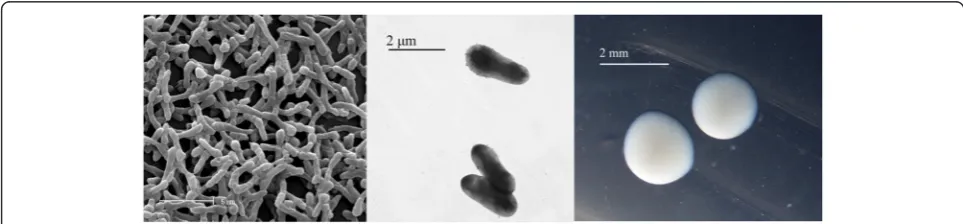
. The rod-shaped form varies in size
with dimensions of 0.8-1
μ
m in width and 2.3-2.5
μ
m in
length (Fig. 1 Left and Center). It is fast growing, forming
colonies within 3
–
4 days when grown on half strength
Lupin Agar (½LA) [15] at 28 °C. Colonies on ½LA are
white-opaque, slightly domed and moderately mucoid
with smooth margins (Fig. 1 Right).
Figure 2 shows the phylogenetic relationship of
Rhizo-bium leguminosarum
bv.
viciae
GB30 in a 16S rRNA gene
sequence based tree. This strain is phylogenetically
most related to
Rhizobium laguerreae
FB206
Tand
Rhi-zobium gallicum
R602sp
Tbased on the 16S rRNA gene
alignment with sequence identities of 100 %, as
deter-mined using the EzTaxon-e server [16].
Rhizobium
laguerreae
FB206
Twas isolated from effective
Vicia faba
root nodules in Tunisia [17], whereas
Rhizobium gallicum
R602sp
Twas isolated from effective
Phaseolus vulgaris
root nodules in France [18]. Sequence similarity was also
investigated with strains from the GEBA-RNB project [12]
and GB30 was found to be closely related to
R.
legumino-sarum
bv.
trifolii
WSM1689 with 100 % 16S rRNA gene
sequence identity.
R. leguminosarum
bv.
trifolii
WSM1689
is a highly effective microsymbiont of the perennial clover
Trifolium uniflorum
and has been shown to have a
re-markable narrow host range [19]. Minimum Information
about the Genome Sequence (MIGS) is provided in Table 1
and Additional file 1: Table S1.
Symbiotaxonomy
R. leguminosarum
bv.
viciae
strain GB30 was obtained
from pea nodules (
P. sativum
cv. Ramrod) growing in
sandy loam (N:P:K 0.157:0.014:0.013 %) in Janow near
Lublin (Poland). The soil contained a relatively high
number of
R. leguminosarum
bv.
viciae
, bv.
trifolii
and
bv.
phaseoli
cells i.e., 9.2 × 10
3, 4.2 ÷ 10
3and 1.5 × 10
3bacteria/g of soil, respectively, as determined by the
most probable number (MPN) method [10]. Plants were
grown on 1 m
2plot for six weeks between May and
June, 2008. Five randomly chosen pea plants growing in
each other
’
s vicinity were harvested; the nodules were
collected, surface-sterilized and the microsymbionts
iso-lated [10]. One of the most abundant isolates, GB30,
formed nodules (Nod
+) and fixed N
2(Fix
+) with
P.
sati-vum
and
Vicia villosa
(cv. Wista) increasing the wet mass
weight by 54 and 38 %, respectively. Plants inoculated with
GB30 also showed a 2.6 fold increase in nodule number
and a 2.2 fold increase in seed pod number.
Genome sequencing and annotation information
Genome project history
This organism was selected for sequencing on the basis
of its environmental and agricultural relevance to issues
in global carbon cycling, alternative energy production, and
biogeochemical importance, and is part of the Genomic
Encyclopedia of Bacteria and Archaea, The Root
Nodu-lating Bacteria chapter (GEBA-RNB) project at the U.S.
Department of Energy, Joint Genome Institute [12]. The
genome project is deposited in the Genomes OnLine
Database [20] and the high-quality permanent draft
gen-ome sequence in IMG [21]. Sequencing, finishing and
annotation were performed by the JGI using state of
the art sequencing technology [22]. A summary of the
project information is shown in Table 2.
Growth conditions and genomic DNA preparation
R. leguminosarum
bv.
viciae
strain GB30 was grown to
mid logarithmic phase in TY rich media [23] on a gyratory
shaker at 28 °C. DNA was isolated from 60 mL of cells
Fig. 2Phylogenetic tree highlighting the position ofRhizobium leguminosarumbv.viciaeGB30 (shown in blue print) relative to other type and non-type strains in theRhizobiumgenus using a 901 bp internal region of the 16S rRNA gene.Bradyrhizobium elkaniiATCC 49852Twas used as
using a CTAB (Cetyl trimethyl ammonium bromide)
bac-terial genomic DNA isolation method [24].
Genome sequencing and assembly
The draft genome of
Rhizobium leguminosarum
bv.
viciae
GB30 was generated at the DOE Joint Genome Institute
[22]. An Illumina Std shotgun library was constructed and
sequenced using the Illumina HiSeq 2000 platform which
generated 25,943,396 reads totaling 3,891.5 Mbp. All
gen-eral aspects of library construction and sequencing
per-formed at the JGI can be found at the JGI web site [25].
All raw Illumina sequence data was passed through DUK,
a filtering program developed at JGI, which removes
known Illumina sequencing and library preparation
arte-facts (Mingkun L, Copeland A, Han J. unpublished).
Fol-lowing steps were then performed for assembly: (1) filtered
Illumina reads were assembled using Velvet version 1.1.04
[26] (2) 1
–
3 Kbp simulated paired end reads were created
Table 1
Classification and general features of
Rhizobium leguminosarum
bv.
viciae
strain GB30 in accordance with the MIGS
recommendations [37] published by the Genome Standards Consortium [38].
MIGS ID Property Term Evidence code
DomainBacteria TAS [39]
PhylumProteobacteria TAS [40,41]
ClassAlphaproteobacteria TAS [42,43]
Classification OrderRhizobiales TAS [44]
FamilyRhizobiaceae TAS [45]
GenusRhizobium TAS [46]
SpeciesRhizobium leguminosarum TAS [47–49]
Gram stain Negative IDA
Cell shape Rod IDA
Motility Motile IDA
Sporulation Non-sporulating NAS
Temperature range Mesophile NAS
Optimum temperature 28 °C TAS [9]
pH range; Optimum Not reported
Carbon source Not reported
MIGS-6 Habitat Soil, root nodule, on host TAS [9]
MIGS-6.3 Salinity Non-halophile NAS
MIGS-22 Oxygen requirement Aerobic TAS [49]
MIGS-15 Biotic relationship Free living, symbiotic TAS [10]
MIGS-14 Pathogenicity Non-pathogenic TAS [50]
MIGS-4 Geographic location Janow, near Lublin, eastern Poland TAS [10]
MIGS-5 Sample collection Between May and June, 2008 TAS [10]
MIGS-4.1 Latitude 51.387638 TAS [10]
MIGS-4.2 Longitude 22.369194 TAS [10]
MIGS-4.3 Altitude 185 m IDA
Evidence codes–IDA: Inferred from Direct Assay; TAS: Traceable Author Statement (i.e., a direct report exists in the literature); NAS: Non-traceable Author Statement (i.e., not directly observed for the living, isolated sample, but based on a generally accepted property for the species, or anecdotal evidence). These evidence codes are from the Gene Ontology project [51].
Table 2
Genome sequencing project information for
Rhizobium
leguminosarum
bv.
viciae
strain GB30
MIGS ID Property Term
MIGS-31 Finishing quality High-quality permanent draft
MIGS-28 Libraries used Illumina Std PE
MIGS-29 Sequencing platforms Illumina Hiseq 2000
MIGS-31.2 Fold coverage 121.9 x Illumina
MIGS-30 Assemblers Velvet version 1.1.04; ALLPATHS v. r41043
MIGS-32 Gene calling methods Prodigal 1.4
Locus Tag A3A3
GenBank ID ATTP00000000
GenBank Date of Release July 9, 2013
GOLD ID Gp0009658 [52]
BIOPROJECT PRJNA165299
MIGS-13 Source Material Identifier GB30
from Velvet contigs using wgsim [27] (3) Illumina reads
were assembled with simulated read pairs using Allpaths
–
LG (version r41043) [28]. Parameters for assembly steps
were: 1) Velvet (velveth: 63
–
shortPaired and velvetg:
−
very_clean yes
–
export-Filtered yes
–
min_contig_lgth 500
–
scaffolding no
–
cov_cutoff 10) 2) wgsim (
−
e 0
–
1 100
–
2
100
–
r 0
–
R 0
–
X 0) 3) Allpaths
–
LG (PrepareAllpaths
Inputs: PHRED_64 = 1 PLOIDY = 1 FRAG_COVERAGE =
125 JUMP_COVERAGE = 25 LONG_JUMP_COV = 50,
RunAllpathsLG: THREADS = 8 RUN = std_shredpairs
TARGETS = standard VAPI_WARN_ONLY = True
OVER-WRITE = True). The final draft assembly contained 78
contigs in 78 scaffolds. The total size of the genome is
7.5 Mbp and the final assembly is based on 910.4 Mbp
of Illumina data, which provides an average of 121.9×
coverage.
Genome annotation
Genes were identified using Prodigal [29], as part of the
DOE-JGI genome annotation pipeline [30, 31]. The
pre-dicted CDSs were translated and used to search the
Na-tional Centre for Biotechnology Information (NCBI)
non-redundant database, UniProt, TIGRFam, Pfam, KEGG,
COG, and InterPro databases. The tRNAScanSE tool [32]
was used to find tRNA genes, whereas ribosomal RNA
genes were found by searches against models of the
ribo-somal RNA genes built from SILVA [33]. Other non
–
cod-ing RNAs such as the RNA components of the protein
secretion complex and the RNase P were identified by
searching the genome for the corresponding Rfam profiles
using INFERNAL [34]. Additional gene prediction analysis
and manual functional annotation was performed within
the Integrated Microbial Genomes-Expert Review (IMG-ER)
system [35] developed by the Joint Genome Institute, Walnut
Creek, CA, USA.
Genome Properties
The genome is 7,468,464 nucleotides with 60.81 % GC
content (Table 3) and comprised of 78 scaffolds of 78
contigs. From a total of 7,302 genes, 7,227 were protein
encoding and 75 RNA only encoding genes. The majority
of genes (79.57 %) were assigned a putative function whilst
the remaining genes were annotated as hypothetical. The
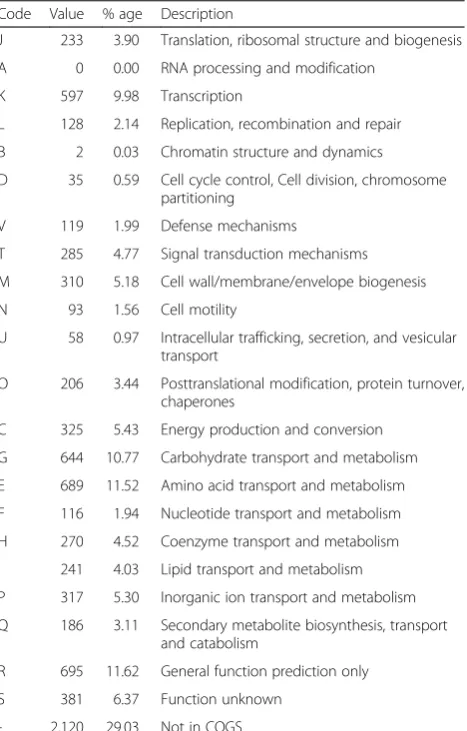
distribution of genes into COGs functional categories is
presented in Table 4.
Conclusion
Rhizobium leguminosarum
bv.
viciae
GB30 belongs to a
group of Alpha-rhizobia strains isolated from
Pisum
sativum
in Poland. Strain GB30 is part of the
GEBA-RNB project that sequenced 24
R. leguminosarum
strains
Table 3
Genome Statistics for
Rhizobium leguminosarum
bv.
viciae
strain GB30
Attribute Value % of Total
Genome size (bp) 7,468,464 100.00
DNA coding (bp) 6,497,898 87.00
DNA G + C (bp) 4,541,558 60.81
DNA scaffolds 78 100.00
Total genes 7,302 100.00
Protein coding genes 7,227 98.97
RNA genes 75 1.03
Pseudo genes 0 0
Genes in internal clusters 470 6.44
Genes with function prediction 5,810 79.57
Genes assigned to COGs 5,182 70.97
Genes with Pfam domains 6,025 82.51
Genes with signal peptides 634 8.68
Genes with transmembrane proteins 1,646 22.54
CRISPR repeats 1
Table 4
Number of genes associated with the general COG
functional categories.
Code Value % age Description
J 233 3.90 Translation, ribosomal structure and biogenesis
A 0 0.00 RNA processing and modification
K 597 9.98 Transcription
L 128 2.14 Replication, recombination and repair
B 2 0.03 Chromatin structure and dynamics
D 35 0.59 Cell cycle control, Cell division, chromosome partitioning
V 119 1.99 Defense mechanisms
T 285 4.77 Signal transduction mechanisms
M 310 5.18 Cell wall/membrane/envelope biogenesis
N 93 1.56 Cell motility
U 58 0.97 Intracellular trafficking, secretion, and vesicular transport
O 206 3.44 Posttranslational modification, protein turnover, chaperones
C 325 5.43 Energy production and conversion
G 644 10.77 Carbohydrate transport and metabolism
E 689 11.52 Amino acid transport and metabolism
F 116 1.94 Nucleotide transport and metabolism
H 270 4.52 Coenzyme transport and metabolism
I 241 4.03 Lipid transport and metabolism
P 317 5.30 Inorganic ion transport and metabolism
Q 186 3.11 Secondary metabolite biosynthesis, transport and catabolism
R 695 11.62 General function prediction only
S 381 6.37 Function unknown
- 2,120 29.03 Not in COGS
and 12
R. leguminosarum
bv.
viciae
strains [12].
Phylo-genetic analysis revealed that GB30 is most closely
re-lated to
Rhizobium leguminosarum
bv.
trifolii
CB782 and
WSM1689, both part of the GEBA-RNB project [12]
.
Full
genome comparison of GB30 and WSM1689 [19] revealed
that GB30 has the largest genome (7.4 Mbp), with the
highest COG count (5,182), the lowest Pfam % (82.51)
and the lowest TIGRfam % (22.13 %). The genome
attri-butes of
R. leguminosarum
bv.
viciae
GB30, in conjunction
with the other
R. leguminosarum
genomes, will be
import-ant for on-going comparative and functional analyses of
the plant microbe interactions required for the successful
establishment of agricultural crops.
Additional file
Additional file 1: Table S1.Associated MIGS record.
Abbreviations
GEBA-RNB:Genomic Encyclopedia of Bacteria and Archaea–Root Nodule Bacteria; JGI: Joint Genome Institute; TY: Trypton Yeast; CTAB: Cetyl trimethyl ammonium bromide; WSM: Western Australian Soil Microbiology; MPN: Most probable number; IMG-ER: Integrated Microbial Genomes-Expert Review; NCBI: National Centre for Biotechnology Information.
Authors’contribution
AM supplied the strain and background information for this project, JW initially characterized the strain, TR supplied DNA to JGI and performed all imaging. SDM drafted the paper, AM provided financial support and all other authors were involved in sequencing the genome and/or editing the final manuscript. All authors read and approved the final manuscript.
Competing interests
The authors declare that they have no competing interests.
Acknowledgements
This work was performed under the auspices of the US Department of Energy’s Office of Science, Biological and Environmental Research Program, and by the University of California, Lawrence Berkeley National Laboratory under contract No. DE-AC02-05CH11231, Lawrence Livermore National Laboratory under Contract No. DE-AC52-07NA27344, and Los Alamos National Laboratory under contract No. DE-AC02-06NA25396.
Author details
1Department of Genetics and Microbiology, Maria Curie Sklodowska
University, Lublin, Poland.2Centre forRhizobiumStudies, Murdoch University, Murdoch, Western Australia.3DOE Joint Genome Institute, Walnut Creek,
California, USA.4Biological Data Management and Technology Center,
Lawrence Berkeley National Laboratory, Berkeley, California, USA.
5
Department of Biological Sciences, King Abdulaziz University, Jeddah, Saudi Arabia.
Received: 18 March 2015 Accepted: 5 June 2015
References
1. Franche C, Lindstrom K, Elmerich C. Nitrogen-fixing bacteria associated with leguminous and non-leguminous plants. Plant Soil. 2009;321:35–59. 2. Masson-Boivin C, Giraud E, Perret X, Batut J. Establishing nitrogen-fixing
symbiosis with legumes: how many rhizobium recipes? Trends Microbiol. 2009;17:458–66.
3. List of prokaryotic names with standing in nomenclature [http:// www.bacterio.net/rhizobium.html]
4. Rogel MA, Ormeño-Orrillo E, Martinez Romero E. Symbiovars in rhizobia reflect bacterial adaptation to legumes. Syst Appl Microbiol. 2011;34:96–104.
5. Kumar N, Lad G, Giuntini E, Kaye ME, Udomwong P, Shamsani NJ, Young JPW, Bailly X: Bacterial genospecies that are not ecologically coherent: population genomics ofRhizobium leguminosarum. Open biol2015, 5.
6. Young JPW, Crossman LC, Johnston AWB, Thomson NR, Ghazoui ZF, Hull KH, Wexler M, Curson ARJ, Todd JD, Poole PS, Mauchline TH, East AK, Quail MA, Churcher C, Arrowsmith C, Cherevach I, Chillingworth T, Clarke K, Cronin A, Davis P, Fraser A, Hance Z, Hauser H, Jagels K, Moule S, Mungall K, Norbertczak H, Rabbinowitsch E, Sanders M, Simmonds M, et al.: The genome ofRhizobium leguminosarumhas recognizable core and accessory components. Genome Biol 2006, 7
7. Reeve W, O'Hara G, Chain P, Ardley J, Brau L, Nandesena K, et al. Complete genome sequence ofRhizobium leguminosarumbv.trifoliistrain WSM1325, an effective microsymbiont of annual Mediterranean clovers. Stand Genomic Sci. 2010;2:347–56.
8. Reeve W, O’Hara G, Chain P, Ardley J, Brau L, Nandesena K, et al. Complete genome sequence ofRhizobium leguminosarumbvtrifoliistrain WSM2304, an effective microsymbiont of the South American cloverTrifolium polymorphum. Stand Genomic Sci. 2010;2:66–76.
9. Wielbo J, Marek-Kozaczuk M, Mazur A, Kubik-Komar A, Skorupska A. Genetic and metabolic divergence within aRhizobium leguminosarumbv. trifolii population recovered from clover nodules. Appl Environ Microbiol. 2010;76:4593–600.
10. Wielbo J, Marek-Kozaczuk M, Mazur A, Kubik-Komar A, Skorupska A. The structure and metabolic diversity of population of pea microsymbionts isolated from root nodules. BMRJ. 2011;1:55–69.
11. Mazur A, Stasiak G, Wielbo J, Kubik-Komar A, Marek-Kozaczuk M, Skorupska A: Intragenomic diversity ofRhizobium leguminosarumbv.trifoliiclover nodule isolates. BMC Microbiol 2011, 11.
12. Reeve W, Ardley J, Tian R, Eshragi L, Yoon J, Ngamwisetkun P, et al. A genomic encyclopedia of the root nodule bacteria: Assessing genetic diversity through a systematic biogeographic survey. Stand Genomic Sci. 2015;10:14.
13. Howieson J, Ballard R. Optimising the legume symbiosis in stressful and competitive environments within southern Australia - some contemporary thoughts. Soil Biol Biochem. 2004;36:1261–73.
14. Howieson JG, Yates RJ, Foster K, Real D, Besier B. Prospects for the future use of legumes. In: Dilworth MJ, James EK, Sprent JI, Newton WE, editors. Leguminous Nitrogen-Fixing Symbioses. London, UK: Elsevier; 2008. p. 363–94. 15. Howieson JG, Ewing MA, D’antuono MF. Selection for acid tolerance in
Rhizobium meliloti. Plant Soil. 1988;105:179–88.
16. Kim O-S, Cho Y-J, Lee K, Yoon S-H, Kim M, Na H, et al. Introducing EzTaxon-e: a prokaryotic 16S rRNA gene sequence database with phylotypes that represent uncultured species. Int J Syst Evol Microbiol. 2012;62:716–21.
17. Saïdi S, Ramírez-Bahena M-H, Santillana N, Zúñiga D, Álvarez-Martínez E, Peix A, et al.Rhizobium laguerreaesp. nov. nodulatesVicia fabaon several continents. Int J Syst Evol Microbiol. 2014;64:242–7.
18. Amarger N, Macheret V, Laguerre G.Rhizobium gallicumsp. nov. and
Rhizobium giardiniisp. nov., fromPhaseolus vulgarisnodules. Int J Syst Bacteriol. 1997;47:996–1006.
19. Terpolilli J, Rui T, Yates R, Howieson J, Poole P, Munk C, et al. Genome sequence ofRhizobium leguminosarumbvtrifoliistrain WSM1689, the microsymbiont of the one flowered cloverTrifolium uniflorum. Stand Genomic Sci. 2014;9:527–39.
20. Pagani I, Liolios K, Jansson J, Chen IM, Smirnova T, Nosrat B, et al. The Genomes OnLine Database (GOLD) v. 4: status of genomic and metagenomic projects and their associated metadata. Nucleic Acids Res. 2012;40:D571–579.
21. Markowitz VM, Chen I-MA, Palaniappan K, Chu K, Szeto E, Pillay M, et al. IMG 4 version of the integrated microbial genomes comparative analysis system. Nucleic Acids Res. 2014;42:D560–7.
22. Mavromatis K, Land ML, Brettin TS, Quest DJ, Copeland A, Clum A, et al. The fast changing landscape of sequencing technologies and their impact on microbial genome assemblies and annotation. PLoS ONE. 2012;7, e48837. 23. Beringer JE. R factor transfer inRhizobium leguminosarum. J Gen Microbiol.
1974;84:188–98.
24. CTAB DNA extraction protocol [http://jgi.doe.gov/collaborate-with-jgi/pmo-overview/protocols-sample-preparation-information/]
25. JGI Website [http://www.jgi.doe.gov]
26. Zerbino D, Birney E. Velvet: algorithms forde novoshort read assembly using de Bruijn graphs. Genome Res. 2008;18:821–9.
28. Gnerre S, MacCallum I, Przybylski D, Ribeiro FJ, Burton JN, Walker BJ, et al. High-quality draft assemblies of mammalian genomes from massively parallel sequence data. PNAS USA. 2011;108:1513–8.
29. Hyatt D, Chen GL, Locascio PF, Land ML, Larimer FW, Hauser LJ. Prodigal: prokaryotic gene recognition and translation initiation site identification. BMC Bioinformatics. 2010;11:119.
30. Mavromatis K, Ivanova NN, Chen IM, Szeto E, Markowitz VM, Kyrpides NC. The DOE-JGI Standard Operating Procedure for the annotations of microbial genomes. Standa Genomic Sci. 2009;1:63–7.
31. Chen IM, Markowitz VM, Chu K, Anderson I, Mavromatis K, Kyrpides NC, et al. Improving microbial genome annotations in an integrated database context. PLoS ONE. 2013;8, e54859.
32. Lowe TM, Eddy SR. tRNAscan-SE: a program for improved detection of trans-fer RNA genes in genomic sequence. Nucleic Acids Res. 1997;25:955–64. 33. Pruesse E, Quast C, Knittel K, Fuchs BM, Ludwig W, Peplies J, et al. SILVA: a
comprehensive online resource for quality checked and aligned ribosomal RNA sequence data compatible with ARB. Nucleic Acids Res. 2007;35:7188–96. 34. INFERNAL. Inference of RNA alignments [http://infernal.janelia.org] 35. Markowitz VM, Mavromatis K, Ivanova NN, Chen IM, Chu K, Kyrpides NC.
IMG ER: a system for microbial genome annotation expert review and curation. Bioinformatics. 2009;25:2271–8.
36. Tamura K, Peterson D, Peterson N, Stecher G, Nei M, Kumar S. MEGA5: Molecular Evolutionary Genetics Analysis using maximum likelihood, evolutionary distance, and maximum parsimony methods. Mol Biol Evol. 2011;28:2731–9.
37. Field D, Garrity G, Gray T, Morrison N, Selengut J, Sterk P, et al. Towards a richer description of our complete collection of genomes and metagenomes “Minimum Information about a Genome Sequence”(MIGS) specification. Nat Biotechnol. 2008;26:541–7.
38. Field D, Amaral-Zettler L, Cochrane G, Cole JR, Dawyndt P, Garrity GM, et al. The Genomic Standards Consortium. PLoS Biol. 2011;9:e1001088. 39. Woese CR, Kandler O, Wheelis ML. Towards a natural system of organisms:
proposal for the domainsArchaea,Bacteria, andEucarya. PNAS USA. 1990;87:4576–9.
40. Chen WX, Wang ET, Kuykendall LD.The Proteobacteria. New York: Springer -Verlag; 2005.
41. Validation of publication of new names and new combinations previously effectively published outside the IJSEM. Int J Syst Evol Microbiol 2005, 55:2235–2238.
42. List of new names and new combinations previously effectively, but not validly, published. Int J Syst Evol Microbiol 2006, 56:1–6.
43. Garrity GM, Bell JA, Lilburn T. Class I.Alphaproteobacteriaclass. In: Garrity GM, Brenner DJ, Kreig NR, Staley JT, editors. Bergey’s Manual of Systematic Bacteriology. Secondth ed. New York: Springer - Verlag; 2005.
44. Kuykendall LD. Order VI.Rhizobialesord. nov. In: Garrity GM, Brenner DJ, Kreig NR, Staley JT, editors. Bergey’s Manual of Systematic Bacteriology. Secondth ed. New York: Springer - Verlag; 2005. p. 324.
45. Kuykendall LD. Family I.RhizobiaceaeIn Bergey’s Manual of Systematic Bacteriology. Edited by Garrity GM, Brenner DJ, Krieg NR, Staley JT. New York: Springer - Verlag; 2005.
46. Kuykendall LD, Young JM, Martínez-Romero E, Kerr A, Sawada H. Genus I.
Rhizobium. In Bergey’s Manual of Systematic Bacteriology. Volume 2. Second edition. Edited by Garrity GM, Brenner DJ, Krieg NR, Staley JT. New York: Springer - Verlag; 2005.
47. Skerman V, McGowan V, Sneath P. Approved lists of bacterial names. Int J Syst Evol Microbiol. 1980;30:225–420.
48. Young JM, Kuykendall LD, Martinez-Romero E, Kerr A, Sawada H. A revision ofRhizobiumFrank 1889, with an emended description of the genus, and the inclusion of all species ofAgrobacteriumConn 1942 andAllorhizobium undicolade Lajudie et al. 1998 as new combinations:Rhizobium radiobacter, R-rhizogenes, R-rubi, R-undicolaandR-vitis. Int J Syst Evol Microbiol. 2001;51:89–103.
49. Ramirez-Bahena MH, Garcia-Fraile P, Peix A, Valverde A, Rivas R, Igual JM, et al. Revision of the taxonomic status of the speciesRhizobium leguminosarum
(Frank 1879) Frank 1889(AL),Rhizobium phaseoliDangeard 1926(AL) and
Rhizobium trifoliiDangeard 1926AL.R-trifoliiis a later synonym of R-leguminosarum. Reclassification of the strainR-leguminosarumDSM
30132 (= NCIMB 11478) asRhizobium pisisp nov. Int J Syst Evol Microbiol. 2008;58:2484–90.
50. Biological Agents: Technical rules for biological agents.TRBA:466. 51. Ashburner M, Ball CA, Blake JA, Botstein D, Butler H, Cherry JM, et al. Gene
ontology: tool for the unification of biology. The Gene Ontology Consortium Nat Genet. 2000;25:25–9.
52. GOLD IDRhizobium leguminosarumbv.viciaeGB30 [https://gold.jgi-psf.org/ projects?id=9658]
Submit your next manuscript to BioMed Central
and take full advantage of:
• Convenient online submission
• Thorough peer review
• No space constraints or color figure charges
• Immediate publication on acceptance
• Inclusion in PubMed, CAS, Scopus and Google Scholar
• Research which is freely available for redistribution

![Table 1 Classification and general features of Rhizobium leguminosarum bv. viciae strain GB30 in accordance with the MIGSrecommendations [37] published by the Genome Standards Consortium [38].](https://thumb-us.123doks.com/thumbv2/123dok_us/671682.2065978/4.595.305.539.528.732/classification-rhizobium-leguminosarum-accordance-migsrecommendations-published-standards-consortium.webp)