Experimental study of ultrasonic atomizer effects on values of EC and pH
of nutrient solution
Imran Ali Lakhiar
,
Xingda Liu
,
Guanqun Wang
,
Jianmin Gao
*(School of Agricultural Equipment Engineering, Jiangsu University, Zhenjiang 212013, Jiangsu, China)
Abstract: The objectives of this research were to reveal how main working parameters of ultrasonic atomizers would influence key properties of the atomized nutrient solution in an aeroponics system. The Yamazaki tomato nutrient solution was selected as a nutrient example. Uniform design (UD) method U12 (122×13) was adopted to arrange the test. In this test, spraying time
and interval time were taken as quantitative factors with 12 levels (10, 20, 30, 40, 50, 60, 70, 80, 90, 100, 110, and 120 min, respectively), and ultrasonic atomizer frequency was taken as qualitative factor with 3 conditions (28 kHz, 107 kHz, 1.7 MHz). Based on test data, two regression formulations used to predict the values of ΔEC, and ΔpH of atomized Yamazaki tomato nutrient solution was established and inspected. The spraying interval time of ultrasonic atomizers had no significant effect on EC and pH of the atomized Yamazaki tomato nutrient solution; the ultrasonic atomizer frequency was more effective than spraying time on the values of EC and pH; the values of EC and pH became maximum at (f3, T1) = (1.7 MHz, 120 min) and
minimum at (f1, T1) = (28 kHz, 10 min). It was concluded that the effect of high-frequency (1.7 MHz) ultrasonic atomizer on
EC and pH of the Yamazaki tomato nutrient solution was beyond the standard value for tomato growth. Therefore, the high-frequency (1.7 MHz) ultrasonic atomizer is not suitable for aeroponics cultivation when using the Yamazaki tomato nutrient solution as aeroponics nutrient solution.
Keywords: aeroponics, tomato nutrient solution, EC, pH, ultrasonic atomizer frequency, spray time, interval time, uniform design
DOI: 10.25165/j.ijabe.20181105.3790
Citation: Lakhiar I A, Liu X D, Wang G Q, Gao J M. Experiment study of ultrasonic atomizer effects on values of EC and pH of nutrient solution. Int J Agric & Biol Eng, 2018; 11(5): 59–64.
1 Introduction
Aeroponics technology is a new model of soilless cultivation to meet the demand for saving water and fertilizer to grow vegetables[1,2]. It is an alternative practice for the cultivation of
various vegetables. Meanwhile, it can effectively solve the root problems of traditional oxygen deficit in non-soil culture[3-5].
Root researchers had used many soilless cultivation systems to grow the root-based plant for experimental studies and reported that only aeroponics could provide best environmental conditions for plant growth[6]. Furthermore, it is a valuable productive system
in controlled environment cultivation with such advantages as extremely saving water up to 99%, saving 50% nutrient, 45% less time than soil-based cultivation and potential for enhanced root yield[7,8]. In soilless cultivation, only aeroponics can provide an
adequate source for root respiration. The benefits of the aeroponics system are numerous. In addition, it is an easy method to provide complete control of the root zone environment including EC, pH, root temperature and oxygen[9,10]. Aeroponics
technology was recommended as one of the best techniques to solve the problems of the water vapor in the root zone for the production of root crops[11,12]. Many recent published studies
reported as a controlled routine biomass production cycle with a lower quantity of water and labor cost in limited time[13] and the
Received date: 2017-09-07 Accepted date: 2018-06-13
Biographies: Imran Ali Lakhiar, PhD candidate, research interest: fog tilling, Email: [email protected]; Xingda Liu, Master candidate, research interest: soil tilling, Email: [email protected]; Guanqun Wang, Master candidate, research interest: fog tilling, Email:[email protected].
*Corresponding Author: Jianmin Gao, PhD, Professor, research interests: soil and fog tilling, No 301 Xuefu Road, Zhenjiang 212013, Jiangsu, China. Phone: +86-13655282069; Email: [email protected].
system can be designed to support continuous production throughout the year without any environmental interference. Although, many research studies cultivated different horticultural species including lettuce, tomato[13,14], cucumber[15], potatoes[16], seed yam[17] and many other ornamental and medicinal root-based
plants in the aeroponics system.
Gao et al.[18] reported that in the ultrasonic aeroponics system,
the ultrasonic atomizer creates the direct atomization of nutrient solution, and nutrient solution droplet sizes influence plant growth speed directly. Thus, the physicochemical properties of the nutrient solution are possibly influenced by the ultrasonic atomizer. The physicochemical properties of the nutrition droplets directly influence the rhizosphere environment of the plant. Selecting proper nutrient solution atomization method is very important for plant growth in the aeroponics system. The atomizer frequency, spraying time and spray interval time are pivot working parameters of an aeroponics system, which affect the physicochemical properties and quality of the nutrient solution. EC and pH are two of most important parameters of the nutrient solution, but till now, few research studies reported that ultrasonic atomizers changed the values of EC and pH of the nutrient solution after atomization. Present studies on aeroponics are mainly focused on improving the production of the aeroponics system. The effects on the nutrient solution EC and pH values with various ultrasonic atomizers have not been thoroughly investigated.
Tomato is one of the most important economically valuable, healthy and widely grown vegetables around the world[19,20]. The
annual global output of tomato crop was up to 106 million tons in 2006. However, China, United States, and Turkey are the three main tomato planting countries in the world[21]. For the present
mathematical models to predict the EC and pH of Yamazaki tomato nutrient solution after atomization.
Fang et al.[22,23] proposed a uniform design (UD) technique,
which is a unique test design technique based on the number system named as quasi-Monte Carlo method. The uniform design is a type of space-filling style method which looks for the design points to be spread on the trial sector continuously, as like orthogonal test design, the uniform design offers a number of test design tables[24]. In this study, the uniform design method was
used to evaluate how aeroponics system pivot parameters, including ultrasonic atomizers frequency, spraying time and spraying interval time, influenced the values of EC and pH of the nutrient solution.
As described in the current article, in order to determine the optimal working parameters for aeroponics cultivation, we sought to discover how the key properties of nutrient solution would be changed after ultrasonic atomization. Therefore, the objectives of this paper were to reveal the relations between ultrasonic atomizers pivot working parameters (ultrasonic atomizer frequency, spraying time and interval time) and two key values of atomized nutrient solution (values of EC and pH).
2 Materials and methods
2.1 Plant material and growth condition
In this experiment, tomato plants (Solanum lycopersicum L.) were cultivated in three different ultrasonic aeroponics systems using the Yamazaki tomato nutrient solution as a study sample. The composition of the Yamazaki formula is shown in Table 1. However, the initial EC and pH of the test prepared Yamazaki tomato nutrient solution were maintained at 1285 um/cm and 6.00 respectively, because the suitable concentration of the Yamazaki tomato nutrient solution was 1200-1600 um/cm and 5.5-6.5. During the test, the day time and night time temperature were maintained at 20°C-25°C. Hence, He and Lee[25] reported that in
aeroponics system when the root environment temperature was in the range of 30°C-35°C, iron deficiency symptoms on leaves would occur. The appropriate temperature range for tomato growth under controlled environment room is shown in Table 2.
Table 1 Yamazaki tomato nutrient solution formula
Nutritive material /mg·L-1
Ca(NO2)2·4H2O KNO2 NH4H2PO4 MgSO4·7H2O
354 404 77 246
Nutritive material /mmol·L-1
NH4+-N NO3–-N P K Ca Mg S
0.67 7 0.67 4 1.5 1 1
Table 2 Suitable temperature range (°C) for tomato Daytime temperatures Nocturnal temperatures Root- temperatures
Upper Limit
Room TEMP
Room TEMP
Lower Limit
Upper Limit
Room TEMP
Lower Limit
35 20-25 8-13 5 25 15-18 13
2.2 Ultrasonic aeroponics system with different ultrasonic atomizers
In order to determine the effect of different ultrasonic aeroponics system working parameters on EC and pH values of tomato nutrient solution. The ultrasonic aeroponics system was manufactured with three different ultrasonic atomization nozzles. The ultrasonic atomizers used in the present study were
high-frequency, medium-frequency and low-frequency. The researchers reported that the ultrasonic atomizer more than 1MHz are reported as high-frequency, between 100-1000 kHz are reported as medium-frequency and between 20-100 kHz are reported as low-frequency[26]. Therefore, the ultrasonic atomizers used in the
present study were 1.7 MHz (high-frequency), 107 kHz (medium-frequency) and 26 kHz (low-frequency) and these ultrasonic atomizers designed by our research team is shown in Figure 1.
a. 28 kHz low-frequency ultrasonic atomizer
b. 107 kHz medium-frequency ultrasonic atomizer
c. 1.7 MHz high-frequency ultrasonic atomizer Figure 1 Ultrasonic atomizers
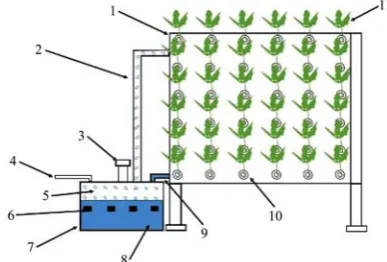
In addition, the ultrasonic aeroponics system was mainly composed of an atomizing chamber, ultrasonic atomizers, mist pipeline, reflux pipeline, nutrient solution collector pump, fluid infusion measuring pump, axial flow fan and cultivation box. However, the ultrasonic aeroponics system with 1.7 MHz and 107 kHz ultrasonic atomizers are shown in Figure 2. In the system, the ultrasonic atomizers were placed in an atomizing chamber under the axial flow fan that blew the air to throw the nutrient solution droplets through a pipeline from the atomizing chamber to the cultivation box. When the nutrient solution reached inside the cultivation box at the height of the hole in return pipe, the nutrient solution returned back to the atomization chamber to make the nutrient solution circulating.
1. Growth chamber 2. Nutrient fog transmission pump 3. Misitng fan 4. Power supply line 5. Nutrinet fog 6. 1.7 MHz (107 kHz) ultrasonic atomizers 7. Nutrient reservior 8. Nutrient solution 9. Nutrient recycle line 10. Plant holder 11. Plant
The ultrasonic aeroponics system with 28 kHz ultrasonic atomizer is shown in Figure 3. In the system, the nutrient solution flows into the atomizing chamber under the action of the fluid infusion measuring pump. However, the droplets appeared from the atomization surface of ultrasonic atomization nozzle and deposited in the cultivation box. The nutrient solution formatted from droplet deposition flows through the nutrient solution pipeline, into the residual nutrient collector.
1. Water-feeder 2. Inlet pipe 3. Fluid infusion measuring pump 4. Outlet pipe 5. Pole of atomizer 6. Atomization nozzle inlet 7. 28 kHz ultrasonic atomizer 8. Atomization chamber 9. Tube axial fan 10. Fog pipeline 11. Cultivation box 12. Nutrient solution pipeline 13. Residual nutrient collector.
Figure 3 Ultrasonic aeroponics system with 28 kHz ultrasonic atomizer
2.3 Measurements of EC and pH
The EC and pH of the nutrient solution were measured from each group at various time intervals with different spraying time and atomizer frequencies. The EC value of tomato nutrient solution was measured with DDSJ-308A conductivity meter (Shanghai instrument electric science instrument Limited by Share Ltd, China) with the accuracy of 0.001 μS/cm and 0.1 mS/cm. The pHS-3C pH meter (Shanghai instrument electric science instrument Limited by Share Ltd, China) was used to measure the pH of tomato nutrient solution at an accuracy of 0.01. The measuring devices are shown in Figure 4. The results were noted each time, and the obtained results indicated that the EC value decreased and pH increased after the nutrient solution acted upon by ultrasonic atomizers. Nutrient solution was intermittently supplied till the results show that there were no changes occurred in
the values of EC and pH.
a. EC measuring device b. pH measuring device Figure 4 EC and pH measuring devices
2.4 Experiment design
In this Study, uniform test design method (UD) was adopted to arrange the test. Three influential factors were selected to investigate the effect of different ultrasonic atomizers on EC and pH value of the nutrient solution. The spraying time T1 and spray
interval time T2 were taken as the quantitative factors and atomizer
frequency f as the qualitative factor. The test was arranged using UD table U12 (122×13). However, the spraying time T1 and spraying
interval time T1 were divided into 12 different levels: T1 (10, 20, 30,
40, 50, 60, 70, 80, 90, 100, 110, and 120 min, respectively), T2 (10,
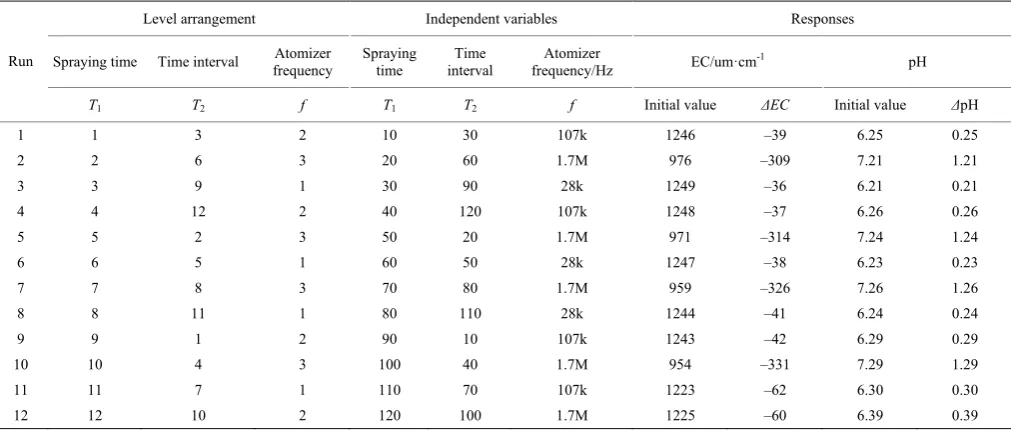
20, 30, 40, 50, 60, 70, 80, 90, 100, 110, and 120 min, respectively) and atomization frequency f was divided into three conditions (low-frequency 28 kHz, medium-frequency 107 kHz and high-frequency 1.7 MHz). The test arrangement, results, and responses are shown in Table 3. However, the statistical analysis was undertaken to determine the effects of the ultrasonic aeroponics system working parameters on the EC and pH of the nutrient solution. A linear regression models were proposed. Moreover, the validity of the optimal test strategies for each response was verified by two additional tests. The parameters of the response equations were evaluated using the quadratic polynomial regression method provided by SPSS (version 19) and the optimum reaction conditions for each response were obtained by using MATLAB R2014b. The interactive effects of the independent variables on the dependent variables were illustrated by three- dimensional view.
Table 3 Level arrangement of the three independent variables in coded units with the observed responses
Level arrangement Independent variables Responses
Spraying time Time interval Atomizer frequency
Spraying time
Time interval
Atomizer
frequency/Hz EC/um·cm
-1 pH
Run
T1 T2 f T1 T2 f Initial value ΔEC Initial value ΔpH
1 1 3 2 10 30 107k 1246 –39 6.25 0.25
2 2 6 3 20 60 1.7M 976 –309 7.21 1.21
3 3 9 1 30 90 28k 1249 –36 6.21 0.21
4 4 12 2 40 120 107k 1248 –37 6.26 0.26
5 5 2 3 50 20 1.7M 971 –314 7.24 1.24
6 6 5 1 60 50 28k 1247 –38 6.23 0.23
7 7 8 3 70 80 1.7M 959 –326 7.26 1.26
8 8 11 1 80 110 28k 1244 –41 6.24 0.24
9 9 1 2 90 10 107k 1243 –42 6.29 0.29
10 10 4 3 100 40 1.7M 954 –331 7.29 1.29
11 11 7 1 110 70 107k 1223 –62 6.30 0.30
12 12 10 2 120 100 1.7M 1225 –60 6.39 0.39
3 Results and analysis
3.1 Effect of ultrasonic atomizers on EC value of the nutrient solution
Statistical analysis was undertaken to determine the effects of the ultrasonic aeroponics system working parameters on the EC value. A linear regression model Equation (1) was proposed. Statistical analysis results are shown in Table 3. Three qualitative state factors of ultrasonic frequency atomizers were f1 (low
frequency), f2 mediumfrequency) and f3 (high frequency). The f1
(001001010010) and f2 (100100001001) were the relatively two
independent dummy and continuous variables analyzed with spraying time T1 and interval time T2. The results of ΔEC
regression analysis are listed in Table 4.
ΔEC=d0+d1T1+d2T2+d3f1+d4f2 (1)
where, dn is coefficient of regression; fn is atomizer frequency; T1 is
spraying time; T2 is interval time.
Table 4 Regression analysis results of ΔEC
Source difference Regression coefficient Standard deviation p-value Significance
d0 –304.75 5.21 1.12×10⁻¹⁰ **
d1 –0.2365 0.0532 2.98×10⁻³ **
d2 –0.0212 0.0565 0.719
d3 278.75 4.7888 1.16×10⁻¹⁰ **
d4 277 4.543 8.38×10⁻¹¹ **
Note: ** represents that test indicator is affected highly significantly by factors and * represents test indicator is affected significantly by factors. The significance level is α=0.05.
According to the test analysis, the effects of atomizer frequency f1 and ultrasonic atomizer frequency f2 on EC value were
P-value 1.16×10⁻¹⁰ (<0.01) and p-value 8.38×10⁻¹¹ (<0.01),
respectively. Therefore, we can say that ultrasonic atomization frequency f1 and f2 have a significant effect on the EC value of
tomato nutrient solution. The corresponding p–v (2.98×10⁻³<0.01)
and p–v (0.719>0.05) were obtained at T1 and T2 respectively.
Thus, the spraying time T1 has a highly significant effect on the EC
value and interval time T2 has not significant effect on EC value.
The EC value decreased with increasing of spraying time T1. The
significance of the factors affecting the EC value of the nutrient solution in descending order are ultrasonic atomizer frequency, atomization time, interval time.
Generally, we noted that the effect of interval time T2 on
Yamazaki tomato nutrient solution is not significant. Therefore, the interval time T2 was taken as residual variable and the
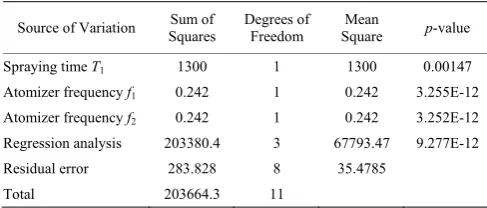
regression Equation (1) for ΔEC was remodeled by Equation (2). The results of regression Equation (2) are shown in Table 5.
ΔEC= –304.75–0.2365T1+287.75f1+277f2 (2)
Table 5 Test result of regression equation (2)
Source of Variation Squares Sum of Degrees of Freedom Square Mean p-value
Spraying time T1 1300 1 1300 0.00147
Atomizer frequency f1 0.242 1 0.242 3.255E-12 Atomizer frequency f2 0.242 1 0.242 3.252E-12 Regression analysis 203380.4 3 67793.47 9.277E-12 Residual error 283.828 8 35.4785
Total 203664.3 11
According to regression Equation (2), the test results in Table 5 reveals that significance F<0.01 and multiple correlation coefficient squares R2=0.9986 were obtained. The results indicate
that the established regression Equation (2) is significant. By using separation of variables method in regression Equation (2), it was determined that the optimal matching of ultrasonic atomizing frequency and spraying time can draw the greatest effect on the EC value of the nutrient solution. During the test, the maximum change in EC value is noted at (f3, T1) = (1.7 MHz, 120 min),
ΔEC=̶ 333 um/cm; the minimum EC value changed at (f1, T1) =
(28 kHz, 10 min), ΔEC = ̶ 19.37 um/cm; and the smallest change in EC value noted at (f3, T1) = (1.7 MHz, 10 min), ΔEC= ̶ 307 um/cm.
The interactive effects of ultrasonic atomizer frequency and spraying time on EC value of the nutrient solution is illustrated by three- dimensional view in Figure 5.
Figure 5 Response surface and contour plots for effects of ultrasonic atomizer frequency and spraying time on the ΔEC value
of the Yamazaki tomato nutrient solution
In order to verify the optimal matching of ultrasonic atomizer frequency and spraying time, two supplement tests were conducted to verify the established regression Equation (2). The test results are shown in Table 6.
Table 6 Results of supplement test for ΔEC
From Table 6, the values of observed and predicted ΔEC were ̶
19.37 um/cm and –20 um/cm at (f1, T1) = (28 kHz, 10 min),
respectively. The values of observed and predicted ΔEC were ̶
321 um/cm and –333 um/cm at (f1, T1) = (1.7 MHz, 120 min),
respectively. The compared results showed that relative errors were 8.41% and 3.6% using Equation (2) to predicting ΔEC. Thus, the regression Equation (2) can be used to predict the effect of ultrasonic atomizers working parameters on EC value of the nutrient solution within a certain margin of error.
3.2 Effect of ultrasonic atomizers on pH of the nutrient solution
A linear regression model was adopted to analyze the influence of ultrasonic atomization frequency, spraying time and interval time on the pH of Yamazaki tomato nutrient solution. This linear regression model is shown in Equation (3). We selected three ultrasonic atomizer frequencies: low frequency, medium frequency, and high frequency as qualitative factors. The selected atomizer frequency f1(001001010010) and f2(100100001001) were relatively
independent and continuous variables and analyzed with spraying time T1 and interval time T2.
ΔpH=c0+c1T1+c2T2+c3f1+c4f2 (3)
Spraying time/min
Atomizer frequency/Hz
Actual
∆EC/um·cm-1 ∆EC/um·cmEstimated -1 Relative error/%
10 28 k –20(±1.31) –19.37 8.41
Table 7 represents that the value of coefficient R2=0.9986 and
significance F<0.01, which means the effect of ultrasonic working parameters on pH value is significant. Furthermore, the detailed result for ΔpH value described as follows:
(1) The ultrasonic atomizer frequency had a significant effect on pH value of the nutrient solution.
(2) The effect of atomization time on pH value of the nutrient solution was very significant.
(3) The effect of interval time T2 on pH value of on the utrient
solution was not significant.
(4) The significance of the factor affecting the pH value of the nutrient solution in descending order was ultrasonic atomizer frequency, spraying time, spraying interval time.
(5) The pH value of the nutrient solution was increased with increasing the atomization time.
Table 7 Regression analysis results of ΔpH
Source difference
Regression coefficient
Standard
deviation p-value Significance c0 1.1775 0.016525 2.82×10⁻¹¹ ** c1 0.001096 0.000169 3.34×10⁻⁴ **
c2 0.000135 0.000179 0.4769
c3 –1.02 0.015191 4.27×10⁻¹¹ ** c4 –0.96 0.014412 4.52×10⁻¹¹ ** Note: Significance level α =0.05. ** represents test indicator is affected highly significantly by factors in the table and * represents test indicator is affected significantly by factors.
Although, when the test results were analyzed with regression Equation (3) we noted that the effect of interval time T2 was not
significant. Therefore, the interval time T2 was taken as residual
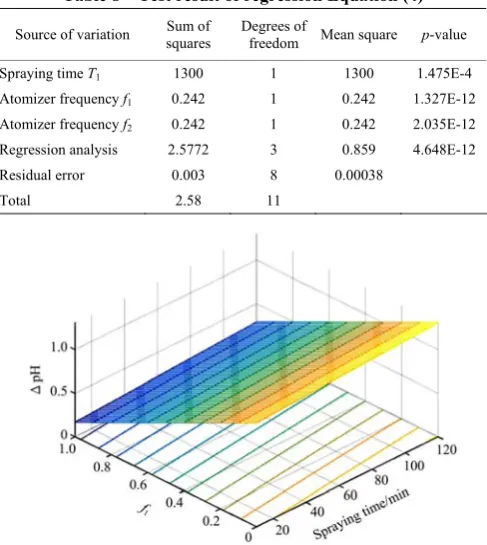
and the regression equation for ΔpH rearranged to Equation (4). In order to test the results by regression Equation (4), the test results are shown in Table 8.
ΔpH=1.1775+0.001096T1–1.02f1–0.96f2 (4)
Table 8 Test result of regression Equation (4)
Source of variation Sum of squares
Degrees of
freedom Mean square p-value
Spraying time T1 1300 1 1300 1.475E-4
Atomizer frequency f1 0.242 1 0.242 1.327E-12 Atomizer frequency f2 0.242 1 0.242 2.035E-12 Regression analysis 2.5772 3 0.859 4.648E-12 Residual error 0.003 8 0.00038
Total 2.58 11
Figure 6 Response surface and contour plots for effects of ultrasonic atomizer frequency and spraying time on the ΔpH of the
Yamazaki tomato nutrient solution
According to Table 8, the established regression Equation (4) was very significant. Therefore, the established regression model between ΔpH, ultrasonic atomizer frequency and atomization time was very significant in the range of ultrasonic atomizer frequency and atomization time. The developed regression model can provide guidance for practical application. It was noted that when the atomizing frequency and spray time was (f3, T1) = (1.7 MHz,
120 min), the maximum pH value changed to ΔpH=1.31; when theultrasonic atomizing frequency and spraying time was (f1, T1) =
(28 kHz, 10 min), the minimum pH value changed to ΔpH = 0.17, and when ultrasonic atomizing frequency and spraying time was (f3,
T1) = (1.7 MHz, 10 min), the smallest change occurs in pH value of
the nutrient solution ΔpH =1.19.
In order to verify the test arrangements, we conducted two additional experiments to verify the established regression Equation (4) and the observed values were compared with predicted values. The comparison test results of observed and predicted values of two additional experiments are listed in Table 9.
Table 9 Results of verifying Equation (4)
The verifying results indicated that:
(1) When the atomizer frequency and spraying time (f1, T1) =
(28 kHz, 10 min) the minimum variation was noted in the pH of the nutrient solution. The compared results between observed change
ΔpH 0.162 and predicted change ΔpH 0.17 obtained; the results were very close to each other and only 4.7% relative error was designated. Therefore, the regression Equation (4) can be used to predict the effect of ultrasonic atomizers working parameters on the pH value of the nutrient solution.
(2) The compared results for atomizer frequency and spraying time (f3, T1) = (1.7 MHz,120 min) shows that the change in pH
value the observed ΔpH 1.27 and predicted ΔpH 1.3 value was noticed. The compared result shows that only 3.1 % relative error was found. Generally, there was a very little difference noted between observed and predicted values.
4 Conclusions
This study was conducted to determine the effect of different ultrasonic atomizer frequency with spraying time and interval time on EC and pH of Yamazaki tomato nutrient solution that how ultrasonic atomizer frequency influence on nutrient solution properties and how properties of the nutrient solution are changed after atomization. According to the results of regression analysis and optimal collocation (significance level α = 0.05), the following conclusions were acquired:
(1) The effects of ultrasonic atomizer frequency, spraying time and interval time on the EC and pH values of tomato nutrient solution is significantly different. The ultrasonic atomizer frequency and ultrasonic atomizer time have a significant effect and interval time have no significant effect on the EC and pH of nutrient solution.
(2) The relationship between ultrasonic atomizer frequency, spraying time, interval time and ΔEC and ΔpH of a nutrient solution can be described by regression model ΔEC = ̶ 304.75 ̶
0.2365T1+287.75f1+277f2 and ΔpH = 1.1775+0.001096T1̶ 1.02f1̶
0.96f2, respectively, this linear regression model can provide
Spraying time/min
Atomizer frequency/Hz
Actual ΔpH
/um·cm-1 Estimated /um·cmΔ-1pH Relative error/%
10 28 k 0.162±0.22 0.17 4.7
guidance for future research, practical production and application of the system.
(3) The high-frequency ultrasonic atomizer (f =1.7 MHz) is not suitable to cultivate tomato in aeroponics cultivation system when using the Yamazaki tomato nutrient solution as an aeroponics solution. Because the effect of high-frequency ultrasonic atomizer on EC and pH of tomato nutrient solution was beyond the suitable range for tomato growth.
Acknowledgements
This work is financially supported by Jiangsu Province Agricultural independent innovation funds (CX (18)3048), the National Natural Science Foundation of China Program (No.51275214), the National Key Research and Development Program of China (Grant No. 2017YFD0700101), and the “Project Funded by the Priority Academic Program Development of Jiangsu Higher Education Institutions (No. 37(2014)).
[References]
[1] Hayden A L, Giacomelli G A, Yokelson T, Hoffmann J J. Aeroponics: An alternative production system for high-value root crops. Acta. Hortic, 2004; 629: 207–213.
[2] Berger H L, Brandow C R. Ultrasonic liquid atomizer having in axially-extending liquid feed passage. US Patent 352459, 1982. [3] Christie C B, Nichols M A. Aeroponics-a production system and
research tool. Acta Horticulturae, 2004; 648: 185–190.
[4] Kamies R, Rafudeen M S, Farrant J. The use of aeroponics to investigate antioxidant activity in the roots of Xerophytaviscosa. Plant Growth Regulation, 2010; 62(3): 203–211.
[5] Mehandru P, Shekhawat N S, Rai M K, Kataria V, Gehlot H S. Evaluation of aeroponic for clonal propagation of carallumaedulis, leptadenia reticulate and Tylophoraindica- three threatened medicinal Asclepiads. J. Physiol. Mol. Biol. Plants, 2014; 20: 365–373.
[6] Weathers P J, Zobel R W. Aeroponics for the culture of organisms, tissues and cells. Biotechnol. Adv, 1992; 10: 93–115.
[7] Pagliarulo C, Hayden A L. Potential for greenhouse aeroponic cultivation of medicinal root crops. Proc. of Conf. of the Amer. Plasticult. Soc., San Diego, California, 2002.
[8] NASA Spinoff. Progressive plant growing has business blooming. environmental and agricultural resources. NASA Spinoff, 2006; pp.68–72. [9] Mirza M, Younis M, Currie R. Greenhouse production of Echinacea and
other medicinal plants. Paper presented at opportunities and profits II: Special crops into the 21st Century. Nov 1-3, 1998, A.B. Edmonton, N.
Canada.
[10] Mohammad A, Khan A G, Kuek C. Improved aeroponic culture of inocula of arbularmycorrhizal fungi. Mycorrhiza, 2000; 9: 337–339. [11] Hayden A L. Aeroponic and hydroponic systems for medicinal herb
rhizome, and root crops. J. Hort. Science., 2006; 41: 16–18.
[12] Lakhiar I A, Gao J, Syed T N, Chandio F A, Buttar N A. Modern plant cultivation technologies in agriculture under controlled environment: A review on aeroponics. J. Plant Inter, 2018; 13(1): 338–358.
[13] Fermor T R. Agaricusmacrosporus: An edible fungus with commercial potential. Sci. Horti., 1982; 16(3): 27–282.
[14] Biddinger E J, Liu C M, Joly R J, Raghothama K G. Physiological and molecular responses of aeroponically grown tomato plants to phosphorus deficiency. J. Ameri, Soc. Horti. Sci, 1998; 123(2): 330–333.
[15] Park H S, Chiang M H, Park H S. Effects of form and concentration of nitrogen in aeroponic solution on growth, chlorophyll, nitrogen contents and enzyme activities in Cucumis sativum L. plant. J. Korean Soc. Hort. Sci, 1997; 38: 642–646.
[16] Rykaczewska K. The potato mini tuber production from microtubers in aeroponic culture .Plant Soil Envi., 2016; 62(5): 210–214.
[17] Oteng-Darko P, Kyei-Baffour N, Otoo E, Agyare W A. Growing seed yams in the air: The agronomic performance of two aeroponics systems developed in Ghana. Sust Agri Res., 2017; 6: 106–116.
[18] Gao J, Zhang J, Lu D. Design and atomization experiments of an ultrasonic atomizer with a levitation mechanism. Appl. Eng. in Agric, 2016; 32(4): 353–360.
[19] Wang L L, Zhao B, Fan J W, Hu X A, Wei S, Li Y S, et al. Development of a tomato harvesting robot used in the greenhouse. Int. J. Agric. Biol. Eng., 2017; 10(4): 140–149.
[20] Liu X G, Li F S, Zhang F C, Cai H J, Yang Q L. Influences of alternate partial root-zone irrigation and urea rates on the water- and nitrogen-use efficiencies in tomato. Int J Agric & Biol Eng, 2017; 10(6): 94–102. [21] Slimestada R, Verheulb M. Review of flavonoids and other phenolics
from fruits of different tomato (Lycopersiconesculentum Mill). J. Sci. Food Agric., 2009; 89(8): 1255–1270.
[22] Fang K T, Lin D K. Uniform experimental designs and their applications in industry. Handbook of Statistics, Vol.22, Elsevier Science B.V., 2003. [23] Liang Y Z, Fang K T, Xu Q S. Uniform design and its applications in
chemistry and chemical engineering. Chemom Intell Lab Syst, 2001; 58: 43–57.
[24] Fang K T, Lin D K J, Winker P, Zhang Y. Uniform design: Theory and application. Technometrics, 2012; 42: 237–248..
[25] He J, Lee S K. Growth and photosynthetic response of 3 aeroponically growth lettuce cultivars (Lactuca sativa L.) to different root zone temperatures and growth irradiances under tropical aerial conditions. J. Hort. Sci. Biotech, 1998; 73(2):173–180.