C
H
A
P
T
E
R
Dynamics:
Newton’s Laws of Motion
75
4
A space shuttle
is carried out into space by powerful rockets. They are accelerating, increasing in speed rapidly. To do so, a force must be exerted on them according to Newton’s second law,
What exerts this force? The rocket engines exert a force on the gases they push out (expel) from the rear of the rockets (labeled ). According to Newton’s third law, these ejected gases exert an equal and opposite force on the rockets in the forward direction. It is this “reaction” force exerted on
therocketsbythegases, labeled that accelerates the rockets forward.
FBRG, FBGR ©FB = maB.
CONTENTS
4–1 Force
4–2 Newton’s First Law of Motion
4–3 Mass
4–4 Newton’s Second Law of Motion 4–5 Newton’s Third Law of Motion 4–6 Weight—the Force of Gravity;
and the Normal Force
4–7 Solving Problems with Newton’s Laws: Free-Body Diagrams 4–8 Problems Involving Friction,
Inclines RG
FB
GR
FB
CHAPTER-OPENING QUESTIONS—Guess now!
1. A 150-kg football player collides head-on with a 75-kg running back. During the collision, the heavier player exerts a force of magnitude on the smaller player. If the smaller player exerts a force back on the heavier player, which response is most accurate?
(a) (b) (c) (d)
(e) We need more information.
2. A line by the poet T. S. Eliot (from Murder in the Cathedral) has the women of Canterbury say “the earth presses up against our feet.” What force is this?
(a) Gravity.
(b) The normal force. (c) A friction force. (d) Centrifugal force.
(e) No force—they are being poetic. FB = 0.
FB 7 FA. FB 6 FA. FB = FA.
FB
W
e have discussed how motion is described in terms of velocity and acceleration. Now we deal with the question of whyobjects move as they do: What makes an object at rest begin to move? What causes an object to accelerate or decelerate? What is involved when an object moves in a curved path? We can answer in each case that a force is required. In this Chapter†, we will investigate the connection between force and motion, which is the subject called dynamics.4–1
Force
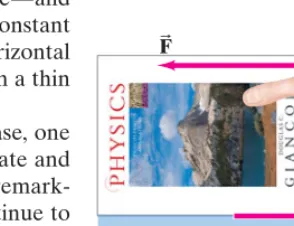
Intuitively, we experience forceas any kind of a push or a pull on an object. When you push a stalled car or a grocery cart (Fig. 4–1), you are exerting a force on it. When a motor lifts an elevator, or a hammer hits a nail, or the wind blows the leaves of a tree, a force is being exerted. We often call these contact forcesbecause the force is exerted when one object comes in contact with another object. On the other hand, we say that an object falls because of the force of gravity(which is not a contact force).
If an object is at rest, to start it moving requires force—that is, a force is needed to accelerate an object from zero velocity to a nonzero velocity. For an object already moving, if you want to change its velocity—either in direction or in magnitude—a force is required. In other words, to accelerate an object, a force is always required. In Section 4–4 we discuss the precise relation between accel-eration and net force, which is Newton’s second law.
One way to measure the magnitude (or strength) of a force is to use a spring scale (Fig. 4–2). Normally, such a spring scale is used to find the weight of an object; by weight we mean the force of gravity acting on the object (Section 4–6). The spring scale, once calibrated, can be used to measure other kinds of forces as well, such as the pulling force shown in Fig. 4–2.
A force exerted in a different direction has a different effect. Force has direc-tion as well as magnitude, and is indeed a vector that follows the rules of vector addition discussed in Chapter 3. We can represent any force on a diagram by an arrow, just as we did with velocity. The direction of the arrow is the direction of the push or pull, and its length is drawn proportional to the magnitude of the force.
†We treat everyday objects in motion here. When velocities are extremely high, close to the speed of
light we use the theory of relativity (Chapter 26), and in the submicroscopic world of atoms and molecules we use quantum theory (Chapter 27 ff).
A3.0 *108m兾sB,
0 1 2 3 4 5 6 7 8 9 10
FIGURE 4;2 A spring scale used to measure a force.
FIGURE 4;1 A force exerted on a grocery cart—in this case exerted by a person.
4–2
Newton’s First Law of Motion
What is the relationship between force and motion? Aristotle (384–322 B.C.)
believed that a force was required to keep an object moving along a horizontal plane. To Aristotle, the natural state of an object was at rest, and a force was believed necessary to keep an object in motion. Furthermore, Aristotle argued, the greater the force on the object, the greater its speed.
To understand Galileo’s idea, consider the following observations involving motion along a horizontal plane. To push an object with a rough surface along a tabletop at constant speed requires a certain amount of force. To push an equally heavy object with a very smooth surface across the table at the same speed will require less force. If a layer of oil or other lubricant is placed between the surface of the object and the table, then almost no force is required to keep the object moving. Notice that in each successive step, less force is required. As the next step, we imagine there is no friction at all, that the object does not rub against the table—or there is a perfect lubricant between the object and the table—and theorize that once started, the object would move across the table at constant speed with no force applied. A steel ball bearing rolling on a hard horizontal surface approaches this situation. So does a puck on an air table, in which a thin layer of air reduces friction almost to zero.
It was Galileo’s genius to imagine such an idealized world—in this case, one where there is no friction—and to see that it could lead to a more accurate and richer understanding of the real world. This idealization led him to his remark-able conclusion that if no force is applied to a moving object, it will continue to move with constant speed in a straight line. An object slows down only if a force is exerted on it. Galileo thus interpreted friction as a force akin to ordinary pushes and pulls.
To push an object across a table at constant speed requires a force from your hand that can balance the force of friction (Fig. 4–3). When the object moves at constant speed, your pushing force is equal in magnitude to the friction force; but these two forces are in opposite directions, so the netforce on the object (the vector sum of the two forces) is zero. This is consistent with Galileo’s viewpoint, for the object moves with constant velocity when no netforce is exerted on it.
Upon this foundation laid by Galileo, Isaac Newton (Fig. 4–4) built his great theory of motion. Newton’s analysis of motion is summarized in his famous “three laws of motion.” In his great work, the Principia (published in 1687), Newton readily acknowledged his debt to Galileo. In fact, Newton’s first law of motionis close to Galileo’s conclusions. It states that
Every object continues in its state of rest, or of uniform velocity in a straight line, as long as no net force acts on it.
The tendency of an object to maintain its state of rest or of uniform velocity in a straight line is called inertia. As a result, Newton’s first law is often called the law of inertia.
SECTION 4–2 Newton’s First Law of Motion
77
NEWTON’S FIRST LAW OF MOTIONFIGURE 4;4
Isaac Newton (1642–1727). Besides developing mechanics, including his three great laws of motion and the law of universal gravitation, he also tried to understand the nature of light.
F B
fr
FB
FIGURE 4;3 represents the force applied by the person and
represents the force of friction. FBfr FB
Newton’s first law. A school bus comes to a sudden stop, and all of the backpacks on the floor start to slide forward. What force causes them to do that?
RESPONSE It isn’t “force” that does it. By Newton’s first law, the backpacks continue their state of motion, maintaining their velocity. The backpacks slow down if a force is applied, such as friction with the floor.
CONCEPTUAL EXAMPLE 4;1
Inertial Reference Frames
Any reference frame that moves with constant velocity (say, a car or an air-plane) relative to an inertial frame is also an inertial reference frame. Reference frames where the law of inertia does nothold, such as the accelerating reference frames discussed above, are called noninertialreference frames. How can we be sure a reference frame is inertial or not? By checking to see if Newton’s first law holds. Thus Newton’s first law serves as the definition of inertial reference frames.
4–3
Mass
Newton’s second law, which we come to in the next Section, makes use of the concept of mass. Newton used the term massas a synonym for “quantity of matter.” This intuitive notion of the mass of an object is not very precise because the concept “quantity of matter” is not very well defined. More precisely, we can say thatmassis a measure of the inertiaof an object. The more mass an object has, the greater the force needed to give it a particular acceleration. It is harder to start it moving from rest, or to stop it when it is moving, or to change its velocity sideways out of a straight-line path. A truck has much more inertia than a baseball moving at the same speed, and a much greater force is needed to change the truck’s velocity at the same rate as the ball’s. The truck therefore has much more mass.
To quantify the concept of mass, we must define a standard. In SI units, the unit of mass is the kilogram(kg) as we discussed in Chapter 1, Section 1–5.
The terms massand weight are often confused with one another, but it is important to distinguish between them. Mass is a property of an object itself (a measure of an object’s inertia, or its “quantity of matter”). Weight, on the other hand, is a force, the pull of gravity acting on an object. To see the difference, suppose we take an object to the Moon. The object will weigh only about one-sixth as much as it did on Earth, since the force of gravity is weaker. But its mass will be the same. It will have the same amount of matter as on Earth, and will have just as much inertia—in the absence of friction, it will be just as hard to start it moving on the Moon as on Earth, or to stop it once it is moving. (More on weight in Section 4–6.)
4–4
Newton’s Second Law of Motion
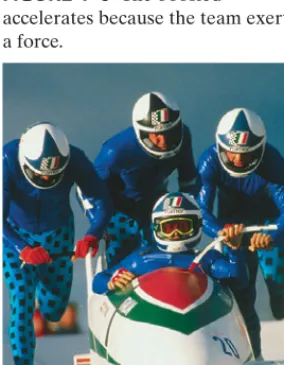
Newton’s first law states that if no net force is acting on an object at rest, the object remains at rest; or if the object is moving, it continues moving with constant speed in a straight line. But what happens if a net force isexerted on an object? Newton perceived that the object’s velocity will change (Fig. 4–5). A net force exerted on an object may make its velocity increase. Or, if the net force is in a direction opposite to the motion, that force will reduce the object’s velocity. If the net force acts sideways on a moving object, the directionof the object’s velocity changes. That change in the directionof the velocity is also an acceleration. So a sideways net force on an object also causes acceleration. In general, we can say thata net force causes acceleration.
What precisely is the relationship between acceleration and force? Everyday experience can suggest an answer. Consider the force required to push a cart when friction is small enough to ignore. (If there is friction, consider the net force, which is the force you exert minus the force of friction.) If you push the cart horizontally with a gentle but constant force for a certain period of time, you will make the cart accelerate from rest up to some speed, say If you push with twice the force, the cart will reach in half the time. The accel-eration will be twice as great. If you triple the force, the accelaccel-eration is tripled, and so on. Thus, the acceleration of an object is directly proportional†to the net applied force. But the acceleration depends on the mass of the object as well. If you push an empty grocery cart with the same force as you push one that is filled with groceries, you will find that the full cart accelerates more slowly.
3km兾h
3km兾h.
C A U T I O N
Distinguish mass from weight
†A review of proportionality is given in Appendix A.
FIGURE 4;5 The bobsled
The greater the mass, the less the acceleration for the same net force. The mathe-matical relation, as Newton argued, is that the acceleration of an object is inversely proportional to its mass. These relationships are found to hold in general and can be summarized as follows:
The acceleration of an object is directly proportional to the net force acting on it, and is inversely proportional to the object’s mass. The direction of the acceleration is in the direction of the net force acting on the object.
This is Newton’s second law of motion.
Newton’s second law can be written as an equation:
where stands for acceleration,mfor the mass, and for the net forceon the object. The symbol (Greek “sigma”) stands for “sum of”; stands for force, so means the vector sum of all forcesacting on the object, which we define as thenet force.
We rearrange this equation to obtain the familiar statement of Newton’s second law:
(4;1)
Newton’s second law relates the description of motion to the cause of motion, force. It is one of the most fundamental relationships in physics. From Newton’s second law we can make a more precise definition of forceasan action capable of accelerating an object.
Every force is a vector, with magnitude and direction. Equation 4–1 is a vector equation valid in any inertial reference frame. It can be written in component form in rectangular coordinates as
If the motion is all along a line (one-dimensional), we can leave out the
sub-scripts and simply write Again, ais the acceleration of an object of
massm, and includes all the forces acting on that object, and only forces
acting on that object. (Sometimes the net force is written as so .)
In SI units, with the mass in kilograms, the unit of force is called the newton(N).
One newton is the force required to impart an acceleration of to a
mass of 1 kg. Thus
In cgs units, the unit of mass is the gram†(g). The unit of force is the dyne, which is defined as the net force needed to impart an acceleration of to a mass
of 1 g. Thus Because and then
In the British system, which we rarely use, the unit of force is the pound
(abbreviated lb), where The unit of mass is the slug,
which is defined as that mass which will undergo an acceleration of when
a force of 1 lb is applied to it. Thus Table 4–1 summarizes the
units in the different systems.
It is very important that only one set of units be used in a given calculation or Problem, with the SI being what we almost always use. If the force is given in, say, newtons, and the mass in grams, then before attempting to solve for the acceleration in SI units, we must change the mass to kilograms. For example, if the force is given as 2.0 N along the xaxis and the mass is 500 g, we change the latter to 0.50 kg, and the acceleration will then automatically come out in when Newton’s second law is used:
where we set 1N = 1kgm兾s2. ax = ©mFx = 2.0N
0.50kg =
2.0kgm兾s2
0.50kg = 4.0m兾s 2,
m兾s2 1lb = 1slugft兾s2.
1ft兾s2 1lb = 4.44822N L 4.45N.
1dyne = 10–5N.
1cm = 10–2m, 1g = 10–3kg
1dyne = 1gcm兾s2.
1cm兾s2 1N = 1kgm兾s2.
1m兾s2 Fnet = ma Fnet,
©F
©F ©F = ma
.
©Fx = max,
©Fy = may,
©Fz = maz. FB
©FB = maB. ©FB
FB
© ©F
B aB
aB = ©F B
m ,
SECTION 4–4 Newton’s Second Law of Motion
79
NEWTON’S SECOND LAW OF MOTIONNEWTON’S SECOND LAW OF MOTION
P R O B L E M S O L V I N G Use a consistent set of units
TABLE 4;1
Units for Mass and Force
System Mass Force
SI kilogram newton (N) (kg)
cgs gram (g) dyne
British slug pound (lb)
Conversion factors:
1 slugL14.6 kg. 1 lbL4.45 N; 1 dyne=10–5N;
A= gcm兾s2B
A= kgm兾s2B
†Be careful not to confuse g for gram with gfor the acceleration due to gravity. The latter is always
Force to accelerate a fast car. Estimate the net force needed to accelerate (a) a 1000-kg car at (b) a 200-gram apple at the same rate.
APPROACH We use Newton’s second law to find the net force needed for each object; we are given the mass and the acceleration. This is an estimate (the is not said to be precise) so we round off to one significant figure.
SOLUTION (a) The car’s acceleration is We use Newton’s second law to get the net force needed to achieve this acceleration:
(If you are used to British units, to get an idea of what a 5000-N force is, you can
divide by and get a force of about 1000 lb.)
(b) For the apple, so
Force to stop a car. What average net force is required to bring a 1500-kg car to rest from a speed of within a distance of 55 m?
APPROACH We use Newton’s second law, to determine the force, but first we need to calculate the acceleration a. We assume the acceleration is constant so that we can use the kinematic equations, Eqs. 2–11, to calculate it.
©F = ma, 100km兾h EXAMPLE 4;3
©F = ma L (0.2kg)A5m兾s2B = 1N. m = 200g = 0.2kg,
4.45N兾lb
©F = ma L (1000kg)A5m兾s2B = 5000N. a = 1
2g = 1
2A9.8m兾s2B L 5m兾s2. 1 2 1
2g;
EXAMPLE 4;2 ESTIMATE
v= 0 v0 = 100 km/h
x= 0 x= 55 m
x(m)
FIGURE 4;6
Example 4–3.
SOLUTION We assume the motion is along the axis (Fig. 4–6). We are
given the initial velocity (Section 1–6), the final
velocity and the distance traveled From Eq. 2–11c, we
have
so
The net force required is then
or The force must be exerted in the direction oppositeto the initial velocity, which is what the negative sign means.
NOTE If the acceleration is not precisely constant, then we are determining an “average” acceleration and we obtain an “average” net force.
Newton’s second law, like the first law, is valid only in inertial reference frames (Section 4–2). In the noninertial reference frame of a car that begins accelerating, a cup on the dashboard starts sliding—it accelerates—even though the net force on it is zero. Thus does not work in such an accelerating reference frame
( but in this noninertial frame).
EXERCISE A Suppose you watch a cup slide on the (smooth) dashboard of an acceler-ating car as we just discussed, but this time from an inertial reference frame outside the car, on the street. From your inertial frame, Newton’s laws are valid. What force pushes the cup off the dashboard?
aB
Z 0 ©FB = 0,
©FB = maB 11,000N.
©F = ma = (1500kg)A–7.0m兾s2B = –1.1 * 104N, a = v
2 - v02
2(x - x0) =
0 - (27.8m兾s)2
2(55m) = –7.0m兾s 2. v2 = v02 + 2aAx - x0B,
x - x0 = 55m. v = 0,
4–5
Newton’s Third Law of Motion
Newton’s second law of motion describes quantitatively how forces affect motion. But where, we may ask, do forces come from? Observations suggest that a force exerted on any object is always exerted by another object. A horse pulls a wagon, a person pushes a grocery cart, a hammer pushes on a nail, a magnet attracts a paper clip. In each of these examples, a force is exerted onone object, and that force is exerted byanother object. For example, the force exerted onthe nail is exertedbythe hammer.But Newton realized that things are not so one-sided. True, the hammer exerts a force on the nail (Fig. 4–7). But the nail evidently exerts a force back on the hammer as well, for the hammer’s speed is rapidly reduced to zero upon contact. Only a strong force could cause such a rapid deceleration of the hammer. Thus, said Newton, the two objects must be treated on an equal basis. The hammer exerts a force on the nail, and the nail exerts a force back on the hammer. This is the essence of Newton’s third law of motion:
Whenever one object exerts a force on a second object, the second object exerts an equal force in the opposite direction on the first.
This law is sometimes paraphrased as “to every action there is an equal and oppo-site reaction.” This is perfectly valid. But to avoid confusion, it is very important to remember that the “action” force and the “reaction” force are acting on different objects.
As evidence for the validity of Newton’s third law, look at your hand when you push against the edge of a desk, Fig. 4–8. Your hand’s shape is distorted, clear evidence that a force is being exerted on it. You can seethe edge of the desk press-ing into your hand. You can even feelthe desk exerting a force on your hand; it hurts! The harder you push against the desk, the harder the desk pushes back on your hand. (You only feel forces exerted onyou; when you exert a force on another object, what you feel is that object pushing back on you.)
SECTION 4–5 Newton’s Third Law of Motion
81
NEWTON’S THIRD LAW OF MOTIONC A U T I O N
Action and reaction forces act on different objects
FIGURE 4;7 A hammer striking a nail. The hammer exerts a force on the nail and the nail exerts a force back on the hammer. The latter force decelerates the hammer and brings it to rest.
Force exerted on hand by desk
Force exerted on desk by hand
FIGURE 4;8 If your hand pushes against the edge of a desk (the force vector is shown in red), the desk pushes back against your hand (this force vector is shown in a different color, violet, to remind us that this force acts on a different object).
Force on skater
Force on wall
FIGURE 4;9 An example of Newton’s third law: when an ice skater pushes against the wall, the wall pushes back and this force causes her to accelerate away.
The force the desk exerts on your hand has the same magnitude as the force your hand exerts on the desk. This is true not only if the desk is at rest but is true even if the desk is accelerating due to the force your hand exerts.
As another demonstration of Newton’s third law, consider the ice skater in Fig. 4–9. There is very little friction between her skates and the ice, so she will move freely if a force is exerted on her. She pushes against the wall; and then she starts moving backward. The force she exerts on the wall cannot make herstart moving, because that force acts on the wall. Something had to exert a force on her to start her moving, and that force could only have been exerted by the wall. The force with which the wall pushes on her is, by Newton’s third law, equal and opposite to the force she exerts on the wall.
Rocket propulsion also is explained using Newton’s third law (Fig. 4–10). A common misconception is that rockets accelerate because the gases rushing out the back of the engine push against the ground or the atmosphere. Not true. What happens, instead, is that a rocket exerts a strong force on the gases, expel-ling them; and the gases exert an equal and opposite force on the rocket. It is this latter force that propels the rocket forward—the force exerted onthe rocket bythe gases (see Chapter-Opening Photo, page 75). Thus, a space vehicle is maneuvered in empty space by firing its rockets in the direction opposite to that in which it needs to accelerate. When the rocket pushes on the gases in one direction, the gases push back on the rocket in the opposite direction. Jet aircraft too accelerate because the gases they thrust out backwards exert a forward force on the engines (Newton’s third law).
Consider how we walk. A person begins walking by pushing with the foot backward against the ground. The ground then exerts an equal and opposite force forward on the person (Fig. 4–11), and it is this force,onthe person, that moves the person forward. (If you doubt this, try walking normally where there is no friction, such as on very smooth slippery ice.) In a similar way, a bird flies forward by exerting a backward force on the air, but it is the air pushing forward (Newton’s third law) on the bird’s wings that propels the bird forward.
What exerts the force to move a car? What makes a car go forward?
RESPONSE A common answer is that the engine makes the car move for-ward. But it is not so simple. The engine makes the wheels go around. But if the tires are on slick ice or wet mud, they just spin. Friction is needed. On firm ground, the tires push backward against the ground because of friction. By Newton’s third law, the ground pushes on the tires in the opposite direction, accelerating the car forward.
We tend to associate forces with active objects such as humans, animals, engines, or a moving object like a hammer. It is often difficult to see how an inanimate object at rest, such as a wall or a desk, or the wall of an ice rink (Fig. 4–9), can exert a force. The explanation is that every material, no matter how hard, is elastic (springy) at least to some degree. A stretched rubber band can exert a force on a wad of paper and accelerate it to fly across the room. Other materials may not stretch as readily as rubber, but they do stretch or compress when a force is applied to them. And just as a stretched rubber band exerts a force, so does a stretched (or compressed) wall, desk, or car fender.
From the examples discussed above, we can see how important it is to rememberonwhat object a given force is exerted and bywhat object that force is exerted. A force influences the motion of an object only when it is applied on that object. A force exerted byan object does not influence that same object; it only influences the other object onwhich it is exerted. Thus, to avoid confusion, the two prepositions onandbymust always be used—and used with care.
One way to keep clear which force acts on which object is to use double sub-scripts. For example, the force exerted onthePersonbytheGround as the person walks in Fig. 4–11 can be labeled And the force exerted on the ground by the person is By Newton’s third law
(4;2)
and have the same magnitude (Newton’s third law), and the minus sign reminds us that these two forces are in opposite directions.
Note carefully that the two forces shown in Fig. 4–11 act on different objects—to emphasize this we used slightly different colors for the vector arrows representing these forces. These two forces would never appear together in a
sum of forces in Newton’s second law, Why not? Because they act on
different objects: is the acceleration of one particular object, and must includeonlythe forces on that oneobject.
©FB aB
©FB = maB. F
B PG FBGP
FBGP = –FBPG. F
B GP.
F B
PG.
CONCEPTUAL EXAMPLE 4;4
NEWTON’S THIRD LAW OF MOTION Horizontal
force exerted on the ground byperson’s foot
Horizontal force exerted on the
person’s foot by the ground
GP PG
FB FB
Force on sled exerted by assistant
Force on assistant exerted by sled
Friction force on sled exerted by ground
Force on assistant exerted by ground Force on
ground exerted by sled
SA (= − AS)
AS
GA
SG GS(= − SG) AG
Force on ground exerted by assistant FB
FB FB
F B
FB FB FB FB
(= −FAG) B
Third law clarification. Michelangelo’s assistant has been assigned the task of moving a block of marble using a sled (Fig. 4–12). He says to his boss, “When I exert a forward force on the sled, the sled exerts an equal and opposite force backward. So how can I ever start it moving? No matter how hard I pull, the backward reaction force always equals my forward force, so the net force must be zero. I’ll never be able to move this load.” Is he correct?
RESPONSE No. Although it is true that the action and reaction forces are equal in magnitude, the assistant has forgotten that they are exerted on different objects. The forward (“action”) force is exerted by the assistant on the sled (Fig. 4–12), whereas the backward “reaction” force is exerted by the sled on the assistant. To determine if the assistant moves or not, we must consider only the forces on the assistantand then apply where is the net force on the assistant, is the acceleration of the assistant, and mis the assistant’s mass. There are two forces on the assistant that affect his forward motion; they are shown as bright red (magenta) arrows in Figs. 4–12 and 4–13: they are (1) the hori-zontal force exerted on the assistant by the ground (the harder he pushes backward against the ground, the harder the ground pushes forward on him— Newton’s third law), and (2) the force exerted on the assistant by the sled, pulling backward on him; see Fig. 4–13. If he pushes hard enough on the ground, the force on him exerted by the ground, will be larger than the sled pulling back, and the assistant accelerates forward (Newton’s second law). The sled, on the other hand, accelerates forward when the force on itexerted by the assis-tant is greater than the frictional force exerted backward on it by the ground (that is, when has greater magnitude than in Fig. 4–12).
Using double subscripts to clarify Newton’s third law can become cumbersome, and we won’t usually use them in this way. We will usually use a single subscript referring to what exerts the force on the object being discussed. Nevertheless, if there is any confusion in your mind about a given force, go ahead and use two subscripts to identify onwhat object and bywhat object the force is exerted.
EXERCISE B Return to the first Chapter-Opening Question, page 75, and answer it again now. Try to explain why you may have answered differently the first time.
EXERCISE C A tennis ball collides head-on with a more massive baseball. (i) Which ball experiences the greater force of impact? (ii) Which experiences the greater acceleration during the impact? (iii) Which of Newton’s laws are useful to obtain the correct answers?
EXERCISE D If you push on a heavy desk, does it always push back on you? (a) No. (b) Yes. (c) Not unless someone else also pushes on it. (d) Yes, if it is out in space. (e) A desk never pushes to start with.
FBSG F
B SA F B
AS,
F B
AG, FBAS FBAG
a
B ©
F B ©FB = maB
,
CONCEPTUAL EXAMPLE 4;5
SECTION 4–5 Newton’s Third Law of Motion
83
P R O B L E M S O L V I N G A study of Newton’s second and third lawsFIGURE 4;12 Example 4–5,
showing only horizontal forces. Michelangelo has selected a fine block of marble for his next sculpture. Shown here is his assistant pulling it on a sled away from the quarry. Forces on the assistant are shown as red (magenta) arrows. Forces on the sled are purple arrows. Forces acting on the ground are orange arrows. Action–reaction forces that are equal and opposite are labeled by the same subscripts but reversed (such as and ) and are of different colors because they act on different objects.
FBAG F
B GA
Force on assistant exerted by sled
Force on assistant exerted by ground
AG AS
F B FB
4–6
Weight—the Force of Gravity;
and the Normal Force
As we saw in Chapter 2, Galileo claimed that all objects dropped near the surface of the Earth would fall with the same acceleration, if air resistance was negligible. The force that causes this acceleration is called the force of gravityorgravitational force. What exerts the gravitational force on an object? It is the Earth, as we will discuss in Chapter 5, and the force acts vertically†downward, toward the center of the Earth. Let us apply Newton’s second law to an object of mass mfalling freely due to gravity. For the acceleration, we use the downward acceleration due to gravity, Thus, the gravitational forceon an object, can be written as
(4;3)
The direction of this force is down toward the center of the Earth. The magnitude of the force of gravity on an object,mg, is commonly called the object’s weight.
In SI units, ‡ so the weight of a 1.00-kg mass on
Earth is We will mainly be concerned with the
weight of objects on Earth, but we note that on the Moon, on other planets, or in space, the weight of a given mass will be different than it is on Earth. For exam-ple, on the Moon the acceleration due to gravity is about one-sixth what it is on Earth, and a 1.0-kg mass weighs only 1.6 N. Although we will not use British units, we note that for practical purposes on the Earth, a mass of 1.0 kg weighs about 2.2 lb. (On the Moon, 1 kg weighs only about 0.4 lb.)
The force of gravity acts on an object when it is falling. When an object is at rest on the Earth, the gravitational force on it does not disappear, as we know if we weigh it on a spring scale. The same force, given by Eq. 4–3, continues to act. Why, then, doesn’t the object move? From Newton’s second law, the net force on an object that remains at rest is zero. There must be another force on the object to balance the gravitational force. For an object resting on a table, the table exerts this upward force; see Fig. 4–14a. The table is compressed slightly beneath the object, and due to its elasticity, it pushes up on the object as shown. The force exerted by the table is often called a contact force, since it occurs when two objects are in contact. (The force of your hand pushing on a cart is also a contact force.) When a contact force acts perpendicular to the common surface of contact, it is referred to as the normal force(“normal” means perpendicular); hence it is labeled in Fig. 4–14a.
The two forces shown in Fig. 4–14a are both acting on the statue, which remains at rest, so the vector sum of these two forces must be zero (Newton’s second law). Hence and must be of equal magnitude and in opposite directions. But they are notthe equal and opposite forces spoken of in Newton’s third law. The action and reaction forces of Newton’s third law act on different objects, whereas the two forces shown in Fig. 4–14a act on the sameobject. For each of the forces shown in Fig. 4–14a, we can ask, “What is the reaction force?” The upward force on the statue is exerted by the table. The reaction to this force is a force exerted by the statue downward on the table. It is shown in Fig. 4–14b, where it is labeled This force, exerted on the table by the statue, is the reaction force to in accord with Newton’s third law. What about the other force on the statue, the force of gravity exerted by the Earth? Can you guess what the reaction is to this force? We will see in Chapter 5 that the reaction force is also a gravitational force, exerted on the Earth by the statue.
EXERCISE E Return to the second Chapter-Opening Question, page 75, and answer it again now. Try to explain why you may have answered differently the first time.
F B G
FBN FBNœ ,
F B
Nœ . F B N FBN
FBG FBN
1.00 kgg*=9.80m兾s2 = 9.80N. 9.80m兾s2 = 9.80N兾kg, FBG = mgB
.
FBG, gB.
a B ,
gB,
†The concept of “vertical” is tied to gravity. The best definition of verticalis that it is the direction in
which objects fall. A surface that is “horizontal,” on the other hand, is a surface on which a round object won’t start rolling: gravity has no effect. Horizontal is perpendicular to vertical.
‡Since 1N = 1kgm兾s2 (Section 4–4), then 1m兾s2= 1N兾kg.
C A U T I O N
Weight and normal force are not
action–reaction pairs
(a)
F B
FB
(b)
N
FB B
G
FB
N
F
G
F B
ⴕ N
FB
FIGURE 4;14 (a) The net force on an object at rest is zero according to Newton’s second law. Therefore the downward force of gravity on an object at rest must be balanced by an upward force (the normal force ) exerted by the table in this case. (b) is the force exerted on the table by the statue and is the reaction force to by Newton’s third law. ( is shown in a different color to remind us it acts on a different object.) The reaction force to FBGis not shown.
FBNœ FBN F
B Nœ FBN
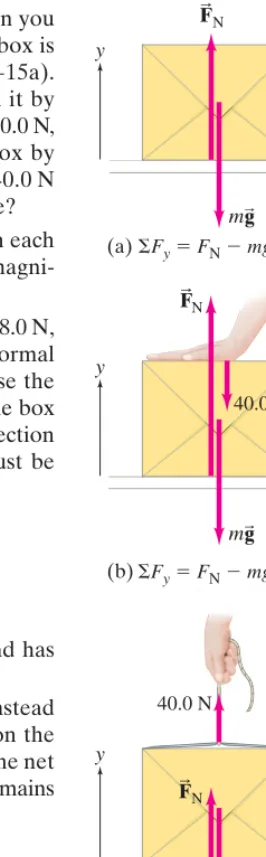
Weight, normal force, and a box. A friend has given you a special gift, a box of mass 10.0 kg with a mystery surprise inside. The box is resting on the smooth (frictionless) horizontal surface of a table (Fig. 4–15a). (a) Determine the weight of the box and the normal force exerted on it by the table. (b) Now your friend pushes down on the box with a force of 40.0 N, as in Fig. 4–15b. Again determine the normal force exerted on the box by the table. (c) If your friend pulls upward on the box with a force of 40.0 N (Fig. 4–15c), what now is the normal force exerted on the box by the table?
APPROACH The box is at rest on the table, so the net force on the box in each case is zero (Newton’s first or second law). The weight of the box has magni-tudemgin all three cases.
SOLUTION (a) The weight of the box is
and this force acts downward. The only other force on the box is the normal force exerted upward on it by the table, as shown in Fig. 4–15a. We chose the upward direction as the positive ydirection; then the net force on the box
is the minus sign means mgacts in the negative ydirection
(m and gare magnitudes). The box is at rest, so the net force on it must be
zero (Newton’s second law, and ). Thus
so we have
The normal force on the box, exerted by the table, is 98.0 N upward, and has magnitude equal to the box’s weight.
(b) Your friend is pushing down on the box with a force of 40.0 N. So instead of only two forces acting on the box, now there are three forces acting on the box, as shown in Fig. 4–15b. The weight of the box is still The net
force is and is equal to zero because the box remains
at rest Newton’s second law gives
We solve this equation for the normal force:
which is greater than in (a). The table pushes back with more force when a person pushes down on the box. The normal force is not always equal to the weight! (c) The box’s weight is still 98.0 N and acts downward. The force exerted by your friend and the normal force both act upward (positive direction), as shown in Fig. 4–15c. The box doesn’t move since your friend’s upward force is less than the weight. The net force, again set to zero in Newton’s second law because
is
so
The table does not push against the full weight of the box because of the upward force exerted by your friend.
NOTE The weight of the box does not change as a result of your friend’s push or pull. Only the normal force is affected.
Recall that the normal force is elastic in origin (the table in Fig. 4–15 sags slightly under the weight of the box). The normal force in Example 4–6 is verti-cal, perpendicular to the horizontal table. The normal force is not always vertiverti-cal, however. When you push against a wall, for example, the normal force with which the wall pushes back on you is horizontal (Fig. 4–9). For an object on a plane inclined at an angle to the horizontal, such as a skier or car on a hill, the normal force acts perpendicular to the plane and so is not vertical.
(= mg)
FN = mg - 40.0N = 98.0N - 40.0N = 58.0N.
©Fy = FN - mg + 40.0 N = 0,
a = 0,
FN = mg + 40.0N = 98.0N + 40.0N = 138.0N,
©Fy = FN - mg - 40.0N = 0. (a = 0).
©Fy = FN - mg - 40.0N,
mg = 98.0N. FN = mg.
FN - mg = 0,
©Fy = may
ay = 0 ©Fy = may,
©Fy = FN - mg;
©Fy
mg = (10.0kg)A9.80m兾s2B = 98.0N,
EXAMPLE 4;6
SECTION 4–6 Weight—the Force of Gravity; and the Normal Force
85
C A U T I O N
The normal force is not always equal to the weight
40.0 N
40.0 N
y
y
y
N
N
N FB
FB
FB
mgB
mgB
mgB
(b) (a)
(c)
Fy FN mg 40.0 N0
Fy FN mg 40.0 N0 Fy FN mg 0
FIGURE 4;15 Example 4–6. (a) A 10-kg gift box is at rest on a table. (b) A person pushes down on the box with a force of 40.0 N. (c) A person pulls upward on the box with a force of 40.0 N. The forces are all assumed to act along a line; they are shown slightly displaced in order to be distinguishable. Only forces acting on the box are shown.
C A U T I O N
The normal force, is not necessarily vertical
Accelerating the box. What happens when a person pulls upward on the box in Example 4–6cwith a force equal to, or greater than,
the box’s weight? For example, let (Fig. 4–16) rather than the
40.0 N shown in Fig. 4–15c.
APPROACH We can start just as in Example 4–6, but be ready for a surprise.
SOLUTION The net force on the box is
and if we set this equal to zero (thinking the acceleration might be zero), we
would get This is nonsense, since the negative sign implies
points downward, and the table surely cannot pull down on the box (unless there’s glue on the table). The least can be is zero, which it will be in this case. What really happens here is that the box accelerates upward ( ) because the net force is not zero. The net force (setting the normal force ) is
upward. See Fig. 4–16. We apply Newton’s second law and see that the box moves upward with an acceleration
= 0.20m兾s2. ay =
©Fy m =
2.0N 10.0kg
= 2.0N
©Fy = FP - mg = 100.0N - 98.0N
FN = 0 a Z 0 FN
FN FN = –2.0N.
= FN - 98.0N + 100.0N,
©Fy = FN - mg + FP
FP = 100.0N
EXAMPLE 4;7
(100.0 N)
(98.0 N)
m
P
FB
g
B
a
B
FIGURE 4;16 Example 4–7. The box accelerates upward because FP 7 mg.
N
F B a
B
mgB
FIGURE 4;17 Example 4–8. The acceleration vector is shown in gold to distinguish it from the red force vectors.
Apparent weight loss. A 65-kg woman descends in an elevator that briefly accelerates at 0.20gdownward. She stands on a scale that reads in kg. (a) During this acceleration, what is her weight and what does the scale read? (b) What does the scale read when the elevator descends at a constant speed of
APPROACH Figure 4–17 shows all the forces that act on the woman (and only those that act on her). The direction of the acceleration is downward, so we choose the positive direction as down (this is the opposite choice from Examples 4–6 and 4–7).
SOLUTION (a) From Newton’s second law,
We solve for
and it acts upward. The normal force is the force the scale exerts on the person, and is equal and opposite to the force she exerts on the scale: downward. Her weight (force of gravity on her) is still But the scale, needing to exert a force of only 0.80mg, will give a reading of
(b) Now there is no acceleration, so by Newton’s second law,
and The scale reads her true mass of 65 kg.
NOTE The scale in (a) gives a reading of 52 kg (as an “apparent mass”), but her mass doesn’t change as a result of the acceleration: it stays at 65 kg.
FN = mg. mg - FN = 0
a = 0, 0.80m = 52 kg. mg = (65kg)A9.8 m兾s2B = 640N.
FNœ = 0.80mg
FBN
= 0.80mg, FN = mg - 0.20mg
FN:
mg - FN = m(0.20g).
4–7
Solving Problems with Newton’s Laws:
Free-Body Diagrams
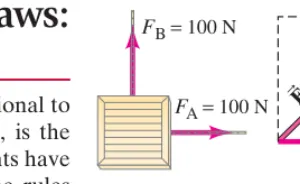
Newton’s second law tells us that the acceleration of an object is proportional to the net force acting on the object. The net force, as mentioned earlier, is the vector sumof all forces acting on the object. Indeed, extensive experiments have shown that forces do add together as vectors precisely according to the rules we developed in Chapter 3. For example, in Fig. 4–18, two forces of equal magni-tude (100 N each) are shown acting on an object at right angles to each other. Intuitively, we can see that the object will start moving at a 45° angle and thus the net force acts at a 45° angle. This is just what the rules of vector addition give. From the theorem of Pythagoras, the magnitude of the resultant force is
Adding force vectors. Calculate the sum of the two forces exerted on the boat by workers A and B in Fig. 4–19a.
APPROACH We add force vectors like any other vectors as described in Chapter 3. The first step is to choose an xycoordinate system (see Fig. 4–19a), and then resolve vectors into their components.
SOLUTION The two force vectors are shown resolved into components in Fig. 4–19b. We add the forces using the method of components. The compo-nents of are
The components of are
is negative because it points along the negative yaxis. The components of the resultant force are (see Fig. 4–19c)
To find the magnitude of the resultant force, we use the Pythagorean theorem,
The only remaining question is the angle that the net force makes with the xaxis. We use:
and The net force on the boat has magnitude 53.3 N and
acts at an 11.0° angle to the xaxis.
When solving problems involving Newton’s laws and force, it is very important to draw a diagram showing all the forces acting oneach object involved. Such a dia-gram is called a free-body diagram, or force diagram: choose one object, and draw an arrow to represent each force acting on it. Includeeveryforce acting on that object. Do not show forces that the chosen object exerts on otherobjects. To help you identify each and every force that is exerted on your chosen object, ask yourself what other objects could exert a force on it. If your problem involves more than one object, a separate free-body diagram is needed for each object. For now, the likely forces that could be acting are gravity andcontact forces(one object pushing or pulling another, normal force, friction). Later we will consider other types of force such as buoyancy, fluid pressure, and electric and magnetic forces.
tan–1(0.195) = 11.0°. tanu = FRy
FRx =
10.2N
52.3N = 0.195,
F B R u
FR = 3FR2x + FR2y = 3(52.3)2 + (10.2)2N = 53.3N.
FRy = FAy + FBy = 28.3N - 18.1N = 10.2N. FRx = FAx + FBx = 28.3N + 24.0N = 52.3N, FBy
FBy = –FBsin 37.0° = –(30.0 N)(0.602) = –18.1 N. FBx = ±FBcos 37.0° = ±(30.0N)(0.799) = ±24.0N,
FBB
FAy = FAsin 45.0° = (40.0N)(0.707) = 28.3N. FAx = FAcos 45.0° = (40.0N)(0.707) = 28.3N, FBA
EXAMPLE 4;9
FR = 3(100N)2 + (100N)2 = 141N.
SECTION 4–7 Solving Problems with Newton’s Laws: Free-Body Diagrams
87
FB= 100 NFA= 100 N
(a) (b)
45°
B
A R=
+ B A
F
B
F
B
F B
FB
F B
FIGURE 4;18 (a) Two horizontal forces, and exerted by workers A and B, act on a crate (we are looking down from above). (b) The sum, or resultant, of and is FBB FBR.
F B A F
B B, F
B A
(b)
(c) (a)
y
x
y
x
θ 45.0° 37.0°
FA = 40.0 N
FB = 30.0 N
y
x
A
B
A
By Bx
Ry
Rx R
B Ax Ay
F B
FB
F B
FB FB
FB
F
B FB
F B
FIGURE 4;19 Example 4–9: Two force vectors act on a boat.
C A U T I O N
Treating an object as a particle
The hockey puck. A hockey puck is sliding at constant velocity across a flat horizontal ice surface that is assumed to be frictionless. Which of the sketches in Fig. 4–20 is the correct free-body diagram for this puck? What would your answer be if the puck slowed down?
RESPONSE Did you choose (a)? If so, can you answer the question: what exerts the horizontal force labeled on the puck? If you say that it is the force needed to maintain the motion, ask yourself: what exerts this force? Remember that another object must exert any force—and there simply isn’t any possibility here. Therefore, (a) is wrong. Besides, the force in Fig. 4–20a would give rise to an acceleration by Newton’s second law. It is (b) that is correct. No net force acts on the puck, and the puck slides at constant velocity across the ice.
In the real world, where even smooth ice exerts at least a tiny friction force, then (c) is the correct answer. The tiny friction force is in the direction opposite to the motion, and the puck’s velocity decreases, even if very slowly.
F B FB
CONCEPTUAL EXAMPLE 4;10
(b) (c)
(a)
Motion
Motion Motion
N N
G G
N
G
F B
F B
FB
FB
F B
F B
F B
FB
FIGURE 4;20 Example 4–10. Which is the correct free-body diagram for a hockey puck sliding across frictionless ice?
force acts, and bywhat object that force is exerted. Only forces acting ona given object can be included
in for that object.
3. Newton’s second law involves vectors, and it is usu-ally important to resolve vectorsinto components. Choose xand yaxes in a way that simplifies the calculation. For example, it often saves work if you choose one coordinate axis to be in the direction of the acceleration (if known).
4. For each object, apply Newton’s second lawto the xandycomponents separately. That is, the x compo-nent of the net force on that object is related to the x component of that object’s acceleration:
and similarly for the ydirection. 5. Solvethe equation or equations for the unknown(s).
Put in numerical values only at the end, and keep track of units.
©Fx = max, ©FB = maB
P
R
O
B
L
E
M
S
O
LV I
N G
Newton’s Laws; Free-Body Diagrams
1. Draw a sketchof the situation, after carefully reading the Problem at least twice.
2. Consider only one object (at a time), and draw a free-body diagramfor that object, showing allthe forces acting onthat object. Include any unknown forces that you have to solve for. Do not show any forces that the chosen object exerts on other objects. Draw the arrow for each force vector reasonably accurately for direction and magnitude. Label each force acting on the object, including forces you must solve for, according to its source (gravity, person, friction, and so on).
If several objects are involved, draw a free-body diagram for each object separately. For each object, show all the forces acting on that object(and only forces acting on that object). For each (and every) force, you must be clear about:onwhat object that
This Problem Solving Strategy should not be considered a prescription. Rather it is a summary of things to do that will start you thinking and getting involved in the problem at hand.
When we are concerned only about translational motion, all the forces on a given object can be drawn as acting at the center of the object, thus treating the object as a point particle. However, for problems involving rotation or statics, the placewhereeach force acts is also important, as we shall see in Chapters 8 and 9.
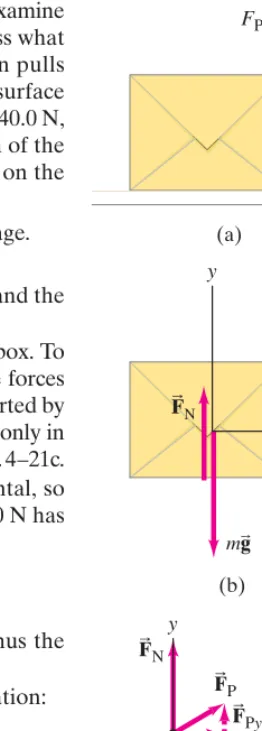
Pulling the mystery box. Suppose a friend asks to examine the 10.0-kg box you were given (Example 4–6, Fig. 4–15), hoping to guess what is inside; and you respond, “Sure, pull the box over to you.” She then pulls the box by the attached cord, as shown in Fig. 4–21a, along the smooth surface of the table. The magnitude of the force exerted by the person is
and it is exerted at a 30.0° angle as shown. Calculate (a) the acceleration of the box, and (b) the magnitude of the upward force exerted by the table on the box. Assume that friction can be neglected.
APPROACH We follow the Problem Solving Strategy on the previous page.
SOLUTION
1. Draw a sketch: The situation is shown in Fig. 4–21a; it shows the box and the force applied by the person,
2. Free-body diagram: Figure 4–21b shows the free-body diagram of the box. To draw it correctly, we show allthe forces acting on the box and onlythe forces acting on the box. They are: the force of gravity the normal force exerted by the table and the force exerted by the person We are interested only in translational motion, so we can show the three forces acting at a point, Fig. 4–21c. 3. Choose axes and resolve vectors: We expect the motion to be horizontal, so we choose the xaxis horizontal and the yaxis vertical. The pull of 40.0 N has components
In the horizontal (x) direction, and have zero components. Thus the horizontal component of the net force is
4. (a)Apply Newton’s second lawto get the xcomponent of the acceleration:
5. (a)Solve:
The acceleration of the box is to the right. (b) Next we want to find
4. (b)Apply Newton’s second lawto the vertical (y) direction, with upward as positive:
5. (b)Solve: We have and, from point 3
above, Furthermore, since the box does not move
vertically, so Thus
so
NOTE is less than mg: the table does not push against the full weight of the box because part of the pull exerted by the person is in the upward direction.
EXERCISE F A 10.0-kg box is dragged on a horizontal frictionless surface by a hori-zontal force of 10.0 N. If the applied force is doubled, the normal force on the box will (a) increase; (b) remain the same; (c) decrease.
Tension in a Flexible Cord
When a flexible cord pulls on an object, the cord is said to be under tension, and the force it exerts on the object is the tension If the cord has negligible mass, the force exerted at one end is transmitted undiminished to each adjacent piece of cord
along the entire length to the other end. Why? Because for the
cord if the cord’s mass mis zero (or negligible) no matter what is. Hence the forces pulling on the cord at its two ends must add up to zero ( and ). Note that flexible cords and strings can only pull. They can’t push because they bend.
–FT FT
a B
©FB = maB = 0 FT.
FN
FN = 78.0N.
FN - 98.0N + 20.0N = 0, ay = 0.
FPy 6 mg, FPy = 20.0N.
mg = (10.0kg)A9.80m兾s2B = 98.0N FN - mg + FPy = may.
©Fy = may FN.
3.46m兾s2 ax = FmPx = (34.6N)
(10.0kg) = 3.46 m兾s 2. FPx = max.
FPx. mgB FBN
FPy = (40.0N)(sin 30.0°) = (40.0N)(0.500) = 20.0N. FPx = (40.0N)(cos 30.0°) = (40.0N)(0.866) = 34.6N,
FBP. FBN;
mgB; FP.
FN
FP = 40.0N,
EXAMPLE 4;11
SECTION 4–7
89
30.0° 30.0°FP= 40.0 N
y
y
(b)
x
(c)
x
(a)
P
N
N
Py
m m
FB
F B
FB
FB
Px F B
g
B
g
B P
FB
FIGURE 4;21 (a) Pulling the box, Example 4–11; (b) is the free-body diagram for the box, and (c) is the free-body diagram considering all the forces to act at a point (translational motion only, which is what we have here).
mB
40.0 N
Box A
(b) y
x
(a) Box B
(c)
x y
mB
mA
P
T BN
FB
F B
FB g
B
g
B
P AN
T FB
FB
FB y
x mA
mB= 12.0 kg
mA= 10.0 kg
Our next Example involves two boxes connected by a cord. We can refer to this group of objects as a system. A systemis any group of one or more objects we choose to consider and study.
Two boxes connected by a cord. Two boxes, A and B, are connected by a lightweight cord and are resting on a smooth (frictionless) table. The boxes have masses of 12.0 kg and 10.0 kg. A horizontal force of 40.0 N is applied to the 10.0-kg box, as shown in Fig. 4–22a. Find (a) the acceleration of each box, and (b) the tension in the cord connecting the boxes.
APPROACH We streamline our approach by not listing each step. We have two boxes so we draw a free-body diagram for each. To draw them correctly, we must consider the forces on each box by itself, so that Newton’s second law can be applied to each. The person exerts a force on box A. Box A exerts a force on the connecting cord, and the cord exerts an opposite but equal magnitude force back on box A (Newton’s third law). The two horizontal forces on box A are shown in Fig. 4–22b, along with the force of gravity downward and the normal force exerted upward by the table. The cord is light, so we neglect its mass. The tension at each end of the cord is thus the same. Hence the cord exerts a force on the second box. Figure 4–22c shows the
forces on box B, which are and the normal force There will be
only horizontal motion. We take the positive xaxis to the right.
SOLUTION (a) We apply to box A:
[box A] For box B, the only horizontal force is so
[box B] The boxes are connected, and if the cord remains taut and doesn’t stretch, then
the two boxes will have the same acceleration a. Thus We are
given and We can add the two equations above
to eliminate an unknown and obtain
or
This is what we sought.
(b) From the equation for box B above the tension in the cord is
Thus, as we expect, since acts to accelerate only
Alternate Solution to (a) We would have obtained the same result had we consid-ered a single system, of mass acted on by a net horizontal force equal to (The tension forces would then be considered internal to the system as a whole, and summed together would make zero contribution to the net force on the wholesystem.)
NOTE It might be tempting to say that the force the person exerts, acts not only on box A but also on box B. It doesn’t. acts only on box A. It affects box B via the tension in the cord, which acts on box B and accelerates it.
(You could look at it this way: because accelerates both boxes
whereas FTonly accelerates box B.)
FP
6 FP FT
FT,
FP
FP, FT
FP.
mA + mB,
mB. FT
6 FP (= 40.0N), FT
FT = mBa = (12.0kg)A1.82m兾s2B = 21.8N. AFT = mBaBB, a = m FP
A + mB =
40.0N
22.0 kg = 1.82m兾s 2. AmA + mBBa = FP - FT + FT = FP
AFmBTB= 12.0kg. mA = 10.0kg
aA = aB = a. ©Fx = FT = mBaB.
FT,
©Fx = FP - FT = mAaA. ©Fx = max
FBBN. F
B T,mBgB,
FT FBAN
mAgB FT
FT
FP
FP
EXAMPLE 4;12
C A U T I O N
For any object, use only the forces on thatobject in
calculating ©F = ma
FIGURE 4;22 Example 4–12. (a) Two boxes,
A and B, are connected by a cord. A person pulls horizontally on box A with force
(b) Free-body diagram for box A. (c) Free-body diagram for box B.
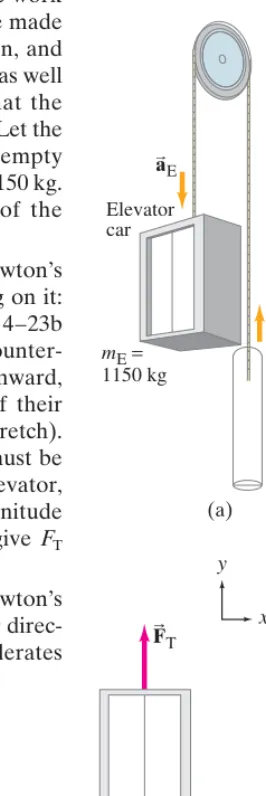
Elevator and counterweight (Atwood machine). A system of two objects suspended over a pulley by a flexible cable, as shown in Fig. 4–23a, is sometimes referred to as an Atwood machine. Consider the real-life
appli-cation of an elevator and its counterweight To minimize the work
done by the motor to raise and lower the elevator safely, and are made similar in mass. We leave the motor out of the system for this calculation, and assume that the cable’s mass is negligible and that the mass of the pulley, as well as any friction, is small and ignorable. These assumptions ensure that the tension in the cable has the same magnitude on both sides of the pulley. Let the
mass of the counterweight be Assume the mass of the empty
elevator is 850 kg, and its mass when carrying four passengers is
For the latter case calculate (a) the acceleration of the
elevator and (b) the tension in the cable.
APPROACH Again we have two objects, and we will need to apply Newton’s second law to each of them separately. Each mass has two forces acting on it: gravity downward and the cable tension pulling upward, Figures 4–23b and c show the free-body diagrams for the elevator and for the
counter-weight The elevator, being the heavier, will accelerate downward,
whereas the counterweight will accelerate upward. The magnitudes of their accelerations will be equal (we assume the cable is massless and doesn’t stretch).
For the counterweight, so must be
greater than 9800 N (in order that will accelerate upward). For the elevator, which must have greater magnitude than so that accelerates downward. Thus our calculation must give between 9800 N and 11,300 N.
SOLUTION (a) To find as well as the acceleration a, we apply Newton’s
second law, to each object. We take upward as the positive y
direc-tion for both objects. With this choice of axes, because accelerates
upward, and because accelerates downward. Thus
We can subtract the first equation from the second to get
whereais now the only unknown. We solve this for a:
The elevator accelerates downward (and the counterweight upward) at
(b) The tension in the cable can be obtained from either of the two
equations at the start of our solution, setting :
or
which are consistent. As predicted, our result lies between 9800 N and 11,300 N.
NOTE We can check our equation for the acceleration ain this Example by noting that if the masses were equal then our equation above for a would give as we should expect. Also, if one of the masses is zero (say,
), then the other mass would be predicted by our equation to
accelerate at a = g, again as expected. AmE Z 0B mC = 0
a = 0,
AmE = mCB,
= 1000kgA9.80m兾s2 + 0.68m兾s2B = 10,500N, FT = mCg + mCa = mC(g + a)
= 1150kgA9.80m兾s2 - 0.68m兾s2B = 10,500N, FT = mEg - mEa = mE(g - a)
a = 0.070g = 0.68m兾s2
©F = ma FT
a = 0.070g =AmEB0.68m兾s2. mC
a = mE - mC
mE + mCg =
1150kg - 1000kg
1150kg + 1000kgg = 0.070g = 0.68m兾s 2. AmE - mCBg = AmE + mCBa,
FT - mCg = mCaC = ±mCa. FT - mEg = mEaE = –mEa
mE
aE = –a aC = a mC
©F = ma, FT
FT mE
FT
mEg = (1150kg)A9.80m兾s2B = 11,300mC N,
FT mCg = (1000kg)A9.80m兾s2B = 9800N, AmCB.
AmEB FBT. AmE = 1150kgB,
mE = 1150kg. mC = 1000kg.
FT
mC mE
AmCB. AmEB
EXAMPLE 4;13
SECTION 4–7 Solving Problems with Newton’s Laws: Free-Body Diagrams
91
P H Y S I C S A P P L I E D
Elevator (as Atwood machine)
y
x
(b) (c)
(a)
Elevator car
mE=
1150 kg Counterweightm C=1000 kg
mE mC
E
C
T T
F
B FB
g
B gB
a
B
a
B
FIGURE 4;23 Example 4–13. (a) Atwood machine in the form of an elevator–counterweight system. (b) and (c) Free-body diagrams for the two objects.
P R O B L E M S O L V I N G Check your result by seeing if it
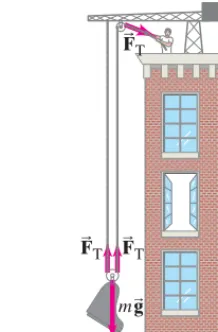
The advantage of a pulley. A mover is trying to lift a piano (slowly) up to a second-story apartment (Fig. 4–24). He is using a rope looped over two pulleys as shown. What force must he exert on the rope to slowly lift the piano’s 1600-N weight?
RESPONSE The magnitude of the tension force within the rope is the same at any point along the rope if we assume we can ignore its mass. First notice the forces acting on the lower pulley at the piano. The weight of the piano
pulls down on the pulley. The tension in the rope, looped through this pulley, pulls up twice, once on each side of the pulley. Let us apply Newton’s second law to the pulley–piano combination (of mass m), choosing the upward direction as positive:
To move the piano with constant speed (set in this equation) thus requires
a tension in the rope, and hence a pull on the rope, of The piano
mover can exert a force equal to half the piano’s weight.
NOTE We say the pulley has given a mechanical advantageof 2, since without the pulley the mover would have to exert twice the force.
FT = mg兾2. a = 0
2FT - mg = ma.
(= mg) FT
CONCEPTUAL EXAMPLE 4;14
P H Y S I C S A P P L I E D
Accelerometer
(b) (a)
u
T F B
mgB
a
B
y x
u
Tsinu
F
Tcosu
F
FIGURE 4;25 Example 4–15.
T
T T
m
F B
F B
FB
gB
FIGURE 4;24 Example 4–14.
Accelerometer. A small mass mhangs from a thin string and can swing like a pendulum. You attach it above the window of your car as shown in Fig. 4–25a. When the car is at rest, the string hangs vertically. What angle does the string make (a) when the car accelerates at a constant
and (b) when the car moves at constant velocity,
APPROACH The free-body diagram of Fig. 4–25b shows the pendulum at some angle relative to the vertical, and the forces on it: downward, and the tension in the cord (including its components). These forces do not add up to zero if and since we have an accelerationa, we expect
SOLUTION (a) The acceleration is horizontal , and the only horizontal force is the xcomponent of (Fig. 4–25b). Then from Newton’s second law,
The vertical component of Newton’s second law gives, since ,
So
Dividing these two equations, we obtain
or
so
(b) The velocity is constant, so and Hence the pendulum hangs
vertically
NOTE This simple device is an accelerometer—it can be used to determine acceleration, by mesuring the angle .u
Au = 0°B.
tanu = 0. a = 0
u = 7.0°.
= 0.122, tanu = 1.20m兾s
2
9.80m兾s2 tanu = FTsinu
FTcosu = ma mg = ag mg = FTcosu.
0 = FTcosu - mg.
ay = 0 ma = FTsinu.
FTsinu FBT,
(= ax) a = 1.20m兾s2
u Z 0. u Z 0;
FBT
mgB u
v = 90km兾h? a = 1.20m兾s2,
u
4–8
Problems Involving Friction, Inclines
Friction
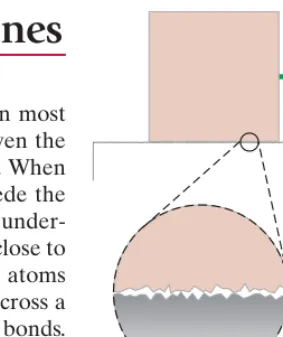
Until now we have ignored friction, but it must be taken into account in most practical situations. Friction exists between two solid surfaces because even the smoothest looking surface is quite rough on a microscopic scale, Fig. 4–26. When we try to slide an object across a surface, these microscopic bumps impede the motion. Exactly what is happening at the microscopic level is not yet fully under-stood. It is thought that the atoms on a bump of one surface may come so close to the atoms of the other surface that attractive electric forces between the atoms could “bond” as a tiny weld between the two surfaces. Sliding an object across a surface is often jerky, perhaps due to the making and breaking of these bonds. Even when a round object rolls across a surface, there is still some friction, called rolling friction, although it is generally much less than when an object slides across a surface. We focus now on sliding friction, which is usually called kinetic friction (kineticis from the Greek for “moving”).
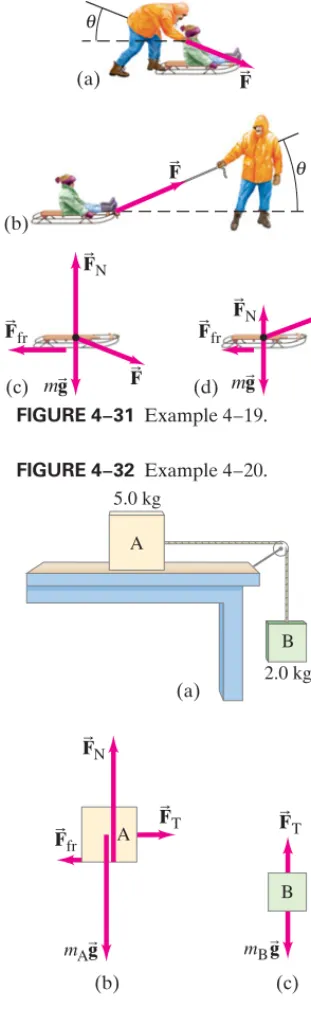
When an object slides along a rough surface, the force of kinetic friction acts opposite to the direction of the object’s velocity. The magnitude of the force of kinetic friction