MARINE FISHERIES CONSERVATION AND MANAGEMENT IN INDIA
Dr. Ansy Mathew N. P.
United Nations -The Nippon Foundation Fellowship Programme 2008-2009
Division for Ocean Affairs and the Law of the Sea (DOALOS) Office of Legal Affairs, United Nations
DISCLAIMER
The views expressed herein are those of the author and do not necessarily reflect the views of The United Nations, The Nippon Foundation of Japan, The Institute of Maritime Law of the University of Southampton or that of the Republic of India.
EXECUTIVE SUMMARY
This paper contains information on steps and initiatives taken or recommended by India to improve the conservation and management of fishery resources and other marine living resources with a view to achieving sustainable fisheries and protecting vulnerable marine ecosystem and biodiversity. The paper is based on information provided by States, relevant specialized agencies, in particular the Food and Agriculture Organization of the United Nations, and other appropriate organs, organizations and programmes of the United Nations System, sub-regional and regional organisations and arrangements for the conservation and management of fishery resources as well as other intergovernmental bodies and non-Governmental organizations.
The paper emphasizes the importance of the full implementation by India of all international fishery instruments, whether legally binding or voluntary, which promote the conservation, management and sustainable use of marine living resources. It also emphasizes the importance of cooperation among States, directly or through sub-regional and regional fisheries management organizations or arrangements (RFMO/As) to address unsustainable fishing practices and promote sustainable fisheries in areas beyond national jurisdiction, including through implementing their responsibilities as flag States, improving governance of RFMO/As, and cooperating in the establishment of new organizations or arrangements where none exist.
DEDICATION
To
ACKNOWLEDGEMENT
I would like to convey my sincere gratitude to the Division for Ocean Affairs and Law of the Sea (DOALOS), Office of Legal Affairs, United Nations and The Nippon Foundation of Japan for this opportunity. The fellowship programme is such a noble idea as it provides an unparalleled opportunity for pragmatic advancement of knowledge on the key aspects in the field of ocean affairs and the law of the sea.
I would also like to thank Dr. Francois Bailet, the Programme Advisorand Co-Supervisor, DOALOS, United Nations, New York, United States of America for doing a sterling job from the initial stages, when all seemed impossible, till the completion of the programme. Mr. Václav Mikulka (Director, DOALOS) and all staff members at the DOALOS including all my co-fellows, made their important contribution towards this endeavour in many ways. Thank you very much.
I acknowledge the invaluable contribution of my Co-Supervisor, Prof. Andrew Serdy, Institute of Maritime Law (IML) of the University of Southampton, Southampton, United Kingdom for his guidance, reading the script and making important corrections and suggestions. I wish to thank Prof. Natalie Lee, Head of School of Law; Ms. Rosemary Holloway, Ms. Christine Segar, Ms. Teresa Worwood, Ms. Aloma Hack, Ms. Sara Le Bas, Mr. Alexandros Ntovas, Mr. Alexander Sandiforth, Mr. Edward Cole, the staff of the IML for their consistent support, either directly or indirectly towards this effort.
LIST OF ABBREVIATIONS
APFIC Asia-Pacific Fishery Commission ARF ASEAN Regional Forum
ASEAN Association of Southeast Asian Nations
BE Budget Estimate
BFDA Brackishwater Fish Farmers’ Development Agency BIMSTEC Bay of Bengal Initiative for Multi-Sectoral Technical and
Economic Cooperation
BOBP-IGO Bay of Bengal Programme-Inter Governmental Organization BOBLME Bay of Bengal Large Marine Ecosystem
BPA Barbados Plan of Action CAA Coastal Aquaculture Authority CAGR Cumulative Annual Growth Rate
CB Community-Based
CBD Convention on Biological Diversity
CBFM Community Based Fisheries Management
CCAMLR Commission for the Conservation of Antarctic Marine Living Resources
CCRF Code of Conduct for Responsible Fisheries CIBA Central Institute of Brackishwater Aquaculture CICEF Central Institute of Coastal Engineering for Fishery CIFA Central Institute of Freshwater Aquaculture
CIFE Central Institute of Fisheries Education
CIFNET Central Institute of Fisheries Nautical and Engineering Training CIFRI Central Inland of Fisheries Research Institute
CIFT Central Institute of Fisheries Technology
CITES Convention on International Trade in Endangered Species CMFRI Central Marine Fisheries Research Institute
CMLRE Centre for Marine Living Resources and Ecology CMS Convention on Migratory Species
CORDIO Coastal Oceans Research and Development in the Indian Ocean
CPUE Catch Per Unit Effort
CSIR Council of Scientific and Industrial Research CWPRS Central Water and Power Research Station
DADF Department of Animal Husbandry, Dairying and Fisheries DANIDA Danish International Development Assistance
DARE Department of Agricultural Research and Education DFID Department for International Development
DoF Department of Fisheries EAS East Asia Summit
EEZ Exclusive Economic Zone
EMS Environmental Management System
ENEA Italian National Agency for New Technologies, Energy and Environment
EU European Union
FAO Food and Agriculture Organization of the United Nations FEE Foreign Exchange Earnings
FFDA Fish Farmer’s development Agency FLC Fish Landing Centre
FOB Freight On Board FRP Fibre-Reinforced Plastic FSI Fishery Survey of India
GA General Assembly
GDP Gross Domestic Product GEF Global Environment Facility GPA Global Programme of Action
HACCP Hazard Analysis and Critical Control Points HRD Human Resource Development
ICMAM Integrated Coastal and Marine Area Management ICOM Integrated Coastal and Ocean Management ICZM Integrated Coastal Zone Management IDBI Industrial Development Bank of India IFCI Industrial Finance Corporation of India IITM Indian Institute of Tropical Meteorology IMD Indian Meteorological Department IMO International Maritime Organisation
INCOIS Indian National Centre for Ocean Information Services
INR Indian Rupees
IOI International Ocean Institute
IOMAC Indian Ocean Marine Affairs Commission
IOR-ARC Indian Ocean Rim Association for Regional Cooperation IOTC Indian Ocean Tuna Commission
IPCC Intergovernmental Panel on Climate Change
IPOA-Capacity International Plan of Action for the Management of Fishing Capacity
IPOA-IUU International Plan of Action to Prevent, Deter and Eliminate Illegal, Unreported and Unregulated Fishing
IPOA-Seabirds International Plan of Action for Reducing Incidental Catch of Seabirds in Longline fisheries
IPOA-Sharks International Plan of Action for the Conservation and Management of Sharks
IRDP Integrated Rural Development Programme ISO International Organization for Standardization ITLOS International Tribunal for the Law of the Sea ITQ Individual Transferable Quota
IUCN International Union for Conservation of Nature IUU Fishing Illegal, Unreported and Unregulated Fishing LME Large Marine Ecosystem
LOSC Law of the Sea Convention
MFRA Marine Fishing Regulation Act MMD Mercantile Marine Department MoEF Ministry of Environment and Forests MoES Ministry of Earth Sciences
MPA Marine Protected Area
MPEDA Marine Production Export Development Authority MSC Marine Stewardship Council
MSY Maximum Sustainable Yield MZI Maritime Zones of India
NABARD National Bank for Agriculture and Rural Development NBFGR National Bureau of Fish Genetic Resources
NCDC National Co-operative Development Corporation
NCMRWF National Centre for Medium Range Weather Forecasting NFDB National Fisheries Development Board
NGO Non-Governmental Organization
NIFPHTT National Institute of Fisheries Post Harvest Technology and Training
NIO National Institute of Oceanography NIOT National Institute of Ocean Technology NMFC National Marine Fisheries Census
NORAD Norwegian Agency for Development Cooperation NPOA National Plan of Action
NRCCWF National Research Centre on Coldwater Fisheries OAL Over All Length
ODA Overseas Development Administration
OSCE Organisation for Security and Cooperation in Europe OSY Optimum Sustainable Yield
PL Post Larvae
POP Persistent Organic Pollutant PPP Purchasing Power Party R&D Research and Development
RFMO/A Regional Fisheries Management Organization or Arrangement SAARC South Asian Association for Regional Cooperation
SACEP South Asia Co-operative Environment Programme SAU State Agricultural University
SCICI Shipping Credit and Investment Company of India SFC State Finance Corporation
SHG Self Help Group
SPS Sanitary and Phyto-Sanitary TAC Total Allowable Catch
TCG Technical Cooperation Group
TD Top-Down
ToR Terms of Reference
UN United Nations
UNCED United Nations Conference on Environment and Development UNCLOS United Nations Convention on the Law of the Sea
UNDP United Nations Development Programme UNEP United Nations Environment Programme
UNESCO United Nations Educational, Scientific and Cultural Organization
UNFSA United Nations Fish Stock Agreement UNTS United Nations Treaty Series
USA United States of America
UT Union Territory
VME Vulnerable Marine Ecosystem VMS Vessel Monitoring System
TABLE OF CONTENTS
Disclaimer ... ii
Executive summary...iii
Dedication... iv
Acknowledgement... v
List of abbreviations ... vi
Table of contents ... xi
List of tables...xv
List of figures ...xvi
Introduction ... 1
Scope of fisheries management in India... 13
Chapter 1. India: The physical profile and status of fisheries ... 15
1.1. Geobiodversity... 15
1.2. Marine fisheries resources and status ... 17
1.2.1. Commercial fisheries ... 23
1.2.2. The fishers in India ... 24
1.2.3. Socio-economic status of fishermen ... 26
1.2.4. Role of women in post-harvest operations ... 27
1.2.5. Trends in fish production and catch composition ... 27
1.2.6. Methods of harvesting ... 31
1.2.7. Status of fisheries policy ... 33
1.2.8. Indian state level consideration... 33
1.2.9. Power and evolution of law ... 34
1.2.10. Backgrounds to the annual closed season ... 34
1.2.11. Comprehensive Marine Fishing Policy ... 35
1.2.12. Allocation of funds for fisheries management activities... 36
1.2.12.1.The basis of allocation of funds to fisheries management ... 36
1.2.12.2.Determinant factors in level of expenditure dedicated to fisheries ... 39
1.2.12.3.Role played by outside fisheries management agencies in the budget allocation process... 40
1.2.12.4.Evaluation of expenditure and process for budget adjustments ... 40
1.2.13. Expenditures on Fisheries ... 40
1.2.13.1.Categorization of expenditure ... 40
1.2.13.2.Approaches followed to track expenditure... 44
1.2.14. Production... 45
1.2.14.1.Exports of marine products... 45
1.2.14.2.Training, extension and transfer of technology ... 46
1.2.15. Source of funding for India’s fisheries ... 47
1.2.15.1.Government funding ... 47
1.2.15.2.Non-government funding for fisheries management activities... 47
1.2.16. Fisheries management service providers ... 48
1.2.16.1.Types and level of services provided by non-government sources ... 48
1.2.16.2.Services by fisheries participants ... 49
1.2.17. Overview of the key issues in marine fisheries ... 57
1.2.17.1.Increase in fishing intensity ... 58
1.2.17.2.Inappropriate exploitation patterns ... 58
1.2.17.3.Marine fish marketing ... 59
1.2.17.4.Fisheries infrastructure ... 60
1.2.17.5.Fisheries Management Systems ... 60
1.3. Stress factors and problems...61
1.3.1. Ensuring long-term and balanced conservation of coastal resources and life-support systems ... 61
1.3.2. Management of open access in marine fisheries ... 63
1.3.3. Monitoring, control and surveillance (MCS) ... 64
1.3.4. Fiscal Reforms ... 64
1.3.5. Attitude of policy makers ... 65
1.3.6. Issues associated with ability to pay mechanism ... 65
1.3.7. Coastal Zone Management issues in India... 65
1.3.8. Development of productive activities ... 66
1.3.9. Development of infrastructure ... 68
1.3.10. Response to natural calamities and their prevention ... 69
1.3.11. Socio-economic issues ... 73
1.3.12. Global climate change ... 74
Chapter 2. Fisheries Law and Policy ...75
2.1. The international framework...75
2.1.1. Legal framework ... 76
2.1.1.1. The 1982 UNCLOS ... 76
2.1.1.2. The 1995 United Nations Convention Agreement on Straddling Fish Stocks and Highly Migratory Fish Stocks... 78
2.1.2. Institutional framework ... 82
2.1.2.1. The 1995 FAO CCRF ... 83
2.1.2.2. The 1993 FAO Compliance Agreement to Promote Compliance with International Conservation and Management Measures by Fishing Vessels on the High Seas... 84
2.1.2.3. The 1993 FAO IPOAs addressing specific key issues of the 1995 CCRF ... 86
2.1.3. Political framework... 89
2.1.3.1. Agenda 21 of the 1992 UNCED ... 90
2.1.3.2. Johannesburg Summit 2002 – the WSSD ... 92
2.2. Regional framework ...93
2.2.1. Regional Fisheries Management Organizations/Arrangements (RFMO/As) ... 93
2.2.1.1. Indian Ocean Tuna Commission (IOTC) ... 94
2.2.1.2. Asia-Pacific Fishery Commission (APFIC) ... 94
2.2.1.3. Bay of Bengal Programme – Inter Governmental Organisation (BOBP-IGO) ... 94
2.2.1.4. Commission for the Conservation of Antarctic Marine Living Resources (CCAMLR)... 94
2.2.1.5. INFOFISH ... 94
2.2.2. Environmental organizations ... 95
2.2.2.1. Bay of Bengal Large Marine Ecosystem (BOBLME) ... 95
2.2.2.3. Coastal Oceans Research and Development in the Indian Ocean
(CORDIO) ... 96
2.2.2.4. The World Wide Fund for Nature (WWF) Projects... 96
2.2.2.5. Technical Cooperation Group (TCG) of Indian Ocean Marine Affairs Commission (IOMAC)... 96
2.2.3. Political organizations ... 97
2.2.3.1. Indian Ocean Rim Association for Regional Cooperation (IOR-ARC) ... 98
2.2.3.2. South Asian Association for Regional Cooperation (SAARC). ... 98
2.2.3.3. Association of South East Asian Nations (ASEAN) East Asia Summit (EAS) and ASEAN Regional Forum (ARF). ... 98
2.2.3.4. Bay of Bengal Initiative for Multi-Sectoral Technical and Economic Cooperation (BIMSTEC)... 98
2.2.3.5. Global Environment Facility (GEF)... 99
2.3. National fisheries management frameworks ... 99
2.3.1. Mandate and authority ... 99
2.3.2. Fisheries legislation: Legal and policy framework... 100
2.3.3. Institutional structure ... 101
2.3.3.1. Role of Central Government ... 101
2.3.3.2. Role of the State Governments... 103
2.3.3.3. The National Fisheries Development Board (NFDB ... 103
Chapter 3. Conclusion and recommendations for sustainable fisheries management ... 105
3.1. The ratification and implementation of International instruments ... 107
3.2. Implementation of the regional instruments ... 109
3.3. National fisheries related laws and regulations reformation... 109
3.4. The potential approaches for sustainable management and recommended measures ... 110
3.4.1. Centralized to decentralized management ... 110
3.4.1.1. Licensing of fishing boats ... 111
3.4.1.2. Enforcement through monitoring, control and surveillance (MCS) ... 111
3.4.1.3. Policy development and operational management ... 112
3.4.2. Rights-based fisheries management strategy ... 112
3.4.2.1. Threats to coastal communities ... 113
3.4.2.2. Rights to fisheries and implementation of policy instruments... 114
3.4.2.3. Social justice with resource management ... 114
3.4.3. Ecosystem-based management strategy ... 114
3.4.3.1. Management of ocean fishery resources ... 115
3.4.3.2. Fisheries management vs. fisheries exploitation ... 117
3.4.3.3. Deep-sea fishing ... 118
3.4.3.4. Harnessing of offshore resource ... 118
3.4.3.5. Responsible fishing ... 119
3.4.3.6. Fisheries exports ... 119
3.4.3.7. Diversification and composite farm practices ... 120
3.4.3.8. Fiscal reforms and policy trends in environmental management and sustainable development ... 120
3.4.3.9. Ecosystem-based management ... 120
3.4.3.11.Marine Protected Areas (MPAs)... 121
3.4.3.12.Integrated Coastal Management (ICM) ... 124
3.4.3.13.Temporal and spatial fishing restrictions ... 126
3.4.3.14.Research and information sharing ... 126
3.4.4. Community based fisheries management (CBFM) strategy ... 127
3.4.5. Co-management strategy ... 127
References...130
Annex 1: Indian Government institutions and other agencies participating in coastal and marine resources management...139
Annex 2: Summary of the major coastal and ocean uses and issues in India...141
Annex 3: Indian statutes relating to the environment ...142
LIST OF TABLES
Table 1. National Marine Fisheries Census, 2005 ... 25
Table 2. Trends in fish production (1950-2006) ... 28
Table 3. Composition of marine catch ... 28
Table 4. Potential yield from continental shelf of India... 31
Table 5. Fishing craft operating in the coastal State and Union Territories... 31
Table 6. Harvesting methods for some commercial varieties of fin and shellfish species... 32
Table 7. Development thrust during the Five-Year Plan Periods (1951-2007)... 39
Table 8. Fish production (compound growth rate, per cent) ... 45
Table 9. Fish production over Plan periods in India (1951-2004) ... 45
Table 10. Growth in fisheries exports and integration with international markets .... 46
Table 11. Marine Parks and reserves in India ... 53
Table 12. Statutes that relate to the fisheries ... 101
LIST OF FIGURES
Figure 1. Physical Map of India...16
Figure 2. Zones delimitation according to the UNCLOS (Part V) ...18
Figure 3. Exclusive Economic Zone of India ...19
Figure 4. State and activity-wise marine fisher population ...25
Figure 5. Engagement profile of active marine fishers in India ...26
Figure 6. Composition of marine landing in 2005...29
Figure 7. Procedure for allocation of funds to fisheries sector ...38
Figure 8. Fish production by source...61
Figure 9. Fish stock depletion due to advances in fishing technology, high-efficiency fishing practices ...62
Figure 10. Harvest mortality, physical impact of fishing gear, bycatch, incidental mortality, habitat modification or destruction, biological interactions due to ecosystem overfishing ...63
Figure 11. Types of policy problems relating to coastal development...72
Introduction
Marine capture fisheries face major and complex challenges: habitat degradation, poor economic returns, social hardships from depleted stocks, illegal fishing and climate change. The key factors that prevent the transition to sustainable fisheries are information failures, transition costs, use and non-use conflicts and capacity constraints (Grafton et al., 2008). It is affected by (and also contributes to) the “globalisation syndrome” (Ludeke et al., 2004) characterised by overexploitation of natural ecosystems, environmental degradation, accumulation of waste, biodiversity loss, increasing mobility of humans, increasing energy consumption and amplification of worldwide disparities, as well as range of other environmental and human concerns.
The scientific challenge is in developing coherence between the disciplinary
projections of the multi-dimensional system on its ecological, economic, social (and societal) and institutional planes. This requires the use of all relevant knowledge – through participatory research, incorporation of validated traditional knowledge, and increasing scientific rigour – as well as approaches to account for uncertainty; dealing simultaneously with long and short-term scales (operations research and strategic planning); improving communication with stakeholders and the public; and developing inter-disciplinary integrated assessment processes (Garcia and Charles, 2008).
The governance challenge is in developing the enabling environments, at
there will be no fixed optimal strategy, or mixture of strategies for seeking sustainability, but rather pathways in an ever changing landscape. Governance will need to be truly adaptive, rationally determining expectations and developing measures to be considered if failures are detected (Garcia and Charles, 2008).
The Societal challenge is in clarifying overall national objectives and
acceptable levels of impacts as well as in equitable allocations of resources and costs among all potential stakeholders and beneficiaries of the aquatic systems. It is also in raising citizens’ awareness of societal stakes and the need for an effective but rational integrated response (Garcia and Charles, 2008).
Multiple causes of failure: Garcia (2005) summarizes some key problems as follows:
It is recognized that the present problems are of an institutional nature, related, inter
alia, to (a) the inadequacy (or absence) of tenure systems (free and open access);
(b) the political difficulty of resource allocation; (c) the insufficient delegation of managerial powers (e.g., in regional commissions or decentralized national systems); (d) the weaknesses of the decision making systems at the regional level (often based on consensus); (e) the weak deterrence of most enforcement systems (particularly regional); (f) the lack of integration of national and regional policies; and (g) the rigidity of the sectoral structures (capital and labour, cultural and historical biases, etc.). Many of theses forces operate at the macro level with irresistible power.
Examined from systemic origin, the problems might be summarized in three key areas (Garcia and Charles, 2008):
(a) Conventional management paradigm: The conventional fishery management
management to deal explicitly with complex species interactions and medium-term natural oscillations is another important cause of poor management performance.
(b) Administration and institutions: The linkages between fisheries operations and
institutions regulating these operations are fundamental. Many fisheries with “failed management”, in reality, are not managed at all, because the administrative structure that is supposed to deliver management functions is most often understaffed, poorly trained, with insufficient scientific and enforcement capacity and quite possibly lacking in general support from the fishing sector. As a consequence, basic statistics are inadequate, formal assessments rare and weak, and compliance poor. The legislative framework is also often incomplete, lacking defendable user rights or protection of vulnerable ecosystems, for example. Chronically under-funded fishery research aggravates the situation, crippling the advice provided.
(c) Governance: Public policies and legislative systems provide the broader
framework for fisheries system administration and management. The objectives found in higher-level policy – such as the generation of foreign currency, the reduction of inter-Governmental conflicts, maximum employment or social peace - strongly affect fisheries management outcomes and performance. Yet fishery sector policy and planning and fishery management itself – which operate respectively at strategic and tactical/operational levels – are rarely developed in harmony. In addition, the governance momentum and the information base within Ministries may well change at each election, resulting in slow institutional learning. The lack of decentralisation and devolution of powers to lower levels and the lack of capacity at these levels are also factors of failure. Most of these problems also affect the management of other sectors interacting with fisheries, complicating the issue.
short-term perspective. Thus it is the practice of ignoring the scientific advice more than the advice itself that is to be blamed for the waste of former large marine resources. What we urgently need for securing marine ecosystems is not more data but immediate actions. Rosenberg (2007) and Cardinale and Svedäng (2008) stated adhering to the scientific advice is always the best course. What is lacking is the political will to implement restrictive management measures (Mace, 1997, 2001). Massive and prolonged over-exploitations, leading to collapses in abundance, may significantly increase the probability of extinction of both exploited and incidentally harvested fish populations (Hutchings, 2000). Frid et al. (2006) opined that scientists advocate that single-species advice need to incorporate ecological and ecosystem aspects in order to move towards an ecosystem approach to fisheries and assure sustainability in the long term. The catch of a certain species by a fishery will have some effects on populations of other species. In addition, fluctuation of population levels of some species as a result of changes in oceanographic conditions (e.g. El Nino phenomenon) could affect the stock level of a target species of a fishery (Morishita, 2008).
Projects have been designed without consideration of the unique resource and institutional characteristics of fisheries, planners have failed to recognize necessity of making difficult choices between increasing exports, increasing domestic fish supply, raising producer’s income and expanding employment opportunities in a fishery, fundamentally political and moral rather than technical and economic in nature because they involve considerations of equity and fairness, lack of project success can be traced to a lack of understanding and respect for social and cultural characteristics of the target populations (Bailey and Jentoft, 1990).
The hard choices in fisheries development are changes in practice and technology and these have been responsible for the intensification of use and in some instances over fishing. Over fishing reduces potential harvest in specific areas and have forced nations to turn their attention to the management of fishery resources (Juda and Burroughs, 1990).
increased beyond what the marine environment can supply. Most of the world’s main capture fisheries have reached their maximum potential, with over 75 per cent of world fish stocks estimated to be either fully exploited or over exploited.1 Impediments to the sustainable development of fisheries also persist in virtually all fishing areas of the world, including overfishing, overcapacity and illegal, unreported and unregulated fishing (IUU fishing).2 At the same time, demand for fish products has increased and is expected to increase as a result of population growth and further expansion of trade.3
Fisheries provide a vital source of food, employment, trade and economic well being for people throughout the world, and may therefore be conducted in a responsible manner in order to meet the needs of both present and future generations. The occurrence of unsustainable fishing practices in the fishing sector, such as the persistence of overcapacity and institutional overfishing, IUU fishing, the use of unselective fishing gear and techniques with their toll of excessive by-catch and destruction of marine habitats, as well as the continuation of large-scale pelagic
1A/62/260, paras.5-6. The Food and Agriculture Organization of the United Nations (FAO) estimated
that more than 75 per cent of world fish stocks were already fully exploited or overexploited, confirming earlier observations that the maximum wild capture fishery potential from the world’s oceans had probably been reached. Those findings also reinforced calls for more cautious and effective fisheries management to rebuild depleted stocks and prevent the decline of stocks being exploited at or close to their maximum potential. The situation was more critical for some highly migratory, straddling and other fishery resources that were exploited solely or partially in the high seas, in particular, straddling stocks and highly migratory oceanic sharks.
2 A/63/79, para.13. The Ad Hoc Open-ended Informal Working Group to study issues relating to the
conservation and sustainable use of marine biological diversity beyond areas of national jurisdiction, which met at United Nations Head Quarters in New York, from 28 April to 2 May 2008, identified certain anthropogenic impacts on marine biodiversity beyond areas of national jurisdiction that required particular attention, including impacts caused by unsustainable fishing activities, such as overfishing, overcapacity, by-catch, destructive fishing practices and IUU fishing.
3
FAO website: http://www.fao.org/fishery/topic/2883/en. The value of world exports of fish and fish products grew 9.5 per cent in 2006 to US$ 86 billion and nearly 7 per cent in 2007 to $92 billion, with developing States accounting for 50 per cent of all fish exports. The proportion of world fish production traded internationally represented 38 per cent of the total, or 55 million tonnes (FAO News Release 2 June 2008, http://www.fao.org/newsroom/en/news/2008/1000850/ index.html). The eleventh session of the FAO Subcommittee on Fish Trade (2-6 June 2008, Bremen, Germany) endorsed a set of technical guidelines aimed at promoting responsible international trade in fish and fishery products, which were intended to ensure that international trade in fish and fishery products did not compromise the sustainable development of fisheries and responsible utilization of living
aquatic resources (FAO News Release, 17 June 2008.
drift-net fishing, have adverse impacts on long-term conservation, management and sustainable use of marine fishery resources (A/62/260, paras. 101-105).4
Overfishing, IUU fishing and destructive fishing practices continue in many regions and are a source of concern in the fishing industry and for the international community. According to the 2006 Food and Agriculture Organization (FAO) World Fisheries Report (FAO, 2006), many stocks are fully exploited or overexploited, depleted or recovering from depletion, confirming earlier observations that the maximum wild capture fishery potential from world’s oceans has probably been reached.
IUU fishing is a serious global problem, one of the main impediments to the achievement of sustainable fisheries. It thrives due to the weak governance and failure to meet international responsibilities. It puts unsustainable pressure on fish stocks, marine wildlife and habitats, subverts labour standards and distorts markets. IUU fishing is a major contributor to over fishing, targets juveniles which would otherwise be protected by rules on minimum sizes, or is carried out during periods or in areas which are normally closed, thus jeopardizing the renewal of the fish stocks. IUU fishing with prohibited methods can result in a high proportion of unwanted species being taken as by-catch and then discarded. Such discards include not only fish species, but other animals, such as sea birds or turtles. Fishing in protected areas may also be the direct cause of irreversible damage to vulnerable marine ecosystems, such as coral reefs. Some of the coastal developing countries lack the means and capacity to manage and control properly the maritime waters under their jurisdiction (FAO, 2005).
The major motive for IUU activities is the potential for high profits. The operating costs of firms involved in IUU fishing are generally lower than those of the
4
average fishing from operating legally. Costs resulting from social and tax charges can be reduced to a minimum or may even be non-existent for fleets engaged in IUU activities under cover of offshore companies or flags of convenience. Non-respect of fisheries rules and trading of catches outside official channels also translate into reduced expenses (FAO, 2005).
IUU operators are rarely penalized, and the sanctions they incur are usually not sufficient to act as an effective deterrent, they thus come to be considered as simply additional operating costs. While costs are low, the probable profits from IUU activities are generally high subject to the number of other IUU fishing fleets, since illegal operators tend to target valuable species which command higher market prices. Under the Law of the Sea, the duty to exert control over a vessel is primarily incumbent upon the flag State (United Nations Convention on Law of the Sea (UNCLOS), 1982). When flag States are unable to exert such control, their flags can be used by those whose intention is to evade fisheries law. This then encourage flag-hopping where vessels regularly change flags in order to benefit from the least demanding regimes and make it more difficult for inspection and control services to keep track of them (FAO, 2005).
Through better governance and institutional change that encompasses the public good of the oceans (biodiversity, ecosystem integrity, sustainability) and social values (existence, aesthetic and amenity) will fisheries be made sustainable (Grafton et al., 2008). In view of the consequences of regulation of marine fisheries like tendency for fish stocks to be fished above biologically optimum levels, tendency for more fishermen to engage in a fishery than is economically justified, likelihood of competition and conflict between different groups of fishermen (Churchill and Lowe, 1999), the UNCLOS,5 the United Nations Conference on Environment and Development (UNCED),6 the World Summit on Sustainable Development (WSSD)7
5 UNCLOS 1833 United Nations Treaty Series (UNTS) 396, refers to the international agreement that
resulted from the Third UNCLOS that took place from 1973 through to 1982 with modifications that were made by the November 1994 Agreement on Implementation. The Convention defines the rights and responsibilities of nations in their interaction and use of the world’s ocean.
www.un.org/Depts/los/convention_agreements/convention_overview_convention.htm
6
and many other international and regional conventions, agreements and initiatives entered into force.
Chapter 17 of Agenda 21 addresses the protection of the oceans, seas and coastal areas and outlines the needs, priorities and guiding principles for all nations in as far as the management of the ocean. Since its conclusion in 1992, and with the realization of the importance of harmonizing the various uses, the existing legal framework and general management of the coastal and ocean regimes as carried out by various Government institutions and other stakeholders, there has been remarkable increase in interest by many coastal States to manage their coastal and ocean spaces in a more holistic manner through the adoption of various strategies. Such approaches include, inter alia, Integrated Coastal Management (ICM)8 and Integrated Coastal and Ocean Management (ICOM). ICM has been defined as ‘A continuous and dynamic process by which decisions are made for the sustainable use, development, and protection of coastal and marine areas and resources’ (Cicin-Sain and Knecht, 1998). The ICOM concept involves rational decisions, comprehensive planning and management of human activities in both the ocean and the adjacent coastal area for the purposes of achieving sustainable use of the resources within them. Such an approach is better placed to address the associated resource exploitation opportunities, environmental, social and economic challenges (Cicin-Sain and Knecht, 1998).
Framework Convention on Climate Change and the United Nations Convention on Biological Diversity. www.un.org/geninfo/bp/enviro.html Divided into 4 major sections and 40 chapters, Agenda 21 is a comprehensive plan of action intended to be taken globally, nationally and locally by Governments, major groups and organisations of the United Nations system with regard to environment, development and social issues. United Nations, Report of the United Nations conference on Environment and Development. Rio de Janeiro, 3-14 June, 1992. A/CONF.151/26 (Vol.I), p. 1-6.
www.un.org/esa/sustdev/documents/agenda21/english/agenda21toc.htm
7
WSSD also known as Earth Summit 2002 took place in Johannesburg, South Africa, from 26 August to 4 September 2002. Organised by the UN, WSSD was convened to discuss sustainable development in the world and to evaluate the effectiveness of Agenda 21 and other agreements reached at the 1992 Earth Summit. WSSD brought together heads of State and Government, national delegates and leaders from Non-Governmental Organisations (NGOs), business and other major groups. www.earthsummit2002.org
8
Paragraph 17.6 of Agenda 21 encourages coastal States to consider establishing, or where necessary strengthening appropriate coordinating mechanisms (such as high level policy planning body) for the integrated management and sustainable development of coastal and marine areas and their resources, at both the local and national levels. Such mechanisms may include consultation with the academic and private sectors, Non-Governmental Organizations (NGOs), local communities, resource user groups and indigenous people.9 Section 17.6 (b) calls for the implementation of integrated coastal and marine management and sustainable development plans and programmes at appropriate levels.10
The Convention on Biological Diversity (CBD),11 The Barbados Plan of Action (BPA),12 the Global Programme of Action (GPA) for the Protection of the Marine Environment from Land-Based Sources of Pollution13 and the FAO Code of Conduct
9
www.un.org/esa/sustdev/documents/agenda21/english/agenda21chapter17.htm
10 Ibid 11
Signed by 150 Government leaders at the 1992 Rio Earth Summit, the CBD is dedicated to the conservation of biological diversity, the sustainable use of its components and the fair and equitable sharing of the benefits arising out of the utilisation of genetic resources, including by appropriate access to genetic resources and by appropriate transfer of relevant technologies, taking into account all rights over those resources and to technologies and by appropriate funding. Article 6 (b) calls for the integration in as far as possible and as appropriate, the conservation and sustainable use of biological diversity into relevant sectoral or cross-sectoral plans, programmes and policies. www.cbd.int/convention/default.shtml The objectives of CBD, 1760, UNTS 79, are the conservation of biological diversity, the sustainable use of its components and the fair and equitable sharing of the benefits arising out of the utilisation of genetic resources. India signed and ratified it on 5th June 1992 and 18th February 1994. www.cbd.int/convention/articles.shtml?a=cbd-01
12
In April 1994, a global conference was held in Barbados to consider how small island States could face up to their special challenges. The Global Conference on the Sustainable Development of Small Island Developing States determined that sustainable development was the logical answer, and adopted the BPA for the Sustainable Development of Small Island Developing States to help bring it about. Paragraph 239(a) calls for the application of ICAM approaches, including provisions to involve stakeholders, in particular local authorities and communities and relevant social and economic
sectors, including NGOs, women, indigenous people and other major groups.
www.unep.ch/regionalseas/partners/sids.htm
13
for Responsible Fisheries (CCRF)14 all call for cross sectoral approaches to the management of coastal and marine areas.
Unfortunately, the lack of, or insufficient implementation of, instruments such as the 1995 FAO CCRF, the 2001 International Plan of Action to Prevent, Deter and Eliminate IUU Fishing adopted under the Code of Conduct (A/59/63 and Corr. I, paras 53-85)15 and the FAO 2005 Model Scheme on Port State Measures to Combat IUU Fishing (A/CONF.210/2006/1 and Corr.1, para.275)16 has diminished their effectiveness in improving fisheries governance and sustainable management for fish stocks. Consequently, a number of new initiatives are being put forward by States and Regional Fisheries Management Organization/Associations (RFMO/As) to ensure effective measures and also provide for better protection of Vulnerable Marine Ecosystems (VMEs) and marine biodiversity.
General Assembly (GA) Resolution 62/177 on sustainable fisheries and 62/215 on oceans and the law of the sea, adopted on 18 and 22 December 2007, respectively, cover a broad range of ocean issues and attest to the ever-increasing importance of the role of the General Assembly as the global institution having the competence to undertake an annual review and evaluation of the implementation of UNCLOS and other developments relating to ocean affairs and the law of the sea. (Report of the Secretary-General, United Nations General Assembly, 2008a, A/62/177).
In its Resolution A/62/177, the General Assembly reaffirmed the importance of achieving sustainable fisheries through the long-term conservation, management and sustainable use of the marine living resources of the world’s oceans and seas, and the obligations of States to cooperate to that end, in accordance with international law, as reflected in the relevant provisions of UNCLOS and related
14
Paragraph 6.9 of the FAO Code of Conduct outlines that States should ensure that their fisheries interests, including the need for conservation of the resources, are taken into account in the multiple uses of the coastal zone and are integrated into coastal area management, planning and development. www.fao.org./DOCREP/005/v9878e00.htm#6
15
Report of the Secretary General, 5 March 2004. Oceans and the Law of the Sea. Consultative Group on Flag State Implementation. General Assembly, 59th Session.
16
international fisheries instruments. The General Assembly requested States to urgently reduce the world’s fishing fleet overcapacity to levels commensurating with the sustainability of fish stocks, implement the International Plan of Action (IPOA)-Capacity and eliminate subsidies that contributed to IUU fishing and overcapacity (Report of the Secretary-General, United Nations General Assembly, 2008b, A/62/215).
Promoting responsible fisheries will help to ensure that fisheries resources will continue to provide important nutritional, economic, social, environmental and cultural benefits for both present and future generations. States must conserve and manage marine living resources in an effective manner, recognizing the importance of fisheries and the interests of those involved in the fishery sector, while at the same time taking into account the biological characteristics of the resources, the interdependence between the harvested species and associated and dependent species, as well as the importance of marine ecosystems, including VMEs, as habitats for many fish species and other components of marine biodiversity. Measures need to be taken in this regard to avoid the adverse impacts of fishing on the marine environment, maintain the integrity of marine ecosystems, and minimize the risk of long-term or irreversible effects of fishing operations.17 There is also a need to improve cooperation and coordination to further promote responsible fisheries in the marine ecosystem and provide international partnerships and funding for capacity-building in developing States.
The number of parties to the UNCLOS and its implementing Agreement is 155 including the European Community. The number of parties to the Agreement relating to the implementation of Part XI of the UNCLOS (the “Part XI Agreement”) is 131 and the number of parties to the United Nations Fish Stocks Agreement is 68 (Report of the Secretary-General, United Nations General Assembly, 2008a).18
India is one of the oldest civilisations and largest democratic countries in the world with a kaleidoscopic variety and rich cultural heritage. It has achieved all-round socio-economic progress during the last 61 years of its independence. India has
17
The Code of Conduct, the Reykjavik Declaration on Responsible Fisheries in the Marine Ecosystem, and the Agreement.
18
become self-sufficient in agricultural production and is now the tenth industrialised country in the world and the sixth nation to have gone into outer space to conquer nature for the benefit of the people. India became the fourth nation after the United States of America (USA), Japan and Russia to have successfully planted their flags on the moon. India, a union of States, is a Sovereign, Secular and Democratic Republic with a Parliamentary system of Government. The President is the constitutional head of the Executive of the Union. In the states, the Governor, as the representative of the President, is the head of the Executive. The system of Government in States closely resembles that of the Union. There are 28 States and 7 Union Territories (UTs) in the country. Union Territories are administered by the President through an Administrator appointed by him. From the largest to the smallest, each State/UT of India has a unique demography, history and culture, dress, festivals, language etc.19
After independence in August 1947, the country adopted a socialistic style of development through centralized planning. The National Five-year Plans were formulated and implemented to harmonize the use of resources for parallel development of capital-intensive heavy industries, with labour intensive small-scale industries and the rural and agricultural sectors. However, the lukewarm growth of the economy during this period and the worsening balance of payment situation led the Government to undertake a series of reforms. India now stands as the third largest economy in the world in terms of purchasing power party (PPP).20
The fisheries sector occupies a very important place in the socio-economic development of India. It has been recognized as a powerful income and employment generator as it stimulates growth of a number of subsidiary industries, and is a source of cheap and nutritious food besides being a foreign exchange earner. Most importantly, it is the source of livelihood for a large section of economically backward population of the country (Handbook on Fisheries Statistics, 2006).
19 http://india.gov.in/knowindia/state_uts.php 20
Scope of fisheries management in India
Fisheries management implies a Governmental system of management rules based on defined objectives and a mix of management means to implement the rules, which is put in place by a system of monitoring, control and surveillance (MCS). Modern fisheries management is most often based on biological arguments where the idea is to protect the biological resources in order to make a sustainable exploitation possible. As per the ‘ecosystem approach’, fisheries management is defined as management actions aimed at conserving the structure and functions of marine ecosystems, in addition to conserving the fishery resources (Yadava, 2008).
The scope of Indian fisheries management can be traced through the Five-Year Plans. Until the Seventh Five-Five-Year Plan (1985-1990), the Government was mainly concerned with increasing fish production and promoting capitalization of the fishing fleet. During the Eighth Five-Year Plan (1992-1997), fisheries management figured in the scope of Plan budget, which was then carried on to the subsequent Plans also. Indian institutions are taking a leading role in the conservation of natural resources and biodiversity by joining hands with the local community. This has been possible through rigorous education campaigns, public participation and joint participation programmes. If all these are well planned and organized, they have a potential of bringing in important funds to the local economy thus uplifting living standards (Yadava, 2008).
The main challenges facing fisheries development in the country includes accurate data on assessment of fishery resources and their potential in terms of fish production, development of sustainable technologies for fin and shell fish culture, yield optimization, harvest and post-harvest operations, landing and berthing facilities for fishing vessels and welfare of fishermen.21
Poverty and marginalization among fishers, lack of awareness and communication of the potential benefits of co-management, lack of equity and power-sharing between Government and resource users (small scale fishing communities), limits empowerment of resource users, national policy and legislative frameworks are not conducive, insufficient institutional linkages and communication
21
between relevant stakeholders, lack of personnel with requisite capacity to implement co-management successfully are to be addressed for the fisheries management in India (Hand Book on Fisheries Statistics, 2006).
The Maritime Zones of India (MZI) (Regulation of Fishing by Foreign Vessels) Act, 1981 needs to be amended so as to take into account the CCRF and other legal instruments. India is yet to accede to the 1993 Agreement to Promote Compliance with International Conservation and Management Measures by Fishing Vessels on the High Seas (Compliance Agreement). Marine fisheries management for fishery resources in the Exclusive Economic Zone (EEZ) of India including depleted stocks will be formulated based on legal instruments, CCRF, including a National Plan of Action (NPOA) for fishing capacity, sharks, sea birds and IUU fishing. Fisheries conservation models developed during the study will be useful for implementation of various schemes and policies for sustainable development of marine fisheries in India.
Chapter 1. INDIA: THE PHYSICAL PROFILE AND STATUS OF FISHERIES
India faces a myriad of environmental challenges and impacts due to rapid development and socio-economic activities in its coastal and marine areas. These activities are mostly associated with industry, tourism, agriculture, fishing and oil exploration in the offshore area. While these activities are going on, there is no effective implementation of legal and institutional framework to guide them comprehensively, thus the many challenges and pressures being faced by the users, the existing institutional arrangement and the associated ecosystems. In order to implement legal and institutional framework effectively, the physical profile and status of fisheries are to be studied. The objectives of this study are to understand, monitor and conserve the geobiodiversity, the condition and extent of ecosystems, distribution and status of species. This Chapter illustrates the geobiodiversity, marine fisheries resources and status and stress factors and problems.
1.1. Geobiodversity
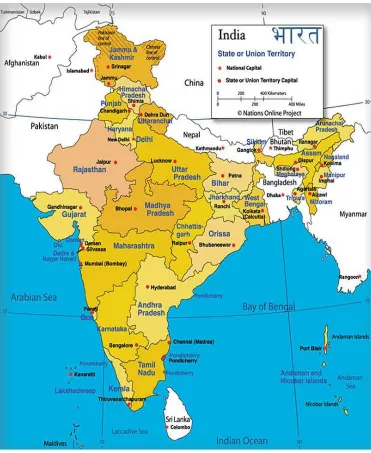
India covers an area of 3.29 million sq. km, extending from the snow-covered Himalayan heights to the tropical rain forests of the south. As the 7th largest country in the world, India stands apart from the rest of Asia, marked off as it is by mountains and the sea, which give the country a distinct geographical entity. Bounded by the Great Himalayas in the north, it stretches southwards and at the Tropic of Cancer, tapers off into the Indian Ocean between the Bay of Bengal on the east and the Arabian Sea on the west (Figure 1).
Figure 1. Physical Map of India22
Border countries, geography, climate, population, political systems are influencing the sustainable development of resources. So, cooperation between neighbours; knowing geography, climate, population, political system may help in the conservation and management of resources.
Border countries are Afghanistan and Pakistan to the north-west; China, Bhutan and Nepal to the north; Myanmar to the east; and Bangladesh to the east of
22
West Bengal. Sri Lanka is separated from India by a narrow channel of sea, formed by the Palk Strait and the Gulf of Mannar. The climate of India can broadly be classified as a tropical monsoon one. But, in spite of much of the northern part of India lying beyond the tropical zone, the entire country has a tropical climate marked by relatively high temperatures and dry winters. There are four seasons – (i) winter (December-February), (ii) summer (March-June), (iii) south-west monsoon season (June-September), and (iv) post monsoon season (October- November). The mainland comprises of four regions, namely the great mountain zone, plains of the Ganga and the Indus, the desert region, and the southern peninsula. A vast plateau flanked by two hilly coastal ranges, the Western Ghats and the Eastern Ghats, covers the southern part of the country. Several rivers weave their way around the country, including the Ganges, the Brahmaputra, and the Yamuna. India’s varied habitats are coasts, rainforests, swamps, mountains and are home to 7.6% of all mammalian, 12.6% of avian, 6.2% of reptilian, and 6.0% of flowering plant species globally. Strong summer monsoons cause seasonal changes in vegetation and habitat every year. The total population is estimated at 1,147,995,898 and is growing at a rate of 1.578% (July 2008 est.). Real Gross Domestic Product (GDP) expanded by 9.2% in 2007 and is continuing to grow at an impressive rate.23
1.2. Marine Fisheries Resources and Status
The fisheries sector occupies a very important place in the socio-economic development of the country. The fisheries sector is a source of livelihood for over 14 million people and an earner of foreign exchange of US$ 160.48 million per annum from 0.551 million tonnes (Hand Book on Fisheries Statistics, 2006). It is an employment generator as it stimulates growth of a number of subsidiary industries and is a source of cheap and nutritious protein. More than 6.7 million fishers depend on fisheries and aquaculture for their livelihood (Hand Book on Fisheries Statistics, 2006).
The country has a long coastline and an equally large area under estuaries, backwaters and lagoons, etc. The continental shelf area amounts to 0.53 million sq.
23
kms of which 71 per cent area is available to the Arabian Sea (west coast) and the remaining 29 per cent in the Bay of Bengal (east coast). After declaration of the EEZ in 1977, the area available to India is estimated at 2.02 million sq. kms, comprising 0.86 million sq. kms on the west coast, 0.56 million sq. kms on the east coast and 0.60 million sq. kms around the Andaman and Nicobar islands (Figure 2 and Figure 3).
(Source: Tsamenyi, 2006)
Figure 2. Zones delimitation according to the UNCLOS (Part V)
In the Territorial Waters, Continental Shelf, Exclusive Economic Zone (EEZ) and other Maritime Zones Act, 1976 (Act No. 80 of 28 May 1976), “limit” in relation to the territorial waters, the EEZ or any other maritime zone of India, means the limit of such waters, shelf or zone with reference to the mainland of India as well as the individual or composite groups of islands constituting part of the territory of India (Territorial Waters, Continental Shelf, Exclusive Economic Zone and other Maritime Zones Act, 1976).24
24
Figure 3. Exclusive Economic Zone of India25
India claims a number of maritime zones in accordance with the provisions of UNCLOS, which provides the basic legal framework for oceans management and sets out the principles and norms that apply to State parties. The outer limits of all these zones are measured from the territorial sea baseline, located at the low-water line along the coast.
Territorial waters: The sovereignty of India extends and has always extended to the
territorial waters of India and to the seabed and subsoil underlying, and the airspace over, such waters. The limit of the territorial waters is the line every point of which is at distance of twelve nautical miles from the nearest point of the appropriate baseline. The Central Government may, whenever it considers necessary so to do having regard to international law and State practice, alter, by notification in the Official Gazette, the limit of the territorial waters. No notification shall be issued unless resolutions approving the issue of such notification are passed by both
25
Houses of Parliament. Without prejudice to the provisions of any other law for the time being in force, all foreign ships (other than warships including submarines and other underwater vehicles) shall enjoy the right of innocent passage through the territorial waters. Foreign warships including submarines and other underwater vehicles may enter or pass though the territorial waters after giving notice to the Central Government: Provided that submarines and other underwater vehicles shall navigate on the surface and show their flag while passing through such waters. The Central Government may, if satisfied that it is necessary so to do in the interests of the peace, good order or security of India or any part thereof, suspend, by notification in the Official Gazette, whether absolutely or subject to such exceptions and qualifications as may be specified in the notification, the entry of all or any class of foreign ships into such area of the territorial waters as may be specified in the notification.
Contiguous zone: The contiguous zone of India is an area beyond and adjacent to
Continental shelf: The continental shelf of India comprises the seabed and subsoil of
the submarine areas that extend beyond the limit of its territorial waters throughout the natural prolongation of its land territory to the outer edge of the continental margin or to a distance of two hundred nautical miles from the baseline. India has, and always had, full and exclusive sovereign rights in respect to its continental shelf. Without prejudice to the generality of the provisions, the Union has in the continental shelf, sovereign rights for the purposes of exploration, exploitation, conservation and management of all resources; exclusive rights and jurisdiction for the construction, maintenance or operation of artificial islands, off-shore terminals, installations and other structures and device necessary for the exploration and exploitation of the resources of the continental shelf or for the convenience of shipping or for any other purpose; exclusive jurisdiction to authorise, regulate and control scientific research; and exclusive jurisdiction to preserve and protect the marine environment and to prevent and control marine pollution. No person (including a foreign Government) shall, except under, and in accordance with the terms of a licence or a letter of authority granted by the Central Government, explore the continental shelf or exploit its resources or carry out any search or excavation or conduct any research within the continental shelf or drill therein or construct, maintain or operate any artificial island, off-shore terminal, installation or other structure or device therein for any purpose whatsoever. The Central Government may, by notification in the Official Gazette, declare any area of the continental shelf and its superjacent waters to be a designated area; and make such provisions as it may deem necessary with respect to, the exploration, exploitation and protection of the resources of the continental shelf within such designated area; or the safety and protection of artificial islands, off-shore terminals, installations and other structures and devices in such designated area; or the protection of marine environment of such designated area; or customs and other fiscal matters in relation to such designated area.
Exclusive Economic Zone (EEZ): The EEZ of India is an area beyond and adjacent
Official Gazette, the limit of the EEZ. No notification shall be issued unless resolutions approving the issue of such notification are passed by both Houses of Parliament. In the EEZ, the Union has sovereign rights for the purpose of exploration, exploitation, conservation and management of the natural resources both living and non-living as well as for producing energy from tides, winds and currents; exclusive rights and jurisdiction for the construction, maintenance or operation of artificial islands, off-shore terminals, installations and other structures and devices necessary for the exploration and exploitation of the resources of the zone or for the convenience of shipping or for any other purpose; exclusive jurisdiction to authorize, regulate and control scientific research; exclusive jurisdiction to preserve and protect the marine environment and to prevent and control marine pollution; and such other rights as are recognised by International law. No person (including a foreign Government) shall, except under, and in accordance with, the terms of any agreement with the Central Government or of a licence or a letter of authority granted by the Central Government, explore or exploit any resources of the EEZ or carry out any research or excavation or conduct any research within the EEZ or drill therein or construct, maintain or operate any artificial island, off-shore terminal, installation or other structure or device therein for any purpose whatsoever: Provided that nothing shall apply in relation to fishing by citizen of India. The Central Government may, by notification in the Official Gazette, declare any area of the EEZ to be a designated area; and make such provisions as it may deem necessary with respect to the exploration, exploitation and protection of the resources of such designated area; or other activities for the economic exploitation and exploration of such designated area such as the production of energy from tides, winds and currents;/or the safety and protection of marine environment of such designated area; or customs and other fiscal matters in relation to such designated area.
zones shall be as determined by agreement (whether entered into before or after the commencement of this section) between India and such State and pending such agreement between India and any such State, and unless any other provisional arrangements are agreed to between them, the maritime boundaries between India and such State shall not extend beyond the line every point of which is equidistant from the nearest point from which the breadth of the territorial waters of India and of such State are measured. Every agreement referred shall, as soon as may be after it is entered into be, published in the Official Gazette. The provisions shall have effect notwithstanding anything contained in any other provision of this Act.
India is the third largest global producer of fish, preceded by China and Peru, 2nd largest producer of freshwater fish preceded by China, 7th largest producer of capture fish in the world and harbours a large percentage of the world’s fishermen, approximately one million in number (FAO Statistics, 2006; Bavinck et al., 2005). India’s share in the world production of fish is 4.33% (Hand Book on Fisheries Statistics, 2006).
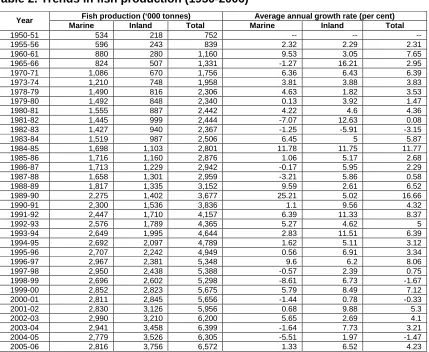
Fish production increased from 0.75 million tonnes in 1950-51 to 6.57 million tonnes in 2005-06, against a harvestable potential of 8.4 million tonnes, an average growth of 4.11 percent over the same period (Hand Book on Fisheries Statistics, 2006). Fish production in 2005-06 was 6.57 million tonnes, and of this, 3.75 million tonnes from inland and 2.82 million tonnes from marine resources (Hand Book on Fisheries Statistics, 2006). The harvestable potential was of 4.5 million tonnes and 3.9 million tonnes from inland and marine resources respectively. Growth rate in inland sector was higher than the marine sector. The GDP has increased by 68.8% in 2005-06 over the year 2000-01 and it was 32.3% in agriculture and related activities. For fisheries, there was an increase of 62.9% (Hand Book on Fisheries Statistics, 2006).
1.2.1. Commercial fisheries
starting from a purely traditional activity in the fifties, both aquaculture and fisheries have now transformed to commercial enterprises. The sector has been recognised as a powerful income and employment generator as it stimulates the growth of a number of subsidiary industries and is a source of cheap and nutritious food. The fisheries sector contributed Indian Rupees (INR) 347,580 million26 to the GDP (at current prices) during 2005-2006, which is 1.07 per cent of the total GDP and 5.84 per cent of the GDP from agriculture, forestry and fishing. Between 1970 to 2006, the share of the sector in total GDP increased from 0.62 per cent to 1.07 per cent, recording a cumulative annual growth rate (CAGR) of 1.86 per cent. The fisheries sector has also been one of the major contributors of foreign exchange earnings (FEE) through export of marine products (Yadava, 2008).
1.2.2. The fishers in India
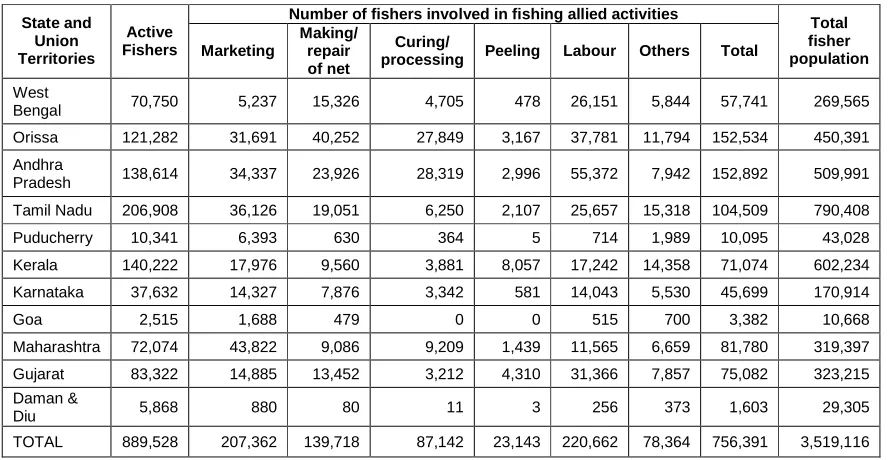
Fishing is a traditional economic activity in India practiced for generations by the fisher communities. The fishers can be broadly classified as: (1) inland fishers; (2) marine fishers; and (3) fish farmers. Among the three, commercial-scale fish farming is a recent development and is also spread outside the domain of traditional fishers’ communities. As per the Livestock Census of 2003, 14.49 million people were engaged in various fisheries related activities in India. About 75 per cent of the fishers are engaged in various inland fisheries activities and about 25 per cent in marine fisheries activities. At the national level, about 6.44 per cent of fishers are full-time and about 7.40 per cent engage in part-time fishing. As per the National Marine Fisheries Census (NMFC), 2005 the marine fisheries sector provides employment to about 0.9 million in active fishing and about 0.7 million fishers in various other fishing operations (Table 1 and Figure 4). The number of people involved in marine fisheries related activities include nearly 0.2 million in fish marketing, 0.1 million in repairs of fisheries requisites, around 0.2 million in fish processing and 0.1 million in other ancillary activities. In all, an estimated 3.51 million people depend on marine fisheries for their livelihoods in India.
Table 1. National Marine Fisheries Census, 2005
Number of fishers involved in fishing allied activities State and
Union Territories
Active
Fishers Marketing
Making/ repair of net
Curing/
processing Peeling Labour Others Total
Total fisher population
West
Bengal 70,750 5,237 15,326 4,705 478 26,151 5,844 57,741 269,565
Orissa 121,282 31,691 40,252 27,849 3,167 37,781 11,794 152,534 450,391
Andhra
Pradesh 138,614 34,337 23,926 28,319 2,996 55,372 7,942 152,892 509,991
Tamil Nadu 206,908 36,126 19,051 6,250 2,107 25,657 15,318 104,509 790,408
Puducherry 10,341 6,393 630 364 5 714 1,989 10,095 43,028
Kerala 140,222 17,976 9,560 3,881 8,057 17,242 14,358 71,074 602,234
Karnataka 37,632 14,327 7,876 3,342 581 14,043 5,530 45,699 170,914
Goa 2,515 1,688 479 0 0 515 700 3,382 10,668
Maharashtra 72,074 43,822 9,086 9,209 1,439 11,565 6,659 81,780 319,397
Gujarat 83,322 14,885 13,452 3,212 4,310 31,366 7,857 75,082 323,215
Daman &
Diu 5,868 880 80 11 3 256 373 1,603 29,305
TOTAL 889,528 207,362 139,718 87,142 23,143 220,662 78,364 756,391 3,519,116
Compared with the previous NMFC undertaken in 1980, it is seen that marine fisher population has nearly doubled from 1.87 million in 1980 to 3.51 million in 2005. Among the marine states, West Bengal has the highest concentration of fishers per kilometre of coastline (1,706) followed by Kerala (1,012) and Orissa (938).
(Source: NMFC, 2005)