Emission characteristics of a compression ignition engine running
castor biodiesel as a blending agent
Rasheed A. Busari
1*and Joshua O. Olaoye
2(1. Food, Agricultural and Biological Engineering Department, Kwara State University Malete, 240001, Nigeria;
2. Agricultural and Biosystems Engineering, Faculty of Engineering and Technology, University of Ilorin, Ilorin, 240001, Nigeria)
Abstract: The objective of this study was to investigate the effects of castor biodiesel and its blends on the emission characteristics of a compression ignition engine. The research work was carried out on a single cylinder, four-stroke, water cooled, direct injection diesel engine by using biodiesel made from castor oil, compared with conventional diesel. The fuels used in the analyses are B5, B10, B15, B20, B25, B50, B100 and convectional diesel. The compression ignition engine was operated by varying the loading conditions (0 - 6 kW) in a step of 1 kW. Based on the parameters measured, detailed analyses were carried out on five regulated exhaust emissions i.e. NOX, CO, CO2, O2, and HC. The results clearly indicated that the engine running with biodiesel and their blends were reduced in CO, CO2 and HC emission by up to 20%. However, further reductions in emissions (CO, CO2, and HC) were observed as biodiesel concentration increases in the blends. Also, for biodiesel and its blends, the NOX(10.6% - 37.7%) emissions increased with increase in the load and, directly proportional to biodiesel concentration while O2 reduces as the load increases and increases as biodiesel concentration increased. The results from the experiments suggested castor biodiesel oil with the engine exhaust gases could be a good substitute fuel for existing diesel engine
Keywords: compression ignition engine, castor biodiesel, exhaust, emission, nitrogen oxides, oxygen and carbon monoxide
Citation: Busari, R. A., and J. O. Olaoye. 2020. Emission characteristics of a compression ignition engine running castor biodiesel as a blending agent. Agricultural Engineering International: CIGR Journal, 22(2): 112-122.
1 Introduction
Biodiesel is a chemically modified alternative fuel for
use in diesel engines without major modifications. It is
obtained from vegetable oils and animal fats and it is
produced at a commercial scale by the transesterification of
vegetable oils with methanol or ethanol. The direct use of
alcohol as fuel causes several performance and corrosion
problems which can be solved through transesterification.
Received date: 2019-01-30 Accepted date: 2019-08-05
*Corresponding author: Rasheed A. Busari, Ph.D., MNSE, MNIAE, Food, Agricultural and Biological Engineering Department, Kwara State University Malete, 240001, Nigeria. Tel: +2348038786090. Email: [email protected].
The given biodiesel contributes to reducing greenhouse
effect gas emissions when compared to conventional diesel
(Ali and Hanna, 1994; Chang et al., 1996; McDonnell et al.,
1999; Peterson and Reece, 1996; Scharmer, 1998).
Many researchers have shown that biodiesel is one of
the most promising alternative and environmentally
friendly fuels which could be used in compression ignition
engines, with little or no requirement of engine hardware
modifications (Ramadhas et al., 2005; Hammond et al.,
2008; Lapuerta et al., 2005; Durbin et al., 2000; Puppan,
2008). It has also been shown that biodiesel has significant
potential to reduce CO2, CO, HC and PM emissions
Lapuerta et al. (2005) and Xue et al. (2011) reported
that 85% and 65% respectively of researchers agreed that
the NOx emission of an engine fuelled with biodiesel was
higher than that of engines running with conventional diesel.
One of the fundamental reasons behind this observation is
the early initiation of engine combustion when running with
biodiesel as a result of the advanced injection derived from
the physical properties of biodiesel such as viscosity,
density, compressibility and speed of sound (Cardone et al.,
2002). Just a few numbers of researchers have reported that
the NOx emissions were reduced when biodiesel was used
as a fuel (Dorado et al., 2003; Utlu and Koçak, 2008; Qi et
al., 2009; Armas et al., 2010). The main reason for NOx
reduction is due to higher degrees of saturation, the longer
chain lengths and higher cetane numbers of fuel from
vegetable oils (Pala-En et al.,2013).
Lapuerta et al. (
2005)and Xue et al.
(2011)also reported that 90% and 84%
respectively of the papers reviewed
show decreases in
CO emissions when the engines were run with
biodiesel fuel. The researchers explained that the
main
reason for the reduction of CO emission is due to the
extra oxygen content of biodiesel which enhances
the
complete combustion and leads to the reduction in CO
emissions
(Tesfa et al., 2014). CO2 is one of the gasesemitted during combustion of carbon in the fuel. Xue et al.
(2011) have reported that 46% of the researchers have
reported that CO2 emission increases when the engine is
running with biodiesel, while 38.5% of the researchers
reported the reverse trend, and 15.4% of the researchers
reported that engines running with dieseland biodiesel have
similar emissions. The CO2 trend discrepancy may be
happening due to the variation of biodiesel feedstock
sources, engine types and testing procedures (Pala-En et al.,
2013). The research specifically addressed the implication
and anticipated environmental impact of using the selected
engine cylinder types that would be the eventual target of
application of this biodiesel. The information is significant
and not currently available. The use of biodiesel as
substitute for diesel is a clear indication and confirmation
for reduction in dependency on mineral fuel. The utilization
of diesel engine is indispensable, there could be seemingly
decrease in its production. The main objective of this study
was to investigate the effects of castor biodiesel and its
blends on the emission characteristics of a compression
ignition engine.
2 Experimental facilities and test procedures
In this study, the combustion characteristics of a
compression ignition engine running with biodiesel
produced (B5, B10, B15, B20, 25, B50 and B100) were
investigated using a single cylinder, four-stroke,
water-cooled and direct-injection internal combustion engine.
This engine was selected due to its wide ranges of usage for
powering stationary agricultural machine in Nigeria. A
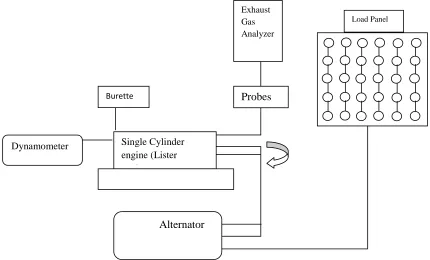
schematic of the experimental facilities is shown in Figure
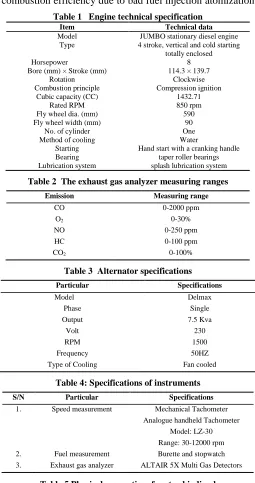
1, and the details of the engine specifications are presented
in Table 1. The engine was connected to dynamometer
(Model: DG-1, MegaTech. Corperation) for measuring the
power output and alternator (for varying the loads on the
testing engine). The measurements of gaseous emissions
were carried out with an exhaust gas analyzer (ALTAIR 5X
MultiGas Detector). The measuring ranges are presented in
Table 2. The gas analyzer probe was connected directly to
the exhaust pipe and the insulated line is extended from the
exhaust pipe to the equipment units where the analyzers are
located. During the testing, the engine was run for five
minutes to enable it to come to a steady state before any
measurements were recorded. The maximum rated speed
and maximum power of the test engine were specified to be
850 rpm and 8 Hp. (6 kW) respectively. The tests were
carried out for a range of loads; from no load to maximum
load (0 to 6 kW) with a step of 1 kW. Tables 3 and 4
presents the specifications of other instruments used and
exhaust gas analyzer measuring ranges. The oil extracted
from castor bean seeds and converted into fuel through a
transesterification process using methanol and KOH as a
catalyst. To analyze the dependence of fuel blends on the
emissions of engines, castor biodiesel, and conventional
diesel were used. The blended fuels were prepared by
mixing castor biodiesel and diesel fuel in different
10%, 15%, 20%, 25% 50% and 100% of Biodiesel and
named B5, B10, B15, B20, B25, B50 and B100
respectively. The blend ratios were set to cover the full
possible range of biodiesel application in emission
reduction.
2.1 Load panel
The loading panel (used for varying the load on test rig)
was made of plywood of 100 cm width and 120 cm height.
This load panel consists of thirty bulbs of 200 W each
which was connected in series, with one switch controlling
five bulbs. The loads were varied from 0 kW to 6 kW in
step of 1 kW at the rated speed of 1500 rpm
2.2 Alternator
A shunt D.C electrical alternator was used for the
experiment while varying the loads on the engine and the
bulbs were connected in series the circuit to control the load
precisely by controlling voltage. The specifications of the
electrical generator are shown in Table 3 and Table 4
presents the specifications of other instruments used.
2.3 Physical properties of castor biodiesel
Suitability of castor biodiesel blends was analyzed, and
it was observed that the main physical properties of castor
biodiesel (B5 – B25) satisfied the standard specifications
(ASTM D-6751, EN-14214, and IS-15607). Density,
calorific value, and viscosity of the castor biodiesel were
measured. The blends physical properties are presented in
Table 5. The density obtained for castor biodiesel is close
to the previous work carried out on the same seeds by
Asmare and Gabbiye (2014) whose result was 920 g cm-3.
Figure 1 Schematic diagram of experimental set-up
A similar trend was observed by Raheman and Ghadge
(2007) they found out that the density of crude mahua oil
was reduced by about 9% on its conversion to biodiesel.
The densities were observed to increase linearly with the
increasing concentration of biodiesel in the blends.
Calorific value of castor biodiesel is less (38,470 kJ kg-1)
as compare to petroleum diesel (42,000 kJ kg-1). The
decrease in calorific value will lead to higher consumption
of fuel from the biodiesel-diesel blend and raw biodiesel as
compared to diesel. Castor Biodiesel is more viscous (10.9
mm2 s-1) as compared to diesel (2.3 mm2 s-1). It is clear
from the table that kinematic viscosity of different biodiesel
blend increases with an increase in biodiesel concentration
and vice versa. However, Aydin and Bayindir (2010) and Single Cylinder
engine (Lister i )
Probes Exhaust Gas Analyzer
Alternator
Load Panel
Dynamometer
Utlu and Koçak (2008) submit that higher viscosity results
in the power losses, because the high viscosity decreases
combustion efficiency due to bad fuel injection atomization.
Table 1 Engine technicalspecification
Item Technical data
Model JUMBO stationary diesel engine
Type 4 stroke, vertical and cold starting
totally enclosed
Horsepower 8
Bore (mm) × Stroke (mm) 114.3 × 139.7
Rotation Clockwise
Combustion principle Compression ignition
Cubic capacity (CC) 1432.71
Rated RPM 850 rpm
Fly wheel dia. (mm) 590
Fly wheel width (mm) 90
No. of cylinder One
Method of cooling Water
Starting Hand start with a cranking handle
Bearing taper roller bearings
Lubrication system splash lubrication system
Table 2 The exhaust gas analyzer measuring ranges
Emission Measuring range
CO 0-2000 ppm
O2 0-30%
NO 0-250 ppm
HC 0-100 ppm
CO2 0-100%
Table 3 Alternator specifications
Particular Specifications
Model Delmax
Phase Single
Output 7.5 Kva
Volt 230
RPM 1500
Frequency 50HZ
Type of Cooling Fan cooled
Table 4: Specifications of instruments
S/N Particular Specifications
1. Speed measurement Mechanical Tachometer
Analogue handheld Tachometer Model: LZ-30 Range: 30-12000 rpm
2. Fuel measurement Burette and stopwatch
3. Exhaust gas analyzer ALTAIR 5X Multi Gas Detectors
Table 5 Physical properties of castor biodiesel
Sample B100 B50 B25 B20 B15 B10 B5
Density, g cm-3 953.63 908.77 880.52 875.76 871.96 869.79 865.38 Kinematic
Viscosity, m m2 s- 1
10.9 6.5 4.79 4.76 4.73 4.64 4.5
Calorific value,
kJ Kg-1 38,470 39,500 40,200 41,230 41,410 41,620 41,800
3 Emission analysis
Compression ignition engine emission was measured
with exhaust gas analyzer (for CO, NOX,CO2, HC, and O2)
and the measured emissions were presented in Figures 1-5.
3.1 HC emission
HC exhaust emissions are shown in the Figure 2. For all
loading conditions and blends of castor biodiesel, the HC
emissions were less than that of the conventional diesel and
HC emissions found to increase with the increase in loads
and reduce as castor biodiesel concentration increases. This
result is confirmed by the work of Lin et al. (2009) reported
that the HC emissions reduced in the range of
22.47%-33.15% for the 8 kinds of biodiesels. Tan et al. (2012)
found that when biodiesel was compared with the
petroleum diesel fuel, the HC emissions show continuous
reductions with increasing biodiesel blends at the 0.10 MPa,
0.26 MPa, 0.51 MPa and 0.77 MPa engine loads. Also, a
good number of researchers reported a sharp decrease in
Hydrocarbon emissions when substituting conventional
diesel fuel with biodiesel fuels (Pinto et al., 2005; Monyem
and Van Gerpen, 2001; Schmidt and Van Gerpen, 1996;
Masjuki et al., 1993). It is important to note that few studies
from available literature revealed that there are no
significant differences when biodiesel is used as a
replacement for conventional diesel fuel (Labeckas and
Slavinskas, 2006; Yuan et al., 2005; Aakko et al., 2002).
Several propositions were put forward to explain the
decrease in hydrocarbon emissions when substituting
conventional diesel for biodiesel – that biodiesel contains
oxygen in its structure, thus, when added to
petroleum-based diesel, the oxygen content of blended fuel increases,
but little oxygen is needed for combustion. Increased
oxygen content in the fuel is probably the reason for better
combustion and reduction in HC emission (Pinto et al.,
2005). Rakopoulos et al. (2004) report in their findings that
hydrocarbon emissions decrease as the oxygen in the
combustion chamber increases, either with oxygenated
fuels or oxygen-enriched air. The higher cetane number of
biodiesels reduces the combustion delay, and such a
reduction has been related to decreasing hydrocarbon
emissions (Monyem and Van Gerpen, 2001; Abd-Alla et al.,
2001).
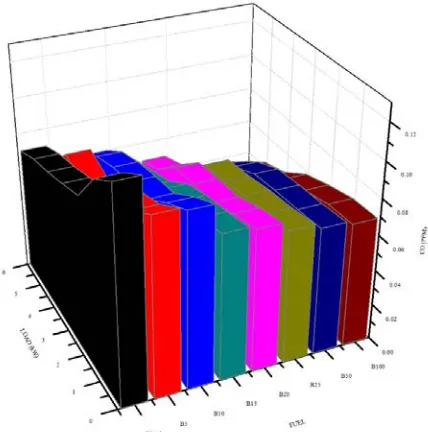
The carbon dioxide emission from single cylinder
compression ignition engine using conventional diesel,
biodiesel, and its blends are shown in Figure 3. The CO2
emissions increased with increase in loads and decreased as
biodiesel concentrations increased, given all loading
conditions. Thus, the Figure 3 shows that CO2 emission for
the diesel is higher than that of any blend of the biodiesel.
This is due to fact that diesel contains higher carbon content
quantity in comparison to biodiesel. The increase of CO2
emission at higher loads was due to higher exhaust gas
temperature and lower O2 concentration in the exhaust,
which led to complete combustion (Jafarmadar and Pashae,
2013). Similarly, Mohsin et al. (2014) reported that the
reduction in CO2 emission from the engine was due to
complete combustion inside the combustion chamber. More
CO2 released means complete fuel combustions. Although
CO2 is considered as a pollutant from the engine
performance point of view, this is an indication that the
engine will perform well and release less pollutant into the
atmosphere with biodiesel. Also some other literatures
studied CO2 emissions of biodiesel and reported that,
biodiesel results in fewer CO2 emissions than diesel during
combustion due to the lower carbon to hydrogen ratio
(Ozsezen et al., 2009; Utlu and Kocak, 2008; Keskin et al.,
2008; Lin and Lin, 2007; Sahoo et al., 2007). On the
contrary, Çelikten et al. (2012) noted that the CO2
emissions for biodiesel blends increased compared to diesel
fuel. They attributed the increase to the oxygen content in
biodiesel which reacted with unburned carbon atoms during
the combustion and increased the formation of CO2.
Therefore, more amount of CO2 in exhaust emission
indicates complete combustion of fuel compared to diesel
fuel. Similarly, other literatures reported that CO2
emissions rise, or increase is due to more efficient
combustion. They pointed out that, the higher carbon
dioxide emission should cause less concern because of
Nature’s recovery by raising biodiesel crops (Fontaras et al.,
2009; Labeckas and Slavinskas, 2006; Canakci, 2005;
Puhan et al., 2005; Ramadhas et al., 2005).
3.3 NOX emission
Variation of NOX produced by the engine used for the
experimental work (stationary, single cylinder lister engine
of 6 kW) when B5, B10, B15, B20, B25 B50, B100 and
conventional diesel are presented in Figure 4. From the
figure, it can be observed that the NOX emission increased
with increase in the load and the emission increase was also
proportional to biodiesel concentration. It was observed that
NOX emission increased from 10.6% to 37.7% for B5 to
B100. The emission was maximum for Bl00 and minimum
for B5. The large quantity of NOX emittedwas as a result of
the high oxygen content in the biodiesel that reacted with
the nitrogen component in the surrounding air (Jafarmadar
and Pashae, 2013). The same trend was reported by
Labeckas and Slavinskas (2006) who reported experimental
work on a 7.31 Navistar engine running 13 mode US Heavy
Duty test cycle using different soybean-oil biodiesel blends.
They observed that an increase in NOx emission obtained
was in proportion to the concentration in biodiesel and 8%
increase was reached when 100% biodiesel was used. On
the other hand, some researchers reported that the effect of
biodiesel on NOx emissions depends on the types of engine
and conditions of operation (Serdari et al., 1999; Hamasaki
et al., 2001). Also, Serdari et al. (1999) measured on-road
emissions from three different vehicles using high sulfur
diesel fuel and 10% of sunflower biodiesel blends. They
discovered both increase and decrease in NOx emissions
and attributed such difference to the different engine
maintenance culture and technology. Similarly, Hamasaki
et al. (2001) tested a single-cylinder engine at 2000 rpm and
varying loads with three waste-oil biodiesel fuels. They
measured a slight reduction in NOx emission at low loads
but increase at high loads. Tan et al. (2012) concluded from
his findings that NOx emission with biodiesel fuels are
usually higher when they are measured in an engine test
bench than those from conventional diesel, but lower when
they are measured from moving vehicles. The reason
pointed out was that engine loads are usually lighter in
moving vehicles than those imposed in experimental test
beds. Furthermore, Durbin et al. (2000) tested pure
engines. The engines were chosen to represent a wide
variety of heavy-duty engines: turbocharged and naturally
aspirated, direct and indirect injection. Little variations
were found in NOx emissions and the researchers
concluded that there are no significant differences between
the two fuels. They attributed similarities in NOx emission
to low unsaturation level of biodiesel (Nabi et al., 2006).
Quite number of literatures also reported a decrease in NOx
emissions when using biodiesel fuels. Peterson and Reece
(1996) used several blends of fuels mixed with both ethyl
and methyl esters from rapeseed oil in vehicles equipped
with similar engines. They measured reductions in NOx
emissions of around 10% both ester blends (as reported by
Graboski and McCormick, 1998). Dorado et al. (2003)
recorded reductions of above 20% from testing biodiesel
from waste olive oil in an eight-mode cycle. Lastly, the
formation of NOX depends on cylinder temperature,
ignition delay and oxygen content in the fuel, longer chain
length and higher amounts of unsaturated fatty acids in
methyl ester have been reported to correlate with an
increase in NOX emission (Kumar, 2014). In addition, most
of the researches report that the increase in NOX emission
with biodiesel was as a result of the advanced combustion
process as a consequence of the advanced injection derived
from the physical properties of methyl ester (viscosity and
density) (Cardone et al., 2002). Graboski and McCormick
(1998) reported that characteristics of the injected fuel, such
as droplet size distribution, droplet moment of inertia, air
entrainment, penetration, fuel evaporation, and heat
dissipation are all affected by the fuel properties: viscosity,
surface tension, and boiling temperature. All these physical
phenomena may have some influence on the delay time,
diffusion combustion ratio and, in consequence, on the
NOX formation.
3.4 O2 emission
Figure 5 shows that O2 emission for the blends of
biodiesel is higher than that of the diesel. The reason being
that biodiesel is an oxygenated fuel and it contains oxygen
of about 11% by volume, as a result of the higher density of
biodiesel, hence, high oxygen content leading to complete
combustion (Krishna et al., 2016). The presence of oxygen
in methyl ester results in higher heat release during the
premixed phase of combustion. Also, from the Figure 5, it
can be observed that as the load increases the O2 reduces
and O2 increased as biodiesel concentration increased. Lin
and Li (2009) compared biodiesel from waste cooking oil
and marine fish-oil in the engine and reported that the
marine fish-oil biodiesel has a larger O2 emission. The
burning marine fish oil biodiesel formed slightly more O2
than that of the commercial biodiesel from waste cooking
oil, due to the slightly lower equivalence ratio of the former.
3.5 CO emission
Variations of CO emission at various biodiesel blends
and loads are presented in Figure 6. Given all fuel
compositions, CO emission reduced as loads and biodiesel
concentration increased. As the quantities of raw biodiesel
increased in blends; CO emissions of blends reduced
because of increase in oxygen content which is as a result
of the low calorific value of biodiesel fuel. With reference
to most of the literature reviewed, decrease in CO
emissions when substituting biodiesel for conventional
diesel fuel can be considered as the general trend (Hansen
and Jensen, 1997; Pinto et al., 2005; Shi et al., 2005). The
result of this research work was also confirmed by the work
of Aydin and Bayindir (2010) who reported that the effect
of B5, B20, B50, B75, B100 and diesel fuel on the engine
and found that minimum CO emission values were
observed for B50, B75 and B100 due to the higher oxygen
content compared to diesel fuels. A similar trend was
reported from reviewed work carried out by Krahl et al.
(2003) and found 15% reduction when using biodiesel as an
alternative for diesel fuel. Load conditions were proved to
have a remarkable effect on CO emissions (Lapuerta et al.,
2008). Ramadhas et al. (2005) found that the engine
releases more CO using petroleum diesel as compared to
that of biodiesel blends under all loading conditions when
rubber seed oil methyl was used to power a four stroke,
direct injection, naturally aspirated single cylinder engine.
research engine with biodiesel from soybean oil. They
reported that there was no major difference in CO
emissions at low loads, but the decrease was recorded at
high loads. Several reasons were found to explain the
general CO emission reduction when substituting biodiesel
for conventional diesel. The additional oxygen content in
the biodiesel fuel enhances a complete combustion of the
fuel, thus reducing CO emissions (Pinto et al., 2005;
Ullman et al., 1994). The advanced injection and
combustion when using biodiesel may also justify the CO
emission reduction when compared to conventional diesel
fuel (Storey et al., 2005).
Figure 2 HCvs load for various blends Figure 3 CO2 vs load for various blends
Figure 6 CO vs load for various blends
4 Conclusion
The physico-chemical properties of castor biodiesel
and its blends with diesel were found to be similar to that
of convectional diesel, and largely within limits specified
by the ASTM D-6751, EN-14214, and IS-15607
standards except for B50 and B100. Performance and
emissions of a diesel engine fuelled with 5%, 10%, 15%,
20%, 25%, 50% and 100% (by volume) of castor
biodiesel and conventional diesel were experimentally
investigated at different loading conditions. The results
indicate compression ignition engine running with
biodiesel highlights a significant reduction in CO2, CO
and HC emission under different loading conditions. It is
also found that when the biodiesel concentration increases
a further reduction in emissions was observed. This
emission reduction is as a result of the oxygen content in
biodiesel and the low carbon-hydrogen ratio. Also, for all
biodiesel contents the NOXandO2 emission increases for
all loading conditions of the engine. This increase may be
explained by the higher oxygen content present in
biodiesel and the advanced injection characteristics.
Castor biodiesel offer petroleum like engine performance
while still maintaining reductions in major emission gases.
It is therefore recommended to farmers to use on farm
fuel that is environmentally friendly and readily available.
Reference
Aakko, P., N. O. Nylund, M. Westerholm, M. Marjamaki, M. Moisio, and R. Hillamo. 2002. Emissions from heavy-duty engine with and without after treatment using selected biofuels. FISITA Paper No. F02E195. 2 - 7 June, Helsinki, Finland: FISITA.
Abd-Alla, G. H., H. A. Soliman, O. A. Badr, and M. F. Abd-Rabbo. 2001. Effects of diluent admissions and intake air temperature in exhaust gas recirculation on the emissions of an indirect injection dual fuel engine. Energy Conversion Management, 42(8): 1033-1045.
Ali, Y., and M. A. Hanna. 1994. Alternative diesel fuels from vegetable oils. Bioresource Technology, 50(2): 153-163. Armas, O., K. Yehliu, and A. L. Boehman. 2010. Effect of
alternative fuels on exhaust emissions during diesel engine operation with matched combustion phasing. Fuel, 89(2): 438-456.
Asmare, M. and Gabbiye, N. 2014. Synthesis and Characterization of Biodiesel from Castor Bean as Alternative Fuel for Diesel Engine; American Journal of Energy Engineering; 2 (1): 1-15.
Aydin, H., and H. Bayindir. 2010. Performance and emission analysis of cotton seed oil methyl ester in a diesel engine. Renewable Energy, 35(3): 588-592.
Mechanical Engineers, Part D: Journal of Automobile Engineering, 219(7): 915–922.
Cardone, M., M. V. Prati, V. Rocco, M. Seggiani, A. Senatore, and S. Vitolo. 2002. Brassica carinata as an alternative oil crop for the production of biodiesel in Italy: engine performance and regulated and unregulated exhaust emissions. Environmental Science Technology, 36(21): 4656–4662. Çelikten, I., E. Mutlu, and H. Solmaz. 2012. Variation of
performance and emission characteristics of a diesel engine fueled with diesel, rapeseed oil and hazelnut oil methyl ester blends. Renewable Energy, 48: 122-126.
Chang, D. Y. Z., J. H. Van Gerpen, I. Lee, L. A. Johnson, E. G. Hammond, and S. J. Marley. 1996. Fuel properties and emissions of soybean oil esters as diesel fuel. Journal of the American Oil Chemists' Society, 73(11): 1549-1555.
Choi, C. Y., G. R. Bower, and R. D. Reitz. 1997. Effects of biodiesel blended fuels and multiple injections on D.I. diesel engines. SAE Transaction, 106(3): 388-407.
Dorado, M. P., E. Ballesteros, J. M. Arnal, J. Gomez, and F. J. Lopez. 2003. Exhaust emissions from a Diesel engine fueled with transesterified waste olive oil. Fuel, 82(11): 1311-1315. Durbin, T. D., J. R., Collins, J. M. Norbeck, and M. R. Smith. 2000.
Effects of biodiesel, biodiesel blends, and a synthetic diesel on emissions from light heavy-duty diesel vehicles. Environmental Science & Technolog, 34(3): 349-355. 1 Fontaras, G., G. Karavalakis, M. Kousoulidou, T. Tzamkiozis, L.
Ntziachristos, E. Bakeas, S. Stournas, and Z. Samaras. 2009. Effects of biodiesel on passenger car fuel consumption, regulated and non-regulated pollutant emissions over legislated and real-world driving cycles. Fuel, 88(9): 1608– 1617.
Graboski, M. S., and R. L. McCormick. 1998. Combustion of fat and vegetable oil derived fuels in diesel engines. Progress in Energy and Combustion Science, 24(2): 125–164.
Hamasaki, K., E. Kinoshita, S. Tajima, K. Takasaki, and D. Morita. 2001. Combustion characteristics of diesel engines with waste vegetable oil methyl ester. In 5th international symposium on diagnostics and modeling of combustion in internal combustion engines; (COMODIA 2001), July 1-4, 2001, Nagoya, Japan.
Hammond, G. P., S. Kallu, and M. C. McManus. 2008. Development of biofuels for the UK automotive market. Applied Energy, 85(6): 506-515.
Hansen, K. F., and M. G. Jensen. 1997. Chemical and biological characteristics of exhaust emissions from a DI diesel engine fuelled with rapeseed oil methyl ester (RME). Technical Paper. 971689. ISSN: 0148-7191, e-ISSN: 2688-3627. DOI:
https://doi.org/10.4271/971689. Published May 1, 1997 by SAE International.
Jafarmadar, S., and J. Pashae. 2013. Experimental study of the effect of castor oil biodiesel fuel on performance and emissions turbocharged DI diesel. International Journal of Engineering-Transactions B: Applications, 26(8): 905-912. Keskin, A., M. Gürü, and D. Altıparmak. 2008. Influence of tall oil
biodiesel with Mg and Mo based fuel additives on diesel engine performance and emission. Bioresource Technology, 99(14): 6434–6438.
Krahl, J., A. Munack, O. Schröder, H. Stein, and J. Bünger. 2003. Influence of biodiesel and different designed diesel fuels on the exhaust gas emissions and health effects. SAE Transactions, 112(4): 2447-2455.
Krishna, K. H., H. S. Dsouza, and N. S. Kumar. 2016. Investigation of properties of different blends of castor and pongamia biodiesels and their performance in a compression ignition engine. Energy and Power, 6(1A): 8-14.
Kumar, N. 2014. Experimental investigation to identify the optimum operating parameters of a compression ignition diesel engine run on B40 biodiesel blend; Ph.D. diss., Mechanical Engineering, National Institute of Technology Hamirpur, India.
Labeckas, G., and S. Slavinskas. 2006. The effect of rapeseed oil methyl ester on direct injection diesel engine performance and exhaust emissions. Energy Conversion and Management, 47(13): 1954-1967.
Lapuerta, M., O. Armas, and J. Rodriguez-Fernandez. 2008. Effect of biodiesel fuels on diesel engine emissions. Progress in Energy and Combustion, 34(2): 198-223.
Lapuerta, M., O. Armas, R. Ballesteros, and J. Fernández. 2005. Diesel emissions from biofuels derived from Spanish potential vegetable oils. Fuel, 84(6): 773-780.
Lin, B., J. Huang, and D. Huang. 2009. Experimental study of the effects of vegetable oil methyl ester on DI diesel engine performance characteristics and pollutant emissions. Fuel, 88(9): 1779-1785.
Lin, C., and R. Li. 2009. Engine performance and emission characteristics of marine fish-oil biodiesel produced from the discarded parts of marine fish. Fuel Processing Technology, 90(7-8): 883-888.
Lin, C., and H. Lin. 2007. Engine performance and emission characteristics of a three-phase emulsion of biodiesel produced by peroxidation. Fuel Process Technology, 88(1): 35-41.
and Industrial Diesel Engines: Proceedings of the 2nd Institute of Mechanical Engineering Seminar, 129-137. London, September 15-17, 1993.
McDonnell, K., S. Ward, J. J. Leahy, and P. McNulty. 1999. Properties of rapeseed oil for use as a diesel fuel extender. Journal of American Oil Chemists’ Society, 76(5): 539-543. Mohsin, R., Z. A. Majid, A. H. Shihnan, N. S. Nasri, and Z. Sharer.
2014. Effect ofbiodiesel blends on engine performance and exhaust emission for diesel dual fuel engine. Energy Conversion and Management, 88: 821-828.
Monyem, A., and J. H. Van Gerpen. 2001. The effect of biodiesel oxidation on engine performance and emissions. Biomass and Bioenergy, 20(4): 317–325.
Nabi, M. N., M. S. Akhter, and M. M. Z. Shahadat. 2006. Improvement of engine emissions with conventional diesel fuel and diesel–biodiesel blends. Bioresource Technology, 97(3): 372–378.
Ozsezen, A. N., M. Canakci, A. Turkcan, and C. Sayin. 2009. Performance and combustion characteristics of a DI diesel engine fueled with waste palm oil and canola oil methyl esters. Fuel, 88(4): 629–636.
Pala-En, N., M. Sattler, B. H. Dennis, C. P. Chen Victoria, and R. L. Muncrief. 2013. On-road measurement of NOx and CO2 emissions from biodiesel produced from different feedstocks. Journal of Environment Prot, 4(1): 74-82.
Peterson, C., and D. Reece. 1996. Emissions characteristics of ethyl and methyl ester of rapeseed oil compared with low sulfur diesel control fuel in a chassis dynamometer test of a pickup truck. Transactions of the ASAE, 39(3): 805-816.
Pinto, A. C., L. L. N. Guarieiro, M. J. C. Rezende, N. M. Ribeiro, E. A. Torres, W. A. Lopes, P. A. P. Pereira, and J. B. Andrade. 2005. Biodiesel: An overview. Journal of the Brazilian Chemical Society, 16(6): 1313-1330.
Puhan, S., N. Vedaraman, G. Sankaranarayanan, and B. V. Bharat Ram. 2005. Performance and emission study of Mahua oil (Madhuca indica oil) ethyl ester in a 4-stroke natural aspirated direct injection diesel engine. Renewable Energy, 30(8): 1269-1278.
Puppan, D. 2008. Environmeental Evaluation of Biofuels.
Available at:
http://www.pp.bme.hu/so/2002_1/pdf/so2002_1_08.pdf. Accessed 16 June 2008.
Qi, D., L. Geng, H. Chen, Y. Bian, J. Liu, and X. Ren. 2009. Combustion and performance evaluation of a diesel engine fueled with biodiesel produced from soybean crude oil. Renewable Energy, 34(12): 2706-2713.
Rakopoulos, C. D., D. T. Hountalas, T. C. Zannis, and Y. A.
Levendis. 2004. Operational and environmental evaluation of diesel engines burning oxygen-enriched intake
air or oxygen-enriched fuels: a review. SAE Transactions, 113(4): 1723-1743.
Raheman, H. and S. V. Ghadge. 2007. Performance of compression ignition engine with Mahua (Madhuca Indica) biodiesel, Fuel, 86(1): 2568 - 2573.
Ramadhas, A. S., C. Muraleedharan, and S. Jayaraj. 2005. Performance and emission evaluation of a diesel engine fueled with methyl esters of rubber seed oil. Renewable Energy, 30(12): 1789-1800.
Sahoo, P. K., L. M. Das, M. K. G. Babu, and S. N. Naik. 2007. Biodiesel development from high acid value polanga seed oil and performance evaluation in a CI engine. Fuel, 86(3): 448– 454.
Scharmer, K. 1998. Biodiesel from set-aside land, Sustainable Agriculture for Food, Energy and Industry. James & James Publishers, London, United Kingdom. 884 - 848.
Schmidt, K. and J. Van Gerpen. 1996. The Effect of Biodiesel Fuel Composition on Diesel Combustion and Emissions. SAE Technical Paper 961086, 1996, https://doi.org/10.4271/961086.
Serdari, A., K. Fragioudakis, C. Teas, F. Zannikos, S. Stournas, and E. Lois. 1999. Effect of biodiesel addition to diesel fuel on engine performance and emissions. Journal of Propulsion and Power, 15(2): 224-231.
Shi, X.Y., X. B. Pang, Y. J. Mu, X. Shi, X. Pang, Y. Mu, H. He, S. Shuai and J. Wang. 2005. Emission reduction potential of using ethanol-biodiesel-diesel fuel blend on a heavy-duty diesel engine. Atmospheric Environment, 40(1):2567 - 2574. Storey, J. M., S. A. Lewis, B. H. West, S. P. Huff, C. S. Slicer, R. M. Wagner, and M. Kass. 2005. Hydrocarbon species in the exhaust of diesel engines equipped with advanced emissions control devices. CRC Project no: AVFL10b-2.
Tan, P., Z. Hu, D. Lou, and Z. Li. 2012. Exhaust emissions from a light-duty diesel engine with jatropha biodiesel fuel. Energy, 39(1): 356-362.
Tesfa, B., F. Gu, R. Mishra, and A. Ball. 2014. Emission characteristics of a CI engine running with a range of biodiesel feedstocks. Energies,7(1): 334-350.
Ullman, T.L., K.B. Spreen, R.L. Mason. 1994. Effects of cetane number, cetane improver, aromatics and oxygenates on heavy-duty diesel engine emissions. SAE Tec Pap Ser; No. 941020
engine performance and exhaust emissions. Renewable Energy, 33(8): 1936-1941.
Xue, J., T. E. Grift, and A. C. Hansen. 2011. Effect of biodiesel on engine performances and emissions. Renewable and Sustainable Energy Reviews, 15(2): 1098-1116.