Book Reviews
Anderson, Kenton. (2017). Integrative Preaching: A Comprehensive Model for
Transformational Proclamation. Grand Rapids, MI: Baker Academic.
Reviewed by Ps Andrew Groza
It is not uncommon in the churches that belong to the movement that I am a part of, to hear the congregation respond to the sermon with great gusto. “Good preaching!” is an oft heard encouragement. Whilst the preaching may well be justly described, it does not always follow that the sermon is indeed all that good. Preaching is both art and science and many elements combine to create a “good” sermon. That is one of the reasons why Kenton Anderson’s new book Integrative Preaching is a welcome addition to the extant homiletical literature.
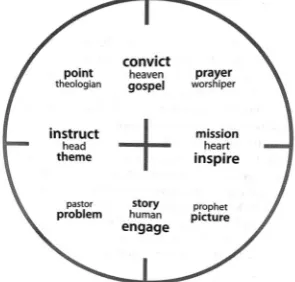
Anderson presents a model that he has dubbed “integrative preaching”, which articulates the various components that create a sermon that allows God to work through the preacher and communicate a message that changes lives. The model (Fig. 1) integrates head (instruction), heart (inspiration), human (engagement), and heaven (conviction), attempting to draw the listener towards the cross and what God is doing in this world to bring about his kingdom. Sermons utilising this framework begin by seeking to engage the audience through story, taking seriously the lived-experience of human life. It then moves towards the head to instruct via the theme of the biblical text, moving upwards towards heaven seeking to convict through the gospel, and then finally towards the heart to inspire God’s people to mission through living out the message. There is so much more that can be said about the various components and Anderson does a thorough job of unpacking each with clarity and conviction.
There is much to commend this book. Littered throughout are profound thoughts about the preaching task that any preacher—whether novice or master—can readily appreciate. For example, early in the book Anderson provocatively asserts that God is actually the one who speaks—not the human preacher; “God preaches, and that is both wonder and comfort to the beleaguered human who has felt the weekly burden as if it was his or her own” (p.xi). What is the preacher’s response then? The preacher has the great privilege of being the first listener—they hear from God first, then “…having heard, we take what we have heard and offer it to others” (p.xii). This, then, ought to change the way that preachers approach the congregation; superiority has no place in the pulpit, preachers are simply those who partake of the same words of life and hope as the rest of the congregation—they just partake of it first.
Further, Anderson discusses different modes or ways of being for a preacher. Within the same sermon, preachers can function like a pastor addressing the problems that real people face; “Preaching as pastors means that we bear the burden of the audience. We hear their hurt and feel their pain…Any problem they have is a problem we have. We might be a little more advanced in our understanding, but we crave the completion every bit as much as they do” (p.90). They can also function like a theologian— theologians that love God, love the truth and seek to move people from instruction to conviction, to encounter the living God. Those who preach are worship leaders too; “Worship is the intentional action of appropriately responding to the presence of God” (p.106). And this can be accomplished through repentance, being grateful, or praising God, and this leads the congregation to encounter God themselves. Those who preach can also function like a prophet—one who supplies pictures for congregations that gives practical and concrete shape to the message that God is communicating. Understanding these modes of being can shape both the message, and the messenger, in such a way that God’s word is more faithfully proclaimed.
The more I read Integrative Preaching, the more I found myself thinking—this guy knows what it is like to live in the real world and preach to a real audience. What Anderson communicates is not just homiletical theory; it is also very practical, and his wisdom and insight gained over many decades of preaching may instruct the newer preacher, refresh the more seasoned one, and inspire both. I’m sure that there may be parts of the book that might confuse some readers. For example, at times it was hard to follow specifically how the key functions of a sermon interacted with the quadrants (e.g. How story can lean towards problem or picture). Also, Anderson’s use of the metaphor of multiple coilings was not easily understood (though that might speak to my cognitive ability to understand and not the author’s ability to communicate).
Austin, Denise A. (2017). Jesus First: The Life and Leadership of Andrew Evans.
Parramatta, NSW : Australian Pentecostal Studies.
Reviewed by Jeremy Weetman
For anyone growing up in the Australian Assemblies of God during the 1970s and 1980s, Andrew Evans was a statesman of the Pentecostal movement. He gave leadership to the AOG during a time of change and growth that provided the platform for the influence of the ACC on the Australian Christian scene today. In her book, Jesus First, Denise Austin documents the life of Andrew Evans and provides some of the principles and lessons that shaped him as a man and leader.
This is a book that, apart from a couple of minor factual errors, is well researched and organised. The framework for the narrative is provided by what Evans terms, ‘biblical principles for success in life and leadership’ (from the Introduction). By weaving these principles into the story, Austin demonstrates how they were developed, often through times of difficulty and challenge. The narrative begins with the salvation of Andrew Evans’ father, Tommy, and demonstrates how the example of his parents provided a strong foundation for Evans’ future ministry. The book is packed with information and, drawing on interviews and first-hand accounts, provides interesting insight into not only Andrew Evans’ life, but what was also a transitional era for the AOG (now ACC) in Australia.
What quickly becomes apparent is how God used each stage of Evans’ life as preparation for the next, including how the seeds of his later political career were sown very early on in his missionary days. I found it moving to read of his first wife, Lorraine’s, struggle with mental health. This particular challenge was faced at a time when mental health issues were thought of very differently to how they are today, and the way the family navigated this season, as well as the way it shaped their later ministry, provided welcome insight into the very human struggles that often accompany Christian ministry. Similarly, Lorraine’s eventual death demonstrated the very real challenge we all face to maintain our trust in God in the most difficult times.
The leadership lessons learned and the growth of Klemzig AOG (later Paradise) provided a model that ‘became an inspiration for Pentecostal megachurches right across the country’ (p. 129). Andrew Evans, however, wasn’t the ‘stereotypical, narcissistic, charismatic leader’ (p. 111) often associated with such churches. His leadership was collaborative, humble, and pastoral, flexible in welcoming new ideas and opportunities, whilst remaining true to his own personal values and convictions. This is clearly depicted in the latter part of the narrative when describing the context for the founding of Family First and Evans’ election to the South Australian parliament. Whilst it would have been interesting to have had more space allocated to this season, particularly the tensions of being a prominent Christian leader in secular politics, Austin provides sufficient storyline within the context of the book.
Bourgelaut, C. (2004). Centering Prayer and Inner Awakening. Lanham: Cowley. Reviewed by Dr Darren Cronshaw
My spiritual director has helped me begin to respond to God’s invitation to let go of compulsiveness and descend from my head to my heart. The thought life of my mind and the tasks of my work life are relatively busy. A personal danger of this is that I can refuse to face my pain and anxiety. A contemporary ministry danger is that I might not draw on a depth of wisdom that will best help nourish my church. I have had some experience of contemplative prayer that helps to balance my activism, yet I have felt the need for some fresh focus and guidance to ground my spirituality. This is why I looked forward to
reading, digesting and practising Centering Prayer and Inner Awakening by Cynthia
Bourgeault.
This book defines centering prayer as a disposition of humility and love leading to self-surrender, “simply a wordless, trusting openness of self to the divine presence” (p. 5). This moves prayer beyond simply “talking to God” without putting it into a rarified form merely for monks and mystics. Developed by Father Thomas Keating and the organisation Contemplative Outreach, Bourgeault adds how it can draw on an authentic wisdom path for inner transformation. Centering Prayer is not so much like the focused concentration of meditation, nor does it use mantras such as in Buddhist practice or mindfulness, but adopts more of a surrender method of “heartfulness”. With intentional focus but without the necessity of thought, centering prayer opens up the spirit to the transformation of God’s Spirit.
The practice uses a time of silence (which John of the Cross suggested is “God’s first language”). Bourgeault helpfully explains that most of us experience a “monkey mind” with ego-focused thinking going in all sorts of directions. Each thought is not something to resist but gives the opportunity to practice letting go and returning to awareness of our soul dwelling with God and God with us. Sitting relaxed with eyes closed, whenever a thought arises, the thought is let go with a sacred word such as “now” or “peace”, and there is a return to interior silence and openness to God’s presence. Using Keating’s metaphor, it is like diving to the bottom of the river and noticing ships passing overhead, but letting them go rather than dwelling on them or returning to the surface and exploring them. Twenty minutes of this each day can teach the spirit to be willing to “lose” its life in order to find the real thing – not through conscious effort but by intentionally allowing the self to be totally open to God.
Beyond that basic pattern, I appreciated Bourgeault’s invitation to consider:
How centring prayer can answer the postmodern search for spiritual paths and
yet be grounded in Scripture, Christian Tradition and Jesus’ example, and offer powerful “Divine Therapy” that purifies our “false self,”
Opening up with apophatic prayer (bypassing our faculties) rather than just
cataphatic processing (using our mind and imagination).
Not practising silence as a tool to “hear from God” but simply to be open to
transformation (independent of thinking),
Combining centering prayer with lectio divina (prayer and word), but as a fluid
Letting the “inner observer” bridge interior silence to our True Self,
Using the “Welcoming Prayer” for self-surrender in challenges of everyday life
where transformation is really honed and tested – by focusing on an upset, welcoming the pain, anger or panic (embracing the demon), and then letting it go,
Using centring prayer as a “God Positioning System” to refocus us on our
yearning for God and God’s for us,
How Centring prayer follows Jesus’ example of completely and freely giving up
of our whole self,
Experiencing a wisdom way of knowing from being “pure in heart” rather than
an Enlightenment-formed “I think, therefore I am.”
This book is a warm and delightful guidebook to the potential and practice of Centering Prayer. It offers one simple and disciplined potential path to help move from the head to the heart. Bourgeault concludes: “As you nurture the heart, your ego will begin to relativize of its own accord. It can then do its real job as a useful instrument of manifestation – in the same way a violin lets you manifest the music. But you have come to know that you are not your violin” (p.167). This book and the practices it discusses are invaluable reading not just for monastics and retreat participants, but for ordinary Christians and college students, pastors and academics.
Clifton, S. (2018). Crippled Grace: Disability, Virtue Ethics, and the Good Life. Waco, TX : Baylor University Press.
Reviewed by Christopher Cat
Shane Clifton is a professor of theology and currently Director of Research at Alphacrucis College in Sydney, where he has studied and taught for the last 20 years. His principal scholarly contribution to the field of Pentecostal theology is flavoured by his postgraduate work at a Catholic University, his ecumenical and liberal openness, his passion for feminist and political theology, and his own (now 10 year) experience of spinal cord injury. His book Crippled Grace, published by Baylor University Press is part of the Studies in Religion, Theology and Disability series, edited by Melcher and Yong.
Crippled Grace is a wide-ranging reflection on the issues surrounding disability and flourishing. Clifton boldly asks the difficult and confronting questions, recognising his limitations and being prepared to not have comprehensive answers, while still setting a solid framework for understanding the dynamics of flourishing and challenges and issues that are presently hindering it for the disabled community. Paragraph after paragraph the work continues to offer wisdom and insight as Clifton shows a comprehensive awareness of the relevant ethical, practical and theological concerns.
the social awareness of disabled flourishing, and insisting on the inclusion of disabled voices in the discussion. Clifton seeks to broaden current prejudicial and oppressive perspectives, create a solidarity that sees limitation as normative to all humanity, and push the church to engage with disability issues it has largely neglected. His chapter on disabled sexuality is particularly targeted to these ends.
Clifton draws from the virtue traditions, necessarily acknowledging their historicity and limitations, to set up his framework of flourishing. He successfully explores how such suffering can be defined as limited but virtuous living within interdependent community and friendships. He wrestles with the difficult tension between medical and social models of disability, that want to tell disabled people what they should want and how they should be instead of letting people frame their diverse experiences in their own terms. Therein is one of the great strengths of his work—his intertwining of scholarship with some compelling, living testimonies of disabled people (including his own) to show the outworking of his ideas. This gives his work a practical grounding while making the reading engaging, informative and empathy creating.
While he recognises that he cannot adequately address the full depths of his dialogue partners’ concerns (ethical, scientific, theological, and disabled experiences themselves), his stated and committed bias to disabled flourishing as an interpretive lens potentially detracts from positioning the biblical themes he addresses in their own contexts. It is a difficult line he is walking. He presents very legitimate grounds for seeking an inclusive reading of the biblical text and correctly and commendably recognises the way in which many traditional readings add burden to the disabled and suffering. However, his move away from traditional readings may be too far for some readers. For example, firstly, in seeking a reading that can promote sexual flourishing for the disabled, he challenges traditional values that limit sexual expression exclusively to marriage. Secondly, he appeals to the tenets of a liberal theology grounded in evolution, with a desire for this path to move away from more traditional ‘greater-good theodicies.’ But the move is unconvincing. He is still left with the problem of finite creation being a choice of God for the greater-good of said finitude. Further, he does not reconcile his claim of the necessity of this finitude with the idea of an uncorrupted new heavens and earth, except to focus, correctly, on the spirit (attitude) of such a resurrected community. His scholarly engagement with the issues, shows an awareness of the counter arguments to his position, though at times his refutation lacks weight and clarity—again because of his central focus on flourishing.
Harper, G., & Barker, K. (ed.) (2017). Finding Lost Words – The Churches Right to Lament. Eugene, OR: Wipf & Stock.
Reviewed by Dr Astrid Staley
This publication boasts a compilation of twenty-two short essays written by predominantly Evangelical authors on a theme rarely mentioned from the pulpit or noted in the lyrics of songs sung in churches today. The theme of lament particularly as expressed through the Psalter, the authors claim, has been pushed aside in contemporary worship music in favour of relentlessly upbeat lyrics, thereby precluding those in the congregation experiencing seasons of turmoil from giving voice to their sorrow(s) through corporate worship. This book is “written by the church, for the church” (p. 4), in the hope of rediscovering the lament Psalms to “find words with which to express personal and corporate lament to God” (p. 5).
In an age where we are constantly told to think positive thoughts and only speak positive words, some within Christianity consider lament an anathema and counterintuitive to the faith walk. However, when we delve into what lament actually is in scripture we note that
lament is a genuine cry of faith, not faithlessness, for at its core is a recognition that one’s own personal situation, or situation in society, is in the hands of a sovereign God; the person of faith brings their complaint to their sovereign Lord, instead of complaining to others about him (p. 23).
In support of the necessity for the church to incorporate worship songs that capture the language of lament in their lyrics, and lament in their preaching, the publication explores this position through insightful essays, with the ultimate intention to move the church from theory to practice. The historical framework is first laid highlighting the factors contributing to the gradual demise, though not entirely lost, theme of lament in church worship. Calvin, Henry, Wesley, Simeon and Spurgeon’s use of the lament psalms, and the abiding value they placed upon them is revisited.
Following this, writers delve into theological questions raised in appropriating the lament psalms for today, particularly as to how lament functions in the light of Jesus and the New Testament. The next section has an exegetical focus, bringing to the fore the need to interpret these individual songs in context of the Psalter as a whole, rather than in isolation, along with some of the challenges that come with interpreting Hebrew poetry. The essays next move into praxis, how lament can be used practically in preaching, pastoral care, praying and singing through the eyes of ministers who have incorporated lament into these areas of church life and contemporary worship. The final section demonstrates lament through the inclusion of three full-text sermons, a lament song written using Psalm 88 and reflection on lament in the context of pastoral care with women.
finding one’s voice in the midst of affliction;
seeking help from outside oneself knowing that God is as present in praise as he is in lament; and
finding solace in community, rather than processing in isolation.
As we communally sing and pray lament psalms, our struggles unite with that of the writer, and together we journey with him from a place of disempowerment to one of empowerment, thereby making a positive impact on one’s mental health.
The book offers important insights for the church today. The reality is that suffering and hardship are as much a part of life today as they were for the psalmist. Therefore, it is incumbent upon churches to be able to preach lament from the pulpit, rather than messages that often border on dismissal of suffering through upbeat contemporary preaching, offering nothing more than “candy theology: it tastes good but it is based on the conviction that consumption can fill spiritual emptiness and quiet the longing in hurting people” (p. 194).
The book is not light reading and demands reflection on each essay. There is no denying that the words of lament are confronting. However, through well thought out argument and exploration of the lament psalms, the authors of these essays challenge the church to dig deeper and become more authentic. The challenge for the church is to see its validity and necessity in preaching and corporate worship. This publication offers valuable insights into how to do this well. In a hurting world if the church is to be truly relevant, it needs to minister holistically to people. Lament offers such opportunity.
Kim, D. M. (2017). Preaching with Cultural Intelligence: Understanding the People
Who Hear our Sermons. Grand Rapids, MI: Baker Academic.
Reviewed by Devni Regis
This is a very useful book as Kim writes with both an understanding of the sensitivities of multicultural people and the challenge that Pastors face when ministering to multicultural audiences. He also provides a “Homiletical Template for preaching with cultural Intelligence” (p. 13).
The book is divided into two parts: “Cultural Intelligence in Theory” and “Cultural Intelligence in Practice.” In Part One Kim initially discusses the importance of constructing homiletical bridges to connect and engage “the world of the Bible and the world of today” and emphasizes “marrying this biblical exegesis to the pressing cultural issues” of this day and age while encouraging us to value the contribution of other cultural groups in our churches (p. 3).
Cultures” by P. Christopher Earley and Soon Ang so as to develop a practical framework to assist Pastors to interact with people of other cultures. (pp. 4, 8).
In addition to the four stages of cultural intelligence, Kim provides a visual image of culture based on an iceberg adapted from Patty Lane’s book: A Beginner’s Guide to
Crossing Cultures: Making Friends in a Multicultural World, which demonstrates the
differences between subjective and objective cultures. Objective culture is the visible part of the iceberg which include “clothing, manner of greeting, food and language” and subjective culture is the hidden part of the iceberg that includes “feelings, assumptions, and motivations” which are often obscured and hard to detect (p. 10).
However Kim points out that Lane’s “understanding of culture” is limited because she emphasizes culture “as ways of living and thinking” but addresses “issues of behaviour” less directly. Therefore Kim creates a new visual cultural model which includes “both visible and invisible components of culture as a triad seen as a way of living, thinking and behaving” with the intention of incorporating “each of these cultural dimensions” into our sermons to make Christian preaching more culturally intelligent (pp. 10-11).
Kim discusses next “The Homiletical Template” which is a practical strategy of preaching with cultural intelligence. This Homiletical template is divided into three stages, specifically “HABIT” - (Historical, Grammatical, and Literary contexts, author’s cultural context, main idea of the text, interpretation in one’s context and theological presuppositions), “BRIDGE”- (six ways to build bridges with listeners by learning about the listeners’ “Beliefs, Rituals, Idols, Dreams,” views of God and their experiences) and “DIALECT” – (seven “mechanics of preaching” (pp. 13-30).
He also provides a Hermeneutical model to provide answers to queries such as how we could interpret Scripture while keeping contact with our listeners who may have different interpretations of Scripture and how we could effectively engage with our listeners’ cultures and experiences without losing the “original authorial intention of the text” (p. 31).
The second part of Kim’s book deals with practicing cultural intelligence in preaching across five different fields:
Denominations, where he discusses the issues caused by denominational differences that Jesus never intended to be present in His church and provides a homiletical model to preach with cultural intelligence across mainline protestant and evangelical churches (p. 66).
Ethnicities, where he focuses on “Ethnocentrism” and “Racism” to develop “Gracism and ethnic celebration” in our churches (p. 123).
Genders, which focuses on how a male preacher can preach a sensitive sermon that provides a relevant interpretation to female listeners as well (pp. 128-129).
Locations, where the focus is on preaching with cultural intelligence in “urban, suburban and rural” locations” (p. 158).
Throughout the book he provides useful explanations and examples using his homiletical model (“HABIT, BRIDGE, DIALECT”).
Kim has read extensively and discusses over 100 resources, comprised of books and articles, to support his arguments in this book. Additionally he includes nine tables and seven figures to stress the importance of preaching with cultural intelligence. Apart from the resources he also includes a sample Homiletical Template, a worksheet and a sample sermon.
In conclusion the Homiletical model that Kim proposes, if followed correctly as explained, will be of great benefit especially to preachers and generally to all Christians as we engage with people of different cultures with sensitivity and cultural intelligence.
Menzies, R. (2016). Speaking in Tongues: Jesus and the Apostolic Church as Models
for the Church Today. Cleveland, TN: CPT Press.
Reviewed by Dr Jon Newton
Today’s contemporary church, at least in the west, has been significantly influenced by Pentecostalism. The older hostility to Pentecostalism on the part of many Protestants has largely evaporated and many evangelical churches are copying at least some aspects of the larger Pentecostal churches like Hillsong, such as their music, positive message and contemporary edge. However, these new Pentecostal churches have also changed significantly from what previous generations experienced from Pentecostalism, especially in their Sunday services.
Tongues-speaking has always been the most controversial feature of the modern “classical” Pentecostal movement and there are signs that aspects of tongues practice are in decline among classical Pentecostals (not only in large contemporary congregations): “tongues and interpretations” in public have become rare in Pentecostal services, the insistence on tongues as the initial evidence of a post-conversion Spirit baptism is less common and there is evidence that fewer members of Pentecostal churches actually speak in tongues either in worship times or in their own prayer life. Hence, although this book is not primarily about contemporary ministry, its appearance is a timely reminder of what classical Pentecostals have stood for and perhaps a hint to contemporary Pentecostals not to neglect speaking in tongues.
with is a summary of Menzies’ findings, an Application (usually consisting of the experience of a specific Pentecostal minister) and Reflection Questions.
Some of the discussion is fairly predictable to those familiar with the issues, but the author does make some striking claims. Perhaps the one which will attract the most attention is his argument that Jesus probably spoke in tongues, built on consideration of Luke 10:21 and the use of Psalm 16 in Acts 2:25-28, and that he encouraged his disciples to do so as well. Here Menzies portrays tongues as a prophetic expression of ecstatic joy in the Holy Spirit. Clearly it is hard to be definitive here as the only place where Jesus is explicitly said to mention tongues is in the longer ending of Mark, which is disputed territory, though Menzies discusses this at some length and quite creatively (pp..68-81). Not everyone will agree with Menzies here, but his case that Jesus probably spoke in tongues is quite strong and will at least make scholars and ministers think carefully before dismissing it.
It’s not possible to summarize all the arguments in this book. Menzies addresses most of the common arguments raised for and against the practice of tongues, especially those based on biblical grounds. He seeks to reconcile Luke and Paul with respect to the value and guidelines for speaking in tongues. He defends the Pentecostal view that speaking in tongues is a practice available to all believers who have been baptized with the Holy Spirit. He draws on Bruce Johanson to offer a persuasive resolution of the tensions in Paul’s argument about tongues as a sign in 1 Cor.14:20-25 (pp. 110-115). He discusses a number of New Testament passages where tongues may be implied even though not explicitly mentioned. He explores the potential uses of tongues in devotional life and in church meetings. One thing I didn’t find here, however, was a discussion of the practicalities of public tongues in larger churches, even though Menzies mounts a strong defence of the classical Pentecostal practice of messages in tongues during church services followed by prophecy-like interpretations; in fact perhaps his most startling story relates to such a message in a meeting where Billy Graham was preaching (pp.153-155).
Menzies clearly wants to encourage ministers to value, practice and encourage others to practice, speaking in tongues. In the Introduction to his book, he urges pastors to overcome three fears “if they want their churches to experience the joy and power of speaking in tongues, and in so doing recapture the power of Pentecost and follow in the apostolic model” (p.5): the fear of disagreement, the fear of embarrassment and the fear of excess. Clearly Menzies sees the teaching and practice of tongues as central to the growth of Pentecostal churches and to the spiritual health of Pentecostal ministers. This is why I think this book should be read by contemporary ministers.
Riches, T. and Wagner, T. (2017). The Hillsong Movement Examined: You Call Me Out
Upon the Waters. Cham, Switzerland: Palgrave Macmillan.
Reviewed by Dr Jon Newton
across the globe: we have seen Rupert Murdoch and his News Corporation take over large media outlets in the UK and US; Westfield has spread its shopping malls across several western markets; BHP has taken over mines in many countries. But perhaps the most surprising and, in its own field, most influential Australian force has been Hillsong. Hillsong’s influence began with music and I can still remember hearing people singing “Shout to the Lord” on a ferry in Switzerland as early as 1999. Then Hillsong Leadership College began attracting large numbers of young people from other nations, especially the US. The Hillsong United youth band began touring internationally, which led to a recent movie about Hillsong. Most recently, however, Hillsong Church has been multiplying congregations across the globe. Now it claims “over 100,000 adherents in 15 countries on five continents” (p. 2). Clearly Hillsong is coming to a town near you, although you may also find yourself confronted by another multinational Christian movement such as the Redeemed Christian Church of God, a Nigerian based church multiplying itself across the globe.
The Hillsong phenomenon has been attacked, lampooned but also celebrated, yet hard analysis of what Hillsong represents and why it is so successful has been lacking. Superficial critiques have put the phenomenon down to great marketing, contemporary style of music and worship, prosperity doctrine or good leadership. But as a sympathetic observer, I felt something was deficient with all these attempts to explain Hillsong. And frequently attempts in analysis failed to identify their target: is Hillsong primarily a brand of music, a conference, a new denomination or a church? This book, a series of essays on “the Hillsong movement,” at least begins the analysis required.
After an introduction by the two editors, the fifteen essays are grouped into historical approaches, “diversity and dialogue” (addressing gender and ethnic factors), “international expansion and spheres of influence” and “What lies ahead?” (a section with a stronger analytical flavour and concluding with an “official” Hillsong Church response). The authors include present and former Hillsong staff and students (4 articles) and independent, but largely sympathetic, observers (10 articles). The essays are mostly around 18 to 22 pages in length, which precludes any in-depth analysis, and generally the scope of the book is limited by the interests of its contributors and the space they have available. Nevertheless any reader coming to the book with little or no knowledge of Hillsong would receive a fair education in what Hillsong is about and at least some ideas about how and why it has grown so much, although there are significant gaps; for example, there is little attention given to the growth and influence of the Hillsong conference, a major feature of Hillsong’s influence on other churches in Australia at least and the source of the name “Hillsong” (p. 30).
culture-driven regional worship church,” “the personality-drive transnational network church” and “the brand-driven global church.” This gives readers a fair understanding of the different stages in the growth of Hillsong into what it has now become. Mark Evans (Chapter 4) mainly tells the story of the music, the people and processes which created it, the trademark qualities it developed and its influence on the wider church. Subsequent articles focus on empowering women (Chapter 5 by Tanya Riches), the growth and ethos of Hillsong College (Chapter 6 by Isaac Soon), the influence of Hillsong among young Brazilians (Chapter 7 by Christian Rocha), Hillsong music and the American evangelical media (Chapter 8 by Wen Reagan), a Hillsong church plant in Oxford, UK and the effect on existing churches (Chapter 9 by Mark Porter), the influence of Hillsong music in Hungary (Chapter 10 by Kinga Povedak), Hillsong’s involvement in social engagement through the theology of its songs and specific social investments (Chapter 11 by Andrew Davies), the articulated vision of Hillsong (Chapter 12 by Dreu Harrison), the positions taken by Hillsong (Chapter 13 by Christopher Parkes) and Hillsong as a powerful religious brand (Chapter 14 by Tom Wagner).
Overall this book gives the readers a good and diverse introduction to one of the outstanding religious movements of the past few decades.
Schachtel, A., Lim, C-H, and Wilson, M.K. (2016) Changing Lanes, Crossing Cultures. Sydney, Australia: Great Western Press.
Reviewed by Jasmine P. Pillay
This book has appeared at a time when the church is having to wrestle with its conscience and the reality that Australia is now a multicultural country. The latest statistics tell us that 47.1% of Christians in Australia are born overseas and Christians comprise only 52.1% of Australian societies (2017, Census). At the very door of our churches live the unchurched; the mission field of the church is within arm’s reach.
The authors of the book have one mission—to empower us to engage in cross-cultural ministry. The book trains, teaches and gives us the tools to change lanes from Anglo-Australian to multi-ethnic in our ministries. The book gives you The Why, The What, The How, and The When to make the necessary changes.
The theological basis of this book is threefold. First and foremost, it presents a mission focus. The authors “do not consider it a mere accident of history that the nations are coming to Australia but consider it an act of God’s sovereignty” (p.38). This becomes to them a motivation to evangelise cross-culturally. Secondly, Biblical Theology demonstrates that Jesus commanded us to disciple all nations in preparation for a new heaven and earth where humanity is multi-ethnic in nature. Thirdly, practical theology enables the praxis of ‘doing’ theology that is, applying our theoretical constructs in actual ministry across cultures.
understandable and applicable to any church. The authors only require that leaders have a vision, a formal strategised plan and a high degree of intentionality to begin. These three factors backed by sufficient resources to initiate the plan will set the wheels in motion.
The greatest hindrance to cross-cultural ministry is cultural insensitivity which can lead to misunderstanding. Cultural inclusivity can only come when leaders become culturally intelligent and train others to be so. The book provides instruction on how to develop cultural intelligence and step by step guidance on initiating a cross-cultural ministry that could lead to a multi-ethnic church.
The book is divided into six modules analogous to acquiring driving skills. Importantly, everything starts with prayer. Biblical reflection is next which sets the basis for our actions being always guided by the Word and the words and actions of Jesus. Practical action and steps are then enumerated and questions appear at the end of each module to guide the thinking and ensure all is on track.
An unfortunate limitation of the book is that it was published in 2016 and missed out on the latest statistics that came out in June 2017 from the 2016 census. That however does not go to the essence of the book which alerts us to the changing nature of Australian society which was already very apparent from the census figures of 2011.
Overall the book is a sound and practical manual that all churches can employ to ensure their growth and to keep in step with Australia’s changing nature and the change happening at the very door of our churches; change or decay could be the cry of this age and season.
Just as the apostle Paul engaged ethnically on the mission field in Asia and Europe, I think that Jesus would want us to do so in the mission field at our very door. The very nature of the church is worldwide and multi-ethnic and it will only become more so with missions, revivals and awakenings prophesied in these end times to reach “every nation, from all tribes and peoples and languages” (Rev 7:9) (Amp.).
Wheeler, S. (2017). The Minister as Moral Theologian. Grand Rapids, MI: Baker Academic.
Reviewed by Jeremy Weetman
Sondra Wheeler has provided a book that is beneficial for both experienced ministers and those new to the ministry. As well as detailing the framework within which Christian ethics are formed she provides strong practical application across a variety of topics.
Before providing the practical application Wheeler explores the theory behind moral theory, how it might be appropriated within the Christian context, and considers the strengths and weaknesses of the frameworks presented. This isn’t a difficult section to read and Wheeler does an admirable job in explaining the ethics of Duty (p. 13), of Consequences (p. 17) and of Virtue (p. 20) before noting that becoming acquainted with these theories is important because ‘it teaches us to pay attention to all aspects of a moral situation’ (p. 25), vital for those who give leadership to a Christian community.
The chapters that follow provide a combination of theory and practice as Wheeler considers the topics noted above. Her consideration of preaching and teaching are particularly good since these are the practices that are most public. She makes the important observation that ‘what the pastor never talks about carries ethical lessons too’ (p. 31), and goes on to make the sobering point that as a consequence ‘that the faith you proclaim has nothing to say to frustration and grief, outrage and perplexity’ (p. 32). She suggests approaches to preaching on difficult or controversial topics, and I found her thoughts on preaching in the face of disaster particularly useful.
Likewise, Wheeler considers teaching on moral issues by first exploring why certain moral beliefs are preferable to others and the sources that form the foundation of Christian morality, namely the accepted sources of Scripture, reason, tradition and experience (p. 66-67). She then gives very clear and helpful guidelines for using these sources to teach ethics, concluding with suggested strategies for the process.
It is her next chapter titled ‘Giving Moral Counsel’ that, perhaps, fails to live up to the standard of the previous ones. She begins by considering how pastoral counsel differs from that of psychiatrists, psychologists or therapists, and carefully details the role of the minister as moral counselor, concluding that ‘the role of a pastor in offering moral guidance cannot be regarded as optional’ (p. 93), for ministers, in their role, represent both their own congregation and the Christian church as a whole. This discussion is helpful, but it is when she turns to application that the chapter loses its way somewhat. Not all the examples she gives come under the umbrella of moral counsel, for example when assisting someone in their decision regarding retirement (p. 105), and whilst she offers useful strategies and approaches, I was left feeling that this chapter says too little or too much. If the intention is to give concrete application of counseling techniques or approaches, then more needs to be provided. If, however, it is to apply the theory regarding moral guidance, then she provides too much detail. This is not to suggest that her application isn’t helpful, but I feel that this chapter was the least focused of the book.
Her final chapter considers the minister as a moral example, and details aspects of the ministry that will be familiar to those who are already pastors, and beneficial to those who are yet to embark on the vocation. She gives useful attention to the ‘fishbowl’ that is, for many, the reality of ministerial life, as well as the tension between the personal and public life of the pastor, including the insightful comment that, ‘Getting it right every time is not essential, which is a good thing because no one does, not in ministry any more than in parenting’ (p. 116). Her thoughtful consideration of dealing with conflict was especially good and included the observation that conflict doesn’t cause fractures within the community as much as reveals them (p. 125).
Wheeler, S. E. (2017). Sustaining Ministry: Foundations and Practices for Serving
Faithfully. Grand Rapids, MI: Baker Academic.
Reviewed by Dr Nigel Pegram
The discussion of sustainable ministry focuses on one’s longevity in ministry. Taken holistically, it includes the wide range of elements which encompasses the person and practice of ministry, such as emotional, physical and spiritual wellbeing. It includes one’s personality, theology, work practices and relational skills. It is no surprise, then that it is not possible to cover the breadth of this important topic in a relatively brief book such as this. In this Wheeler has been wise, focussing in detail on one important area of ministry wellbeing—how to serve ethically. In light of worldwide attention being given to ethical failures of ministers and Christian organisations, this is an important issue to address.
Rather than taking a rules-bases approach, Wheeler takes a helpful stance, emphasising the fundamental role of ethics, particularly virtue ethics. However, this is not an abstract book, but one that ties this approach tightly with the sustaining power of grounded spiritual practices. The usefulness of this book became evident as time and again chapters were recommended to colleagues for use in their teaching duties.
The book moves from an initial discussion of the use and abuse of power. In this chapter, ministry ethics are set in a professional context, comparing the expectation and practice of ministry to that of medicine and law, where one has both legal and moral obligation to consider the benefit of those being served (the patient, the client, the church member). In this chapter, the complexity and ambiguity created by the special circumstances of ministry are discussed. The following chapter turns to the discussion of a foundation for ethical behaviour in ministry. While recognising the valuable role played by codes of conduct and similar boundary-defining documents, Wheeler challenges ministers to move from a deontological or consequential view of ethics, to a deeper virtue-based ethic. This chapter also valuably places ministry in a wider thought context, that is, the reality of embodied, interdependent, human ministry. Chapter three moves to ground the discussion further, addressing boundaries and the complexity of relationships in ministry. Herein, many practical suggestions and wise advice is found. The following chapter moves to discuss how most in ministry actually fall into error. In this Wheeler makes the point that few errors are deliberate, but that most misconduct is a gradual journey over time. In this chapter, not only is this journey discussed but one is alerted to warning signs and given strategies how to safeguard oneself. The chapter finishes with a helpful discussion of what to do if one has indeed crossed the ethical line.
a brief annotated bibliography where one can read further.
The focus of the book on relational boundary crossing is both a strength and a limitation. Beginning with a discussion of power, a valuable addition would have been to discuss other abuses of power which can be found in ministry. Bullying, unsafe work practices, stress-filled workplaces, unhealthy and unrealistic expectations can all arise from the unhealthy exercise of power. This abuse of power frequently impacts on others’ ministry sustainability. This area of misconduct and abuse is one that needs highlighting. It may be that Wheeler’s denominational context played a role in the omission here. Some may also find the exegetical work in the book a little superficial. However, this does not detract either from the importance of the topic nor reduce the book’s usefulness.
The book is written well, in an engaging style. While based on wide reading and building on research, it is not overly technical. It is well-targeted at the general ministry population, yet is also useful as a resource in the ministry education context. I commend this book.
White, J.E. (2017). Meet Generation Z: Understanding and Reaching the New
Post-Christian World. Grand Rapids, MI: Baker Books.
Reviewed by Dr U-Wen Low
It is rare to encounter a book discussing mission or ministry to a younger generation that does not clearly exhibit some sort of disconnect between the author and the generation being written about. In most cases, the so-called defining characteristics of a particular generation are dissected and commented upon by the author—who is more often than not an academic from a prior generation—as though the traits that define an entire generation of people can be neatly categorised and ordered and understood through pure academic inquiry. Meet Generation Z is unlike those books, as White’s knowledge of “Generation Z” is not clinical but rather experiential, much like the generation he is writing about. This is a book that should be read by every person engaging with young people on a Christian basis—whether teachers, leaders, volunteers or executive pastors.
The book begins dramatically: White argues that the new generation represents “the most significant cultural challenge facing the Western church” (p. 11). At no point does he back down from this assertion, but instead draws on equal amounts of research, firsthand pastoral knowledge and popular culture in demonstrating that Generation Z are, indeed, different—so different that the church needs to drastically rethink its methods in reaching out to them.
the post-Christendom world are becoming all the more apparent in American society. The second part of the book, “A New Approach”, sets out some tried-and-tested ideas on how the church can respond to these changes and begin effective evangelism to Generation Z.
White opens by articulating the figures that form the basis of his book: the “rise of the nones”, the marked and dramatic increase of people in Western nations identifying as having “no religion” (Chapter 1). He also argues that many churches in the United States are unwilling to recognise this trend, and continue to operate using outdated paradigms that are quickly becoming irrelevant. This is a critique that weaves its way throughout the entire book—and though it is harsh at times, it is often brutally honest in its assessment. He then sets out a series of helpful observations that encompass the lived experience of Generation Z. Unlike others, White does not attempt to list a set of traits; instead, he first speaks in terms of wider characteristics, like the fact that the generation has never known a time without the Internet being widely available, or that it is the first generation to grow up as “post-Christian” (Chapter 2). He then lists some helpful context that helps ground an understanding of the generation—like the fact that the concept of childhood is shrinking, or that the generation has always been exposed to a “pornified” world (Chapter 3).
With these in mind, White then begins the journey to the core of his argument: that the contemporary church needs to enact serious change in order to survive and stay relevant. It is here that White’s own contextual biases begin to emerge: he is unapologetically conservative in his theology and his approach to the Biblical text, and is suspicious of (and indeed somewhat opposed to) the more liberal expressions of church and their high-profile, media-savvy leaders. Yet to his credit, White does not disparage those he disagrees with (with perhaps one notable exception) but instead engages with them, remaining open to dialogue. He is a thoughtful conservative, one who recognises the damage done by past, extreme views, and seeks a way forward that does not compromise the core values of Christianity but also does not alienate those the church is trying to reach.
This thoughtfulness is evident in the way White critiques the church’s engagement with culture (Chapter 4), and suggests that the church should return to its first-century roots in offering a viable alternative to the prevailing dominant culture that continues to engage rather than isolate itself (Chapters 5 and 6). Perhaps the most thought-provoking statement is his view that the church should begin to utilise an “Acts 17 strategy” (p. 110-112) whereby the prevailing cultural context is not one with foundations that are receptive towards Christianity, but rather one that has no understanding or memory of Christianity. In other words, he sees that the Western world has become truly post-Christian, and that churches need to recognise this and respond accordingly if they wish to survive (Chapters 7 and 8).
specifically targeted at American audiences, particularly pastors and church leaders, although astute readers should be able to carefully apply White’s statements to their own contexts. For the purposes of this book, the biggest difference between an American audience and an Australian one is the level of penetration of Christendom—Australia has been, and remains, a much more fiercely secular state than the United States.
This book stands out among its peers for its blend of experienced pastoral understanding, quality of research, strong Biblical foundations, and careful, considered suggestions. White does not speak solely from a theoretical perspective, but as a senior pastor who clearly has a great deal of experience in continually engaging with Generation Z. Unlike many others, he is not prescriptive in his approach but rather suggests a more collaborative method of reshaping church and evangelism in light of the challenges he presents. I think writing from my own experience as a Millennial youth pastor closely engaged with Generation Z, White has a clear understanding of the issues facing the church. He clearly articulates and justifies many of the solutions younger pastors have been agitating for in churches.