Assuming the Role of
the Systems Analyst
Systems Analysis and Design
Kendall & Kendall
Lecture 01
Systems Analysts Recommend, Design, and
Maintain Many Types of Systems for Users
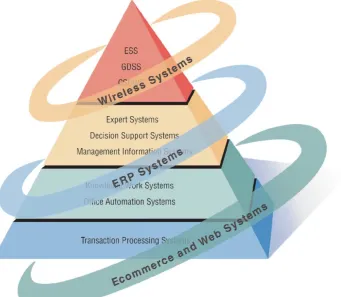
Transaction Processing Systems (TPS)
Office Automation Systems (OAS)
Knowledge Work Systems (KWS)
Management Information Systems (MIS)
Decision Support Systems (DSS)
Expert Systems (ES)
Executive Support Systems (ESS)
Group Decision Support Systems (GDSS)
Strategic
Level
Operational
Level
Knowledge
Level
Higher
Level
A systems analyst
Operational Level
Transaction Processing System (TPS)
Process large amounts of data for routine business
transactions
Boundary-spanning
Support the day-to-day operations of the company
Knowledge Level
Office Automation System (OAS)
Supports data workers who share information, but do not usually
create new knowledge
Examples: Word processing, Spreadsheets, Desktop publishing,
Electronic scheduling, Communication through voice mail, Email,
Video conferencing
Knowledge Work System (KWS)
Supports professional workers such as scientists, engineers, and
doctors
Higher Level
Management Information System (MIS)
Support a broad spectrum of organizational tasks including decision
analysis and decision making
Examples: profit margin by sales region, expenses vs. budgets
Decision Support System (DSS)
Aids decision makers in the making of decisions
Examples: financial planning with what-if analysis, budgeting with
modeling
Expert System (ES)
Captures and uses the knowledge of an expert for solving a
particular problem which leads to a conclusion or recommendation
Strategic Level
Executive Support System (ESS)
Helps executives to make unstructured strategic decisions in an
informed way
Examples: drill-down analysis, status access
Group Decision Support System (GDSS)
Permit group members to interact with electronic support
Examples: email, Lotus Notes
Computer-Supported Collaborative Work System (CSCWS)
CDCWS is a more general term of GDSS
Integrating New Technologies into
Traditional Systems
•
Ecommerce and Web Systems
•
Enterprise Resource Planning Systems
•
Wireless Systems
•
Open Source Software
Ecommerce and Web Systems
Benefits
Increasing user awareness of the availability of a
service, product, industry, person, or group
The possibility of 24-hour access for users
Improving the usefulness and usability of interface
design
Creating a system that can extend globally rather than
remain local, thus reaching people in remote locations
without worry of the time zone in which they are
Enterprise Resource Planning Systems
(ERP)
•
Performs integration of many information systems
existing on different management levels and within
different functions
Wireless Systems
System analyst may be asked to design standard or
wireless communication networks that integrate
voice, video and email into organizational intranets
or industry extranets
System analyst may also be asked to develop
intelligent agents
Example: Microsoft's new software based on
Bayesian statistics
Open Source Software
An alternative of traditional software development
where proprietary code is hidden from the users
Open source software is free to distribute, share
and modify
Characterized as a philosophy rather than simply
the process of creating new software
Need for Systems Analysis and Design
Installing a system without proper planning leads
to great user dissatisfaction and frequently causes
the system to fall into disuse
Lends structure to the analysis and design of
information systems
A series of processes systematically undertaken to
improve a business through the use of
Roles of the Systems Analyst
•
The analyst must be able to work with people of
all descriptions and be experienced in working
with computers
•
Three primary roles:
•
Consultant
•
Supporting Expert
Qualities of the Systems Analyst
•
Problem solver
•
Communicator
•
Strong personal and professional ethics
Systems Development Life Cycle
(SDLC)
•
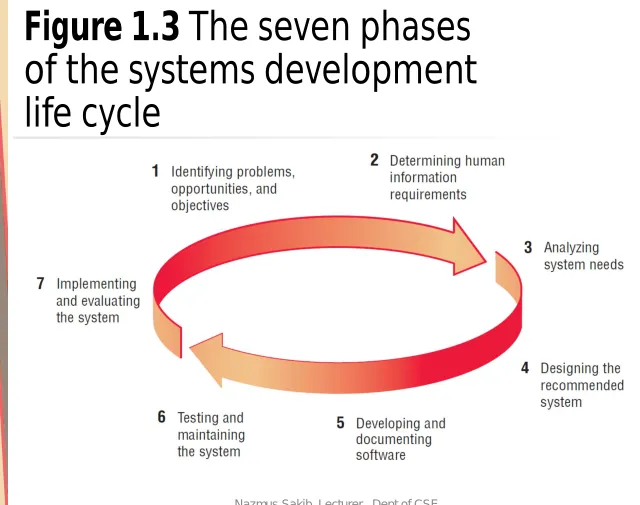
The systems development life cycle is a phased
approach to solving business problems
•
Developed through the use of a specific cycle of
analyst and user activities
Incorporating Human-Computer
Interaction (HCI) Considerations
•
The demand for analysts who are capable of
incorporating HCI into the systems development
process keeps increasing, as companies begin to
realize that the quality of systems and the quality of
work life can be improved by taking a
Identifying Problems, Opportunities,
and Objectives
Activity:
Interviewing user management
Summarizing the knowledge obtained
Estimating the scope of the project
Documenting the results
Output:
Feasibility report containing problem definition and
objective summaries from which management can make
a decision on whether to proceed with the proposed
Determining Human Information
Requirements
Activity:
Interviewing
Sampling and investing hard data
Questionnaires
Observe the decision maker’s behavior and environment
Prototyping
Learn the who, what, where, when, how, and why of the current
system
Output:
Analyst understands how users accomplish their work when
Analyzing System Needs
•
Activity:
•
Create data flow diagrams
•
Complete the data dictionary
•
Analyze the structured decisions made
•
Prepare and present the system proposal
•
Output:
Designing the Recommended System
•
Activity:
•
Design procedures for data entry
•
Design the human-computer interface
•
Design system controls
•
Design files and/or database
•
Design backup procedures
•
Output
Developing and Documenting
Software
Activity:
System analyst works with programmers to develop any original
software
Works with users to develop effective documentation
Programmers design, code, and remove syntactical errors from
computer programs
Document software with help files, procedure manuals, and
Web sites with Frequently Asked Questions
Output:
Computer programs
Testing and Maintaining the System
•
Activity:
•
Test the information system
•
System maintenance
•
Maintenance documentation
•
Output:
•
Problems, if any
•
Updated programs
Implementing and Evaluating the
System
•
Activity:
•
Train users
•
Analyst plans smooth conversion from old system to
new system
•
Review and evaluate system
•
Output:
•
Trained personnel
The Impact of Maintenance
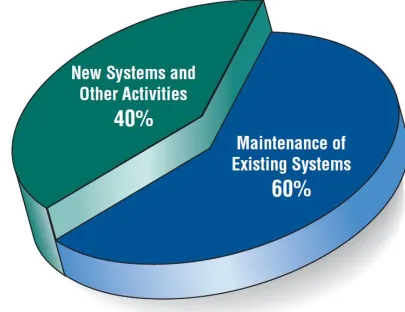
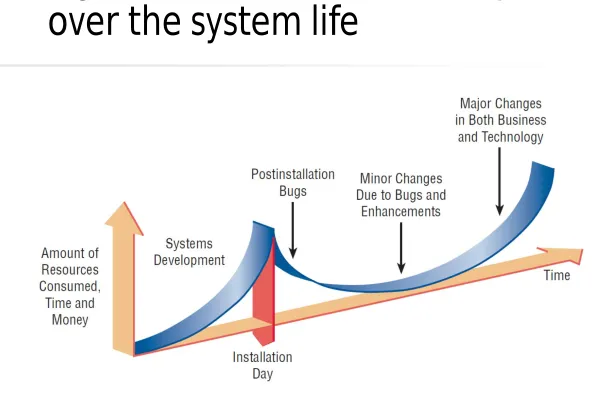
Maintenance is performed for two reasons
Removing software errors, and
Enhancing existing software
Over time the cost of continued maintenance
will be greater than that of creating an entirely
new system. At that point it becomes more
Approaches to Structured Analysis and Design and to
the Systems Development Life Cycle
•
Traditional systems development life
cycle
•
CASE systems development life cycle
•
Object-Oriented Systems Analysis and
Case Tools
CASE tools are productivity tools for systems
analysts that have been created explicitly to
improve their routine work through the use of
automated support
Reasons for using CASE tools
Increasing Analyst Productivity
Improving Analyst-User Communication
Case Tool Classifications
Upper CASE tools perform analysis and
design
Lower CASE tools generate programs
from CASE design
Integrated CASE tools perform both
Upper CASE Tools
Create and modify the system design
Help in modeling organizational
requirements and defining system
boundaries
Can also support prototyping of screen
Lower CASE Tools
•
Lower CASE tools generate computer
source code from the CASE design