Exploration of Wireless Sensor Network Based on
RSSI Positioning Algorithm
https://doi.org/10.3991/ijoe.v14i11.9519
Shuan Liu
Huanghuai University, Henan, China [email protected]
Abstract—Based on the security of the receiving signal strength indicator positioning algorithm, the RSSI positioning algorithm in the environment of witch attack, wormhole attack and replication attack has largely failed. Alt-hough existing security positioning algorithms can effectively prevent attacks from occurring, the massive consumption of network resources can’t be ig-nored. Therefore, a tolerable security positioning method is proposed for each of the three attacks in order to improve the security of positioning. According to the node's physical information, the attack node is detected. Through simulation experiments, compared with the traditional indoor security positioning method, the proposed algorithm can significantly reduce the intervention of witch attack, wormhole attack and replication attack on positioning error. While achieving the goal of combating attacks, it reduces the computational complexity, de-creases node energy consumption, and extends the network life cycle.
Keywords—RSSI positioning algorithm, prevention of attacks, network re-sources
1
Introduction
Wireless sensor network technology rises on the basis of the rapid development of wireless communication technology, microelectronics technology, and low-power embedded technology. The traditional sensor data acquisition mode shifts from a single mode to an integrated, networked mode. The wireless sensor network monitors the environmental information in the network distribution area in real time through the cooperation of micro-sensors and transmits it to the receiving end in a multi-hop self-organizing network. It has been widely used in fields such as location information navigation, security firefighting, medical security, defense military, and environmen-tal monitoring.
positioning requirements. However, in the interior of a building, the accuracy of the satellite positioning system is severely reduced and it is difficult to meet the applica-tion requirements. With the improvement of wireless communicaapplica-tion technology and information processing technology, indoor positioning technology relies more on parameter measurement and calculation to perform indoor positioning.
The existing localization algorithm defaults that the nodes are deployed in an envi-ronment without attacks and doesn’t consider the location of the nodes in the presence of malicious attacks. Sensor networks have been widely used in businesses and indus-tries that require data security. The monitoring and tampering of information and the resistance of heterogeneous node intrusions have gradually become an arduous and challenging problem. The focus of positioning technology is mainly on precision and energy consumption, and a very good result has achieved through the unremitting efforts of the predecessors. The security of positioning process data transmission has become a new hot spot in wireless sensor network positioning technology.
2
Literature review
The algorithm has high requirements on the density of beacon node and the relative positioning accuracy is 40%.
Tomic et al. (2017) proposed a WSN local space constrained problem based on a distributed localization method. It estimates the coordinates of an unknown node by iteratively solving a local space constrained program, and then the neighboring nodes are jointly updated to update the positioning error [1]. Nayak and Devulapalli (2016) proposed a cluster-based WSN localization algorithm that uses cluster structure and a global system to represent network distribution, reduces measurement error through multi-hop probability calculation, and improves node positioning accuracy [2]. Asaei et al. (2017) proposed a localization method based on perceptual sparse matrix, trans-forming the distribution of nodes into discrete regions of sparse matrices, and using greedy algorithms and deterministic monitoring matrices to reduce the number of measurements [3].
Sicari (2015) used a global single key to encrypt nodes in the TinSec positioning system. However, the key is the key to the security of the entire network. Once the key is stolen, the entire network is exposed to the enemy. The LEAP protocol adopts a complex key method. The heavy key management work increases the energy con-sumption of the system dramatically [4]. Devanagavi et al. (2016) proposed a secure routing protocol INSEN that can tolerate aggressiveness and solve the attack risk through cooperation between redundant routing and authentication mechanisms [5].
Ferng et al. (2016) proposed the LAD scheme to mark the abnormal beacon node during the positioning process and determine whether the estimated coordinate of the detection node is the same as or similar to its actual position. If the number of incon-sistent nodes exceeds a certain value, it is determined that there is an attack. But how to deal with exceptions, no solution is given [6]. Khairi et al. (2018) proposed a scheme to detect anomalies and delete the abnormal beacon node. By cancelling the scheme, the beacon nodes with abnormalities are isolated from the positioning calcu-lation. However, the pressure of the aggregation node and the base station is in-creased, and the calculation amount of algorithm and energy consumption are large [7].
The safety positioning system proposed by Cui (2017) is based on the gradient de-scent method and has a low computational complexity. Compared with the classic algorithms such as Newton method, greedy algorithm and particle swarm algorithm, the convergence speed is faster, the positioning accuracy is higher, and it is easy to implement on hardware. It is suitable for scenarios with high real-time requirements [8].
Many scholars have conducted in-depth research on positioning algorithms in sen-sor networks. Cui et al. (2017) used differential particle swarm algorithm to optimize the coordinates of unknown nodes and proposed to use percentages to correct the average hop distance between beaconing nodes in DV-Hop. Xin et al. (2015) used a quantitative model to represent the positioning error of the node, and then used a weighting factor to correct the relative position coordinates of the node. Teng (2014) proposed the integration of RSSI positioning method and centroid algorithm, and a beacon node weighting method is also proposed. The calculated amount and cost are relatively reduced, but the positioning accuracy is easily affected by RSSI. Chai (2016) proposed a four-side measurement positioning algorithm, which increases the amount of calculation on the basis of trilateration, but the positioning error of the node is reduced to some extent.
In summary, in addition to being able to effectively combat attacks, the security lo-cation algorithms for wireless sensor networks under malicious attacks should also fully consider the robustness of the network, traffic, and computation. Since the exist-ing sensor nodes carry the RSSI device by default, the RSSI-based positionexist-ing algo-rithm has become one of the most widely used positioning algoalgo-rithms. A secure loca-tion algorithm based on RSSI posiloca-tioning is proposed to combat witch attacks, worm-hole attacks, and replication attacks during RSSI positioning. Finally, through simula-tion experiments, in the specific indoor environment, the proposed security locasimula-tion algorithms corresponding three attacks are simulated to verify the effectiveness and low energy consumption of the algorithm.
3
The analysis of wireless sensor network positioning system
and security
3.1 The structure of wireless sensor network
Fig. 1. The architecture of wireless sensor network
In the WSN, there are different sensors in each node to sense and collect data in the monitoring area, and some nodes also have data processing capabilities. The purpose of use for the user is to collect information. Therefore, data-centricity is the main feature that distinguishes WSN from other types of networks.
The sensor node consists of two parts: software system and hardware system. The hardware system mainly includes four parts: energy supply module, communication module, processing module and data acquisition module. As shown in Figure 2, its main functions are as follows:
Fig. 2. The module structure of wireless sensor node
This module provides nodes with the energy to maintain the normal operation of the node. Miniature batteries are usually used. Designing an effective energy-saving positioning algorithm can reduce the energy loss and extend the life cycle of the net-work. It is the main research topic of WSN.
The data acquisition module consists of a sensor device and an A/D conversion module. The sensor collects the relevant data of the monitoring object, and the A/D conversion module converts the analog quantity into a digital signal. The processing module is mainly composed of a memory and a microprocessor and is responsible for executing a communication protocol and processing data. The embedded CPU pro-cessor is generally used. The communication unit is mainly responsible for communi-cation between nodes, including the sending, receiving, and exchanging of data be-tween nodes. The energy consumption of the communication unit is proportional to the distance. Different communication modules can be used depending on the dis-tance. Data fusion techniques can also be used to reduce network flow.
satellite Internet Mobile communication
network
Task management node
Aggregation node
target
surveyed area sensor node
sensor A/D
sensor module
processor storage processor module
network MAC transceiver
3.2 Analysis of node location technology in wireless sensor networks
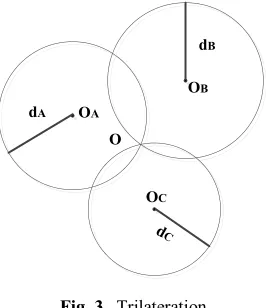
As shown in the schematic diagram of the trilateration method in Figure 3, O is the node to be measured. There are three nodes in the communication range: OA, OB, and OC. The coordinates are (xA, yA), (xB, yB), and (xC, yC). The distances from O are dA, dB, and dC, respectively. It assumes that the A coordinate is (x,y).
Fig. 3. Trilateration
According to the geometry of the circle there are:
. (1)
The coordinates of O from (1) are:
. (2)
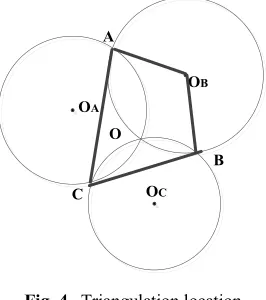
Triangulation calculates unknown node coordinates through the angle between beacon nodes. The principle is shown in Figure 4. D is the node to be measured, and A, B, and C are three beacon nodes in the D communication range, and the coordi-nates are (xA, yA), (xB, yB), (xC, yC), respectively. The angles of D to A, B, and C are ∠CDA, ∠BDA, and ∠CDB, respectively, and the coordinates of D are assumed
to be (x,y).
Fig. 4. Triangulation location
For the nodes A, B, and ∠ADB, the center coordinate of the circle is O(xo, yo),
and the circle of radius r is α=∠AOB:
. (3)
The coordinates of the circle O are calculated by the equations set. For A, C, ∠
ADC and B, C, and ∠CDB, O1 and O2 can also be calculated, and then the estimated
coordinates of the unknown node D can be calculated.
3.3 RSSI-based positioning algorithm
The RSSI-based wireless sensor network positioning algorithm is known for its low energy consumption, low cost and easy implementation, and it has been applied in many fields. The principle of RSSI ranging technology is to record the RSSI signal strength transmitted by the beacon node, calculate the loss of the signal in the medium propagation process according to the RSSI signal strength received by the measure-ment node, and finally use the appropriate signal propagation model and the loss of the signal in the propagation process to derive the distance. The RSSI value has cer-tain symmetry. When measuring the RSSI value between two nodes, only one mes-sage packet can be sent and received to complete the measurement. There is no need to send messages back and forth between the two nodes. The algorithm can be used when pursuing the low complexity of the positioning algorithm when the accuracy requirement of the algorithm is not high.
At present, there is no clear mathematical model for the relationship between path attenuation and distance. It is mainly a model based on a variety of data measurement values and a semi-empirical model. According to the actual work environment,
ent models are used. Whether the selected model can better simulate the wireless system also depends on the match between the environment and the model. The commonly used wireless signal propagation model is:
. (4)
In the formula, P(d) is the signal strength received by the node under test with a distance d from the beacon node, d represents the distance between the two nodes required, P(d0) represents the signal strength of the reference distance d0, and n is the path consumption index. The path consumption index depends on the environment, and X represents a Gaussian random variable with an average value of 0 added to reduce the influence of obstacles. The RSSI average of a certain distance is mainly obtained by collecting measured data, and then using the mean value to correct the propagation model of the area.
4
The improvement of RSSI positioning algorithm against
witch attack
Witch attacks are proposed in point-to-point networks. Attacking nodes claim that they have multiple identities, illegally existing in the network with multiple identities, participating in network communications and destroying redundancy mechanisms in distributed storage systems.
Witch attacks have the following two attack modes:
Direct communication: witch attack nodes communicate directly with legitimate nodes, send fake information to legitimate nodes, and reflect different identities at different times, thereby disrupting network communications.
Forged identity: an attacking node can forge multiple node identities and partici-pate in network communication. It allows legitimate nodes to think that there are multiple nodes around, which disrupts the message communication of legitimate nodes.
In the positioning process, if the unknown node receives multiple position mation from the same node, the positioning system will add all the position infor-mation to the position calculation, resulting in a great error in the positioning algo-rithm. The basis for the normal operation of the positioning system is the correspond-ence between the identity and the actual position. The witch attack is an attack against this correspondence.
It assumes that all nodes in the environment are stationary and all nodes are divid-ed into beacon nodes and unknown nodes. The node uses a simple, idealizdivid-ed radio communication model. In the process of RSSI positioning, the unknown node calcu-lates the distance to the beacon node with the attenuation model according to the de-gree of attenuation of the signal. It is assumed that only the node within the commu-nication range of the node can receive the position information of the node.
X
d
d
n
d
P
d
P
(
)
=
(
)
-
10
lg(
)
+
Since the RSSI ranging error is affected by the reflection of the signal in the medi-um, obstacles, multipath effects, etc., in the process of RSSI positioning, a method of averaging the multiple RSSI measurement values is adopted to eliminate the envi-ronmental factors on the positioning, but it also gives the witch attack an opportunity to attack. Witch attack can be divided into two parts: one ranging process and multi-ple ranging process.
Through the ratio of nodes receiving energy, it is detected that there is a witch at-tack in the network. All nodes with the same ratio of received energy are considered to be the virtual location information of the attacking node. These nodes are eliminat-ed from the positioning calculation, and the purpose of combating the witch attack is achieved.
Matlab2014a is used to simulate the algorithm and verify the effectiveness and low energy consumption of the algorithm. The simulation environment is designed on a hypothetical manufacturing shop with 100 randomly distributed sensor termination nodes. The workshop is a 100m*100m area, and the area is divided into 20m*20m grids according to the distribution of equipment. Because the indoor sensor beacon nodes can be deployed, the beacon nodes are arranged in the center of the grid in the simulation.
For better simulation experiments, the replication attack nodes are also randomly distributed in the area. The average positioning error formula is:
. (5)
In the formula, N is the number of unknown nodes, R is the communication radius of the radio frequency, x is the actual value of the node to be measured, and y is the measurement value of the unknown node. For each case, 100 independent repeat ex-periments are performed and the average of 100 test results is taken as the final exper-imental result.
In the above experimental environment, the impact of replication attacks on the av-erage positioning error is analyzed through simulation experiments: simulation exper-iments are performed on the positioning error under normal environment and the positioning error under the threat of witch attack.
R
N
y
y
x
x
error
N
i
i i i
i
´
-+
-=
å
=12 1 2
1
)
(
)
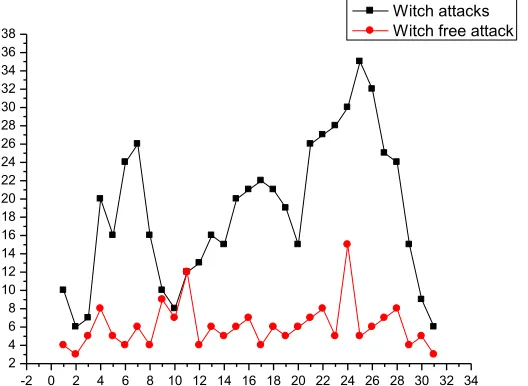
Fig. 5. Effect of witch attack on error
As shown in Figure 5, when there are two Witch attack nodes, after positioning, 31 nodes with larger errors are selected, o is the positioning error of 31 nodes when there is no attack, and □ is the positioning error of 31 nodes when there is a witch attack. It
can be concluded from the figure that the witch attack has a great influence on the positioning error. Under normal circumstances, the node positioning error is main-tained within 8m, and the positioning error of individual nodes is around 10m. In the attack, the positioning error of most nodes has reached 15m-30m, and even the posi-tioning error of individual nodes has reached more than 35m, and the posiposi-tioning algorithm has basically failed.
Through learning and researching various security location algorithms, the attack principle of witch attack is analyzed, and a security positioning mechanism that uses the physical characteristics of nodes to defend against witch attacks is proposed: in the one-ranging phase and multiple-ranging phases of the RSSI positioning, ratios are used to filter the witch attack nodes to achieve the purpose of combating witch attacks and reducing RSSI positioning errors. In the following simulation experiments, the meaning of this algorithm is discussed in terms of the impact of witch attack on posi-tioning, the effectiveness of the algorithm in this chapter, and the low energy con-sumption of the essential algorithm.
-2 0 2 4 6 8 10 12 14 16 18 20 22 24 26 28 30 32 34 2
4 6 8 10 12 14 16 18 20 22 24 26 28 30 32 34 36 38
5
The improvement of RSSI positioning algorithm under
replication attacks
Replication attack is one of the most destructive attacks in wireless sensor net-works. It means that the attacker captures the node and copies a large number of at-tacking nodes with the same legal identity. The replication attack carries the same information as the captured node. The attacker places attack nodes in the network and participates in network communications. Once a replication attack is initiated, the performance of the WSN's location system, routing system, etc. will be drastically reduced due to the wrong location information and routing information. If the attacker replicates the unknown node, the copied node will not carry the position information, or the carried position information will be covered by the next positioning data and will not affect the positioning result. If the attacker replicates the beacon node, the attacking node will directly participate in the positioning, and the surrounding un-known nodes will use the location information as an important basis for positioning. Therefore, only the situation where the attacker replicates the beaconing node is con-sidered in this chapter.
When the distance between two attacking nodes is greater than 2R, no node exists in the communication range of the two attacking nodes at the same time. According to the physical property of RSSI, when the location information carried by a node and the real location correspond to each other, any node can’t communicate with a node outside its RSSI communication range.
This brings about the limited characteristics of the communication range.
. (6)
Under normal circumstances, the limited characteristics of the communication range will not be violated, but when the node is subject to a replication attack, if there are no two replication attack nodes in the communication range of the same node, the limited characteristics of the communication range will be violated. As shown in Figure 4.1, C1 and C2 are replication attack nodes. The distance between C1 and C2 is greater than 2R. Assuming that all carry the coordinates of C1, then according to the position information carried by C2 to calculate the distance d between C2 and B, d must be greater than the communication radius R of B, which violates the limited characteristic of the communication range.
When there is a distance between two attacking nodes is less than 2R, the nodes in the network will not receive two or more messages from the same node. If two repli-cation attack nodes exist within the communirepli-cation range of a certain node at the same time, according to the physical property of RSSI, when the location information carried by the node and the real location correspond to each other, one node can only receive information from the same node once.
Compared with other detection IP algorithms, this algorithm can not only detect the replication attack node, but also detect the legitimate node being copied, thereby reducing the misjudgment rate of the algorithm and better protecting the robustness of
R
y
y
x
x
i)
2(
i)
2!
-the WSN network. After -the WSN node is initialized, it detects -the unique characteris-tics of the received message. If a replication attack node is found, it will be immedi-ately deleted from the positioning calculation; after that, the location information is calculated, it is checked whether or not the limited characteristics of the communica-tion range are violated. If a replicacommunica-tion attack node is found, it is immediately deleted from the location calculation. As long as one of the two characteristics is violated, the existence of a replication attack can be determined. Finally, normal RSSI positioning calculations are performed.
Communication radius R of radio frequency is 50m, and the experimental path loss coefficient n is set to 3. For better simulation experiments, replication attack nodes are also randomly distributed within the area. The average positioning error formula is:
. (7)
By learning and studying various security location algorithms and analyzing the at-tack principle of replication atat-tacks, a security location mechanism that uses the phys-ical characteristics of nodes to protect against replication attacks is proposed: the limited characteristics of the communication distance, the unique characteristics of the received message. In the following simulation experiments, the significance of this algorithm is discussed in three aspects: the impact of the replication attack on the positioning, the effectiveness of the algorithm in this chapter, and the low energy consumption of the essential algorithm.
6
Improvement of RSSI positioning algorithm in wormhole
attacks
Wormhole attacks are mainly directed to defensive routing protocols in the net-work. A dedicated channel is established between malicious nodes. The attacker rec-ords information sent by eavesdropping nodes and passes the received information to another accomplice node over the private channel. In general, this dedicated channel has low delay and high quality characteristics, making the link easier to participate in network communications. It can be concluded that although the two attacking nodes can’t theoretically communicate, in reality, the data can be transmitted and the wrong location information can be sent, thereby affecting the positioning error.
When the distance between the attacking node and the unknown node is greater than 2R, the attacking node and the unknown node can’t have a communication rela-tionship in principle and can’t transmit position information to each other. According to the physical property of RSSI, when the location information carried by a node and the real location correspond to each other, any node can’t communicate with a node outside its RSSI communication range.
R
N
y
y
x
x
error
N
i
i i i
i
´
-+
-=
å
=12 1 2
1
)
(
)
. (8)
Under normal circumstances, it is impossible for a node in the network to com-municate with nodes outside its RSSI communication range. As shown in Figure 5.2, R is the RSSI communication radius of the node. The distance between B2 and B3 is obviously greater than 2R. There is no communication relationship. B3 can’t receive the message packet from B2. If there are wormhole attack nodes W1 and W2 in the network, the attack node W1 listens to the message sent by the beacon node B2 and sends it to the attack node W2 through the private link, and W2 immediately broad-casts the message packet from the W1. At this time, B3 received a message from B2. B3 and B2 generated a communication relationship that should not exist, which vio-lated the restricted characteristic of the communication range.
The security location algorithm that resists the wormhole attack is studied, and the attack principle of wormhole attack and several methods to fight wormhole attack are described. An attack method based on RSSI positioning is proposed, and the restricted characteristics, the message restricted characteristics, and the uniqueness of received messages are proposed in the communication range. Through the simulation experi-ments, the effectiveness and low energy consumption of the algorithm are verified, which can effectively reduce the impact of wormhole attack on positioning while improving the positioning accuracy.
7
Conclusion
Node location technology is a key technology in WSN applications and has been widely applied in various fields of people's daily life. Currently existing localization algorithms have defaulted nodes deployed in an environment without attacks and don’t consider the location of nodes in the presence of malicious attacks. In times of peace, large-scale wars have moved away from us. Urban operations such as fighting terrorism and rescuing hostages have become major battlefields. If the sensor network in the building is infringed by terrorists, the implementation of network attacks and disruption of network communications will bring great misdirection to the combat-ants. The resistance to the eavesdropping and tampering of information and the intru-sion of heterogeneous nodes has gradually become a challenging research. Therefore, some improvements are proposed in the traditional positioning algorithm. The im-proved algorithm can effectively fight witch attack, copy attack and wormhole attack, and achieve the purpose of security on the basis of positioning.
8
References
[1]Tomic S, Beko M, Dinis R. (2017). Distributed algorithm for target localization in wireless sensor networks using RSS and AoA measurements. Pervasive and Mobile Computing, 37: 63-77. https://doi.org/10.1016/j.pmcj.2016.09.013
R
y
y
x
x
i)
2(
i)
2!
-[2]Nayak P, Devulapalli A. (2016). A fuzzy logic-based clustering algorithm for WSN to ex-tend the network lifetime. IEEE sensors journal, 16(1): 137-144. https://doi.org/10.1109/ JSEN.2015.2472970
[3]Asaei A, Bourlard H, Taghizadeh M J. (2016). Computational methods for under-determined convolutive speech localization and separation via model-based sparse compo-nent analysis. Speech Communication, 76: 201-217. https://doi.org/10.1016/j.spe com.2015.07.002
[4]Sicari S, Rizzardi A, Grieco L A. (2015). Security, privacy and trust in Internet of Things: The road ahead. Computer networks, 76: 146-164. https://doi.org/10.1016/j.com net.2014.11.008
[5]Devanagavi G D, Nalini N, Biradar R C. (2016). Secured routing in wireless sen-sor net-works using fault-free and trusted nodes. International Journal of Communi-cation Sys-tems, 29(1): 170-193. https://doi.org/10.1002/dac.2810
[6]Ferng, H. W., & Khoa, N. M. (2016). On security of wireless sensor networks: a data au-thentication protocol using digital signature. Wireless Networks, 23(4): 1-19.
[7]Khairi M H H, Ariffin S H S, Latiff N M A. (2018). A Review of Anomaly Detec-tion Techniques and Distributed Denial of Service (DDoS) on Software Defined Net-work (SDN). Engineering, Technology & Applied Science Research, 8(2): 2724-2730.
[8]Cui Z, Sun B, Wang G. (2017). A novel oriented cuckoo search algorithm to im-prove DV-Hop performance for cyber–physical systems. Journal of Parallel and Dis-tributed Computing, 103: 42-52 https://doi.org/10.1016/j.jpdc.2016.10.011
9
Authors
Shuan Liu works as associate professor at School of Information Engineering, Huanghuai University, Henan, China