Path Planning for Unmanned Underwater Vehicle Based
on Improved Particle Swarm Optimization Method
https://doi.org/10.3991/ijoe.v14i12.9227
Jianhua Xu
Northwestern Polytechnical University, Xi’an, Shaanxi, China Sanjiang University, Nanjing, Jiangsu, China
Hao Gu
Northwestern Polytechnical University, Xi’an, Shaanxi, China
Hongtao Liang(*)
Shaanxi Normal University, Xi’an, Shaanxi, China
Abstract—Path planning of Unmanned Underwater Vehicle (UUV) is of con-siderable significance for the underwater navigation, the objective of the path planning is to find an optimal collision-free and the shortest trajectory from the start to the destination. In this paper, a new improved particle swarm optimization (IPSO) was proposed to process the global path planning in a static underwater environment for UUV. Firstly, the path planning principle for UUV was estab-lished, in which three cost functions, path length, exclusion potential field be-tween the UUV and obstacle, and attraction potential field bebe-tween UUV and destination, were considered and developed as an optimization objective. Then, on the basis of analysis traditional particle swarm optimization (PSO), the time-varying acceleration coefficients and slowly time-varying function were employed to improve performance of PSO, time-varying acceleration coefficients was utilized to balance the local optimum and global optimum, and slowly varying function was introduced into the updating formula of PSO to expand search space and maintain particle diversity. Finally, numerical simulations verify that, the pro-posed approach can fulfill path planning problems for UUV successfully.
Keywords—Unmanned Underwater Vehicle, path planning, PSO, time-varying acceleration coefficient, slowly varying function
1
Introduction
collision-free and the shortest trajectory from the start to the destination without hitting with any of the obstacles in underwater environment.
Generally, path planning problem can be classified into two categories: local path planning (LPP) and global path planning (GPP) [11,12]. LPP mainly relies on the un-known or partially un-known environmental information that is obtained from the acoustic sensors, such as forward-looking sonar. In dealing with the LPP problem, some ap-proaches have been applied, such as artificial potential field method [13], fuzzy logic algorithm [14], and the rolling windows method [15]. However, those methods always exists some significant problems such as high computational cost, ineffective in path planning when the underwater space is large, and even deadlock phenomenon.
GPP as the other approach has been widely put forward, which can be formulated as a constrained optimization problem that is a non-deterministic polynomial hard prob-lem with high computational complexity. Recent decades, numerous GPP approaches have been proposed such as diagrams algorithm and visibility graphs, especially global evolutionary algorithms [6,8,11,16-18]. The evolutionary algorithms compared with others GPP methods have advantages: easy implementation, strong capacity of global search, fast convergence rate and good robustness. Generally, there are some useful evolutionary algorithms [16] has been developed such as the heuristic A-star algorithm, genetic algorithm, ant colony algorithm, differential evolution, and obtained some great achievements.
Among those algorithm, PSO [6,16,19] as a global evolutionary algorithm is inspired by the behaviors of stochastic swarm such as flocks of birds and schools of fish, which mainly uses the swarm intelligent to achieve the goal of optimization. PSO has been applied to many domains with good performance such as system identification, neural networks and system control because of its characteristics of swarm intelligence, intrin-sic parallelism, and inexpensive computational. However, Due to a few adjustable pa-rameters such as population size, inertia weight and acceleration coefficients, PSO suf-fered from the premature convergence and trapping in local optimum problem, and even lack of population diversity. Several improved PSO algorithms, such as PSO-linearly inertia weight, PSO-fuzzy inertia weight and PSO-nonlinear inertia weight, had been proposed [8,19]. At present those methods have obtained with a certain perfor-mance improvement, but convergence and scarce exploration was also the frequent problems in the application process.
2
Formulation and Principle of Global Path Planning for UUV
The goal of path planning for UUV is to find an optimal collision free and the short-est trajectory path to avoid obstacles between the start and the dshort-estination with in an unknown underwater environment. To clear illustrate the path planning problem for UUV, this section presents formulation and principle of global path planning for UUV.
2.1 UUV Modeling and Environment Modeling
To clearly demonstrate path planning for UUV, UUV modeling and environmental modeling are developed by three assumptions, which are shown as following.
(1) UUV model is simplified as a particle description, and its kinematic model is demonstrated as:
(1)
where denotes the position of the UUV. denotes the heading, and denotes the velocity.
(2) The UUV system moves on a two-dimensional space, and the motion region can be expressed by finite convex polygons, in which there are finite number of unknown static obstacles. The UUV sensor system can determine the position of the obstacle by the perceived obstacle information and estimate the obstacle size, but limited scope of perception. The detection range of UUV sensor system is a circular area with radius r.
(3) The obstacle is depicted as the circle, which is subjected to a corresponding puff-ing process accordpuff-ing to the actual dimensions and safety requirements of the UUV, that is, the radius of the obstacle includes its own radius and the radius of rotation of the UUV. Also, the obstacle boundary is a safe area.
2.2 Cost Function Modeling
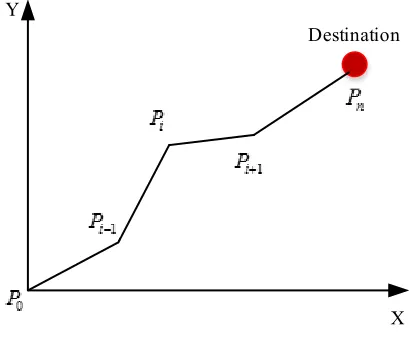
It is very important to select a fitness function to evaluate the path individual. The tradition method of cost function generally considers the path length, which is shown as Fig.1.
cos
sin
x v
y v
q
q
q w
ì
=
ï
=
í
ï
=
î
!
!
!
Fig. 1. Cost Function of Path Length
In Fig.1, and respectively denote the starting point and des-tination point coordinates for UUV planning, and denotes i-th path point, . To simplify the planning process, UUV searches the path point by the fixed step length S. Thus, cost function can be calculated as follow
(2)
where denotes the length between the point and .
According to the Eq.(2), the path planning of UUV can be converted to find the shortest path, however the constraint, whether the line between point and ap-pear in the obstacles region, is not considered, which can only be judged by the algo-rithm itself and increased the complexity of algoalgo-rithm design and computation.
In order to overcome the above shortcoming, wo consider the attractive and repulsive fields as the other factors according to potential field theory, in which every search step onley need to find the best heading angle [6].
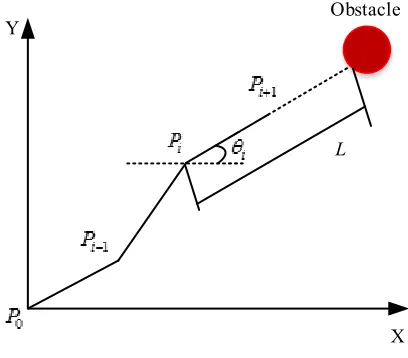
(1). Cost function of repulsive potential field in avoiding obstacle. In underwater environment, there exists some static obstacle, which is shown as Fig.2.
X Y
Destination
0
( , )
0 0P x y
P x y
d( , )
d d( , )
i i i
P x y
1,2, ,
i
=
×××
n
( , )
i i i
P x y
1
0 i i
n
l P P
i
f
L L
+=
=
å
1 i i
P P
L L
+P
iP
i+1i
P
P
i+1Fig. 2. Cost Function of repulsive Potential Field
In Fig.2, denotes the positon at i-th point, denotes the candidate position at i+1 point, and L denotes the distance between the i-th point and obstacle at the heading angle . So, the cost function of avoiding obstacle can be defined as
(3)
where S denotes the step length. At the heading angle , if the distance between UUV and obstacle is larger, the cost function is greater, otherwise the cost function is smaller.
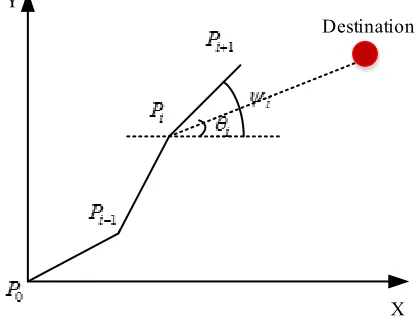
(2). Cost Function of attractive potential field to the destination. According to the potential field theory, there is an attractive potential field existing between the UUV and destination, so attraction potential field between them is shown as Fig.3.
X Y
L Obstacle
i
P
P
i+1i
q
( )
o i
f
=
S L
q
i
Fig. 3. Cost Function of attractive Potential Field
In Fig.3, denotes the angle between the current point and the destination point , and denotes the heading angle between the candidate point and destina-tion point . If attractive potential field obey the normal distribution, the cost function of attractive potential field to the destination can be defined as
(4)
where is parameter of normal distribution.
Then, the cost function of attractive and repulsive fields can be calculated as
, (5)
where and are the weight coefficient.
Finally, according to the Eq.(2)and Eq.(5), total cost function of the path planning for UUV can be calculated as
, (6)
where and are the weight coefficient.
Based on the above analysis, the cost function of path planning at the current path point is established for UUV, the IPSO is used to search the trajectory of the cost func-tion that obtains the minimum value of path point. And searched point can be taken as optimal path point at the next navigation path.
X Y
Destination
i
q
P
id
P
y
iP
i+1d
P
2 2
( ) 2
1
2
df
e
y qsps
-=
s
p o o d d
f
=
k f
-
k f
k
o>
0,
k
d>
0
o
k
k
dl l p p
f w f w f
=
+
w
l>
0,
w
p>
0
l
3
Improved PSO algorithm
In PSO, there exists two questions falling into local minima and lack of diversity of particles in practical application. How to solve the questions has attracted some atten-tion. Therefore, we propose a novel Improved PSO (IPSO) with the purpose of increas-ing performance in this paper. In IPSO, time-varyincreas-ing acceleration coefficients and slowly varying function were employed, time-varying acceleration coefficients is uti-lized to balance the local optimum and global optimum, and slowly varying function is introduced into the updating formula of PSO to expand search space and maintain par-ticle diversity.
3.1 Time-Varying Acceleration Coefficients
Acceleration coefficients determines the cognitive experience of particle and social experience of all particle in the search of swarm trajectory. That is, the larger c1 is, the more is the attraction of particle toward its own personal best, therefore the more ex-plorative capability. In contrast, the larger c2 is, the more is the attraction of particles toward swarm global best, therefore the more exploitative capability. Therefore, the appropriate balance of the control learning factors c1 and c2 is very important to find the optimal solution accurately and efficiently.
Ideally, at the early stages of the optimization processing, particles should be focus more on exploration of region of search space in hope of finding the region included global optimum. And at the later of the optimization processing, particles should be focus more on exploitative and converge towards the global optimum. Therefore, to meet the requirement of ideal acceleration coefficients, c1 and c2 are updated in a way that the cognitive part is reduced and social part is increased along iteration process. So, a new time-varying acceleration coefficients is employed to enhance exploration and exploitation of particle towards optimal solution, which are defined as [20,21]
(11)
(12)
(13)
where c1,ini and c2,ini are the initial values of cognitive factor and social factor respectively, c1,fin, and c2,fin are the final values of cognitive factor and social factor respectively. as the adding part in Eq.(7) is utilized to converge to a better solution due to the fact that the best solution in the k iteration. Therefore, the velocity and position of the particles are updated as:
1,fin 1,ini 1 1,ini
(c c )
c c k
K
-= +
2,fin 2,ini 2 2,ini
(c c )
c c k
K
-= +
2
( ) 3 1 (1 c k )
c =c ´ -e- ´
3
c
(14)
(15)
where is a random number in the interval of [0,1], similar to the r1 and r2.
3.2 Maintain particle diversity based on Slowly-Varying Function
In order to maintain swarm diversity of and expand search space, slowly-varying function is introduced into the updating formula of PSO algorithm [19,22].
Definition1: Given function l(x), and a>0, there exists l(x)>0 in , if is monotone increasing and is monotone decreasing, then l(x) is called as the slowly varying function(SVF).
Definition2: Given SVF l(x), and a>0, in , is defined as regular varying function (RVF).
RVF is employed to use in early-stage in PSO optimization because of the fact that PSO need better global optimization ability in the early-stage. The update formulates are calculated as
(16)
(17)
where is the control parameter.
SVF is employed to use in later-stage in PSO optimization because of the fact that algorithm needs precise local searching ability. The update formulates are calculated as
(18)
(19)
SVF had been proved convergence. So, in this paper, we select a slowly varying function with increasing speed and disturbance relatively faster, it is shown as [19]
(20)
where is the control factor.
1
1 1
(
)
2 2(
)
3 3(C
)
iD iD iD iD
k k k k k k k k
iD best best best
V
+=
wv
+
c r P
-
x
+
c r G
-
x
+
c r
-
x
1 1
iD iD iD
k k k
x
+=
x V
+
+3
r
0
d
" >
[ ,
a
+¥
)
( )
x l x
dx l x
-d( )
0
d
" >
[ ,
a
+¥
)
x l x
d( )
1
1 1
(
)
2 2(
)
3 3(C
)
iD iD iD iD
k k k k k k k k
iD best best best
V
+=
wv
+
c r P
-
x
+
c r G
-
x
+
c r
-
x
1 1
( )
iD iD iD
k k k
x
+=
x V
+
++
x l x
dd
1
1 1
(
)
2 2(
)
3 3(C
)
iD iD iD iD
k k k k k k k k
iD best best best
V
+=
wv
+
c r P
-
x
+
c r G
-
x
+
c r
-
x
1 1
( )
iD iD iD
k k k
x
+=
x V
+
++
l x
( ) (10ln )
l x
=
x
g3.3 Algorithm description
Based on the above analysis and discussion, solution procedures of the proposed method are summarized as follows:
Step1: Initialize the related parameters such as the size of the population M, learning factors c1, c2 and c3, maximum number of iterations K. initial values of cognitive co-efficient c1,ini and c2,ini, final values of cognitive coco-efficient c1,fin, and c2,fin.
Step2: Initialize the particles' velocities V0 and positions X0. optimal solution of individual particle Pbest(0) and particle population optimal solution Gbest(0), and par-ticle best solution iteration Cbest(0).
Step3: At k=K, calculate time-varying acceleration coefficients c1, c2 and c3 ac-cording to Eq.(11)- Eq.(13).
Step4: Calculate nonlinear inertia weight according to Eq.(10). If nonlinear inertia weight is equal to the 0.5, then turn to Step5, and If nonlinear inertia weight is smaller than 0,5, then turn to Step6, other then turn to Step7.
Step5: Update particles' velocities Vk and positions Xk according to Eq.(14)-(15), then turn to Step8.
Step6: Update particles velocities Vk and positions Xk based on regular varying function according to Eq.(16)-(17), then turn to Step8.
Step7: Update particles velocities Vk and positions Xk based on slowly varying function according to Eq.(18)-(19), then turn to Step8.
Step8: calculate cost function in Eq.(6), and update the optimal solution of indi-vidual particle Pbest, particle population optimal solution Gbest, and particle best solu-tion in the k iterasolu-tion Cbest.
Step9: If the termination criterion is satisfied, export result of the algorithm, and iteration is equal to maximum number K, stop the algorithm. Otherwise, k=k+1, go back to Step3.
4
Simulation Experiment Analysis
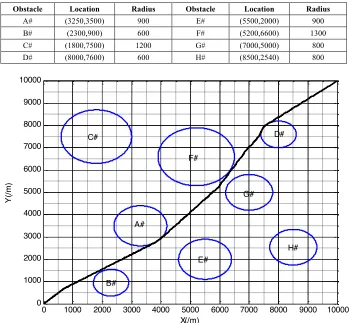
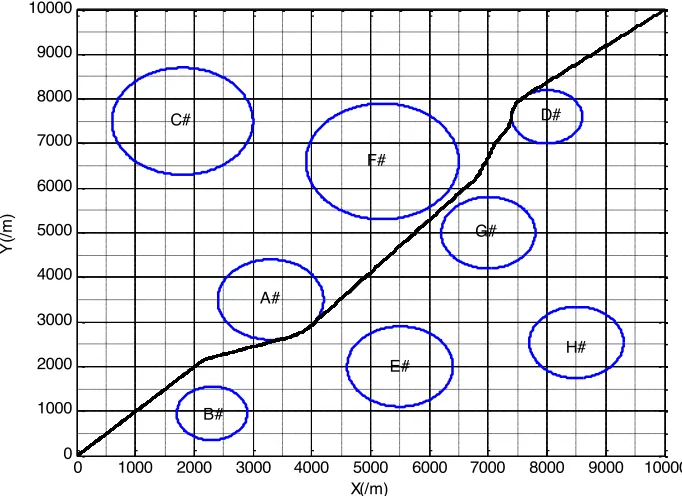
To verify the correctness and validity of the proposed IPSO for UUV path planning, a representative scenario simulation is implemented in this paper. Assume that the UUV avoids underwater static obstacles to reach the destination. Simulation environment is a 10000(m)×10000(m) underwater space, there have eight randomly obstacles in space, which is described as circular area (A#,B#,C#,D#,E#,F#,G#,H#), and the location and radius are described as Table 1. Moreover, the size of the UUV is a circle, movement velocity is set as 2.5 m/s, the initial heading is set as , and the sensor ranger is set as 1000 m, the starting and destination are located at (0,0) and (10000,10000), re-spectively. The IPSO parameters are setting as population M=200, maximum number
of iterations K=200, maximum weight and minimum weight .The
simulation experiment is designed by using the MATLAB on PC computer, and the configuration is Intel(R) Core™ i7 CPU3.40GHz, 8.0G RAM memory. The path
plan-f
45
q
=
!max
10
As shown in Fig.5-Fig.6, the path planning of the proposed IPSO can avoid the static underwater obstacles successfully from the start to the destination, and the path is much smoother compared with PSO. That is because that the IPSO can converge faster to the global optimum and avoid falling into local optimum in the iterative process. In order to verity the better performance of the proposed method in path planning for UUV, the experiment is testified by Monte Carlo simulation of 100 times by the performance indicators: path length and run time under the same condition. The statistical results quantitative indicators of IPSO and PSO are shown in Table 2.
Table 1. The location and radius of obstacles
Obstacle Location Radius Obstacle Location Radius
A# (3250,3500) 900 E# (5500,2000) 900
B# (2300,900) 600 F# (5200,6600) 1300
C# (1800,7500) 1200 G# (7000,5000) 800
D# (8000,7600) 600 H# (8500,2540) 800
Fig. 4. Path planning trajectory of IPSO
0 1000 2000 3000 4000 5000 6000 7000 8000 9000 10000 0
1000 2000 3000 4000 5000 6000 7000 8000 9000 10000
A#
B#
C# D#
E# F#
G#
H#
X(/m)
Y(/
m
Fig. 5. Path planning trajectory of PSO
Table 2. Comparison results on path length and run time Methods Path Length Run Time
PSO 16142(m) 6456.8(s)
IPSO 14980(m) 5992.0(s)
As can be seen from Table 2, it is reported that path length and run time with our proposed method reduces respectively by all 7.2% compared with PSO under the same simulation condition. Obviously, the proposed IPSO has a better performance in path planning for UUV.
5
Conclusions and Future Work
The path planning of UUV is one of challenging problem, because it is a foundation to ensure safe and efficient completion of underwater complex tasks. In this paper, a new improved particle swarm optimization (IPSO) is proposed to find a collision-free and the shortest path from a start to a destination without hitting with any of the obsta-cle. There are several contributions in this method as follows: (1) path planning princi-ple for UUV is established, in which three cost functions, path length, attractive and repulsive fields are developed as an optimization objective. And (2) time-varying
ac-0 1000 2000 3000 4000 5000 6000 7000 8000 9000 10000 0
1000 2000 3000 4000 5000 6000 7000 8000 9000 10000
A#
B#
C# D#
E# F#
G#
H#
X(/m)
Y(/
m
performance of IPSO. To verify the feasibility and effectiveness of proposed method, compared experiment has been established. Simulation results demonstrate that the IPSO can effectively fulfill path planning for UUV. Our future work will focus on the exact application of our proposed method in re-planning and navigation controller de-sign, and multiple UUV formation coordinated control is also another hot issue in this field.
6
Acknowledgment
The work was sponsored by Qing Lan Project of Jiangsu Province.
7
Reference
[1]A. Spears, M. West, M. Meister, J. Buffo, C. Walker, T.R. Collins, A. Howard, B. Schmidt, Under ice in Antarctica: the Icefin unmanned underwater vehicle develop-ment and deploy-ment, IEEE Robotics & Automation Magazine, 23(4):30-41, 2016. https://doi.org/10.1109/ MRA.2016.2578858
[2]H.T. Liang, F.J. Kang, Tracking UUV based on interacting multiple model unscented parti-cle filter with multi-sensor information fusion, Optik, 126(24):5067-5073,2015.
https://doi.org/10.1016/j.ijleo.2015.09.062
[3]F. Valentinis, A. Donaire, T. Perez, Energy-based motion control of a slender hull un-manned underwater vehicle, Ocean Engineering, 104:604-616, 2015.
https://doi.org/10.1016/j.oceaneng.2015.05.014
[4]K.L. Davies, R.M. Moore, Unmanned underwater vehicle fuel cell energy/power sys-tem technology assessment, IEEE Journal of Oceanic Engineering, 32(2):365-372, 2007.
https://doi.org/10.1109/JOE.2007.893690
[5]M.B. Loc, H.S. Choi, S.S. You, T.N. Huy, Time optimal trajectory design for unmanned underwater vehicle, Ocean Engineering, 89:69-81, 2014. https://doi.org/10.1016/j.ocean eng.2014.06.019
[6]Z.P. Yan,C. Deng, Y.F. Zhao, B.Y. Li, Path planning method for UUV near sea bot-tom, Journal of Harbin Engineering University, 35(3):307-312,2014.
[7]T. Phanthong, T. Maki, T. Ura, T. Sakamaki, P. Aiyarak, Application of A* algorithm for real-time path re-planning of an unmanned surface vehicle avoiding underwater obstacles, Journal of Marine Science and Application,13(1):105-116,2014. https://doi.org/10.1007/ s11804-014-1224-3
[8]X.Z. Jia, K.S. Liu, M. Zhang, C. Deng, D. Shan, Potential Field Method for Unmanned Underwater Vehicle Path-planning, Computer Measurement & Control, 27(1): 144-148, 2017.
[9]B. Sun, D.Q. Zhu, Y.Y. Yang, Fuzzy path planning for autonomous underwater vehi-cles based on particle swarm optimization, Chinese High Technology Letters, 23(12):1284-1291,2013.
[10]Z.W. Wen, W.J. Cai, C.W. Yang, Three-dimensional Path Planning Method Based on Im-proved Ant Colony Algorithm for UUV, Torpedo Technology, 24(2):120-125, 2016. [11]N.Y. Zeng, H. Zhang, Y.P. Chen, B.Q. Chen, Y.R. Liu, Path planning for intelligent ro-bot
[12]E. Peymani, T.I. Fossen, Path following of underwater robots using Lagrange multipli-ers, Robotics and Autonomous Systems, 67:44-52, 2015. https://doi.org/10.1016/j.ro-bot.2014.10.011
[13]M. Fakoor, A. Kosari, M. Jafarzadeh, Revision on fuzzy artificial potential field for human-oid robot path planning in unknown environment, International Journal of Advanced Mech-atronic Systems, 6(4):174-183, 2015. https://doi.org/10.1504/IJAMECHS.2015.072707
[14]C.J. Huang, Y.W. Wang, H.M. Chen, H.W. Tsai, J.J. Jian, A.L. Cheng, J.J. Liao, Appli-cation of cellular automata and type-2 fuzzy logic to dynamic vehicle path planning, Applied Soft Computing, 19:333-342, 2014. https://doi.org/10.1016/j.asoc.2014.02.023
[15]G. Loianno, C. Brunner, G. McGrath, V. Kumar, Estimation, Control, and Planning for Ag-gressive Flight with a Small Quadrotor with a Single Camera and IMU, IEEE Ro-botics and Automation Letters, 2(2):404-411,2017.
[16]E.G. Tsardoulias, A. Iliakopoulou, A. Kargakos, L. Petrou, A review of global path planning methods for occupancy grid maps regardless of obstacle density, Journal of Intelligent & Robotic Systems, 84(1-4):829-858,2016. https://doi.org/10.1007/s10846-016-0362-z
[17]T. Chi, K. Fallahi, H. Leung, C.K. Tse, A Genetic Algorithm-Inspired UUV Path Plan-ner Based on Dynamic Programming, IEEE Transactions on Systems, Man and Cyber-netics, Part C, 42(6):1128-1134, 2012.
[18]J. Kok, L.F. Gonzalez, N. Kelson, FPGA implementation of an evolutionary algorithm for autonomous unmanned aerial vehicle on-board path planning, IEEE Transactions on Evolu-tionary Computation, 17(2):272-281,2013. https://doi.org/10.1109/TEVC.2012.2192124
[19]H.T. Liang, F.J Kang, Adaptive mutation particle swarm algorithm with dynamic non-linear changed inertia weight, Optik,127(19): 8036-8042,2016. https://doi.org/10.1016/j.ijleo. 2016.06.002
[20]B. Mohammadi-Ivatloo, A. Rabiee, A. Soroudi, M. Ehsan, Iteration PSO with time varying acceleration coefficients for solving non-convex economic dispatch prob-lems, Electrical Power and Energy Systems, 42:508-516, 2012. https://doi.org/10.1016/j.ijepes.2012.04.060
[21]A. Safari, H. Shayeghi, Iteration particle swarm optimization procedure for economic load dispatch with generator constraints, Expert Systems with Applications, 38(5):6043-6048, 2011. https://doi.org/10.1016/j.eswa.2010.11.015
[22]V.K. Ignatjev, A.V. Nikitin, S.V. Yushanov, Parametric analysis of oscillations with slowly varying frequency, Radio physics and Quantum Electronics, 53(2):132-145, 2010.
https://doi.org/10.1007/s11141-010-9209-9
8
Authors
Jianhua Xu is a Doctorate degree candidate of School of Marine Science and Tech-nology, Northwestern Polytechnical University, Xi’an, Shaanxi, 710072, China; in ad-dition, he is an Associate Professor of School of Computer Science and Engineering, Sanjiang University, Nanjing, Jiangsu, 210012, China.
Hao Gu is a Professor of School of Marine Science and Technology, Northwestern Polytechnical University, Xi’an, Shaanxi, 710072, China.
Hongtao Liang is a lecturer of School of Physics and Information Technology, Shaanxi Normal University, Xi’an, Shaanxi, 710062, China.