LeaderTICE: A Platforms Recommendation System
Based on a Comparative and Evaluative Study of
Free E-learning Platforms
https://doi.org/10.3991/ijoe.v14i01.7865
Mohammed Ouadoud!!", Mohamed Yassin Chkouri, Amel Nejjari Abdelmalek Essaadi University (UAE), Tetouan, Morocco
Abstract—E-learning platforms are constantly changing; they have
trans-formed the life of teachers and students. In this paper, we propose a compara-tive study of free e-learning platforms, from a methodical and systemic ap-proach that identifies the dimensions, the specifications and the essential critria for evaluating platforms. In addition, we evaluate the most recognized e-learning platforms in order to measure the match degree between technological possibilities that they offer and the pedagogical training assumptions. Eventual-ly, we exploit the obtained results for the recommendation of free e-learning platforms since the LeaderTICE system that we implemented, in order to facili-tate the choice of the most suitable e-learning platform to help the users in their choice to benefit of the potential offered by technologies in pedagogy.
Keywords—comparative study, evaluative study, e-learning platform, LMS,
recommendation system, LeaderTICE
1
Introduction
In the digital age, universities and companies are increasingly concerned about the quality of the training they offer their students or employers in order to ensure their integration into the labor market or in the company. Moreover, distance learning helps students and teachers in their research, in the exploration and the deepening knowledge content. Thus, it helps to communicate, and interact without taking the spatial or temporal constraints between tutors and learners into consideration. Univer-sities contributes widely to ensure the quality of courses, and help solving the prob-lem of overcrowding in terraces. Especially, Moroccan and international universities suffer from overpopulation between student ranks, and this is due to the schooling high rate in recent years. In this respect, national and international reflections are looking for a new smart platform that are able to diffuse innovative trainings in the context of teaching and learning where a large place is given to the distance and hy-brid learning, mobile learning, to using the web tools, and social networks.
In such proliferation context of the e-learning platforms, the choice becomes diffi-cult. Consequently, any random choice causes a loss of money, effort and time. In-deed, several comparative studies on e-learning platforms have been developed previ-ously [27, 26, 21, 13, 12, 9, 8, 22, 7], but they have been abandoned because the lifecycle of the e-learning platforms is evolving apace. Therefore, we conducted a comparative study of the existing on free e-learning platforms in use in teaching and learning in order to choosing the most suitable platform.
On one side, the choosing process a free e-learning platform is related to the bene-fit it can bring to the training of learners. It is at the level of the mediatisation quality of didactic and pedagogical resources and access to distance trainings that were only possible in presential. On the other side, it should be noted that if the technology is supposed to address the spatial and temporal constraints between tutors and learners, it must not hinder the learning process.
This double constraint pushed us to issue the following questions:
• On one hand, how can we choose an e-learning platform that meets the norms and standards as they are acknowledged in the distance education device?
• On the other hand, what norms and standards do the requirements meet in evalua-tion of these platforms? Which approach in terms of pedagogical multimedia engi-neering should we use to assess these platforms?
These issues are the subject of the investigations as part of our study, in order to put the item on the question of the provisions. What we are proposing is an approach that allows us to make the right choice of the e-learning platform from an evaluative comparative study, technical and pedagogical of its e-learning platforms. To our knowledge, there is no kind of study that has been conducted. What makes this im-portant for the educational community, which works for the development of ap-proaches, methods and tools, to advance research in the education context. This paper mainly consists of five sections:
• First section (free learning platform) presents the definition and the benefits of e-learning platforms.
• Second section (evaluation methodology) presents the selected platforms and the approach used for the evaluation. Then, it specifies the chosen rating method, and gives a description for each rating score.
• In the third section (platforms’ comparison), we put the selected platforms in com-parison.
• In the fourth section (platforms’ evaluation), we are putting the obtained results in contribution.
2
Free e-learning platforms
2.1 Definition
An LMS (Learning Management System) or e-learning platform is a software in-cluding a range of services that assist teachers with the management of their courses. It offers many services allowing the management of content, particularly by creating, importing and exporting learning objects. The set of the available tools in the LMS represent all these services that help in managing the teaching process and the interac-tion between users such as the access control services, synchronous and asynchronous tools of communication and user administration services.
Moreover, as defined by the OVAREP (Observatoire des ressources multimédias), the e-learning platform, especially LMS, is a computing device that groups several tools and ensures the educational lines. Across dedicated platforms to the ODL (open and distance learning), all conduits are preserved and expanded for the learner, tutor, coordinator and administrator within the e-learning platform [22].
It should be mentioned, that a free e-learning platform is a software, which the use, the study, the modification and the duplication with a view to release or diffuse it are permitted, technically and legally [3]. This is to ensure certain freedoms that are in-duced, which include the program’s control by the user and the sharing possibility between individuals [2]. These rights may simply be available or established by a license, called "free" based on copyright.
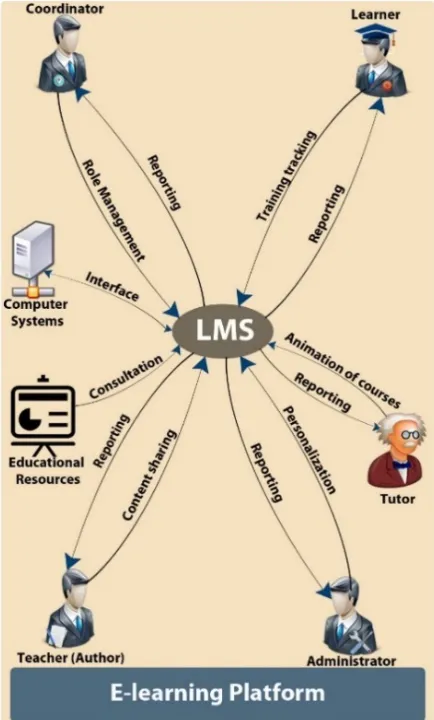
Figure 1 illustrates the general principle of the operation of an e-learning platform LMS by presenting the key features associated with the main actors: learners, teach-ers, tutors, coordinators, and administrators. The learner can consult and/or download the resources placed at his/her disposal by the teacher, he/she can create his/her learn-ing activities while followlearn-ing his/her progress in trainlearn-ing. The teacher, who is respon-sible for one or more modules, can create and manage the educational content he/she wishes to broadcast via the platform. The tutor accompanies and monitors each learn-er by providing the tools of communication and collaboration. Conclearn-erning the coordi-nator, they ensure the management of the overall system. Finally, the administrator is responsible for the customization of the platform having the rights of the administra-tion deriving from it (system installaadministra-tion, maintenance, access management...).
2.2 Benefits of free e-learning platforms
E-learning platforms on which we count increasingly as a means of learning have considerable potential in knowledge building and skills development. Through the various services that these e-learning platforms offer, individuals can access and use multiple sources of information, available interactively at anytime and anywhere, compose personalized training paths and therefore develop the higher level skills according to their needs [30, 10].
Fig. 1. The general architecture of an LMS
Today, the multitude of free e-learning platforms available, their recognized ro-bustness makes the assembly process much more alluring. You have at your disposal dozens of free e-learning platforms that you can for the most part, simply download. This allows you to evaluate and test the components you need quickly without having to engage in a traditional buying process too long often, constraining and expensive. Free platforms also allow you to test and deploy a solution without purchasing licens-es. The major advantages of free e-learning platforms are:
• the implementation speed, • the reduction of your costs,
Free platforms are designed, developed and tested in a highly modular way. The different parts of a platform can all be assembled and disassembled at your leisure in another platform. Free platforms are particularly well suited to the unique case, cus-tomization and some institutions specific needs. Therefore, we have listed below some advantages of free e-learning platforms.
• Easy deployment. You can install it in as many desired locations without making a particular follow-up.
• No black box. The teams can explore the source code to actually understand the platform operation.
• Independence towards editors. The evolutions of a free platform, like its updates, rely on a community of developers and not a single editor.
• Access to the source code. Your institution maintains control the program code lines. It can adapt it to their needs. According to the license affixed to the free and open source platform, institutions and developers are required or not to share the changes of the source code.
• Unlike to proprietary model. The open source license is free and defines the plat-form use terms.
• Community development. Communities develop each part of the free and open source platforms. The later promotes responsiveness when it comes to fix a bug or a security flaw.
• Economy. A null cost for the platform in the majority case of the free platforms downloadable on the internet.
3
Evaluation methodology
3.1 Selection of platforms
In this paper, we take care of four free e-learning platforms, which were selected in detail on 27 platforms. These platforms were selected from 650 platforms listed in the THOT CURSUS directory1.
Other platforms like Elgg, Dokeos, and WIMS..., are “encountered” in the work and are not cited as counted because: they are tools and not e-learning platforms in the sense of this study. In addition, their costs, their development status, their orienta-tion, and the used technologies are too far from the axis of this study. We did a first filter on free platforms currently used in University or training structures. Next, we have elaborated a second filter according to the following criteria:
• Be operational and have been used by learners as part of lessons, • Rely on new internet technologies, and meet the standards in force,
• Allow managing several types of pedagogical activities (reading, exercises, collab-oration, communication…),
• Can manage a large number of users.
1 THOT CURSUS is an e-learning platforms’ directory, LMS, LCMS and other systems for content and
• Enable the teachers and learners to create, organize and propose different types of activities (forum, wiki, blog…) as they like.
• Enable the teachers and learners to access and manage their interactions via these activities where and when they want according to their needs and objectives in terms of learning.
• Relies on well-founded and proven learning theories.
After applying the two filters, the study had focused on four listed e-learning plat-forms, namely: Atutor, Claroline Connect, Chamilo Connect, Efront, Formagri, Ilias, Moodle, Opigno and Sakai.
It should be recalled that this study was conducted in two stages:
• a census of platforms that matches the type of e-learning platforms, including the requested filters,
• Then, a detailed comparative study of the selected platforms.
Thus, to achieve our study, we opted for a qualitative approach consisting to real-ize an analysis by products exploration, analysis of documentation, collection of user opinions, discussions with publishers and simulation tests that we carried on the se-lected e-learning platforms. We present thereafter a common table we used to evalu-ate its e-learning platforms.
3.2 Evaluation Approach
To be used effectively, the selected e-learning platforms need an overall evaluation of the utility and usability specifications to be well exploited and used in the best conditions. Several evaluation methods of the platforms were encountered in litera-ture [17, 14]. However, they have not been chosen, because these studies focus main-ly on the functional aspect, forgetting other aspects very important such as security, maintainability, portability, compatibility, performance efficiency and usability. For this reason, we have realized our own evaluation approach of the e-learning platforms quality. Table I present an overview of our approach with measures and criteria adapted for evaluation of the e-learning platforms.
Table 1. Evaluation approach of the e-learning platforms quality [1] Assessment And Analysis Grid Of The E-Learning Platforms Quality
Platform Identification
Platform’s name: Platform designer: Platform type: Platform genre:
Platform’s pedagogical model: Platform license:
Description: Version & Edition: Used technology: Language: Website:
Utility Specifications
Functional suitability tools Performance efficiency tools Compatibility tools Security tools Maintainability tools Portability tools
Usability Specifications
Usability criteria
3.3 Quality metric
In order to verify that each e-learning platform meets the various criteria men-tioned in the evaluation approach of the e-learning platforms quality.
We have mentioned in this study, that the metric for measuring the quality of an e-learning platform will be the IS0 9126's conformity index [24]. Furthermore, we have implemented a rating system that gives a score ranging from 0 to 4 for each criteria, instead of 0 to 1 will therefore be adapted as follows: ! A, B, X, Y "#
!" !! !! !! !!!!"#$%&'#()!!"#$%&#'#$(!!""#$%&"'(!!!"#$%&'#()!!"#$%&#'#$(!!"#$%! With A " [0, 116], x = 2n ! n " [0, 2]
Or
!" !! !! !! !!!!"#$%#&'()"!!""#$#!%$&!!""#$%&"'(!!!"#$%#&'()"!!""#$#!%$&!!"#$%! With A " [0, 12], x = 2n ! n " [0, 2]
!" !! !! !! !!!!"#$%&'(')'&*!!""#$%&"'(!!!"#$%&'(')'&*!!"#$%!! ! With A " [0, 36], x = 2n ! n " [0, 2]
Or
!" !! !! !! !!!!"#$%&'(!!""#$%&"'(!!!!"#$%&'(!!"#$%! With A " [0, 32], x = 2n ! n " [0, 2]
Or
!" !! !! !! !!!!"#$%"#$"&#'#%(!!""#$%&"'(!!!!"#$%"#$"&#'#%(!!"#$%! With A " [0, 20], x = 2n ! n " [0, 2]
Or
!" !! !! !! !!!!"#$%&'('$)!!""#$%&"'(!!!"#$%&'('$)!!"#$%! With A " [0, 20], x = 2n ! n " [0, 2]
Or
!"!! !! !! !!!!"#$%&%'(!!""#$%&"'(!!!"#$%&%'(!!"#$%!! With A " [0, 32], x = 2n ! n " [0, 2]
CI is the conformity index to the functional suitability, performance efficiency, compatibility, security, maintainability, portability, or usability requirements.
A is sum of the functional suitability, performance efficiency, compatibility, secu-rity, maintainability, portability or usability scores.
X is the functional suitability, performance efficiency, compatibility, security, maintainability, portability or usability scores. Each score has a value selected in our case between 0 and 4 is defined according to the following scale:
• 4: means that the platform fully satisfies to this characteristic (or sub-characteristic).
• 2: means that the platform partially satisfies to this characteristic (or sub-characteristic).
• 0: means that the platform does not satisfies to this characteristic (or sub-characteristic).
B is the number of the functional suitability, performance efficiency, compatibility, security, maintainability, portability or usability attributes.
Y is the functional suitability, performance efficiency, compatibility, security, maintainability, portability or usability attributes.
meets to 75% (3/4) of the standard requirements for the given characteristic or sub-characteristic. Consequently, the quality measuring metric of an e-learning platform will be calculated as following:
!" !!!!!"#$#"%!!"#!!"!!"#$%&%'(!!"#$%!!!!"#$#"%!!"#!!"!!"#$%&%'(!!""#$%&"'($
3.4 Quality level
In this study, we are assessing the overall quality level of the designed platforms to be integrated into distance-learning field. This following evaluation type, allows hav-ing a general idea about of the quality level of the evaluated e-learnhav-ing platforms.
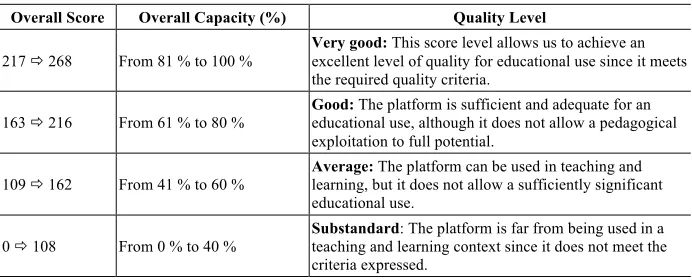
Table 2. Description of the appropriate quality level for each obtained score note
Overall Score Overall Capacity (%) Quality Level
217 " 268 From 81 % to 100 % Very good: This score level allows us to achieve an excellent level of quality for educational use since it meets the required quality criteria.
163 " 216 From 61 % to 80 % Good: The platform is sufficient and adequate for an educational use, although it does not allow a pedagogical exploitation to full potential.
109 " 162 From 41 % to 60 % Average: The platform can be used in teaching and learning, but it does not allow a sufficiently significant educational use.
0 " 108 From 0 % to 40 % Substandard: The platform is far from being used in a teaching and learning context since it does not meet the criteria expressed.
The selected platforms are presented in the next section, with their identification, their general characterization, their strong and weak points. Moreover, this, using with a critical analysis based on the evaluation approach of the e-learning platforms quality presented in the Table 1.
4
Platforms’ comparison
In this section, we will do a comparison of the selected e-learning platforms by us-ing critical analysis, based on an evaluation approach presented in table I. The latter present an overview of the utility and usability dimensions with the measurements and adapted criteria for the e-learning platforms' evaluation (Appendix, Table 3).
4.1 Identification of platforms
4.2 Utility specifications analysis
In the development of interactive software, the best-known utility criteria were presented in this section. Moreover, in the following, we present the essential criteria for the utility analysis, as well as the analyzed e-learning platforms.
Functional suitability. Functional suitability which means the degree to which a product or system provides functions that meet stated and implied needs when used under specified conditions [28]. Table 4 (Appendix) projects the essential functionali-ties for functional suitability analysis, as well as the analyzed e-learning platforms.
Performance efficiency. Performance efficiency, which means the performance relative to the amount of resources used under stated conditions [28]. In Table 5 (Ap-pendix), we project the essential functionalities for performance efficiency analysis, as well as the analyzed e-learning platforms.
Compatibility. Compatibility which signifies the degree to which a product, sys-tem or component can exchange information with other products, syssys-tems or compo-nents, and/or perform its required functions, while sharing the same hardware or software environment [28]. Table 6 (Appendix) presents the essential functionalities for compatibility analysis, as well as the analyzed e-learning platforms.
Security. Security which means the degree to which a product or system protects information and data so persons or other products or systems have the degree of data access appropriate to their types and levels of authorization [28]. Table 7 shows the essential functionalities for security analysis, as well as the analyzed e-learning plat-forms.
Maintainability. Maintainability. It means the degree of effectiveness and effi-ciency with which a product or system can be modified by the intended maintainers [28]. In Table 8 (Appendix), the essential functionalities for maintainability analysis, as well as the analyzed e-learning platforms.
Portability. Portability which signifies the degree of effectiveness and efficiency with which a system, product or component can be transferred from one hardware, software or other operational or usage environment to another [28]. Table 9 shows the essential functionalities for portability analysis, as well as the analyzed e-learning platforms.
4.3 Usability specifications analysis
Usability refers to means the degree to which a product or system can be used by specified users to achieve specified goals with effectiveness, efficiency and satisfac-tion in a specified context of use [28]. Table 10 (Appendix) projects the essential functionalities for usability analysis, as well as the analysed e-learning platforms.
5
Platforms’ evaluation
5.1 Comparison results
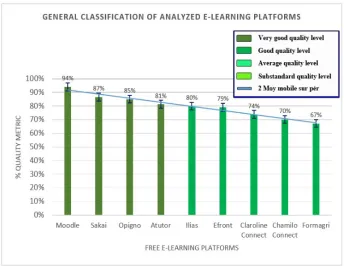
We achieved overall scores between 180 and 252, which mean that the e-learning platforms have reached between 67% and 94% of the criteria. The percentages that reflects the platforms' quality levels regarding the analysis and evaluation of each dimension. Consequently, we obtained the presented results in the Table 11 (Appen-dix).
Analyzed platforms, present each with a philosophy, interesting pedagogical con-ceptual references, different benefits and special characteristics, which all offering a set of functionalities allowing educational institutions to put online training courses.
Moodle, Sakai, Opigno, and Atutor are platforms that present a very good utility and usability degree.
Moodle provides, operationally, the greatest functional and pedagogical wealth for learners and teachers as it is shown in table XI. This platform offers a plagiarism detection module, as well as other important educational tools.
The platform is centered on the social constructivism2, it is extremely modular, and the platform is suitable for all structures. Thus, we obtained the following results:
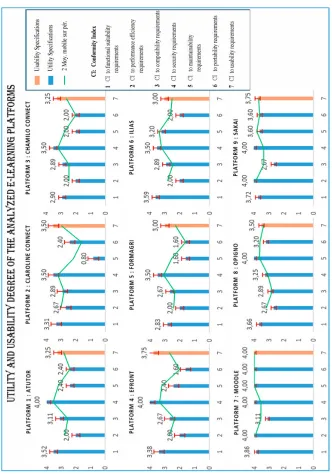
We got a 4 (100%) compliance index regarding maintainability, security, and usa-bility. In addition, this reflects that these Moodle’s specifications are fully satisfied for educational use. Moreover, we got a: 3.86 (97%) functional suitability, 3.6 (90%) portability, 3.33 (83%) compatibility, and 2.67 (67%) effective performance compli-ance index. This reflects that these Moodle’s specifications are sufficient for good pedagogy. Consequently, we obtained a 252 overall score, which means that the plat-form has 94% reached criteria, a percentage that reflects the platplat-form quality level. This level allows Moodle to achieve an excellent quality level for educational use.
Sakai offers a very important functional and pedagogical wealth. The platform is centered on constructivism3 and it is extremely modular. Notably, we obtained the following results:
We got a: 3,75 (94 %) usability and security, 3,66 (92 %) functional suitability, 3,6 (90 %) maintainability, 3,2 (80 %) portability, and 2.67 (67%) compatibility and ef-fective performance compliance index. This reflects that these Sakai’s specifications are sufficient for good pedagogy. Consequently, we obtained a 232 overall score, which means that the platform has 87 % reached criteria, a percentage that reflects the platform quality level. This level allows Sakai to achieve a very good quality level for educational use.
Opigno offers a very important pedagogical wealth, for the learning support and for the design and the conduct of the teachings. Opigno is centered on traditional pedagogy4, it is extremely modular. Notably, we obtained the following results:
2Social constructivism is centered on the learner. The learner learns through its representations. The
construction of a knowledge although personal is carried out in a social setting. The context and come from both what we think and what others bring as interactions.
3Constructivism is a learning pedagogy based on the idea that the learner himself builds knowledge based
on a mental activity. Constructivism is based on the assumption that, by reflecting on our experiences, we construct our own vision of the world in which we live.
4 Traditional pedagogy is that of the transmissive model. This pedagogy privileges the relationship
We got a 4 (100%) compliance index regarding maintainability. In addition, this reflects that this Opigno’s specification is fully satisfied for educational use. Moreo-ver, we got a: 3,66 (92 %) functional suitability, 3,5 (88 %) usability, 3,25 (81 %) security, 2,89 (72 %) compatibility, 2,8 (70 %) portability, and 2,67 (67 %) effective performance compliance index. This reflects that these Opigno’s specifications are sufficient for good pedagogy. Consequently, we obtained a 228 overall score, which means that the platform has 85 % reached criteria, a percentage that reflects the plat-form quality level. This level allows Opigno to achieve a very good quality level for educational use.
Atutor offers a very important functional wealth. The platform is centered on tradi-tional pedagogy, it is extremely modular. Notably, we obtained the following results:
We got a 4 (100%) compliance index regarding security. In addition, this reflect that this Atutor’s specification is fully satisfied for educational use. Moreover, we got a: 3,52 (88 %) functional suitability, 3,25 (81 %) usability, 3,11 (78 %) compatibility, and 2,4 (60 %) portability and maintainability compliance index. This reflects that these Atutor’s specifications are sufficient for good pedagogy. Furthermore, we got a 2 (50 %) effective performance compliance index. This reflects that this Atutor’s specification is partially sufficient for educational use. Consequently, we obtained a 218 overall score, which means that the platform has 81 % reached criteria, a percent-age that reflects the platform quality level. This level allows Atutor to achieve a very good quality level for educational use.
Ilias, Efront, Claroline Connect, Chamilo Connect and Formagri are plat-forms that present a good utility and usability degree.
Ilias allows some sharing of tasks between teachers and offers important function-alities. The platform is centered on the social constructivism. It is extremely modular. Notably, we obtained the following results:
We got a: 3,59 (90 %) functional suitability, 3,5 (88 %) security, 3,2 (80 %) main-tainability, 3 (75 %) usability, and 2,89 (72 %) compatibility compliance index. This reflects that these Ilias’s specifications are sufficient for good pedagogy. Moreover, we got a 2 (50 %) effective performance and portability compliance index. This re-flects that these Ilias’s specifications are partially sufficient for educational use. Con-sequently, we obtained a 214 overall score, which means that the platform has 80 % reached criteria, a percentage that reflects the platform quality level. This level allows Ilias to achieve a good quality level for educational use.
Efront offers important functionalities. The platform is centered on the traditional pedagogy. It is extremely modular. Notably, we obtained the following results:
We got a 4 (100%) compliance index regarding security. In addition, this reflect that this Efront’s specification is fully satisfied for educational use. Moreover, we got a: 3,75 (94 %) usability, 3,45 (86 %) functional suitability, 2,67 (67 %) compatibility, and 2,4 (60 %) maintainability compliance index. This reflects that these Efront’s specifications are sufficient for good pedagogy. Furthermore, we got a: 2 (50 %) effective performance, and 1,6 (40 %) portability compliance index. This reflects that these Efront’s specifications are partially sufficient for educational use. Consequently,
lecturing, usually followed by exercises and / or lessons to be learned. The learner must integrate and apply
Fig. 2. The utility and usability degree for analyzed e-learning platforms, turn by turn, in each figure, the x-axis represents certain conformities indices to the utility and usability re-quirements for each platform. These preliminary indices are presented in the Subfigures
we obtained a 212 overall score, which means that the platform has 79 % reached criteria, a percentage that reflects the platform quality level. This level allows Efront’s to achieve a good quality level for educational use.
Claroline Connect offers important functionalities. The platform is centered on the social constructivism. It allows some sharing of tasks between teachers, as well as interconnection and exchange of information with several Claroline Connect plat-form. Notably, we obtained the following results:
We got a: 3,5 (88 %) usability and security, 3,24 (81 %) functional suitability, 2,89 (72 %) compatibility, and 2,67 (67 %) effective performance compliance index. This reflects that these Claroline’s specifications are sufficient for good pedagogy. Moreo-ver, we got a 2 (50 %) portability compliance index. This reflects that this Claroline’s specification is partially sufficient for educational use. Furthermore, we got a 0,8 (20 %) maintainability compliance index. This reflects that this Claroline’s specification is not sufficient for good pedagogy. Consequently, we obtained a 198 overall score, which means that the platform has 74 % reached criteria, a percentage that reflects the platform quality level. This level allows Claroline Connect to achieve a good quality level for educational use.
Chamilo Connect offers important functionalities. The platform is centered on the social constructivism. It allows some sharing of tasks between teachers. Notably, we obtained the following results:
We got a: 3,25 (81 %) security and usability, 2,9 (73 %) functional suitability, and 2,89 (72 %) compatibility compliance index. This reflects that these Chamilo Connect specifications are sufficient for good pedagogy. Furthermore, we got a: 2 (50 %) effective performance, portability, and maintainability compliance index. This reflects that these Chamilo’s specifications are partially sufficient for educational use. Conse-quently, we obtained a 188 overall score, which means that the platform has 70 % reached criteria, a percentage that reflects the platform quality level. This level allows Chamilo Connect to achieve a good quality level for educational use.
Formagri offers important functionalities. The platform is centered on the tradi-tional pedagogy. Notably, we obtained the following results:
We got a: 3,25 (81 %) security, 3 (75 %) usability, 2,90 (73 %) functional suitabil-ity, and 2,67 (67 %) compatibility compliance index. This reflects that these Formagri specifications are sufficient for good pedagogy. Moreover, we got a: 2 (50 %) effec-tive performance, and 1,6 (40 %) maintainability and portability compliance index. This reflects that these Formagri’s specifications are partially sufficient for education-al use. Consequently, we obtained a 180 overeducation-all score, which means that the platform has 67 % reached criteria, a percentage that reflects the platform quality level. This level allows Formagri to achieve a good quality level for educational use.
5.2 Synthesis
These analyzed platforms offer an important pedagogical and functional wealth, for the learning support and designing. They also offer an improvement in the conduct of teachings, the construction and organization of elaborate formations. In addition, these platforms implement an interoperability management between multimedia teaching resources and platform.
Fig. 3. General classification of the analyzed e-learning platforms, according to utility and
usability degree
a new conceptual model of an e-learning platforms LMS is presented [34]. The model is based on the hybridization between four learning theories, namely the traditional pedagogy, the behaviorism, the cognitivist, and the social constructivism. Then, to-gether with the main principles of these learning theories and the technical functional-ities of the proposed LMS that result from the hybridization of these principles are outlined.
In the next section, we present our study results in the form of a recommendation system of free e-learning platforms according to the objectives and the specificities of any institution.
6
LeaderTICE recommendation system
LeaderTICE is a recommendation system of free e-learning platforms, that we im-plemented [29], in order to facilitate choosing the e-learning platforms, seeing that any random choice entails a money, effort and time loss. The system based on an approach [1, 6], which identifies the appropriate criteria to the specifications of any institution.
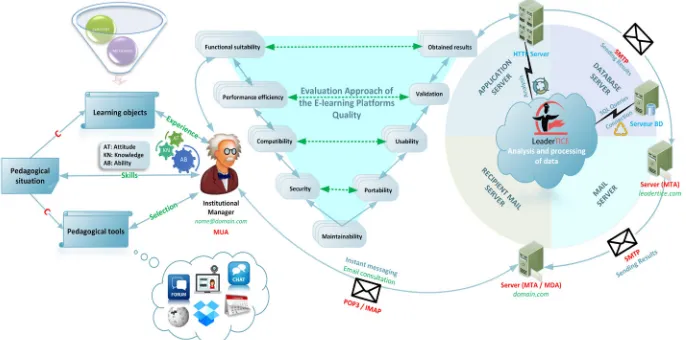
Fig. 4. Functional architecture of the LeaderTICE recommendation system of free e-learning
platforms.
The system allows you choose the most suitable e-learning platform for your ob-jects and your requested pedagogical tools. Moreover, this, according to the circuit shown in figure 4. In the choice process, the formalization of needs will facilitate the selection of the e-learning platform that will allow the dissemination of trainings [5]. To choose the one that be integrated with our training ecosystem, we therefore, must arbitrate between:
[25], after determining the objectives, specifying the pedagogical used method (expositive, interrogative ...) and the used supports (documents, video, image ...). • Learning Objects, which present the smallest information units or smallest
infor-mation processing tools used in a teaching context with a pedagogical intention aiming at facilitating the learning through technological support [23].
• Functional or organizational pedagogical tools... such as forum, wiki, videoconfer-encing, activities, tests, certification... corresponding to your pedagogical expecta-tions and your teaching / learning situation.
• Financial implications, any wrong choice of e-learning platform will have financial repercussions.
After the formalization of the needs, the institutional manager has to choose the characteristics and pedagogical tools adapted to the institutional specificities, accord-ing to a questionnaire based on an evaluation approach of the e-learnaccord-ing platforms quality [1]. The latter presents an overview on the utility and usability dimensions with their adapted measures and criteria to evaluate e-learning platforms. This ap-proach is mainly composed of seven characteristics, namely: functional suitability, performance efficiency, compatibility, security, maintainability, portability, and usa-bility. Thus, it should be mentioned that you have the right to choose just the adapted characteristics and sub-characteristics to your institutional needs, your technical im-peratives and your functional and organizational expectations.
After validating your choices, the system done the analysis and processing of ob-tained results by interpreted algorithmic programs via an application server (Apache HTTP5 Server), who took charge of the analysis and processing of the code, and in-terconnection to the database. Thereafter, the application server sends the results ob-tained by the mailing way via the SMTP6 communication protocol, used to transfer the electronic mails towards the mail server. Furthermore, the MTA7 mail server re-sponsible for transport, by its turn, returns the mail of received results by the applica-tion server by the mailing way via the SMTP communicaapplica-tion protocol toward the MTA recipient's mail server. Lastly, the latter delivers, then, the mail that contains the result obtained in the incoming electronic mail server, which then stores the waiting mail that you use it via the POP3 / IMAP protocol.
7
Conclusion and perspectives
The subject of this paper is very important. In actually fact, the free platforms are, on the one hand, a topical domain in Software Engineering and Pedagogical Engi-neering Multimedia. On the other hand, the application of these platforms in e- learn-ing reaches a vast clientele. Moreover, academically, it seems that it is interestlearn-ing to apply for the first time an inspired approach of software engineering to evaluate the e-learning platforms quality.
5 HTTP : Hypertext Transfer Protocol
6 SMTP : Simple Mail Transfer Protocol
Indeed, platforms quality analysis, according to our own approach led to very in-teresting results. We see that most of the analyzed platforms were initially developed a decade ago, based on a classical training model. The teacher is the one who holds the knowledge and transmits it, according to different modalities, to future learners in order to the learning foster of these latter. They are mostly TMS (Teaching Manage-ment Systems), that is to say tools at the teacher service to create and manage courses rather than at the learner service and the learning process. They are always part in a logic, uniform, techno-centric, and cantoned architecture in a reduced learning con-ception, which advocates a particular pedagogical theory independently of others.
A platform choice, pledge of success and sustainability for the pedagogical device, which also seems in adequacy with the free e-learning platforms’ philosophy and their community dynamic. Consequently, constructed a new platform, we seem ideal for implementing a first one of distance training devices centered on the user and his activity. The new platform we are looking at implementing will allow teachers and learners to create, organize and propose different types of activities (forum, wiki, blog…) as they like. Furthermore, they are able to access and manage their interac-tions via these activities where and when they want according to their needs and their objectives in learning terms. Our platform will be based on the idea that we should give the equal action possibilities to both teachers and learners of distributing their control on the platform. The latter will also give the place to the learner to learn and make himself an actor of his own learning.
In this perspective, an experiment is therefore indispensable to validate what has been developed in the context of this paper. Indeed, the latter will be based on the implementing results of a teaching and learning device in Moroccan university, based on a platform known as intelligent and anthropocentric relying on a reduced learning design, with a view to enhance distance learning.
8
References
[1]Ouadoud, M., Chkouri, M.Y., Nejjari, A., Kadiri, K.E.E., 2016. Studying and Analyzing the Evaluation Dimensions of E-learning Platforms Relying on a Software Engineering Approach. International Journal of Emerging Technologies in Learning (iJET) 11, 11–20. https://doi.org/10.3991/ijet.v11i1.4924
[2]Stallman, R., 2017. gnu.org [WWW Document]. URL http://www.gnu.org/gnu/ thegnuproject.html (Accessed 6.5.16).
[3]Free Software Foundation, 2017. gnu.org [WWW Document]. URL http://www.gnu.org/ philosophy/free-sw.fr.html (Accessed 4.11.17).
[4]Knoop, A.P., Groen, R., 2012. SCORM - Contrib: SCORM Player - Confluence [WWW Document]. URL https://confluence.sakaiproject.org/display/SCORMPLAYER/SCORM (Accessed 4.12.17).
[5], M.Y., Nejjari, A., Kadiri, K.E.E., 2017. Exploring a Recommendation System of Free E-learning Platform: Functional Architecture of the System. International Journal of Emerg-ing Technologies in LearnEmerg-ing (iJET) 12, 219–226. https://dx.doi.org/10.3991/ijet.v12i02. 6381
Science and Technology (CiSt). Presented at the 2016 4th IEEE International Colloquium on Information Science and Technology (CiSt), pp. 581–586. https://doi.org/10.1109/ CIST.2016.7804953
[7] Dambreville, S.C., 2008. Evaluer un dispositif de formation à distance": Principes et retour d’expérience. Revue des Interactions Humaines Médiatisées (RIHM) = Journal of Human Mediated Interactions 9, 25–52.
[8]Galloy, S., Haas, C., Lodewijck, M., 2002, “ Analyse d’environnements de formation à distance, ” CIFoP – Le Centre Interuniversitaire de Formation Permanente.
[9]Graf, S., List, B., 2005. An evaluation of open source e-learning platforms stressing adap-tation issues, in: Fifth IEEE International Conference on Advanced Learning Technologies (ICALT’05). Presented at the Fifth IEEE International Conference on Advanced Learning Technologies (ICALT’05), pp. 163–165. https://doi.org/10.1109/ICALT.2005.54
[10]Marquet, P., n.d, 2005. Lorsque le développement des TIC et l’évolution des théories de l’apprentissage se croisent. Savoirs, pp. 105–121. https://doi.org/10.3917/savo.009.0105 [11]Connect-i society, 2016. Opigno User Manual [WWW Document]. URL
https://www.opigno.org/160707_Opigno_User-Manual.pdf. (Accessed 4.12.17).
[12]El-Mawas, N., Oubahssi, L., and Laforcade, P., 2014. Étude comparative de plateformes de formation à distance. GRAPHIT-D2.5&2.2.
[13]Kaddouri, M., Bouamri, A., 2010. Usage de plateformes d’enseignement à distance dans l’enseignement supérieur marocain": avantages pédagogiques et difficultés d’appropriation. Questions Vives. Recherches en éducation 107–118. https://doi.org/10.4000/questions vives.642
[14]Aska, Le Préau and Klr.fr, 2000. Choisir une solution de téléformation : 2000 study: l'offre de plates-formes et de portails de téléformation » / [Study conducted by Bouthry, A., Che-valier, P., Ravet, S., and al.].
[15]Dooremont, F., 2014. Sakaï | Fiche logiciel validé PLUME, [WWW Document]. URL http://www.projet-plume.org/fiche/sakai. (Accessed 4.12.17).
[16]Moodle community, 2016. Fonctionnalités — MoodleDocs, [WWW Document]. URL https://docs.moodle.org/3x/fr/Fonctionnalités. (Accessed 4.12.17).
[17]Lablidi, A., Abourrich, A., and Talbi, M., 2009. Démarche préconisée pour évaluer une plate-forme, Association EPI, [WWW Document]. URL http://www.epi.asso.fr/revue/ articles/a0912b.htm. (Accessed 4.12.17).
[18]Escribano, M.A.E., 2010. Manual de Usuario ATutor 1.6.2. Unidad de Coordinación del Nodo Nacional de GBIF en España, [WWW Document]. URL http://www.atutor.ca/ atutor/docs/Manual_ATutor_v1.1_ES.pdf. (Accessed 4.12.17).
[19]ATutor community, 2016. ATutor: Learning Content Management System: Download, [WWW Document]. URL http://www.atutor.ca/atutor/modules. (Accessed 4.12.17). [20]Claroline community, 2016. Introduction. Claroline Connect Documentation, [WWW
Do-cument]. URL https://claroline.gitbooks.io/claroline-connect-documentation/en/. (Ac-cessed 4.12.17).
[21]DOGBE-SEMANOU, Koffi, DA., DURAND, A., LEPROUST, M., VANDERSTICHEL, H., 2007. Etude comparative de plates-formes de formation à distance. Le cadre du Pro-jet@ 2L Octobre.
[22]The OVAREP (Observatoire des ressources multimédias), 2000. Étude comparative tech-nique et pédagogique des plateformes pour la formation ouverte et à distance
[23]CREPUQ - Novasys, 2003. p. 133
[24]ISO/IEC 9126-3, 2003. Software Engineering - Software product quality - Part 3: Internal Metric
[26]Menasri, S., 2004. Etude comparative de plateformes d’enseignement en ligne (e-learning) utilisées dans un contexte universitaire [WWW Document]. URL http://urfist.enc. sorbonne.fr/anciensite/archives/gremi/gremi10juin04/comparatif.htm. (Accessed 4.12.17). [27]Dimet, B., 2006. Etude comparative technique et pédagogique des plates-formes pour la
formation ouverte et à distance, [WWW Document]. URL http://www.portices.fr/forma tion/Res/-Formation/Plateformes/Pf1Resume.html. (Accessed 4.12.17).
[28]ISO/IEC 25010, 2011. Systems and software engineering -- Systems and software Quality Requirements and Evaluation (SQuaRE) – System and software quality models
[29]Ouadoud, M., 2016 LeaderTICE – About Us. [WWW Document]. URL http://leadertice.com/AproposDeNous. (Accessed 4.12.17).
[30]Gilbert, P., 2002. L’ingénierie pédagogique. Pour construire l’apprentissage en réseau. [31]Whyte, A., and Federico, J., 2016. Home – Contrib: bigbluebutton – Confluence, [WWW
Document]. URL http://confluence.sakaiproject.org/display/BBB/Home. (Accessed 4.12.17).
[32]Apereo Foundation, 2014. Features, Tools & Functionality | Sakai, [WWW Document]. URL http://sakaiproject.org/features-tools-functionality. (Accessed 4.12.17).
[33] Apereo Foundation, 2014. Learning Management | Sakai, [WWW Document]. URL http://sakaiproject.org/learning-management. (Accessed 4.12.17).
[34]Ouadoud, M., Nejjari, A., Chkouri, M.Y., Kadiri, K.E.E., 2017. Educational modeling of a learning management system, in: 2017 International Conference on Electrical and Infor-mation Technologies (ICEIT). Presented at the 2017 International Conference on Electri-cal and Information Technologies (ICEIT), pp. 1–6. https://doi.org/10.1109/EITech.2017.8255247
9
Authors
Mohammed Ouadoud is a PhD Candidate in Computer sciences, at the Laborato-ry of Informatics, Research Operational and Statistic Applied (LIROSA) at Faculty of Sciences, Abdelmalek Essaadi University. He has a Master degree in Instructional design Multimedia engineering at the École Normale Supérieure of Martil, Morocco in 2013. His current research focuses on E-learning, Software Engineering, Man Ma-chine Interface, Bigdata and Adaptive Hypermedia Systems. (E-mail: [email protected]).
Mohamed Yassin Chkouri is with Laboratory of the Information System and Software Engineering (SIGL) at National School of Applied Sciences, Abdelmalek Essaadi University, Tetouan, Morocco. (E-mail: [email protected]).
Amel Nejjari is with Laboratory of the Information System and Software Engi-neering (SIGL) at National School of Applied Sciences, Abdelmalek Essaadi Univer-sity, Tetouan, Morocco. (E-mail: [email protected]).
Article submitted 22 October 2017. Published as resubmitted by the authors 13 December 2017.
10
Appendix
T
ab
le
3.
Ide
nt
ifi
ca
tion
of
the
sel
ec
te
d
e-le
ar
ni
ng pl
at
for
m
s
Identification
Platform’s name
Atutor*
Claroline
Con-nect*
Chamilo Connect*
Efront*
Formagri*
Ilias*
Moodle*
Opigno*
Sakai*
Platform designer
Inclusive Design Research Centre, OCAD Université UCL / IPM / ECAM Communauté Chamilo and Partenaires professionnels Société grecque Epignosis AGROSUP DijonEDUTER /Eduter CNERTA
Alexander Killing
Martin Dougiamas and Moodle Community
Société Connect-i.
Sakai Community
Platform type
LMS
LMS
LCMS
LMS
LMS
LMS
CMS, VLE, LCMS
LMS
LMS
Platform genre
Online learning platform Online learning platform Online learning platform Online learning platform Online learning platform Online learning platform Online learning platform Online learning platform Online learning platform
Platform’s pedagogical model traditional peda- gogy social constructiv- ist
social constructivist
traditional pedagogy
traditional pedagogy social constructiv- ist
social constructivist
traditional pedagogy
Constructivism
Platform license
GPL
GPL
GNU/GPL V3+
GPL V2
GPL
GPL
GPL
GNU/GPL V2+
Educational Commu- nity License
Version & Edition
V. 2.2.2 (1 Jul. 2016) V. 5.1.10 (1 Jun. 2016)
V. 4.1 (24 Dec. 2014)
V.3.6.15.5 15/06/ 2015
V. 2.7 (24 Sept. 2014) V. 5.1.11 (28 Oct. 2016) V. 3.1.3 (14 Nov. 2016) V. 1.23 (08 Jul. 2016) V. 10.2 (14 Oct. 2014)
Used technology
PHP (5.6.3)
PHP (5.5+)
PHP (>=5.3+)
PHP (5.2+)
PHP
PHP (5.3+)
PHP (5.4.4+)
PHP (5.3+)
JAVA
Language
Multi-language support, more than 21 languages Multi-language support, limited languages number (fr, en, es) Support multi-langue, more than 57 lan- guages Multi-language support, more than 45 languages Multi-language support, limited languages number, 3 languages Multi-language support, more than 28 languages Multi-language support, more than 135 languages Multi-language support, limited languages number, 5 languages Multi-language support, more than 20 languages
Website
www.atutor.ca
www.claroline.net
www.chamilo.org
www.efrontlearning.net
www.formagri.fr
www.ilias.de
www.moodle.org
www.opigno.org
www.sakaiproject.org
User institutions
Srinakharinwirot university, softacu- lous, Nursing Course Server, Ubicomp Courses, etc. High School of Namur-Liège- Luxembourg, Neuchâtel university, campus : Belfort & Lyon ‘esta’, LaSalle Beauvais, etc. Atlassian Bitbucket, Makina Corpus, etc.
Francisco Partners ‘FP’, Softaculous, les Echos, SiteGround, Glassdoor, eLearning Industry, ECHO STATTION, Prezi, etc. Forestry and vocational training in Midi-Pyrénées EPLEFPA VIC, Web space of professionals in French agricultural education '
Chloro-Fil'
, etc.
T ab le 4. Fu nc tio na l s uita bility a na ly sis o f th e s ele cte d e -le ar ni ng pl at for m s Fu nc tio na l S uita bility Pl at fo rm ’s n am e At ut or* C la ro lin e C on-nect* C ham ilo C on-nect* E front * Form ag ri* Il ia s* M oo dl e* O pi gno* Sa kai * F un ct ion al C om pl et en es s For um
Yes. Discussion forum / export [18] Yes, public or private discussion forum
[20]
Yes
Yes. Public, closed, or invisible discussion Yes. Forums related to modules
Yes
Yes. Various types of forums are available [16] Yes. Forum for all users and a forum in course [11]
Yes Sync hr onous ca us er ie (c ha t)
Yes. Synchronous interaction in writing, audio and video [18, 19]
Yes
Yes. Social network
Yes, plugin Chat
Yes
Yes
Yes, flexible synchronous interaction in writing [16] Yes, synchronous interaction in writing [11]
Yes V irt ual C lassro om (vi deoconfer en c-ing)
Yes, ‘BigBlueButton’ plugin [18]
No
No
Yes, plugin ‘BigBlue- Button’
No
Yes, plugin ‘BigBlueButton’ Yes, ‘BigBlueBut- ton’ plugin Yes, plugin ‘Webex’ [11] Yes, ‘BigBlueBut- ton’ plugin [31]
Sha ring doc um ent s Yes, ' Dropbox' tool
for creating shared files Yes, collaboration Wiki space [20], and shared files. Yes, collaboration Wiki space + ‘Dropbox’ tool
Yes, ‘Shared files’ tool
Yes. Shared folders space Yes, collaboration Wiki space, + ‘Dropbox’ tool Yes, collaboration Wiki space [16] Yes, collaboration Wiki space Yes, collaboration Wiki space, + ‘Dropbox’ tool
C
al
endar
Yes. Structure an agenda with tasks and deadlines [18] Yes. Structure an agenda with tasks and deadlines Yes, Shared calendar with iCal link and Google Calendar import Yes. Interne + import/export iCal Yes. Interactive Agenda Yes, Shared and multi-layered calendar with iCal link
Yes
Yes. Shared calendar [11]
Yes A w aren ess Yes Yes No Yes Yes Yes Yes Yes Yes Test s m anagem ent
Yes, module ‘ Tests and Surveys’ Yes. Generation of exercises (MCQ, open answers...) [20] Yes, tools ‘Question Hotspot ; QCM ; task; etc’ Yes. Various tools (GIFT/AIKEN ; Complete tests ; Gradebook’) Yes, authoring solution and design tests or MCQs Yes, tools (Ques- tion; Numeric Question; Ordering Question…) Yes, choose the level of sharing issues [16] Yes, "Quiz import" tool [11] (+Drag Drop Question…) Yes, the tool open and closed questions. [4]
C ol labor at ion (W ik i) Yes, '
EWiki’ plugin +
ErFurtWiki [19]
Yes [20]
Yes, a collaboration wiki space and portfolio Yes, plugin ‘ eFront Wiki’ Yes, a collaboration ‘WikiDocs’ space Yes, a collaboration wiki space and portfolio Yes, a collaboration 'Wiki'
space [16] Yes Yes Le arn ers ’ m an-age m ent (r egi st ra -tion, sc he dul e. ..)
Yes, multiple authentication mechanisms of learners [18] Yes, a user man- agement space + interfacing with LDAP [20] Partial, a user management space / planning lack Partial, a user man- agement space / planning lack Yes, data import solution for the registration of learners Partial, a user management space, + interfacing with LDAP directory Yes. Authentication via '
User
Manage-ment'
module [16]
Partial, a role management space / planning lack Partial, a role management space / planning lack
Le ar ne rs m an ag e-m ent in w or ki ng gr oups
Yes, Manual and automatic groups [18] Partial, creation of related discussion forums and not groups Yes, attribution of learners in groups (class) Yes, attribution of learners in groups (class) Partial, discussion forums related to the modules and not to the groups
Yes, '
Group'
space
of learners'
attribu-tion in groups
Yes, attribution of learners in groups (class) Yes, attribution of learners in groups (class) [11] Yes, creation of a discussion forum in groups
U sers ro les m an-age m ent
Yes, multi-profile (student, instructor, administrator) Yes, roles manage- ment space is offered by the platform [20]. Partial, two existing profiles (student, course administra- tor) Yes, multi-profiles (student ; professor, administrator) Yes, multi-profiles (learners, trainers administrator, tutors coordinator, and) Yes, multi-profiles (guest ; user ; administrator) Yes, multi-profile (manager, teacher, student, administra- tor…) Yes, multi-profiles (administrator, teacher, student…) [11] Yes, multi-profile management.
C ust om izabl e pl at fo rm
Yes. Managing roles, groups, users, modules, etc. Yes. Managing roles, users, groups, plugins, etc [20]. Yes. Managing rights, users, groups, plugins, etc. Yes. Managing rights, users, groups, etc. Yes. Managing roles, groups, plugins, and home interface customiza- tion, etc Yes. Managing roles, users, groups, plugins, etc. Yes. Managing roles, users, customizable themes, + activity plugins [16] Yes. Managing roles, classes'
groups,
courses, etc.
A dv an cem en t Scal e o r p ro gre s-si on pe rc ent age in the c our se
Yes, ‘statistics’ module Yes, consult the attendance and success statistics in the exercises
No
Yes, consult the attendance and success statistics in the exercises
No
Yes, ‘Statistics and Learning Progress’ space Yes, Registration and follow-up of activities [16] Yes, ‘Statistics ‘ and ‘Quiz Statistics’ module
Yes [4] R esour ce M an-age m ent (c our se )
Partial, sharing courses for the groups [18] and not in activity spaces Yes, share resources of activity spaces [20] Yes, The integration of multimedia teaching resources Yes. The integration of teaching resources Yes. Multi-format teaching resource management
Yes, ‘Course’ tool
Yes, course management plugin [16] Yes, The integration of multimedia teaching resources [11] Yes, integration of multimedia in the course.
Su pp ort o f m ul tip le aut hor s
Yes, the teacher has the right to create and manage his course Yes, the teacher has the right to create and manage his / her course Yes, the teacher has the right to create and manage his / her course Yes, the teacher has the right to create and manage his / her course Yes, the teacher has the right to create, manage, and giving access right to tutors in his / her course Yes, the teacher has the right to create and manage his / her course Yes, the teacher has the right to create, manage, and giving access right to tutors in his / her course Yes, the teacher has the right to create and manage his / her course Yes, the teacher has the right to create and manage his / her course
[15]. F un ct ion al C or rect nes s M an ag em en t o f w ork in g t im e o f le ar ne rs a nd te ac he rs
No, the platform does not manage the learners'
working
time
No, the platform does not manage the learners'
working
time
No, the platform does not manage the learners'
working
time
No, the platform does not manage the learners'
working time
No, the platform does not manage the learners'
working
time
No, the platform does not manage the learners'
working
time
No, the platform does not manage the learners' working time No, the platform does not manage the learners'
working time
No, the platform does not manage the learners'
working time R es ul ts a nd not es
Yes, ‘ Tests and Surveys’ module
Yes
Yes, Hotspot, matrix, and correspondence questions tools, etc.
Yes, '
Gradebook'
tool
which managing of students'
notes
Yes, solution of sending and correcting home- work Yes, using ‘Test and assessment’ tool Yes. All given notes in forums and tests [16] Yes, ‘Quiz certifi- cates’ module
Yes [15] N ot es d isp lay Yes Yes Yes Yes Yes Yes Yes Yes Yes Tr acki ng st at ist ics of co urse
Yes, ‘ tests and surveys’ tool Yes, monitoring tools of the learners' activities [20].
Yes
Partial, '
Reports'
space
to tracking user statistics, courses and lessons. Yes, a statistic tracking module of the platform users. Yes, ‘Statistics and Learning Progress’ space Yes, activity reports are available with graphs for each module [16] Yes, ‘Statistics ‘ and ‘Quiz Statistics’ module Yes, statistics of learner visits [4, 15].
C ont rol C onne c-tio ns (l earn ers’ tra cki ng)
Yes, module ‘ Tests and Surveys’ Yes, monitoring tools, statistics; + dashboard [20]
Yes
Yes, '
Reports'
space to
tracking user statistics.
Partial, supervisory tools to tracking of learners / missing dashboard Partial, supervisory tools to tracking of learners / missing dashboard Yes, supervision tools (groups, activities, etc.); + dashboard. Yes, Monitoring the result of the class or the course [11]
Yes [15]
R
epor
t on t
he t
est
resul
ts
Yes, ‘ tests and surveys’ tool
No
Yes
Yes, tracking student progress via '
Lesson
reports'
interface.
No
Yes. ‘Statistics and Learning Progress’ interface Yes, Interface for viewing reports of test results. Yes, visualization via the report interface and scoring quizzes
Yes
G
lo
ssary
Yes, ‘Glossary’ tool
No
Yes
No
No
Yes
Yes, Glossary Module
Yes
Yes, Glossary Module
R
epor
t on t
he fr eque nc y or the use o
f a co
urse
Yes, ‘My Tracker’ tool Yes, through a tracking interface
No
Yes, tracking student progress via ‘Course reports‘ interface
Yes
Yes, ‘Statistics and Learning Progress’ tool
Yes, «
Rapports
d'
activités» tool
Yes
Yes, ‘Statistics’ tool
F un ct ion al A ppr opr iat en es s C ertif ic atio n Yes [18] Yes No
Yes, ‘Certificates per Lesson’ plugin
No
Yes, Certificate of completing course objectives Yes, ‘Certificate’ plugin Yes, Certificate of completing the course [11]
Yes Fo yer (fam ily gr oup)
R
egi
st
rat
ion chat
Yes [18, 19]
Yes
Yes (+réseau social)
Yes
Yes
Yes
Yes, All sessions are recorded [16]
Yes Yes M essag in g
Yes, mail [18]
Yes, internal messaging
[20]
Yes, internal e-mail and mailing
Yes, Using the '
Quick
mails'
tool
Yes
Yes, internal e-mail and mailing Yes, messaging has existed since Moodle Yes, internal e-mail and mailing [11]
Yes Pl ag iari sm d et ec -tio n t oo ls No No No No No
No, currently in production Yes, plagiarism plugin ‘Turnitin ‘
No No R SS / podcast No Yes
Yes, RSS (reading and emission) Yes, RSS feed inside the lesson dashboard
Yes, RSS
Yes, RSS (reading and emission) and podCast
Yes
Yes, RSS (reading and emission) Yes, Display the news contents via RSS [31]
T ab le 6. C om pa tib ility a na ly sis o f th e s ele cte d e -le ar ni ng pl at for m s C om pa tib ili ty Pl at fo rm ’s na m e At ut or* C la ro lin e C on-nect* C ham ilo C on-nect* E front * Form agri * Il ia s* M oo dl e* O pi gno* Sakai * Co -E xi st ence C our se t ransfer fr om one pl at for m to a not he r Yes, transfer of
SCORM courses to an adapted platform
Yes,
transfer of
SCORM courses to an adapted platform
Yes,
transfer of
SCORM
courses
to
an adapted platform
Yes,
transfer of
SCORM courses to an adapted platform
Yes,
transfer
of
SCORM courses to an adapted platform
Yes,
transfer of
SCORM courses to an adapted platform
Yes,
transfer of
SCORM courses to an adapted platform
Yes,
transfer of
SCORM courses to an adapted platform
Yes,
transfer of
SCORM courses to an adapted platform
SCORM Yes . SCORM V.1.2/2004 [19] Yes [20] Yes
, SCORM V.1.2
-/2004 import
-/export
Yes
, SCORM V. 1.2
-/2004
Yes
, SCORM V. 1
.2
-/2004
Yes
, SCORM V. 1.2
-/2004
Yes, SCORM V. 1.2 import-/2004
Yes, 2004 [11]
Yes [4] IM S Q TI Yes, QTI– V.1.2 and V.2.1 Partial, QTI being finalized Yes, QTI –V.1.2 and V.2.0 No Yes No Partial
, QTI 2.0 export
is still unfinished
Yes, QTI –V.1.2 and V.2.0 Yes A ICC No No Partial No Yes Yes Yes Partial No IMS X ML
Yes, C/I/E CC-CP
No No Yes No No Yes No No Int er ope rabi lit y Infor m at ion and appl ic at ion sha ring Yes,
via Dropbox and
EWiki collabor
ation
tools [19]
Yes
, via Wiki
[20],
and shared files.
Yes
, via the shared
files, wiki and portfolio.
Yes, via ' Shared files' and ' eFront Wiki’ tools Yes , via the shared
folders and "WikiDocs".
Yes
,
via
the
Wiki
and portfolio, + the "Dropbox" tool
Yes , via Wiki collaboration [16], + “Dropbox” tool Yes, Wiki collaboration space Yes , Wiki collaboration space Int er connect ion pl at fo rm No Yes , platforms
exchange information [20]
No No No No No No No Im por
t and expor
t
of reso
urces
Yes
, the platform
offers the
ability
to
import and export of resources
Yes
,
the
ability
to
import and export of resources
Yes
, possibility to
import and export resources
Yes
, possibi
lity to
import and export resources
Yes , possibi lity to import and export resources Yes , possibi lity to
import and export resources
Yes
, possibility to
imp
ort and export
resources
Yes
, possibi
lity to
import and export resources
Yes
, possibi
lity to
import and export resources
U si ng pl ugi ns Yes Yes Yes Yes No Yes Yes Yes Yes
T
ab
le
7.
Secu
rit
y an
al
ysi
s o
f t
he sel
ect
ed
e
-le
ar
ni
ng pl
at
for
m
s
Secu
ri
ty
Platform’s name
Atutor*
Claroline Connect*
Chamilo Connect*
Efront*
Formagri*
Ilias*
Moodle*
Opigno*
Sakai*
C
on
fid
en
tia
lity
Secured by login / password Yes, the user name and the password allow the system to authenticate each user'
s access
Yes, the user name and the password allow the system to authenticate each user'
s access
Yes, the user name and the password allow the system to authenticate each user'
s access
Yes, the user name and the password allow the system to authenticate each user'
s access
Yes, the user name and the password allow the system to authenticate each user'
s access
Yes, the user name and the password allow the system to authenticate each user'
s access
Yes, the user name and the password allow the system to authenticate each user'
s access
Yes, the user name and the password allow the system to authenticate each user'
s access
Yes, the user name and the password allow the system to authenticate each user'
s access
Assigning access rights Yes, assign different access levels to the system based on the predefined roles Yes, assign different access levels to the system based on the predefined roles Yes, assign different access levels to the system based on the predefined roles Yes, assign different access levels to the system based on the predefined roles Yes, assign different access levels to the system based on the predefined roles Yes, assign different access levels to the system based on the predefined roles Yes, assign different access levels to the system based on the predefined roles Yes, assign different access levels to the system based on the predefined roles Yes, assign different access levels to the system based on the predefined roles
In
te
gr
ity
Ability to use SSL Yes, SSL protocol, certificates and TLS are supported via OpenSSL/1.0.1i toolbox Yes, the protocol SSL, certificates and TLS are supported by the platform Yes, the protocol SSL, certificates and TLS are supported by the platform Yes, the protocol SSL, certificates and TLS are supported by the platform Yes, the protocol SSL, certificates and TLS are supported by the platform Yes, the protocol SSL, certificates and TLS are supported by the platform Yes, the protocol SSL, certificates and TLS are supported by the platform Yes, the protocol SSL, certificates and TLS are supported by the platform Yes, the protocol SSL, certificates and TLS are supported by the platform
N
on
-R
epu
di
at
ion
Tracking system Yes, the platform allows teachers to track learner progress via the '
My Tests and
Surveys'
, and '
My
Tracker'
tools
Yes. Tracking learner progress via the dashboard, statistics and tracking of badges [20]
Yes
Yes, the platform allows teachers to track learner progress via the '
Reports'
interface
Yes, the platform allows teachers to track learner progress via statistical tracking module of the usages Yes. Tracking learner progress via the ‘Statistics and Learning Progress’ tool Yes, the platform allows teachers to track learner progress. Yes, the platform allows teachers to track learner progress. Yes, the platform allows teachers to track learner progress.
Backup system Yes, backup and restore of copies via the '
Backup Manager'
tool.
No
No
Yes, Data backup via 'Backup - Restore' tool. Yes, the platform offers a data backup solution
No
Yes, the possibility of making backup copies and restore these copies.
No
Yes
A
cc
ou
nta
bility
Barrier of security Yes, a well secured workspace. Manage- ment of access rights and anti-spam. Yes, a well secured workspace. Manage- ment of access rights [20]. Partial, via the error detection tool using the log files / the workspace is not well secured
Yes, plugin '
Security'
which manages a number of self
-control
Partial, lack of error detection tools
Yes, via the '
Privacy
and Security'
tool +
data are validated, cookies are encrypted Yes, The forms are checked against an LDAP server, of a mail or newsgroup server. Partial, lack of error detection tools Partial, self-register possible / lack of error detection tools
A
uth
en
tic
ity
Assigning username and password Yes, assignment with login and password Yes, assignment with login and password, + LDAP authentication [20] Yes, the system or course access is protected by username and password Yes, the system or course access is protected by username and password Yes, the system or course access is protected by username and password, + LDAP authentication, Sso-cas, etc. Yes, the system or course access is protected by username and password Yes, the system or course access is protected by username and password Yes, the system or course access is protected by username and password Yes, the system or course access is protected by username and password
Identity card
Yes (profile)
Yes (badge) [20]
Yes (profile)
Yes (profile)
No
Yes (profile)
Yes (visit card)
Yes, dashboard [11]
![Table 1. Evaluation approach of the e-learning platforms quality [1]](https://thumb-us.123doks.com/thumbv2/123dok_us/574778.2056711/7.595.122.475.164.441/table-evaluation-approach-e-learning-platforms-quality.webp)