http://www.sciencepublishinggroup.com/j/ajtas doi: 10.11648/j.ajtas.20170606.16
ISSN: 2326-8999 (Print); ISSN: 2326-9006 (Online)
Construction of Second Order Rotatable Simplex Designs
Otieno-Roche Emily
1, Koske Joseph
2, Mutiso John
21Department of Computer and Information Technology, Africa Nazarene University, Nairobi, Kenya 2Department of Statistics and Computer Science, Moi University, Eldoret, Kenya
Email addresses:
[email protected] (Otieno-Roche E.), [email protected] (Koske J.), [email protected] (Mutiso J.)
To cite this article:
Otieno-Roche Emily, Koske Joseph, Mutiso John. Construction of Second Order Rotatable Simplex Designs. American Journal of
Theoretical and Applied Statistics. Vol. 6, No. 6, 2017, pp. 297-302. doi: 10.11648/j.ajtas.20170606.16
Received: June 2, 2017; Accepted: June 16, 2017; Published: December 7, 2017
Abstract:
Rotatable designs are mainly for the exploration of response surfaces. These designs provide the preferred property of constant prediction variance at all points that are equidistant from the design center, thus improving the quality of the prediction. Initially, they were constructed through geometrical configurations and several second order designs were obtained. Full Factorial Design of Experiment provides the most response information about factor main effects and interactions, the process model’s coefficients for all factors and interactions, and when validated, allows process to be optimized. On the other hand, mixture designs are a special case of response surface designs where prediction and optimization are the main goals. These designs usually predict all possible formulations of the ingredients however, little or no research has been done incorporating rotatability with the mixture designs. This paper therefore aims at constructing Rotatable Simplex Designs (RSDs) using the properties of Simplex - Lattice Designs (SLDs) in connection with Full Factorial Designs (FFDs).Keywords:
Response Surface Designs, Second-Order Rotatable Designs (SORD), Mixture Designs, Moment Matrices, Central Composite Designs1. Introduction
A response surface design is an experimental field in which treatments are various combinations of different levels of the factors that are quantitative. Here the main objective of the experimenter is usually to estimate the absolute response or the parameters of a model providing the relationship between the response and the factors. In many experimental situations this relationship is a functional one say =
, , … , + where is the response, , , … , are factors and is the random error term.
A − simplex is a generalization of the notion of a − dimensional polytope which is the convex hull of its +
1 vertices. Simplex Designs are used to study the effects of mixture components on the response variable. There are standard mixture designs for fitting standard models such as Simplex – Lattice Designs and Simplex – Centroid Designs
In this paper, the properties of Simplex Lattice Designs, in connection with Full Factorial Designs have been used to construct Second Order Rotatable Simplex Design with any number of factors.
2. Second Order Rotatable Designs
Box and Hunter (1957) introduced rotatability as a natural and highly desirable property in response surface methodology for the exploration of response surfaces. They constructed these designs through geometrical configurations and obtained second order rotatable designs (SORD). Das and Narasimham (1962) constructed second order rotatable designs (SORD) through balanced incomplete block designs (BIBD). Tyagi (1964) constructed SORD using pairwise balanced designs (PBD). Panda and Das (1994) studied first order rotatable designs with correlated errors. Das (1997, 1999) introduced robust second order rotatable designs (RSORD). Rajyalakshmi and Victorbabu (2011) constructed robust rotatable central composite designs (RRCCD) for factors 2 ≤ v ≤ 17. Victorbabu and Rajyalakshmi (2012) gave a new method of construction of robust second order rotatable designs using BIBD.
(2012) studied robust slope rotatable designs (RSOSRD) using BIBD for the factors 3 ≤ v ≤ 8.
Rajyalakshmi and Victorbabu (2014) suggested an empirical study of second order rotatable designs under tridiagonal correlation structure of errors using central composite designs.
3. Conditions for Second – Order
Rotatability
Rotatable designs provide the preferred property of constant prediction variance at all points that are equidistant from the design center, thus improving the quality of the prediction.
Let there be variables each at levels. If a design be formed with of the treatment combinations, it can be written as the following × matrix which we shall call the design matrix
⋯ ⋯
⋮ ⋮ ⋮ ⋱ ⋮
⋯
A variate has been associated with the factor to denote its level. The treatment combinations will hereafter be called points of the design. According to Box and Hunter (1957), a design of the above form will be a rotatable design of order if a response polynomial surface
!"= #$"+ ∑ #" " "+ ∑ #" " "+ ∑"'&"#&" " &"+ ∑"'&"' "#& " " &" "+ ⋯ + (" (1)
of order of the response ! as obtained from the treatments on the variates , = 1, 2, ⋯ , , with some suitable origin and scale, can be so fitted that the variance function
*+ !, = -. /./ 0 -1 (2) is a function of only +" = "+ "+ ⋯ + " i.e. the variance of !," is a function of only the distance of from the origin not of the direction.
When the response surface is of the second degree (i.e. = 2), such constancy of variance is possible if the design points are selected to satisfy the following relations
2 "= 0, 2 " &"= 0, 2 " &"= 0, 2 "= 0, 2 " &"= 0, 2 " &" "= 0, 2 " &" "= 0, 2 " &" " 4"= 0 5+ ≠ 7 ≠ ≠ 8.
2 "= :5;< *; = = *; 2 >"= :5;< *; = 3 => 5+ *88
2 " &"= :5;< *; 5+ *88 ≠ 7
∑ >"= 3 ∑ " &" 5+ *88 ≠ 7 (3)
where the summation in the above relations is over the design points @ = 1, 2, … , .
4. Moment Matrix
The moment matrix
A / = ∑ B&H & C&D C&D.= EG ′ / (4)
reflects the statistical properties of a design Τ.
5. Simplex Designs
A mixture experiment involves the study of performance of various mixtures formed by mixing two or more components called factors. The special nature of the factors necessitates specific regression models and specific types of experimental designs. Let represent the proportion of factor in a mixture. Then the key feature of these factors is:
0 ≤ "≤ 1 = 1, 2, … ,
and
∑H "= 1 (5)
Simplex designs are used to study the effects of mixture components on the response variable. A − simplex is a generalization of the notion of a − dimensional polytope which is the convex hull of its + 1 vertices.
Scheffe (1958, 1963) introduced Simplex Lattice Designs and Simplex Centroid Designs for estimation of the parameters in the mean response function.
The “standard” mixture designs suggested ensure: (1)full column rank condition;
(2)general structure for the information matrix for routine computation of the variance and covariance of the estimates of the model parameters.
6. Rotatable Simplex Design
This design was constructed in connection with the Full Factorial design. Construction was done for two and three factors, followed by a generalization to factors.
Equation [3d] was then solved to attain rotatability.
6.1. Rotatable Simplex Design (RSD) KL, MN
A RSD design for factors involves all possible formulations of K , 2N, i.e the individual factor proportions belonging to the set ± P0, , 1Q, augmented with the 2 Full Factorial Design points of the distance from the centre.
6.2. RSD KM, MN
The design points which constitute a 2RS order RSD are given by K2, 2N ∪ ±* as shown below:
Table 1. Design points for RSDK2, 2N.
" 1 −1 0 0 ½ −½ −½ ½ * −* * −*
" 0 0 1 −1 ½ −½ ½ −½ * * −* −*
At the @ observation. @ = 1, 2, … , = 12
The value of * is determined such that the rotatability, relation in [3 ] is satisfied. Therefore using [Table 1] in
[3 ], the following relation is obtained
2 + 4 ^12_>+ 4*>= 12 ^1 2_
>
+ 12*>
This then gives:
* = ` abcd
(6)
Following [1], the model used was
!"= #$" $"+ #" "+ #" "+ # " "+ # " "+ # " " "+ ("
for the @ observation, @ = 1, 2, … , = 12 .
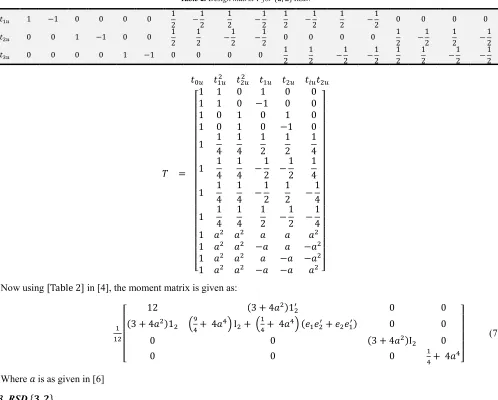
Hence from [Table 1], the design matrix / is arranged as:
Table 2. Design matrix / for K2, 2N RSD.
" 1 −1 0 0 0 0 12 −12 12 −12 12 −12 12 −12 0 0 0 0
" 0 0 1 −1 0 0 12 12 −12 −12 0 0 0 0 12 −12 12 −12
" 0 0 0 0 1 −1 0 0 0 0 12 12 −12 −12 12 12 −12 −12
/ =
e" " " " " " "
f g g g g g g g g g g g g g g g
h1 11 1 00 −1 0 1 0 0 0
1 0 1 0 1 0
1 0 1 0 −1 0
1 14 14 12 12 14
1 14 14 −12 −12 14
1 14 14 −12 12 −14 1 14 14 12 −12 −14
1 * * * * *
1 * * −* * −*
1 * * * −* −*
1 * * −* −* * ij
j j j j j j j j j j j j j j k
Now using [Table 2] in [4], the moment matrix is given as:
f g g g g
h 12 3 + 4* 1. 0 0
3 + 4* 1 lm>+ 4*>n I + l
>+ 4*>n .+ . 0 0
0 0 3 + 4* I 0
0 0 0 >+ 4*>
i j j j j k
(7)
Where * is as given in [6]
6.3. RSD Kp, MN
Table 3. Design points for RSD K3,2N.
" −* −* −* −* * * * *
" −* −* * * −* −* * *
" −* * −* * −* * −* *
At the @ observation. (@ = 1, 2, … , = 26)
The choice of the design points in [Table 3] to satisfy the rotatability relation in [3 ] yields:
2 + 8 ^12_>+ 8*>= 12 ^1 2_
>
+ 24*>
This then gives:
* = `a>sbcd
(8)
Following [1], the model used was
!"= #$" $"+ #" "+ #" "+ #" "+ # " "+ # " "+ # " "+ # " " "+ # " " "+ # " " "+ (" for the @ observation, (@ = 1, 2, … , = 26)
The design matrix / was then arranged as: (APPENDIX I), and the corresponding moment matrix for the design matrix as in [4] is:
a
f g g g g
h 26 (4 + 8* )1. 0 0
(4 + 8* )1 >mt + l>+ 8*>n J ) 0 0
0 0 (4 + 8* )I 0
0 0 0 l>+ 8*>n I ij
j j j k
(9)
Where * is as defined in [8].
6.4. General RSD {L, M}
The above findings were generalized for a { , 2} RSD, and the rotatability conditions too considered obtaining;
* = ` ( 0 )v wx b c d
(10)
From [7] and [9] above, the generalized moment matrix for a { , 2} Rotatable Simplex Design is given as:
ℳ = zA0 A0 00
0 0 A { (11)
Where
M = ^}1 :I + (}1..+ .)_ , M = bI~ and M = dI~(~0 )
In which
N = 2Ck~0 + 4D, b = (k + 1) + 2~a , c =2 + (k − 1)
4 + 2~a> and d =14 + 2~a>
7. Conclusion
Rotatable designs have been widely studied. In recent years more emphasis has been placed by the chemical and processing field for finding regions where there is an improvement in response instead of finding the optimum response (Myers, Khuri, and Carter 1989). In practice, the experimenter aims at obtaining optimal designs with minimum cost.
When experimentation is expensive, difficult or time consuming, rotatable designs seem more appropriate in practice. One of the aims of design of experiment in general is to extract as much as possible information from a limited set of experimental study.
experimental error in a minimum number of required runs.
Appendix
I. Design matrix / for {3, 2} RSD
/ =
e" " " " " " " " " " " " "
f g g g g g g g g g g g g g g g g g g g g g g g g g g g g g g g g g g g g g g
h1 1 01 1 0 00 −11 00 00 00 00 00
1 0 1 0 0 1 0 0 0 0
1 0 1 0 0 −1 0 0 0 0
1 0 0 1 0 0 1 0 0 0
1 0 0 1 0 0 −1 0 0 0
1 14 14 0 12 12 0 14 0 0
1 14 14 0 −12 12 0 −14 0 0
1 14 14 0 12 −12 0 −14 0 0
1 14 14 0 −12 −12 0 14 0 0
1 14 0 14 12 0 12 0 14 0
1 14 0 14 −12 0 12 0 −14 0
1 14 0 14 12 0 −12 0 −14 0
1 14 0 14 −12 0 −12 0 14 0
1 0 14 14 0 12 12 0 0 14
1 0 14 14 0 −12 12 0 0 −14
1 0 14 14 0 12 −12 0 0 −14
1 0 14 14 0 −12 −12 0 0 14
1 * * * −* −* −* * * *
1 * * * −* −* * * −* −*
1 * * * −* * −* −* * −*
1 * * * −* * * −* −* *
1 * * * * −* −* −* −* *
1 * * * * −* * −* * −*
1 * * * * * −* * −* −*
1 * * * * * * * * * ij
j j j j j j j j j j j j j j j j j j j j j j j j j j j j j j j j j j j j j k
References
[1] Box, G. E. P., & Draper, N. R. (1959). A basis for the selection of a response surface design. Journal of American
Statistical Association, 54, 622-654.
[2] Das, M. N., & Narasimham, V. L. (1962). Construction of rotatable designs through balanced incomplete block designs.
Annals of Mathematical Statistics, 33(4), 1421-1439.
[3] Das, R. N. (1997). Robust second order rotatable designs: Part I RSORD. Calcutta Statistical Association Bulletin, 47, 199-214.
[4] Das, R. N. (1999). Robust Second Order Rotatable Designs: Part - II RSORD. Calcutta Statistical Association Bulletin, 49, 65-76. [5] Myers, R., Khuri, A., & Carter, W. (1989). Response Surface
Methodology: 1966-1988. Technometrics, 31(2), 137-157. doi: 10.2307/1268813.
[6] Panda, R. N., & Das, R. N. (1994). First order rotatable designs with correlated errors. Calcutta Statistical Association
Bulletin, 44, 83-101.
[7] Rajyalakshmi, K., & Victorbabu B. R. (2014). Construction of second order rotatable designs under tri-diagonal correlation structure of errors using central composite designs. Journal of
[8] Rajyalakshmi, K., & Victorbabu, B. R. (2011). Robust Second Order Rotatable Central Composite Designs. JP Journal of
Fundamental and Applied Statistics, 1(2), 85-102.
[9] Tyagi, B. N. (1964). Construction of second order and third order rotatable designs through pairwise balanced designs and doubly balanced designs. Calcutta Statistical Association
Bulletin, 13, 150-162.
[10] Victorbabu, B. R., & Rajyalakshmi, K. (2012). A new method of construction of robust second order rotatable designs using balanced incomplete block designs. Open Journal of Statistics,
2(2), 88-96.