Vol.8 (2018) No. 6
ISSN: 2088-5334
The Protection of Masonry Blocks with Using Hydrophobization
Before Load Due to Increased Moisture
Novak Vitezslav
#,Zach Jiri
# #Brno University of Technology, Faculty of Civil Engineering, Centre AdMaS, Purkyňova 139, 612 00 Brno, Czech Republic Email: [email protected]; [email protected]
Abstract—The Faculty of Civil Engineering (Brno University of Technology) has for several years been developing and researching
the properties of modern building materials. One area of research is the development and modification of the properties of masonry elements, particularly masonry blocks that are able to withstand increased moisture loads. These masonry blocks can be used as protection in buildings in flood areas or buildings that may be prone to damage from natural disasters. Increased moisture is one of the most common problems encountered in building structures. Most problems concern moisture in liquid form, which can have significant effects on changing the properties of materials and structures. If the structure of brick blocks is changed by moisture in liquid form due to porosity and water absorption, thereby affecting load, it can reduce the service life of masonry blocks. This paper investigates the use of special silicone products on the surface layer of ceramic masonry elements. The application of these silicone agents forms a protective surface layer on masonry blocks, protecting them via hydrophobisation and the effects of increased humidity. Hydrophobisation reduces water absorption into masonry blocks and eliminates the negative effects of moisture on the properties of masonry blocks. Through hydrophobisation, masonry blocks can be extremely effective for use as preventive protection in case of failure or damage on the part of conventional waterproofing measures.
Keywords— water absorption; hydrophobization; flood; flood area; high humidity; masonry; ceramic masonry elements.
I. INTRODUCTION
A variety of stress types can have an impact on a building as a whole, or on parts of the structure [1]. One of the most common effects causing stress is humidity [2]- [ 4]. The effect of moisture increase on the structure often leads to degradation of the properties of individual and the structure as a whole [5]-[7]. Moisture burdens vertical, horizontal, and inclined structures. Moisture inside the building can affect all states of matter, whether gaseous, liquid or solid [8, 11, 9, 10,12].
Moisture affects the stress of the structure both externally and interiorly. In case of the interior, this concerns especially moisture generated due to normal operations in the form of water vapour. Stress caused by moisture in the exterior includes in particular moisture in the form of climatic stress, i.e., rain and snow, and in extreme cases also natural disasters (flooding). In case of flooding, this also includes stress caused by hydrostatic pressure and possible simultaneous flooding of the construction, both in the exterior and interior.
In case of a ceramic masonry system, increased moisture may result in disintegration and degradation of construction materials and masonry binders, leading to the gradual
degradation of entire walls, which may cause loss of load capacity and structure interaction [3].
Two basic principles for protection against the negative effects of water and moisture on building structure can be applied [8], [13]:
Indirect waterproofing principles: minimising/reducing moisture stress on the structure, e.g., by situating a building in an optimal environment, drainage of the environment adjacent to the building, and increasing the surface temperature of structures.
Direct waterproofing principles: preventing penetration of water and moisture into the structure. Application of waterproof (or vapour-proof) materials to achieve the desired properties, e.g., waterproof coating, use of a waterproof concrete/method, e.g., white tub/ grouting penetration, and impregnation of surfaces and waterproofing surfaces. Active methods [14]-[16] include, e.g., electrokinetic methods, another option for preventing the penetration of water and moisture into the building construction.
structures against increased moisture includes waterproof coating and surface treatments on the exterior [17].
At the time of construction, moisture enters into the individual structures of the construction primarily before roofing of the structural work, and before completion of the surface treatments. If there is no hermetic closure of structures immediately after completion in autumn or winter months, re-evaporation of excess moisture from building structures will occur in spring and summer months. Closure of moisture within the structures will result primarily in the deterioration of the thermal properties of structures and consequently, in the formation of mold and moisture maps.
Moisture increases in the building structure during the use of the building, mainly due to damage failed waterproofing. The cause of this may be the erroneous application of waterproofing or additional applications of penetrations through waterproofing. In such cases, this often becomes a serious problem that affects degradation of the structure, depending on the extent of the moisture stress on the construction.
One of how to protect masonry from moisture stress is through the hydrophobization of various masonry elements. Hydrophobisation changes the absorbency of the surface of masonry elements and thus reduces moisture stress on the structure. Chemical hydrophobization products may significantly affect the final cost of the resulting masonry elements; it is, therefore, necessary to take into account the extent of hydrophobic treatment for individual elements. Hydrophobisation of the bottom part of fittings up to several centimeters appears to be the most suitable practice, both economically and regarding added value. These fittings can be used for the first wall, thereby eliminating the influence of moisture in the substructure, both during the construction phase and the period of use of the building.
II. MATERIAL AND METHOD
A. Hydrophobisation Agents
Ensuring the protection of walls using hydrophobization protection includes the hydrophobization of various masonry elements. Hydrophobisation changes the physical-chemical properties of the given material. Hydrophobisation products form a thin layer, unobservable to the human eye, on the material’s surface. This layer results in the formation of spherical droplets of water, which are not absorbed into the material. Since water does not penetrate into the structure, it cannot deposit undesirable salts into it, which can otherwise cause corrosion, cracking, and other problems [18, 19, 20]. The angle between the surface of the material and the droplet
is called the contact angle and is defined as the angle formed by the intersection of the solid interface and liquid-vapor interface. The larger the angle, the more waterproof the material is. Hydrophobic materials have a larger angle than 90°, which is why they are hydrophobic. In the case of super-hydrophobic materials, this angle is larger than 120°. Importantly, although the layer is waterproof, it is permeable to the passage of gases and vapor [19], [21].
Following previous laboratory experiments, it was discovered that the best hydrophobic results were obtained by the application of products based on silicone. These include organ silicon compounds characterized by high thermal resistance in the range of
-50°C to 200°C, resistance to sudden temperature changes, to weather effects and sunlight, and by high chemical resistance. The hydrophobic coating is formed through the intermolecular condensation of low-molecular methyl siloxanes, the effect of atmospheric carbon dioxide. The main condition of the hydrophobic effect is the orientation of the silicone molecules towards the surface of construction materials, and the large quantity of, albeit short, hydrocarbon residues (e.g., methyl and ethyl (CH3-, C2H5-). This weak, often macromolecular film increases the contact angle to such an extent that capillary rise is limited to zero; it may even cause capillary depression. This principle maintains the permeability of building materials to gasses and vapor. These waterproofing agents cannot be used when operating in water under pressure [22].
The most commonly used silicone waterproofing agents include solutions of silicone resins in organic solvents, mostly in white spirit or industrial spirit. Resin content typically ranges from 3-8% and consist of a single component; they are generally colorless or slightly yellow. The transparent and hydrophobic effect arises immediately after solvent evaporation. Such agents cannot be used on wet surfaces but can be used for hydrophobization of previously already hydrophobic materials. The presence of solvents is disadvantageous regarding fire, environmental aspects, and pose potential health hazards.
Another type of silicone hydrophobic agent solution includes low-molecular compounds, oligomers, which spontaneously polymerize after application to form the desired polymer, the result of atmospheric moisture. They usually consist of a single component and are transparent and colorless. Compared to solutions of high-molecular-weight resins, their advantage is that they can bind chemically to the surface of quartz grains in the treated material (if present), increasing their abrasion resistance. Sometimes they are supplied as a concentrate, and the user
needs to prepare the suitable agent by mixing with a suitable solvent. Another advantage is the improved ability of these compounds to penetrate into porous materials.
A special group includes silicone microemulsions. These are also relatively low-molecular-weight silicone compounds that can form an emulsion with very small particles due to the structure of their molecules, following mixing with water. A slow reaction with water then gives rise to the desired hydrophobic polymer. Their advantage is this miscibility with water, which allows one to avoid organic solvents and good penetration ability.
Silicon hydrophobic agents include methyl silanolates (methyl silicones) comprising sodium or potassium. These substances are a type of hydrophobic variant of water glass. Like water glass, they turn into a modified gel of silicic acid upon contact with carbon dioxide, in this case, a hydrophobic gel, Unfortunately, a metal hydroxide (containing sodium or potassium) is released during this chemical reaction, and later turns into carbonate. This means that undesirable, water-soluble efflorescent salts contaminate the structure of the treated material. Their presence poses the risk of the formation of whitish efflorescence, in the worst case, even degradation of the treated material due to crystallization pressure. The advantage of silicones is their good solubility in water (i.e., the possibility of application to wet surfaces), and compared to other silicone compositions, their affordability. The resulting gel is insoluble and therefore practically irremovable. Silanolates are recommended for the protection of monuments, due to their high solubility and low price [23, 24].
B. Testing Methodology For The Hydrophobisation of Masonry Blocks
The hydrophobic efficiency of ceramic fittings was measured by determining (1) absorption and (2) capillary absorption. The effect of the concentration of hydrophobic agents on the depth of the efficient protection of hydrophobic fittings was also examined.
C. Hydrophobisation of ceramic blocks
Four hydrophobic agents (A – based on triethoxy(octyl)silane, isotridecanol and ethoxylated; B – Based on silicon compounds, nonylphenol and ethoxylated; C – based on organofunctional polysiloxane; D – based on silan-siloxane) in the concentrations 1:30 and 1:50 were
selected to study the hydrophobization of masonry blocks (the hydrophobic agent was always diluted shortly before the application of distilled water).
Each of the tested blocks was weighed before testing, and its weight was recorded. Subsequently, the block was immersed in the appropriate concentration of the hydrophobic agent, and always up to a height of 70 mm from the lower edge of the block. The measured time of hydrophobization of the block was 10s. After pulling the block from the hydrophobic solution, the block was left to dry out on a wooden grid under laboratory conditions freely.
D. Determination of absorption and capillarity
After drying to a constant weight (seven days), the blocks were placed onto a grid fitting and water at a temperature of +20±2°C was poured over them, up to a height of 50 mm from the lower edge of the block. The water level was continuously monitored and adjusted to ensure constant testing conditions. Before the weighing of each block it was removed from the water after the determined time, and placed on a wooden grate for one minute to drain excess water; it was then weighed.
The effect of the hydrophobic agent water was monitored according to the amount of water absorbed during testing. The amount of absorbed water was always determined by weighing the blocks in the selected time interval. This addressed (1) mass absorption and (2) recalculation of capillary absorption per the surface of the block.
cb d
cb d cb w w
m
m
m
A
, ,
,
−
=
(1)A
m
m
C
a wcb dcb,
,
−
=
(2)E. Determination of hydrophobic depth protection
After determining capillary absorption, samples with a thickness of 50 mm were cut from the lower parts of hydrophobic blocks. These samples were dried and subsequently soaked in water dyed with pigment for 10 s.
The depth of efficient hydrophobic protection was visually recognizable due to the color shade of the hydrophobic and non-hydrophobic parts of the fragment.
III. RESULTS AND DISCUSSION
A. Absorption and capillary absorption
The results determining absorbability and capillary absorption for the individually tested hydrophobic agents are indicated in the following tables and graphs.
The study first focused on learning what influence the selected hydrophobic agents had at the given concentrations of 1:30 and 1:50 (Fig. 3) on the water absorption of blocks. The values of capillary absorption for hydrophobized blocks (fittings) were compared with the values of capillary absorption for non-hydrophobic- reference fitting (REF).
The values of capillary absorption clearly show that the use of all hydrophobic agents tested resulted in its significant reduction. The best results were achieved by the application of agents B and D, which were used for further testing at a
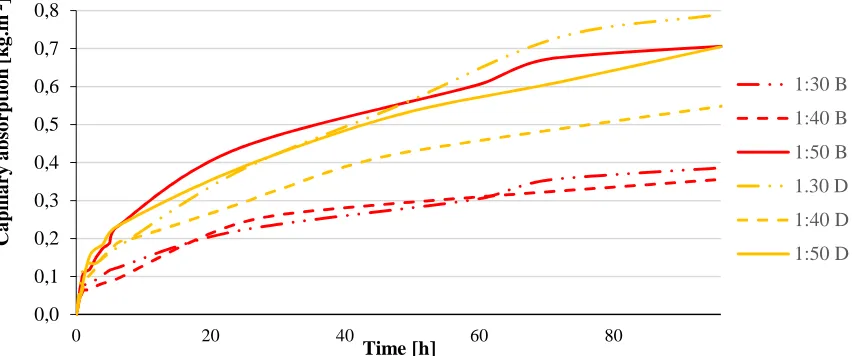
later stage. First, an additional test of absorption with the hydrophobic agents at a concentration of 1:40 was performed (Fig. 4).
It appears that 1:40 was an optimal concentration for the intended purpose. After consulting the results alongside the manufacturer of the ceramic blocks, it was decided that the next testing step of hydrophobization would concern the use of pigment.
This next step involved the design of optimal pigmentation and the determination of the influence of the pigment on the performance of the hydrophobic agents. Pigmentation is particularly useful in cases where only a part of the masonry unit is being hydrophobized, and where it is necessary to distinguish between the hydrophobized and non-hydrophobised parts.
Fig. 3. Capillary absorption for using concentrations 1:30 and 1:50
Fig. 4. Capillary absorption using concentrations 1:30, 1:40, and 1:50.
Based on market research, an organic pigment compatible with siloxane-based hydrophobic agents was chosen. It was applied together with the hydrophobic agents as one mixture;
the concentration of hydrophobic: pigment was 1:0.04. The pigment’s influence on the final capillary absorption was only tested with the concentration of 1:40. For the results, see Tab. 1 and Fig. 5.
0,0 1,0 2,0 3,0 4,0 5,0 6,0 7,0 8,0
0 10 20 30 40 50 60 70 80 90
C
a
p
il
la
ry
a
b
so
rp
ti
o
n
[
k
g
.m
-2]
Time [h]
RE F 1:5 0 A 1:3 0 A 1:5 0 B 1:3 0 B
0,0 0,1 0,2 0,3 0,4 0,5 0,6 0,7 0,8
0 20 40 60 80
C
a
p
il
la
ry
a
b
so
rp
ti
o
n
[
k
g
.m
-2]
Time [h]
1:30 B
1:40 B
1:50 B
1.30 D
1:40 D
TABLEI
CAPILLARY ABSORPTION MEASURED IN TIME.
Hydrophobic
liquid B B + pig. D D + pig.
Concentration 1:40 1:40:0.04 1:40 1:40:0.04
Time [h]
2 0.06 0.04 0.10 0.08
4 0.08 0.05 0.15 0.14
6 0.09 0.07 0.19 0.15
24 0.24 0.16 0.29 0.32
48 0.29 0.21 0.43 0.45
72 0.33 0.22 0.49 0.52
96 0.36 0.28 0.55 0.59
Fig. 5. Capillary absorption using pigment.
The values of capillary absorption appeared to be heavily influenced by the addition of pigment to the hydrophobising solution. While in the case of hydrophobic agent D, capillary absorption was only reduced by 1% at a time of 96 h, the presence of pigment in hydrophobic agent B caused capillary absorption to decrease by 25% at the time of 96 h.
B. Depth of hydrophobic protection
This step of the researchers measured the depth to which the hydrophobic preparation penetrated the body of the ceramic masonry units. Fig. 6 shows the results of this measurement. Depth was always measured in five areas on two specimens, which were treated by the same hydrophobic agent and at the same concentration.
Fig. 6. The depth of hydrophobic protection using pigment.
The effective depth of hydrophobic protection provided by agents ranged between 0.5 and 1.5 mm. The results show that hydrophobic agent B protected the material to a depth of 50% greater than agent D. Specifically, this depth ranged between 1.0 and 1.5 mm.
C. Simulation of aging by UV light
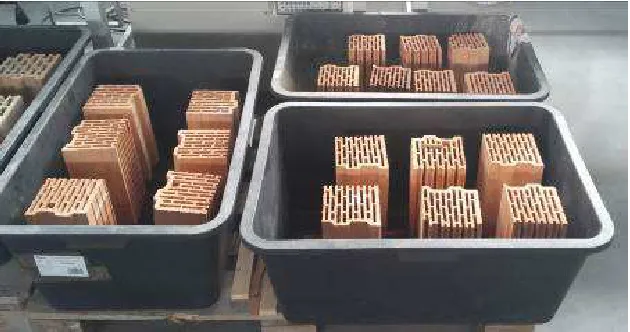
The specimens were then tested regarding the resistance of their hydrophobic protection to UV light (simulation of masonry exposed to sunlight with no plaster applied). The principle was to expose the specimens to UV light provided by a lamp set to an intensity of 45 W/m2 at a black-body temperature of 60°C, and relative humidity of 11% (dry period). The intensity of the UV lamps lighting the surface of each specimen was not to differ by more than 10% between two irradiated points. When inside the testing device, the specimens were sprinkled with demineralized water with a specific conductivity of 500 μS/m, and at a temperature of 25±5°C. The sprinkling was uniform and continued for 60 minutes (wet period).
The specimens were aged for 21 days during a pre-programmed cycle, which was set according to ČSN EN 1297 [25]. A cycle took 360 minutes, of which 300 minutes were taken up by the dry period and 60 minutes by the wet period. There were a total of 84 cycles.
Fig. 7. Exposure UV radiation
Fig. 8. The depth of hydrophobic protection following UV radiation.
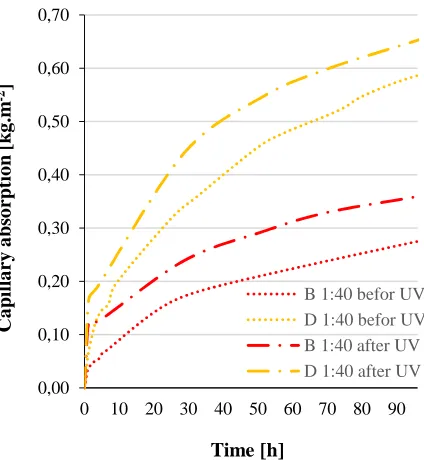
The test was conducted with specimens treated by hydrophobic agents B and D, mixed with the pigment at a concentration of 1:40:0.04. After the specimens had been exposed to UV light, their capillary absorption and depth of effective hydrophobic protection were tested again. The
0,00 0,10 0,20 0,30 0,40 0,50 0,60 0,70
0 10 20 30 40 50 60 70 80 90
C
a
p
il
la
ry
a
b
so
rp
ti
o
n
[k
g
.m
-2]
Time [h]
1:40 B
0,00 0,25 0,50 0,75 1,00 1,25 1,50
B D
D
ep
th
o
f
p
ro
te
ct
io
n
[
m
m
]
Conditions hydrophobization [-]
0,00 0,25 0,50 0,75 1,00 1,25 1,50
B befor UV B after UV D befor UV D after UV
D
ep
th
o
f
h
y
d
ro
p
h
o
b
ic
p
ro
te
cti
o
n
[m
m
]
results were compared with those obtained prior to UV light exposure.
Fig. 9. Capillary absorption following UV radiation.
Exposure to UV light caused some changes in the properties observed. The depth of effective hydrophobic protection decreased by approximately 40% in the case of agent B, and in the case of agent D, by approximately 65% (Tab. 2).
TABLEII
THE DEPTH OF HYDROPHOBIC PROTECTION AFTER UV RADIATION.
Depth of protection
[mm]
min median max average
B before UV 1.02 1.18 1.45 1.22
B after UV 0.41 0.72 0.89 0.68
Change 60% 39% 39% 44%
D before UV 0.49 0.77 0.96 0.75
D after UV 0.11 0.25 0.47 0.27
Change 78% 68% 51% 65%
Exposure to UV light also resulted in increased capillary absorption. An increase in water absorption was observed in specimens treated by both agent B and D. The most significant difference was observed between 0 and 2 hours. Prior to exposure to UV light, the increase of capillary absorption during this period was slow and smooth; however, after exposure, capillary absorption increased in sudden increments up to more than 0.1 kg.m-2 in both hydrophobic agents, which in the case of agent B meant an increase by more than 200% and in agent D, by more than 100%. Later, the capillary absorption of specimens following UV light exposure stabilized and roughly corresponded to a gradual increase, much like in the case of specimens that were not exposed to UV light. At a time of 96 hours, the magnitude of deterioration of capillary absorption in the case of agent B
was 30% and 10% in the case of agent D. Table 3 below shows a complete summary of the results.
TABLEIII
CAPILLARY ABSORPTION FOLLOWING UV RADIATION.
Time [h] 2 6 24 96
B 1:40 before UV 0.04 0.07 0.16 0.28
B 1:40 after UV 0.13 0.13 0.24 0.36
Charge 225% 86% 50% 29%
D 1:40 before UV 0.08 0.15 0.32 0.59
D 1:40 after UV 0.17 0.20 0.44 0.65
Charge 113% 33% 38% 10%
D. Evaluation of results
Fig. 3 and Fig. 4 summarise all the values obtained during testing about the effectiveness of hydrophobic agents. The data shows that the application of these agents reduced the capillary absorption of the masonry units’ ceramic body, compared to reference values. The concentration of agents affected their efficiency. Concentrations of up to 1:50 were tested; this ratio is much lower than the concentration recommended by manufacturers, which range between 1:1 and 1:10.
The performance of all agents was best at a concentration of 1:40. The overall best results were measured for hydrophobic agent B at a concentration of 1:30. Compared to a non-treated ceramic block, which reached a capillary absorption of 7.33 kg.m-2 after 24 h of loading by moisture, the capillary absorption of a hydrophobized ceramic block was below 0.22 kg.m-2. Even after a week-long uninterrupted moisture loading, the capillary absorption of hydrophobized blocks did not exceed the value of 0.4 kg.m-2.
Hydrophobic agents B and D were also tested in combination with pigment (Table 1 and Fig. 5). The outcome of this test indicated the influence of pigment on capillary absorption as being unpredictable and as such, each particular combination with a hydrophobic agent must be tested individually. The pigment improved the performance of agent B; however, it reduced the effectiveness of agent D. Given the effective depth of hydrophobic protection, agent B appears more suitable, as it reached an effective depth of above 1 mm. This depth can be considered sufficient for providing adequate hydrophobic protection, even in cases where the ceramic blocks suffer some surface abrasion during handling and transport. However, hydrophobic protection cannot be guaranteed if a piece of the hydrophobized part should chip off.
Exposure to UV light resulted in worse capillary absorption and reduced the effective depth of hydrophobic protection in both agents B and D (Tables 2 and 3). UV light also increased the capillary absorption in specimens treated by agent B by 29% after 96 hours and reduced the sufficient depth of hydrophobic protection by 44%.
0,00 0,10 0,20 0,30 0,40 0,50 0,60 0,70
0 10 20 30 40 50 60 70 80 90
C
a
p
il
la
ry
a
b
so
rp
ti
o
n
[
k
g
.m
-2]
Time [h]
IV. CONCLUSION
These tested hydrophobic agents cannot be regarded as full replacements for an insulation coating, but it is possible to use them for the protection of walls during construction of a structure. Additionally, hydrophobic agents form a sufficient protection in case of occasional moisture stress in the lower part of walls (splashing moisture from precipitation).
Absorptivity is reduced due to the hydrophobization of masonry blocks, which has a hugely positive effect on moisture capillary absorption. This fitting is one of the basic building blocks, and can also serve for the development of masonry designed for flood areas. In this context, we are currently working on the development of other parts of masonry intended for flood areas, as well as their mutual interaction.
In terms of research at VUT (University of Technology) in Brno, we are working on designing technology for the construction of waterproof masonry involving the use of hydrophobic (water-repellent) ceramic brick masonry blocks, glued both to the coursing and butt joints, and including a hydrophobic surface finish (plaster) on the exterior and interior. In the context of experimental works, the application of hydrophobic agents is carried out both on the surface of ceramic masonry fittings and as part of plaster mixtures, to reduce the absorbability of individual components in the masonry system. The reduction of absorbability in individual components renders masonry and walling systems more appropriate for areas with a higher risk of moisture stress. The topic of hydrophobization of construction products has been addressed in some scientific studies. However, the hydrophobization of the ceramic masonry elements, which apply to areas with increased moisture stress and the influence of aging by UV radiation is a new direction of research.
Fig. 10. Ceramic masonry block with the application of hydrophobic agent B (based on a silicon compound, nonylphenol, and ethoxylate) and pigment at a concentration of 1:40.
The masonry should also be useful for the construction of the substructure up to the height of expected possible flooding in the case of operating humidity load. The use of this masonry is also appropriate regarding prevention, e.g., measures in case of incidental humidity load. These
masonry components can also be successfully applied during the study and research of a walling system designed for flood areas. Realistic interaction of individual components, including efficient solutions for butt and coursing joints for this type of masonry, is currently in the research phase.
ACKNOWLEDGMENTS
This paper was written under the project No. LO1408 “AdMaS UP - Advanced Materials, Structures, and Technologies,” supported by the Ministry of Education, Youth and Sports under the “National Sustainability Programme I” and under the project of the Technology Agency of the Czech Republic ref. n. TA04020920.
NOMENCLATURE
Aw absorption in time %
Ca capillary absorption in time kg.m-2
mw,cb weight of wet ceramic block kg
md, cb weight of dry ceramic block kg
A surface ceramic block of the stress of water m2
REFERENCES
[1] J. F. Straube. Moisture in building, ASHRAE (Journal 44), pp. 15-19, 2002.
[2] Ch. Hall, W.D. Hoff, H.A. Viles, J.A. Eklund. Moisture dynamics in walls: Response to micro-environment and climate change, (Proceedings of The Royal Society A 466), pp. 194-211, 2010. [3] T. Ritchie. Moisture degradation of masonry walls, Proceedings of
the 1st Canadian Masonry Symposium held at the University of Calgary, pp. 66-71, 1976.
[4] T.D. Gonçalves, L. Pel, J.D. Rodrigues. Drying of salt-contaminated masonry: MRI laboratory Monitoring, (Environmental Geology 52), pp. 293-302, 2007.
[5] D. D'Agostino. Moisture dynamics in a historical masonry structure: The Cathedral of Lecce (South Italy), (Building and Environment 63), pp. 122-133, 2013.
[6] C. Gentilini, E. Franzoni, S. Bandini, L. Nobile. Effect of salt crystallization on the shear behavior of masonry walls: An experimental study, (Construction and Building Materials 37), pp. 181-189, 2012.
[7] P. Kotlík. Stavební materiály historických objektů – materiály, koroze, sanace, Vysoká škola chemicko-technologická v Praze, Praha, 1999.
[8] Czech standard ČSN 73 0600 Waterproofing of buildings – Basic provisions, (Czech standards Institute), Prague, 2000.
[9] M. Blaha, L. Bukovský. Prevence a odstraňování vlhkosti, (ERA group spol.s.r.o.), Brno, 2004.
[10] M. Balík. Vysušování zdiva III, (Grada Publishing, spol. s r.o.), Praha, 1999.
[11] M. Balík, a kolektiv. Odvlhčování zdiva, (Grada Publishing, spol. s r.o.), Praha, 2008.
[12] M. Balík. Vysušování zdiva I, (Grada Publishing, spol. s r.o.), Praha, 2002.
[13] Czech standard CSN P 73 0610 Waterproofing of buildings – The rehabilitation of damp masonry and additional protection of buildings against ground moisture and atmospheric water – Basic provision. (Czech Standards Institute), Prague, 2000.
[14] D. Beden, Z.Z. Manko. Influence of selected hydrophobic agents on some properties of autoclaving cellular concrete (ACC), (Construction and Building Materials 25), pp. 282-287, 2011. [15] M. Medeiros, P. Helene. Efficacy of surface hydrophobic agents
in reducing water and chloride ion penetration in concrete, (Mater Struct 41), pp. 59-71, 2008.
[16] L. Wolf, M. Raupach. Hydrophobization of concrete products,
(Betonwerk und Fertigteil-Technik, 69),
pp. 12-21, 2003,
[18] M. Balík. Odvlhčování staveb 2., (Stavitel), 2008.
[19] P. Kotlík. Hydrofobizace stavebních materiálů [online], 2008, [cit. 2015-02-26].
[20] F. Bamoharram, M. Heravi, S. Saneinezhad, A. Ayati. Synthesis of a nano organo-silicon compound for building materials waterproofing, using heteropolyacids as a green and eco-friendly catalyst, (Progress in Organic Coatings 76), pp. 384-387, 2013.
[21] Surface science techniques [online], 2013, [cit. 2015-02-27]. [22] R. Drochytka. “Plastic substances”, (Study support BUT), Brno,
2007.
[23] J. de Vries. R.B. Polder. Hydrophobic Treatment of Concrete, (Internationale Zeitschrift für Bauinstandsetzen 2), pp.145-160, 1996. [24] P. Kotlík. Stavební materiály historických objektů, Praha, 1999. [25] Czech standard CSN EN 1297 Flexible sheets for waterproofing -
![Fig. 1. The orientation of silicone molecules [7].](https://thumb-us.123doks.com/thumbv2/123dok_us/9987666.1986940/2.595.82.503.636.756/fig-orientation-silicone-molecules.webp)
![Fig. 6. The depth of hydrophobic protection using pigment.Conditions hydrophobization [-]](https://thumb-us.123doks.com/thumbv2/123dok_us/9987666.1986940/5.595.60.260.515.643/fig-depth-hydrophobic-protection-using-pigment-conditions-hydrophobization.webp)