Vol.9 (2019) No. 1
ISSN: 2088-5334
Uniform Distorted Scene Reduction on Distribution of Colour
Cast Correction
Muhamad Lazim Talib
#, Mohamad Faidzul Nasruddin
#, Siti Norul Huda Sheikh Abdullah
# #Center for Artificial Intelligence and Technology, Faculty of Information Science and Technology, Universiti Kebangsaan Malaysia, 43600 Bangi, Selangor, Malaysia
Email: [email protected], [email protected], [email protected]
Abstract— Scene in the photo occulated by uniform particles distribution can degrade the image quality accidently. State of the art
pre-processing methods are able to enhance visibility by employing local and global filters on the image scene. Regardless of air light and transmission map right estimation, those methods unfortunately produce artifacts and halo effects because of uncorrelated problem between the global and local filter’s windows. Besides, previous approaches might abruptly eliminate the primary scene structure of an image like texture and colour. Therefore, this study aims not solely to improve scene image quality via a recovery method but also to overcome image content issues such as the artefacts and halo effects, and finally to reduce the light disturbance in the scene image. We introduce our proposed visibility enhancement method by using joint ambience distribution that improves the colour cast in the image. Furthermore, the method is able to balance the atmospheric light in correspondence to the depth map accordingly. Consequently, our method maintains the image texture structural information by calculating the lighting estimation and maintaining a range of colours simultaneously. The method is tested on images from the Benchmarking Single Image Dehazing research by assessing their clear edge ratio, gradient, range of saturated pixels, and structural similarity metric index. The scene image restoration assessment results show that our proposed method had outperformed resuls from the Tan, Tarel and He methods by gaining the highest score in the structural similarity index and colourfulness measurement. Furthermore, our proposed method also had achieved acceptable gradient ratio and percentage of the number of saturated pixels. The proposed approach enhances the visibility in the images without affecting them structurally.
Keywords— uniform distorted scene; colour cast; colour correction.
I. INTRODUCTION
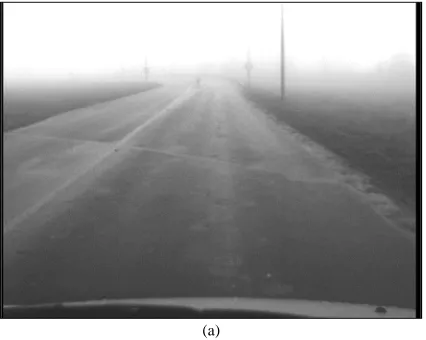
The colorful scenery will reduce its quality and also hard to recognize because of the uniform scene distorted [1]. Uniform scene distorted in the image may cause noise and artifact [2]. The main activities like object recognition, tracking, and monitoring in outdoor camera system often disruption with the weather, as haze and fog [3]. Haze is tiny particles, and vapors distribute in the air that may reduce the performance of the vision system as light disturbance, and uniform scene distorted [4]. However, this problem occurred by scene depth and irregular light received across the line of the observance [5]-[7]. Cordially, this result of uniform scene distorted differ as usual depend on various light sources that effect to the scene look like the air color veil in the physical uniform scene distorted model. The light effect to this veil across the view of the observance. Therefore, the scene will reduce its colorfulness, and real structure due to this matter occurred [8], [9]. Figure 1 shows the uniform scene distorted model.
Currently, the approaches of pre-processing to enhance visibility use the local windows of the image scene [5]. These approaches’ purpose is to estimate air light and transmission map. However, the uncorrelation between the global window and the local window may occur the artifact and halo effect after the process [5], [8]. As an example, Tarel used the higher local contrast to estimate air light and transmission map by maximizing the local contrast. Hence, for this approach occurred over saturation of color.
Fig. 1. Uniform scene distorted model
Two safety alertness steps will be introduced accordingly. The first step is to project the image on the display by the front camera after the elimination process that will enhance the vision of the scenery. The second step is a combination of preliminary or initial price the ss and object and scene recognition that may be as obstacles across the line of driving performance that alert the driver during the vehicle [12]. The scenario will happen, when the driver near the limitation of vision against the speed of the vehicle. This procedure to obtain the safe driving mode by use of the single camera in the front of the vehicle that will get an instant response during the serial of scene frame processing and risk calculation in the real time. However, the primary matter occurred is not the color cast image. The contrast enhancement during the process is not necessary, but the way of distance detected estimation is the principal use [9], [13]. Therefore, the scenario of the fog and haze occurred physically. The scene recovery needs to estimate both the environment light sources and a depth map of the scene accordingly. As a result, this two variables per pixel value need to determine from this single image wisely [9], [14]. Hence, this study introduced the method to increase visibility by using joint ambiance distribution that affects the colorcast in the image. The method estimates the atmospheric balance light the o the depth map accordingly.
This paper follows the baseline of the following section. In section 1, the general purpose of the method deliberates structurally. Section 2 describes the model of uniform scene distorted, related work and method. Meanwhile, section 3 discussed the detail information of the method assessment. Finally, in section 4, the conclusion of the overall research and study finds.
II. MATERIAL AND METHOD
The purpose of this study is to introduce an optical model with a description of the hazy images character and the restoration technique. Therefore, the combining strategies to remove scattering particles proposed to overcome artifact and halo effect using minimum intensity of RGB channel in the global window.
A. Retinex Theory
Rea next theory is the method to achieve color constancy. This method improves the image quality according to person vision [15]. The illumination and reflectance component are the escribing as the color of the object depends on the lighting source that image intensity I(x,y) against the weight
age of illumination, L(x,y) and color cast reflected, R (x,y). The equation in (1) is described as follow:
I x, y L x, y ∙ R x, y (1)
Description :
I x, y : Image light intensity L x, y : Illumination weightage R x, ya : Colour Reflection
The lighting comes from several sources across the image. Therefore, image lighting is suitable to find through low pass filtering that filters the image usually. The particles feature distribution in the scene could be approximated with the Gaussian distribution; some further details are disposed of in the Gaussian filter processing and cause crossing the color unity. T too overcome this matter occurred, the Bilateral filter is used forward based on the Retinex theory to determine image lighting g components [16]. While it is easy to apply, the edge-to-edge sharpness may blurry, and impulse noise occurs as extra content. However, the result of using this step is time-consuming, cast and fails to remain n a variety of the color [17].
B. Uthe uniform Scene Distorted Model
The previous Study of the previous method aligns the interest to enhance image quality using the physical model character and discipline. Hence, the varieties of the approach introduced to overcome and restore the cast image without depending on other sources of information. Athe s an example, the use of local window processing and graphical model to eliminate the existence of the haze [18]. As a result, this method got the great achievement to separate unrelated fields. However, this kind of the method needs the expensive computer the costs [18], [19].
On the other hand, the method uses the processing kernel and optimize the contrast not always got the same result during each saturation iteration. However, the method comes more generic and easy to identify a different variety of the scene. Specifically, this the processing able to color image and image of grayscale. Thus, during this process may take expensive data cost and decrease the speed of time processing. In the way of use fusion strategy, the two of original input will derive to get the correlation between the input determinations. The feasibility and effectiveness of the fusion strategy could achieve to eliminate the haze, but content of the color is fatal during recovery of the image by unclear and incorrect color contrast [17], [18].
transmission map. In addition, the anisotropic diffusion is introduced to refine the transmission map after using the dark channel prior [20], [21].
Generally, according to dark channel prior method describe the intensity atmospheric light scene as the infinity scene brightness content the key of the interest value that recovers the scene using of the physical atmospheric scattering model [20]. If the global atmospheric light estimation is stronger than a regular characteristic of atmospheric. The result of the image may become darker. Thus, the halo effect and over-saturation will happen in the sky during the estimating process if the estimation value is less than the actual value [21]. Figure 2 shows the experimental result with various global atmospheric light values through the recent methods. The atmospheric light accuracy had been improved to the selected 0.2 % bright pixels in the dark channel prior. However, the uncorrelated global atmospheric value will have occurred across the white objects [22]. Combination of selecting top 0.1% brightest value in the dark channel prior and top 30% darkest value in the bright channel overcome this matter. However, the result may dull due to the lack of light value across the scene [23]. Visibility will be increased according to the larger coefficients that multiplied the gradient value due to the smaller transmission value. This study will be altering the following condition to avoid the weakness that occurred as follow as previous works. The restoration function process in the gradient of the scene to refine the actual transmission correlation. In addition, visibility can be restored by use of multiple scale methods in the area of very tiny deliveries and obtain the close contrast range. However, adjusting the scene gradient will make the dynamic range image raise to high dynamic networks that will make the image result to darken or become exposed. This method uses multiple linear dynamic compression that easy to avoid uncorrelated value but sometimes it will slightly obscure part of its granules. Another disadvantage is the complexity of expensive calculations. In addition, although the result is free of artifacts, color changes and image structures should not be ignored. Colour saturation will fail when the colorcast exists onto the original scattered image. Deviation of the boundary of the sky aborted than the color of the area of the boundary will be oversaturated and the colorcast will become clear.
(a)
(b)
(c)
(d)
Fig. 2. Input (a), Dark Channel Prior Method (b), Maximising the Contrast Method (c) and Maximising Atmospheric Light Veil method (d)
specific event. Therefore, the result will be got the eliminate process without halo and artifacts effect in the whole scene. Then, the local atmospheric light veil and the transmission map that calculated to describe the RGB channel structure that comes from a uniform scene distorted model.
C. Proposed Methodology
The scattered particle model or image degradation model is the attenuation of light through the atmosphere between the observer and the object [24]. The equation (2) shows the baseline that elaborate uniform scene distorted model.
, , . , + . 1 − , (2)
Description :
I(x, y) : Uniform scene distorted intensity
J(x, y) : Clear intensity
A : Atmospheric light
t(x, y) : Transmission value
Where I(x, y) is the uniform scene distorted intensity of the image or haze, whereas J(x, y) is the sun's rays, indicating the reflection of the scene's eyes towards the audience. This J(x, y) describe the intensity of the bright image. A is the atmosphere of global atmospheric light, and t(x, y) is a transmission value that describes the range of independent light and touches the camera lens. The aim of elimination the haze is to restore J(x, y), A and t(x, y) from I (x, y). In general, in image recovery, A and t (x, y) are the first estimates of I(x, y), then include them in the model in equation (1) for recovery J (x, y).
The first part of J(x, y).t(x, y), to the right of equation (2) is called direct transmission or lower transmission while the second part A.(1 - t(x, y)) is called the lamp. Here, transmissions continue to be described as non-scattered or light-shining scenes after the attenuation of the medium, while the aerial light produces scattered atmospheric debris and lead to the color event of the scene.
Based to optical model followed the Koschmieder's law as described in equation (4) by manipulating recover , as equation on in (3) [8]. Therefore, rearrange and expand the equation as (5). Then, simplified as equation (6).
, . , (3)
, . , . , + . 1 − , ) (4)
, . , . , + − . , (5)
, . , − 1 . , + 1 (6)
Description :
H(x, y) : Haze or foggy intensity
O(x, y) : Reflection intensity
C(x, y) : Clear intensity
G : global atmospheric light
m(x, y) : Transmission value
Where H(x, y) is the intensity of the foggy image, A is the light brightness or the maximum intensity value in the RGB color model, O(x, y) is the intensity reflection of the object and m(x, y) to the intensity of the foreground. This equation is based on the Retinex Theory which H(x, y) remains as the intensity of the haze image, G is the constant light as the weight of the light, and the parameters O(x, y) and m(x, y) are part of the color reflection phonology. Usually, while there is clear or any medium occult in the image. So that this image can be converted to HSI color space to eliminate color cast in the image. The equation (7) represents the event or scenario.
, . 1 (7)
This occurred while the m (x,y) is ∞ or 0. Then the alter of the equation it could be as the equation (8).
, . + 1 (8) After that, the equation (9) estimate the global atmospheric light.
! max #, $, % (9)
Description :
G : Global atmospheric light
# : Red intensity $ : Green intensity
% : Blue intensity
Where G is the estimation of the global atmospheric light constant that affecting the scene statically. From the equation (8), we assume that α is the distribution of colorcast occurred in the RGB channel intensity. Then, the α is elaborate as equation (10)
, − 1 (10)
Then, this study did in the haze image and the clear image, the brightness of the scene is equally the same. So that the equation of haze image can be described as retinex equation as equation (11).
&' log+' , − log+- ∗ ' , (11)
III. RESULTS AND DISCUSSION
Due to the difficulty of obtaining corresponding benchmark image data for haze and foggy image inputs, this study took four assessments for quantitative evaluation of this proposed method and compared with others method. These four assessment metrics are called the recently viewed edge ratio (ϵ), the gradient ratio (ǥ), the percentage of the number of saturated pixels (Σ), the structural similarity index (Ş) and colorfulness (Ͼ). The first three metrics are suggested by Hautiere et al. for the objective blind assessment of the effects of the removal of the haze [12]. The (ϵ) represents rate edge recovery appears in haze-free images and is rendered by equation (12).
/ 0#− 00 1 1
(12)
Description :
Vr : Visible edge restored image
Vo : Visible edge original image / Edge ratio
Where Vr and Vo describe the total number of visible edges within the restoration of the foggy image and the original foggy image respectively. The metric ϵ assesses the effectiveness of the uniform scene distorted method to return the invisible edge to the original image but appears in the photo-released haze; the value higher than ϵ shows better performance than the image removal method of the image because the net image has a more precise and clearer contrast than the blurry image. Furthermore, metric (ǥ), are used to state quality of contrast recovery in haze-free images. As alike that, the metrics formulated as follows equation (13).
ǥ e4 567∑<∈>9:; # (13)
Description :
P : Similar element in set C
r : Gradient rate
Vr Visible edge restored image ǥ Gradient ratio
Where P is the same element in set C (color channel), and r is the gradient rate between the blurred image being recovered and input blur image. Note that C is comprised of visible edges in blurry image restored. In addition, Σ metric as equation (14) describes the number of pixels, which are either too white like white or less lightly like black in the restored image.
Σ A 0@ B A C
(14)
Description :
0@ : the sum of both over saturation and pixel underexposed in the restored image
dimx : Dimension x
dimy Dimension y
Σ Percentage of pixels that become entirely black or white entirely after recovery
Where Vs describe the sum of both over saturation and pixel underexposed in restored image and dimx dimy become the size of the outcome image. The Σ metric describes the percentage of pixels that become completely black or white completely over the recovery. For evaluation of structural Ş, image quality is obtained through haze removal approach before being measured using the structure index of similarity images. Structure similarity index value is based on comparative lighting, contrast, and structure original blur image value and unclear image [26]. The measurement of the Ş or structural index is expressed in equation (15).
Ş A 2A#A1 + F5 2G'G#+ FH #H+ A1H+ F5 G#H+ G1H+ FH
(15)
Where F5 and FH is a constant, defined as F5 I5J H and FH IHJ H
WhereI5, IHare constants and J is a dynamic array of pixels values (255 for 8 bit greyscale images), A# and A1 shows min the intensity of input and output images, respectively, and G'and G# show contrast input image and output image respectively. For the colourfulness measurement Ͼ, the distribution of the image pixels in the CIELAB colour space used and the mathematical formula for calculating as equation (16).
Ͼ L + 0.94 + P (16)
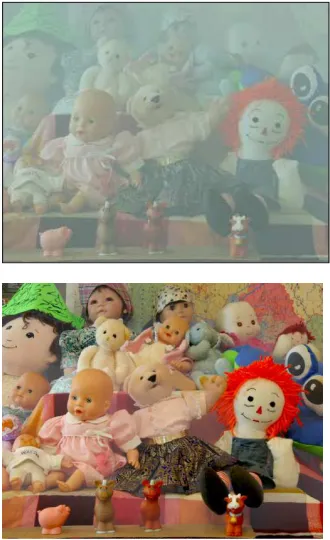
Where L is calculated as √RH+ SH and R , S are the Standard Deviation of Chroma components in CIELAB color space. P is the mean of C component and C(i, j) is calculated as TR A, U H+ S A, U H [26]. This study implements three images with the following texture differences as figure 3, figure 4 and figure 5.
.
Fig. 4. Sample Input (top) and output (bottom) of Uniform scene distorted named New York
Fig. 5. Sample Input (top) and output (bottom) of Uniform scene distorted named Roof
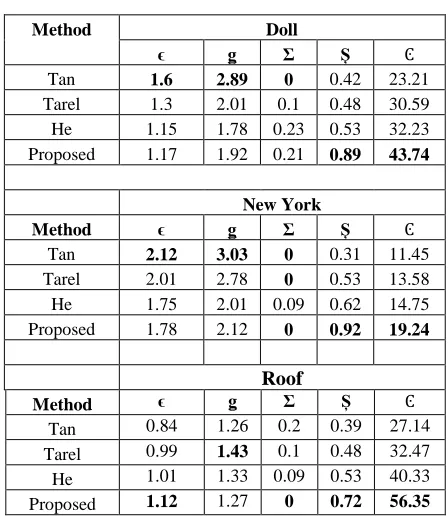
TABLEI.
THE IMAGE RESTORATION ASSESSMENT
Method Doll
ϵ ǥ Ʃ Ș Ͼ
Tan 1.6 2.89 0 0.42 23.21
Tarel 1.3 2.01 0.1 0.48 30.59 He 1.15 1.78 0.23 0.53 32.23 Proposed 1.17 1.92 0.21 0.89 43.74
New York
Method ϵ ǥ Ʃ Ș Ͼ
Tan 2.12 3.03 0 0.31 11.45
Tarel 2.01 2.78 0 0.53 13.58 He 1.75 2.01 0.09 0.62 14.75 Proposed 1.78 2.12 0 0.92 19.24
Roof
Method ϵ ǥ Ʃ Ș Ͼ
Tan 0.84 1.26 0.2 0.39 27.14 Tarel 0.99 1.43 0.1 0.48 32.47 He 1.01 1.33 0.09 0.53 40.33 Proposed 1.12 1.27 0 0.72 56.35
on sources. Finally, the image gains the more colorfulness. Therefore, the study requires calculating improvement of the contrast degree, the remaining structural similarity, and the colorfulness of the image. Table 1 shows the result of the performance-listed method reliably. The table 1 shows the best result for the different field is the Tan method that relies on contrast degree. This stress to the effect in ‘Doll’ and ‘New York.’ The result is described as the motivation of using maximizing the contrast. However, the Tan method changed the structure of the image, as the score for SSIM is low and uncorrelated color correction. As for structural similarity and colorfulness, the proposed method used the joint ambiance of the scene to remain structural information; this result is best compared to others in table I. The distribution of the colorcast had been corrected due to suitable color space balance. The color had been restored more efficiency than the other methods. Tarel introduces a complete conclusion on the atmospheric cap, and He recommended dark channels before starting the estimated transmission. However, the Laplacian regularisation mats may lead to the overall reduction of contrast in the distance area and have a space complexity. So that, the result for the SSIM and colorfulness may have affected. For the effectiveness of the saturation affect, the He method is more sensitive to the low light sources and much brightness image. The comparison made to other methods of elimination; the assessment results show that these methods are achievable more scattered removal are ideal without any additional supplements information as an example is depth information or any user interaction.
IV.CONCLUSION
The conclusions from this study found that the scene structural contained in the various images could be maintained independently than changing the texture structure and variety of color. The SSIM rating point to prove this method makes little refinement in the picture but gives improved results. The suggestion in this paper has the right mathematical acknowledgment correctly, and unnecessary need any observation of probability and statistic assumptions. Also, the transmission map acquires using the introduced approach free of artifacts. Therefore, it is not necessary to take any mechanisms like soft mats or interpolation of respective filters to eliminate artifacts.
Consequently, it is recommended to take less use and a low-cost intensive computer approach. The proposed is more effective because the value depends on all the pixel values given as lighting information. From experimental results, it is clear that the proposed approach eliminates the haze from the images provided significantly, without affecting them as a natural appearance. This method can be effective for practical navigation applications. Others, our work shares the same constraints most of the image removal methods as an example the process remain to get the same results in different haze scenes. Our work can cause adverse effects when it fails many edge and gradients accurately. Therefore, setting this parameter under different haze conditions is very important. The reality emphasizes the strength of the introduced method that it yields better results although for a small number of lighting sources.
ACKNOWLEDGMENT
This research is fund and supported by Ministry of Higher Learning Malaysia, National Defence University of Malaysia, and the Universiti Kebangsaan Malaysia with contract number: FRGS/1/2016/ICT02/UKM/02/1.
REFERENCES
[1] Ahmed, H.S. and M.J. Nordin, Improving diagnostic viewing of medical images using enhancement algorithms. Journal of Computer Science, 2011. 7(12): p. 1831.
[2] Huddin, A.B., et al., Enhancement techniques for MRI human spine images. Jumal Teknologi, 2015. 77.
[3] Talib, M.L.B., M.F. Nasrudin, and S.N.H.S. Abdullah. A study of uniform scene distorted removal based on contrast recovery. In Advances in Electrical, Electronic, and Systems Engineering (ICAEES), International Conference on. 2016. IEEE.
[4] Bansal, B., J. Singh Sidhu, and K. Jyoti, A Review of Image Restoration based Image Defogging Algorithms. International Journal of Image, Graphics and Signal Processing, 2017. 9(11): p. 62-74.
[5] He, K., J. Sun, and X. Tang, Single image haze removal using dark channel prior. Pattern Analysis and Machine Intelligence, IEEE Transactions on, 2011. 33(12): p. 2341-2353.
[6] Shi, L., et al. Image haze removal using dark channel prior and minimizing the energy function. In Technology, Networking, Electronic and Automation Control Conference (ITNEC), 2017 IEEE 2nd Information. 2017. IEEE.
[7] Qing, C., et al. Image Haze Removal Using Depth-Based Cluster and Self-Adaptive Parameters. in the Internet of Things (iThings) and IEEE Green Computing and Communications (GreenCom) and IEEE Cyber, Physical and Social Computing (CPSCom) and IEEE Smart Data (SmartData), 2017 IEEE International Conference on. 2017. IEEE.
[8] Tan, R.T. Visibility in bad weather from a single image. In Computer Vision and Pattern Recognition, 2008. CVPR 2008. IEEE Conference on. 2008. IEEE.
[9] Talib, M.L., S.N.H.S. Abdullah, and M.F. Nasruddin. Uniform scene distorted removal in the single image based on illumination information. In Electrical Engineering and Informatics (ICEEI), 2017 6th International Conference on. 2017. IEEE.
[10] Hautière, N., J.-P. Tarel, and D. Aubert. Towards fog-free in-vehicle vision systems through contrast restoration. In Computer Vision and Pattern Recognition, 2007. CVPR'07. IEEE Conference on. 2007. IEEE.
[11] Tarel, J.-P. and N. Hautiere. Fast visibility restoration from a single color or gray level image. in Computer Vision, 2009 IEEE 12th International Conference on. 2009. IEEE.
[12] Tarel, J.-P., et al., Vision enhancement in homogeneous and heterogeneous fog. Intelligent Transportation Systems Magazine, IEEE, 2012. 4(2): p. 6-20.
[13] Yahya, S.R., et al. Review on image enhancement methods of the old manuscript with the damaged background. In Electrical Engineering and Informatics, 2009. ICEEI'09. International Conference on. 2009. IEEE.
[14] 14. Tarel, J.-P., et al. Improved visibility of road scene images under the heterogeneous fog. in Intelligent Vehicles Symposium (IV), 2010 IEEE. 2010. IEEE.
[15] Parthasarathy, S. and P. Sankaran. A RETINEX based haze removal method. In Industrial and Information Systems (ICIIS), 2012 7th IEEE International Conference on. 2012. IEEE.
[16] Xie, B., F. Guo, and Z. Cai. Improved single image dehazing using dark channel prior and multi-scale Retinex. In Intelligent System Design and Engineering Application (ISDEA), 2010 International Conference on. 2010. IEEE.
[17] Zhou, J. and F. Zhou. Single image dehazing motivated by Retinex theory. In Instrumentation and Measurement, Sensor Network and Automation (IMSNA), 2013 2nd International Symposium on. 2013. IEEE.
[18] Fattal, R., Dehazing using color-lines. ACM Transactions on Graphics (TOG), 2014. 34(1): p. 13.
[20] Pal, N.S., S. Lal, and K. Shinghal, Modified Visibility Restoration-Based Contrast Enhancement Algorithm for Colour Foggy Images. IETE Technical Review, 2017: p. 1-14.
[21] He, L., et al., Haze Removal Using the Difference- Structure-Preservation Prior. IEEE Trans Image Process, 2017. 26(3): p. 1063-1075.
[22] Xiong, Y., H. Yan, and C. Yu, Improved haze removal algorithm using dark channel prior. Journal of Computational Information Systems, 2013. 9(14): p. 5743-5750.
[23] Yeh, C.-H., et al. Efficient image/video dehazing through haze density analysis based on pixel-based dark channel prior. in Information Security and Intelligence Control (ISIC), 2012 International Conference on. 2012. IEEE.
[24] Zhu, Q., J. Mai, and L. Shao, A fast single image haze removal algorithm using color attenuation prior. Image Processing, IEEE Transactions on, 2015. 24(11): p. 3522-3533.
[25] Al-Sammaraie, M.F. Contrast enhancement of roads images with foggy scenes based on histogram equalization. In Computer Science & Education (ICCSE), 2015 10th International Conference on. 2015. IEEE.