
A Public Transport Fare Collection System with
Smart Phone Based NFC Interface
Sadık Arslan, Veli Demirel, and İbrahim Kuru
Research and Development Department, Kentkart Ege Elektronik A.Ş. Company, İzmir, Turkey Email: {sadik.arslan, veli.demirel, ibrahim.kuru}@kentkart.com.tr
Abstract—Today, nearly all electronic public transport fare collection systems are using contactless IC cards for payment. Payment procedure can not be done without these cards. Generally, all cities have different and independent cards that do not suit to each other. People who want to use public transportation have to get new cards for each city and find charge points for charging cards. In our study, a public transport fare collection system was developed with using NFC which is embedded inside of Android smart phones. Thus, usage of contactless IC cards will not be necessary and there will be easy online credit charge option. An Android operating system based smart phone application was developed for public transportation clients. Index Terms—NFC, fare collection, contactless IC cards, Android
I. INTRODUCTION
In 90s, paper tickets were used in public transport fare collection systems. Today, fare collection procedures are generally done by ISO/IEC 14443 Type-A contactless
clients should have contactless IC cards first. After that, cards should be charged by specific charge devices in specific charge stations. By this way, clients can use contactless IC cards, but each time they credit out, they have to go to charge station for credit charge. If a card is lost, credit that loaded to the contactless IC card will also be lost. In this situation, clients should get new cards and charge to new cards again. Different cities that have public transport fare collection systems have different pass cards. So, passengers who travel different cities need to buy new contactless IC cards for each city.
Smart phones have an indispensable position in human life anymore. In these phones, there are many applications like surfing the internet, watching videos, taking photos apart from simple applications like Short Message Service (SMS), phone call etc. Near Field Communication (NFC) protocols that have hardware and software standards [5] basically perform near field communication between electronic devices which are NFC compliant. NFC standards cover communication protocols, data exchange formats and existing Radio-Frequency Identification (RFID) standards including ISO/IEC 14443 Type-A contactless IC cards. In our study, public transport fare collection procedure was integrated
Manuscript received December 1, 2014; revised October 19, 2015.
to Android operating system based smart phones by NFC interface.
Passengers will not carry contactless IC cards and there will not be any credit loss condition because of card loss situations with new developed NFC payment system. Clients will not have to get new cards in new cities because of general fare collection system in smart phones.
potential use of a shopping trolley to act as a rogue antenna to eavesdrop information of a contactless payment using NFC technology [13].
II. BASIC THEORY OF NEAR FIELD COMMUNICATION
NFC is a short range, standards based wireless connectivity technology, based on RFID technology that uses magnetic field induction to enable communication between electronic devices in close proximity. It provides a seamless medium for the identification protocols that validate secure data transfer. This enables users to perform intuitive, safe, contactless transactions, access digital content and connect electronic devices simply by touching or bringing devices into close proximity. NFC operates in the standard unlicensed 13.56MHz frequency band over a distance of up to around 10 centimeters. Currently it offers data transfer rates of 106kbit/s, 212kbit/s and 424kbit/s, and higher rates are expected in the future. NFC tags are used to store information like maps, transformation information, Global Positioning System (GPS) location etc. A tag is essentially an integrated circuit containing data, connected to an antenna that can be read and written by the reader [14].
NFC has the Active and the Passive communication modes as follows [5]:
In the Active communication mode, both the initiator and the target shall use their own Radio Frequency (RF) field to enable communication. The initiator starts the NFC communication. The target responds to an initiator command in the active communication mode using self-generated modulation of self-self-generated the RF field.
In the Passive communication mode, the initiator generates the RF field and starts the communication. The target responds to an initiator command in the passive communication mode using a load modulation scheme.
Under the Passive mode, the operation distance is 10cm with the maximum distance approaching 20cm in the Active mode.
Figure 1. NFC compared with other wireless technologies [15]
Fig. 1 shows how NFC compares in range and speed with other wireless technologies that can be used in a mobile phone. Communication occurs when two NFC compatible devices are brought within about five centimeters of each other. By design, NFC requires close proximity and it offers instant connectivity, which provides an intuitive consumer experience that can be readily applied to the transit environment [15].
According to NFC forum [16] there are three different operating modes; Reader/Writer mode, Card Emulation mode and Peer-to-peer (P2P) mode.
In Reader/Writer mode, RF interface is compliant to ISO/IEC 14443 and FeliCa [17]. NFC complied devices are capable of reading different contactless cards and able to read and write to NFC devices. For example, if an NFC tag is attached to a bus stop, NFC embedded smart phone can “tap” the tag to access the information stored in the tag. Fig. 2 shows basic relations of Reader/Writer mode.
Figure 2. Reader/Writer NFC operating mode and related standard
In Card Emulation mode, NFC compliant smart phone can behave like an existing contactless IC card without adaptors in the existing payment infrastructure. A contactless IC card and a tag are technically the same; however, contactless cards used in e-ticketing and payment today include additional technology to store secure data. This will enable NFC devices to be used with existing contactless IC card infrastructure in applications such as ticketing, access control and payments. Simplified Card Emulation mode diagram can be seen from Fig. 3.
Figure 3. Card emulation operating mode and related standard
In Peer-to-peer mode, two active NFC devices can exchange data like address information, bus schedules, e-mails, photos etc. P2P mode enables two NFC devices to share data between them. Because of the low transfer speed of NFC standards if large amounts of data need to be transfer, P2P mode can be used to create a secondary high speed connection such as Bluetooth. In this case, the NFC is used to negotiate the optimal communication protocol and transfer authentication data for the secondary protocol. The file or data is then sent over the high capacity protocol. Basic relations of P2P mode can be seen from Fig. 4.
Figure 4. P2P operating mode and related standard
III. NFC IMPLEMENTED SYSTEM DESIGN
A. NFC Based General System Design
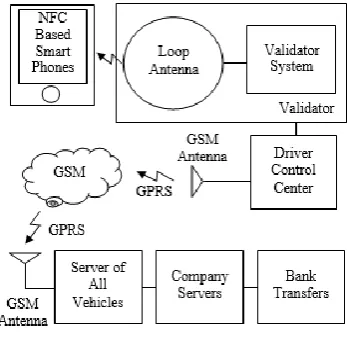
application to validators inside the vehicles. The electromagnetic RF communication which is defined in ISO/IEC 18092 standards between loop antenna of validator and NFC device occurs at this time. Validators manage the fare collection process and passenger information. Passenger information includes the result of the process and usage credit, in application they can be seen from LCDs of validators. Driver control centers transfer fare collection information such as credit and aliasing numbers that coming from the validator to the server of all vehicles. This transfer operation is managed by driver control centers via GSM modems that located on driver control centers using General Packet Radio Service (GPRS) interface. Collected information in the server of all vehicles periodically comes to company (fare collection operator) servers for starting money transfer procedures to bank accounts of municipalities.
Figure 5. Basic diagram of a fare collection system
However, fare collection operation that occurs in validators is an offline process. Because of slow communication problems of GSM system, remained credit information does not questioned from bank client’s accounts. Passengers charge their accounts before first usage of public transport fare collection system. Public transport accounts and bank credit card accounts are synchronized to each other. If there is a public transport usage situation, public transport accounts will be recharged from passenger’s credit cards at the end of the day. Thus, public transport fare collection procedure is finalized after recharge operation. Basic diagram of above mentioned fare collection system with smart phone based NFC interface can be seen from Fig. 5.
B. NFC Based Validator Design
As can be seen in Fig. 6, there are 5 main parts in the validator system that named the media controller, reader/writer IC, matching circuit, antenna and NFC compliant smart phone. The media controller and reader/writer IC are communicating each other via Universal Asynchronous Receiver Transmitter (UART) interface and all reading from NFC devices and writing to NFC devices procedures has been managing from the media controller. The media controller also controls all visual and auditory processes via LCDs, audio codecs, audio amplifiers and speakers. LCD of validators
includes visual information for passengers. The NXP CLRC663 contactless reader IC [18] is selected for reader/writer block. This IC does coding/decoding of transceived data and modulating of low level RF signal according to selected interface. Designed loop antenna sets RF communication between NFC devices and the system. When designing the antenna printed circuit board (PCB), main target was reaching to maximum power transfer and maximum operation range. 50Ω matched antennas were used and antenna matching was done for 50Ω matched antenna topology. The matching circuit is located between the reader/writer IC and antenna for adjustment of maximum power transfer.
When designing NFC side of the fare collection system, system working modes and data transfer rates were decided. P2P data transfer mode was used because of its suitability to public transport fare collection systems. The validator is in the passive initiator mode because of CLRC663 reader/writer block structure. Both the validator and smart phone are affecting to the electromagnetic communication field at this condition. 106kbit/s data transfer rate is selected as NFC communication speed.
Figure 6. Diagram of designed validator system
Figure 7. NFC based validator device layers
layer of the system were modified and nfc.lib were written for NFC compliance. After all of these design steps, Valapp named Linux application software layer were coded. This application manages LCD drive, credit usage from NFC devices, audio information etc. procedures.
C. Android Based NFC Application
Android is a Linux based operating system for mobile devices that is developed by Google and other companies in Open Handset Alliance. It is a mobile device platform for smart phones, tablet personal computers and television set-top-boxes [20]. Android is open source and has free software license. Because of these reasons, Android platform is selected for smart phone application development and Android Software Development Kit (SDK) [21] is installed.
In Android, NFC functions can be supported by android.nfc package. It provides access to NFC functionality, allowing applications to read NFC Data Exchange Format (NDEF) message in NFC tags [22]. A tag may actually be another device that appears as a tag. In android.nfc, there are several classes that listed in Table I and they are used for development of NFC procedures in Android.
Designed application of the Android uses NDEF packets for handling all NFC operations. NDEF packets are transmitted via Simple NDEF Exchange Protocol (SNEP) [23]. Logical Link Control Protocol (LLCP) code block were modified for the system [24]. In P2P mode, NFC communication link established by LLCP layer. LLCP code block manages activation, supervision and deactivation of the link as defined in ISO/IEC 18092 standard. Simple block diagram of layers that located in NFC compliant smart phones can be seen in Fig. 8. The designed Android application generates credit usage, credit monitoring and credit charge operations at the same interface.
TABLE I. LIST OF ANDROID NFCPACKET CLASSES [22]
Class Name Class Description
NdefMessage Represents an immutable NDEF Message
NdefRecord Represents an immutable NDEF Record
NfcAdapter Represents the local NFC adapter
NfcEvent Wraps information associated with any NFC
event
NfcManager High level manager used to obtain an instance
of an NfcAdapter
Tag Represents an NFC tag that has been
discovered
Figure 8. General review of the NFC based Android system
D. System Security
To provide high level of information security, Security Access Modules (SAM) modules that have international standards for information security were used in the designed system. SAMs are a form of smart chip which are widely used in electronic transaction systems to store cryptographic functions and keys [25]. In validators and company servers, SAMs were used for decryption of encrypted credit data. So, these devices will have hardware SAM protection. All SAM transactions were done inside of the validator and company server software. However, hardware protection procedures may not be available in smart phones. Because of this reason, different security techniques were implemented in the smart phone application like International Mobile Equipment Identity (IMEI) number authentication and unique security key protection. To prevent copied data usage in different phones, IMEI numbers and private application for each client were synchronized. By this way, unique applications can be used only in owners’ smart phones. Besides, unique private password is used for activating smart phone application. Thus, private usage of the smart phone application is provided.
Usage count of fare collection system for each account is reserved in company servers. If there is a conflict about usage counts, additional usage will be charged from credid cards. So, problematic account will be stated in the blacklist for protecting the system from new unfair usage.
IV. CONCLUSION
A new smart phone based and NFC implemented public transport fare collection system has been designed. Successful NFC procedures between validators and Android based smart phones has been done. Secure fare collection system has been established by different hardware and software security techniques.
By this NFC implementation study, customers who want to use public transportation do not need to get new cards for each city and find charge points for charging cards. This solution shall not depend on existent SIM card technology of mobile network operator. With this application, passengers can buy single usage credits or recharge credit into their applications. Balance value of customer will be held securely inside the application.
For further work, we will study with third generation (3G) GSM system for information transfer instead of GPRS. We will work on Apple Inc. iPhone Operating System (iOS) for NFC implementation.
ACKNOWLEDGMENT
We would like to thank Kentkart Ege Elektronik A.S. Company for all equipment and laboratory conditions.
REFERENCES
[1] Identification Cards - Contactless Integrated Circuit(s) Cards -
Proximity Cards - Part 1: Physical Characteristics, ISO/IEC 14443-1 International Standard, 2008.
[2] Identification Cards - Contactless Integrated Circuit(s) Cards -
[3] Identification Cards - Contactless Integrated Circuit(s) Cards - Proximity Cards - Part 3: Initialization and Anti-Collision, ISO/IEC 14443-3 International Standard, 2011.
[4] Identification Cards - Contactless Integrated Circuit(s) Cards -
Proximity Cards - Part 4: Transmission Protocol, ISO/IEC 14443-2, 2008.
[5] Information Technology, Telecommunications and Information
Exchange between Systems, Near Field Communication, Interface and Protocol NFCIP-l, ISO/IEC 18092 International Standard, 2004.
[6] S. M. Nasution, E. M. Husni, and A. I. Wuryandari, “Prototype of
train ticketing application using Near Field Communication (NFC)
technology on Android device,” in Proc. International Conference
on System Engineering and Technology, Bandung, Indonesia,
2012, pp. 1-6.
[7] W. Chen, G. P. Hancke, K. E. Mayes, Y. Lien, and J. H. Chiu, “NFC mobile transactions and authentication based on GSM
network,” in Proc. Second International Workshop on Near Field
Communication (NFC), Monaco, 2010, pp. 83-89.
[8] G. Benelli and A. Pozzebon, “An automated payment system for
car parks based on near field communication technology,” in Prpc.
International Conference for Internet Technology and Secured
Transactions, London, England, 2010, pp. 1-6.
[9] W. Chen, K. E. Mayes, Y. Lien, and J. Chiu, “NFC mobile
payment with Citizen Digital Certificate,” in Proc. 2nd
International Conference on Next Generation Information
Technology, Gyeongju, South Korea, 2011, pp. 120-126.
[10] L. Finzgar and M. Trebar, “Use of NFC and QR code
identification in an electronic ticket system for public transport,”
in Proc. 19th International Conference on Software,
Telecommunications and Computer Networks, Split, Croatia, 2011,
pp. 1-6.
[11] R. Widmann, S. Grunberger, B. Stadlmann, and J. Langer,
“System integration of NFC ticketing into an existing public transport infrastructure,” in Proc. 4th International Workshop on
Near Field Communication (NFC), Helsinki, Finland, 2012, pp.
13-18.
[12] L. Mainetti, L. Patrono, and R. Vergallo, “IDA-Pay: An
innovative micro-payment system based on NFC technology for
Android mobile devices,” in Proc. 20th International Conference
on Software, Telecommunications and Computer Networks, Split,
Croatia, 2012, pp. 1-6.
[13] T. W. C. Brown and T. Diakos, “On the design of NFC antennas
for contactless payment applications,” in Proc. 5th European
Conference on Antennas and Propagation, Rome, Italy, 2011, pp.
44-47.
[14] Near Field Communication in the Real World - Turning the NFC
Promise into Profitable, Everyday Applications, Innovision
Research & Technology PLC, 2007.
[15] NFC in Public Transport, NFC Forum Inc., 2011.
[16] NFC Digital Protocol, Technical Specification, NFC Forum Inc.,
2010.
[17] Specification of Implementation for Integrated Circuit(s) Cards - Part 4: High Speed Proximity Cards, JIS X 6319-4 Japanese Industrial Standard, 2005.
[18] CLRC663 Contactless Reader IC Product Data Sheet, NXP
Semiconductors, 2012.
[19] The Linux Kernel Archives. [Online]. Available:
https://www.kernel.org/
[20] OS Android. [Online]. Available: http://developer.android.com/
about/start.html
[21] Android SDK. [Online]. Available: http://developer.android.com/
[22] Android SDK developer guide. [Online]. Available:
http://developer.android.com/reference/android/nfc/package-summary.html
[23] Simple NDEF Exchange Protocol, Technical Specification, NFC
Forum Inc., 2013.
[24] Logical Link Control Protocol, Technical Specification, NFC
Forum Inc., 2011.
[25] SAM global platform. [Online]. Available:
http://www.globalplatform.org/mediaguideSAM.asp
Sadık Arslan was born in Kırcali, Bulgaria.
He received the B.S. degree, electrical and electronics engineering, in 2008 from Ege University and the M.B.A degree in 2014 from Maltepe University. Now, he is studying master of software engineering at Ege University. He worked as an electronics engineer and project manager in R&D Department at Vestel Elektronik A.Ş Company. Now, he is working as an embedded software developer in Kentkart Ege Elektronik A.Ş. Company. During his work and academic life, he mainly focused on embedded system development, analog and digital hardware design, software development.
Veli Demirel was born in Kırıkkale, Turkey.
He received the B.S. degree in 2008 and the M.S. degree in 2015; both degrees were in electrical and electronics engineering and Dokuz Eylül University. He worked as an electronics engineer and team leader in R&D Department at Kentkart Ege Elektronik A.Ş. Company. He research interests include embedded system development, analog and digital hardware design, software development, digital communication.
İbrahim Kuru was born in Ankara, Turkey.
He received the B.S. degree in 2010 in electrical and electronics engineering at Ege University. He worked as an electronics engineer in R&D Department at Kentkart Ege Elektronik A.Ş. Company. Now, hi is in military obligation in Mersin, Turkey. He research interests include embedded system development, analog and digital hardware design, power design, software development, signal processing.
![Figure 1. NFC compared with other wireless technologies [15]](https://thumb-us.123doks.com/thumbv2/123dok_us/9946063.1982287/2.595.72.272.534.674/figure-nfc-compared-wireless-technologies.webp)
![TABLE I. LIST OF ANDROID NFC PACKET CLASSES [22]](https://thumb-us.123doks.com/thumbv2/123dok_us/9946063.1982287/4.595.60.288.542.769/table-i-list-android-nfc-packet-classes.webp)
