http://www.sciencepublishinggroup.com/j/ijber doi: 10.11648/j.ijber.20180701.11
ISSN: 2328-7543 (Print); ISSN: 2328-756X (Online)
The Escalation of Commitment and Disposition Effect in
Securities Trading: An Experimental Study
Gao Kai
1, 2, Jia Chen
1, Nie Lei
11
School of Business, Nanjing Normal University, Nanjing, China
2Jiangsu Vocational College of Agriculture and Forestry, Zhenjiang, China
Email address:
To cite this article:
Gao Kai, Jia Chen, Nie Lei. The Escalation of Commitment and Disposition Effect in Securities Trading: An Experimental Study. International Journal of Business and Economics Research. Vol. 7, No. 1, 2018, pp. 1-6. doi: 10.11648/j.ijber.20180701.11
Received: December 25, 2017; Accepted: January 11, 2018; Published: January 23, 2018
Abstract:
This paper investigates the relationship between disposition effect and escalation of commitment in securities trading. First, we developed an investment simulation system, that manipulated five stocks' price during thirty-six periods to test investors' behavioral patterns in securities trading. Then, we investigate whether the gain ratio or loss ratio impacts on disposition effect and escalation of commitment after controlling other variables. The results summarized as follow: First, investors are exhibited disposition effect and escalation of commitment in securities trading. Second, sex, education, duration of securities trading, and investment amount did not affect the disposition effect and escalation of commitment. Third, disposition effect and escalation of commitment has negative impact on performance. Finally, we find individual investors with stronger disposition effect are more likely to be escalated in securities trading.Keywords: Escalation of Commitment, Disposition Effect, Prospect Theory
1. Introduction
In the traditional financial theory, rational investors makes investment decisions based on the characteristics of investment portfolio risk; however, prior studies show that the disposition effect do exist in investment. Investors are likely to sell profitable stocks, while holding the losses in their portfolio. But some investors not only holding losses, they tend to go further, that is, purchases more, and then fall into the trap of escalation of commitment.
Researches focused on the causes of escalation of commitment [1-2], influencing factors [3-7], control mechanisms [8-9], the existence of disposition effect [10-11], influencing factors [12-14], investment performance and market impact [15-17]. However, there are two insufficient places in these studies. Firstly, most of these studies were based on indirect data, such as fund transaction data and questionnaire, which makes difficult to investigate individual investors' behavior. Secondly, although these studies have explained the causes of escalation of commitment and disposition effect, these studies ignored the intrinsic linkages between the two kinds of behavior.
This paper developed an investment simulation system to examine disposition effect and escalation of commitment in securities trading. We tested the impact of these variables, such as sex, education, duration of securities trading, and investment amount to disposition effect and escalation of commitment. Then we divided the investors into five groups to test the relationship between two kinds of behavior with investment performance. Finally, we find the relationship between disposition effect and escalation of commitment in securities trading.
2. Literature Review and Hypotheses
Literature reviews consist of three categories, first, the review of escalation of commitment; second, the review of the disposition effect; third, the review of the relationship between two kinds of behavior.
2.1. Escalation of Commitment
desired effect or is actually on the verge of failure, that is, a negative feedback has been received; investors can decide either to continue investing in an attempt to recover the costs already paid or to withdraw completely from the operation. Escalation of commitment means that investors continued to devote resources to purchasing more while they suffered a serious setback in their previous investments in order to share the loss of their previous investments. Prospect theory and self-defense theory explain the causes of escalation of commitment from the perspective of cognitive process and motivation. Both theories declared that escalation of commitment is a distortion of investors' cognition and is mainly emotional and irrational. However, the decision dilemmas theory argued that escalation of commitment is not totally irrational. Bowen pointed that negative feedback and social value norms are not the main reasons for the escalation of commitment. The ambiguity of feedback and the lack of objective criteria for evaluating feedback are the major contributors to escalation of commitment [18]. The experimental methods can not only overcome the deficiencies of indirect data, but also investigate the process of personal information processing through a programmed experimental platform [19]. In order to test the escalation of the individual's commitment in securities trading, according to the connotation of escalation of commitment, we derive hypotheses as follow:
H1a: Taking the purchase price as a reference point, subjects buy more shares for the lost stock than for the profitable stock.
H1b: Subjects' gender, education, duration of securities trading, and investment amount influence the level of escalation of commitment.
H1c: The escalation of commitment has a negative impact on investment performance.
2.2. Disposition Effect
According to Prospect theory, due to the existence of framework effect, investors’ utility of holding profitable shares is less than the utility of selling them. On the other hand, investors’ utility of holding losses is more than the utility of selling them [10]. Elzbieta built a model from both the value function and the probability weight function, and found that the traders with reverse strategy has a stronger tendency of disposition effect [12]. Based on the Estonian stock market data, Tonn measured the effects of disposition effect with Cox's method and found that foreign investors tended to exhibit more negative effects of deposition than domestic ones, with more inertia traded. Experienced investors showed lower Disposition Effect [15]. To test disposition effect in individual investment, we derive hypotheses as follow:
H2a: Taking the purchase price as a reference point, subjects sell more shares for the profitable stock than for the lost stock.
H2b: Subjects' gender, education, duration of securities trading, and investment amount influence the level of disposition effect.
H2c: The disposition effect has a negative impact on
investment performance.
2.3. The Relationship Between Disposition Effect and Escalation of Commitment
There are some differences between disposition effect and escalation of commitment, but there are also some links of them. Firstly, they are different in the manifestations and measurement. The escalation of commitment mainly reflects in the buying side of the securities, while the disposition effect reflects in the selling side. Secondly, in the perspective of the prospect theory, both of the causes of the two kinds of behavior is the frame effect and the deterministic effect. Investors tend to go further when they hold the shares that the sale price is below the purchase price, that makes disposition effect and escalation of commitment occur at the same time. To test the relationship between the two, we derive hypotheses as follow:
H3: Subjects with higher degree of disposition effect will be with higher degree of escalation of commitment.
3. Method
3.1. Subjects
A total of 123 subjects were randomly selected from the two groups. Group I consist of 72 undergraduates from Nanjing
Normal University. These students had studied
investment-related knowledge. Group II consist of 51 investors with investment experience from the Bank of Nanjing and Tianfeng Securities Ltd.
3.2. Experimental Design
The experiment was complemented by the investment simulation software. Each participant abided by the presumed 100,000 Yuan budget constraint before the experiment started, and formed a portfolio investment by buying and selling stocks. All of the subjects was informed that at the end of the experiment, the corresponding reward of 1‰ would be given according to the sum of the cash on the account and the market value of the stock portfolio. In addition, the subjects were informed that their stock trading activities did not affect the market price. For the participants, they faced a perfectly competitive market, which was also consistent with the real market.
the medium to long term (3-5 years) and the excess returns can be obtained by using the reversal strategy [20]. Choosing a three-year period of price will reduces the difference in returns due to the difference in initial investment strategy. (2) From
January 2013 to December 2015, the Shanghai Composite Index represented a bull market and bear market from 1849 points to 5178 points and 2,600 points. The data of this period is more representative.
Figure 1. Time series of stock prices used in the experiment.
3.3. Experimental Procedure
For group I, the test procedure was as follow: (1) The subjects were concentrated in a laboratory and distributed to each person a stock "learning material" with 10 major knowledge points quoted from the stock books and large stock trading website to help them understanding the stocks trading. (2) Laboratory staff readed the instructions, including guidelines and operation introductions. (3) Subjects logined the investment simulation system through LAN to complete 32 investment experiments. (4) Each subject left the laboratory at end of the experiment, led by an experimenter to the next room to receive the reward corresponding to the investment performance. For group II, test procedures were as follow: (1) subjects login the experimental system to read the "learning material" and experimental notes. (2) The subjects completed the experiment in investment simulation system. (3) According to the social accounts subjects left, we gave the rewards to them.
3.4. Measurement
There are three ways to measure disposition effect: the first one is developed by Shefrin and Statman [21]. The second one is the method of survival model used in actuarial science by Feng and Seasholes; the third one is the method of "sell ratio" statistic by Odean [22]. On the basis of Odean, Weber constructed the degree of disposition effect index, which was widely used in experimental research [23]. We measured disposition Effect with Weber's method. Taking the bidding price as a reference point, the number of shares an investor sold the profitable stocks is Si+, the number of shares an
investor sold the losing stocks is Si−. Then the degree of disposition effect is:
-= - / ( )
i Si Si Si Si
α
( + −) ++Obviously, αi∈
[ ]
-1,1For the measure of escalation of commitment, Lin proposed a calculation indicator of "P /L ratio". However, this method adds investors' influence on the buying of profitable stocks so it is not accurate. According to the connotation of escalation of commitment, we developed an indicator to measure the degree of escalation of commitment. Taking the bidding price as a reference point, the number of shares an investor bought the profitable stocks is Bi+, the number of shares an investor bought the losing stocks is Bi-. Then the degree of escalation
of commitment is:
-
-= / ( )
i Bi Bi Bi
β
+ +Obviously, βi∈
( )
0,1 .4. Result
4.1. Test of the Escalation of Commitment
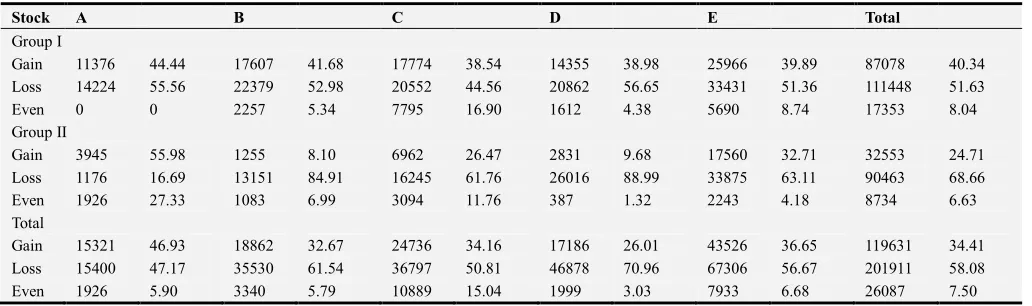
stock A slightly more than the loss under the stock A Buy in profitability. Therefore, investors have a higher probability of buying shares for losing stocks, and the escalation of commitment occurs. Comparing group I and group II, we found that investors with experience were more likely to buy stocks at a loss price, that is, they had high degree of
escalation of commitment. There are two reasons. Firstly, investors with experience are more likely to be affected by "avoidance of regret." Secondly, the stock market has just undergone dramatic fluctuations before the experiment, investors may have a stronger willingness to evade losses, that made them more escalated.
Table 1. Number of shares bought by subjects depending on the purchase price.
Stock A B C D E Total
Group I
Gain 11376 44.44 17607 41.68 17774 38.54 14355 38.98 25966 39.89 87078 40.34
Loss 14224 55.56 22379 52.98 20552 44.56 20862 56.65 33431 51.36 111448 51.63
Even 0 0 2257 5.34 7795 16.90 1612 4.38 5690 8.74 17353 8.04
Group II
Gain 3945 55.98 1255 8.10 6962 26.47 2831 9.68 17560 32.71 32553 24.71
Loss 1176 16.69 13151 84.91 16245 61.76 26016 88.99 33875 63.11 90463 68.66
Even 1926 27.33 1083 6.99 3094 11.76 387 1.32 2243 4.18 8734 6.63
Total
Gain 15321 46.93 18862 32.67 24736 34.16 17186 26.01 43526 36.65 119631 34.41
Loss 15400 47.17 35530 61.54 36797 50.81 46878 70.96 67306 56.67 201911 58.08
Even 1926 5.90 3340 5.79 10889 15.04 1999 3.03 7933 6.68 26087 7.50
4.2. Test of the Disposition Effect
Table 2. Number of shares sold by subjects depending on the purchase price.
Stock A B C D E Total
Group I
Gain 19564 55.68 26998 83.88 35181 53.71 27310 60.90 56905 65.03 165958 62.58
Loss 15050 42.84 2234 6.94 20122 30.72 14680 32.73 22847 26.11 74933 28.26
Even 520 1.48 2954 9.18 10204 15.58 2857 6.37 7752 8.86 24288 9.16
Group II
Gain 1702 18.72 16647 87.64 20458 55.53 32361 83.55 42138 64.42 113305 67.02
Loss 4995 54.93 866 4.56 12378 33.60 5890 15.21 21930 33.53 46059 27.24
Even 2396 26.35 1482 7.80 4003 10.87 481 1.24 1340 2.05 9702 5.74
Total
Gain 21266 48.08 43645 85.27 55638 54.36 59671 71.39 99042 64.77 279263 64.31
Loss 20045 45.32 3100 6.06 32500 31.76 20570 24.61 44777 29.28 120992 27.86
Even 2916 6.59 4436 8.67 14207 13.88 3338 3.99 9092 5.95 33990 7.83
Table 2 shows the sales of group I and group II at profit, loss and flat time. Investors tend to sell previously profitable shares more than loss-making stocks, which is evident in the four stocks of B, C, D and E. For stock B, the number of shares investors sold at loss is 14 times of that at gain. The results shows that the disposition effect exist in the experiment, which is consistent with previous researches. In addition, we also find that group I shows a stronger disposition effect in stock A and stock E, while group II shows a stronger disposition effect on stock B and stock D.
4.3. The Factors Influence Disposition Effect and Escalation of Commitment
The mean value of the index of disposition effect is 0.36 and the standard deviation is 0.36. The mean value of the index of escalation of commitment is 0.47 and the standard deviation is
Table 3. Regression model test results.
Variables Escalation of commitment Disposition effect
β (std. dev.) t (p) β (Std. dev.) T (p)
constant 0.065(0.138) 0.472(0.638) 0.2(0.144) 1.394(0.166)
sex 0.063(0.065) 0.391(0.696) 0.069(0.068) 0.116(0.908)
education -0.21(0.032) -0.671(0.503) -0.16(0.33) -0.045(0.487)
investment amount 0.13(0.033) 0.970(0.334) 0.04(0.035) 1.011(0.314)
duration of securities trading 0.002(0.034) 0.05(0.961) 0.30(0.036) 0.839(0.403)
2
R
0.003 0.02
F 1.075 0.528
1.881 2.304
4.4. A Test of Disposition Effect, Escalation of Commitment and Returns
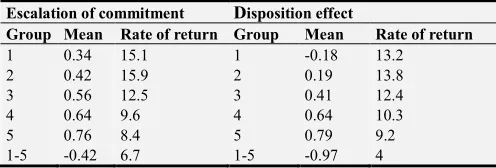
The subjects were divided into five groups according to the degree of escalation of commitment, and compared the average return for each group. The results are shown in Table 4. The third group with the highest returns and the fifth with the lowest returns. As the degree of escalation of commitment increases, the rate of return generally decreased. Then we divided the subjects into five different groups according to the degree of disposition effect, and compared the average return for each group. The second group has the highest return rate and the fifth group has the lowest return rate. As the degree of disposition effect increases, the return on investment generally decreases. From the table, it is also found that the rate of return of the first group with the weakest disposition effect is 4 higher than the rate of return of the fifth group with the strongest disposition effect. The rate of return of the first group with the weakest escalation of commitment is 6.7 lower than the rate of return of the fifth group with the strongest escalation of commitment. The escalation of commitment is more harmful to returns than the disposition effect insecurities trading.
Table 4. Disposition effect, escalation of commitment and returns.
Escalation of commitment Disposition effect
Group Mean Rate of return Group Mean Rate of return
1 0.34 15.1 1 -0.18 13.2
2 0.42 15.9 2 0.19 13.8
3 0.56 12.5 3 0.41 12.4
4 0.64 9.6 4 0.64 10.3
5 0.76 8.4 5 0.79 9.2
1-5 -0.42 6.7 1-5 -0.97 4
4.5. Test of the Relationship Between the Disposition Effect and Escalation of Commitment
Correlation analysis and regression analysis of the indicators of escalation of commitment and disposition effect showed that Pearson's correlation coefficient was 0.828 and the significance reached 0.05. There is a strong correlation between the two kinds of behavior. Taking the the index of escalation of commitment as the dependent variable and the index of disposition effect as the independent variable, the regression results showed that the adjusted R square was 0.683, the D-W value was 2.359, and the t value was 16.191, which
was significant at 0.05 level. Results show that investors with higher degree of disposition effect on the selling side tend to be with higher degree of escalation of commitment on the buying side.
5. Conclusion
Our analysis show the disposition effect and the escalation of commitment in securities trading. Investors not only hold more shares that are below purchase price, but also they may continue to buy more of them. However, both the disposition effect and the escalation of commitment are harmful to investment performance. The escalation of commitment has a greater negative impact on returns. The escalation of commitment has a positive correlation with the disposition effect. The results support the validity of prospect theory in explaining the causes of disposition effect and escalation of commitment.
Investors should recognize the negative effects of irrational investment, especially the escalation of commitment. Firstly, they can diversify the investment portfolio to reduce the risk of investment and return fluctuations. Secondly, taking self-control mechanisms to reduce impulse to the hold and buy loss. For example, investors can set stop-loss points to get rid of the wrong investment decisions.
References
[1] Kahneman D., Tversky A. Choices, values and frames. Cambridge University Press, Cambridge, 2000.
[2] Boulding W., Guha A, Staelin R. Do We Really Need to Change the Decision Maker? Counterintuitive Escalation of Commitment Results in Real Options Contexts. Management Science. 2017; 63 (10):3459-72.
[3] Barsky A. P., Zyphur M. J. Disentangling sunk-costs and completion proximity: The role of regulatory focus. Journal of Experimental Social Psychology. 2016; 65:105-8.
[4] Ku G., Malhotra D., Murnighan J. K. Towards a competitive arousal model of decision-making: A study of auction fever in live and Internet auctions. Organizational Behavior and Human Decision Processes, 2005 (96):89-103.
[6] Lambooij M, Koster F. How organizational escalation prevention potential affects success of implementation of innovations: Electronic medical records in hospitals. Implementation Science. 2016; 11 (1):75.
[7] Whyte G., Saks A. M. The effects of self-efficacy on behavior in escalation situations. Human Performance, 2007 (1):23-42. [8] Elfenbein D. W., Knott A. M., Croson R. Equity stakes and exit:
An experimental approach to decomposing exit delay. Strategic Management Journal. 2017; 38 (2):278-99.
[9] Yamakawa Y, Cardon M. How prior investments of time, money, and employee hires influence time to exit a distressed venture, and the extent to which contingency planning helps. Journal of Business Venturing. 2017; 32 (1):1-17.
[10] Barberis N., Xiong W.What Drives the Disposition Effect? An
Analysis of A Long Standing Preference Based Explanation.Journal of Finance,2009 (2):751-784.
[11] Cheng T. Y., Lin C. H., Li H., Lai S., Watkins K. A. Day Trader Behavior and Performance: Evidence from Taiwan Futures Market. Emerging Markets Finance and Trade. 2016; 52 (11):2495-511.
[12] Elzbieta K., Kubinsk A. Disposition Effect Among Contrarian. The Journal of Behavioral Finance, 2012 (13):214-225. [13] Braga R, Favero L. Disposition Effect and Tolerance to Losses
in Stock Investment Decisions: An Experimental Study. Journal of Behavioral Finance. 2017; 18 (3):271-80.
[14] Kohsaka Y, Mardyla G, Takenaka S, Tsutsui Y. Disposition Effect and Diminishing Sensitivity: An Analysis Based on a
Simulated Experimental Stock Market. Journal of Behavioral Finance. 2017; 18 (2):189-201.
[15] Tonn T. Reverse Disposition Effect of Foreign Investors. The Journal of Behavioral Finance, 2011 (12):183-200.
[16] Bradley D, Pantzalis C, Yuan X. The influence of political bias in state pension funds. Journal of Financial Economics. 2016; 119 (1):69-91.
[17] Jiao P. Belief in Mean Reversion and the Disposition Effect: An Experimental Test. Journal of Behavioral Finance. 2017; 18 (1):29-44.
[18] Bowen M. The escalation phenomenon reconsidered: Decision dilemmas or decision errors? Academy of Management Review, 1987 (12):52-66.
[19] Gneezy U. Updating the Reference Level: Experimental Evidence and Experimental Business Research. USA: Springer US. 2005:263-284.
[20] Debondt W. F. M., Thaler R. H. Does the Stock Market Overreact? Journal of Finance, 1985 (8):40-50.
[21] Shefrin H. M., Statman M. The Disposition to Sell Winners too Early and Ride Losers too Long. Journal of Finance, 1985 (40):777-790.
[22] Odean T. Are Investors Reluctant to Realize Their Losses? Journal of Finance, 1988 (5):1775-1798.