ISSN 0015–5659 www.fm.viamedica.pl
Address for correspondence: M. Polguj, PhD, MD, Department of Angiology, Chair of Anatomy, Medical University of Lodz, ul. Narutowicza 60, 90–136 Łódź, Poland, tel: +48 42 630 49 49, e-mail: [email protected]
Morphological study of linea aspera variations:
proposal of classification and sexual dimorphism
M. Polguj
1, K. Bliźniewska
1, K. Jędrzejewski
2, A. Majos
3, M. Topol
21Department of Angiology, Chair of Anatomy, Medical University of Lodz, Lodz, Poland
2Department of Normal and Clinical Anatomy, Chair of Anatomy, Medical University of Lodz, Lodz, Poland 3Radiology Department, Medical University of Lodz, Lodz, Poland
[Received 17 October 2012; Accepted 12 November 2012]
The linea aspera is a roughened, longitudinally oriented, irregular crest com-posed of two lips located on the posterior surface of the femoral shaft. The purpose of this research was to investigate the morphological variations of the linea aspera in humans. The study was carried out on 90 femurs. Osteometric measurements of the bones were taken using two complementary methods: classical osteometry and a new one based on the analysis of digital photo-graphic documentation of the femur using MultiScanBase v.18.03 software. The analysis allowed four types of linea aspera to be determined: parallel (type I 27.2%), concave (type II 25.7%), convex (type III 5.7%), and variform (type IV 41.4%). The frequency of the each type in females and males was also de-scribed. A better knowledge of the anatomical variations of the linea aspera may be helpful in orthopaedy and radiology to distinguish pathological from normal anatomical variations. (Folia Morphol 2013; 72, 1: 72–77)
Key words: linea aspera, morphological variations, sexual dimorphism
INTRODUCTION
The linea aspera is the roughened, longitudinal-ly oriented, irregular crest on the posterior surface of the femoral shaft. This structure is composed of two lips — the labium mediale and the labium la-terale, which may be separated by up to 10 mm [15, 17]. A rough line divides it distally into medial and lateral supracondylar ridges. Proximally, the lateral lip becomes continuous as the gluteal tuberosity. In rare cases, the most superior part of the gluteal ridge may form a prominent excrescence named the third trochanter [2]. The proximal continuation of the medial lip diverges into two separate lines — the spiral line and the pectineal line. While the spiral line, which provides the origin for the vastus media-lis muscle, runs medially towards the lesser
trochant-er, the pectineal line, marking the insertion of the pectineus muscle, is located lateral and superior to it [15]. Contrary to this morphological definition, the clinical definition is short, because the linea as-pera consists of two axially oriented parallel lines superimposed on the middle third of the posterior surface of the shaft [5, 8, 10, 17]. However, accord-ing to our observations, the shape of the linea as-pera is much more varied and so it is necessary to describe this structure more precisely. Such know-ledge may be useful in clinical practice, especially in Radiology and Orthopaedy [3, 7, 8, 17].
aims to establish the first quantitative classification of linea aspera morphology which is simple and based on specific geometrical parameters that clearly distinguish each type.
MATERIALS AND METHODS
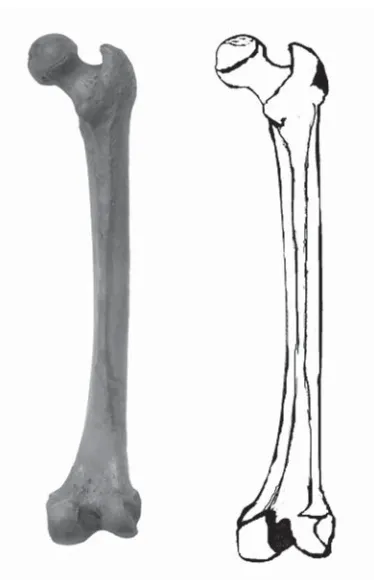
A total of 90 human femurs were included in the study (47 left and 43 right). The bones were dated to the second half of the twentieth century (1950s) and originated from the Caucasian popu-lation. All investigations were performed in the Chair of Anatomy, the Medical University of Lodz. The osteometric measurements of the femur were carried out according to standard definitions, us-ing procedures and degrees of precision as de-scribed elsewhere [14].The osteometric measurements of the femur were taken directly from the standard anthropometry handbook and used unchanged (Fig. 1) [14]: 1 — greatest femur length;
2 — femoral shaft length;
3 — superior transverse diameter; 4 — femoral head circumference; 5 — femoral head height;
6 — anterior femoral head and neck length; 7 — cervico-corporal angle.
According to the anthropometric rules (Koszelev and Olivier classifications [14]) to determine sexual dimorphism, using the measurements described above, all femurs were divided into three groups: female, male, and non-classified.
For the purpose of the present study, the linea aspera was defined as a prominent longitudinal ridge or crest, localised on the middle third of the posterior surface of the femur, and consisting of medial and lateral lips, and a narrow trough. The term ‘ridge’ refers to certain measurable features of the structure: the length and width.
Ten measurements precisely describing the linea aspera were taken, the definitions of which were evaluated for the purposes of this study (Fig. 2): — L1–L9 — nine widths of the linea aspera, defined
as the maximum dimension of the measurements, were taken in the horizontal plane in nine differ-ent places along its length, between the medial and lateral lips of the linea aspera, which were numbered from L1 to L9. L1 refers to the width of the linea aspera on its proximal onset and L9 re-fers to its width on its distal ending. The other diameters were taken at equally spaced intervals between these two points. L5 is the width of the linea aspera half way along its length;
Figure 1. Osteometric measurements of the human femur: 1 — greatest femur length; 2 — femoral shaft length; 3 — superior transverse diameter; 4 — femoral head circumference; 5 — femoral head height; 6 — anterior femoral head and neck length; 7 — cervico-corporal angle.
— LA — length of the linea aspera, defined as the maximum value of the longitudinal measure-ments taken in the vertical plane from the pro-ximal end to the distal end of the linea aspera (from L1 to L9).
Detailed measurements of the linea aspera were taken by using two independent methods: the first being a classical anthropometric method using a mi-crometer digital calliper with an accuracy of 0.05 mm (Mitutoyo Company, Japan), and the second using di-gital photographic documentation, which was subse-quently analysed using MultiScanBase v. 18.03 soft-ware (Computer Scanning System II, Warsaw, Poland). Photographic documentation was collected for every specimen. The photographs were saved in JPEG and TIFF format and later digitally transformed. All mea-surements of the femur and linea aspera were taken twice by two independent investigators, and the mean of the values was calculated to provide the greatest accuracy. The descriptive statistics used were mean, standard deviation, median, and minimum and maxi-mum for continuous variables.
Data analysis was performed using Statistica 8 software (StatSoft Polska, Cracow, Poland). The dis-tribution of continuous variables was investigated with the Shapiro-Wilk test in order to check whether
Figure 3. Type I (parallel) of the linea aspera. Figure 4. Type II (concave) of the linea aspera.
the distribution was normal or not. The descrip-tive statistics used were mean and standard devia-tion for continuous variables. The differences be-tween the measurements in all types of linea as-pera were examined using the Mann-Whitney test. A p level of < 0.05 was accepted as statistically significant.
RESULTS
To incorporate anthropometric rules describing sexual dimorphism of the femur [14], 39 female, 40 male, and 11 non-classified bones were distin-guished. With regard to sex differences, the most common type of linea aspera was the type IV — variform (41% in men and 39% in women) in both groups. In men, the second and third most com-mon types were the type II — concave (31%) and type I — parallel (22%). However, in women this order was reversed — type I (parallel) was second (32%) and type II (concave) was third (23%). Type III (convex) was the least common in both groups (6% of male and 6% of female). The anthropometric measurements of the femurs collected in the study in female and male are presented in Table 1.
The mean length of the concave-shaped linea as-pera (195.3 ± 35.9 mm) was higher than that of those with variform (189.9 ± 40.1 mm), convex (184.8 ± ± 55.3 mm), and parallel (181.4 ± 34.2 mm) shapes (Table 2). However, this difference was statistically in-significant according the Mann-Whitney test (p < 0.05).
DISCUSSION
The linea aspera is one of several “qualitative fea-tures” describing the human body [12, 13]. Other
features, which have been much better described, include the third trochanter [2, 11] or suprascapu-lar notch [20, 22].
One of the most probable explanations of the function of the linea aspera is that both of the lips of the rough line serve for the insertion of strong ad-ductor and extensor muscles such as the musculus adductor longus, musculus adductor brevis, muscu-lus adductor magnus, muscumuscu-lus vastus medialis, and musculus vastus lateralis. Hence, its development would be the consequence of a relative strengthen-ing of those muscles in humans in comparison to other primates [11, 12]. Additionally, the linea as-pera may work as a resistance pole that can stiffen the femur within its forward prominence. It is fre-quently elevated by an underlying bony ridge, result-ing in a prismatic, cross-sectional configuration [13]. Also, Pauwels [16] states that the main func-tions of the linea aspera are stabilisation and sup-port for the femur, especially while walking and running. The linea aspera may be a feature that helped our species to extend its sphere of influ-ence. The prominent development of the linea as-pera is a distinctly human feature not seen in low-er primates [11, 12].Thanks to the above-described Figure 6. Type IV (variform) of the linea aspera.
functions, the linea aspera would appear to be a form of adaptation to a bipedal gait pattern [13], as confirmed by Beauval et al. [1]. A further study addressed the morphology of the linea aspera on Neanderthal femurs, in which both lips of the linea aspera were seen to form a soft crest. Pleistocene modern human femurs also tend to have teardrop shaped cross-sections, prominent pilasters, and flat or especially concave surfaces adjacent to the linea aspera [23]. The pilaster also provides the additional biomechemical support for the posterior femur. In rachitis, insufficient calcification may lead to os-teomalacia, in which, as a result of loading, the femoral forward prominence can increase signifi-cantly, the bone can be flattened to one side, and the linea aspera can change into a narrow ridge known as the stenometry [11].
The topography of the linea aspera is an impor-tant factor in some surgical techniques, such as in the posterior approach of the femur [3] or in the modified transfemoral approach [7]. It is a crucial area for fat embolism protection during cemented total hip arthroplasty. In this example, drainage of the venous system located along the linea aspera significantly reduces the risk of intraoperative em-bolism and cardiopulmonary impairment [18, 19]. Similarly, Draenert [6] report that an increase in the
intramedullary pressure can lead to embolisation of bone marrow contents via the venous drainage sys-tem along the linea aspera.
An important piece of topographic information for Orthopaedics and surgery is that the principal nu-trient foramina of the femur are located in the linea aspera with possible variations in number and posi-tion [9]. Colipal et al. [4] discovered that the nutrient foramina of the femur was located in the linea as-pera in 72.5% of specimens: 36.25% in the interstice, 8.75% in the lateral lip, and 27.5% in the medial lip of the linea aspera. Also Yamamoto et al. [24] note that either one or two nutrient vessels of a large ca-libre originating from the perforating branches of the profunda femoris artery enter at a number of points along the linea aspera of the femur. Such awareness of the terminal courses of arteries may be useful in performing operations, by minimizing the risk of bleeding.
The prominent development of the linea aspera is visible on frontal and anteroposterior radiographs of the femur mainly in adults and, in some cases, adolescents as two thin, axially-oriented, parallel lines [17]. Pitt [17] named it the “track sign” and proposed that it represents the linea aspera-pilas-ter complex. Hoeffel et al. [10] assert that knowledge of the shape of the normal linea aspera is important
Table 1. The comparison of osteometric measurements of the femurs in females and males
Measurements Female Male
Mean ± SD Median Min.–Max. Mean ± SD Median Min.–Max.
Greatest femur length [mm] 421.1 ± 33.7 421 359–508 456.3 ± 27.3 457 370–514
Femoral shaft length [mm] 328.3 ± 28.1 327 285–392 355.8 ± 26.7 352.5 289–422
Superior transverse diameter [mm] 32.5 ± 2.3 32.1 27.3–39 33.1 ± 1.9 32.7 29.4–37
Femoral head circumference [mm] 138.2 ± 10.2 140 118–156 149.3 ± 9.6 150.5 129–163
Femoral head height [mm] 40.9 ± 4.9 42.1 31–49.2 43.7 ± 4.1 44 37–51
Anterior femoral head and neck length [mm] 69.6 ± 4.1 69.1 53–78.9 71.4 ± 4.3 69.8 66.9–82
Cervico-corporal angle [°] 118.6 ± 2.9 119.5 109–126 130.3 ± 2.6 130 127–136
Table 2. The comparison of lengths of the linea aspera in its different morphologies [mm]
Type I (parallel) Type II (concave) Type III (convex) Type IV (variform)
Mean 181.4 195.3 184.8 189.9
Standard deviation 34.2 35.9 55.3 40.1
Median 182 195 184.5 190
and should not be confused with diseases such as symmetrical osteonecrosis. Also, Gheorghiu and Leinenkugel [8] noted that the “track sign” can be readily confused with the pathological “flame sign” of Paget’s disease leading to unnecessary investiga-tions. Pitt [17] concluded that normal morphological variants should be well known, especially to ortho-paedic surgeons and radiologists. This is confirmed by Seeger et al. [21] who described a tumoral calcino-sis-like growth located along the proximal part of the linea aspera, probably formed by the lesion of this part of the bone, which may be mistaken for some varia-tions of the linea aspera. Therefore, knowledge of morphological variations is essential to form an ap-propriate clinical diagnosis.
Thanks to two techniques used for measuring and typing the linea aspera our investigation has very pre-cisely classified variations of this structure. It has also, for the first time, explicitly demonstrated types of linea aspera in females and males. To our knowledge, no similar study exists in the literature.
CONCLUSIONS
The present study aims to establish the first quan-titative classification of the linea aspera, which is simple to apply, being based on specific geometri-cal parameters and its morphology. The two me-thods used for measuring were complementary and could be used to better analyse the fine details. The classification we present may be helpful in ortho-paedic open procedures of the posterior femoral region, as well as in diagnostic radiological proce-dures to distinguish pathology from anatomical variations.
REFERENCES
1. Beauval C, Maureille B, Lacrampe-Cuyaubère F, Serre D, Peressinotto D, Bordes JG, Cochard D, Couchoud I, Dubrasquet D, Laroulandie V, Lenoble A, Mallye JB, Pasty S, Primault J, Rohland N, Pääbo S, Trinkaus E (2005) A late Neandertal femur from Les Rochers-de--Villeneuve France. Proc Natl Acad Sci, 102: 7085–790. 2. Bolanowski W, Śmiszkiewicz-Skwarska A, Polguj M, Jędrzejewski KS (2005) The occurrence of the third tro-chanter and its correlation to certain anthropometric parameters of the human femur. Folia Morphol, 64: 168–175.
3. Bosworth DM (1944) Posterior approach of the femur. J Bone Joint Surg Am, 26: 687–690.
4. Collipal E, Vargas R, Parra X, Silva H, del Sol M (2007) Forámenes Nutricios Diafisarios de los Huesos Fémur, Tibia, Fíbula. Int J Morphol, 25: 305–308.
5. Desai SC, Willson S (1985) Radiology of the linea as-pera. Australian Radiol, 29: 273–274.
6. Draenert K (1989) Modern cementing techniques. An experimental study of vacuum insertion of bone ce-ment. Acta Orthop Belg, 55: 273–293.
7. Fink B, Grossmann A (2007) Modified transfemoral ap-proach to revision arthroplasty with uncemented mod-ular revision stems. Oper Orthop Traumatol, 19: 32–55. 8. Gheorghiu D, Leinenkugel A (2010) The linea aspera-pilaster complex as a possible cause of confusion with the «flame sign’: a case report. Acta Orthop Traumatol Turc, 44: 254–256.
9. Gumusburun E, Yucel F, Ozkan Y, Akgun Z (1994) A study of the nutrient foramina of lower limb long bones. Surg Radiol Anat, 16: 409–412.
10. Hoeffel C, Munier G, Hoeffel JC (1993) The femoral lin-ea aspera: radiological pattern. Eur Radiol, 3: 357–358. 11. Hrdlica A (1934) The gluteal ridge and gluteal tuberosi-ties (3rd trochanter). Am J Phys Antropol, 23: 127–198. 12. Loth E (1955) Odmiany mammalogeniczne w budowie
człowieka. Przegl Antrop, 21: 258–280.
13. Loth E (1957) Cechy eugeniczne w budowie człowieka. Przegl Antrop, 23: 259–312.
14. Malinowski A, Bożiłow W (1997) Podstawy antro-pometrii: metody, techniki, normy. Wydawnictwo Naukowe PWN, Warszawa-Łódź.
15. Moroe K, Dalley A (2006) Clinically oriented anatomy. Lippincott Wiliams & Wilkins, Philadelphia.
16. Pauwels F (1954) The static significance of linea aspera; fourth contribution to the functional anatomy and causal morphology of the supporting apparatus. Z Anat Entwicklungsgesch, 117: 497–503.
17. Pitt MJ (1982) Radiology of the femoral linea aspera-pilaster complex: the track sign. Radiology, 142: 66. 18. Pitto RP, Schramm M, Hohmann D, Kössler M (1999)
Relevance of the drainage along the linea aspera for the reduction of fat embolism during cemented total hip arthoplasty, Arch Orthop Trauma Surg, 119: 146–150. 19. Pitto RP, Koessler M, Kuehle JW (1999) Comparison of
fixation of the femoral component without cement and fixation with use of a bone-vacuum cementing tech-nique for the prevention of fat embolism during total hip arthroplasty. A prospective, randomized clinical tri-al. J Bone Joint Surg Am, 81: 831–843.
20. Sinkeet SR, Awori KO, Odula PO, Ogeng JA, Mwachaka PM (2010) The suprascapular notch: its morphology and distance from the glenoid cavity in a Kenyan population. Folia Morphol, 69: 241–245.
21. Seeger LL, Butler DL, Eckardt JJ, Layfield L, Adams JS (1990) Tumoral calcinosis-like lesion of the proximal linea aspera. Skeletal Radiol, 19: 579–583.
22. Ticker JB, Djurasovic M, Strauch RJ, April EW, Pollock RG, Flatow EL, Bigliani LU (1998) The incidence of gangli-on cysts and other variatigangli-ons in anatomy algangli-ong the course of the suprascapular nerve. J Shoulder Elbow Surg, 7: 472–478.
23. Trinkaus E, Ruff CB (1999) Diaphyseal Cross-sectional geometry of Near Eastern middle palaeolithic humans: the femur. J Archaeol Sci,26: 409–424.