152
Emotional Intelligence as a Moderator in the Relationship between Occupational Stress and Organizational Citizenship Behavior among Nigerian Graduate Employees
John K. Aderibigbe*, Themba Q. Mjoli
Department of Industrial Psychology, University of Fort Hare, South Africa [email protected], [email protected]
Abstract: The study investigated emotional intelligence as a moderator in the relationship between occupational stress and organizational citizenship behavior among graduate employees in Nigeria. The purpose of the study was in twofold: firstly, to empirically examine the relationship between occupational stress and organizational citizenship behavior. Secondly, to empirically investigate if emotional intelligence would moderate the relationship between occupational stress and organizational citizenship behavior. The study was conducted to demonstrate whether the presence of emotional intelligence could result in a better level of employee performance, even as employees experience a certain level of occupational stress. In view of the above, the study has contributed to the formation of a new model of psychological intervention for occupational stress and organizational citizenship behavior. The study adopted the positivist explanatory cross-sectional (survey) research design to systematically sample opinions of 1,532 male and female graduate employees across. The various sectors of the Nigerian economy, using a structured and validated questionnaire and version 20 of the Statistical Package for the Social Sciences (SPSS), two hypotheses were stated and analyzed using Pearson Correlation Analysis and Multiple Regression Analysis while the percentage, mean, standard deviation and the frequency of the biographical and occupational data were also determined by the descriptive statistics. The results showed that there was a weak positive relationship between occupational stress and organizational citizenship behavior. Emotional intelligence significantly moderated the relationship between occupational stress and organizational citizenship behavior. Human resource managers should develop emotional intelligence in employees in order to increase the level of organizational performance, and reduce the negative impact of occupational stress. This could be achieved through training and seminar participation. Recommendations of the study could assist in training and developing effective manpower capacity towards improving the economy of the nation.
Keywords: Emotional intelligence, human resource management, occupational stress, organizational citizenship behavior, performance, psychological intervention.
1. Introduction
Scholars have linked challenges that relate to organizational citizenship behavior to high levels of occupational stress (Baxter, 2010; Laschinger, 2011; Shafaghat, Zarchi & Kavosi, 2018). In the same vein, studies have shown that occupational stress is significantly related to both task-related work behavior and non-task related work behavior of employees (Adebiyi, 2013; Arogundade & Lawal, 2016; Niks, de Jonge, Gevers & Houtman, 2018). The World Health Organization has also reported occupational stress as a global epidemic (WHO, 2010). The consequences of an increasingly strenuous work environment are evident in Nigerian work settings, as cases of job dissatisfaction, a high rate of absenteeism, employee intention to quit, labor turnover, and poor job performance (contrast to organizational citizenship behavior) is prevalent (Adebayo & Ogunsina, 2011; Adebiyi, 2013; Adetayo, Ajani & Olabisi, 2014; Arogundade & Lawal, 2016). One variable that has been identified in the literature that can reduce the impact of organizational stress on outcomes is that of emotional intelligence (Greenidge & Coyne, 2014).
153
the potential to reduce the negative impacts, which occupational stress may have on organizational citizenship behavior.
So far, broad studies throughout the years have centred more on identifying stressors (Paillé, 2011; Brynien & Igoe, 2016). The literature further reveals that most studies conducted on occupational stress have concentrated on determinants. As opposed to outcomes such as employee performance, turnover intention, turnover behavior and employee productivity (American Psychological Association, 2013; Goh, Pfeiffer & Zenios, 2015), hence, few scientific investigations have been conducted to devise psychological intervention strategies to ameliorate the situation and ensure organizational citizenship behavior (Ahmad, Hussain, Saleem, Qureshi & Mufti, 2015; Niks, de Jonge, Gevers & Houtman, 2018). Furthermore, though there is increasing consideration of the phenomenon of organizational citizenship behavior by researchers, a thorough review of the literature shows a lack of agreement about the scope of the concept (Farzianpour, Foroushani, Kamjoo & Hosseini, 2011). However, the current study sought to fill the existing vacuum identified in the literature through the research purpose stated below. The purpose of the study is in twofold; firstly, to empirically examine the relationship between occupational stress and organizational citizenship behavior. Secondly, to empirically investigate if emotional intelligence would moderate the relationship between occupational stress and organizational citizenship behavior.
2. Literature Review Conceptual Literature
Organizational Citizenship Behavior: Organizational citizenship behavior is an essential phenomenon in the formal work setting because of its potential to facilitate interpersonal relationships among employees, and also to increase organizational performance (Pradhan, Jena & Bhattacharya, 2016). Organizational citizenship behavior is an alternative form of performance behavior, which is differentiated from the traditional performance that relies heavily on official assignments and tasks (Karolidis, 2016). For instance, having subordinates who are highly engaged in organizational citizenship may improve managers’ efficiency by allowing them to devote a greater amount of time to long-range planning matters. Hence, managers, employees and organizations at large benefit from these positive behaviors (Lelei, Chepkwony & Ambrose, 2016). These behaviors are explained by concepts such as pro-social behaviors, extra-role behaviors, contextual performance, spontaneous behaviors or organizational citizenship behavior. In the contemporary world of work, organizational citizenship behavior is one of the variables that improve performance and the quality of services that are provided by the employees (Behtooee, 2016). It can lead to greater achievement of organizational aims and objectives. Organizational citizenship behavior is a central part of performance management. Employees who engage in the behavior are mostly found to be predisposed to it while others are shaped by the influence of the environment. It consequently implies that organizational citizenship behavior could be the result of nature or nurture in terms of development, and it could as well be accounted for by the combination of the two broad factors (Karolidis, 2016).
Occupational Stress: Occupational stress is a negative career-related concept that generates concerns among career holders, and it has the ability to influence individual and organizational outcomes (Beheshtifar & Nazarian, 2013). In other words, occupational stress is a negative phenomenon, the occurrence of which often stimulates an unpleasant response to the work environment making it appear threatening to the employees. Moreover, prolonged occupational stress could manifest itself physically, emotionally and psychologically in the lives of the affected employees. According to Chandra and Parvez (2016), a commonly reported physical symptom of occupational stress is headaches, which makes the affected employees unconsciously tense in their necks, foreheads and shoulder muscles. The other known symptoms of occupational stress are digestive problems, ulcers, hypertension, anxiety and inordinate sweating, coronary illness, strokes and even male pattern baldness.
154
stress, on the other hand, include withdrawal from society, phobias, compulsive behaviors, eating disorders and night fears (Goh, Pfeiffer & Zenios, 2015). It consequently results in counterproductive work behaviors or negative work behaviors such as intention to quit, low productivity and actual turnover behavior among others (Yahaya, Yahaya, Ma’alip, Ramli & Kamal, 2012) if it is not well managed. Among the various identified job conditions that lead to occupational stress, according to Narban, Narban and Singh (2016), are the design of tasks (such as underutilization of employees' ability or skill, high workload, inconsistent rest times, long work durations.
Routinely hectic tasks, minimal control over work, and rigidity), management style (such as lack of employees’ involvement in management decisions, poor organizational communication, lack of employee-friendly policies, poor consideration of employee family needs) and interpersonal relationships (such as poor social environment and low level of support or lack of help from co-employees and superiors). The other conditions are work roles (such as conflicting job expectations and overwhelming responsibility), career concerns (such as job insecurity, lack of opportunity for career development and frequent organization changes) and unpleasant or dangerous environmental conditions such as air pollution overcrowding and noise (Narban, Narban & Singh, 2016).
Emotional Intelligence: The concept of emotional intelligence (EI) is viewed by Mayer, Salovey and Caruso (2004) as a person’s ability to think about feelings and emotions in order to enhance reasoning. It entails the capacities of individuals to precisely observe feelings, to access or elicit emotions, to understand feelings and emotional information, and to thoughtfully control reactions in order to enhance enthusiastic and scholarly development (Mayer & Salovey, 1997). Emotional intelligence is also described as a force that drives human behaviors and actions (Akinboye, 2002). However, Bar-On (1997) defines emotional intelligence as an accumulation of non-cognitive competencies, skills and abilities that impact one's capacity to prosper in managing situations and pressures positively. Hence there is a little assertion about whether emotional intelligence signifies a cognitive capacity for processing emotional stimuli, characteristics of personality such as integrity and charisma, or some aptitude for coping with challenging circumstances. According to Deshwal (2016), emotional intelligence is a variety of abilities and skills that covers a wide collection of individuals’ expertise and personalities that are normally allude to as soft inter - and intra-individual aptitudes.
Which are beyond the conventional parts of overall intelligence, specialized or proficient aptitudes and specific knowledge in addition, emotional intelligence refers to the aptitude of a person to perceive, evaluate and control emotions. In other words, it is the awareness of emotion and enthusiastic management aptitudes which offer the capacity to adjust feeling and reason in order to expand a positive state of mind. Similarly, Venkteshwar and Warrier (2016) describe emotional intelligence as the capacity to recognize one’s own moods and those of fellow human beings. According to Goleman (1997), emotional intelligence connotes what you feel, the ability to control those emotions without them overwhelm you, the ability to encourage yourself to have jobs completed, to be imaginative and operate at your peak, perceiving what others feel and managing relationships effectively. It consists of five factors: recognizing emotions in others, managing emotions, handling relationships, motivating oneself and knowing one's emotions (Palmer & Stough, 2001).
Empirical Literature Review
155
Moreover, Soo and Ali (2016) studied the link between occupational stress and organizational citizenship behavior among a sample of 472 bankers in Malaysia. The findings of Soo and Ali’s (2016) study revealed that there is a significant negative impact of occupational stress on organizational citizenship behavior. In the same vein, Gregory, Yitzhak and Steffen (2016) scientifically examined the proposed need to distinguish between self-initiated and organizationally imposed overload in studies of work stress, using three samples, which consisted of 116 male and female full-time employed students in three countries, some nursing staff of six private hospitals in Switzerland, and 161 middle manager-supervisor dyads in Switzerland.
The study revealed that self-initiated imposed overload is significantly positively related to organizational citizenship behavior, but organizationally imposed overload is not a significant predictor of organizational citizenship behavior. Furthermore, Ikonne and Madukoma (2016) conducted a survey on the relationship among organizational citizenship behavior, job stress and satisfaction among 109 librarians in some selected universities around the south-west region of Nigeria. The results of the study show that there is a significant negative relationship between organizational citizenship behavior and job stress. In addition, Uzonwanne (2014) conducted survey research on depression, anxiety and stress as correlates of organizational citizenship behavior, using the convenience sampling technique to sample 151 female and 149 male employees of oil and gas companies in Ogun State, Nigeria. The outcomes of the research show that there is a significant positive relationship between occupational stress and organizational citizenship behavior. The findings of the study also indicate that, though there is a statistically positive relationship between the two variables, the observed positive relationship is weak considering the r-value of 0.118, which is close to 0.
Emotional Intelligence as a Moderator in the Relationship between Occupational Stress and Organizational Citizenship Behavior: Hameed (2016) studied the moderating role of emotional intelligence in the relationship between surface acting-emotional exhaustion and deep acting-emotional exhaustion among two samples: 471 female frontline service employees and 76 supervisors and heads of different hotels in Pakistan. The results of the investigation indicate that emotional intelligence moderates surface-acting emotional exhaustion relationships as well as deep-acting emotional exhaustion connections. The findings further showed that emotional exhaustion mediated the relationship between surface acting-adaptive performance and deep acting-adaptive performance. However, Hwa and Amin (2016) in their survey of the moderating role of emotional intelligence in the relationship between emotional labor, deviant behavior and organizational citizenship behavior among a sample size of 205 male and female employees that were drawn from the population of employees in the Malaysian Employer Directory, report that emotional intelligence is not a significant moderator of the relationship between emotional labor and organizational citizenship behavior.
On the other hand, Gökçe, Emhan, Topuz and Şimşek (2015) conducted an empirical study on the mediating role of emotional regulation in the relationship between job stress and performance among a sample size of 392, which was drawn from a population of employees that were working in the automotive sector in Diyarbakır, Turkey. The findings of the study show that emotional regulation played a significant mediating role in the relationship between job stress and performance. Likewise, Soran, Balkan and Serin (2014) examined the moderating impact of emotional intelligence in the relationship between job stress and employee performance among 265 bankers in Turkey. In their study, performance was equated to employee citizenship behavior. The outcomes of the study revealed that emotional intelligence had a moderating effect on the relationship between job stress and employee performance. Similarly, Irshad and Hashmi (2014) explored the mediating role of emotional intelligence in the relationship between organizational citizenship behavior and transformational leadership among a sample size of 300 male and female employees, which were drawn from the population of employees in the banking sector of Pakistan’s economy.
156
(2012) research focused on investigating the moderating roles of personal and organizational variables in the effect of emotional dissonance on organizational citizenship behavior among a sample of 222 nurses who were drawn from the population of nurses in hospitals within the northern region of Italy. The findings of the study revealed that empathy (a measure of emotional intelligence) is a significant moderator of the relationship between emotional dissonance and organizational citizenship behavior.
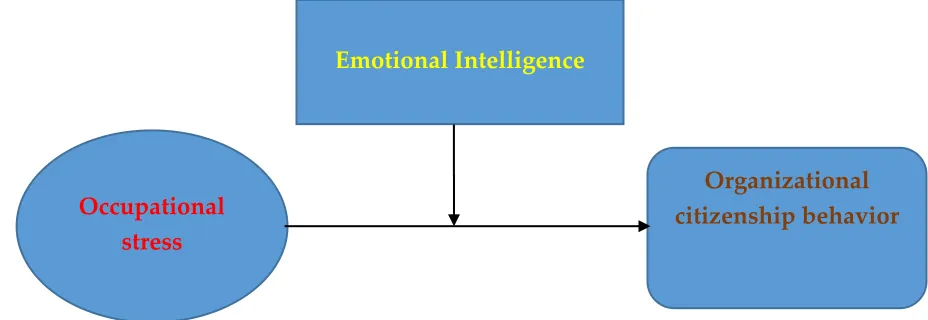
Conceptual Model: Based on the previous studies reviewed and on logical grounds, a conceptual model was developed indicating the hypothesized relationship between occupational stress and organizational citizenship behavior; and the moderating role of emotional intelligence. Organizational citizenship behavior is depicted as the dependent variable, while occupational stress is the independent variable, with emotional intelligence as the moderating variable. The conceptual model demonstrated in Figure 1 indicates the moderating role of emotional intelligence in the relationship between occupational stress and organizational citizenship behavior.
Figure 1: Emotional Intelligence as a Moderator of the Relationship between Occupational Stress and Organizational Citizenship Behavior
Statement of Hypotheses: Hypothesis 1
H0: Occupational stress is not significantly correlated with organizational citizenship behavior. H1: Occupational stress is significantly correlated with organizational citizenship behavior. Hypothesis 2
H0: Emotional intelligence is not a significant moderator of the relationship between occupational stress and organizational citizenship behavior.
H1: Emotional intelligence is a significant moderator of the relationship between occupational stress and organizational citizenship behavior.
3. Methodology
Research Design, Sample and Procedure: The study adopted a positivist explanatory cross-sectional survey research design. The explanatory cross-sectional survey research was considered appropriate for the study because the researchers used the positivist approach by means of quantitative data generation, and hypotheses testing (Bhattacherjee, 2012). The probability (The North Carolina Centre for Public Health Preparedness’ (2013) two-stage sampling scheme, and The Research Advisors (2006) Calculated Sample Size Table), and non-probability sampling (purposive and convenience) techniques were employed in this investigation. The sample comprised of 916 (60%) male and 616 (40%) female graduate employees from 19 sectors of the Nigerian economy. Among the participants, 202 (13.2%) were graduate employees from the
Emotional Intelligence
Occupational
stress
157
educational sector, 38 (2.5%) from the research institutes, 51 (3.3%) from the transportation sector, 291 (19%) from the finance and insurance sector.
Furthermore, 83 (5.4%) of those that participated were from the fast-moving consumer goods per internet (FMCGs) Industry, 21 (1.4%) from the commercial sector, 70 (4.6%) from the healthcare sector, 8 (0.5%) from the aviation sector, 77 (5.0%) from the agricultural sector and 57 (3.7%) from the information. All participants were Nigerian English speakers, and their ages ranged from 20 years to 65 years old. Relatively, 974 (63.6%) of the participants were senior staff while the remaining 558 (36.4%) were junior staff. Besides, 730 (47.7%) of the participants were government employees, and 802 (52.3%) were employees in the private sector. Data were collected by means of paper-pencil inventories (structured validated questionnaires), which were distributed to employees in large lecture auditoriums during their weekend (Saturdays) part-time professional postgraduate programs.
Ethical Consideration: The participants’ voluntary participation in the study was sought through a letter of consent, signed by each of the participants. The participants were informed about the importance of the study as the findings from the study may positively influence the government policy helping in improving their conditions of employment and service respectively. Moreover, assurance was given to the participants in respect of confidentiality of all information supplied. Furthermore, the participants were instructed not to give a form of identification such as name, identity number or organizational affiliation. With utmost sincerity, information concerning the study and its outcomes was accurately submitted to the appropriate institutions. Thus, it was ensured that no instance of misleading information was given in the course of the study. The researchers also ensured that the study was conducted in a conducive, environment such that it would not expose the participants to any physical or psychological harm. The Research Ethics Committee of the University of Fort Hare furthermore granted approval for ethical clearance of the study (Certificate reference number: MJO071SADE01).
Measuring Instruments: Three established scales of measurement were used to assess emotional intelligence, occupational stress and organizational citizenship behavior. In the three renowned public and private universities (University of Ibadan, Obafemi Awolowo University and the Pan-Atlantic University), situated in Oyo, Osun and Lagos states of Nigeria.
Occupational Stress: A 9-item scale of job stress that was developed and validated by Jamal and Baba (1992) was utilized to measure occupational stress. The measure was designed with a 5-point Likert-type response format ranging from 1/ (Strongly disagree) to 5/ (Strongly agree). The sample items on the scale include “My job makes me nervous,” “Sometimes when I think about my job I get a tight feeling in my chest.” The authors reported a Cronbach Alpha coefficient score of 0.83 for the scale, while the present study yielded a Cronbach Alpha coefficient score of 0.80 for the measure of occupational stress.
Organizational Citizenship Behavior: A 15-item modified version of Podsakoff, Mackenzie, Moorman, and Fetter’s (1990) organizational citizenship behavior questionnaire by Argentero, Cortese and Ferretti (2008) was utilized to measure organizational citizenship behavior. The construct consisted of altruism, conscientiousness and civic virtue sub-scales, with a 5-point Likert-type response format ranging from 1/ (Strongly disagree) to 5/ (Strongly agree). The sample items on the scale include “I am always ready to give a helping hand to those around me,” “I guide new people even though it is not required.” Argentero, Cortese and Ferretti (2008) reported the following Cronbach Alpha coefficient for the scale: altruism =0.81, conscientiousness =0.73, civic virtue =0.73 and 0.84 for the whole scale of organizational citizenship behavior. However, the outcome of the pilot factor analysis of this study reduced the scale-item to 13, and yielded Cronbach Alpha coefficient of 0.88 (altruism), 0.81 (conscientiousness), 0.86 (civic virtue) and 0.93 for the whole scale of organizational citizenship behavior, while the main study’s factor analysis yielded a Cronbach Alpha coefficient score of 0.82 for the whole scale of organizational citizenship behavior.
158
awareness of others sub-scales, with a 5-point Likert-type response format ranging from 1/ (Strongly disagree) to 5/ (Strongly agree). The sample items on the scale include “I am effective in helping others to feel positive at work,” “I gain stakeholders’ commitment to decisions I make at the workplace.” Seyal, Afzaal and Chin (2012) reported a Cronbach Alpha coefficient score of 0.92 for the whole scale of emotional intelligence. However, the outcome of the pilot factor analysis of this study reduced the scale-item to 2, and yielded Cronbach Alpha coefficient scores 0.57 for the scale of emotional intelligence, while the main study’s factor analysis yielded a Cronbach Alpha coefficient score of 0.81 for the scale of emotional intelligence.
Statistical Analysis of Data: The data generated from 1,532 screened questionnaires were analyzed based on the hypotheses stated, using version 20 of the Statistical Package for the Social Sciences (SPSS). Hypothesis 1 was analyzed, using Pearson Correlation Analysis. Hypothesis 2 was analyzed using Multiple Regression Analysis, while the percentage, mean, standard deviation and the frequency of the biographical and occupational data were also determined by the descriptive statistics.
4. Research Results
Hypothesis 1, Which States the Following:
H0: Occupational stress is not significantly correlated with organizational citizenship behavior.
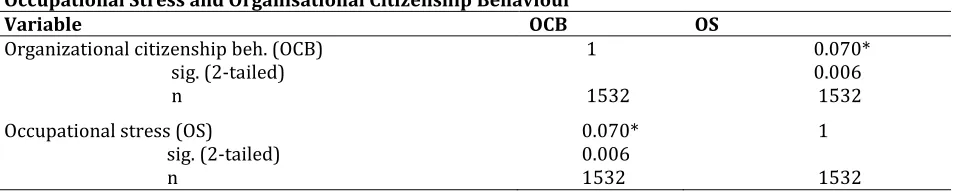
H1: Occupational stress is significantly correlated with organizational citizenship behavior was analyzed using Pearson Correlation Analysis. The results of the analysis are therefore presented in table 1 below.
Table 1: A Summary Table of Pearson Correlation Analysis Showing the Relationship between Occupational Stress and Organisational Citizenship Behaviour
Variable OCB OS
Organizational citizenship beh. (OCB) sig. (2-tailed) n
1
1532
0.070* 0.006 1532 Occupational stress (OS)
sig. (2-tailed) n
0.070* 0.006 1532
1 1532 ** Correlation is significant at the 0.01 level (2-tailed)
From Table 1 presented above, the results show that there is a positive relationship between occupational stress and organizational citizenship behavior, r = 0.070, p>0.01. Even though there is a positive relationship observed between occupational stress and organizational citizenship behavior, the level of the observed positive relationship between the two aforementioned variables is weak, considering the given significance value, 0.006 = 0.01 (approximated to 2 decimal points), which is exactly the maximum limit of acceptable value of significance at the 0.01 level (2-tailed). Though, the above results contradict the expectation that occupational stress would inversely relate to organizational citizenship behavior, yet it is understandable, particularly, when the peculiarities of the Nigerian work environment and the high level of unemployment situation of the country are put into consideration. Therefore, based on the results and interpretations, the hypothesis that states that occupational stress is significantly positively correlated with organizational citizenship behavior is to an extent confirmed. In other words, hypothesis 1 H0, which states that occupational
stress is not significantly positively correlated with organizational citizenship behavior, is rejected while hypothesis 1 H1, which states that occupational stress is significantly positively correlated with organizational
159
Figure 2: Relationship between Occupational Stress and Organizational Citizenship Behavior
R = 0.070*; p>0.01 ** Correlation is significant at the 0.01 level (2-tailed)
Hypothesis 2, Which States the Following:
H0: Emotional intelligence is not a significant moderator of the relationship between occupational stress and organizational citizenship behavior.
H1: Emotional intelligence is a significant moderator of the relationship between occupational stress and organizational citizenship behavior was analyzed using Multiple Regression Analysis. The results of the analysis are therefore presented in table 2 below.
Table 2: A Summary Table of Multiple Regression Analysis Showing the Moderating Role of Emotional Intelligence in the Relationship between Occupational Stress and Organizational Citizenship Behavior
Variable R R2 Β T F P
Occupational stress
0.088 0.008
0.063 2.473
5.945
0.013
Emotional intelligence with Occupational
stress 0.054 2.092 0.003
Dependent Variable: Organizational citizenship behavior (OCB). Predictor: Occupational stress (OS). Predictor, Moderator with Predictor: OS, EI with OS
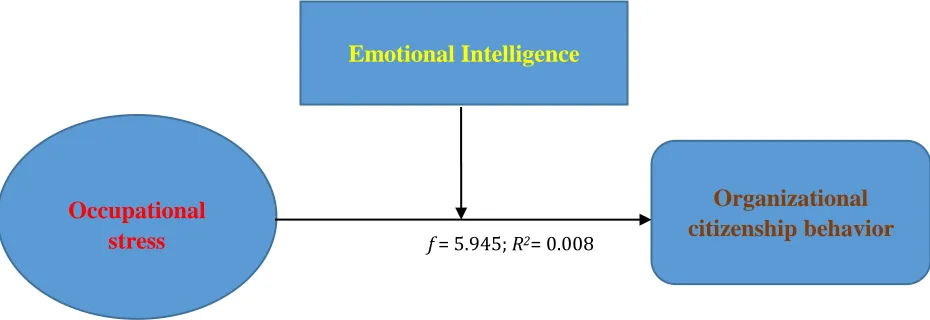
The results in the table 2 above show that emotional intelligence is a significant moderator of the relationship between occupational stress and organizational citizenship behavior, F(2,1529) = 5.945; R2= 0.008; p <0.05.
The results also indicate that occupational stress independently predicts organizational citizenship behavior, (β = 0.063; t = 2.473; p < 0.05). It further shows that the moderating role of emotional intelligence accounts for 8% of the total variance in the relationship between occupational stress and organizational citizenship behavior. It thus implies that some other factors that were not considered in the study could be responsible for the remaining 92% variance in the relationship between occupational stress and organizational citizenship behavior. In view of the above results and its interpretations, hypothesis 2 H0, which states that
emotional intelligence are not a significant moderator of the relationship between occupational stress and organizational citizenship behavior is rejected while the H1, which states that emotional intelligence is a
significant moderator of the relationship between occupational stress and organizational citizenship behavior is accepted. Figure 3 below depicts emotional intelligence moderating the relationship between occupational stress and organizational citizenship behavior.
Occupational
stress
Organizational
citizenship
160
Figure 3: Emotional Intelligence as a Moderator of the Relationship between Occupational Stress and Organizational Citizenship Behavior
f = 5.945; R2= 0.008
Discussion: The results established the hypothesized relationship and moderation in the conceptual model (figure 1). A weak positive relationship was found to exist between occupational stress and organizational citizenship behavior. This explains that though there is an indication of a positive relationship between occupational stress and organizational citizenship behavior, the observed level of positive relationship between the two variables is not reliable enough. Thus perhaps, it requires the introduction of one or more positive variables, to serve as moderators or mediators in order to yield a more significant and reliable relationship. These findings corroborate the reports of Uzonwanne (2014), which states that there is a weak positive relationship between occupational stress and organizational citizenship behavior. Similarly, Soo and Ali (2016) report further that self-initiated imposed work-overload is significantly positively related to organizational citizenship behavior, but organizationally imposed overload is not a significant predictor of organizational citizenship behavior. In terms of moderation, emotional intelligence was found to have demonstrated a significant level of moderating role in the observed positive relationship between occupational stress and organizational citizenship. Although, the results show that there are many other variables or factors, which are of a similar nature with emotional intelligence, and could have also moderated the relationship between occupational stress and organizational citizenship behavior, but were not considered in the structured model. The observed results are supported by the findings of Hameed (2016) which indicated that emotional intelligence moderates surface-acting emotional exhaustion relationships as well as deep-acting emotional exhaustion connections. The findings further show that emotional exhaustion mediated the relationship between surface acting-adaptive performance and deep acting-adaptive performances. Likewise, Gökçe et al. (2015) reported that emotional regulation plays a significant mediating role in the relationship between job stress and performance.
5. Conclusion
The Study Makes the Following Conclusions:
There is a weak positive relationship between occupational stress and organizational citizenship behavior.
Emotional intelligence is a significant moderator of the relationship between occupational stress and organizational citizenship behavior.
Recommendations: In view of the above discussion of the findings, the researchers make the following practical recommendations: that model of the relationship between occupational stress and organisational citizenship behaviour, propounded in this study, should be adopted and applied by teachers, lecturers, seminar facilitators, workshop trainers, supervisors and managers during their coaching or training sessions. Specifically, the focus should be on training the individual employees or graduates to discover their covert behavioural endowments such as emotional intelligence, and makes them refined through a systematic training process that converts the covert behavioural gifts into overt psychological assets in the form of
Emotional Intelligence
Occupational
stress
161
demonstrable managerial competencies, which can enhance their performance on the job, and also enable them to be pro-social among colleagues in the work settings.
The human resource managers, supervisors and practitioners should uphold and develop the concept of emotional intelligence in the psyche of employees through training, workshops, seminars and conference exposure so as to increase employee commitment and organizational performance in the face of occupational stress epidemics. Although, occupational stress is inevitable in the contemporary world of work, in as much as employee performance is sacrosanct, work stress can be effectively managed through psychological strategies. Therefore, during recruitment, training and development activities of the employee it is a challenge to the employers of labor, management of organizations and importantly experts who are saddled with the task of employing persons to the rightful positions, to consider the conclusions and recommendations of this study, so that the employee can develop more appropriate psychological coping mechanisms in their professions.
Acknowledgements
Competing Interests: The authors declare that they have no financial or personal relationships that may have inappropriately influenced them in writing this article.
Authors’ Contributions: The first author was the PhD researcher who designed, developed and implemented the research blueprint under the research supervising of the second author.
References
Adebayo, S. O. & Ogunsina, S. O. (2011). Influence of supervisory behavior and job stress on job satisfaction and turnover intention of police personnel in Ekiti State. Journal of Management and Strategy, 2(3), 13-20.
Adebiyi, D. R. (2013). Occupational stress among academic staff of Ekiti State University, Ado-Ekiti. European Scientific Journal, 9(4), 202-208.
Adetayo, J. O., Ajani, J. O. & Olabisi, O. (2014). An overview of the effects of job stress on employees’ performance in Nigeria Tertiary Hospitals. Ekonomika, 60(4), 139-153.
Ahmad, A., Hussain, A., Saleem, M. Q., Qureshi, M. A. M. & Mufti, N. A. (2015). Workplace stress: A critical insight of causes, effects and interventions. Technical Journal, University of Engineering and Technology, Taxila, Pakistan, 20(2), 45-55.
Akinboye, J. O. (2002). Creativity and innovation in life and the workplace. (ED) psychological principles for success in life and workplace, Ibadan Stirling-Horden Publishers, 52-100.
American Psychological Association. (2013). Stress in America: Missing the health care connection.
Argentero, P., Cortese, C. G. & Ferretti, M. S. (2008). Organizational citizenship behavior: Podsakoff et al.’s scale. TPM, 15(2), 61-75.
Arogundade, O. T. & Lawal, O. (2016). The influence of perceived occupational stress on the organizational citizenship behavior of bankers in Ikeja, lagos state. European Scientific Journal, 12(17), 449-458. Bar-On, R. (1997). The emotional quotient inventory (EQ-I): A test of emotional intelligence. Toronto, Canada:
Multi-Health System, Inc.
Baxter, P. E. (2010). Providing orientation programs to new graduate nurses: Points to consider. Journal for Nurses in Staff Development, 26, E12-E17.
Beheshtifar, M. & Nazarian, R. (2013). Role of occupational stress in organizations. Interdisciplinary Journal of Contemporary Research in Business, 4(9), 648-657.
Behtooee, L. (2016). A model for explanation of social capital in organizations, psychological empowerment, job involvement, and organizational citizenship behavior. International Journal of Advanced and Applied Sciences, 3(5), 80‐87.
Bhattacherjee, A. (2012). Social science research: Principle, methods and practices. Textbook collection. Book 3. Athens: Book 3. http://scholarcommons.usf.edu/oa_textbooks/3
162
Chandra, N. & Parvez, R. (2016). A review article: Impact of environmental and occupational stress on health. Paripex - Indian Journal of Research, 5(5), 456-457.
Deshwal, P. (2016). Impact of emotional intelligence on organizational performance. International Journal of Advanced Research in Management and Social Sciences, 5(1), 173-182.
Farzianpour, F., Foroushani, A. R., Kamjoo, H. & Hosseini, S. S. (2011). Organizational citizenship behavior (OCB) among the managers of teaching hospitals. American Journal of Economics and Business Administration, 3(3), 534-542.
Federal Ministry of Women Affairs & Social Development. (2008). Nigeria Gender Statistics Book. Mitsubishi UFJ Research & Consulting Co., Ltd, Japan.
Goh, J., Pfeiffer, J. & Zenios, S. A. (2015). Workplace stressors & health outcomes: Health policy for the workplace. Behavioral Science & Policy, 1(1), 43–52.
Gökçe, S. G., Emhan, A., Topuz, G. & Şimşek, M. S. (2015). The analysis of the relationship between job stress, interpersonal conflict, emotion regulation ability and performance: A research in the automotive sector. International Journal of Business and Social Science, 6(8), 201-208.
Goleman, D. (1995). Emotional intelligence. New York: Bantam Books.
Goleman, D. (1997). Beyond IQ: Developing the leadership competencies of emotional intelligence. London. Greenidge, D. & Coyne, I. (2014). Job stressors and voluntary work behaviors: Mediating effect of emotion and
moderating roles of personality and emotional intelligence. Human Resource Management Journal, 24(4), 479-495.
Gregory, A. L., Yitzhak, F. & Steffen, R. (2016). Evidence for the need to distinguish between self-initiated and organizationally imposed overload in studies of work stress. Work & Stress, 30(4), 337-355, DOI: 10.1080/02678373.2016.1253045.
Hameed, F. (2016). Impact of personality on adaptive performance with mediating role of emotional labor: Testing a mediated moderated model among front-line female hospitality industry employees in Pakistan. PhD Thesis, Department of Management & Social Sciences, Capital University of Science & Technology, Islamabad.
Hwa, M. A. C. & Amin, H. (2016). Why emotion at work matters: Examining the influence of emotional labor and emotional intelligence on workplace behaviors among service workers in East Malaysia. Kajian Malaysia, 34(1), 79–105.
Ikonne, C. N. & Madukoma, E. (2016). An investigation of the relationship between job satisfaction, job stress and organizational citizenship behavior: A research on librarians in Nigerian University Libraries. International Journal of Science and Research, 5(8), 480-484.
Irshad, R. & Hashmi, M. S. (2014). How transformational leadership is related to organizational citizenship behavior? The mediating role of emotional intelligence. Pakistan Journal of Commerce and Social Sciences, 8(2), 413-425.
Jamal, M. & Baba, V. V. (1992). Shiftwork and department type related to job stress, work attitudes and behavioral intentions: A study of nurses. Journal of Organizational Behavior, 13, 449–464.
Karolidis, D. (2016). Organizational citizenship behavior in the Greek public sector. Interdependent Program of Postgraduate Studies in Business Administration, University of Macedonia.
Laschinger, H. K. S. (2011). Job and career satisfaction and turnover intentions of newly graduated nurses. Journal of Nursing Management. Advance online publication.
Lelei, J. C., Chepkwony, P. K. & Ambrose, K. (2016). Effect of organizational citizenship behavior on employee performance in banking sector, Nairobi County, Kenya. International Journal of Business, Humanities and Technology, 5(4), 55-61.
Mayer, J. D. & Salovey, P. (1997). What is emotional intelligence? In P. Salovey & D. Sluyter (Eds.), Emotional development and emotional intelligence: Implications for educators (pp. 3-31). New York: Basic Books.
Mayer, J. D., Salovey, P. & Caruso, D. R. (2004). Emotional intelligence: Theory, findings, and implications. Psychological Inquiry, 15(3), 197-215.
North Carolina Center for Public Health Preparedness. (2013). Two-stage cluster sampling: General guidance for use in public health assessments. University of North Carolina, Chapel Hill.
163
Niks, I., de Jonge, J., Gevers, J. & Houtman, I. (2018). Work stress interventions in hospitals care: Effectiveness of the Discovery method. International Journal of Environmental Research and Public Health, 15, 332; doi:10.3390/ijerph 15020332.
North Carolina Center for Public Health Preparedness. (2013). Two-stage cluster sampling: general guidance for use in public health assessments. Cited in Aramide, O. K. (2014). Relationship between the use of family planning related information and attitudes of rural childbearing women toward family planning. A PhD Thesis, Postgraduate School, Babcock University, Nigeria, 73-75.
Nourani, S. S., Kohansal, D. Z., Esmaily, H. & Hooshmand, E. (2016). The relationship between organizational citizenship behavior, job satisfaction and occupational stress among Midwives Working in Healthcare Centers of Mashhad, Iran. Journal of Midwifery and Reproductive Health, 4(2), 622-630.
Paillé, P. (2011). Stressful work, citizenship behavior and intention to leave the organization in a high turnover environment: Examining the mediating role of job satisfaction. Journal of Management Research, 3(1), 1-14.
Palmer, B. & Stough, C. (2001). Workplace SUEIT – Swinburne university emotional intelligence test. Swinburne University, Organizational Psychology Research Unit, Australia.
Podsakoff, P. M., Mackenzie, S. B, Moorman, R. H. & Fetter, R. (1990). Transformational leader behaviors and their effects on followers’ trust in leader, satisfaction and organizational citizenship behavior. The Leadership Quarterly, 1(2), 107-142.
Pradhan, R. K., Jena, L. K. & Bhattacharya, P. (2016). Impact of psychological capital on organizational citizenship behavior: Moderating role of emotional intelligence. Cogent Business & Management, 3, 1-16.
Santo, L. D. (2012). The nurse – patient emotional interaction in quality of work life: The role of empathy and emotional dissonance. PhD Thesis, Department of Organizational Psychology, Universite Libra De Bruxelles.
Seyal, A. H., Afzaal, T. & Chin, S. T. S. (2012). Assessing emotional intelligence and organizational citizenship behavior among Executives: Examples from Brunesian SMEs. International Business Management, 6(4), 476-486.
Shafaghat, T., Zarchi, M. K. R. & Kavosi, Z. (2018). Occupational stress and how to confront it: A case study of a hospital in Shiraz. Hospital Pract Res, 3(2), 64-68.
Soo, H. S. & Ali, H. (2016). The linkage between stress and organizational citizenship behavior. International Business Management, 10(14), 2713-2718.
Soran, S., Balkan, M. O. & Serin, M. E. (2014). Job stress and performance: The mediating effect of emotional intelligence. European Journal of Business and Social Sciences, 3(5), 67-75.
The Research Advisors. (2006). http://research-advisors.com
Uzonwanne, F. C. (2014). Depression, anxiety and stress as correlates of organizational citizenship behavior among oil workers in Nigeria. European Journal of Globalization and Development Research, 10(1), 619-637.
Venkteshwar, A. & Warrier, U. (2016). The relationship between emotional intelligence, personality and academic performance of net generation students. IOSR Journal of Business and Management, 18(3), 10-14.
World Health Organization. (2010). Healthy workplaces: A model for action for employers, workers, policymakers and practitioners. Geneva: WHO.