www.ijaer.in Copyright © IJAER 2016, All right reserved Page 1891
CORRELATIONS BETWEEN VIABILITY AND DIFFERENT VIGOUR
TESTS IN MAIZE SEEDS
H. O. Sivritepe*, N. Sivritepe and B. Senturk
Department of Horticulture, Faculty of Agriculture, Uludag University, Görükle Campus, Bursa 16059, Turkey
ABSTRACT
Different vigour tests were conducted in maize seeds cv. ‘89MAY70’ in order to determine the highest correlation between viability and vigour; and any possible vigour test methods beside the ISTA validated radicle emergence test. The results of germination tests [normal germination rate (NGR)] and vigour tests [first count (FC), mean germination time (MGT), germination index (GI), radicle emergence (RE), electrical conductivity (EC) and cold test (CT)] were evaluated on the bases of 6 different seed calibration classes, which were composed depending on the seed shape (round and flat) and seed size (small, medium and large). Significant differences (P≤0.05) were found both in germination and vigour tests due to seed shape and seed size. Especially, viability and vigour levels of flat shaped seeds were determined higher than those of the round shaped ones, irrespective of the seed size. Moreover, the correlations between normal germination rate and vigour parameters were investigated in a correlation matrix. Consequently, the highest correlation between seed viability and vigour was found between NGR and GI. This was followed by NGR and EC, RE, FC, MGT, respectively. However, the correlation between NGR and CT was statistically not significant (P≥0.05). These results suggest that in maize seeds GI and EC are promising vigour test methods beside the RE test, which is validated by ISTA. EC test should be used to determine seed vigour before any treatment (i.e., fungicide treatment, film coating, pelleting, etc.) used in seed technology, however, GI and RE tests could be used before and after any seed treatment.
www.ijaer.in Copyright © IJAER 2016, All right reserved Page 1892 INTRODUCTION
Germination testing remains the principle, and internationally accepted, criterion for seed viability. Germination test results less than an acceptable standard usually reflect seed deterioration, and indicate that the seed lot performance may be poor. However, for high germinating seed lots, the germination test result alone may not provide enough information as to potential seed lot performance. It is in these circumstances that the vigour status of the seed lot becomes important and vigour testing necessary (ISTA, 1995a).
The term vigour cannot be identified as a single defined physiological process such as germination or deterioration. In fact, seed vigour is an interaction of characteristics that also could be considered as independent attributes of physiological potential such as speed of germination, seedling growth, ability to germinate above or below optimal temperatures, and other aspects of tolerance to stresses (Marcos-Filho, 2015).
Physiological deterioration starts before seed harvest and continues during the harvest, processing and storage periods. Thus, this process progressively causes changes in cell membrane integrity, enzyme activities and protein synthesis. The final stage of this deterioration is death of the seed. Nevertheless, seeds lose vigour before they lose the ability to germinate. Therefore, seed lots that have similar high germination values can differ in their physiological age and so differ in seed vigour (ISTA, 1995a; Sivritepe, 2012).
Seed vigour tests should be inexpensive, rapid, simple, objective, reproducible, and have high correlation with field performance (Copeland and McDonald, 2001). Depending on the parameters examined, seed vigour tests are divided into three main categories. Physiological tests or direct tests comprise measurements based on seed germination or seedling growth under stress conditions. Biochemical tests are indirect tests which largely measure one of the consequences of seed ageing. The third group of vigour tests, which include accelerated ageing, controlled deterioration and determination of Ki, evaluate the effects of a period of seed ageing on
germination (ISTA, 1995b, 2012; Powell, 2006; Sivritepe, 2012).
Recently, studies on seed vigour have been increased and a number of researchers have tried to develop new vigour tests for seeds of more plant species. Particularly, several different vigour tests have been developed for maize seeds (which have a large share in the seed industry) such as seedling growth test, radicle emergence test, Hiltner test, cold test, and complex stress test (ISTA 1995b, 2012; Powell, 2006; Sivritepe, 2012).
www.ijaer.in Copyright © IJAER 2016, All right reserved Page 1893
maize seeds (ISTA, 2012). However, standardised methods for measuring seed vigour will continue to evolve in maize seeds as well as in seeds of other species.
Therefore, this study was conducted to determine: (i) the highest correlation between viability and vigour in maize seeds, and (ii) any possible vigour test methods beside the ISTA validated radicle emergence test.
MATERIALS AND METHODS
Seeds of maize (Zea mays L.) cv. ‘89MAY70’ (obtained from MayAgro Seed Corp. in Bursa, Turkey) were used in the experiments. The maize seeds of 6 different calibration classes, which were formed depending on the seed shape (round and flat) and seed size (small, medium and large), were stored in hermetically closed glass jars in a fridge at 3±1°C until required for experimentation.
Germination tests (normal germination rate) and vigour tests (first count, mean germination time, germination index, radicle emergence, electrical conductivity and cold test) were conducted on the bases of the 6 different seed calibration classes.
The seeds (i.e., eight 25-seed replicates) were set to germinate, between moist rolled paper towels, in an incubator running at 25°C and 70% RH. Then the percentage viability (normal germination rate; NGR) of seeds was determined (ISTA, 2012). Germination test results were recorded daily until day 7.
According to the ISTA Rules, the time for the first count of maize seeds is day 4 of the germination test (ISTA, 2012). Therefore, in each germination test, the percentage of normal germinating seedlings on day 4 were recorded in the first count (FC) test.
Mean germination time (MGT) was calculated from the germination test records according to the equation of Ellis and Roberts (1981):
MGT = ∑dn / ∑n
d: Days counted from the beginning of germination n: The number of seeds germinated on day d
Germination index (GI) was also calculated from the germination test records according to the equation of Maguire (1962):
GI = ∑ n / d
www.ijaer.in Copyright © IJAER 2016, All right reserved Page 1894
d: Days counted from the beginning of germination
Radicle emergence (RE) test was set up by the use of eight replicates of 25 seeds to germinate on paper towels, following the normal procedure for a rolled towel germination test. The RE test was conducted for 66 hours at 20°C. At the end of the test, the number of seeds that had produced a radicle at least 2 mm long was recorded for each replicate (ISTA, 2012).
The electrical conductivity (EC) test was conducted with the four 50-seed replicates which were weighed and placed in 500 mL glass jars. Then, 250 mL distilled water (EC < 5 µS cm-1) was
added in each jar and the lid was tightly closed. Following this, the jars were placed in an incubator running at 25°C for 24 hours. At the end of the EC test, electrical conductivity (µS cm -1 g-1) of the substances leaking from the seeds was determined (Sivritepe et al., 2015).
The procedure of the moist rolled paper towel was used in the cold test (CT) as described by ISTA (1995). The seeds (i.e., eight 25-seed replicates) were initially set to germinate at 10°C for 7 days, the rolled towels were then transferred to 25°C for a further period of 5 days. Seedlings were evaluated using the same criteria as for the standard germination test (ISTA, 2012).
The data obtained in each test was subjected to a two-way ANOVA and the differences of means were compared by LSD tests at p≤0.05, in a JMP 7.0 computer programme. Moreover, the correlations between normal germination rate and vigour parameters were evaluated in a correlation matrix.
RESULTS AND DISCUSSION
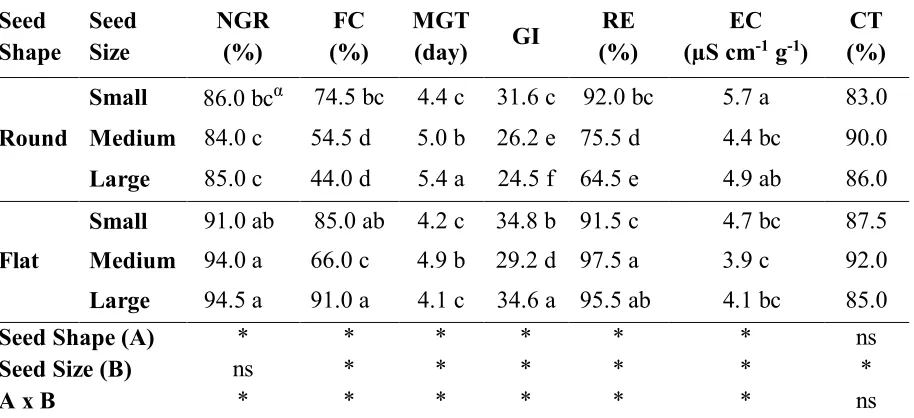
The results have shown that seed shape had significant effects (P≤0.05) on viability (NGR) and vigour (FC, MGT, GI, RE and EC) parameters, except CT (P≥0.05). However, the effect of seed size was insignificant (P≥0.05) for NGR, while it was significant (P≤0.05) for all the vigour parameters examined. Moreover, the effects of the interaction between seed shape and seed size were also significant (P≤0.05) for NGR and vigour parameters, except for CT (P≥0.05) (Table 1).
www.ijaer.in Copyright © IJAER 2016, All right reserved Page 1895 Table 1. The effects of seed shape and seed size on viability and vigour in seeds of maize cv.
‘89MAY70’. Seed Shape Seed Size NGR (%) FC (%) MGT
(day) GI
RE (%)
EC (µS cm-1 g-1)
CT (%)
Round
Small 86.0 bcα 74.5 bc 4.4 c 31.6 c 92.0 bc 5.7 a 83.0 Medium 84.0 c 54.5 d 5.0 b 26.2 e 75.5 d 4.4 bc 90.0 Large 85.0 c 44.0 d 5.4 a 24.5 f 64.5 e 4.9 ab 86.0
Flat
Small 91.0 ab 85.0 ab 4.2 c 34.8 b 91.5 c 4.7 bc 87.5 Medium 94.0 a 66.0 c 4.9 b 29.2 d 97.5 a 3.9 c 92.0 Large 94.5 a 91.0 a 4.1 c 34.6 a 95.5 ab 4.1 bc 85.0
Seed Shape (A) * * * * * * ns
Seed Size (B) ns * * * * * *
A x B * * * * * * ns
α Values not associated with the same letter are significantly different (P≤0.05).
* Significant at 0.05 level.
Moreover, the correlations between NGR and vigour parameters were investigated in a correlation matrix (Table 2). Consequently, the highest correlation between seed viability and vigour was found between NGR and GI. This was followed by EC, RE, FC and MGT, respectively. However, the correlation between NGR and CT was statistically not significant (P≥0.05).
Table 2. The multivariate correlations between viability and vigour parameters in seeds of
maize cv. ‘89MAY70’ with different calibration classes.
NGR FC MGT GI RE EC CT
NGR 1.0000
FC 0.5668* 1.0000
MGT -0.4739* -0.9184* 1.0000
GI 0.6787* 0.9895* -0.9383* 1.0000
RE 0.6296* 0.7372* -0.6057* 0.7674* 1.0000
EC -0.6571* -0.0673* -0.0217 -0.0274 -0.1850 1.0000
www.ijaer.in Copyright © IJAER 2016, All right reserved Page 1896
To date, many researchers have conducted a number of studies on different vigour test methods in maize seeds. Before the validation of RE test by ISTA (2012), the CT for maize seeds has been the most used of all vigour tests (Tekrony, 2001) and has often been related to field emergence (Lovato and Balboni, 1997; Noli et al., 2008; Aliloo and Shokati, 2011). However, in the present study, CT gave conflicting results (i.e., the correlation between NGR and CT were insignificant). Previously, Nijenstein and Kruse (2000) also concluded that CT was difficult to standardise.
A number of researchers have pointed out that there is potential for comparative measurements of MGT as an indicator of field emergence in maize (Matthews and Khajeh Hosseini, 2006; Matthews et al., 2010; Luo et al., 2015). Our results are in parallel to those of the above works in terms of MGT. Moreover, the results of the present study have shown that correlation coefficient between NGR and GI is higher than that of the MGT. This result is also supported by Luo et al.
(2015). Present findings suggest that each of the FC, MGT and GI could be incorporated into routine germination testing and hence assess germination and vigour within one test.
Furthermore, previous works on single counts of RE test (Matthews et al., 2011; Luo et al., 2015) and EC test (Vitoria and Natera, 2007; Aliloo and Shokati, 2011; Luo et al., 2015) are in aggreement with the results of our study.
CONCLUSIONS
Consequently, these results suggest that in maize seeds GI and EC are promising vigour test methods beside the RE test, which is validated by ISTA. Since the EC test is a simple, low-cost and fast method, it should be preferred to determine maize seed vigour before any treatment (i.e., fungicide treatment, film coating, pelleting, etc.) used in seed technology, however, GI and RE tests could be used before and after any seed treatment.
REFERENCES
Aliloo, A. A. and Shokati, B. (2011). Correlation between seed tests and field emergence of two maize hybrids (SC704 and SC500). Online Journal of Animal and Feed Research, 1(6), 249-254.
Copeland, L. O. and McDonald, M. B. (2001). Principles of seed science and technology. Kluwer Academic Publishers, Massachusetts, USA.
www.ijaer.in Copyright © IJAER 2016, All right reserved Page 1897
ISTA. (1995a). Understanding Seed Vigour. International Seed Testing Association. Zurich, Switzerland.
ISTA. (1995b). Handbook of Vigour Test Methods. Third Edition. (J. G. Hampton and D. M. TeKrony, Eds.) International Seed Testing Association. Zurich, Switzerland.
ISTA. (2012). International Rules for Seed Testing. Edition 2012. International Seed Testing Association. Bassersdorf, Switzerland.
Lovato, A. and Balboni, M. (1997). Seed vigour in maize (Zea mays L.): two-year laboratory and field test compared. Italian Journal of Agronomy, 1, 1-6.
Luo, Y., Guan, Y. J., Huang, Y. T., Li, J., Li, Z. and Hu, J. (2015). Single counts of radicle emergence provides an alternative method to test seed vigour in sweet corn. Seed Science and Technology, 43, 519-525.
Maguire, J. D. (1962). Speed of germination - aid in selection and evaluation for seedling emergence and vigor. Crop Science, 2, 176-177.
Marcos-Filho, J. (2015). Seed vigor testing: an overview of the past, present and future perspective. Scientia Agricola, 72(4), 363-374.
Matthews, S and Khajeh-Hosseini, M. (2006). Mean germination time as an indicator of emergence performance in soil of seed lots of maize (Zea mays L). Seed Science and Technology, 34, 361-369.
Matthews, S., Wagner, M.-H., Ratzenboeck, A., Khajeh Hosseini, M., Casarini, E., El-Khadem, R., Yakhlifi, M. and Powell, A.A. (2011). Early counts of radicle emergence during germination as a repeatable and reproducible vigour test for maize. Seed Testing International, 141, 39-45.
Nijenstein, J.H. and Kruse, M. (2000). The potential for standardization in cold testing of maize
(Zea mays L.). Seed Science and Technology, 28, 837-851.
www.ijaer.in Copyright © IJAER 2016, All right reserved Page 1898
Powell, A. A. (2006). Seed vigour and its assessment. In A. S. Basra (Ed.), Handbook of seed science and technology (pp. 603-648). The Haworth Press, Inc., New York, USA.
Sivritepe, H. O. (2012). Assessment of seed vigour. Alatarım, 11(2), 33-44.
Sivritepe, H. O., Senturk, B. and Teoman, S. (2015). Electrical conductivity tests in maize seeds. Advances in Plants and Agriculture Research, 2(7), 1-2.
Tekrony, D.M. (2001). ISTA seed vigour survey-2000. ISTA News Bulletin, 122, 14-15.