Volume 5
Article 1
2016
Volume 5
Leigh G. Dillard
university of north georgiaFollow this and additional works at:
http://digitalcommons.northgeorgia.edu/papersandpubs
Part of the
Digital Humanities Commons
This Full Issue is brought to you for free and open access by the Center for Undergraduate Research and Creative Activities (CURCA) at Nighthawks Open Institutional Repository. It has been accepted for inclusion in Papers & Publications: Interdisciplinary Journal of Undergraduate Research by an authorized editor of Nighthawks Open Institutional Repository.
Recommended Citation
ublica
tions
2016
Vol
ume 5
cerpts in connection with a review in newspaper, magazine, or electronic publications; nor may any part of this book be reproduced, stored in a retrieval system, or transmitted in any form or by any means electronic, mechanical, photocopying, recording, or other without the written permission from the publisher.
Published by:
University of North Georgia Dahlonega, Georgia Printing Support by: Interstate Graphics, Inc. Johnson City, Tennessee
Cover art: Juan J. Garces, Maleiwa (Creation) Cover Design: Julianne M. Reynolds ISSN: 2325-2502
Printed in the United States of America, 2016
For more information, please visit: http://www.ung.edu/curca Or email: [email protected]
Anastasia Lin Managing Editor Gloria Bennett Content Editor Royce Dansby-Sparks Content Editor Susann Doyle-Portillo Content Editor Randall Parrish Content Editor Craig Wilson Content Editor Jules Reynolds
3
Letter from the Managing Editor 4
Anastasia Lin, PhD
Letter from the Editor-in-Chief 5
Leigh G. Dillard, PhD
‘It Relates to My Everyday Life.’ Critical Pedagogy and Student Explanations of Interest in Sociology Course Topics 7 Mindy R. Mauldin, Cullen T. O’Donnell, Chastity L. Blankenship, PhD
Florida Southern College Jeremie Bates
Valencia College
The Puppeteer: An Analysis of the Implications of Gendered Spheres
through Sadie Burke in All the King’s Men 15
Sierra Riddle Lee University
The Gaps in Health Care of the LGBT Community: Perspectives of
Nursing Students and Faculty 21
Keily Mitchell, LaKenya Lee, Ayana Green, and Jasmine Sykes Georgia Southern University
Optimism in Independence: The European Central Bank after the
2008 Global Financial Crisis 31
Melissa D. Dixon and Jamie E. Scalera, PhD Georgia Southern University
Computer Vision Based Object Detection and Tracking in Micro
Aerial Vehicles 40
Richard F. Chapman and H. David Mathias, DSc Florida Southern College
The Clerk Conundrum: Chaucer’s Attitude towards Pilgrim
and Profession 47
Amber N. Jurgensen Louisiana Tech University
From Sensor to Street: Intelligent Vehicle Control Systems 52 Zachariah Coles, Imani Augusma, Thomas Beryl, and Valentin Sololu, PhD
Georgia Southern University
Mapping Joaquín: How Literary Cartography Opens New
Perspectives on the Western Novel 59
Reinhild Kokula
University of North Georgia / University of Würzburg
Maleiwa: A Story of Creation 66
Juan Garces
University of North Georgia
Contributor Biographies 68
O
ver the last five years, Papers & Publications has served the southeastern region as an outlet for outstanding undergraduate students in any discipline to publish peer-reviewed manuscripts. Over these five years, the journal has also grown and shifted. Papers and Pub(lication)s, as it was originally denoted, was founded in 2012 by the former North Georgia College and State University. In 2013, the University of North Georgia was founded through the consolidation of NGCSU and the former Gainesville State College. This consolidation has led to many exciting new opportunities through the combined strengths of these two former universities. Papers & Publications is no exception.As Managing Editor for Papers & Publications and director for the Center for Undergraduate Research and Creative Activities (CURCA), it is my pleasure to introduce Volume 5 of the journal as well as to introduce our new Editor-in-Chief, Dr. Leigh Dillard, assistant professor of English at UNG. Dr. Dillard brings a wealth of experience in current publishing and graphic design trends to the project, and her own scholarly work focuses on eighteenth- century print culture. Papers & Publications also remains indebted to the work of Miriam Segura-Totten, founding Editor-In-Chief of the journal, who remains a key resource and reviewer. We are also grateful for the pioneering work of B.J. Robinson and the UNG Press for supporting the first four volumes of the journal. Allison Galloup, a long-time Papers & Publications board member, has also taken over as Digital Content Editor.
Each volume of Papers & Publications continues to build and improve on the last, and this year is no exception. The student work showcased here underscores the increasing diversity of both content area and student home university. In the current issue, the articles cover a broad range of subjects from Engineering to British Literature, Biology to the cross-disciplinary field of Literary Cartography. In addition, student authors hail from around the southeastern region and include one international author who completed research while on study abroad in the U.S. The caliber and diversity of these submissions speak to the importance of offering a journal for the exceptional research and creative work of students in our region.
In her inaugural letter introducing Papers & Publications, founding editor-in-chief Totten wrote: “Our mission in creating this journal was twofold: to provide a forum for young minds to showcase the fruits of their creative and scholarly work, and to give students the experience of going through the process of peer review.” That mission has not changed; rather, we hope with this edition to show that we have intensified our focus on providing a forum to celebrate scholarly exchange and academic excellence. I invite you to peruse the current volume and to engage with our student authors’ pursuits of innovation, creativity, problem solving, and meaning-making. Thank you for your interest in celebrating and supporting these students.
Anastasia Lin, PhD
5
U
ndergraduate research is a popular phrase in academia atpresent. More than a trend, however, this growing practice affords new challenges to students and faculty alike. Conference presentations and academic publications were reserved for the select few in my undergraduate years; while the process is still selective, I am encouraged by the movement toward more avenues for presentation and publication and increasing institutional support for students across disciplines wishing to engage in these opportunities.
I am honored to begin my tenure as Editor-in-Chief of Papers & Publications, following in the astute leadership of past Editor-in-Chief Miriam Segura-Totten, who showed a commitment to undergraduate research through her supervision of the first four volumes. This venture would also not be possible without the ongoing support of Dr. Anastasia Lin and the Center for Undergraduate Research and Creative Activities at the University of North Georgia (CURCA). I am equally grateful to my colleagues, both at the University of North Georgia and beyond, who agreed to serve as editors and reviewers for this issue. Likewise, the faculty mentors of the students represented here deserve recognition for their encouragement and patience in creating classroom environments that reward inquisitiveness and problem solving.
The breadth of the essays presented in this volume is little surprise given our interdisciplinary focus, yet the contributions of these authors are united in their engagement in current topics and research methodologies. From pedagogical concerns in the field of nursing and technology enhancements in drone technology to discussions of European economic policy, literary cartography, and literary analysis, these essays reveal the viability of student-driven contributions to the academic conversation.
As I look to the future of this journal, I am encouraged by the opportunities it presents, chances to continue fostering and celebrating the critical efforts of undergraduate students in a way that provides them a taste of academic publishing. It is with great pleasure that I present this fifth volume of Papers & Publications to recognize the work of these promising young scholars with hopes that others will be similarly inspired.
Leigh G. Dillard, PhD Editor-in-Chief
Assistant Professor of English
Letter from the Editor-in-Chief
Leigh G. Dillard, PhD
Mauldin, O’Donnell, Bates, and Blankenship | 7
E
ducators strive to teach students about being responsible for theirown learning, but they often deny the students the freedom of doing so. Although there is some disagreement over the core concepts of sociology, a sample of sociological leaders agree that the top five primary goals of an Introduction to Sociology course are (1) to understand the structural factors in everyday life, (2) to place an issue in a larger context, (3) to identify and explain social inequality, (4) to recognize the differ-ence between empirical and normative statements, and (5) to compare and contrast one’s own experience with those of people in other parts of the United States and the world (Persell, 2010). Furthermore, in 2006, The Task Force on Sociology and General Education identified several general education learning outcomes to which sociology courses contrib-ute, some of which include quantitative literacy, knowledge of society, diversity awareness and understanding, critical thinking, and collabora-tion and teamwork (Keith et al., 2007; Howard & Zoeller, 2007). From a student perspective, Howard and Zoeller (2007) indicate that students believe that Introduction to Sociology courses contribute to their general educational requirements—primarily critical thinking skills, integration and application of knowledge, and understanding of society and culture. How do Introduction to Sociology instructors implement the necessary sociology core while keeping students interested and engaged? In any field of study, teachers may struggle to successfully do both. A teacher’s educational philosophy guides how, what, and why they teach topics related to the introductory sociology core. Educational philoso-phies can be student-focused or centered around the teacher; they can be pragmatic or progressive; they can prioritize the interests of society over the interests of the individual, or the other way around; they can even be a combination of some, or all, of these characteristics. Nevertheless, traditional approaches to education, such as conservative and liberal ped-agogies tend to dominate classrooms throughout the country. Lecture is the pervasive teaching strategy; however, instructors also often utilize in-class discussion as well (Grauerholz & Gibson, 2006; Howard & Zoeller, 2007).
Traditionally, teachers have used a banking pedagogy, in which someone in a position of power determines what the students need to know and the teachers are expected to provide the students with that knowledge (Aslan-Tutak, Bondy, & Adams, 2011). Throughout history, educators have been solely responsible for teaching, while their pupils have only had the task of learning. Some sociologists contend that this
‘It Relates to My Everyday Life.’
Critical Pedagogy and Student
Explanations of Interest in Sociology
Course Topics
Mindy R. Mauldin, Cullen T. O’Donnell, Chastity L. Blankenship, PhD
Florida Southern College
Jeremie Bates
Valencia College
one-way approach to pedagogy creates a culture of silence that reinforces power relations and propagates conformity and passivity among the students (Freire, 1974; Martin & Brown, 2013). Furthermore, through the banking concept of education, neither the professor nor the scholar learns as much information as possible.
Critical pedagogy, on the other hand, is relatable to conflict theory because they both challenge the status quo and encourage social change. Banking pedagogy disempowers students and teachers by hindering the students’ thinking and preventing them from actively engaging in their pursuit of knowledge (Aslan-Tutak, Bondy, & Adams, 2011). However, the less prevalent philosophy of critical pedagogy opposes traditional, teacher-centered perspec-tives of education in nearly every way, therefore offering the greatest opportunities for student advancement (Widdersheim, 2013).
While all educators face challenges in creating a curriculum that finds a balance between departmental expectations and maintaining student interest, it can be par-ticularly challenging for professors who teach Introduction to Sociology courses. They must teach topics that will be useful to both students majoring in sociology and students of other majors who are taking the course as a general education requirement. Introductory sociology courses may include students majoring in a wide variety of subjects who have many different interests. Under the current system, Introduction to Sociology instructors require students from all majors to study the same subject matter and then test them on the subjects using the same methods of evaluation. While college courses still consist of textbook readings, lectures, and discussions, many postsecondary educational institutions are now emphasizing the need for engaged learning (Bain, 2004). Students are beginning to be encouraged to express their unique thoughts and ideas in creative ways through hands-on classroom activities. Allowing students the option to choose the course content and the teaching style, through methods of critical pedagogy, is the one way to give them true freedom to express their individuality during their education.
Not all students share the same interests and goals, so not all instructors should teach the same topics in the same ways. Teachers who use critical pedagogy strive to give the students an understanding of the connection between what they learn in the classroom and the reality of the outside world, because this teaching method emphasizes hands-on, integrative and inqui-ry-based learning (Howard & Zoeller, 2007). The process of critical pedagogy gives agency to both the teachers and the students, creating a partnership, which allows students to have more input in their own educations.
Despite the extensive research done on the benefits of giving more power to the students, few practical methods have been found to implement the practice in classrooms (Braa & Callero, 2006). Rather, sociologists tend to discuss critical pedagogy as a general theory that allows for flexible application to different situ-ations (Aslan-Tutak, Bondy, & Adams, 2011). Although this method of teaching seems to aid in students’ development educationally, as well as personally and emotionally, most sociology teachers are somewhat reluctant to adopt this pedagogy (Sweet, 1998). Catering to the indi-vidual wishes of students will cost professors more time and energy. The rewards for students are worth the effort, but professors may not always have the time available to do so. In today’s postsecondary education system, educating students is only one of many tasks of college faculty members (Sweet, 1998). Sweet (1998) further indicates that instructors are comfort-able nurturing dialogue within the classroom setting, but few abandon traditional grading practices and truly surrender their power to the students. Institutional constraints appear to be the main deterrents; most colleges and universi-ties have rules and practices set in place that may not allow critical pedagogy, as a whole, to be put into practice (Sweet, 1998).
Mauldin, O’Donnell, Bates, and Blankenship | 9 to devote all of their time and energy toward
student development, or do the students suffer in another traditional classroom setting so that the professor can ensure his or her job security? This is a difficult question that a number of sociology professors likely struggle with while composing their curriculum for each semester. Sweet (1998) offers a suggestion that may help satisfy the needs of everyone: work within the confines imposed by the institution, but also get student input on some of the shortcomings. This will help satisfy the officials of the college or university, while allowing the students to openly discuss institutional constraints placed on the professors and how that may influence the subjects they learn and the methods used to teach them.
Reflecting on the balance between in-stitutional demands and critical pedagogy, the current study explores student interest of subject areas within Introduction to Sociology courses. It seeks to answer the question: if sociology instructors gave students the power to choose, what topics would the course content include? It is important to note that Introduction to Sociology courses often include non-major students, who may not feel that sociology topics are important or that they relate to their future careers. Thus, this study, which is an example of critical pedagogy implemented within an introductory sociology course, explores the re-lationship between students and subject-area interest. By implementing the methods used in this study into introductory sociology classes, students will likely be granted more power and control over course content and professors can also gain an understanding of general student interests pertaining to their course.
Data and Methods
This study evaluated the topics students would pick if instructors in these courses implement-ed a more critical pimplement-edagogical approach in the classroom. It is common for instructors to have the power to decide what topics may not be covered in order to focus on his or her preferred concepts in more detail during the term. In order to give some of the power back to the students and allow them more control over their
own learning, a questionnaire about sociological course topics was administered at the first class meeting, before the students had a chance to interact with the instructor in any meaningful way.
The current study was conducted using a sample of students in Introduction to Sociology courses at a mid-sized community college in the southeast. To encourage participation and to minimize questionnaire items, we did not collect demographic data in the survey. To give the reader an idea of the overall population char-acteristics, the majority of the college’s student population was part-time, and the students came from a wide variety of ethnic groups: 35% were Caucasian, 31% were Hispanic, and 17% were African-American. The average age of students at this institution is 24, which is somewhat older than most traditional colleges and universities. All Introduction to Sociology courses at this in-stitution are capped at 32 students.
During the first day of face-to-face Introduction to Sociology courses, students were asked to participate in a survey, which assessed their level of interest in potential course topics. A list of topics was provided in case students did not have any idea of the types of topics that might be included in an introductory sociology course. The questionnaire asked participants to rate their level of interest in 21 different sociology topics (e.g. global stratification, culture, and religion) using a Likert scale from zero to four: (0) not interested, (1) slightly in-terested, (2) neutral, (3) inin-terested, and (4) very interested. Afterwards, participants were asked to pick three topics that they were most inter-ested in learning about during the term. In an open-ended question, they were asked: “Based off the three you selected, why do you think you are interested in those topics?” They were then asked to identify three topics that they were not interested in learning about and asked to explain why they may not be interested in those areas.
then collaborated to create the final agreed upon themes that seemed the most prevalent throughout participant responses. Ultimately, open-ended responses were organized into themes, such as “relevant to participant personal-ly,” “controversial,” and “large societal influence.” All responses were then coded as no (0) or yes (1) based on whether or not the statement contained that theme. Responses that were left blank were coded as no response (2). Based off the coding scheme, each response could possess multiple themes. Allowing for multiple themes was necessary because sometimes a student’s response contained a variety of interests and different reasons for being interested in those topics. For example, the response “I’m an animal major, so the socialization of animals is important in my field. Environment is what drives my passions. I want to conserve and educate. I am gay so sex and gender intrigues me, because I can feel the social ‘disdain’ in public.” was coded as: “pas-sionate,” “relevant to participant personally,” and “relevant to participant’s future life experi-ences/major/career.” After the initial coding was completed, two authors double-coded about five percent of the responses to verify inter-coder re-liability and ensure there were
no discrepancies in coding.
Results
The final sample size consisted of 191 students, who gave varying responses describing their interest in sociology topics. A majority of the students in our study were Undecided (N=37), followed by Medical (N=28) and General Studies (N=24) majors. We expected to have the most majors in our sample from the Undecided and General Studies categories because the community college where the data was collected from is one of the largest sources of transfer students to traditional universi-ties in the area.
Overall students were the most interested in learning
about culture, deviance, race, and gender. Each of these topics had a mean score of 3.33 or above on our four-point scale. In contrast, students were the least interested in bureaucra-cy, the elderly and aging, urbanization, and the economy (mean scores of less than 2.65 for each topic). Not all student participants answered the open-ended questions regarding the reasoning behind their interest and disinterest in topics. Fifteen percent of students did not respond with an explanation for their interest and approx-imately 24 percent of student participants did not answer the question of why they were not interested.
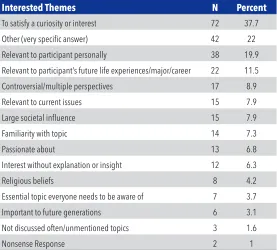
Of students that explained the reasoning behind their interest, the most prominent theme was “satisfying a curiosity” (see Table 1). Approximately 38 percent of students claimed that their topic preferences were based on specific curiosities; for example, one student wrote, “I enjoy learning about how others live and what they believe is okay.” Student interest was also greatly dependent upon personal relevance to participant; 20 percent of partici-pants responded that they were interested in specific topics because the topics related to them
Table 1. Student Explanation for Interest by Theme1
Interested Themes N Percent
To satisfy a curiosity or interest 72 37.7 Other (very specific answer) 42 22 Relevant to participant personally 38 19.9 Relevant to participant’s future life experiences/major/career 22 11.5 Controversial/multiple perspectives 17 8.9 Relevant to current issues 15 7.9
Large societal influence 15 7.9
Familiarity with topic 14 7.3
Passionate about 13 6.8
Interest without explanation or insight 12 6.3
Religious beliefs 8 4.2
Essential topic everyone needs to be aware of 7 3.7 Important to future generations 6 3.1 Not discussed often/unmentioned topics 3 1.6
Nonsense Response 2 1
Mauldin, O’Donnell, Bates, and Blankenship | 11 personally. As one student explained, “As a gay
man, sex and gender always interests me. Why do people call things gay that they dislike?” Aside from personal relevance, approximately 12 percent of students chose topics that they believed to correspond with their future life ex-periences and careers, which was often based on their college majors. One participant wrote, “I believe they will help prepare me for what and who I have to work with or help in the future.”
Frequently, responses included material that did not fall into a constructed theme yet may have captured other themes that we did not classify; therefore, these responses were coded as “other.” For example, part of a student response categorized as “other” reads, “Are we forget-ting about the elderly?” For obvious reasons, this vague statement is difficult to classify and thus fit into our “other” theme. As this was a very broad theme, it ranked the second most common in both the interested (22 percent) and not interested (17 percent) categories. However, because we did not limit ourselves to classifying each response to only one theme, statements classified as “other” may also have been catego-rized under additional themes. The quote from the student above regarding the elderly also had one additional sentence, which stated, “I want to learn about how other countries feel about liking the same sex.” This part of the student response was coded under the “to satisfy a curiosity or interest” theme. Therefore, the student’s entire response was coded as both “to satisfy a curiosity or interest” and “other.”
Overall, students did not clarify why they were disinterested in course topics to the same degree of specificity that they used when ex-plaining why they would be interested. Similar to the interested responses, our results showed that the greatest number of respondents indicated that they were not interested in the topics because they were just generally disinter-ested. Approximately 27 percent of respondents claimed that they were not interested in the topics without describing a specific reason that would allow us to categorize their response in any meaningful way besides “not interested;” for instance, “Just not interested” was one of the responses coded as this theme.
Unimportance to the student was another determining factor for disinterest, with 14 percent of respondents indicating that they were not interested because the topics were un-important to them or they simply did not care about them. Students indicated this by writing responses like, “Because they have less impact on my life when compared to the rest of the topics” or “Bureaucracy and Formal Organizations [are] not important to me.” Additionally, nearly 8 percent of respondents indicated that they were not interested in the topics because they found them to be boring or not thought provoking. One student responded, “They don’t really grasp my attention and don’t feel their [sic] very important.”
One theme that was found that explained both interest and disinterest was the level of controversy of the topic. This was particular-ly true if the topic centered on personal or religious beliefs. As an educator, one topic that comes to mind would be a class discussion on an issue such as abortion. A discussion on abortion could easily fit into many different topics within an introductory sociology course, such as gender, family, race, social class, or global stratification. Controversial topics, with no clear right or wrong answer, seemed to create the greatest split in interest and disinterest among students. For example, one student explained his or her interest was due to the grey area of the topics; “they seemingly have no right answer.” In contrast, another student wrote a similar response to explain his or her lack of interest as, “those always lead to arguments, because everyone has an opinion, that’s fine, but they don’t like everyone elses [sic].”
Discussion
vary significantly from class to class, constant-ly changing over time. Relevant topics students see on Facebook or other social media networks may make students feel more interested in so-ciological material. Of course, a lack of interest among some students is likely to occur no matter the course topic. Some students may also try to avoid certain important concepts if they find them boring.
Oftentimes, there is more material to include in an introductory course than time to do so adequately. Educators are usually the ones who determine which chapters or concepts will be cut from the curriculum. Using critical pedagogy is just a different way to address this problem that many instructors face when deciding what material to include beyond core concepts. When critical pedagogy is utilized, educators would be able to focus their teaching on topics students feel are relevant to their everyday lives. They may also be able to structure their classes to include topics that are at least slightly of interest to all of their current students, depending upon the specific interests of their students. Additionally, updating course curriculum based off student interest in topics could be conducted in any class size. This could be done through a variety of methods we did not use in our study, including the use of online methods to allow for automatic tallying of the results so students could see survey results by the next class meeting.
In addition to topics they find generally interesting, people tend to show more interest in sociological topics that are relevant to their current lives and their futures. The results from our study showed that “relevance to participant’s future” was a major factor for student interest, but not for disinterest. For the most part, students were most interested in topics because they found them to be relevant to themselves and their futures, but they were not directly opposed to learning about topics that were not related to their futures. However, if a partici-pant considered a topic to be “unimportant” to them, it was a major factor in determining disinterest. Thus, theoretically, the student attitudes could be reflected in student effort. Since student interest increases for topics related to the students’ futures, teachers should consider
restructuring their courses to include material relevant to common student majors indicated by the surveys conducted each semester, thus encouraging interest in the course curriculum.
Another recurring reason for disinterest is that students find topics to be boring or not thought-provoking. The prevalence of the theme “boring/not thought-provoking” among not in-terested responses indicates that students clearly have a desire to learn and be stimulated by course material. Topics students view as boring could influence their motivation to learn the course material. For example, it is not surprising that a chapter on research methods would rank lower in student interest than a chapter on deviant behavior. However, the core concepts of socio-logical research methods could be spread out and covered within a variety of other chapters such as deviance or gender. This means that the material is not lumped together in one chapter that students may find “boring,” but it still allows instructors to include the core concepts into the introductory course. Certain topics are fundamental to an introductory sociology course and educators still need to teach them, regardless of student disinterest. It is impractical to only include the topics that interest students and exclude the drier topics that may contain vital information; therefore, teachers should incorporate the core topics into a wide variety of chapters, especially into those that evoke the most student interest.
Mauldin, O’Donnell, Bates, and Blankenship | 13 introductory courses in other disciplines can be
utilized to allow students to exert greater control over their own learning.
As with all studies, the researchers en-countered some unavoidable limitations. A major limitation of this study was the lack of detailed responses and sometimes-tauto-logical reasoning students provided for open-ended questions about their interests and disinterests. Many students essentially said they were interested or disinterested because they were “interested” or “uninterested” without connecting their reasoning to their personal lives, careers, or other factors. This problem did allow one author to have a teachable moment by explaining the lack of detailed responses with her class as a major downside to open-ended questions in research. One of the authors of the current study feels our questionnaire could be refined to include close-ended questions with our themes as choices for why a student is interested or disinterested in a topic. Utilizing pre-con-structed themes would clarify the respondents’ reasoning for interest and noninterest in topics; however, removing open-ended questions would limit the variety and detail of student responses. In order to allow participants the same freedom to express their thoughts, we could still include a space for “other” where students can write in their own reasons.
Another limitation with the study was that only one of the participating professors actually changed the course content based on the results of the survey. All other professors let their students participate in the survey, but did not make any syllabus changes based on the findings. As a result, we were unable to conduct pre- and post-tests, which would have allowed for a stronger statistical analysis. If more instruc-tors did change their topics based on class data, we may determine whether or not the students noticed when the course content was altered to coincide with their preferences. We would also be able to compare an experimental group to a control group to see if these changes influenced student grades or satisfaction with the course. At this point, all we have is anecdotal evidence of students noticing the shift in power, which allowed them to help choose course topics.
For example, one participant – who was in the sample of courses in which the syllabus was changed based off student data – wrote about his or her experience in an anonymous student evaluation at the end of the term. The student wrote, “I knew from the first day when she took our votes on what we wanted to learn that… she was going to be a great professor. She was able to keep a lecture interesting and engage her students through humor and relevant examples so that we could actually relate...” Overall, including more professors who are willing to alter their course content based upon survey results would strengthen future analysis.
The most frequently occurring themes between both interested and disinterested student responses were based upon specific student preferences. Our results showed a large variance from participant to participant, which means that professors could observe a noticeable difference in student interests across semesters. By implementing critical pedagogical instruc-tion methods, such as the survey used in this study, professors will be able to determine which topics will produce the most student interest each semester and change their curriculum accordingly, thereby increasing student engage-ment and control in the classroom.
References
Aslan-Tutak, F., Bondy, E., & Adams, T. L. (2011). Critical pedagogy for critical mathematics edu-cation. International Journal of Mathematical Education in Science and Technology, 42(1), 65-74.
Bain, K. (2004). What the Best College Teachers Do. Cambridge, MA: Harvard University Press. Braa, D., & Callero, P. (2006). Critical pedagogy
and classroom praxis. Teaching Sociology, 34(4), 357-369.
Freire, P. (1974). Pedagogy of the Oppressed. New York: Tenth Printing.
Grauerholz, L., & Gibson, G. (2006). Articulation of goals and means in sociology courses: What we can learn from syllabi. Teaching Sociology, 34, 5-22.
Teaching Sociology, 35, 209-222.
Keith, B., Greenwood, N. A., Hampe, G., Hart-man, H., Howery, C. B., Jenkins, C., KaufHart-man, G., Meiksins, P., Reitzes, D., Ross, S., Swanson, D., & White, D. (2007). Sociology and Gen-eral Education. Washington, D.C.: American Sociological Association.
Martin, G., & Brown, T. (2013). Out of the box: Making space for everyday critical pedagogies. Canadian Geographer 57(3), 381-388. Persell, C. H. (2010). How sociological leaders
rank learning goals for introductory sociology. Teaching Sociology 38(4), 330-339.
Sweet, S. (1998). Practicing radical pedagogy: Balancing ideals with institutional constraints. Teaching Sociology, 26(2), 100-111.
Riddle | 15
R
obert Penn Warren is a distinguished professor, poet, and author,who is credited for being the founder of New Criticism. He is the only person in history to win a Pulitzer Prize for both fiction and poetry, and his talent for writing has been celebrated as one of the most influential models for contemporary literature. The unique analyses of moral dilemma in the South within his literature have raised the bar for Southern writers, for “he writes about such shortcomings with an eloquence and an elemental rage [that places him] worlds apart from the sordid bitterness of … his literary colleagues” (Prescott). The fiercely emotional and mentally stimulating nature of his novel All the King’s Men ardently supports this assertion. Rumored to be based on the career of Louisiana politician Huey Long, this critically-acclaimed novel chron-icles the journey of “The Boss,” or Willie Stark, from hick to hellfire, through the eyes of his faithful muckraker Jack Burden. Warren creates a historically-relevant political narrative that is littered with surprising-ly fresh philosophical musings through the use of fiery metaphors and clever punches of sardonic humor. While both the author and various critics admit that “All the King’s Men is really a double story,” it is clear upon further analysis that the novel is not limited to telling the stories of Willie Stark and Jack Burden alone (Prescott). In fact, Warren’s hy-per-attention to the relationship between the past and present weaves the essential tale of a seemingly minor character named Sadie Burke. Often written off as a mere supporting character, her dynamism and gregarious nature mirrors the vivaciousness of Willie Stark himself, thus perpetu-ating her reckonable force. Sadie Burke is the token woman in a man’s world, and still she is more than that. In a fervent attempt to achieve power for herself, Burke leaves the feminine sphere in order to exercise her political prowess. It is this rejection of traditional femininity that allows Sadie Burke to transcend to the status of creator God in Warren’s narrative and her ultimate attempt to return to the feminine sphere that leads to Willie Stark’s destruction.
The relationship between male and female is colored with a tradition of separatism. Throughout the history of America, it has been agreed that “men and women’s functions [are] to be equal and complementary, not identical” (Norton 297). In other words, humanity is expected to operate with equal respects, but in separate divisions according to gender. The separatism between genders is a result of a domestic ideology that suggests the necessity for a separate male and female sphere. Although it origi-nated much earlier, this division between male and female spheres was
The Puppeteer:
An Analysis of the Implications of
Gendered Spheres through Sadie Burke
in All the King’s Men
Sierra D. Riddle
Lee University
Sierra D. Riddle is a senior Presidential and Honors Scholar at Lee University in Cleveland, Tennessee where she majors in English with a concentration in literature. Sierra serves as the secretary for the Society for Law and Justice, as well as the prosecuting attorney for Lee University’s Competitive American Mock Trial Association Team, and as a judge for the National Christian Forensics and Communications Association. She is also a member of the Sigma Tau Delta International English Honor Society. In her free time Sierra interns at the 10th Judicial District Attorney’s
Office, with a particular interest in the Juvenile
strongly reinforced during the industrial boom of the nineteenth century. During this time of economic growth, “true men,” characterized by competitiveness, intelligence, and logic, went to work in public sectors such as business and politics, while “true women,” deemed submis-sive, chaste, and domestic, were limited to the private sphere of organizing the household and providing maternal care to the family (Freedman 24). Historians make it clear that the division between men and women was created to shield the supposed delicacy of women from “all those stern and contaminating and demoralizing duties that devolves [sic] upon the hardier sex— man” (Elshtain 230). Indeed, it can be assumed that this gendered division suggests that the softness of the female sphere is required to make up for the hardness of the male.
Throughout history, both men and women have challenged the expectations of their respec-tive genders through subversion and rejection. In her 1990 book titled Gender Trouble, Judith Butler develops her theory of performative gender by deconstructing the gendered spheres. The self-proclaimed purpose of Butler’s text is to “think through the possibility of subverting and displacing … notions of gender … through the mobilization, subversive confusion, and prolif-eration of precisely those constitutive categories that seek to keep gender in its place by posturing as the foundational illusions of identity” (44). Surprisingly, Sadie Burke does not subvert the gendered spheres like the feminist heroes of Judith Butler, but instead rejects traditional femininity by becoming defiantly masculine, and assimilates to the public sphere that is con-ventionally restricted to men. Although she is described as being “built very satisfactorily” with “wonderful eyes,” her “awful clothes,” “violent, snatching gestures,” and “wild, electric” black hair that is “cut off at a crazy length” and flies “in all directions in a wild, electric way” creates a character of lackluster femininity. However, the most detracting attribute is her pock-marked face, which Jack Burden describes as “a plas-ter-of-Paris mask of Medusa” that has “been [used] as a target for a BB gun” (Warren 170). In chapter two, readers learn that Burke’s loss and ultimate rejection of femininity began with
a childhood case of smallpox. She reveals this childhood pain to Jack Burden while pulling viciously at her scarred skin. She agonizes that her “brother died—and he ought to have lived,” and simultaneously confesses that “it wouldn’t have mattered to him—not to a man—but me, I didn’t die” it is clear that she fully understands the significance of her disfigured appearance (Warren 173). It is easy to assume that this survival of sister over brother represents a sub-version of “gender within its binary frame,” by challenging the inherent weakness of women (Butler 526). However, Burke’s survival is not intended to be a social commentary on the foolishness of gendered expectations, but rather Warren’s reiteration of the importance of beauty for women, and the ultimate reason behind Burke’s choice to assume her place in the political world that is so commonly guarded by mascu-linity. Undoubtedly, the unflattering haircut and exaggerated lack of style Burden mocks through-out the narrative are Burke’s personal form of rejection to the femininity that was stolen from her at such a young age. Therefore, this passage enables readers to realize the significance of her loss of beauty in the creation of Sadie Burke who resides in the public sphere of politics, rather than the role of Sadie Burke in the private sphere of household civility that she could have assumed.
Riddle | 17 burning” (Warren 493). This observation
re-inforces Burke’s likeness to Medusa, for both their eyes claim great significance. Furthermore, Sadie Burke is often depicted as metaphorically guarding the door to the world of politics. In many passages, Burke is found lingering outside the doors of political negotiations and acting as the middleman who relays messages or appoint-ments between Stark and government officials, various businesspeople, and the public. She even acts as a barrier between The Boss and the political bigwigs mulling around his house, by clearing “‘em all out … and fast” (Warren 40). In the same way, Medusa serves as a guardian in numerous ancient legends. From Hesiod’s Theogony and Homer’s Odyssey to Dante’s Divine Comedy and Milton’s Paradise Lost, she is “the guardian of terrifying places,” including “the nocturnal borders of the world” and “the world of the dead” (“Medusa”). Surprisingly, through-out her dedication to Stark’s politics, Burke manages to maintain her own identity through her rejection of traditional femininity. Similar to Medusa’s assertion of “her ‘own’ identity,” she maintains this identity even while engaging in sexual intimacy with Willie Stark (“Medusa”). While Lucy Stark is rarely labeled anything but Mrs. Stark, and Anne Stanton is habitually referred to as Stark’s mistress, it is never explic-itly stated that Sadie Burke is sleeping with The Boss. Moreover, in contrast to Sadie Burke, Lucy Stark and Anne Stanton exist solely through their male counterparts. Lucy Stark does not show up in the narrative unless context or clar-ification is required to paint a better picture of her husband. Similarly, Anne Stanton is only described through the terms previously assigned to her brother Adam. According to Burden’s de-scription, her skin-tone is “brown-toned” and “golden-lighted,” but not as dark as Adam’s, her facial structure paralleled “the tension which was in Adam’s face,” her “blue eyes looked at you like Adam’s eyes,” and “They even had the same smile” (Warren 125). Undoubtedly, while Anne Stanton exists through Adam, and Lucy Stark through Willie, “Sadie Burke was just Sadie Burke” (Warren 117). Additionally, the legend of Medusa claims that her decapitated head acts as “both a mirror and a mask” (Medusa). Just
like Medusa’s double role, Sadie serves as a mask to the brutal truth behind the closed doors of Governor Stark’s political games, as well as a mirror to the pain of his careless actions. She is the perfect mask, for she is dependable, un-trusting, and quiet (Warren 397). This is proven when she admits that Stark’s actions stay “in the family” when faced with yet another affair (Warren 397). Her role as a mirror intensifies when she checks into the sanatorium, in which she decides to leave the world of politics alto-gether. Once a burning light of political prowess and passion, the consequences of Stark’s corrupt practices leave her with “unburning eyes” (Warren 493). Clearly, Burke’s withdrawal from the masculine world of politics she had fought for so long to conquer serves as a mirror to the carelessness of Stark’s personal and political life.
be a fool if it weren’t for “that fine woman right there … honest enough and decent enough to tell the foul truth” is the first step in his transfor-mation from farmer to fascist (Warren 111). This archetype of creator God is furthered with the Judeo-Christian tradition that claims creation is made in the image of God and thus is a re-flection of His Godly desires. Similarly, Stark’s emboldened journey from rags to riches directly mirrors Burke’s own. They have both “come a long way from the shanty in the mud flats” and are equally hungry for more (Warren 101). The difference, however, is that Burke wanted power from the beginning. Unlike the happy hillbilly version of Stark readers find at the beginning of the narrative, Burke is static in her desires. Under the guise of a powerless woman secretary, Sadie Burke is often the puppeteer guiding Stark’s political puppet strings. Her innate desire for power and willingness to use men to achieve this power is made clear through her previous relationships. “Sadie was a very smart cooky,” Burden surmises, confessing that she had also put her previous beau Sen-Sen Puckett “into political pay dirt,” which refers to extensive profit (Warren 88). With both Puckett and Stark in mind, it is clear that Burke doesn’t want to simply support the man in her life, but in fact she uses these men to achieve some semblance of power. Trapped by the limits of her gender in the society of the mid 1930s, she is willing to wait for a man with potential, through whom she can exercise her political savvy and gain power. Thankfully, “Sadie knew how to wait … She had to wait for everything she had ever got out of the world” (Warren 398). Thus, by pulling the puppet strings of political men, Sadie achieves her own form of power.
According to Archetypes and Motifs in Folklore and Literature, the archetype of the creator God “combines the attributes of visibility and invis-ibility simultaneously” although usually “his invisibility is more significant than his visibility” (7). Burke clearly establishes her visibility both by being the only woman in the world of men, as well as through the flawless management of Stark’s political affairs and constant presence at his side. However, the majority of her work and influence is behind the scenes. In fact, she is often
described as being surrounded by “a coronal of smoke” that revolves “slowly about her head” (Warren 157). She is undeniably present yet still hidden by the smolder of her cigarette. This cloud of smoke imagery that often accompanies Burke is the greatest reflection of her simul-taneous visibility and invisibility. The sexual relationship between Burke and Stark is also representative of Stark’s invisibility. While critics argue that the assimilation of women into male spaces causes women to give up their feminine charms, Sadie Burke does not. Although she talks like a man and looks “them straight in the eye like a man,” she balances public masculinity with private femininity, a perfect equilibrium that manifests within her sexual relationship with Stark (Warren 101). Often referred to as the “only one who knew the trick” to rattle Stark’s proverbial cage, and the only one who “had the nerve” to do so, it is clear that Burke exerts sexual power over her male counterpart (Warren 39). Additionally, in light of his extra-curricular escapades with “sluts on skates,” Sadie Burke confidently affirms that “He’ll always come back” (Warren 174). This detached procla-mation is clearly influenced by her participation in the masculine sphere, and readers come to find time and time again that she is truthful in her assertion. While every business trip has its fair share of sluts on skates, Willie Stark always comes crawling back. Unfortunately, these reunions are not limited to kissing and making up, and it is in one of these vitriolic fits of rage that Burke herself proclaims her role in Stark’s creation. Following an eventful business trip, she is found screeching furiously at Burden, “Who made that son-of-a-bitch what he is today? Who made him Governor?” (Warren 171). These mock-inquisitions establish a level of comfort with her role as creator God and instill her sig-nificance within the minds of readers.
Riddle | 19 different (Archetypes 6-7). Throughout her
rela-tionship with Stark, Burke walks on a tightrope between her masculine, public persona and the privately feminine creature she assumes in sexuality. However, once she discovers Stark plans to resume faithfulness to his wife, “just then like a flash [she] knew [she’d] kill him” (Warren 497). This revelation causes her to break from the masculine mold in which she dwelt and attempt to do anything she can to preserve the relationship, an attempt that possesses inherently feminine implications. Burke’s desperation to “attract and keep a man” is a “commonly accepted practice of femininity,” and serves as Burke’s attempt to cross over the return threshold into the fully feminine sphere (Discourse 274). This desperation is demonstrat-ed when she directs Tiny Duffy to reveal Stark’s affair with Anne to Adam Stanton, which results in a bullet in the bodies of both Stark and Adam Stanton. Although she does not literally murder The Boss, her actions figuratively “put the weapon into [the killer’s] hand and had aimed it for him” (Warren 497). Furthermore, Burke threatens to kill Stark for his unfaithfulness multiple times throughout the narrative. When faced with the proposition of leaving him, she proclaims, “I’ll kill him first, I swear it” (Warren 174). Warren’s heavy use of foreshadowing per-petuates the characterization of Sadie Burke as the all-knowing Judeo-Christian God. Even when Burden suggests getting back at Duffy for his assumption of Stark’s government position, she hesitates, declaring that “the world is full of Duffy’s [sic],” and immediately admitting that she’s “been knowing them all [her] life” (Warren 499). This is a reference to her previous sexual relationship with the political bigwig Sen-Sen Puckett, and is a moment of clarity regarding her latest creation. Interestingly enough, at the beginning of the novel Puckett is credited for tricking Stark in the Harrison scheme (Warren 88). It is clear from her experience with Puckett that Burke knew from the beginning that her transformation of Stark would result in another Duffy. Warren’s final pages reiterate Burke’s omniscience, when Jack Burden’s stepfather hauntingly dictates, “The creation of man whom God in His foreknowledge knew doomed to sin
was the awful index of God’s omnipotence” (529). With the foreknowledge that creation is bound to morally fail, resulting in inevitable death, the Judeo-Christian God unmistakably acts as both a creator and destroyer. For “the wages of sin is death,” and Burke knew her creation was doomed to sin. This idea is rein-forced by revisiting Burke’s aforementioned possession of a distinct identity. Warren writes that “Separateness is identity and the only way for God to create, truly create, man was to make him separate from God Himself, and to be separate from God is to be sinful” (529). By clinging to her own identity, it is clear that this separation was the only way for Burke to create, which demands the sin and ultimate destruction of her creation.
selfishness. During the final game before the championship, Tom puts “on a little show for the stands,” rather than taking it seriously, which results in the careless football accident that ul-timately claims his life (Warren 445). If Burke hadn’t created The Boss, presumably Tom’s childhood would have echoed the childhood of his humble father and perhaps saved him from a premature death.
In its final pages, Warren’s narrator pro-nounces, “This has been the story of Willie Stark, but it is my story, too” (527). However, Jack Burden fails to recognize the principal role Sadie Burke plays within their narratives, for clearly it is her story as well. Without Willie Stark’s rise to the brutal and politicized version who readers find at the novel’s closing, the story of Jack Burden would be meaningless, and this conversion did not happen with Stark alone. As demonstrated by his violent protest that “they made me!” the responsibility for Stark’s transfor-mation lay in Sadie Burke’s hands (Warren 440). In a subconscious struggle for power, she takes advantage of Stark’s gender and uses it as a vessel to achieve the potential that is otherwise limited to her. Furthermore, Burke wholly rejects the feminine sphere and transcends to the archetype of the creator through the reinvention of Willie Stark as personified in The Boss. It is only through her return to traditional femininity that she ultimately destroys The Boss, thus fulfilling the role of destroyer in her claim to godliness.
Works Cited
Archetypes and Motifs in Folklore and Literature. Ed. Jane Garry and Hasan El Shamy. London: Routledge, 2004. Print.
Butler, Judith. Gender Trouble. New York: Rout-ledge, 1999. Print.
Butler, Judith. “Performative Acts and Gender Constitution: An Essay in Phenomenology and Feminist Theory.” Theatre Journal 40.4 (1988): 519-31. JSTOR. Web. 18 Nov. 2015.
Discourse Theory and Practice: A Reader. Ed. Marga-ret Wetherell and Stephanie Taylor. London: SAGE, 2001. Print.
Elshtain, Jean Bethke. Public Man, Private Woman: Women in Social and Political Thought. 2nd ed. Princeton: Princeton UP, 1993. Print.
Freedman, Estelle B. Feminism, Sexuality, Politics. Chapel Hill: North Carolina UP, 2006. Print. “Medusa in Myth and Literary History.” Modern
American Poetry. University of Illinois, n.d. Web. 18 Nov. 2015.
Norton, Mary Beth. Liberty’s Daughters: The Revolu-tionary Experience of American Women, 1750-1800. 1st ed. New York: Cornell UP, 1996. Print.
Prescott, Orville. “All the King’s Men.” Rev. of All the King’s Men, Robert Penn Warren. New York Times 19 Aug. 1946. Web. 18 Nov. 2015. Warren, Robert Penn. All the King’s Men. New York:
Harcourt, 1953. Print.
Acknowledgements
Mitchell, Lee, Green, and Sykes | 21 “Their care shouldn’t differ from the average patient.”
“All the hours in class I have spent learning patient care: they would not be treated any different!”
— excerpt statements from participants
W
hen considering American adults who choose to disclose their sexual identity, 3.8% identify themselves as being lesbian, gay, bisexual, or transgender [LGBT] (US Department of Health and Human Services, 2012). This translates to about nine million individuals in the United States (Gates, 2011). It is likely that most nurses or health care providers have encountered LGBT individuals in their practices whether they were aware of such patients’ sexual orien-tation and gender identities or not. Why is LGBT health important? There is a history of anti-LGBT bias in healthcare that continues to impact health-seeking behavior and access to care for LGBT individuals despite increasing social acceptance (Mayer et al., 2008; Meyer, 2003; Coker et al., 2010; Institute of Medicine, 2011; Obedin-Maliver et al., 2011; Smith & Matthews, 2007; Strong & Folse, 2015). Most impor-tantly, healthcare providers must also be informed about LGBT health because of the numerous health disparities which affect members of this population. Sexually transmitted infections, including human immu-nodeficiency virus [HIV] (Workowski & Berman, 2010; CDC, 2012), eating disorders and body image disorders (Boehmer, Bowen, & Bauer, 2007), suicide (CDC, 2014; Saewcy, Konish, Rose, & Homma, 2014; Grossman & D’Augelli, 2007; Meyer, 2003;), substance abuse (Song et al., 2008), and depression (Ruble & Forstein, 2008; Birkett, Espelage, & Koenig, 2009) are major concerns among some LGBT groups.The LGBT community is diverse. They represent people from various backgrounds differing in race, ethnicity, age, gender, socio-eco-nomic status, and identities (Chandra, 2011). Some of the common experiences they face include stigma and discrimination as they integrate into society (Mayer, 2008; Grossman & D’Augelli, 2007, Saewcy et al., 2014). They often conceal their sexual orientation for fear of retribution. Reported cases of suicide among teenagers bullied for being gay, lesbian, bisexual, or transgender have shed light on the violence and victimiza-tion experienced by LGBT individuals (Birkett et al., 2009, Russell, Ryan et al., 2011). Sexual orientation is often one of the common
The Gaps in Health Care of the LGBT
Community: Perspectives of Nursing
Students and Faculty
Keily Mitchell,
LaKenya Lee,
Ayana Green,
and Jasmine Sykes
Georgia Southern University
factors that motivates violence and hate crimes towards LGBT adults and youth (Espelage et al., 2008). Such events often produce an environ-ment of stress and intimidation even for those not directly impacted. As a result, the LGBT community faces challenges in accessing cul-turally competent health services to achieve the highest quality level of health. Discrimination and the lack of awareness of health needs by health professionals (Cornelius & Carrick, 2015; Smith & Matthews, 2007; Strong & Folse, 2015) are barriers that need to be addressed.
Every semester over 50,000 students graduate from nursing programs. According to the American Association of Colleges of Nursing (AACN, 2012), there are approximately 674 four-year institutions in the United States that offer Bachelors of Science in Nursing (BSN) degrees. Graduating nurses must enter the workforce ready to meet the needs of a diverse population. Standards are in place to ensure that critical competencies are met and that the nursing curricula have prepared these individu-als to provide safe, qualified, and skilled nursing care. Nurses are often the first point of contact when patients seek medical attention. It is essential that the nurse is culturally competent and prepared to provide care to individuals of all backgrounds.
Among many variables, cultural competence includes religion, race, ethnicity, and sexual ori-entation. As health care providers, nurses have an obligation to be knowledgeable about and sensitive to the health care needs of marginalized individuals. If curricula do not prepare nurses to provide optimal care, then health disparities will continue to exist for LGBT individuals (Cornelius & Carrick, 2015). Research suggests that the average time spent in the classroom covering LGBT health in BSN programs is 2.12 hours (Lim, Johnson, & Eliason, 2015). Cultural competency and the subsequent in-corporation into nursing curricula are pivotal to the essence of nursing (Carabez, Pellegrini, Mankovitz, Eliason, & Dariotis, 2015; Carabez et al., 2015). Calvillo et al. (2009) outlined standards for cultural competence in their article titled, “Cultural Competency in Baccalaureate Nursing Education,” which was published in
2009 in the Journal of Transcultural Nursing. According to Calvillo et al. (2009) existing models often fall short of the needs of nurses who encounter diverse patients in their clinical practice. They emphasized that the intent of a culturally competent curriculum is to ensure that students have the knowledge, attitudes, and skills that allow them to work effectively with patients and their families, as well as with other members of communities including the health care medical community. Cultural competence should not be an “add-on” to the existing cur-riculum. Total curriculum review and revision should be undertaken to address education for cultural competency (Brenna, Barnsteiner, de Leon Siantz, Cotter, & Everett, 2012; Calvillo et al., 2009).
In line with the goal of eliminating health disparities, Healthy People 2020 outlines the need to improve the health, safety, and well-be-ing of lesbian, gay, bisexual, and transgender (LGBT) individuals. Often, sexual orientation and gender identity questions are not asked on most national or state surveys which makes it difficult to accurately estimate the number of LGBT individuals and their health needs. Furthermore, research suggests that LGBT indi-viduals face health disparities linked to societal stigma, discrimination, and denial of their civil and human rights (Ruble & Forstein, 2008). Discrimination against LGBT persons has been associated with high rates of psychiatric disorders, substance abuse, and suicide (CDC, 2014). Experiences of violence and victimiza-tion are frequent for LGBT individuals and have long-lasting effects on the individual and the community. Personal, family, and social accep-tance of sexual orientation and gender identity affects the mental health and personal safety of LGBT individuals (Espelage et al., 2008.)
Mitchell, Lee, Green, and Sykes | 23 at large have dismissed or discounted the needs
of gender nonconforming people in their com-munities (Agency for Healthcare Research & Quality, 2014). Studies like this are an essential part in creating awareness of LGBT health dis-parities and their need to be eliminated. Logic dictates that in order to eliminate known dispar-ities health care workers must first know what they are. According to Healthy People 2020, eliminating these disparities will reduce disease transmission and progression, increase mental and physical well-being, provide LGBT individ-uals with supportive services, and increase life expectancy.
Research points to common prejudices and false assumptions about the LGBT community that often act as barriers to quality healthcare. The attitudes of nurses and the impact of those attitudes are very relevant to the issue of LGBT healthcare (Strong & Folse, 2015; Smith & Matthew, 2008). Societal stigma, including avoidance of disclosing one’s sexual minority status, threats or acts of violence, avoidance of health care providers, and risk of pregnancy among LGBT teens needs to be identified and discussed (Brennan et al., 2012). LGBT health-care topics must be brought to the forefront and discussed. Other challenges to be addressed include the integration of spiritual and religious beliefs, self-awareness, and the fact that until recently LGBT issues have not really been ap-proached in nursing education (Brennan et al., 2012; Carabez et al., 2015). Nursing research has inadequately addressed the health needs of the LGBT population. Between 2005 and 2009, the top 10 nursing journals published only eight articles that focused on LGBT health issues of almost 5,000 total articles (Strong & Folse, 2015). This study aimed to address the discourse of nursing programs preparing students for provision of culturally competent care for all in-dividuals, including the LBGT community.
Purpose
The purpose of this study was to explore the perceptions of nursing students and faculty on LGBT health issues in a BSN program. The far reaching purpose of this study was to increase awareness in cultural competencies specific to
the LGBT community and to increase coverage time in the curriculum. In this current health climate, LGBT individuals are identified as a priority population. This study hopes to explore the gaps, challenges, and successes in a BSN nursing educational curriculum. It is our hope that findings from this study will contribute to the existing literature and add to the discourse to improve health outcomes and reduce health disparities in the LGBT community.
Research Questions
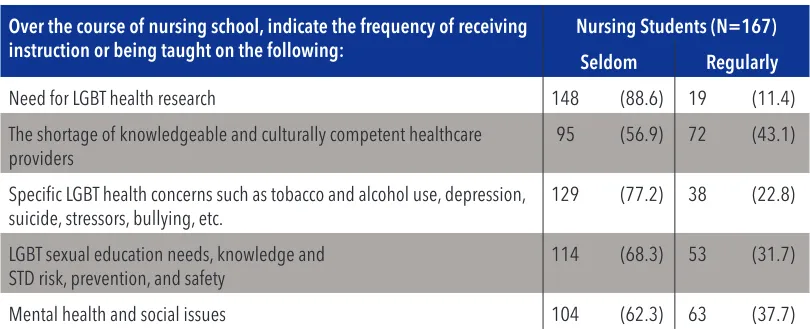
There is the need to examine the education and preparation of the nurses who will provide skilled care to the LGBT community. Educating the nurses of tomorrow to provide culturally competent care to all individuals from diverse backgrounds is essential. The research questions addressed are: (1) Are faculty incorporating LGBT topics into their nursing curriculum? (2) What is the BSN student’s and faculty’s knowledge and perception of specific LGBT healthcare needs, and do they feel equipped to meet them? (3) How do BSN program members view the importance of minimizing health dis-parities affecting LGBT individuals? (4) Do BSN students feel that their nursing curriculum successfully meets LGBT competencies and prepares them for the workforce?
The underlying assumption of the study was based on Madeline Leininger’s Theory of Culture Care Diversity and Universality. Leininger’s theory describes how nurses provide meaningful and culturally-competent care for a diverse pop-ulation of patients (Murphy, 2006). According to the theory, understanding a person’s values and cultural background is essential to influence patient outcomes. Patient care will improve and become more adept over time if nurses continuously seek knowledge, develop cultural competence, and incorporate learning into their practice. In order to effectively care for lesbian, gay, bisexual, and transgender patients, nurses must understand the culture and concerns of those individuals (Murphy, 2006).
Review of Literature
database Galileo Scholar. EBSCO and asso-ciated databases, academic search completes, and CINAHL complete, all delivered relevant literature. Keyword searches were utilized over multiple days. A recent study published in the Journal of Professional Nursing describes the current sociopolitical focus on the healthcare needs of lesbian, gay, bisexual, and transgender patients, while drawing attention to the lack of basic education that nurses receive on how to provide LGBT patient-centered care (Carabez et al., 2015). In general, nursing has been slower than other health professions to address LGBT health. This study investigated the education or training of nurses on LGBT issues, attitudes, stereotypes, and comfort level. Findings of the study indicated that 71% of the nurses who responded said they were comfortable providing care to LGBT patients, 79% of respondents indicated that LGBT patient-centered training was not offered at their respective practice settings, 20% of nurses wanted training or wished that more was available, and about 30% of respondents expressed stereotypical beliefs about LGBT people (Carabez et al., 2015). The study concluded there was a need to integrate LGBT content into schools of nursing.
Cornelius and Carrick (2015) published a study in Nursing Education Perspectives which examined the knowledge and attitudes of nursing students in the U.S. towards providing
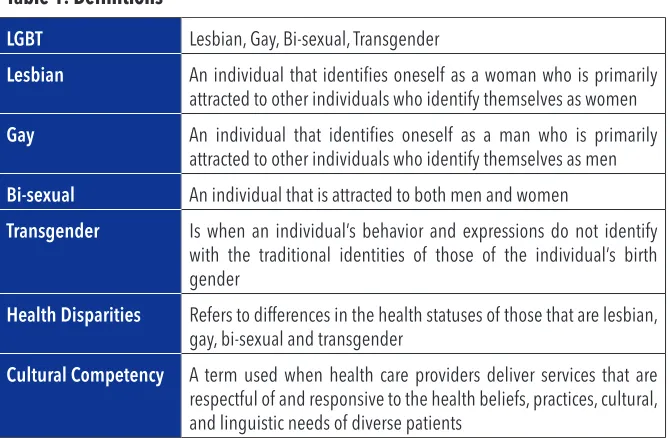
health care to the LGBT community. This study reported that nursing students felt that nurse educators were not proactive in addressing issues of LGBT patients. It was specifically noted that many providers and educators themselves lacked adequate knowledge in LGBT health issues to prepare students to deliver culturally competent care to the LGBT community. Cornelius and Carrick (2015) further recommended that nursing schools examine their curricula and discuss health disparities that LGBT patients face. The need to prepare the next genera-tion of faculty and students to openly discuss health disparities with diverse clients, including LGBT clients, is essential to break down barriers. Lim, Johnson, and Eliason (2015) conducted a national survey of baccalaureate nursing program faculty that explored faculty knowledge, teaching experience, comfort, and readiness to teach LGBT Health. A total of 721 schools and 1,231 faculty members participat-ed in the survey. Results indicatparticipat-ed that 69% of respondents reported that they never or seldom teach LGBT health topics; 70% perceived LGBT health issues were important in nursing, and the majority of respondents indicated some degree of readiness to include LGBT health in their teaching. In conclusion, Lim, Johnson, and Eliason (2015) recommended undergraduate school of nursing programs adopt the Institute of Medicine’s (IOM) four conceptual perspectives Table 1: Definitions
LGBT Lesbian, Gay, Bi-sexual, Transgender
Lesbian An individual that identifies oneself as a woman who is primarily
attracted to other individuals who identify themselves as women Gay An individual that identifies oneself as a man who is primarily
attracted to other individuals who identify themselves as men Bi-sexual An individual that is attracted to both men and women
Transgender Is when an individual’s behavior and expressions do not identify with the traditional identities of those of the individual’s birth gender
Health Disparities Refers to differences in the health statuses of those that are lesbian, gay, bi-sexual and transgender