A Framework for Modeling and Modular Verification of
Component-Based System Designs
✩
Chi-Luan Le
1,2,∗, Hoang-Viet Tran
1, Pham Ngoc Hung
1 1Faculty of Information Technology,VNU University of Engineering and Technology, E3 Building, 144 Xuan Thuy Street, Cau Giay, Hanoi, Vietnam
2Faculty of Information Technology, University of Transport Technology,
H1 Building, 54 Trieu Khuc Street, Thanh Xuan, Hanoi, Vietnam
Abstract
This paper introduces a framework for modeling and verifying safety properties of component-based systems (CBS) by extracting their models from designs in the form of UML 2.0 sequence diagrams. Given UML 2.0 sequence diagrams of a CBS, the framework extracts regular expressions exactly describing behaviors of the system. From these expressions, the proposed framework then generates accurate operation models represented by labeled transition systems (LTSs). After that, these models are used to modular check whether given designs satisfy required safety properties by using the assume-guarantee reasoning paradigm. This framework is not only useful for modeling and verifying designs at design phase, but also for effectively rechecking the correctness of CBS in the context of software evolution. Implemented tools and experimental results are also presented in order to show the feasibilities and effectiveness of the proposed framework.
Received 01 December 2015, revised 13 January 2016, accepted 14 January 2016
Keywords: Software Modeling, Sequence Diagram Analysis, Assume-Guarantee Verification, Model Checking.
1. Introduction
The specification and verification approaches nowadays play an important role in guaranteeing
software quality. The assume-guarantee
verification [11] has been considered as a potential method for solving the state space explosion problem when checking of large scale
CBSs. It can be applied at both design and
implementation phases. However, the current
researches in regards to this method often assume that the models of systems under checking are
already available. This makes the methods
✩ This work is dedicated to the 20th Anniversary of the IT Faculty of VNU-UET.
∗Corresponding author. Email: [email protected]
difficult to be applied in practice because generating models for systems is a hard problem. The method presented in [12] had mentioned a way of using the model generated from the design artifacts to check safety properties of the system implementation. However, the paper did not describe in details how to use and what kind of artifacts of design level to use to generate component models that will be used in verification. In [15], the author proposed a way to check the consistency of software designs by a set of consistency rules defined by users. However, the method is not used for verifying
system designs against safety properties. In
regards to the system verification, the research carried out in [16] also addresses the problem
of verifying properties of systems through its given UML 2.0 sequence diagrams. However, that is for each of the separate fragments and properties are written in PPTL. Moreover, the method in [16] has not solved the problem for the whole sequence diagrams when all
of the fragments are integrated. Although
the mentioned researches have addressed an important part of the verification process, they have not shown a complete method of how to
do design verification of CBSs. On the other
hand, there are other studies that focus on generating models for CBS. Nevertheless, they have not been integrated with any verification method. The method proposed in [17] is used to generate models from sets of traces by doing experiment on components and bases
on the Thompson algorithm [1]. The model
generation method in [13] is used to retrieve extended finite state machines from interactive
traces. The work presented in [9] generates
finite state models from source code of software programs written in Java. While these researches have great contribution in model generation, they have not been integrated the generated models with any verification method. From the above reason, this paper proposes a framework to integrate model generation methods with verification ones in order to be applied in the real
software development world. The framework
generates regular expressions for the behaviors of CBS from sequence diagrams. It then parses these expressions to create operation models in the form of LTSs that exactly describe the
system behaviors. In the end, it applies the
assume-guarantee reasoning paradigm to check
if the system satisfies a given property. This
method of verification prevents us from the state explosion problem. This framework is not only useful in design phase but also in system maintenance when the design is changed. The paper is organized as follows. At first, we present some background definitions which are used
in Section 2. An overview of the framework
is described in Section 3. Section 4 shows
algorithms to generate regular expressions from
given sequence diagrams. The mechanism
to generate models from the result regular expressions of Section 4 is shown in Section 5. The generated models are then used in automatic verification in Section 6. The implemented tool and experimental results are shown in Section 7. Finally, we conclude the paper in Section 8.
2. Background
In this section, we present some basic concepts which will be used in this paper.
LTSs. This paper uses Labeled Transition
Systems (LTSs) to model behaviors of
components. Let Act be the universal set of
observable actions and letτdenote a local action unobservable to a component’s environment. We use πto denote a special error state. An LTS is defined as follows.
Definition 1. (LTS). An LTS M is a quadruple
hQ, αM, δ,q0iwhere:
• Q is a non-empty set of states,
• αM ⊆ Act is a finite set of observable actions called the alphabet of M,
• δ⊆ Q×αM∪ {τ} ×Q is a transition relation, and
• q0 ∈Q is the initial state.
Traces. A traceσof an LTS Mis a sequence of
observable actions thatMcan perform starting at its initial state.
Definition 2. (Trace). A trace σ of an LTS M
= hQ, αM, δ,q0i is a finite sequence of actions a1a2...an, such that there exists a sequence of
states starting at the initial state (i.e., q0q1...qn)
such that for1≤i≤n,(qi−1,ai,qi)∈δ, qi∈Q.
Note 1. The set of all traces of M is called
the language of M, denoted by L(M). Let σ =
a1a2...an be a finite trace of an LTS M. We use
[σ] to denote the LTS Mσ = hQ, αM, δ,q0iwith Q= {q0,q1, ...,qn}, andδ= {(qi−1,ai,qi)}, where
Parallel Composition. The parallel composition
operator k is a commutative and associative
operator that combines the behavior of two models by synchronizing the common actions to their alphabets and interleaving the remaining actions.
Definition 3. (Parallel composition operator).
The parallel composition between M1 =
hQ1, αM1, δ1,q10i and M2 = hQ2, αM2, δ2,q20i, denoted by M1kM2, is defined as follows. If M1 = Q or M2 = Q, then M1kM2 = Q, where
Q
denotes the LTS h{π},Act,ø, πi. Otherwise, M1kM2 is an LTS M = hQ, αM, δ,q0i where Q = Q1×Q2, αM = αM1∪αM2, q0 = (q10,q20), and the transition relation δ is given by the following rules:
(i)α∈αM1∩αM2,(p, α,p ′)∈δ
1,(q, α,q′)∈δ2
((p,q), α,(p′,q′))∈δ
(1)
(ii)α∈αM1\αM2,(p, α,p ′)∈δ
1
((p,q), α,(p′,q))∈δ (2)
(iii)α∈αM2\αM1,(q, α,q ′)∈δ
2
((p,q), α,(p,q′))∈δ (3)
Safety LTSs, Safety Property, Satisfiability and Error LTSs.
Definition 4. (Safety LTS). A safety LTS is a
deterministic LTS that contains noπstates.
Note 2. A safety property asserts that nothing
bad happens for all time. The safety property p is specified as a safety LTS p= hQ, αp, δ,q0i whose language L(p)defines the set of acceptable behaviors overαp.
Definition 5. (Satisfiability). an LTS M satisfies
p, denoted by M |=p, if and only if∀σ∈ L(M): (σ↑αp) ∈ L(p), where σ↑αp denotes the trace obtained by removing from σall occurrences of actions a<αp.
Note 3. When we check whether an LTS M
satisfies a required property p, an error LTS, denoted by perr, is created which traps possible
violations with the π state. perr is defined as
follows:
Definition 6. (Error LTS). An error LTS of
a property p = hQ, αp, δ,q0i is perr = hQ ∪ {π}, αp, δ′,q0i, whereδ′ = δ∪ {(q,a, π) | a ∈ αp and6∃q′∈Q: (q,a,q′)∈δ}.
Remark 1. The error LTS is complete, meaning
each state other than the error state has outgoing transitions for every action in the alphabet. In order to verify a component M satisfying a property p, both M and p are represented by safety LTSs, the parallel compositional system Mkperr is then computed. If the state π is
reachable in the compositional system then M violates p. Otherwise, it satisfies p.
Assume-Guarantee Reasoning. An
assume-guarantee formula/rule is defined as follows.
Definition 7. (Assume-guarantee formula/rule).
Let M be a component, p be a property, and A(p) be an assumption about M’s environment. An assume-guarantee formula/rule is a triple (hA(p)i M hpi) representing the compositional formula A(p)kMkperr, where M, A(p), and perr
are presented by LTSs.
Note 4. We use the formula htruei M hAi to
represent the compositional formula MkAerr. The
formula hA(p)i M hpi is true if whenever M is part of a system satisfying A(p), then the system must also guarantee p. In order to check the formula, where both A(p) and p are safety LTSs, we compute the compositional formula A(p)kMkperr and check if the error state π is
reachable in the composition. If it is, then the formula is violated, otherwise it is satisfied.
Definition 8. (Assumption). Given two models
M1 and M2, and a required safety property p, A(p) is an assumption if and only if it is strong enough for M1to satisfy p but weak enough to be discharged by M2(i.e.,hA(p)iM1hpiandhtruei M2 hA(p)i both hold). Equivalently, A(p) is an assumption if and only if L(A(p)kM1)↑αp⊆L(p) and L(M2)↑αA(p)⊆L(A(p)).
3. Framework architecture
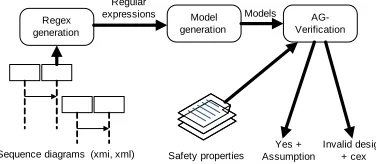
Figure 1 shows the architecture of the proposed
Regex generation
Model generation
Sequence diagrams (xmi, xml) Regular
expressions
AG-Verification Models
Safety properties
Invalid design + cex Yes + Assumption
Fig. 1: The proposed framework for verifying designs in the form of sequence diagrams
systems are in the form of an xmi file. They are analyzed to generate corresponding regular expressions. These expressions then are used to
generate models. Finally, the framework uses
those models and assume-guarantee reasoning paradigm to do modular check to see if given systems satisfy predefined safety properties in the form of LTSs. If designs satisfy properties, the assumption is returned. Otherwise, they violate properties, a counter example is also returned. Details about each of the process are described in Sections 4, 5, and 6.
4. Generating Regular Expression from
Sequence Diagrams
In this section, we present algorithms
that generate regular expressions of software components’ actions from sequence diagrams
of design phase. Given a UML 2.0 sequence
diagram in the form of xmi file, it is analyzed
to get basic fragments such as opt, break, etc.
The corresponding regular expressions of some
of them are then generated. These fragments
are opt,break,critical,strict,consider,ignore. Algorithms for generating regular expressions
corresponding to the other fragments of
loop,alt,par/seqcan be found in [18].
4.1. Analyzing Sequence Diagrams
Given a sequence diagram in the form of xmi file, we use Algorithm 1 to analyze it to have a list of fragments and their relationships.
Algorithm 1 describes the process to analyze the sequence diagram in an xmi file. The result
data is an array of Fragmentor Messagesorted
by the time of execution and an array of life line
Algorithm 1:Analyze sequence diagram
1 begin
2 createstackwith anOperandon top
3 create arrayli f elineListand array messageList
4 forall theelement in xmi filedo
5 ifmeet open tag thenthen
6 switchelementdo
7 caseLi f eLine
8 create new lifeline and
add toli f elineList; break
9 caseFragment
10 create new fragment and
push tostack; break
11 caseOperand
12 create new operand and
push tostack; break
13 caseMessage
14 create new message and
add tomessageList;break
15 caseEventOccurrence
16 create new
eventoccurrence and add to the Operand on the top ofstack; break
17 caseConstraint
18 create new constraint and
add to the Fragment on the top ofstack; break
19 endsw
20 else ifmeet close tagthen
21 ifelement is Operandthen
22 op=stack.pop()
23 addopto the Fragment on
top ofstack
24 else ifelement is Fragmentthen
25 f m= stack.pop()
26 add f mto the Operand on the
top ofstack
27 end
28 end
29 end
(li f eline). At first, the algorithm initiates astack
that contains anOperand(line 2), thisOperand
is used to store the array of fragment or message in the data structure. Next, it initiates an array of Li f eLine and an array of messages (line 3). When parsing the xmi file, if the algorithm meets an open tag (line 5), it bases on the tag’s type to process. If the tag type is Fragments(line 9) or Operand(line 11), add these objects tostack. If the tag type isLi f eLine(line 7) orMessage(line 13), add object to the corresponding array. If the
tag is EventOccurrence (line 15) or Constraint
(line 17), add these objects to the object that is
on top of the stack. If the algorithm meets a
close tag (line 20) that is Operand (line 21) or Fragment (line 24), get these object from the
top of stack and then add them to the object
on the top of stack. After reading all of the
elements in the xmi file, we have an array of Fragments and events inside operands on the
top of stack, an array of the Li f eLine and
an array of messages. The couple of events
will be replaced by the corresponding messages.
4.2. Generating Sub-Regular Expressions for opt Fragments
Algorithm 2 describes the regular expression generation process for theoptfragment. Theopt fragment contains only one operand which can be executed or not. Therefore, the regular expression
corresponding to the opt fragment contains the
regular expression of operand concatenate with “|” andλ, whereλis a special character represents the empty regular expression.
Algorithm 2: Generate sub regular
expression foroptFragments
1 begin
2 createregexis empty
3 regex=regex+operand.getRegex()+| +λ
4 returnregex
5 end
4.3. Generating Sub-Regular Expressions for break/critical/strict Fragments
Algorithm 3 describes the regular expressions
generation process for the break, critical and
strict fragments. The break fragment is only meaningful when it is embedded in the
loop fragment. Therefore, the break’s regular
expression is the concatenation of the operands inside thebreak. The same with thecriticaland strict fragments. The fragmentcritical only has
meaning when embedded in the par fragment.
The strict fragment describes the sequences of actions. Therefore, the result regular expression includes the concatenation of sub-expressions corresponding to the operands inside thestrict.
Algorithm 3: Generate sub regular
expression for break/critical/strict
Fragments
1 begin
2 createregexis empty
3 forall theoperand in f ragmentdo
4 regex=regex+operand.getRegex()
5 end
6 returnregex
7 end
4.4. Generating Sub-Regular Expressions for consider Fragments
Algorithm 4 describes the process of
generating regular expression for the consider
fragment. The considerfragment contains a list
of messages need to be kept. If messages in the consider operands are not in this list, they are removed. Line 3 to line 7 is the process of finding
and removing messages not in considerList.
Line 8 to line 10 is the process of creating regular expression after removing unneeded messages. The regular expression of theconsider fragment consists of the sub-regular expressions
corresponding to operands belong to consider
Algorithm 4: Generate sub regular
expression forconsiderFragments
Input :considerListis an array which
contains messages that need to be kept
Output: The regular expression
corresponding to theconsider fragment
1 begin
2 createregexis empty
3 forall theelement in consider fragment
do
4 ifelement is message and not in considerListthen
5 removeelement
6 end
7 end
8 forall theoperand in consider fragment
do
9 regex=regex+operand.getRegex()
10 end
11 returnregex
12 end
4.5. Generating Sub-Regular Expressions for ignore Fragments
Algorithm 5 describes the process of
generating the corresponding regular expression
for the ignore fragments. The ignore fragment
contains a list of messages that need to be removed. If messages of operands are included in this list, they need to be removed. The removing process is from line 3 to line 7. Line 8 to line 10 is to generate the corresponding regular expressions
of the ignore fragments. The resulting regular
expression is the concatenation of the sub-regular expressions corresponding to operands.
5. Generating Models from Regular Expressions
From the regular expressions returned by the previous section, we can apply several algorithms to generate the corresponding component models. In our study, we applied three algorithms to
Algorithm 5: Generate sub regular
expression forignoreFragments
Input :ignoreListis an array which
contains messages that need to be ignored
Output: The regular expression
corresponding to theignore fragment
1 begin
2 createregexis empty
3 forall theelement in ignore fragmentdo
4 ifelement is message and in ignoreListthen
5 removeelement
6 end
7 end
8 forall theoperand in ignore fragmentdo
9 regex=regex+operand.getRegex()
10 end
11 returnregex
12 end
generate software models in the form of LTSs from the given regular expressions retrieved from the previous step. These algorithms are:
Thompson [1], L∗ [4] and CNNFA [5, 7].
Each algorithm has its own advantages and disadvantages. We should consider using which algorithm bases on our specific scenarios.
5.1. Generating Models using Thompson Algorithm
Thompson algorithm is a very simple and easy to understand way to build models of components in the form of NFAs from given regular expressions of observable behaviors. The details of the algorithm can be found in [17, 1].
Given a regular expression RL, the Thompson
algorithm will generate a correspondingǫ−NFA
as follows:
• If a ∈ Σ is a symbol of the alphabet, then
ais an atomic regular expression. The NFA
that recognizes the regular language of {a}
is the initial state, f is the final state and (i,a,f) is the unique transition of the NFA.
i a f
Fig. 2: Generating an NFA that recognizes{a}.
• Suppose that N(s) and N(t) are
non-deterministic finite automata corresponding
to the regular expressions s and t
respectively, then
– (s).(t) is a regular expression that represents the languageL(s).L(t). The automaton accepting this language is built as shown in Figure 3. The initial state is the initial state ofN(s), the final states are the final states ofN(t) and the algorithm adds empty transitions from the final states of N(s) to the initial state ofN(t).
i N(s) N(t) f
Fig. 3: An NFA recognizes regular expression (s).(t).
– (s) + (t) is a regular expression that represents the languageL(s)∪L(t). An ǫ−NFAthat corresponds to the regular expression (s)+(t) is built as shown in Figure 4. In this case, the initial state callediandǫ−transitionsfromito the initial states ofN(s) andN(t) are added to the automaton. After that, it adds a final state called f andǫ−transitions from the final states of N(s) and N(t) to f. As a result, we have theǫ−NFA that is the union ofN(s) andN(t).
– (s∗) is a regular expression that
represents the language L(s∗). Anǫ −
NFA that corresponds to the regular
expression (s∗) is built as shown in Figure 5. In this case, the initial state
is called i. An ǫ −transition from f
to the initial state ofi is added to the
i f
ǫ
N(s)
ǫ
ǫ N(t) ǫ
Fig. 4: An NFA recognizes regular expression (s)+(t).
automaton. As a result, we have the ǫ−NFAthat is theN(s∗).
i f
ǫ N(s)
Fig. 5: An NFA recognizes regular expression (s∗).
5.2. Generating Models using L∗Algorithm The L∗ is used to generate the M models that can describe the behaviors of the component C.
In order to generate models, the L∗ algorithm
depends on a Teacher that answers two kinds of question. The first kind is the membership
question. With σ ∈ Σ∗, Teacher answer true if
σ ∈ L(C) and vice versa. Next, Teacher answers
the equivalence query. That is whether the Mi
model can describe the whole behavior of the
componentC or not. If the model can describe
the model exactly, Mi becomes the model ofC.
Otherwise, Teacher provides a counter example cextoL∗to learn again (e.g: cex∈L(C)\L(Mi)
orcex ∈ L(Mi)\L(C)) in order to generate new
model that can describe the component better. In order to represent behaviors of models, the L∗algorithm uses the tableV,W,T that is defined as follows:
• V ∈Σ∗is a set of prefixes. Prefixes represent classes or states.
• W∈Σ∗is a set of suffixes. Suffixes represent the differences of languages.
of sequencesPandQ,P.Q= {pq|p∈ P,q∈
Q}, wherepqrepresents the concatenation of the event sequencespandq. With a strings inΣ∗,T(s) = truemeans s ∈ U, otherwise s<U.
Algorithm 6 describes the model generation
process using the L∗ learning algorithm. The
algorithm requires the component (C) and a maximum length of sequence of actions in the component (n). At first, the algorithm initiates the OT withV = {λ},W = {λ},T = TC andΣ = ΣC
(λis the empty string) (line 2). Next, the table
is updated by using the component C to answer
whether a specific action can be performed on the component (line 4). After updating, the algorithm
checks whether the table is closed or not. If
the table is not closed, va is added to V where
v ∈ V,a ∈ Σ (line 6) and the table is updated
again (line 7). After the table updating process, we have a corresponding model candidate that represents the behaviors of the component. The
OT table is used by VC algorithm [3] to check
whether the corresponding model can represent the behaviors of the given component or not (line 9). If the model can represent the component, that model is returned by the algorithm (line 12). Otherwise, a counter example is provided by VC to the learning process to generate a new better model. The counter example is analyzed to find the smallest suffix that is not in the suffixes set
of the OT table (line 14). The found suffix is
added to the set of suffixes W. The OT table
is then updated and the algorithmL∗ generates a new better model (line 4).
5.3. Generating Models using CNNFA algorithm
The key idea when using the CNNFA algorithm to generate models corresponding to regular expressions is that it uses an algorithm to parse the given regular expression into basic and non-basic blocks. A basic block is a valid sub-regular expression that contains at least one
symbol in the alphabet. Non-basic blocks are
parts of the regular expression separated by
basic blocks. While doing that, it constructs
the CNNFA representations for basic blocks
Algorithm 6: Generate models using L∗
algorithm
Input : Component C, maximum length n
1 begin
2 OT =(V,W,T) withV ={λ}, T =TC,Σ = ΣC
3 whiletruedo
4 UpdateOTiby T
5 whileOTiis not closeddo
6 addvatoV (v∈V,a∈Σ)
7 updateOTi by T to make it
closed
8 end
9 con f orm=VC(OTi,C,n)
10 ifcon f orm=truethen
11 create LTSMi fromOTi
12 returnMi
13 else
14 v′=minimum suffix(conform)
that is not inW
15 Addv′toMiofOTi
16 end
17 end
18 end
and perform reduction steps (from line 4 to
line 20). When the algorithm halts, if there
is only one CNNFA representation, we can build the corresponding models for the given regular expression. Otherwise, the given regular
expression is not valid. The algorithm uses a
stack (line 1) of elements, each of them is either
a symbol from R, or a record Np that stores a
CNNFA representation of the corresponding sub-regular expression. Detailed information about the models generation process using CNNFA
algorithm can be found in [19]. The parsing
algorithm is shown in algorithm 7.
5.4. Discussion
From the details of the above algorithms when generating models, we can see that the
generated models are not optimal. We need
to perform additional tasks to optimize the
Algorithm 7: Generate models using CNNFA algorithm
1: Initialize the stack to empty.
2: foreach input symbolcin a left-to-right scan throughRdo
3: Pushconto the stack.
4: repeat
5: iftopmost elements of the stack=λthen
6: Replace by CNNFA representation ofλ.
7: else iftopmost elements of the stack=a, an
alphabet symbol then
8: Replace by CNNFA representation ofa.
9: else iftopmost elements of the stack=
NJ|NKthen
10: Replace by CNNFA representation of NJ|K.
11: else iftopmost elements of the stack=
NJNKthen
12: Replace by CNNFA representation of NJK.
13: else iftopmost elements of the stack=N∗
J
then
14: Replace by CNNFA representation of NJ∗.
15: else iftopmost elements of the stack=(NJ)
then
16: Replace byNJ. 17: else
18: break;
19: end if
20: untilthe above steps can no longer be applied
21: end for
models from NFAs to DFAs, then minimizing the returned DFAs to have the optimal models
using Hopcroft algorithm [2]. You can also
notice that the result models are not LTSs while the required inputs of the assumption generation
process are LTSs. We notice that if the state
of the component is accepting state every time an action is performed, then all states of the generated models are accepting states. Therefore,
those models are LTSs. We can use them in
the assumption generation process. Another
important point here is that in [17], the generation
process is limited by a MaxLengthrepresent for
the longest testable trace against the component
under checking. Generally, using Thompson
algorithm [1] to parse regular expressions to
generate the corresponding models is not limited
by any MaxLength. Therefore, in Table 3,
we don’t have any MaxLength information for
the model generation method using Thompson algorithm.
6. Assume-Guarantee Verification of
Component-Based Software
Let M1,M2, ...,Mn be models of the system
under checking. These models are generated
from Section 5. We need to verify whether the system satisfy a predefined safety property p or
not. In this paper, we use assume-guarantee
reasoning approach proposed in [11, 14] to do
this (e.g., to check the formula M |= p, where
M= M1kM2k...kMn).
For this purpose, the models are divided into two classes (e.g., fixed and extensional
components). Let M1,M2, ...,Mi be fixed
components and Mi+1, ...,Mn(0 < i < n) be
extensional components, Mf = M1kM2k...kMi
and Me = Mi+1k...kMn are compositional
models of the fixed and extensional components,
respectively. These compositional models and
the property pare inputs of the assume-guarantee verification method in order to check the system.
The goal of the assume-guarantee verification method is to verify whether the system satisfies
the property p without composing Mf with Me.
For this purpose, an assumptionA(p) is generated by applying the L* learning algorithm [4, 6] such that A(p) is strong enough for Mf to satisfy
p but weak enough to be discharged by Me
(i.e., hA(p)i Mf hpi and htruei Me hA(p)i both
hold, called assume-guarantee rules) [11, 14]. From these assume-guarantee rules, this system satisfiespwithout verifying on the whole system. In order to obtain such appropriate assumptions, this method applies the assume-guarantee rules in an iterative process presented in Figure 6. At
each iteration i, a candidate assumption Ai is
produced based on some knowledge about the system under checking and the results of the
previous iterations. The following two steps
of the assume-guarantee rules are then applied.
Fig. 6: Framework for the L*-based assumption generation.
environment that guaranteesAiby computing the
formula hAii Mf hpi. If the result is f alse, it
means that this candidate assumption istoo weak
for Mf to satisfy p. The candidate assumption
Ai therefore must be strengthened with the help
of the produced counterexamplecex. Otherwise,
the result istrue. In this case,Aiis strong enough
for the property to be satisfied. Then the step 2 is applied for checking whether the component Me satisfies Ai by computing the formulahtruei
Me hAii. If this step returnstrue, the property p
holds in the compositional systemMfkMeand the
algorithm terminates. Otherwise, this step returns f alse. In this case, a further analysis is required
to identify whether p is indeed violated in the
system MfkMe or the candidate Ai is too strong
to be satisfied by Me. Such analysis is based
on the produced counterexample cex. For the
purpose, the L* algorithm must check whether
the counterexample cexbelongs to the unknown
language U = L(AW), where AW is the weakest
assumption which restricts the environment of Mf no more and no less than necessary forpto be
satisfied [10]. If it does not, the property p does not hold in the system MfkMe. Otherwise,Ai is
too strong for Me to satisfy. The consequence
of this is the candidate assumption Ai must be
weakened (i.e., behaviors must be added with the
help of cex) in the next iteration i+ 1. A new
candidate assumption may of course be too weak, and therefore the entire process must be repeated.
7. Experimental Results
In order to show the correctness and feasibility of the proposed framework, we implemented tools to support it. We have tested the method for several systems [8] that contain typical fragments in sequence diagrams until generating
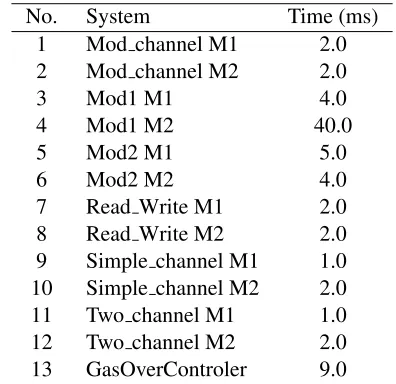
the corresponding assumptions. The regular
expression generation time is shown in Table 1.
Table 1: Regular expression generation time
No. System Time (ms)
1 Mod channel M1 2.0
2 Mod channel M2 2.0
3 Mod1 M1 4.0
4 Mod1 M2 40.0
5 Mod2 M1 5.0
6 Mod2 M2 4.0
7 Read Write M1 2.0
8 Read Write M2 2.0
9 Simple channel M1 1.0
10 Simple channel M2 2.0
11 Two channel M1 1.0
12 Two channel M2 2.0
13 GasOverControler 9.0
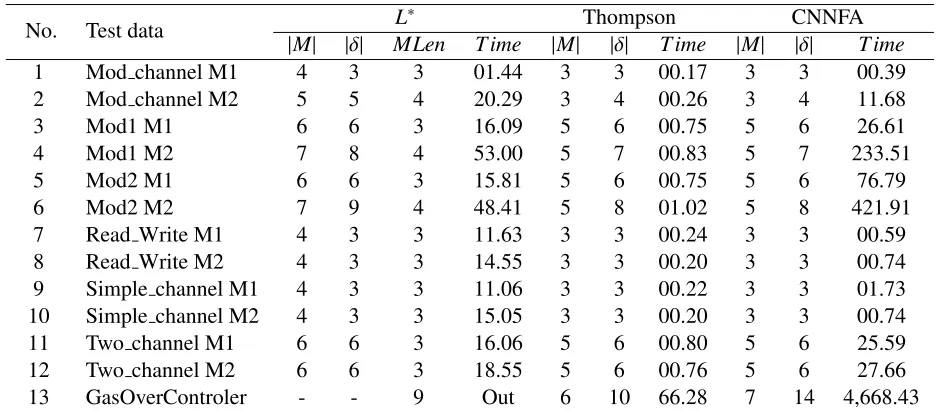
We then test the model generation process by using the three algorithms of L∗, Thompson, CNNFA. The generation time is presented in the table 2. The size of generated models is shown in the column |M|. The columns |δ| shows the number of transitions in generated models. The generated time (in milliseconds) is shown in the
column T ime(ms). The maxlength in case of
generating models using L∗methods is shown in
the column MLen. “Out” in the columns T ime
means “Out of memory”, this is the case we could not generate the model using the corresponding algorithm.
From Table 2, we have the following
observations:
• Using these testing systems, generating
models using Thompson algorithm is faster
than the other two methods using L∗ and
Table 2: Model generation time
No. Test data L
∗ Thompson CNNFA
|M| |δ| MLen T ime |M| |δ| T ime |M| |δ| T ime
1 Mod channel M1 4 3 3 01.44 3 3 00.17 3 3 00.39
2 Mod channel M2 5 5 4 20.29 3 4 00.26 3 4 11.68
3 Mod1 M1 6 6 3 16.09 5 6 00.75 5 6 26.61
4 Mod1 M2 7 8 4 53.00 5 7 00.83 5 7 233.51
5 Mod2 M1 6 6 3 15.81 5 6 00.75 5 6 76.79
6 Mod2 M2 7 9 4 48.41 5 8 01.02 5 8 421.91
7 Read Write M1 4 3 3 11.63 3 3 00.24 3 3 00.59
8 Read Write M2 4 3 3 14.55 3 3 00.20 3 3 00.74
9 Simple channel M1 4 3 3 11.06 3 3 00.22 3 3 01.73
10 Simple channel M2 4 3 3 15.05 3 3 00.20 3 3 00.74
11 Two channel M1 6 6 3 16.06 5 6 00.80 5 6 25.59
12 Two channel M2 6 6 3 18.55 5 6 00.76 5 6 27.66
13 GasOverControler - - 9 Out 6 10 66.28 7 14 4,668.43
Table 3: Assumption Generation Result
No. System Verification result Time (ms)
1 Read Write acquireRead.acquireWrite 05.50
2 Mod1 OK 13.58
3 Mod2 OK 05.68
4 Mod channel in.send.send.in 00.54
5 Simple channel OK 09.21
6 Two channel OK 02.26
7 GasOverControler OK 13.11
• With the big system (GasOverControler),
using L∗ algorithm cannot generate the
models of the system due to out of memory.
• Using theL∗algorithm to generate the model of system is limited by themaxlengthof the traces recognized by the models.
The time of the assumption generation process is shown in Table 3.
8. Conclusion
We have presented a framework for automated
design verification for component-based
software. The method generates regular
expressions from one of the outputs of the
design phase (sequence diagrams). Models
corresponding to these regular expressions
are then generated. These models are used
to verify whether the design satisfies the predefined property or not. The whole process can be re-executed when the design is changed. Experimental result shows that this method is feasible with the time of the verification process.
paths, test cases and help testing automatically. It can be very helpful for such organizations that not have much testing resources.
We are finding a way to apply the method to some practical and larger systems to prove its effectiveness. We are also extending the method using other kinds of output of design phase (e.g., class diagrams, state-chart diagrams, etc.) so that the given system can be verified in all aspects of design automatically.
Acknowledgments
This work is supported by the project
no. QG.16.31 granted by Vietnam National
University, Hanoi (VNU).
References
[1] K. Thompson, “Regular expression search algorithm”, Communications of the ACM 11:6 (1968) 419-422.
[2] J. E. Hopcroft, “An nlogn algorithm for minimizing states in a finite automaton”, Tech. Report, Stanford University, Stanford, CA, USA, 1971.
[3] T. S. Chow, “Testing software design modeled by finite-state machines”, IEEE Transactions on Soft. Engineering, vol. 4(3), pp. 178–187, 1978. [4] D. Angluin, “Learning regular sets from
queries and counterexamples”, Information and Computation, vol. 75, no. 2, pp. 87-106, Nov. 1987.
[5] C. Chang, “From regular expressions to DFA’s using compressed NFA’s”, Ph.D. Thesis, New York University, New York, 1992.
[6] R. L. Rivest and R. E. Schapire, “Inference of finite automata using homing sequences”, Information and Computation, vol. 103, no. 2, pp. 299-347, April 1993.
[7] C. Chang, R. Paige, “From regular expressions to DFA’s using compressed NFA’s”, Theoretical Computer Science 178, pp. 1-36, 1997.
[8] J. Magee and J. Kramer, Concurrency: “State Models & Java Programs”, John Wiley & Sons, 1999. The MIT Press, 1999.
[9] J.C. Corbett, M.B. Dwyer, J. Hatcliff, S. Laubach, C.S. Pasareanu, Robby and Hongjun Zheng, “Bandera: extracting finite-state models from Java source code”, Proceedings of the 2000 International Conference on Software Engineering, pp. 439-448d, 2000.
[10] D. Giannakopoulou, C. Pasareanu, and H. Barringer, “Assumption generation for software component verification”, Proc. 17th IEEE Int. Conf. on Automated Softw. Eng., pp. 3–12, Edinburgh, UK, Sept. 2002.
[11] J. M. Cobleigh, D. Giannakopoulou, C. S. Pasareanu, “Learning Assumptions for Compositional Verification”, Proc. 9th International Conference on Tools and Algorithms for the Construction and Analysis of Systems (TACAS), pp. 331–346, 2003.
[12] Giannakopoulou, Dimitra and Pasareanu, Corina S. and Cobleigh, Jamieson M., “Assume-Guarantee Verification of Source Code with Design-Level Assumptions”, IEEE Computer Society, Proceedings of the 26th International Conference on Software Engineering, pp. 211-220, 2004.
[13] D. Lorenzoli, L. Mariani and M. Pezz`e, “Automatic generation of software behavioral models”, ACM, Proceedings of the 30th international conference on Soft. engineering, pp. 501-510, 2008.
[14] P. N. Hung, T. Aoki and T. Katayama, “Modular Conformance Testing and Assume-Guarantee Verification for Evolving Component-Based Software. IEICE Trans. on Fundamentals”, Special Issue on Theory of Concurrent Systems and Its Applications, Vol. E92-A, No.11, pp. 2772-2780, 2009.
[15] Egyed, A., “Automatically Detecting and Tracking Inconsistencies in Software Design Models”, Software Engineering, IEEE Transactions on , vol.37, no.2, pp.188-204, March-April 2011.
[16] Zhang Chen, Duan Zhenhua, “Specification and Verification of UML2.0 Sequence Diagrams using Event Deterministic Finite Automata”, pp.41-46, IEEE Computer SocietyWashington, DC, USA 2011.
[17] L. B. Cuong and P. N. Hung, “A Method for Generating Models of Black-box Components”, 4th International Conference on Knowledge and Systems Engineering, IEEE Computer Society Press, pp. 177-222, 2012.
[18] H.M. Duong, L.K. Trinh and P. N. Hung, “An Assume-Guarantee Model Checker for Component-Based Systems”, The 10th IEEE-RIVF International Conference on Computing and Communication Technologies, pp. 22–26, IEEE Computer Society Press, 2013.