Res Dev Med Educ, 2018, 7(1), 8-13 doi: 10.15171/rdme.2018.003
http://journals.tbzmed.ac.ir/rdme
Effectiveness of teaching evidence-based nursing to undergraduate
nursing students in Iran: a systematic review
Reza Ghaffari1 , Somaye Shapoori1, Maryam Baradaran Binazir1* , Fariba Heidari2 , Mojgan Behshid1
1Medical Education Research Center, Health Management and Safety Promotion Research Institute, Tabriz University of Medical Sciences, Tabriz, Iran
2Community and Family Medicine Department, Faculty Of Medicine, Tabriz University of Medical Sciences, Tabriz, Iran
Introduction
Patient health is a critical issue for the health care system, and patient care should be such that minimal side effects accrue to patients and their families.1 In this regard,
evidence-based nursing (EBN) is one of the most efficient approaches to providing care in a cost-effective manner in order to improve the outcomes of the healthcare system. Using a high volume of information in a minimum time, doing things correctly, doing things with the available and effective standard methods, assuring the choice of the
proper course of care, improving the quality of nursing care, providing the best and the most effective patient care in a timely manner, and increasing patient satisfaction levels are among the significance effects of using evidence in nursing performance.2 Nursing education has a duty to
prepare competent nursing graduates who can identify clients’ needs in a changing society and take the most appropriate action in light of the best scientific evidence. The process of preparing nursing students to undertake these tasks must begin in college and this requires the
*Corresponding author: Maryam Baradaran Binazir, Email: [email protected]
Publishing Group TUOMS
Article Type:
Review
Article History:
Received: 1 June 2017 Accepted: 23 May 2018 epublished: 30 June 2018
Keywords:
Teaching, Evidence-based nursing, Undergraduate nursing education, Iran, Systematic review
Abstract
Background:Evidence-based nursing (EBN) is an approach to make effective clinical decisions based upon personal clinical expertise and patient preferences and values in combination with the most current and relevant research and evidence available on the topic. This approach uses the evidence-based practice (EBP) as a foundation. In spite of extensive training in EBN for nursing students in Iran, appropriate articles have not been summarized suitably as to EBN’s effectiveness. The present study aimed to systematically review the effectiveness of EBN education on the knowledge, skills, and attitudes of nursing students in Iran.
Methods: For a systematic review on the topic, different searching methods were applied by searching on the following key words: training, learning, evidence-based nursing, nursing education in B.A. course, nursing students, workshop, knowledge, attitudes, skills, Iran. Their English equivalents were included. Databases that were searched included SID, Magiran, Medlib, Iranmedex, PubMed, Google Scholar, and CINAHL. We included studies that had recruited undergraduate nursing students, articles that had the key words in the titles, all studies conducted in Persian and English up to 2016, and the studies which used at least one educational intervention for evidence-based teaching.
Results: Based on the results of automated and manual database searches of over 313 papers, 143 articles were eliminated by studying their titles based on not reporting teaching EBM to undergraduate nursing students, and 160 articles were removed based on content. In all, eight articles were related to the topic of the present study, indicating that EBN education promotes knowledge, attitudes, and skills of nursing students.
Conclusion: This study found that EBN educational methods can promote knowledge, attitudes and skills in undergraduate nursing students, but the review does not reach a conclusion as to the advisability of one strategy.
Article info
Please cite this article as: Ghaffari R, Shapoori S, Baradaran Binazir M, Heidari F, Behshid M. Effectiveness of teaching
evidence-based nursing to undergraduate nursing students in Iran: a systematic review. Res Dev Med Educ. 2018;7(1):8-13. doi: 10.15171/ rdme.2018.003.
educational system to consider the available evidence and best methods in the learning process.
The results of one study indicated that evidence-based practice (EBP) education acts as a catalyst for the participation of nurses in that same EBP and is potentially effective in improving patient health outcomes; however, nurses still have difficulty in implementation in practice.3
According to previous studies, the use of evidence-based education in nursing students has shown clinical effectiveness.4 The results of a study conducted by
Considine also showed that the use of evidence-based care in patients with stroke leads to the delivery of improved health care and better treatment outcomes for the patients.5,6
In their book entitled, “Evidence-based Teaching in Nursing,” Cannon and Boswell introduce evidence-based education as a general and dynamic system which provides valid educational principles with evidence in order to support, maintain, and promote a new level of knowledge to learners in different environments. They propose the following steps for its implementation as follow7: (1) Exposure to question, (2) Reviewing the
literature, (3) identifying instructional strategies, (4) development of educational changes, and (5) assessment of applied changes. Therefore, if nursing students learn to apply EBP in an appropriate manner, after graduation they can improve the quality of nursing services in the clinical settings.
Evidence-based medical professionals have systematically reviewed articles related to teaching evidence-based medicine (EBM) to undergraduate medical students, postgraduates, and allied health professionals in Iran. Nevertheless, the most effective strategies for teaching EBN to undergraduate nursing students are not well known. Accordingly, the present study aimed to systematically review the effect of EBN education on knowledge, skills, and attitudes of nursing students in Iran
Materials and Methods
The present study is a systematic review that was designed and conducted in 2016. The BEME protocol was used for conducting this systematic review.8 This study’s researchers
included a librarian, a medical education specialist, a nursing education specialist, a nurse who was also a medical education student, and a community medicine specialist. First, the required information was gathered using the following search strategy: ((evidence-based nurse*) OR (evidence-based practic*)) AND (educat*
OR teach* OR cours* OR workshop* OR learn*) AND (student* OR undergraduat* OR nursing education in B.A*) AND (knowledge*) AND (attitude*) AND (skill*) AND (Iran*). Databases included SID, Magiran, Medlib, Iranmedex, PubMed, Google Scholar, and CINAHL, and articles related to these search terms were selected up to 2016. A backward and forward reference check was done by checking and choosing the references of our selected
studies, then checking the studies that had cited any of our entered studies as their references. Duplicate studies were removed. The remaining studies were checked based on their titles and summaries, and their full text. One of 2 researchers (MB, SS) determined the inclusion of each study based on these decision rules: studies that had recruited undergraduate nursing students, articles that had the keywords in the title, studies conducted in Persian and English up to 2016, and studies which used at least one educational intervention for evidence-based teaching. The included studies were evaluated by 2 checklists, CASP and TREND. The risk of bias assessment and ancillary quality criteria were done manually to check the quality of the articles. Two researchers (SS and MB) separately abstracted study components, key outcomes, and quality indicators, applying an electronic data abstraction form using Microsoft Excel. Disagreements between the two researchers were clarified by speaking with a third reviewer. For studies with unclear or insufficient results, more points were requested from corresponding author. Results were combined subjectively by classifying the components of the included studies (Table 1) even if they accomplished the characteristic criteria (Table 2). Studies were further tabulated based on the act of intervening, and the researchers deliberated the effects of the interventions on the knowledge, attitudes, and skills of using EBN. Inter-rater agreement was quantified applying the kappa statistic. To estimate the kappa scores for this data abstraction, codes assigned to the study patterns, intervention types, and evaluation types were examined in contrast (Table 1). To compute kappa scores for these quality evaluations, the assigned codes were examined in contrast to the quality scales (Table 2).
A meta-analysis was attempted, but there were so few studies with similar characteristics that the meta-analysis was found to be an unsuitable statistical effort in this circumstance.
Results
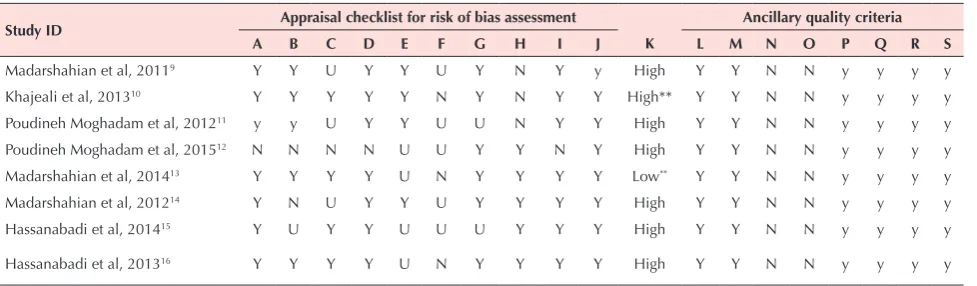
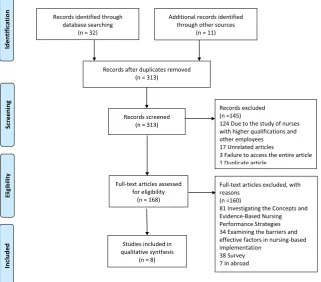
Overall, 313 studies were identified, of which 8 were entered in this systematic review (Figure 1). Each entered study had quasi-experimental designs; high risks of bias were prevalent (Table 1). Data on the risk of bias for each study was determined (Table 2).
Kappa scores were 0.81, 0.65, and 0.82 for the inter-rater agreement in information summarizing and in both parts of the quality evaluation, respectively.
Madarshahian et al9 investigated the effect of clinical
education with evidence-based method on the quality of patient care and patient satisfaction level. For this purpose, 40 seventh-academic semester nursing students were selected through purposive sampling method. They concluded that EBN education promoted the knowledge and skills of students and resulted in high-quality nursing care.
Ghaffari et al
the effect of research methodology teaching based on evidence-based care in 78 nursing students and concluded that this method improves the knowledge and attitude of nursing students.
Furthermore, Madarshahian et al14 investigated the effect
of the inclusion of the EBP in teaching plans based on problem-based learning (PBL); this study was conducted among 40 nursing students and concluded that this approach improved the clinical care and performance of students.
Hasanabadi et al15 investigated the effect of
evidence-based teaching using a problem solving approach among
76 nursing students, and concluded that this approach promoted student knowledge.
Hasanabadi et al16 conducted another study among 36
nursing students with a problem-based approach and found improved learning conditions in the experimental group.
Khajeali et al10 in a study investigating the effect of EBN
education on the 5-step nursing process conducted among 48 nursing students concluded that this approach improved students’ performance in nursing.
Poudineh Moghadam et al12 investigated the impact of
EBN education on the critical thinking of 43 nursing Table 1. Specifications of articles published by the Iranian researchers on evidence-based nursing up to 2016
No. Author and year of publication Place of the study, sample size Intervention (type and method of the study) Results (assessment) Key results and findings
1 Madarshahian et al, 20119 Birjand, 40 students A quasi-experimental research Checklist and 2 questionnaires Improved knowledge and skills
2 Khajeali et al, 201310 Urmia, 48
students A quasi-experimental research Checklist Improved performance
3 Poudineh Moghadam et al, 201211 Zabol, 42 students A quasi-experimental research Questionnaire Improved knowledge and attitudes
4 Poudineh Moghadam et al, 201512 Zabol, 43 students A quasi-experimental research Questionnaire Improved critical thinking skill
5 Madarshahian et al, 201413 Birjand,78 students A quasi-experimental research Questionnaire Improved knowledge, attitude, and students' satisfaction
6 Madarshahian et al, 201214 Birjand, 40students A quasi-experimental research Checklist and 2 questionnaires Improved clinical care and patient education
7 Hassanabadi et al, 201415 Birjand, 76 students A quasi-experimental research 2 questionnaires
Promotion of the students’ access to scientific resources, teaching satisfaction and their learning of health principles in evidence- based teaching
8 Hassanabadi et al, 201316 Birjand, 36 students A quasi-experimental research 2 questionnaires Improved learning conditions
Table 2. Risk of bias assessment and ancillary quality criteria
Study ID Appraisal checklist for risk of bias assessment Ancillary quality criteria
A B C D E F G H I J K L M N O P Q R S
Madarshahian et al, 20119 Y Y U Y Y U Y N Y y High Y Y N N y y y y
Khajeali et al, 201310 Y Y Y Y Y N Y N Y Y High** Y Y N N y y y y
Poudineh Moghadam et al, 201211 y y U Y Y U U N Y Y High Y Y N N y y y y
Poudineh Moghadam et al, 201512 N N N N U U Y Y N Y High Y Y N N y y y y
Madarshahian et al, 201413 Y Y Y Y U N Y Y Y Y Low** Y Y N N y y y y
Madarshahian et al, 201214 Y N U Y Y U Y Y Y Y High Y Y N N y y y y
Hassanabadi et al, 201415 Y U Y Y U U U Y Y Y High Y Y N N y y y y
Hassanabadi et al, 201316 Y Y Y Y U N Y Y Y Y High Y Y N N y y y y
A: Generation of randomization sequence; B, Allocation concealment; C, Similar baseline outcome measurements; D, Similar baseline characteristics; E, Addressing incomplete outcome data; F, Blinding of the outcome assessors; G, Protection against contamination; H, No selective outcome reporting; I, No other risks of bias; J, Validated assessment tools; K, Overall risk of bias; L, Description of learner characteristics; M, Description of teaching objectives and content; N, Description of teaching methods; O, Description of assessment methods; P, Assessment of long-term effects; Q, Power analysis for sample size calculation; R, Appropriate statistical tests; S, Reporting results in adequate details.
Y: yes; N: no; U: unclear.
students and findings confirmed that this method could lead to the improvement of critical thinking skills in nursing students.
Discussion
These findings were systematically reviewed, indicating that EBN education improves the knowledge, attitudes, and skills of nursing students. Evidence-based education means the integration of the professional knowledge with the best available empirical evidence in decision-making about providing some guidelines for the manner of doing something.17 For the first time, this concept was proposed
as EBM by Gayat et al in McMaster University in Canada and its use was considered essential for doctors, and it was accepted as a new approach in the medical education.18
Although evidence-based care began in medicine, it has now infiltrated all aspects of health, and the nursing profession is also changing towards documented performance in a way that the use of evidence in patient care has been focused on since the late 1990s.7
The use of evidence-based education improves care and treatment, reduces costs, and gains trust and satisfaction for patients; it also contributes to professional satisfaction and empowerment among students. The aim of evidence-based care education is to combine scientific evidence with personal expertise for judgment and decision-making in the clinical setting.19 Lack of awareness among
nurses about EBP and the theory-practice gap has caused
this concept to be used less in nursing than in some other medical fields. In this regard, nurses’ lack of skills to evaluate the studies, lack of time, and lack of support for nurses to use evidence in caring have been introduced as the main obstacles. In addition, getting into the habit of following the available trends and working conditions, including the shortage of nurses and the desire to meet their obligations, have been mentioned as other barriers to the use of evidence in nursing.19 Due to the weakness
of students in implementation of the process of evidence-based approach and lack of knowledge about information retrieval skills, and lack of access to the best evidence, evidence-based teaching in all university courses has been emphasized.20
The results of one study indicated that evidence-based education acted as a catalyst for nurses to begin and participate in the EBP and it was potentially effective in improving patient health outcomes; however, nurses still had difficulty in the implementation of this approach in practice.21 In another study, it was noted that
evidence-based approach may be used as a complementary approach in nursing education and leads students to the acquisition of some specific skills.22 A review of the literature indicates
that using evidence-based education in nursing students has clinical effectiveness.23 Evidence-based education has
also been considered essential in the educational planning of universities of medical sciences in Iran.19
Decision to use the evidence-based approach must
From: Moher D, Liberati A, Tetzlaff J, Altman DG, The PRISMA Group (2009). Preferred Reporting Items for Systematic Reviews and M
eta-Analyses: The PRISMA Statement. PLoS Med 6(6): e1000097. doi:10.1371/journal.pmed1000097
For more information, visitwww.prisma-statement.org. Records identified through
database searching (n = 32)
Sc
ree
ni
ng
In
clud
ed
Eligibilit
y
Id
enti
ficatio
n Additional records identified
through other sources (n = 11)
Records after duplicates removed (n = 313)
Records screened (n = 313)
Records excluded (n =145)
124 Due to the study of nurses with higher qualifications and other employees 17 Unrelated articles
3 Failure to access the entire article 1 Duplicate article
Full-text articles assessed for eligibility
(n = 168)
Full-text articles excluded, with reasons
(n =160)
81 Investigating the Concepts and Evidence-Based Nursing Performance Strategies 34 Examining the barriers and effective factors in nursing-based implementation
38 Survey 7 In abroad Studies included in
qualitative synthesis (n = 8)
Ghaffari et al
be accompanied by teaching this approach fully and with all the details to students during their education.23
Today, due to an emphasis on resource management, cost control, effectiveness of patient care, improved quality and accountability, proper patient care seems necessary.24
Oh et al found that the use of evidence-based education in nursing students would have high efficacy.25 Health
care systems need to design actions that not only lead to improved knowledge and skills among nurses in relation to evidence-based care, but also strengthen their attitudes and beliefs about the benefits of this method.26 Habibzadeh
et al suggested that an increase in the training hours of nursing and consideration of a separate training unit for EBN education can lead to the improved administrative skills of students in the nursing process.27
Among the benefits of using evidence in nursing care are as follows: getting a high volume of information in a minimal time, doing things in the correct manner by using the available standard methods, choosing the right care, improved quality of nursing care, delivery of the most effective patient care in the best time, increased patient satisfaction, etc. Rojjanasrirat and Rice, in a study on EBP knowledge, attitudes, and practice of online graduate nursing students, believes that Most frequently cited barriers to EBP were lack of understanding of statistics, interpretation of findings, lack of time, and lack of library resources.28
In general, nurses who base their actions on scientific evidence and documents are more likely to provide high quality care, decrease hospital stays and costs for patients, and lead to more effective nursing care. These nurses are also more professionally accountable to clients and have high level of self-confidence and a stronger professional identity.
Limitations: We had no connection to the Educational Resource Information Center (ERIC) while doing this review; thus we were not able to search it. No abbreviated term such as EBN was used in our search strategies. In addition, to include more articles, we only did a backward and forward reference checking.
Conclusion
This study found that EBN educational methods can promote knowledge, attitudes and skills in undergraduate nursing students, but the review does not reach a conclusion as to the advisability of one strategy.
Based on the results from the systematic review, putting an emphasis on EBN leads to improved knowledge, attitudes, and performance of nursing students. Hence, taking into account EBN in theoretical and practical discussions and removing barriers to its implementation can be regarded as an effective step towards the development of the nursing profession. As a result, it is recommended to take appropriate actions to improve factors influencing the implementation of EBN. Some of these factors include consideration of the training role of clinical instructors
by the educational planners, full formulation of task descriptions for students, balancing the number of the accepted students in each semester, holding training courses on EBP, creating an appropriate educational atmosphere, creating enough opportunities, providing basic training on research methodology, and using the results for more effective research. Furthermore, due to the few number of intervention studies conducted in Iran, and considering their positive impacts, designing and implementing effective interventions to improve the EBP may also be effective.
Ethical approval
The research project was approved by the Ethics Committee of Tabriz University of Medical Sciences (Ethics No. TBZMED. REC. 1395.861).
Competing interests
The authors declare that there is no conflict of interest.
Authors’ Contributions
FH and SS searched articles. MBB and SS extracted the data and summarized it. RG and MB reviewed the quality of the articles. All authors provided critical feedback in all stages of the research.
Acknowledgements
We thank Dr Yousef Asgari for his advice on translating the article.
References
1. Salimi T, Taftian SH, Shahbazi L, Mojahed SH. Evidence Based Nursing. Journal of Shahid Sadoughi University of Medical Sciences and Health Services. 2003;11(3):3-6. [Persian].
2. Retsas A. Barriers to using research evidence in nursing practice. J Adv Nurs. 2000;31(3):599-606.
3. Hagbaghery MA, Salsali M, Ahmadi F. The factors facilitating and inhibiting effective clinical decision-making in nursing: a qualitative study. BMC Nurs. 2004;3(1):2. doi: 10.1186/1472-6955-3-2
4. Seyedrasouli A, Valizadeh S, Hajebrahimi S, Parvan K, Abedini K. The principle of evidence based nursing care in the senile women with urinary incontinence. Nursing and Midwifery Journal. 2010;5(17):459-11. [Persian].
5. Sciarra E. Impacting practice through evidence-based education. Dimens Crit Care Nurs. 2011;30(5):269-75. doi: 10.1097/DCC.0b013e318227738c.
6. Ciliska D. Educating for evidence-based practice. J Prof Nurs. 2005;21(6):345-50. doi: 10.1016/j.profnurs.2005.10.008. 7. Cannon S, Boswell C. Evidence-Based Teaching In Nursing:
A Foundation For Educators. Sudbury: Jones & Bartlett Learning; 2011.
8. Rivera J. BEME Review Protocol. Available from: https:// bemecollaboration.org/downloads/1905/BEME%20 IPE%20Protocol.pdf. Accessed July 2014.
9. Madarshahian F, Hassanabadi M, Khazaei S. Effect of evidence-based method clinical education on patients care quality and their satisfaction. Iranian Quarterly of Education Strategies. 2012;4(4):189-93. [Persian].
Y. Analysis of evidence-based nursing education on the five stages of the nursing process. Scientific Journal of Hamadan Nursing & Midwifery Faculty. 2013;21(2):67-77. [Persian]. 11. Podineh Moghadam M, Ildarabadi E, Jahantigh M,
Shojai F. A study on the effects of evidence-based nursing education on knowledge and attitudes of nursing students. The First National Conference on Science Teaching and Learning Methods; May 20, 2014; Payam Noor University of Bojnourd, Iran.
12. Poodineh Moghadam M, Jahantigh Haghighi M, Shahdadi H, Saravani S, Shojaei Shad F. The Impact of Evidence-Based Education on Nursing Students’ Critical Thinking. Journal of Nursing Education. 2015;4(2):9-17. [Persian]. 13. Madarshahian F, Hassanabadi M, Khazaei S. Effect of
research methodology teaching based on evidence based care, applications and research designing on knowledge, attitude and teaching satisfaction. Journal of Medical Education Development. 2015;8(17):58-69. [Persian]. 14. Madarshahian F, Hassanabadi M, Khazaei S. Impact of
evidence based care on nursing included in teaching plan on the students practice. Journal of Medical Education Development. 2012;4(7):61-7. [Persian].
15. Hassanabadi M, Madarshahian F, Khazaei S. Effect of Evidence-Based Teaching by Problem Solving Approach on Scientific Resources Search, Health Principles Knowledge and Teaching Satisfaction. Education Strategies in Medical Sciences. 2014;6(4):201-8. [Persian].
16. Hassanabadi M, Madarshahian F, Khazaei S. Effect of Evidence Based Community Visits for Risk Factors of Crimean-Congo Fever on Students’ Learning. Iranian Journal of Medical Education. 2013;12(12):965-74.
17. John P, Beder H, Reder S, Bingman B, Smith C. Establishing an evidence-based adult education system. Cambridge, MA: National Center for the Study of Adult Learning and Literacy, Harvard Graduate School of Education; 2003. 18. Tomlin A, Dearness KL, Badenoch DS. Enabling
evidence-based change in health care. Evid Based Ment Health. 2002;5(3):68-71.doi: 10.1136/ebmh.5.3.68.
19. Considine J, McGillivray B. An evidence-based practice approach to improving nursing care of acute stroke in an Australian Emergency Department. J Clin Nurs. 2010;19(1-2):138-44. doi: 10.1111/j.1365-2702.2009.02970.x.
20. Cullen R, Clark M, Esson R. Evidence-based information-seeking skills of junior doctors entering the workforce: an evaluation of the impact of information literacy training during pre-clinical years. Health Info Libr J. 2011;28(2):119-29. doi: 10.1111/j.1471-1842.2011.00933.x.
21. Sciarra E. Impacting practice through evidence-based education. Dimens Crit Care Nurs. 2011;30(5):269-75. doi: 10.1097/DCC.0b013e318227738c.
22. Jalali-Nia SF, Salsali M, Dehghan-Nayeri N, Ebadi A. Effect of evidence-based education on Iranian nursing students’ knowledge and attitude. Nurs Health Sci. 2011;13(2):221-7. doi: 10.1111/j.1442-2018.2011.00603.x.
23. Duff J, Walker K, Omari A. Translating Venous Thromboembolism (VTE) prevention evidence into practice: A multidisciplinary evidence implementation project. Worldviews Evid Based Nurs. 2010;8(1):30-9. doi: 10.1111/j.1741-6787.2010.00209.x.
24. Memarian R. Application of Nursing Concepts and Theories. Tehran: Tarbiat Modares University; 1999. [Persian].
25. Oh EG, Kim S, Kim SS, Kim S, Cho EY, Yoo JS, et al. Integrating evidence-based practice into RN-to-BSN clinical nursing education. J Nurs Educ. 2010;49(7):387-92. doi: 10.3928/01484834-20100331-02.
26. Melnyk BM, Fineout-Overholt E, Feinstein NF, Sadler LS, Green-Hernandez C. Nurse practitioner educators’ perceived knowledge, beliefs, and teaching strategies regarding evidence-based practice: implications for accelerating the integration of evidence-based practice into graduate programs. J Prof Nurs. 2008;24(1):7-13. doi: 10.1016/j.profnurs.2007.06.023.
27. Habibzadeh H, Khajehali N, Khalkhali HR, Mohammadpour Y. Effect of evidence base nursing training on nursing students ability in executive skill of nursing process in Urmia University of Medical Science Journal of Urmia Nursing and Midwifery Faculty. 2013;11(4):284-92. [Persian].