An Analysis of Spatial Distribution Pattern of Knowledge-Based Activities in Tehran
Milad Homafar
Ph.D., Department of Urbanization, Islamic Azad University, Qazvin Branch, Qazvin, Iran
Mohammadreza Poorjafar*
Ph.D., Department of Urbanization, Faculty of Art, Tarbiyat Modarres University, Tehran, Iran Navid Saeidi Rezvani
Assistant Professor, Department of Urban Development Engineering, Faculty of Architecture and Urbanization, Islamic Azad University, Qazvin Branch, Qazvin, Iran
Received: 2017/07/05 Accepted: 2017/09/06
Abstract: World urban economy accompanied with knowledge and information economy, so
metropolitan areas drastically compete for attracting, developing knowledge-based and information activities, and promoting their competitive advantages.This research tries to identify the effective criteria on location selection of activities by explaining the spatial distribution pattern of knowledge-based activities in Tehran.The research method is mixed and the population of the study includes 560 knowledge-based companies in Tehran. Purposefully, 50 managers of Tehran’s knowledge-based companies were interviewed to identify and prioritize the criteria for choosing the locations of companies, using Delphi techniques. Linear regression analysis was used in GIS software to analyze the data quantitatively and to find out the relationship between the location of activities and the criteria for locating.The findings of this study showed that access criteria to main arteries, access to fast transportation lines and access to the subway have the most explanatory power. Contrary to traditional theories of location, there is no significant relationship between the cost of ownership or lease and the location of knowledge-based activities in Tehran. Statistical analysis complementary to regression analysis identified university decisions to locate knowledge-based growth centers, as an effective unknown factor on current spatial distribution pattern. The results of this research provide a suitable tool for urban planners to revive the spatial arrangement of knowledge-based activities in Tehran with the aim of improving performance.
Keywords: knowledge-based activity, spatial arrangement, site selection, linear regression, city of
Tehran
JEL Classification:R53, O32, C25, N75
* Corresponding Author: [email protected]
To cite this document: Homafar, M.,Poorjafar, M., & Saeidi Rezvani, N. (2018). An Analysis of Spatial Distribution Pattern of Knowledge-Based Activities in Tehran. Urban Economics and Management, 6(2(22)), 201-221.
www.iueam.ir
Indexed in: ISC, EconLit, Econbiz, SID, EZB, GateWay-Bayern, RICeST, Magiran, Civilica, Google Scholar, Noormags, Ensani ISSN: 2345-2870
1- Introduction
Alterations in the value chain production and the preference of knowledge-based information economy on other forms of the value chain production during the first years of current century reflects a deep change in the fundamentals and methods for the production of added-value in the economic future of the world. Therefore, the major vision and the goals of the national plans and programs for the acropolises in Iran have a strong emphasis on the knowledge-based economy. This change in the value chain production, have presented spatial-physical specifications which are considered as the essentials for preserving the competitive capacity of the cities in the context of global economy (Newman & Thornley, 2011). Along in this path, the role of the urban and regional planning is to prepare an urban functional spatial organization, symmetric with the knowledge-based activities with the goal of increasing the power of competitiveness of the knowledge-based enterprises in the terms of functional efficiency. Functional efficiency of the spatial organization is impacted by the expenses related to the settling place, access, flexibility and various advantages related to the location site (Cardoso & Meijers, 2017).
Transitions in both aspects of production logic and its mechanism in the knowledge-based economy have accompanied changes in the spatial scales, which are not aligned with the previous terms of the spatial plan (Sassen, 2011); therefore, spatial efficiency has reached new sets of dimensions. According to the organization in Iran, there is a deep theoretical division on identification and scrutinizing the spatial demands of the knowledge-based activities for the competition in the field of knowledge-based economy and its
newfound nature of the knowledge-based activities in Iran. This shortage puts the possibility of preparing an efficient s pat i al organi z at i on at far -fet ched distances; since achieving to an optimal and efficient spatial organization will depend on the identification of effective indexes on deciding selecting the place of the knowledge-based activities, in the first place, in order to proceed on planning and to look ahead the symmetric spatial mechanisms and policies for reaching the regarded spatial organization on the next levels of the urban planning based on the scrutinized criteria. Therefore, the urgency of supplementary studies for identification of the criteria and scrutinizing the specific demands of the knowledge-based activities in Iran is evident. According to the main goal of this research, is the identification of the criteria and the effective factors on deciding the optimum location site for the knowledge-based enterprises based on the existing spatial realities symmetric to the needs and demands of such enterprises. The research questions are listed as follow:
-Which of the proposed criteria in the theoretical references are effective on site selection of knowledge-based activities in the city of Tehran?
-Which pattern does the spatial distribution of the knowledge-based activities in Tehran follow?
-To what extent the spatial distribution pattern (spatial realities) is symmetric with the decided criteria of the experts?
In order to answer the research questions, the present paper focuses on the first step in defining the concept of knowledge-based activities in Iran and determining the scope and forms of activities covered by this research. In the next step, after reviewing location theories related to knowledge-based and information
activities, the criteria for choosing the place are extracted from theoretical texts and the spatial distribution of knowledge activities in Tehran and the extent of the impact of each of the criteria used to determine the location of the deployment have been evaluated. At the last stage, this research attempts to determine the significance of each criterion in choosing a place, providing an equivalence for locating the activities of knowledgeable people in Tehran.
2- Literature Review a) Foreign Researches
On analyzing the local specifications of the shopping centers in the city of Ankara, Ozuduru and Varol (2010) have identified the impactful factors on the location site of the shipping centers using the two methods of weighted and spatial regression. Results of the study show that these two different methods reflect different indexes.
Hammer (2014) has analyzed the geography of knowledge-based services in Karlsruhe using the multi-variable regression model and identified the establishment of the regression equation for the pathway to innovation in the factories.
Gumprecht, et al., (2007), have used the regression with the least squares on the spatial analysis of infiltration to the base of knowledge in the research and development centers and they have proven the effect of knowledge spillover of the research and development centers using a regression method.
De Noronha Vaz, et al., (2013), have employed logistic regression method in a research for identifying the innovation clusters in Portugal and they have developed their spatial analysis in the
form of cellular clusters taken from the innovation clusters in the central region of Portugal.
Chika, et al., (2013), have employed the regression method in the spatial analysis of the knowledge-based activities in the city of Hensinky. He identified clusters of knowledge-based activities in the Acropolis area of Helsinki according to a number of two indexes related to the number of people with jobs in the knowledge-based activities, and the distance from the central active area of the city.
b) Iranian Researches
Saed Moucheshi, et al., (2016), conducted a research in which they surveyed the urgency of locating the knowledge-based corporations in Tehran. This research has offered a number of ten key elements about the quality of the place and society, access to the demanding infrastructure by the knowledge-based activities, and also offered the physical specifications of each region as the impactful factor on locating the site of knowledge-based activities. According to the spatial impacts of the globalization process and eventually the spatial -physical requirements for reorganizing the city in relation with the globalization, this research analyses the globalization of physical-spatial fundamentals on the first step, and it classify the departments which offer knowledge-based services as the main functions of the current global time-span in order to analyses and survey the indexes in Tehran. Along with this aim, the research is designed in two stages. In the first stage, distribution of advanced services and their organization form, and in the second indexes of locating sites and adapting the possessing physical-spatial conditions of these indexes in respect to
the international cities were analyzed. Tehran, as the research area of the research, includes a number of seven hundred corporations which offer ideal services detached by seven groups. On the first part, results of this research indicated the single-core and centralized establishment of these functions, and it explains the most impact of the access to the supplementary services (administrative functions and in the superior services) on the configuration in the physical regions is the function of this part. Also, along with this index, service companies, are usually situated in areas in which the living quality and social identity of the location was at a high level. In spite of this establishment, configurations of different functions of superior services in Tehran is not aligned with the necessities of reconstruction in relation to globalization.
Safari & Mohammadi (2016), identified the spatial distribution patterns of knowledge-based corporations and the spatial relationship with the environmental, social, economic and infrastructural, didactic and research factors in Tehran metropolitan area. In his research, data from more than 930 participant individuals were registered and were deployed in the GIS environment where they become analyzed and decomposed using the spatial statistics methods. Results indicated that the distribution of spatial pattern for the knowledge-based corporations in Tehran fits in the category of cluster type in which there exists a deep relationship between fundamental infrastructures, including transport and other elements revolving higher education and research.
Daneshfard (2016), in a research with the aim of identifying impactful factors on the strategic execution of locating the site of knowledge-based
corporations in the Islamic Azad University and modeling their establishment patterns. This research was done with a descriptive method in mixed qualitative and qualitative methods. The 6-factor model of Russ, et al (????) is considered as the basis for the research which employed the Delphi technique and the testimony of the participants in order to localize the results. Later on, in order to control the final pattern with six factors and thirty-six confirmed indexes, the inductive reasoning was employed. The statistical population of the academic board members in Azad university, research, and development branch in which a number of 280 questionnaires were randomly distributed among the academic board members. Findings of the research indicated that the six main analyzed factors were in a meaningful relationship with the strategic execution of knowledge-based corporations in the Islamic Azad University, but the empowerment gained the first standing and the roadmap during construction gained the least significance.
Ashournejad, et al., (2016), have analyzed the spatial organization of the location site selection of financial and credit centers using weighted geographical regression method. In this research, variables related identifiers of educational and cultural, ministerial, social, hygiene, treatment, economic, and finance, traffic, transport and the population are considered as the independent variables and the current specifications of the different buildings of the financial and credit foundation is considered as the dependent variable in the geographically weighted regression method. Results of the research indicated that the accuracy of the model has a high sensitivity regarding the local parameters; therefore, combining the
ideas of experts with the objective data was recommended in order to raise the accuracy and function of the model.
3- Theoretical Background Knowledge-Based Economy
During the past decades, knowledge-based economy is presented as a new form of value in the chain of the global economy. According to its newfound nature and the extended meaning, a minute number of studies have paid attention to the investigation of the concepts and instances of knowledge-based economy and to differentiate it from other new economic approaches, including the information economy; therefore, along with the identification and extraction of the priorities, and demands of the knowledge-based economy, the first step will be to scrutinize and differentiate the knowledge-based activities from other economic activities. Knowledge-based economy is directly based on the production, distribution and the use of knowledge and the information (Al-maadeed, et al., 2016). The information economy primarily infiltrated in the research and development process of the advanced industries and services and the resource-based factories included medium and low knowledge-based activities. According to preserve the competitiveness and efficiency, strategy of the resource-based factories quickly changed and they started to produce and offer knowledge -based products and services (Chimay, et al., 2005), we can express the following specifications and attributes for the knowledge-based economy in general:
1. Changes happen with a high speed, therefore Entrepreneurship and creative destruction is at work in order to
answer the key changes (Van Winden et al., 2014).
2. It is based on the collaboration and developing networks, therefore it goes beyond the geographical borders (Ornston, 2012).
3. Value of the products and services in the knowl edge -bas ed econom y depends on the condition of the people. A definite information or knowledge can have different values for different people at the different times and places.
4. The knowledge-based economy, has a universal market, the type of the customers’ need is constantly changing (Chimay, 2005).
5. In the context of knowledge-based economy, knowledge and information infiltrates and impacts where there are more demands and fewer obstacles for it.
6. A large portion of the capital is based on the production of the knowledge and innovations (OECD, 2003).
7. In the knowledge-oriented economy, there is a demand for the expert and skilled workers, a type of demand for the workers that can deal with the classified knowledge, the competition is on attracting the workforce that possess innovation and knowledge (Arundel, et al., 2008).
According to the following specifications, knowledge-based industries can have an implicit knowledge or knowledge-based products in the list of their strategies (Anumba et al., 2008). Therefore, the collection of enterprises or factories that produce knowledge-based activities and products are called the knowledge-based industries. Knowledge-based industries are those type of industries which their proceedings and products are directly relying on the production, collecting and using the knowledge. These industries include two categories: The first set
include those industries which employ complex procedural and thematic scientific knowledge, including industries with advanced technologies (Nanotechnology, Biotechnology, Nuclear technology, Information technology, Aerospace technology, Chemistry, petro chemistry, electrical and electronic technology). The second group includes the industries that produce smart products or they employ the smart process in the production of their products. Smart productions that are produced by the knowledge -based industries are interactive, in a way that the repetition in their use leads to them becoming smarter; they have the capability of becoming customized as they are explained for the customers on the time of purchase. According to the regulation regarding the identification of the knowledge-based corporations and institutes in Iran, knowledge-based enterprises are the private or cooperative institutes or center which are shaped in order to reach for a synergy in the knowledge and wealth, development of the knowledge-based economy, fulfillment of scientific and economic goals (including the development and the employment of inventions and innovations), commercialization of results of the research and development (including design and production of commodities and services) in the field of advanced technologies along with plenty of added-values, especially in the case of designing the related soft wares (Scientific and technology department of the president office in Iran, 2012). In agreement the same regulation, 13 different sets of knowledge-based corporations exist in Iran and in order to obtain the terms and conditions of a knowledge-based corporation, must spend at least an amount of half of the income of that company in a fiscal year, from the sales in the f ield of
knowledge-based technology, products or services (including the research and development services and engineering design related to the knowledge-based products and advanced knowledge-based services). In addition, the relation between the full-time workforce in different parts of the corporation, except of the support team with the bachelor degree and employees with higher education which are active in the departments related to the manufacture of knowledge-based products to all of the full-time employees should possess a minimum value of 30 percent (Deputy of Science and Technology, 2012).
Knowledge-based products and services fit in the context of high-tech and upper mid-technologies and they include technical complexities, as its production demands an expert research and development team. The target of the added value of the products and services are due to the technical knowledge and technological innovations.
Optimal Place and the Economic Logic
for Site Selection of Knowledge-Based Activities Locating theories are interleaved with economic logic. The models related to the decision on the selection of sites are usually based on the economic profit, advantage. In many of instances, these advantages find their spatial crystallization in the form of agglomerations or clusters of activity. Prorating the expenses is proposed [/presented] in order to supply shared resources, including the expenses of developing infrastructures including fundamental infrastructure, education systems for the reduction in the expenses related to the production, maintenance and development of the infrastructures and securing the resource material, access to the skilled workforce and reducing the
expense of internal transactions of the factories regarding the transport by reducing the distance - as the main factor on crystallizing activity clusters and agglomerations. More recent theories, namely the knowledge spillover theory, believe that localizing a number of factories contributes to the enhancement in the process of knowledge spillover and to stimulate [ignite] different learning methods, innovation, and adoption (He & Gebhardt, 2014). According to this theory, the amount of information related to industry and knowledge is higher in a cluster or agglomerations to the extent that all of the factories would be benefited from it (Ellison, et al., 2010). Therefore the local culture makes possible the transfer of implicit knowledge from one of the key roles to the another with its specific norms, values and official or non-official foundations (Malmberg & Maskell, 2002): 1. Uncompetitive nature of the knowledge, 2. The impossibility of omissive viewpoint on accessing the knowledge. Phene & Tallman (2014) have explained the advantages of the knowledge spillover depending on the distance from the knowledge production centers with a focus on the role of knowledge spillover as a contributing factor to success. Thereupon, he analyses the process of formation of knowledge-based activity clusters and agglomerations in the cities from this point of view. Studies of Lee, et al. (2004) indicates that the geography of innovation is influenced by the location site of the R&D centers.
Acs, et al., (2002) reflect the fact that the knowledge spillover channels, R&D institutes and universities make possible the collaboration between the industry and the academic field. University seminars, research journals, consultative societies of
the university professors, collaborative industrial programs, industrial parks, technological improvements, loc al workforce market consisting of researchers, engineers and specialist societies are in the list of the methods for the spillover of the knowledge.
The theory of urbanized economy includes three advantages or factors that contribute to the formation of activity groups: 1. Benefit from the production and use of public products and services., 2. Benefit from the city's' market size and quality of the workforce market, size of the available market for the produced material together with the presence of differ ence faciliti es and unknown marketplaces., 3. Benefits from the city as the heart of the economic activities which has factors ranging from the production and the market for the primary material, size and variety of the workforce market, access to the advanced producer services and high level of urbanization together with the access to the extended information and communications (Cappellin, 1988).
Van Winden, et al., (2014), consider four types of local, social, geographical and perceptual adjacencies on the site selection of knowledge-based activity clusters, they consider the development of a powerful network between the skilled workers and the factories along with an emphasis on the local adjacency, on the innovation and successful function of the key enterprises. From this point of view, any place [locality] that can provide this connection and network would be a suitable location for the knowledge-based industries. Therefore, in this regard, communicative infrastructures and access to the telecommunication infrastructure would have an increasing value (Van Winden, et al., 2014). In addition to the
proximity index, rental value in the metropolitan areas are at a high rate due to the scarcity of the land; therefore, knowledge-based industries usually appear in the form of clusters in the proximity of large cities with a general goal of enhancing three key factors: access to the skilled workforce, connection to the networks of information and power, innovation and customers, and reducing the settlement expenses to its minimum amount.
Studies of Von Zedtwitz (2004) in China indicate that access to the insurance companies, standardization of the products, access to the skilled workforce together with research and development companies and the academic body of the universities include the list of highly important factors
on site selection of knowledge-based industries.
Studies of Shin & Byeon (2001) show that access to the peaceful and high-quality environment, access to the skilled workforce and ideal access to the transport infrastructure, especially the public transport routes and highways are the most important factors on the site selection of knowledge-based activities. Hershberg, et al., (2007) have pointed out to the two criteria of access to the socio-cultural facilities and access to the financial centers (banks and credit organizations). Rasiah (2003) refers to the role of the skilled workforce in location site selection for the knowledge-based industries. Figure 1 indicates the theoretical framework of the research.
Fig1. Conceptual Framework
The theory of knowledge dissemination
Urban economy Lack of
ommissive attitude
Not competitive
S
p
at
ia
l
d
is
tr
ib
u
ti
o
n
o
f
k
n
o
w
le
d
g
e
-b
as
ed
c
o
mp
an
ie
s
Access to public services Consumer market and expert labor
Access to specialized
function
Theory Cost-effective method of scale
Effective variables on deployment
The distance from knowledge centers
Local culture
Values and formal and informal institutions
Specialist workforce
Specialized technology and communication infrastructure
Access to communication infrastructure
Access to credit and financial institutions Access to cultural facilities
Access to a quiet and quality environment
4- Research Method
According to the nature of the subject and the goals, the following research is applied since the results possess the capability of becoming employed in the modification of the urban planning process. Based on the data collection method, this research is on the list of mixed-method studies. In this research, criteria for site selection were scrutinized through the interview with the managers of knowledge-based corporations. The statistical population of this research includes a number of 560 knowledge-based corporations with the official register in the information technology department of the presidential office. Rocco (2008), have used a number of 15 interviews with the head managers of enterprises. Park (2002) has employed 30 samples by adopting the Delphi method in order to identify the indexes related to the location of welfare facility services. Creswell (2013) considers a number of 20 to 30 samples as the least sample size for the validity of the outputs from the Delphi method. Powell (2003) considers a number of 30 samples as the acceptable sample size for the Delphi method.
Based on the proposed sample size in the theoretical literature for implementing the Delphi technique, and in order to ensure the accuracy of the results, the number of specialists involved in the implementation of the Delphi method was 50 experts. Therefore, 50 interviews were done with the knowledge based corporations managers (as the experts), and in order to reach for a more efficient interview, the main questions were inscribed in the form of a questionnaire for the head managers to answer. At first, it was distributed among 30 experts and the validity of authored questioned was analyzed using
the validity index. In this method, the importance of each question was defined in a triple spectrum of ‘urgent’, ‘useful and non-urgent’ and ‘nonurgent’ by 10 experts as the validity index for each of the question is analyzed [/calculated] according to Equation. 1:
Equation (1):
In this equation, is the number of experts who answered the required questions and N is the total number of experts. After assuring from the validity of the questions, interviews (using the questionnaires) were executed with a number of 50 experts in a Delphi method and results of the opinions from other managers were reviewed by the experts in four stages and the selected indexes were questioned again. On the last steps of stage four, there was accordance for more than 80% of the ranking of the questions and the considered indexes which were selected with consensus among the extracted criteria from the theoretical literature as the effective criteria for the site selection of knowledge-based activities in Iran. On the next stage, statistical data related to the three criteria of land value, access to the bank services and to the skilled workforce and access to the information networks in all of the 22 municipality districts of Tehran were collected and respectively sorted in the GIS. Then, to adopt the results of the questionnaire with the spatial realities, using the weighted multi-variable regression analytical method in Arc Map software, the relationship between the extracted indicators from the theoretical literature and the questionnaires and the current local conditions o f knowledge-based activities were evaluated and analyzed. Fig2 shows the general process of this research:
Fig2. Research process
Introducing the Case Study Area of the Research
The case study area of this research is the municipality district number 22 in the Tehran metropolitan area. As the capital of Iran, Tehran is considered an important national economy center and as the junction with the worldwide commerce in many of the fields of economy. According to the strategic-plan’s studies of Tehran, during the recent years, the city is facing a low contribution level in the gross national products. The strategic plan, explains the role of Tehran as the most important international city of Iran and the gateway to the global communications of the country (Boom Sazan, 2006). By situation in the heart of the political decisions and numerous different infrastructural advantages
(both in the human and spatial aspects), Tehran is known as the main source of skilled workforce, and knowledge-based economy R&D center. Results of the report on industry with R&D activity, indicates that an estimate of 25% of the whole number of centers with permits for research and development activity and 25% of the whole research centers of the country is located in Tehran, while an estimate of 45% of the researchers of the country are active in the capital (Statistical Center of Iran, 2011). In the strategic plan of the city, construction of centers is considered for the metropolitan area of Tehran with a universal, and suburban viewpoint along with upgrading the economic and spatial role of Tehran. According to the published census by the Spatial explanation of the pattern of the distribution of knowledge-based activities
Literature review on the topic
Extracting criteria and indicators for choosing deployment location
Determine the sub-criteria related to each criterion by reviewing related research
Establishing the position of knowledge-based companies, the establishment of registers, colleges, research centers and growth poles, and the introduction of spatial information into GIS
Entering the criteria for access to banking services, labor and land prices in different parts of Tehran Determining criteria based on interviews with corporate executives in Iran and selection of criteria with
the help of Delphi technique
The transformation of business location data to the distance from the center of activity of Tehran
Measurement of the relationship between the meta-criteria in the previous step with the location of knowledge based companies in Tehran with regression model
Analyzing the statistical results, analyzing and comparing statistical findings with theoretical foundations and presenting the findings and results of the research
information technology of the municipality in Tehran, Tehran province has the first standing in Iran with a number of 879 knowledge-based corporations, and Isfahan province has the second national standing with only 230 corporations (www.daneshbonyan.isti.ir). An estimate of 437 enterprises from the list of all knowledge-based corporations in Tehran is the startups (not yet reached their production stage). The emanated results from the statistics have two main outcomes: 1. According to the roles and potentials of Tehran metropolitan area, the main center for the knowledge-based activities and information economy of Iran is converged in Tehran, major part of the problems and issues related to the local situation site of knowledge-based activities are not yet visible and there is still an opportunity for the intervention of urban planning activities in order to perform an intense and purposeful planning along with the optimum spatial organization of knowledge -based activities in Tehran metropolitan area with the aim of improving functional efficiency.
5- Results
Explaining the spatial organization of knowledge-based activities in Tehran depends on the identification and scrutinization of impactful criteria on site selection of knowledge-based activities. In order to identify and scrutinize the specific criteria symmetric with the conditions in Iran with a Delphi method, impactful criteria for deciding the location site was subjected to questioning and ranking. The Delphi process continued until reaching for a consensus on 80% of the criteria. Results of the Delphi which led to the extraction of criteria are presented in Table 1. Analyzing the mean, average and standard deviation according to the Table. 1, indicates that the criteria for accessing public transport routes and the highways, rental price, distance from the universities and centers for research and development, access to the skilled workforce, access to the financial institutions and banks are considered as the most important factors that impact the location site of knowledge-based activities in Iran. The indexes of standard deviation from the center, vicinity of the facade and the average of the ranking results reflect the saturation of Delphi method and reaching for a general consensus.
Table1. Delphi results of interviews and their quantitative analysis for selecting criteria at the end of the fourth stage
Criterion Mean View Variance SD
Access to transport 1.1 1 0.09 0.3
Access to workforce 2.1 2 0.07 0.26
Access to financial institutions and insurance 2.95 3 0.067 0.25
Ownership cost 3.85 4 0.085 0.29
Distance to R&D centers 5.1 5 0.095 0.3
Distance to university and research center 5.9 6 0.08 0.28
The next stage would be authoring symmetric indexes for identification of the selected criteria. By reviewing the theoretical basis and other related studies, proportionate indexes related to the access to
the highways and transport routes, access to the skilled workforce and access to the financial organizations and banks were scrutinized as observable in Table 2. Applicative indexes with the criteria of
distance from the knowledge-based centers is from the distance [length] and the land and ownership expenses are extracted based on the mean [average] price of the land detached for the 22 municipality districts in Tehran based on
the report of statistical center of Iran for 2015 in Tehran and these data were imported into GIS software. The next step is to identify the local-spatial organization of the knowledge-based activities in the city of Tehran.
Table2. The results of spatial regression analysis for research variables
Optimal selection of
criteria
Criterion Calculation method Access to public or
highway transportation lines
Distance from main highway Distance from BRT stations Distance from metro stations
Ownership cost Average land prices in the regions
Access to financial and banking
institutions
Access to specialist force
Distance to research and development
centers
Distance based on meter
On the first stage, the existence of a cluster, or an agglomeration of knowledge-based activities were analyzed in the city of Tehran. Along with the following survey, and according to the average dimensions of the blocks in the district 4, 5, 6 and 7 in Tehran (areas with the highest count of knowledge-based corporations), a 400*400 mesh network was attached on the 22 districts of Tehran (Fig. 3). Preliminary researches indicated that there is no trace of a cluster or an agglomeration of knowledge-based activities in the city of Tehran. The next stage is to analyze the current [existing] spatial distribution and defying the role of different variables on the crystallization of this form of
spatial distribution. In order to reach this goal, the linear regression model was employed, therefore the local situation of the activities should be measured from a reference point and in the scales of distance [length]. Based on the theoretical basis of the research it is expected that the economic activities in the first phase in the core of the city activity area become centralized in order to enjoy the advantages of economies of scale, and would be scattered under the impact of negative external forces and a decrease in the profits of association compared to its negative influences. Therefore, the central activity core of the city can be the considered reference point of this research.
Fig3. The focal points of knowledge activities in Tehran According to the studies of Bertaud
(2003) regarding the spatial organization of Tehran city, Enghelab-Valiasr Junction (Valiasr crossroad) is identified as the exertion center of the activity in Tehran. The distance between each of the knowledge-based activities was calculated with the mentioned point using the ‘NEAREST’ command and the results were imported in a new column in the descriptive information table. Selected independent variables of the research include the distance from the BRT station, Metro [subway] station, distance from the first grade arterial roads and the highways, levels of access to the workforce, distance from the universities, research centers and the rental value.
The next step is to analyze the possible relationship between the research variables according to the spatial distribution of the activities; which was done using the diagram of distribution of the relationship between each of the independent variables and
dependent variables. After reaching for a relative certainty of a high possibility of a linear relationship between most of the independent variables with the dependent variables, the regression relationship between independent and dependent GIS variables was analyzed. Results of the regression analysis were tested in five points and the establishment of regression relationship was also tested.
1. According to Table. 3, the correlation coefficient between the research variables indicated that relationship between the distance from BRT routes, subway, university, rental value and access to the skilled workforce in respect to access to the financial organizations in positive and the correlation between the possibility of changing the transport mode and distance from the highways and grade one arterial roads have a negative distance from the functional center of Tehran.
Table3. The results of spatial regression analysis for research variables
VIF PR SE Fitness T value Standard error Correlation Variable 5.6 0.99 2.15 0.9 0.02 1161 22.8
Width from origin
4.1 *0.00 0.085 0.00 11.3 0.08 0.91
Distance from the metro
3.5 *0.00 0.16 0.00 12 0.07 0.94
Distance from BRT
1.3 *0.00 0.086 0.00 16 0.06 0.9
Distance from university
1.2 0.77 0.005 0.75 0.3 0.0005 0.002 Land price 1.2 *0.00 0.16 0.00 -7.8 0.013 *-0.9
Distance to highway
4.4 *0.00 0.059 0.00 15.83 0.06 -0.5
Ability to change travel style
1.7 *0.00 2.3 0.00 8.00 0.015 0.9
Access to specialist
4.2 *0.04 6.5 0.00 3.7 0.012 0.6
Access to financial and banking services
2. Analyzing the lack of relationship between the independent and dependent variables: According to Table 3, Three VIP numbers are less than 5.7 for all of the independent variables except for the rental value, lower amounts of VIP indicates the more accuracy of independent variables on describing the dependent variables. Rates higher than 5.7 indicates that one or two variables are explaining an entity together (For explaining a phenomenon, two different variables are selected), Therefore, variables with higher than 5.7 amount will be eliminated from the equation. In the current regression equation, there are no variables with scores higher than 5.7, therefore authenticity and accuracy of the selected variables is confirmed.
3. Analyzing the meaningfulness of the coefficient of impact: The level of meaningfulness is evaluated with two columns for probability and power of probability which indicates the meaningfulness level of the impact coefficient. Non -meaningful variables cannot help the model unless they current theories confirm the meaningfulness of the aforementioned variable. We can make certain from the results of the probability column when the Koenker test is meaningful - in the terms of statistics. The lower the probability, the better it is; since this probability test
reflects the randomness of the anticipations; therefore, the lower probability reflects a more level of significance. The points which are marked with the asterisk [*] are significant. According to Table. 3, all of the research variables are significant except for the rental value, as they all will be influential in the regression model. Importance of the rental or ownership value was the subject of emphasis in different theories and different interviews with the head managers, therefore will not be eliminated from the current model.
4. Analyzing the Jarque test results: This test indicates that the remainders (points which were not estimated by the model) have a normal distribution or they follow other certain types of distribution. Results of this test in Table 4, indicate the meaningfulness of the test, thus, the distribution of remainders follow a specific pattern and it means that there exist a dependent variable which has not entered the regression equation. Therefore all of the dependent variables should be controlled.
5. Analyzing the utility of the model function: According to Table. 4, the functionality of model indicates that the model’s function has an estimated value of 82.0. According to the high level of the anticipation power of the model (more than 5.0 is acceptable), the model has a desirable function.
Table4. Evaluation of the utility of regression model in estimating
The coefficient of
determination 0.82
Adjusted coefficient of
determination 0.82
Fisher test 323.68 Degree of freedom *0.00
Wald test 2629.3 Degree of freedom 8 *0.00
Koenker test 82.5 Degree of freedom 8 *0.00
Jarco Test 152.83 Degree of freedom 2 *0.00
Analyzing five points from the table related to the result of regression analysis
in the previous section, indicated two important subjects:
1. Existence of an important independent variable which had an influence on the spatial distribution of the activities and was not considered in the regression equation. 2. Significance of the Koenker test indicates that the relationship between the independent and dependent variables are not equal; it means that the impact of an independent variable on anticipation of the distance of a corporation from the
distance of other corporation is not equal. In order to analyze the existence or lack of existence of a centralized pattern, the following two surveys are performed:
A. The standard remainder diagram: According to the Fig. 4, the standard deviation diagram indicates that the regression model of the research has exceeded the standard mode - between zero and one.
Fig4. Distribution of data around the mean
B. According to the Fig5, distribution diagram of the activities based on each of the independent or dependent variables of the research show that the data are
scattered around the standard deviation diagram i n t he form of a clust er (centralized).
Fig5. Distribution of data of independent and dependent variables
The significance of the Koenker test indicates the necessity of supplementary analyses for explaining the importance or the influence on each of the dependent variables on anticipating the distance of each corporation from the activity center. In order to execute this test, the weighted regression spatial analysis instrument is employed in GIS. After running the mentioned model, results will be
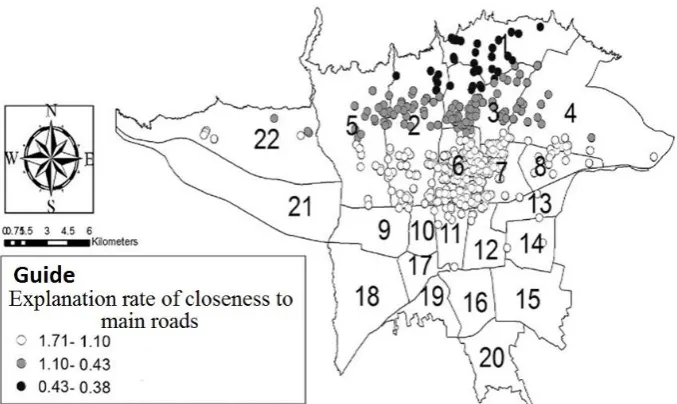
produced in the form of maps. Map 6 indicates the impact of different independent variables on anticipating the location sites of knowledge-based corporations. Fig 6 shows the high correlation of the location sites of knowledge-based activities of Tehran with distance from the main arterial roads. Only established enterprises in the district 3 does not possess a desirable access to the arterial roads.
Fig6. Correlation between arterial lines and firm position
Fig 7 shows that the access to the BRT routes and local situation has a lower correlation compared with access to
the arterial roads, especially in the district 3 and 4.
Fig7. Correlation rate of BRT lines
According to the Fig 7, analyzing the correlation of the distance from the university indicates that there is a high correlation between the location site of the corporations that are located in the
borders of district 6 and 7 and the distance from the university, but the mentioned criterion does not indicate a high correlation across Tehran.
Fig8. Correlation of distance between scientific centers
According to the Fig 8, evaluating the correlation of the access to the skilled workforce and location site reveals a
strong relationship between these two variables on the area of Tehran, especially in district 2, 7, 5 and 6.
Fig9. Correlation of access to skilled workforce
Fig 9 shows that there is a weak correlation between the location site of the knowledge-based activities in the city of Tehran and the ownership or rental
value. All of the corporations, except for the corporations in the district 4, are located in the areas with the highest rental and ownership land values.
Fig10. Correlation between land prices and the position of firms
6- Conclusion and Discussion
This research aims to explain the spatial relationship of the site selection for the enterprises and impactful factors in deciding their location sites in Tehran. Analyzing the anticipation power of the regression model (72%) indicates that the regression model has an acceptable function on explaining the spatial relationships of the knowledge-based activities and it approves the results of the Gampert et al. (2007), Chika (2016), Ashourinejad (2016), Saffari & Mohammadi (2016).
The framework of regression model indicates that all of the extracted criteria from the interviews with the head managers and the theoretical literature had a considerable impact on the location pattern for the settlement of knowledge-based enterprises in Tehran. In spite of the lower rental value, southern areas of Tehran include a small percentage of the activities within. Therefore, we can describe the first pivotal conclusion of the research
as follow: The logic for locating the sites of knowledge-based activities in Tehran are not symmetric with the traditional locating theories that are based on optimization of the ownership values and it is impacted according to the priorities and forms of production from different criteria. Weighted regression reflects the evident impact of criteria of access to the arterial roads, access to the BRT routes and the subway in the establishment site of the activities.
Spatial distribution pattern of knowledge-based activities in Tehran is aligned with the findings of Feldman (1999), Acs et al., (2002) regarding the relationship between the geography of the research and development centers and location of the sites of knowledge-based activities, but this relationship is not true for the location of the corporations and their distances from the universities in all of the areas of Tehran, as there exist a meaningful correlation relevance only in
district 6 and 7. This geographical distribution is in conflict with the results of Lee’s (2004) research. On the other hand, the high correlation between the access to the BRT with the local situation site of knowledge-based corporations in Tehran corresponds to the findings of the researches by Shin (2993), Saed Moucheshi et al., (2016) regarding the important role of BRT routes on deciding the site of knowledge-based activities.
The supplementary tests of the regression model indicate the clustering of the estimation remainders. This cluster shape increases the necessity of supplementary tests and the probability of unknown indexes on the local site of knowledge-based activities. Results of the supplementary tests and evaluating the estimation remainders indicated that most of the remainders from the regression model are the knowledge-based corporations that are situated in the university development centers. Results of the supplementary interviews with the managers of these enterprises show that deciding the location site of these activities is impacted by the regulations for deciding their sites by the universities that are programmed according to the land that is dedicated to the universities; therefore, it does not follow the economic logic of optimal location. This point is the reason for the clustering of remainders of regression analysis. Therefore, according to the special system for the official registration of knowledge-based activities in Iran, we can refer to the role of rules regulations that are initiated by the universities on developing research centers as an influential local variable on site selection of knowledge -based activities in Tehran metropolitan area as the second key finding of the research.
Utilizing the findings and results of this research on the process of planning and arranging the spatial organization of Tehran city by considering the influential criteria on site selection of knowledgebased in a more efficien t spatial -functional way, which will influence the competitive advantages of knowledge-based activities in the city of Tehran for inter-city competitions in the context of knowledge-based economy. Competitiveness of the knowledge-based activities and enjoying the advantages of knowledge spillover, demands a codified and multi-aspect planning. One of the contexts of planning for reaching competitiveness is the spatial planning on the urban scale. Along with the fulfillment of the research goals, the following recommendations are listed for a more efficient spatial management of Tehran:
- Site selection for the knowledge-based activities in Tehran lacks any type of systematic planning; therefore, revising the assigned centers in the strategic plan for the new and knowl edge -bas ed activities and explaining specific zones for the establishments will be helpful by prioritizing the three following criteria: access to the skilled-workforce, close distance from the man arterial roads and BRT routes.
- The results of this research identified the important role of decisions by the universities on the spatial distribution of knowledge-based activities in Tehran; therefore, joint projects between the spatial management authority and the universities can supply the spatial demands of knowledge-based activities including access to the workforce, universities and R&D centers together with access to the transport lines, and arterial roads on the reduction of
settlement expenses in order to establish the research centers in specific zones. This will have a direct impact on the reduction of expenses related to the knowledge-based activities in Tehran and growth in the competitive power on the national and regional level.
7- References
Acs, Z. J., Anselin, L., & Varga, A. (2002). Patents and innovation counts as measures of regional production of new knowledge.
Research policy, 31(7), 1069-1085. Al-Maadeed, S. A., & Weerakkody, V. (2016).
The Determinants of Knowledge- based Economy Development at a National Level: A Conceptual Model driven from KBE Theoretical Paradox and Advanced Practices. Electronic Journal of Knowledge Management, 14(4).
Anumba, C. J., Egbu, C., & Carrillo, P. (2008).
Knowledge management in construction. John Wiley & Sons.
Arundel, A., Van Cruysen, A., & Kanerva, M. (2008). Defining the Knowledge-Based Economy: Fi nal Synthesis Report. European Commission.
Ashoorinejad, Gh., FarajiSabokbar, H., & AmirAslani, F. (2016). Spatial Relations Modeling Factors Affecting Establishment of Financial and Credit Centers in Tehran with Geographical Weight Regression.
Quarterly Journal of Geography and Urban Planning, 4(2), 223-240 (In Persian). Bertaud, A. (2003). Tehran spatial structure:
Constraints and opportunities for future development. Ministry of Housing and Urban Development, Tehran.
Boomsazegan. (2006). Strategic-Structural Design of Tehran City Development (Summary Report). Center for Study and Planning, Tehran, Tehran (In Persian). Cappellin, R. (1988). Transaction costs and
urban agglomeration. Revue d’Economie
Régionale et Urbaine, 2, 261-278. Cardoso, R. V., & Meijers, E. J. (2017).
Secondar y Yet Met r op ol i t an? T he
Challenges of Metropolitan Integration for Second-Tier Cities. Planning Theory & Practice, 18(4), 616-635.
Chica, J. E. (2016). Spatial clustering of knowledge-based industries in the Helsinki Metropolitan Area. Regional Studies, Regional Science, 3(1), 320-328. Chimay, G., Anumba, CH., Egbu, P & Carrillo,
P. (2005). Knowledge Management in Construction. Blackwell.
Creswell, J.W. (2013). Qualitative inquiry and research design: Choosing among five traditions.2rd Edition. Sage.
Daneshfard, K. (2016). Analyzing the factors affecting the strategy of deploying knowledge-based companies and presenting a suitable model. Quarterly Journal of Strategic Management Studies, 22 (61), 29-53 (In Persian).
De Noronha Vaz, M. T., Galindo, P. V., & Nijkamp, P. (2013). Modelling R&D and Innovation Support Systems-Analysis of Regional Cluster Structures in Innovation in Portugal.
Deputy for Science and Technology. (1391).
Scheme for recognizing knowledge-based companies and institutes. Tehran.
Ellison, G., Glaeser, E. L., & Kerr, W. R. (2010). What causes industry agglomeration? Evidence from coagglomeration patterns.
American Economic Review, 100(3), 1195-1213.
Feldman, M. P., & Audretsch, D. (1999). Innovation in cities: science-based diversity, specialization and localized competition.
European Economic Review, 43,409-429. Gumprecht, D., Müller, W., &
Rodrıguez-Dıaz, J. (2007). Optimal design for detecting spatial dependence. Submitted for publication.
Hammer, A. (2014). Innovation of knowledge intensive service firms in urban areas
(No. 63). Working Paper Series in Economics, Karlsruher Institut für Technologie (KIT). He, J. L., & Gebhardt, H. (2014). Space of
creative industries: a case study of spatial characteristics of creative clusters
in Shanghai. European planning studies,
22(11), 2351-2368.
Hershberg, E., Nabeshima, K., & Yusuf, S. (2007). Opening the ivory tower to business: University–industry linkages and the development of knowledge-intensive clusters in Asian cities.
Lee, S. Y., Florida, R., & Acs, Z. (2004). Creativity and entrepreneurship: A regional analysis of new firm formation.
Regional studies, 38(8), 879-891.
Malmberg, A., & Maskell, P. (2002). The elusive concept of localization economies: towards a knowledge-based theory of spatial clustering. Environment and Planning A: Economy and Space, 34(3), 429-449.
Nazeman, H., & Eslamifar, A. (2010). Knowledge-based economy and sustainable development.
Journal of knowledge and development, 18(33), 2-33 (In Persian).
Newman, P., & Thornley, A. (2011). Planning world cities: globalization and urban politics. Palgrave Macmillan.
OECD. (2003). Science, Technology and Industry Scoreboard.OECD.
Ornston, D. (2012). Old ideas and new investments: Divergent pathways to a knowledge economy in Denmark and Finland. Governance, 25(4), 687-710. Ozuduru, B. H., & Varol, C. (2011). Spatial
statistics methods in retail location research: a case study of Ankara, Turkey.
Procedia Environmental Sciences, 7, 287-292.
Phene, A., & Tallman, S. (2014). Knowledge spillovers and alliance formation. Journal of Management Studies, 51(7), 1058-1090. Powell, C. (2003). The Delphi technique:
myths and realities. Journal of advanced nursing, 41(4), 376-382.
Rasiah, R. (2003). Regional dynamics and production networks: the development of electronics clusters in Malaysia. Universiti Malaysia Sarawak, consulté le, 27, 04-05. Rocco, R. (2008). An urban geography of
globalisation: new urban structures in the age of hyper-connectivity (Doctoral
dissertation, TU Delft, Delft University of Technology).
SaedMocheshi, R., Ziyari, K., Hataminejad, H., & Farhoodi, R. (2016).An Analysis of the Pattern of Establishment of Knowledge Companies in Tehran and the Necessities of Locating in Connection with Globalization. Journal of Armanshahr Architecture & Urban Development, 17, 243-253 (In Persian).
Sarafi, M., & Mohammdi, A. (2016). Spatial Analysis of Distribution of Knowledge Companies Case Study: Tehran Metropolis.
Planning and Space Magazine, 20(3), 181-208 (In Persian).
Sassen, S. (2011). Cities in a world economy.
pine Forge Press.
Shin, C. H., & Byeon, C. H. (2001). New industrialization in Seoul: Industrial restructuring and strategic responses.
Urban Management in Seoul, 125-46. Song Shin, H. (2003). Disclosures and asset
returns. Econometrica, 71(1), 105-133. Statistical Center of Iran. (2011). Results from
workshops with research and development activities. Tehran (In Persian).
Van Winden, W., Braun, E., Otgaar, A., & Witte, J. J. (2014). Urban Innovation Systems: What Makes Them Tick? (Vol. 72). Routledge.
Von Zedtwitz, M. (2004). Managing foreign R&D laboratories in China. R&D Management, 34(4), 439-452.