ISSN: 2334-2986 (Print), 2334-2994 (Online) Copyright © The Author(s). 2014. All Rights Reserved. Published by American Research Institute for Policy Development DOI: 10.15640/jea.v2n2a16 URL: http://dx.doi.org/10.15640/jea.v2n2a16
Development and Evaluation of Brick/Block Laying and Concreting (B/Bc) Instructional Video
Ayonmike, Chinyere Shirley Mrs.1, Okwelle, P. Chijioke2 & Okeke, Benjamin Chukwumaijem3
Abstract
Brick/Blocklaying and Concreting (B/BC) is one of the trade at the National Technical Certificate (NTC) level in Nigeria which is obtainable at the technical colleges. The objectives of this trade have not been achieved due to the inadequate nature of materials and human resources for implementing its curriculum. In order to address the issue of lack of psychomotor skills amongst technical college graduates, an intervening measure is to develop and evaluate instructional video for teaching and learning B/BC. The purpose of this study is to develop and evaluate B/BC instructional video. Five (5) research questions guided the study. Forty (40) heads of department of B/BC were selected for the study. Primary data were collected using camera and its accessories, and the Province of Prince Edwards Island Department of Education DVD/Video Evaluation form. The data collected was analyzed using frequency count and mean. The results from the study revealed that the developed B/BC instructional video was appropriate and suitable for use in teaching and learning B/BC in technical colleges in Nigeria. Hence, it was recommended that government should provide grants for TVET teachers/Instructors to develop and evaluate instructional video for teaching and learning technical courses.
Keywords: Brick/Block Laying and Concreting, Development, Evaluation, Instructional Video
Introduction
The important role of technical vocational education and training (TVET) with regards to individual occupational preparation in addition to national development is well recognized worldwide today. TVET is considered essential because a country cannot achieve economic and social development without a skilled, productive labor force that can meet the changing requirements of its environment. In Nigerian educational system, technical colleges offer technical and vocational education programmes for the purpose of producing middle level skilled manpower required for the nation’s economic and technological development (Federal Republic of Nigeria [FRN], 2004). National Technical Certificate (NTC) is awarded by the National Business and Technical Examinations Board (NABTEB) to students who have completed their post- primary education at technical colleges (NABTEB, 2004). Brick/Blocklaying and Concreting (B/BC) is one of the trades at the National Technical Certificate (NTC) level and its curriculum primarily is aimed at equipping an individual with skill on the application of the right or appropriate blocks, tools and concrete as applicable in the construction industry.
1 Department of Technical and Business Education, Delta State University, PMB1 Abraka, Delta State, Nigeria.
Email: [email protected], Mobile: +2348033772087
2 PhD, Department of Science and Technical Education, Rivers State University of Science and Technology, Port Harcourt, Nigeria.
Email: [email protected] , Mobile: +2348023311193
3 Professor of Technical Education, President /Vice Chancellor, Federal University, Gausau, Zamfara State, Nigeria.
In the field of technical and vocational education, practical skill activities form major part of instruction (Okwelle & Okeke, 2012). This suggests that the teaching of practical skills requires the use of precise instructional resources and methods to enable the learners to follow the process and thereafter repeat the skill in the teaching – learning process (Donkor, 2010). B/BC therefore, like any other TVET subject is activity oriented and facility – dependent. Unfortunately, education on technical and vocational training for skills acquisition suffers the most neglect in Nigeria (Okoye & Okwelle, 2013). These authors argue that the sector is underfunded, lacks the basic infrastructure needed to facilitate teaching and training, and scarcely available machine shop (workshop) rooms with poorly equipped or obsolete machine, equipment and facilities. These challenges portend a great danger to the effective and quality delivery of TVET subjects (B/BC inclusive) especially at the technical college level.
Furthermore, it must be recognized that TVET is expensive, involving expensive training equipments and costly training materials. In the face of the worsening economic conditions in the country, it may be very difficult to adequately find solutions to problems of TVET highlighted so far. In recent times, alternatives have been sought especially in area of improvisation of instructional materials in TVET instruction.
Instructional aids/materials are defined as small units of digital educational materials that can be used flexibly and in a variety of formats (e.g., instructional videos, interactive games, and tutorials) to enhance teaching and learning. It is also known as learning objects, instructional aids “decompose content into granular pieces of information that can be stored, retrieved, and reused in instruction” (Jonassen & Churchill, 2004). These learning objects, or instructional aids, can be used individually, or they can be linked together in units to form a course (Hamel & Ryan-Jones, 2001). One form of instructional materials that have received wide acceptance in some parts of the world in TVET instruction is video-based practical lessons. The use of video in the delivery of practical lessons is acknowledged in the literature (Donkor, 2010). According to Mishra (2001) video is useful to show practical and real life activities and can be used to capture hazardous and costly experiments for presentation and for repeated use. Hampton (2002) views video as a successful medium because it links the audio and the visual together to provide a multisensory experience for the learner. However, Tooth (2000) observed that video resources are expensive to produce but are very useful where practical demonstrations of skills are required. In this context, Jung (2005) maintained that cost-savings are expected from reuse of video resources. In spite of the foregoing, video-based instruction is seen to possess the qualities of providing semi-permanent, complete and audiovisual records of events to a learner which will lead to his/her competency development; and therefore has high potential in teaching practical skills in B/BC. The production of these instructional materials involves various design and development process.
Conceptual views of Instructional Design
Instructional Design is simply the step-by-step procedure for creating instructional materials in a consistent and reliable manner in order to enhance teaching and learning. The various terms and definitions used to refer to instructional design (e.g., instructional design, instructional development, educational/ instructional technology, and instructional systems development/design) reflect the theoretical assumptions and practical descriptions of instructional design.
Crawford (2004) opined that, instructional design is the distinct systematic process through which evolves a superior instructional product as delineated through an instructional design model. It guides designers to work more efficiently while producing more effective and appealing instruction suitable for a wide range of learning environments.
Furthermore, Smith and Ragan (2005) sees instructional design as an entire process: from the analysis of learning needs and goals, through the development of instructional materials and activities, to the evaluation of all instruction and learning activities. Spector and Muraida (1997) refer to instructional design as a structuring of the learning environment for the purpose of facilitating learning or improving learning effectiveness.
Instructional design is the systematic process of translating general principles of learning and instruction into plans for instructional materials and learning (Seels and Glasgow, 1998; Morrison, Ross and Kemp, 2004). It is also an application of theory to create effective instruction (Jonassen, 2001; Reigeluth, 1999). Similarly, Seels and Richie (1994) described instructional design as the theory and practice of design, development, utilization, management, and evaluation of processes and resources for learning. There are many instructional design theories and models available to approach instructional design.
Instructional Design Models (IDM)
An instructional design (ID) model provides procedural framework for the systematic production of instruction. It incorporates basic elements of the instructional design process, including analysis of the intended audience and determination of goals and objectives, and may be used in different contexts. It prescribes how combinations of instructional strategy components should be integrated to produce a course of instruction (Braxton, Bronico, and Looms, 1995). The effectiveness of any model depends on the context in which it is applied; instructional design methods are situational and not universal. According to Morrison, Ross, and Kemp (2004) instructional design models provide a systematic approach of implementing the instructional design process for a specific educational initiative. Instructional design models varies from basic descriptive laws about learning to broad curriculum programmes that concentrate on what is taught rather than on how to teach. The models of Andre (1997), Clark (1998) and Merrill (1994) were adapted in this study.
Production of Instructional Video
According to Yalams, Dixon, Russell, Williams, Davis, Goulbourne, Wright, and Reynolds (2011) the steps in developing instructional DVD include: identification of problems; brainstorming for strategies to the problems; literature search; writing, vetting editing and producing the projects scripts; planning the on-location; video recording; and mastering the DVD. Similarly, Media Maker (2009) posited that the ten (10) steps to make a video include: identification of the purpose of the video; identification of your audience; the message you want to communicate; identify what you want your audience to gain; identify the content points you want to include; research and write a script or sprits outline; prepare for the short video tape; and edit the footage and combine the elements to create a video story. These steps were considered in this study.
Criteria for Evaluation of Instructional Video
Statement of Problem
Physical and material resources such as hand tools, consumable materials, equipments, and instructional video are predictors of quality assurance in school. Adeogun (2001) discovered a very positive and significant relationship between instructional resources and academic performance.
According to him, schools endowed with more material resources performed better than schools that are less endowed. Adeogun opined that instructional materials increase teachers’ effectiveness in the classroom because they augment, complement and supplement their effort. Newton (1997) in Adeogun and Osifila (n.d) stressed the magnitude of instructional resources when he stated that they make teaching more productive; give instruction a more scientific base; make teaching and learning more individualistic; make instruction more powerful and immediate; and finally make attainment of objectives easier. Despite the role of physical and material resources in improving quality, many institutions (technical colleges inclusive) in Nigeria do not have the physical and material resources and those which have do not have current and relevant ones which now makes practical lessons to be taught as theoretical while equipment and materials are inadequate and sometimes borrowed for external examinations (Ezewu, 1986, Okoye & Okwelle, 2013). One alternative to improving quality delivery of practical sills is video-based instruction (Donkor, 2010; Hampton, 2002; Mishra, 2001). Instructional video for teaching and learning B/BC in Nigerian technical colleges has not being in used due to the fact that such instructional video are not available. In this context, there is need to improve the teaching and learning of B/BC trade by using valid and reliable instructional video which will enhance the processes of acquiring psychomotor skills in B/BC. However, literatures available to the researchers indicate that no such instructional video for teaching and learning B/BC is in use in Nigerian technical colleges. It is against these backdrops that this study seek to develop instructional video for the teaching and learning of Brick/Blocklaying and Concreting at National Technical Certificate (NTC) level to enhance teaching and learning in the technical colleges in Nigeria.
Purpose of the Study
The purpose of this study is to:
i) Develop instructional video for teaching and learning B/BC at the National Technical Certificate (NTC) level
ii) Evaluate the developed instructional video for teaching and learning B/BC at the National technical Certificate (NTC) level
Research Questions
The following research questions were asked to guide the study:
i) What are the steps taken to develop instructional video for teaching and learning B/BC at the National Technical Certificate (NTC) level?
ii) Does the developed instructional video for teaching and learning B/BC at the National Technical Certificate (NTC) level appropriate in terms of its content?
iii) Does the developed instructional video for teaching and learning B/BC at the National Technical Certificate (NTC) level appropriate in terms of its instructional design?
iv) Does the developed instructional video for teaching and learning B/BC at the National Technical Certificate (NTC) level appropriate in terms of its technical design?
v) Does the developed instructional video for teaching and learning B/BC at National Technical Certificate (NTC) level suitable in terms of its social consideration?
Significance of the Study
They will find the developed instructional video for teaching and learning B/BC viable since it will serve as supplementary resources for teaching and learning B/BC concepts. More so, the developed instructional video for teaching and learning B/BC will help to promote the integration of instructional video in teaching and learning in Nigerian technical colleges.
Scope of the Study
This study was limited in scope to Development and Evaluation of Instructional Video for Teaching and Learning Brick/Blocklaying and Concreting at the National Technical Certificate (NTC) level. Specifically, six concepts was the content of the developed instructional video. These concepts include; manufacturing of solid sandcrete blocks using manual method, excavation of foundation trench, construction of concrete strip foundation, mixing of mortar by hand, and laying of blocks in courses.
Methods and Procedure
Research Design
The research design that was used for this study is instrumentation research design. This design is appropriate for use when introducing new procedures, technologies or instruments for educational practices (Garba, 1993; Gay, 1996).
Population and Sample of the Study
The population of this study comprise of one hundred and ten (110) heads of departments of B/BC in all the one hundred and ten (110) government technical colleges in Nigeria as at 2013 (National Board for Technical Education ,2013). The random sampling technique was used to select forty (40) heads of departments of B/BC from one hundred and ten (110) technical colleges in Nigeria.
Instrument for Data Collection
Two types of data were collected for this study. The first being data collected for developing the instructional video for teaching and learning B/BC. The instruments used for collecting the video footage include: camera and its accessories, and editing software (Cook & LittleField, 2009). The developed instructional video was evaluated using the Province of Prince Edward Island Department of Education DVD/Video Evaluation form.
Method of Data Collection and Analysis
The instructional video footage was collected using the camera and its accessories to produce the developed instructional video while the researchers, students and head of department of B/BC in Agbor Technical College, Delta State Nigeria displayed the various tasks associated with the six concepts in B/BC. The forty (40) heads of department of B/BC was invited by the researchers to evaluate the developed instructional video using the Province of Prince Edwards Island Department of Education DVD/ Video Evaluation form.
Results
The results are presented in the order of the research questions: Research Questions 1
What are the steps taken to develop instructional video for teaching and learning B/BC at National Technical Certificate (NTC) level?
Development of Instructional Video for Teaching and Learning Block/Bricklaying and Concreting:
The various steps in developing the instructional video in B/B/C are outline sequentially below: Step 1: Identification of Problem
The problem of lack of required materials and human resources in teaching and learning B/B/C at the NTC level was identified by the researchers based on various research carried out by the researchers as students and also as supervisor of students’ research works. Notable among these researches is the work carried out by Awurum (2006) Analysis of Resources for Teaching and Learning Block/Blocklaying and concreting in Edo and Delta State Technical Colleges.
Step 2: Brainstorming by Researchers on How to Address the Identified Problems
The researchers during the brainstorming section posited that the effects of technical colleges in Nigeria not having adequate materials and human resources for teaching and learning B/BC can be address by developing instructional video which can address the challenges of not having consumable materials, equipments, tools and instructors to teaching B/BC concepts in Nigerian technical colleges. Also, they opined that with the introduction of instructional video students can enhance their psychomotor skills in B/BC. The researchers developed and evaluated the instructional video for teaching and learning B/BC at NTC level in Nigeria.
Step 3: Planning for the Development of the Instructional Video
The researchers after long meeting and discourse, the following was done to produce the instructional video:
i) Stated the purpose of the instructional video ii) Wrote and edited the scripts
iii) Acquired materials/hand tools needed
iv) Solicited for approval to use the location selected for developing the instructional video v) Choose date and time to shoot the instructional video
Step 4: Development of the Instructional Video
i) Moved to location for production of the instructional video ii) Assembled equipment for instructional video production iii) Started production
vi) Edited the recorded instructional video Research Question 2
Table I: Mean response of respondents on B/BC Instructional Video Content
S/N Item Statement
Frequency
Mean Remark
SA (4)
A (3)
D (2)
NA (1)
1 Content is current 20 15 3 2 3.33 Agree
2 Content is accurate 30 6 3 1 3.63 Agree
3 Content support NBTE curriculum 33 3 1 3 3.65 Agree
4 Scope (range)and depth of topics are appropriate to students
needs
25 13 1 3 3.58 Agree
5 Materials has significant Nigerian content 36 2 1 1 3.83 Agree
6 Level of difficulty is appropriate for intended audience 20 14 5 1 3.08 Agree
7 Content integrates a “real- world” experiences 32 2 3 3 3.58 Agree
Research Question 3
Does the developed instructional video for teaching and learning B/BC at the National Technical Certificate (NTC) level appropriate in terms of its instructional design?
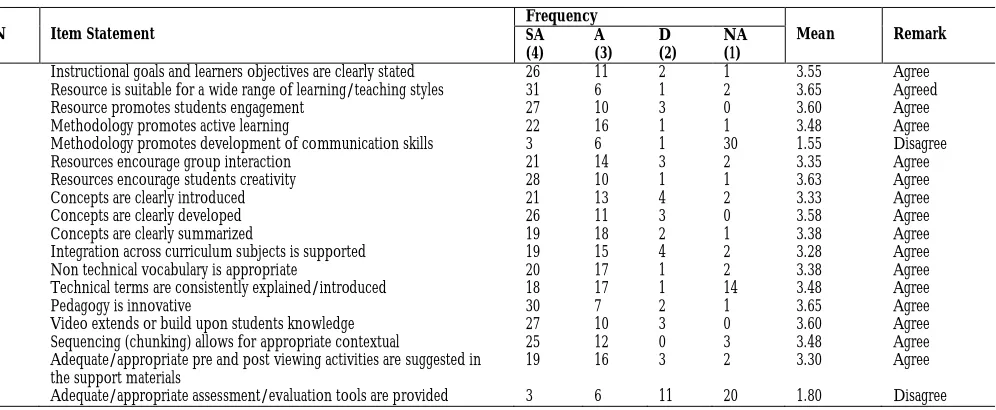
Table II: Mean response of Respondents on B/BC Instructional Video Instructional Design
S/N Item Statement
Frequency
Mean Remark
SA (4)
A (3)
D (2)
NA (1)
8 Instructional goals and learners objectives are clearly stated 26 11 2 1 3.55 Agree 9 Resource is suitable for a wide range of learning/teaching styles 31 6 1 2 3.65 Agreed
10 Resource promotes students engagement 27 10 3 0 3.60 Agree
11 Methodology promotes active learning 22 16 1 1 3.48 Agree
12 Methodology promotes development of communication skills 3 6 1 30 1.55 Disagree
13 Resources encourage group interaction 21 14 3 2 3.35 Agree
14 Resources encourage students creativity 28 10 1 1 3.63 Agree
15 Concepts are clearly introduced 21 13 4 2 3.33 Agree
16 Concepts are clearly developed 26 11 3 0 3.58 Agree
17 Concepts are clearly summarized 19 18 2 1 3.38 Agree
18 Integration across curriculum subjects is supported 19 15 4 2 3.28 Agree
19 Non technical vocabulary is appropriate 20 17 1 2 3.38 Agree
20 Technical terms are consistently explained/introduced 18 17 1 14 3.48 Agree
21 Pedagogy is innovative 30 7 2 1 3.65 Agree
22 Video extends or build upon students knowledge 27 10 3 0 3.60 Agree
23 Sequencing (chunking) allows for appropriate contextual 25 12 0 3 3.48 Agree 24 Adequate/appropriate pre and post viewing activities are suggested in
the support materials
19 16 3 2 3.30 Agree
25 Adequate/appropriate assessment/evaluation tools are provided 3 6 11 20 1.80 Disagree
Research Question 4
Table III: Mean Response of Respondents on B/BC Instructional Video Technical Design
S/N Item Statement
Frequency
Mean Remark
SA (4) A (3) D (2) NA (1)
26 Volume and quality of sound are appropriate 26 10 2 2 3.50 Agree
27 Narration is effective and appropriate to instructional purposes
(pacing, clarity, and gender)
23 14 1 2 3.48 Agree
28 Music and sound effects are appropriate and effective for
instructional purposes
30 4 3 3 3.53 Agree
29 Appropriate support materials are provided 10 1 19 10 2.28 Disagree
30 Visual effects/transitions are used appropriately to highlight
story and topic
20 13 3 4 3.23 Agree
31 Animation /graphics are appropriate and clear 26 9 3 2 3.48 Agree
32 Title/caption are appropriate and clear 30 2 5 3 3.48 Agree
33 Presentation is logical and varied 19 16 4 1 3.33 Agree
34 Pacing is appropriate 18 17 2 3 3.25 Agree
35 Resource makes effective use of various medium 13 24 2 1 3.23 Agree
Research Question 5
Does the developed instructional video for teaching and learning B/BC at National Technical Certificate (NTC) level suitable in terms of its social consideration?
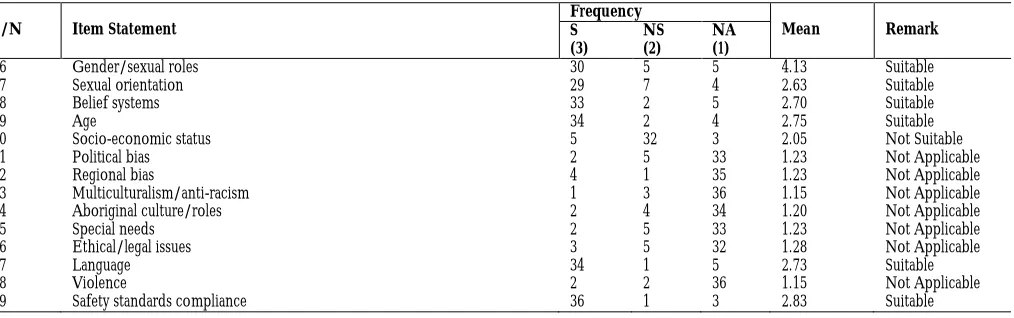
Table IV: Mean Response of Respondents on B/BC Instructional Video Social Consideration
S/N Item Statement
Frequency
Mean Remark
S (3) NS (2) NA (1)
36 Gender/sexual roles 30 5 5 4.13 Suitable
37 Sexual orientation 29 7 4 2.63 Suitable
38 Belief systems 33 2 5 2.70 Suitable
39 Age 34 2 4 2.75 Suitable
40 Socio-economic status 5 32 3 2.05 Not Suitable
41 Political bias 2 5 33 1.23 Not Applicable
42 Regional bias 4 1 35 1.23 Not Applicable
43 Multiculturalism/anti-racism 1 3 36 1.15 Not Applicable
44 Aboriginal culture/roles 2 4 34 1.20 Not Applicable
45 Special needs 2 5 33 1.23 Not Applicable
46 Ethical/legal issues 3 5 32 1.28 Not Applicable
47 Language 34 1 5 2.73 Suitable
48 Violence 2 2 36 1.15 Not Applicable
49 Safety standards compliance 36 1 3 2.83 Suitable
Discussion of Results
The results for research question one show that in developing video instructional aid, the following steps needs to be followed: identification of the problems, brainstorming by researchers on how to address the identified problems, and planning and development of the video instructional aid. This is in line with the work of Yalams, Dixon, Russell, Williams, Davis, Goulbourne, Wright, and Reynolds (2011) they reported that the steps in developing instructional DVD include: identification of problems; Brainstorming for strategies to the problems; literature search; writing, vetting editing and producing the projects scripts; planning the on-location video recording; and mastering the DVD. Similarly, Media Maker (2009) posited that the ten (10) steps to make a video include: identification of the purpose of the video; identification of your audience; the message you want to communicate; identify what you want your audience to gain; identify the content points you want to include; research and write a script or outline; prepare for the short video tape; and edit the footage and combine the elements to create a video story.
The result in table II revealed that the B/BC instructional video design is appropriate. Specifically, the result shows that, instructional goals and learners objectives are clearly stated; resources is suitable for a wide range of learning/teaching styles; resources promote students engagement; methodology promotes active learning; resources encourage group interaction; resources encourage students creativity; developed and summarized integration across curriculum subjects is supported; non technical vocabulary is appropriate, technical terms are consistently explained/introduced; pedagogy is innovative; video extends or build upon students knowledge; sequencing allows for appropriate contextual pauses in viewing; and adequate activities are suggested in the support materials.
The results in table III revealed that the B/BC instructional video volume and quality of sound are appropriate; narration, music and sound are effective and appropriate to instructional purposes; visual effects/transitions are used appropriately to highlight story and topics animation/graphics; title/caption are appropriate and clear; presentation is logical and varied; pacing is appropriate and resources make effective use of various medium.
Results in table IV revealed that the B/BC instructional video social considerations are appropriate. The instructional video is suitable for gender/sexual roles; sexual orientations; belief systems; age; language; and safety standard.
Conclusion
Based on the findings of this study, it was concluded that the developed B/BC instructional video meets up with the evaluation criteria and also it will help in enhancing students’ interest, performance and motivate them to study B/BC in government technical colleges when integrated. This implies that the developed B/BC instructional video is appropriate for teaching and learning B/BC in technical colleges in Nigeria
Recommendations
Based on the findings of this study, the following recommendations were made;
i. Government should provide grants to TVET teachers/instructors to developed instructional video for
teaching and learning technical related courses at the technical college level.
ii. Government should conduct in service training programme for TVET teachers/instructors on how to
developed instructional video.
iii.Government should set up a body that will be responsible for the development and evaluation of
instructional video for teaching and learning TVET courses.
iv.Instructional video should be integrated into TVET curriculum implementation process.
References
Adeogun, A. A. & Osifila, G. I. (n.d). Adequacy of educational resources for quality assurance in public colleges of education in Lagos State. Retrieved November 8th 2013 from
http://www.herp-net.org/TOWARDS_QUALITY_IN_AFRICAN_HIGHER_EDUCATION/Chapter%203.pdf.
Adeogun, A. A. (2001). Instructional resources and school effectiveness in private and public secondary schools in Lagos State. Lagos Journal of Educational Administration and Planning 1(1): 74 – 81.
Andre, T. (1997). Selected microinstructional methods to facilitate knowledge construction: Implications for instructional design. In R. D. Tennyson, F. Schott, N. Seel, & S. Dijkstra. Instructional Design: International Perspective: Theory, Research, and Models (Vol. 1) (pp. 243- 267). Mahwah, NJ: Lawrence Erlbaum Associates.
Awurum, C.S. (2005). Analysis of resources for the teaching and learning of blocklaying and concrete work at the technical colleges’ level: a case study of Edo and Delta State. M.Ed Thesis in Technical Education Submitted to Postgraduate School, University of Benin.
Braxton, S., Bronico, K., & Looms, T. (1995). Instructional design methodologies and techniques. Retrieved November 8th 2013 from http://www.futureu.com/ estore/braxton/ registered/intro.html.
Clark, R. (1998). Building Expertise: Cognitive methods for training and performance development. Washington D.C.: International Society for Performance Improvement
Crawford, C. (2004). Non-linear instructional design model: Eternal, synergistic design and development. British Journal of Educational Technology, 35(4):413-420. Retrieved November 8th 2013 from
http://www.onlinelibrary.wiley.com
Ezewu, E. E. (1986). An analysis of the causes of mass failure at the General Certificate of Education (ordinary level) Examination in Nigeria .In Mass failure in public examinations. University of Ibadan: Faculty of Education. Gagné, R. M., & Briggs, L. J. (1974). The principles of instructional design (1st ed.). New York, New York: Holt. Garba, L. N. 1993. Development of an instrument for evaluating practical project in woodwork. Unpublished
doctoral dissertation, University of Nigeria, Nsukka, Nigeria.
Federal Republic of Nigeria (2004). National policy on education (4th ed.). Lagos: NERDC Press.
Hamel, C. J., & Ryan-Jones, D. L. (2001). We’re not designing courses anymore. In W. A. Lawrence-Fowler and Joachim Hasebrook (Eds.), Proceedings of WebNet 2001 – World Conference on the WWW and Internet (pp. 1057-1062), Orlando, FL.
Hampton, C. (2002). Teaching practical skills. In A. K. Mishra & J. Bartram (Eds.), Perspectives on distance education: Skills development through distance education (pp. 83-91). Vancouver, Canada: Commonwealth of Learning. Retrieved from http://www.col.org/SiteCollectionDocuments/Skills_Chapter09.pdf
Jonassen, D. H. (2001). Objectivism versus constructivism: Do we need a new philosophical paradigm? In D. Ely and T. Plomp (Eds.) Classic Writings on Instructional Technology. Englewood: Libraries Unlimited.
Jonassen, D., & Churchill, D. (2004). Is there a learning orientation in learning objects? International Journal on E-Learning, 3(2), 32-41.
Jung, I. (2005). Innovative and good practices of open and distance learning in Asia and the Pacific (A study commissioned by UNESCO, Bangkok). Retrieved from
http://www.unescobkk.org/fileadmin/template2/apeid/odl_innov.pdf
Konbor, F. (2010). The comparative instructional effectiveness of print-based and video-based instructional materials for teaching practical skills at a distance. International Review of Research in Open and Distance Learning 11(1), 96 – 116. Retrieved from http://www.irrodl.org/index.php/irrodl/article/view/792/1506
Media-Maker (2009).Video storytelling handout. Retrieved 8th November 2013 from
http:// www.mediamakersinc.com
Merrill, M. D. (1994). Instructional design theory. Englewood Cliffs: Educational Technology Publications.
Mishra, S. (2001). Designing online learning. Vancouver, Canada: Commonwealth of Learning. Retrieved from http://www.col.org/SiteCollectionDocuments/KS2001-02_online.pdf
Morrison, G.R., Ross, S.M., & Kemp, J.E. (2004). Designing effective instruction. (4th ed.). Hoboken, New Jersey:
John Wiley and Sons, Inc.
Okwelle, P.C. & Okeke, B. C. (2012) . Development and validation of instrument for assessing practical skills in fault diagnoses and repairs of radio and television systems in Nigerian technical colleges. American Journal of Scientific and Industrial Research, 3(3), 181 –190. Retrieved from http://www.scihub.org/Ajsir
Province of Prince Edward Island Department of Education (2008). Evaluation and selection of learning resources: a guide. Retrieved November 8th 2013 from www.gov.pe.ca/photos/original/ed_ESLR_08.pdf
National Board for Technical Education (2013). List of government technical colleges. Retrieved November 8th 2013
from www.nbte.gov.ng
National Business and Technical Examinations Board (NABTEB) (2004). Syllabus for engineering trades for the national technical certificate examinations. Benin City: Yuwa Printing Press.
Reigeluth, C. (1999). What is instructional design theory and how is it changing? In C. Reigeluth (Ed.), Instructional design theories and models, volume II: A new paradigm of instructional theory (5-30). Mahwah, New Jersey: Lawrence Erlbaum Associates.
Seels, B. & Glasgow, Z. (1998). Making instructional design decisions. Upper Saddle River, New Jersey: Merrill. Seels, B. & Glasgow, Z. (1998). Making instructional design decisions. (2nd ed.). Upper Saddle River, New Jersey:
Merrill.
Seels, B. B., & Richey, R. C. (1994). Instructional technology: The definition and domains of the field. Washington, DC: Association for Educational Communications and Technology.
Smith, P.L. & Ragan, T.J. (2005). Instructional design. (3rd ed.) Hoboken, New Jersey: John Wiley and Sons, Inc.
Spector, J., & Muraida, D. (1997). Automating design instruction. In S. Dijkstra, N. Seel, F. Schott, & D. Tennyson (Eds.), Instructional design: International perspectives (Vol. 2). Mahwah, New Jersey: Lawrence Erlbaum. Tooth, T. (2000). The use of multi media in distance education. Vancouver, Canada: Commonwealth of Learning.
Retrieved from
http://www.col.org/SiteCollectionDocuments/KS2000%20multimedia.pdf