
OPEN A
CCE
SS
JZ
AR E
videnc
OPEN A
CCE
SS
2The Connecticut’s Beardsley Zoo, 1875 Noble Avenue, Bridgeport 06610, USA 3 United States Department of Agriculture Natural Resources Conservation Service,
*Correspondence: S. Ashley Byun, Fairfield University, Department of Biology, 1073 North Benson Road, Fairfield, CT 06824: [email protected]
Keywords:
ground penetrating radar, fog machine, coteries, undergraduate research, RIZE
Article history:
Received: 27 Feb 2018 Accepted: 04 Jul 2019 Published online: 31 Jul 2019
Abstract
In 2014, staff at the Connecticut’s Beardsley Zoo reported seeing high levels of aggression within their exhibit prairie dog (Cynomys ludovicianus) colony. Through RIZE (Research, Internships and Zoo Education), a service learning partnership between Fairfield University and The Connecticut’s Beardsley Zoo, the study set out to better understand the potential sources of aggression by documenting the colony’s behaviour and developing underground burrow maps using ground penetrating radar and polypropylene glycol fog. Observations and burrow maps suggest that the zoo colony consists of two distinct coteries and that territorial food aggression between individuals of these different coteries was the principal cause of increased hostility observed by zoo staff. To test this hypothesis, it was requested that zoo staff distribute the food within the enclosure so each of the two coteries had equal access to food. The redistribution of food according to coterie boundaries resulted in a significant decrease in aggressive behaviours (z=2.91, P=0.0). This study highlights the positive and practical impact that programs like RIZE can have for institutions like zoos and aquariums.
Introduction
The Connecticut’s Beardsley Zoo, located within the city of Bridgeport Connecticut, hosts a colony of black-tailed prairie dog (Cynomys ludovicianus) of approximately 60 to 80 individuals. The exhibit is an outdoor, open air enclosure, frequented by squirrels, chipmunks and birds during the day, and racoons and occasionally feral cats at night. Throughout the year, the colony is provided with ample hay and food which is typically deposited in the several piles in the northern part of the enclosure next to visitor observation tubes (Figure 1).
Beginning in 2014, zoo staff noticed an increase in the level of prairie dog aggression causing some concern for overall colony welfare. Unfortunately, due to budget and time constraints, staff were unable to prioritise behavioural monitoring and investigation into the cause of this increased aggression.
Action
Observations and above ground burrow entrance mapping To better understand the dynamics of colony behaviour, above ground burrow maps were developed and regular behavioural observations were conducted. Due to frequent burrow construction/deconstruction, aluminum knitting needles were used to number and keep track of individual burrows. These were embedded in the ground adjacent to the entrances, with needles being added or removed on a weekly basis to account for new burrow openings or unused burrows closing. A schematic diagram of the above ground burrow networks was generated from 2015-2017 (Figure 2).
Once the above ground burrow system was mapped, observations of prairie dog behaviour began. Of particular interest, was the documentation of instances of aggression, specifically when and where in the enclosure such incidents occurred. Prairie dog behaviour and burrowing activity were initially observed on a weekly basis in order to become familiar with behaviours and behavioural patterns of the colony. Documentation of behaviour then began through eight one-hour sessions spread weekly through March and April 2015. Observations occurred during the zoo’s operating hours, and the public was typically present during observation sessions. There are some data to suggest that observer density can affect captive prairie dog behaviour so most direct observations were done during the early morning when visitor density was lowest (Eltorai and Sussman 2011). Because
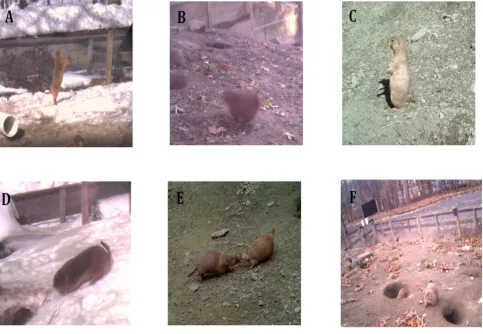
of the limited time undergraduate researchers had available for direct observations, we also installed two motion sensor camera traps (Cuddeback) to monitor behaviour. Camera traps were stationed within the enclosure to monitor behaviour during the autumn 2014, spring, summer and autumn of 2015. Motion sensors were programmed to take photos with a 30 second lag. Photos were subsequently examined to identify and document behaviour. Behaviours that could be identified through the still images included sentry/alert, sniffing, kissing, jump yips, face offs, tail spreading, lunges, chasing, running and digging (Figure 3). Face-offs, tail spreading, lunges and chasing were categorised as aggressive behaviours and the others as non-aggressive (Smith et al. 1973; Hoogland 1995). Because most of the media collected were still images, sequences of images were sometimes required
Figure 1. The Connecticut’s Beardsley Zoo’s Prairie Dog Exhibit. The enclosure is surrounded by plexiglass on the sides and a metal mesh is buried underground to contain the prairie dogs within the exhibit. Five plexiglass tubes are placed in the upper portion of the exhibit as viewing portals and are accessible via a concrete tunnel. The soil type is a sandy loam material with about 20 % rock fragments and artifacts. The enclosure slopes downward in an east to west direction and downwards on both the southwest and northwest ends of the enclosure. Food, hay and water are left daily directly in front of the largest central plexiglass visitor tube in several piles.
Figure 2. Schematic diagram of the Connecticut’s Beardsley Zoo prairie
dog exhibit 2015-2017. The exhibit is surrounded by a plexiglass barrier and contains 5 plastic tubes for visitor observations. The tubes are located at the top of the exhibit which then gives way to a 45o incline. Ovals
to identify certain behaviours such as face offs, tail spreading and chasing. Although there was a particular interest in aggressive behaviour, the above non-aggressive behaviours were categorised into order to normalise the data and account for differences in overall prairie dog activity due to factors such as weather and seasonal changes. Behaviours in these images were documented and then compared using a two-proportion z test.
Fogging for underground burrow connections
Starting in 2015, a Chauvet Hurricane (1100) fog machine was used to pump a propylene glycol-based vapour into burrow entrances down the entrances in order to determine direct connectivity between burrows. Synthetic propylene glycol vapour, which is commonly used to produce Halloween fog, has no known detriment or toxic effects on mammals (MSDS 57556). Vapour was channeled down into burrows using PVC piping. These burrows were referred to as origin burrows. The origin burrows were covered to ensure vapour did not back out. The study monitored for the presence of vapour emerging from other burrows (Figure 4). If a such a burrow(s) was found, the connection on the burrow map was marked. Successful fogging required low humidity, low wind, and mid-range temperatures in order for the vapour to efficiently travel through the network. Due to incidences of misleading residual fog emerging from previously tested burrows, testing alternated between entrances at opposite ends of the exhibit over several days. After pumping fog into burrows for at
least 8-10 seconds, the entrance was stopped using a large feed bag, ensuring all fog exited elsewhere. In the event that no fog emerged from a separate entrance, thick clouds of vapour backed up out of the tested entrance; it was assumed that these burrows led to a single chamber, and they were marked as such on the map.
Using Ground Penetrating Radar (GPR) to visualise underground burrow connections
In 2017, GPR was employed to establish underground burrow connections. GPR is a non-invasive geophysical method that uses the reflection of electromagnetic energy to produce images of subsurface interfaces and features. A favorable feature of GPR is its ability to noninvasively produce high-resolution images of the subsurface, and detect points or areas that have different reflection patterns than neighboring areas. An area or point having a contrasting spatial reflection pattern may be referred to as an “anomaly” because of its uncertainty and/or non-uniqueness. In this case, such anomalies can be interpreted to be prairie dog burrows and underground chambers.
The soil type within the enclosure is a sandy loam material with about 20 percent rock fragments and artifacts. The soil material slopes downward in an east to west direction and downwards on both the southwest and northwest ends of the enclosure. To prevent individuals from digging out of the enclosure a metal mesh lining was installed at a depth of about 1.25-1.8 m (4-6 feet).
Figure 3. Sample behaviors observed through camera trap photos taken from 2014-2015. A) Jump yip B) Chasing C) Sentry/Alert D) Face off E) Kiss F) Tail
A 3x12 m area within the enclosure was determined as the best area to scan using GPR. This area was outlined using survey lines and a survey grid established using pink coloured flags inserted into the ground every 25 cm. The area was then scanned in 25 cm sections using a SIR (Subsurface Interface Radar) 4000, a ground-penetrating radar data acquisition system manufactured by Geophysical Survey Systems, Inc. (GSSI) (Figure 5). The SIR-4000 mounted to a 3-wheel survey cart with an analog 400 MHz antenna was used to collect the radar data and RADAN for Windows (version 7) was used to process the radar records.
Consequences
Based on camera-trap monitoring, frequent aggressive behaviours were observed during the autumn (2014) and early spring (2015). These behaviours included lunging, tail spreading, face offs and chasing. In addition to camera-trap monitoring, documentation of aggression through direct observation occurred during four, one-hour weekly sessions during March 2015. During that time, five instances of aggression were observed: three face offs (accompanied by chirping), one chase, one dramatic physical
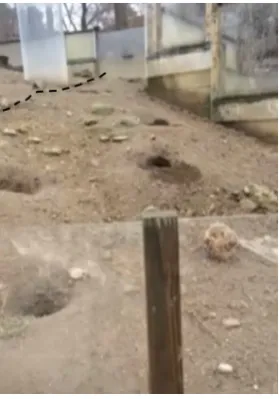
Figure 6. Two individual prairie dogs fighting near the primary tension zone
These two individuals are locked in a fighting embrace and were tumbling down the hill when this photo was taken. The aggression began at the primary tension zone (depicted by the dotted line) by the plexiglass visitor tube located at the top right of the photo.
Figure 7. Schematic of underground burrow connections as determined
by using propylene glycol vapor. Results suggested the existence of two separate burrow systems: a northern system (blue) and a southern system (red). Although not all burrows in the northern system were physically connected, we concluded that social bonds existed between them due to observations that individuals seemed to move freely between these burrows. The dotted line indicates the area where all aggressive behaviors were observed during four, one hour periods in March 2014.
Figure 4. Propylene glycol fog emerging from a connected burrow.
Propylene glycol vapor was pumped into a single burrow entrance and then all other burrows were monitored for emerging fog. Burrows found with emerging fog were documented as having a direct physical connection with the origin burrow.
Figure 5. GPR scan. The area was serially scanned by using GPR (SIR 4000)
altercation which resulted in two individuals locked together rolling down a hill in the enclosure. All five instances of aggression occurred in a specific area within the enclosure which was later dubbed the primary tension zone (Figure 6). No aggression was observed between prairie dogs and frequent enclosure intruders such as squirrels and chipmunks (however see Hoogland and Brown 2016) directly or through camera trap images. All observed aggression appeared to be intraspecific.
Underground burrow connections suggest at least two coteries exist in colony
Underground burrow mapping using synthetic fog provided a potential reason for the localised aggression. Based on fogging experiments, it was found that burrows in the southern part of the enclosure appeared to be highly interconnected but not with any of the burrows in the northern part of the enclosure. Burrows in the northern enclosure demonstrated direct connectivity with one another but this connectivity was more limited in scope (Figure 7). However direct observations of specific individuals
leaving and entering burrows indicated that individuals in the northern enclosure were using various burrows suggesting a social if not a direct, physical connection. None of the individuals using the burrows in the northern part of the enclosure were seen using the burrows in the southern part of the enclosure and vice versa. These data suggested that territoriality might be the reason for the observed localised aggression. As such, it was postulated that the original colony might have recently fractured into two coteries and that the recent increase in aggression being observed by zoo staff was due to intercoterie aggression. Such fissions are not unusual and can occur due to reasons such as intraspecific competition (Manno et al. 2007).
Food redistribution according to putative coterie boundaries significantly reduced observed aggression
Based on both observations of burrow use and underground connections, it was hypothesised that the CT’s Beardsley Zoo’s captive prairie dog colony consisted of two separate coteries, one larger coterie in the northern part of the exhibit and another
z 4.28 0.247 2.41 4.17 2.12 6.7 5.22 1.18 2.49 4.16
P 0.00002* 0.8 0.015* 0.0003* 0.0343* 0* 0* 0.24 0.013* 0.0003*
Table 2. Frequency of Aggression documented from camera trap images
collected before and after food redistribution April 2015 according to season. Frequency of aggression was not significantly different between the F2014 and Sp2015 (z=1.25, P=0.21) but the frequency of aggression did significantly decrease between F2014 and F2015 (z= 2.08, P=0.037) and Sp2015 and S2015.
Season Autumn 2014 (F2014)
Spring 2015
(Sp2015) Summer 2015 (S2015)
Autumn 2015 (F2015) Frequency
of aggression
0.33 0.37 0.021 0.12
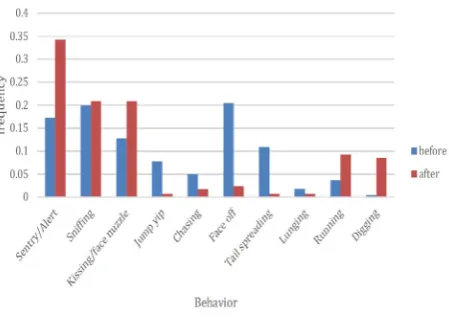
Figure 8. Frequency of documented behaviors before and after food
of the burrows of the lower coterie would attempt to move into the area of the food located in the upper part of the enclosure. Based on the burrow maps, it was hypothesised that aggression might be alleviated if the food was distributed so that each coterie had their own food source. In early April 2015, it was requested that the keepers distribute food so that individuals could have access to food without crossing potential coterie territories. Direct behavioural monitoring of the colony following the food redistribution indicated that individuals associated with the southern coterie did not seem to venture into the perceived boundary of the northern coterie. Instead, those individuals remained in the southern part of the enclosure, using the food that was now easily available to them. During four, one-hour weekly sessions of direct behavioural monitoring following food redistribution (April 2015), no instance of aggressive behaviour was documented.
To assess whether food redistribution had a significant lasting effect on reducing aggression, aggressive behaviours were compared before and after food redistribution using camera trap images collected during the autumn of 2014, and the spring, summer and autumn of 2015. A total of 8930 images were collected, 5511 of which contained at least one prairie dog. From these images, a total of 512 individuals were documented displaying specific behaviours such as sentry, sniffing and kissing. We categorised face offs, chasing, tail spreads and lunging as aggressive behaviours (Table 1). Because jump yips can be territorial in nature (Hoogland 1995) and thus could be considered as aggressive, the data were analysed twice, counting jump yips as both aggressive and non-aggressive. The inclusion of jump yips as both aggressive and non-aggressive did not affect the statistical outcome. Here we report only the outcome considering jump yips as non-aggressive.
Prior to food redistribution, 220 behaviours were documented, 84 of which were considered aggressive (frequency 0.38) over the autumn of 2014 and spring of 2015. After food was distributed within both putative coterie territories, the number of aggressive behaviours decreased significantly to 16/282 (frequency 0.057) (z=9.05, P=0) during the summer and autumn of 2015 (Figure 8). Because of possible seasonal differences in behaviour, the frequency of aggressive behaviours were also compared between the autumn of 2014 and spring 2015 and no significant difference was found (z=1.25, P=0.21) suggesting that prior to food redistribution the amount of aggression was not significantly different between the autumn and spring seasons.
The aggression documented in the autumn of 2014 (0.33) was compared to that of the autumn of 2015 (0.12). The difference in aggression was significant (z= 2.08, P=0.037) suggesting that aggression may have decreased due to the change in food distribution rather than a change in season (Table 2). The conclusion that aggression was significantly reduced is supported by zoo staff who also observed a notable reduction in aggression following food redistribution and continue to observe this reduction through to the autumn of 2018.
The hypothesis that the Connecticut’s Beardsley Zoo colony consisted of two coteries with separate burrow systems was independently corroborated by GPR in 2017. The GPR survey
downwards into the grid, progressively increasing in depth by 15 cm (Figure 9). Between 15 and 150 cm, burrows are interpreted as small areas of green, yellow, and purple coloured shapes which gradually expand and move with depth. The multiple gray colour shapes are believed to represent some of the connecting tunnels, especially the more linear shapes which are not natural soil features. Starting along the north and south ends at 115 cm GPR revealed large anomalies (depicted in purple) which move inward with depth. These areas are interpreted to represent the metal mesh lining underlying the enclosure. The GPR data seem to suggest: 1) Chambers seem to be located directly above the metal mesh lining suggesting the prairie dogs are digging down as far as possible. It also appears that some chambers have multiple tunnels leading into them; 2) Tunnels and chambers seem to be concentrated in two areas: the northern and southern parts of the enclosure with the northern area having what appears to be a much more extensive network; and 3) There is a relative lack of burrows/chambers in the middle area of the enclosure despite the fact that there is no physical obstacle prohibiting tunnel or chamber construction. Based on these images, this is interpreted to mean that there are no connections between the northern and southern regions in this area and that the two coteries that existed in 2014 have continued to coexist.
Regular behavioural observation supported by the confirmation of two separate burrow networks helped zoo staff develop a new feeding method that alleviated territorial food aggression between existing coteries. It is understood that keepers at the Connecticut’s Beardsley Zoo continue to note decreased levels of aggression within their prairie dog colony. This study emphasises the value of 1) regular observation and experimentation in understanding the dynamics of multi-individual exhibits and providing management solutions for behavioural issues; and 2) undergraduate researchers in a service-based student research program like RIZE for zoos and aquariums.
Acknowledgements
We would like to thank the following individuals and organizations for their support and contributions to this project: J.T. Warner, keeper for the prairie dog exhibit for providing insightful information and helping us with fogging experiments; Dr Brian Jones, Connecticut (CT) State archaeologist UCONN, Storrs, CT for connecting Fairfield University and the CT’s Beardsley Zoo with the USDA-NRCS; David Colberg, Program & Public Information Coordinator, Office of State Archaeology, UCONN, Storrs, CT and Scott Brady, Volunteer, Friends of the Office of State Archaeology for their assistance in carrying out the GPR scan in the field; past undergraduate students Amanda Reilly and Katherine Martin for getting the project going in those early days, CT’s Beardsley Zoo staff, especially L. Tomas and G. Warner, for their unending assistance and support of student researchers; the Fairfield Biology Department for providing financial support, and Melissa Quan of Fairfield University’s Center for Faith and Public Life for ongoing financial, logistical, and intellectual support of RIZE and RIZE students.
References
Propylene glycol; MSDS No. 57556 [Online]; Sciencelab.com: Huston, TX, 21 May (2013) http://www.sciencelab.com/msds.php?msdsId=9927239 (accessed 3 February 2018).
Eltorai A.E.M., Sussman R.W. (2011) Social Behavior of Captive Black Tailed Prairie Dogs (Mammalia, Rodentia) with changing number of observers. Vestnik Zoologii 45: 25-32.
Hoogland J.L. (1995) Black-tailed Prairie Dog: Social Life of a Burrowing Mammal. University of Chicago Press, Chicago IL, USA.
Hoogland J.L., Brown C.R. (2016) Prairie dogs increase fitness by killing interspecific competitors. Proceedings of the Royal Society B: Biological Sciences 2016: 1-7 20160144; DOI: 10.1098/rspb.2016.0144 Manno T., Dobson F.S., Hoogland J., Foltz D. (2007). Social group fission and
gene dynamics among Prairie Dog Black Tailed Prairie dog (Cynomys ludovicianus). Journal of Mammalology 88: 448-456.


![[GUNSMITHING] The .22 Pistol](data:image/gif;base64,R0lGODlhAQABAIAAAP///wAAACH5BAEAAAAALAAAAAABAAEAAAICRAEAOw==)