56
Iranian Journal of Chemical Engineering Vol. 11, No. 2 (Spring 2014), IAChE
Biosorption of cobalt (II) by Intact and Chemically Modified Brown
Algae: Optimization Using Response Surface Methodology and
Equilibrium, Dynamics and Thermodynamics Studies
F. Soleymani1, H. Pahlevanzadeh1*, M.H. Khani2, M. Manteghian1
1- Chemical Engineering Department, Tarbiat Modares University, Tehran, Iran
2- Nuclear Fuel Cycle Research School, Nuclear Science and Technology Research Institute, Tehran, Iran Abstract
By using response surface methodology, Batch shaking biosorption of cobalt (II) experiments were conducted in order to examine the combined effects of operating parameters. The results indicate that magnesium nitrate performed as an effective biosorbent surface modifier, which increases the rate of adsorption capacity. At optimal conditions (initial pH 7.0, temperature 45◦C, biosorbent concentration 0.1 g/100ml, and initial cobalt concentration 300mg/l for Mg-treated biomass) the biosorption capacity of the algae for cobalt was found to be 80.55 mg/g. The Langmuir and Freundlich isotherms were applied to the equilibrium data. The results are best fitted by the Freundlich model. Evaluation of the experimental data in terms of biosorption dynamics showed that the biosorption of cobalt (II) onto algal biomass followed the pseudo-second-order dynamics well. Using the thermodynamic equilibrium coefficients obtained at different temperatures, the thermodynamic parameters (ΔG◦, ΔH◦ and ΔS◦) were also evaluated.
Keywords: Biosorption, Response Surface Methodology, Pretreated Algae, Cobalt, Sargassum sp.
1. Introduction∗
Cobalt containing compounds discharged through different industrial activities constitute one of the major causes of water pollution. Heavy metals pose a significant threat to the environment and public health because of their toxicity, accumulation in the food chainand persistence in nature [1,2]. So it is necessary to remove cobalt at the time of release of effluent. There are some conventional methods for treatment of liquid effluent for removal of heavy metals such as
∗Corresponding author: [email protected]
industry. Biosorbent materials derived from suitable biomass can be used for the effective removal and recovery of heavy metal ions from industrial solutions. Many algae, yeasts, bacteria and other fungi are known to be capable of concentrating metal species from dilute aqueous solutions and accumulating them within their cell structure [5]. Among biosorbent materials algae have proved to be both economic and eco-friendly as they are abundantly available, have regeneration and metal recovery potentiality, lesser volume of chemical and/or biological sludge, high efficiency in dilute effluents, and a high surface area to volume ratio [6]. The cell walls of brown algae generally contain components such as cellulose and alginicacid which contain several functional groups (amino, carboxyl, sulphate and hydroxyl) that could play an important role in the biosorption process [7]. The binding strength of alkaline earth metals to alginic acid was found to decrease in the order Ba(II) >Sr (II) > Ca (II) > Mg (II) [8,9]. Haug interpreted the preferential binding of heavier ions to stereochemical effects, since larger ions might better fit a binding site with two distant functional groups [10]. Also, the preferential binding of larger ions can be attributed to stereochemical effects such as the coordination of the oxygen atoms surrounding the metal ion [11]. According to the trends, cobalt ion is preferable to replace magnesium instead of calcium ion because Mg(II) has less binding strength. So for pretreatment of biomass, Mg(II) was used as a surface modifier instead of other ions such as Ca(II).
The aim of this study was to conduct a central composite design (CCD) analysis to
find the significant factors that influenced the removal of cobalt from aqueous solution by marine brown algae Sargassum sp. and understand their impact on the process. The effect of some operating variables such aschemical modification of the biomass, temperature, pH, adsorbent dose and initial concentration of Co2+ on biosorption was studied using CCD, which gives a mathematical model that shows the influence of each variable and their interactions. In addition, the equilibrium, dynamic and thermodynamic parameters were calculated In the statistical design, the factors involved in an experiment are simultaneously changed. The most important advantages are that not only the effects of individual parameters but also their relative importance in a given process are evaluated and the interaction of two or more variables can also be derived. This is not possible in a classical one factor at a time experiment [2].
2. Mathematical description
The amount of metal uptake by algae was calculated from the differences between the metal quantity added to the biomass and the metal content of the supernatant using the following equation:
ads 0
M ) C C ( V
q = − (1)
Biosorption of cobalt (II) by Intact and Chemically Modified Brown Algae: Optimization Using Response Surface Methodology and Equilibrium, Dynamics and Thermodynamics Studies
58 Iranian Journal of Chemical Engineering, Vol. 11, No. 2
time t (min) in mg/l, and Mads is the amount of added biosorbent on dry basis in g[12].
2-1. Dynamic parameters of biosorption
It is known that the biosorption process is time-dependent; so in this study the pseudo-first-order and pseudo-second-order dynamic models have been discussed to identify the rate and kinetics of sorption of cobalt on
Sargassum sp. adsorbent.
Pseudo-first-order Lagergren model considers that the rate of occupation of biosorption sites is proportional to the number of unoccupied sites. The linear form of the model is:
303 2
1 .
t k q log ) q q
log( eq − t = eq − (2)
where qeq and qt (mg g−1) are amount of cobalt adsorbed at equilibrium and at time t (min), respectively, and k1 (min−1) shows the equilibrium rate constant of pseudo-fi rst-order adsorption. k1 and qeq can be determined from the linear plot of log (qeq
−qt) versus t.
The adsorption dynamics may also be described by pseudo-second-order model. Pseudo-second-order model considers that the rate of occupation of biosorption sites is proportional to the square of the number of unoccupied sites and after being integrated and rearranged:
t q q k q
t
eq eq t
1 1
2 2
+
= (3)
Where qeq and qt (mg g−1) are amount of cobalt adsorbed at equilibrium and at time t (min), respectively, and k2 (g mg-1 min-1) is
the equilibrium rate constant of pseudo-fi rst-order adsorption. k2 and qeq can be determined from the linear plot of t/qt versus t. This model is more likely to predict dynamic behavior of biosorption with chemical sorption being the rate-controlling step. Due to the presence of greater number of metal ions in industrial wastewater, the sorption equilibrium was reached much faster due to faster occupancy of sorption sites by metal ions [2,13].
2-2. Equilibrium parameters of biosorption
The biosorption isotherms are characterized by definite parameters whose values express the surface properties and affinity of biosorbent for different heavy metal ions [14]. Several isotherm equations have been used for the equilibrium modeling of biosorption systems. In this study, the Langmuir and Freundlich adsorption models were tested to determine the relationship between adsorbed cobalt ions on the algal cell (qeq) and unadsorbed cobalt ions in solution (Ceq). The most widely used isotherm equation for modeling equilibrium is the Langmuir equation, based on the assumption that there is a finite number of binding sites which are homogeneously distributed over the adsorbent surface, these binding sites have the same affinity for adsorption of a single molecular layer and there is no interaction between adsorbed molecules [5]. The linear form of Langmuir isotherm is given by the following equation:
m eq m
eq bq C q
q
1 1
1 = +
(4)
the equilibrium, Ceq (mg/l) the equilibrium concentration, qm (mg/g) is the Langmuir constant representing the maximum monolayer adsorption capacity and b(l/mg) is the Langmuir constant related to energy of adsorption and the affinity of the binding sites [1,15]. The equilibrium parameters (qm and b) are determined from the linear plot of 1/qeq versus 1/Ceq.
The adsorption data was also analyzed by Freundlich model. The Freundlich expression is used for heterogeneous surface energy term. The Freundlich isotherm equation is an exponential equation and therefore, assumes that as the adsorbate concentration increases, the concentration of adsorbate on the adsorbent surface also increases [5]. Freundlich equation is commonly presented as shown below:
n eq eq kC
q = 1 (5)
The logarithmic form of Freundlich model is given by the following equation:
eq
eq
C
n
k
q
log
1
log
log
=
+
(6)where k and n are constants related to the adsorption capacity and intensity of the adsorbent characteristics of the system, respectively. The fractional values of biosorbent surface indicate a favorable biosorption of metal ions onto biomass [16]. The plots of log qeq versus Ceq determine values of 1/n and k.
2-3. Thermodynamic parameters of biosorption
The determination of thermodynamics parameters has great importance in
evaluating spontaneity and heat change for the biosorption reactions. The Gibbs free energy change of the adsorption process (ΔG°) is related to the standard thermodynamic equilibrium constant (Keq°) of the biosorption system by the classic equation[17,18]:
ο ο
eq K RT G =− ln
Δ (7)
Where T is the absolute temperature (kelvin) and R is the universal gas constant which is 8.314 (j/mol k).
The apparent equilibrium constant (K'e) of the adsorption is defined as [17, 19]:
eq eq ad e
C C
K' = , (8)
Where Cad,eq is the amount of adsorbed metal ion on the biosorbent per volume of the solution at equilibrium and Ceq is the equilibrium concentration of the metal ion in the solution. The Gibbs free energy change (ΔG°) reflects the feasibility and spontaneous nature of the process. At a given temperature, the higher the negative value of ΔG°, the more energetically favorable adsorption process.
In order to determine the nature of the biosorption process regarding heat of adsorption and also affinity of biosorbent to metal ion, enthalpy changes (ΔH°), and entropy changes (ΔS°) should also be estimated. These parameters can be estimated by the van’t Hoff equation [17, 19]:
RT H R
S Keq
ο ο
ο = Δ − Δ
ln (9)
Biosorption of cobalt (II) by Intact and Chemically Modified Brown Algae: Optimization Using Response Surface Methodology and Equilibrium, Dynamics and Thermodynamics Studies
60 Iranian Journal of Chemical Engineering, Vol. 11, No. 2
3. Materials and methods
3-1. Preparation of biosorbents
Samples of marine algae Sargassum sp. were collected from Persian Gulf on the coast of Qeshm, Iran. Algal samples were washed with tap water and distilled water to remove sand and excess sodium and potassium ions. After drying overnight at a maximum temperature of 55◦C to avoid degradation of the binding sites [14], the samples were grounded to an average particle size of 0.7 mm. The biomasses were subsequently loaded with Mg2+ in a solution of 0.1 M Mg(NO3)2.6H2O (biomass concentration of 10 g/l) for 24 h under slow stirring. Then pretreated biomass was washed several times with deionized water until a stable wash solution pH was reached and excess magnesium ions were removed from the biomasses. The Mg-pretreated biomasses were then dried overnight in an oven at 55ºC and subsequently natural algae and Mg-pretreated algae were used for biosorption experiments.
3-2. Preparation of synthetic metal solution
A stock solution of cobalt, with 1000 ppm concentration was prepared using analytical grade (Co(NO3)2.6H2O). This solution was diluted depending upon requirements. All solutions were prepared in deionized water. The initial pH of cobalt solutions was adjusted with diluted or concentrated HNO3 and NaOH solutions before mixing with the biosorbent. All chemicals used wereof analytical grade (Sigma Aldrich, Germany).
3-3. Characterization test
3-3-1. Energy dispersive X-ray spectroscopy (EDX)
To determine the chemical composition of biosorbent before and after treatment by 0.1
M Mg(NO3)2.6H2O and also after Co2+ sorption, a system of analysis for energy dispersive X-ray spectroscopy (EDX, RONTECH, Germany) was used.
3-3-2. Analysis of cobalt concentration
Dissolved cobalt concentrations in solution were assessed by an inductively coupled plasma atomic emission spectrophotometer (ICP-AES, Optima, 7300DV, USA). The ICP analyses were conducted at wavelength of 228.616 nm.
3-4. Batch adsorption experiments
Gallenkamp shaker was used, enabling us to set the temperature of the solution. The flasks were shaken at 150 rpm for a period contact time of 90min. The pH of initial solution was adjusted to the desired values with diluted or concentrated HNO3 and NaOH solutions before mixing with the biosorbent. Cobalt solution was filtrated through Whatman filter paper. Filtered samples were analyzed for residual cobalt ion concentration.
3-5. Experimental design
In this study, the effects of operating parameters were optimized using response surface methodology (RSM). RSM is essentially a particular set of mathematical and statistical methods for designing experiments, building models, evaluating the effects of variables, estimating interaction between variables and searching optimum conditions of variables to predict targeted responses [15, 16].The application of statistical experimental design techniques in sorption processes could result in improved product yields, reduced process variability, aswell as reduced development time and overall costs [20].
In this study, central composite design (CCD) was used for the RSM in the experimental design which is well suited for fitting a quadratic surface and usually works well for the process optimization [15, 16].The CCD consisted of 2k factorial runs with 2k axial runs and r center runs. The center points were used to evaluate the experimental error and the reproducibility of the data. The independent variables were coded to the (−1,1) interval where the low and high levels were coded as −1 and +1, respectively. The axial points were located at (±α, 0, 0), (0,±α, 0) and (0, 0, ±α) where α is
the distance of the axial point from center and makes the design rotatable[5]. In the study, α was fixed at 2.0.
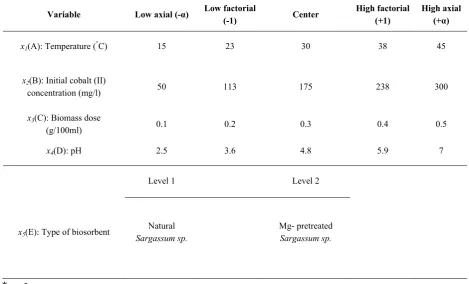
Therefore, central composite design with four numeric factors (initial cobalt (II) concentration: 50–300 mg/l, biosorbent concentration: 0.1–0.5 g/100ml, initial pH: 2.5–7.0 and temperature: 15–45 ◦C) and one categorical factor at 2 levels (natural
Sargassum sp and Mg- pretreated Sargassum
sp. algae) was applied using Design-Expert version 7 (Stat-Ease Inc., Minneapolis, USA) as shown in Table 1. Performance of the process was evaluated by analyzing the response of biosorbent for cobalt (II) ions. The responses were biosorption capacity of natural and modified algae, y1 and y2 respectively.
In the optimization process, the responses can be simply related to chosen factors by linear or quadratic models. Aquadratic model, which also includes the linear model, is given as:
∑∑
∑
∑
= = =
=
+ +
+
= k
i k
j
j i ij k
i i ii i
k
i
ix b x b xx
b b
y
1 1
1 2
1
0 (10)
where b0, bi, bii, bij are a constant, a linear coefficient, a square coefficient and an interaction coefficient, respectively [15, 21, 22].
Biosorption of cobalt (II) by Intact and Chemically Modified Brown Algae: Optimization Using Response Surface Methodology and Equilibrium, Dynamics and Thermodynamics Studies
62 Iranian Journal of Chemical Engineering, Vol. 11, No. 2
variables and the responses. The quality of the fit of polynomial model was expressed by the coefficient of determination R2 andRadj2 . The statistical significance was checked with adequate precision ratio and F-test [5]. The second-order polynomial models were represented as response, whilst keeping third variable constant.
4. Results and discussion
4-1. Statistical analysis
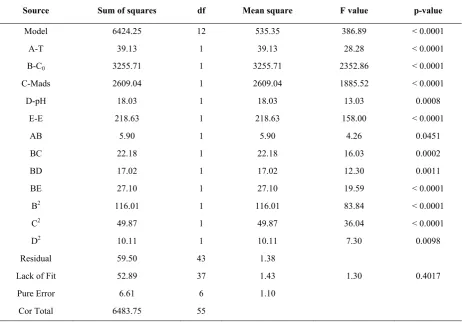
In order to determine the significant terms 56 runs were statistically analyzed with CCD design. The p-values were used as a tool to check the significance of every coefficient. The smaller the magnitude of p, the more significant the corresponding coefficient is. Values of p less than 0.05 indicate model terms are significant. In this case all five factors, AB (T, C0), BC (C0, Mads), BD (C0,
pH) and BE (C0, Type of biosorbent) interaction terms are highly significant terms (p < 0.05). By eliminating the insignificant model terms automatically, the resulting ANOVA for the reduced quadratic model is summarized in Table 2. The final responses for the biosorption capacity of untreated and treated biomasses for cobalt (II) ions were obtained in Eqs. (11) and (12), respectively.
2 4 2 3 2 2 4 2 3 2 2 1 4 3 2 1 1 35106 0 69344 98 004 85354 3 010372 0 13322 0 004 15733 9 06483 2 62840 109 21785 0 039876 0 01193 27 x . x . x E . x x . x x . x x E . x . x . x . x . . y − + − − + − − + + − + − = (11) 2 4 2 3 2 2 4 2 3 2 2 1 4 3 2 1 2 35106 0 69344 98 004 85354 3 010372 0 13322 0 004 15733 9 06483 2 62840 109 24190 0 039876 0 75589 26 x . x . x E . x x . x x . x x E . x . x . x . x . . y − + − − + − − + + − + − = (12)
Table 1. The experimental range and levels of the control factors in the CCD.
Variable Low axial (-α) Low factorial
(-1) Center
High factorial (+1)
High axial (+α)
x1(A): Temperature (°C) 15 23 30 38 45
x2(B): Initial cobalt (II)
concentration (mg/l) 50 113 175 238 300
x3(C): Biomass dose
(g/100ml) 0.1 0.2 0.3 0.4 0.5
x4(D): pH 2.5 3.6 4.8 5.9 7
Level 1 Level 2
x5(E): Type of biosorbent
Natural
Sargassum sp.
Mg- pretreated
Sargassum sp.
Table 2. ANOVA for the response surface reduced quadratic model for cobalt biosorption .
Source Sum of squares df Mean square F value p-value
Model 6424.25 12 535.35 386.89 < 0.0001
A-T 39.13 1 39.13 28.28 < 0.0001
B-C0 3255.71 1 3255.71 2352.86 < 0.0001
C-Mads 2609.04 1 2609.04 1885.52 < 0.0001
D-pH 18.03 1 18.03 13.03 0.0008
E-E 218.63 1 218.63 158.00 < 0.0001
AB 5.90 1 5.90 4.26 0.0451
BC 22.18 1 22.18 16.03 0.0002
BD 17.02 1 17.02 12.30 0.0011
BE 27.10 1 27.10 19.59 < 0.0001
B2 116.01 1 116.01 83.84 < 0.0001
C2 49.87 1 49.87 36.04 < 0.0001
D2 10.11 1 10.11 7.30 0.0098
Residual 59.50 43 1.38
Lack of Fit 52.89 37 1.43 1.30 0.4017
Pure Error 6.61 6 1.10
Cor Total 6483.75 55
Non-significant value lack of fit shows the validity of the quadratic model for biosorption by Sargassum sp. biomass. The obtained values for the correlation between the actual and predicted response (R2) and coefficient adjusted R2 are 0.9908 and 0.9883, respectively. These values, which are closer to 1.0 are in reasonable agreement for cobalt (II), indicating the better fitness of the reduced quadratic model in the experimental data. Adequate precision measures the signal to noise ratio and a ratio greater than 4 is
desirable. The ratio of 77.361 indicates an adequate signal. This model can be used to navigate the design space.The CV value was found to be 3.13 for biosorption capacity. Since CV is a measure expressing standard deviation as a percentage of the mean, the smaller values of CV give better reproducibility. In general, a CV higher than 10 indicates that variation in the mean value is high and does not satisfactorily develop an adequate response model [16]. Data in Table 3 confirmed these results.
Table 3. Statistical results of the ANOVA for reduced quadratic model. R2
Adjusted R2
C.V %
Adequate Precision
0.9908
0.9883
3.13
Biosorption
64
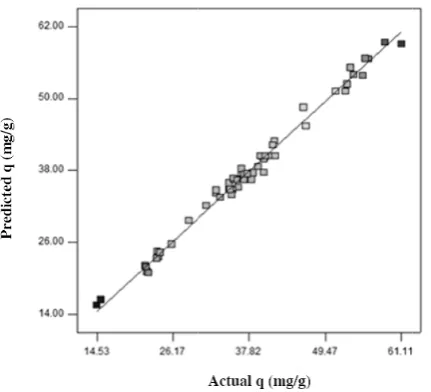
The predi statistical values ob shown in F the model around th probability shown in F
of Sargass
2, residua satisfies th variance ( residuals m deviations values. Fi transforma apparent pr
Figure 1. S values versu biosorption c
Table 4. O
Paramete
Value
n of cobalt (II) Met
icted value model vers btained by
Fig. 1. It app since all he diagona y and stude
Fig. 2 for t
sum Sp. for als show he assumpti (ANOVA)
measure th separating ig. 2 sho ation neede
roblem with
Scatter graph us the actua capacity of bio
Optimum value
ers T(°
4
) by Intact and thodology and
es calculate sus the actu
the exper proves the
the points al line. T entized resid the biosorpt
cobalt (II) how well ions of the
where the he number
the actual a ws that n ed nor wa h normality
of the pred al response v
omass for cob
es of the proce
°C) C
45
d Chemically d Equilibrium,
I ed from th ual respons riment wer suitability o are locate The norma
duals plot i tion capacit ions. In Fig
the mode e analysis o studentize of standar and predicte no respons as there a y.
dicted respons values for th balt.
ess parameters
C0 (mg/l)
300
Modified Bro , Dynamics an
Iranian Jour he se re of ed al is ty g. el of ed rd ed se an se he 4-2. The bios (II) opti cob and 0.1 Acc best met Mg( biom para pres Figu norm coba
s for maximum
Mads(g)
0.1
own Algae: Op nd Thermodyn
rnal of Chem
Statistical o
e aim of th sorption cap ions and fi imum valu alt (II) con pH were e g/100ml cording to
t biosorben tal uptak (NO3)2.6H2 mass).The ameters by sented in Ta
ure 2. Normal mal % probab
alt ions. m biosorption pH 7 ptimization Us namics Studies mical Engine optimization he process pacity of bi find optimiz ues for te ncentration, estimated to
, and 7 the optimu nt which h ke (80.5 O-treated b results y Design-Ex
able 4.
l plot of stude bility for bear
n capacity. Typ Mg sing Response s eering, Vol. n
was to m iosorbent fo zed conditio emperature,
biosorbent o be 45°C, 3
7.0, resp um conditio had the m 5 mg/g) biomass (Mg
for op xpert softw
entized residu ring the exper
pe of biosorb
g-treated biom
e Surface
The software calculated the expected responses and associated confidence intervals based on the prediction equations (Eqs. (11) and (12)). The 95% confidence interval (C.I.) is the range in which the process average was expected to fall 95% of the time, while the 95% prediction interval (P.I.) is the range in which it was expected that any individual value would fall 95% of the time[23]. As shown in Table 5, the P.I. is larger (a wider spread) than the C.I. since more scatter in individual values is expected than in averages. In this Table, SE mean refers to the standard deviation associated with the prediction of an average value at the selected component-levels, while the standard deviation associated with SEpred. indicates the prediction of an individual observation at the selected factor levels.
4-3. Effect of pretreatment on biosorption capacity and sorption mechanism
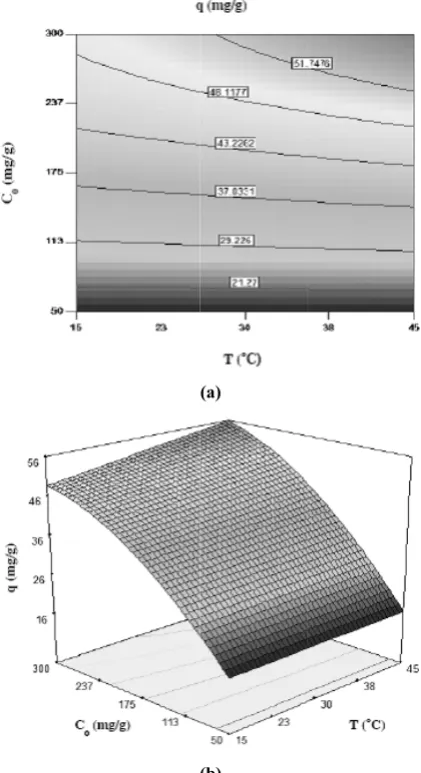
The chemically modified biosorbents increase the stability of the biosorbent material and enhance the biosorbent properties[24]. The interactive effect of initial cobalt (II) concentration and type of biomass on the cobalt uptake of biomass holding other variables at their central values is shown in Fig. 3. The capacities of treated
Sargassum sp. and untreated Sargassum sp.
for cobalt ion at different concentration noted that the treatment of Mg(NO3)2 had enhanced the adsorption capacity. At the sorption of cobalt, the adsorption capacity for untreated
Sargassum sp. and treated sargassum sp.
increased from 15.43 to 45.49 mg/g and 16.37 to 52.45 mg/g with the increase of the initial concentration in 50–300 mg/l, respectively. According to the Table 2, the interaction between initial cobalt (II) concentration and type of biomass (BE) was highly significant (p<0.0001). EDX spectra taken in spot profile mode showed the enhancement of magnesium peaks on EDX spectra of biomass after treatment compared with biosorbent before Mg-treatment (Fig. 4a, b) and also confirmed the presence of cobalt (Fig.4c), suggesting bonding of metal cations onto algae surface by interactions with negatively charged functional groups. Additionally, for the samples after biosorption, we observed that the peaks of Mg on EDX spectra of biosorbent after metal sorption were omitted (Fig. 4c).The amount of magnesium and cobalt of the untreated Sargassum sp., Mg-treated biomass and cobalt-loaded biomass was determined using anEDX spectrometer, given in Table 6. Our data suggest that Co2+ ions have replaced Mg2+ ions from biosorbent surface and ion exchange mechanism participates in cobalt biosorption. The same conclusions were also postulated by others [25-28]. But, due to the complexity of biomaterials, maybe other mechanisms such as coordination and chelation of metals, adsorption and surface complexation of cations with exposed functional groups on the biomass act simultaneously, to varying degrees, depending on the biosorbent and the solution chemistry[8, 29-31].
Table 5. Point prediction of the responses at the optimal conditions.
Response Prediction SE Mean 95%C.I. low 95% C.I. high SE pred. 95% P.I.low 95% P.I. high
Biosorption
66
Fi
n of cobalt (II) Met
igure 3. Intera on the
Figure 4. ED
) by Intact and thodology and
action plot sho cobalt uptake
DX analysis o (c) cobalt (I
d Chemically d Equilibrium,
I owing effect o of biomass h
of Sargassum s
II) sorption. A
Modified Bro , Dynamics an
Iranian Jour of initial cobal holding other v
sp. before (a) Au peak comes
own Algae: Op nd Thermodyn
rnal of Chem lt (II) concentr variables at th
and after (b) M s from sample
ptimization Us namics Studies
mical Engine ration and typ eir central val
Mg treatment, e coating.
sing Response s
eering, Vol. pe of biomass
lues.
, and after
(a)
(b)
(c)
e Surface
Table 6. biomass. Type o Un Sarga Mg Sarga coba Sarga 4-4. Ef biosorpt As show that all mutual initial c cobalt ( (BC) an pH (BD 0.05). T dimensi presente varying constan Adsorpt surface chemist predom broad concent 7.5. The Co(OH) the pH 7.0, pH because formatio removal to distin precipit initial c The amount of biomass ntreated assum sp. g-treated assum sp. alt-loaded assum sp.
ffect of o tion
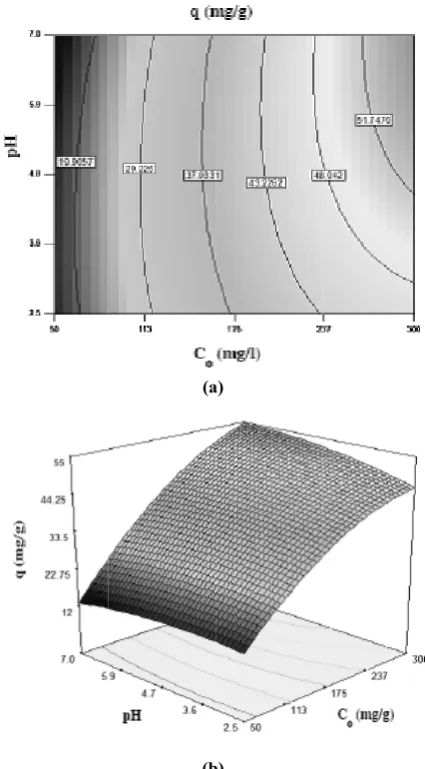
wn in Tabl linear and interaction cobalt (II) c (II) concent nd initial co D) were s The respon ional grap ed in Figs two factor nt in center v
tion solutio metal bi try in minantly exis
pH range tration of Co e precipitati )2 form) sta range stud H values ab
e cobalt on begins l by biosorp nguish betw tation. Fig.
obalt (II) co
of magnesium Eleme Magnesiu 1.91 4.19 0.0
operating p
le 2, the re quadratic between te concentratio tration and b obalt (II) co
significant nse surface phs and
. 5-7 were rs while kee
values. on pH influ
inding site water sts as Co2+
from 2.5 o2+ starts to ion of coba arted at pH died was be bove 7 we
removal to interfer ption and it ween cobalt 5 shows oncentration
m and cobalt o
ent [wt. %] um Coba 0.0 0.0 11.0 parameters esults indic parameters emperature on (AB), in biomass do oncentration (p<0.0001, e plots (th contour p e generated eping the ot
uences both es and m [14]. Co +cation with 5 to 7.0. o decrease a alt (formatio 7.5. There etween 2.5 ere not stu
by hydro re with co
will be diff biosorption the effect n and pH (B
of the alt 4 on cated and and nitial osage n and , p< hree– plots) d by thers cell metal obalt hin a The at pH on of fore, and udied oxide obalt ficult n and s of BD) F in b o o b in s A a m c p a b w
Figure 5. Thr nitial cobalt ( biosorption ca other variables
on the bios biomass.
ncreases w smaller inc According t at pH 7.0 a mg/g, res concentratio parameters a and Mads= biosorption with initial p
(a
(b
ee-dimentiona (II) concentra apacity for M s at their centr
sorption cap Cobalt u with metal crease wit
o Fig. 5, th and pH 2.5
spectively, on was 300 are in the c = 0.3). T uptake did pH, indicati
a)
b)
al plots show ation and pH Mg-treated bio
ral values.
pacity for uptake si
concentrat th pH is he biosorpti
was 54.73 and t 0 mg/l whil
center value The data not vary si ing that the
ing effects of (BD) on the mass holding
Biosorption
68
Figure 6. Th temperature on the cobal other variabl
n of cobalt (II) Met
hree-dimensio and initial co lt uptake of M les at their cen
) by Intact and thodology and
(a)
(b)
onal plots show obalt (II) conc
Mg-treated bi ntral values. (a) d Chemically d Equilibrium, I wing effects o centration (AB iomass holdin
Modified Bro , Dynamics an
Iranian Jour of B) ng Figu initia (BC) can the capa whi the part met cob conc Sim auth rang som e.g. char inte The amo incr exam abou conc Hig solu
sp. t bios suff
own Algae: Op nd Thermodyn
rnal of Chem
ure 7. Three-d al cobalt (II) ) holding the t
be used wi pH range acity decr
ch is expla proton by ticles surfa tal ion. Con
alt concentr centration, milar results hors [5, 29 ge of 4–7 [5 me functiona carboxyl a rged, inc
ractions wit e biosorptio
ount of met reasing with
mple, the ut +41.79 m centration f her concen ution causes to be surrou sorption w ficiently. Si ptimization Us namics Studies mical Engine (b) dimensional p concentration temperature a ith compara 2.5 to 7.0 eases with ained by the the binding ace when c
nversely, at ration is mu
the metal have been 9] who fou 5, 25, 29, 30
al groups in and sulfate,
creasing th the metal on is highly tal initially h the initial biosorption mg/g by inc from 50 to ntration of s the active unded by m would be imilar result sing Response s eering, Vol. plots showing
n and bioma t 30◦C and pH
able effectiv 0. The bios h decreasi e greater af g sites at t compared w
t higher pH uch greater
uptake in n obtained b und an opti
0]. At this p n the algae become ne the elec l cation [5]. y dependen present in s l concentrat n capacity creasing init 300 mg/l a cobalt ion
sites of Sa
ore cobalt i carried ou ts are also
e Surface
11, No. 2 effects of ass dosage H 4.8. veness in sorption-ng pH, ffinity of the algal with the H where than H+ ncreases. by other imal pH pH range surface, egatively ctrostatic .
nt on the solution, tion. For changes tial Co2+ at pH 7. s in the
rgassum
ions, and ut more
by researchers for a variety of adsorbate-adsorbent systems [3, 32]. An increase of metal uptake by increasing initial metal ion concentration is a result of the increase in the driving force of the concentration gradient, rather than increase in the initial metal ion concentration[33]. The initial concentration provides an important driving force to overcome all mass transfer resistance of cobalt between the aqueous and solid phases. The effect of temperature on the cobalt uptakeof Mg-treated biomass holding other variables at their central values is shown in Fig. 6. The biosorption capacity of treated
Sargassum sp. increased with the increase in
biosorption temperature and initial cobalt (II) concentration.The maximum biosorption capacity occurred at 45◦C. However, temperature variation between 15 and 45◦C slightly increases the metal uptake capacity from 38.63 to 42.24 mg/g, respectively. The uptake capacity was calculated at pH 4.8, 175 mg/l initial cobalt (II) concentration and 0.3 g biomass dosage. These results indicate the negligible interaction effect of these two parameters on biosorption capacity which confirmed the result of ANOVA as shown in Table 2 (p value = 0.0451).The increment of sorption capacity with increasing temperature suggests an endothermic nature of the sorption of cobalt by this dried biomass. Several studies have indicated the same effect of temperature [13, 34-36]. Higher temperature causes rupture that enhances the number of available active sites, surface activity, kinetic energy of the solute, and affinity of sites for metal ions which lead to an increase in the probability of the collision between active surface binding sites and metal ions and a decrease in the thickness of the boundary layer surrounding the biosorbent [13, 35-37]. However, the temperature higher than 55ºC caused a change in the texture of the biomass and thus
reduced its sorption capacity [14, 38]. In addition, the decrease of biosorption efficiency with the increase of temperature is due, most probably, to the desorption tendency of heavy metals from biosorbent surface. [39] Therefore, it depends on the type of metal and adsorbent. That is the reason for having different behavior of heavy metal uptake with temperature [38].
The effects of biomass dosage(BC) can be inferred from the response plot (Fig. 7), holding the temperature at 30◦C and pH at 4.8. The biosorption capacity was decreased from 59.13 to 29.64 mg/g for the Co2+ ions with increasing the biosorbent dosage from 0.1 to 0.5 g, respectively.The uptake capacity was calculated at pH 4.8 and initial metal ion concentration 175mg/l. At higher biosorbent dose the uptake capacity is low, perhaps due to the unsaturation of biosorption sites through the biosorption reaction and due to the particle interaction, such as aggregation, resulted from high biosorbent concentration [40]. Such aggregation would lead to decrease in total surfacearea of the biosorbent and an increase in diffusional path length[41].
4-5. Confirmatory experiments
Biosorption
70
Table 7. Opt
Run T(°
1 2 4 4 4-6. Determ optimized c
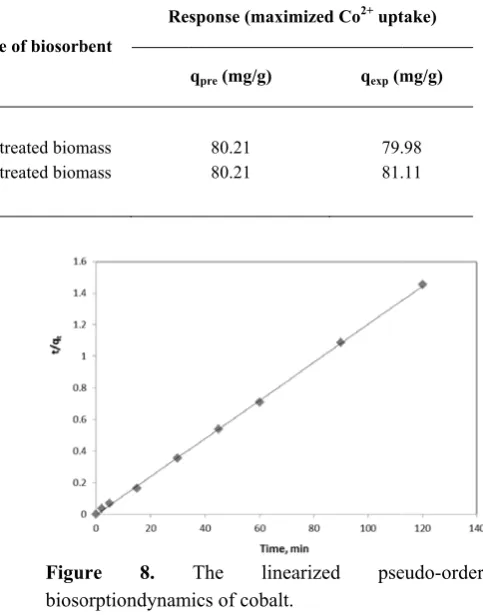
In order t constants biomass, tw optimized Expert soft and Mads= the theoret the pseudo reasonable experiment correlation than 0.99 adsorption first-order reported by The plots second-ord can be se qe(cal) value uptake valu coefficient kinetic mo present ad more fav process. 4-7. Isother The biosor cobalt on at differe
n of cobalt (II) Met
timum conditi
°C) C 0 (mg/
45 45 300 300 mination of condition
to obtain th of cobalt wo kinetics
conditions ftware (T=45
0.1 g). Ac tical qe(cal) o-first-orde e values
tal uptake o n coefficien 9, suggesti system do process. S y other rese
between t/q der model a en from T es agree wel ues, qe (exp). t (R2) for th odel was 0.9 dsorption sy vorably by
rm at optim
rption isoth Mg-treated ent tempe
) by Intact and thodology and
ion verificatio
/l) Mads(g)
0.1 0.1 f dynamic he biosorpt ions on models we determined 5°C, C0=30 ccording to values calc r model d
with rega ones, qe(exp). nt (R2=0.72
ing that oes not foll Similar resu earchers[1, 1 qt and t for are shown i Table 8, the
ll with the e Further, th he pseudo-s 999, sugges ystem can b y pseudo-s
mized conditi
herm for the d biomass w
erature an
d Chemically d Equilibrium,
I on and addition
pH T
7 7
M M
constants a
tion kinetic Mg-treate ere studied a d by Design 00 ppm, pH o the result
culated from did not giv
ard to th . Further, th 224) is les the presen low pseudo ults are als 17, 42, 43].
the pseudo in Fig. 8. A e theoretica experimenta he correlatio
second-orde sting that th
be describe second-orde
ion
e sorption o was obtaine nd constan
Modified Bro , Dynamics an
Iranian Jour nal experimen
Type of biosorb
Mg-treated biom Mg-treated biom at cs ed at n-7 s, m ve he he ss nt o-so o-As al al on er he ed er on ed nt Figu bioso Tabl on mod ppm ( 8 opti Exp resu cob pres coef Freu Lan cob the sorp [41]
own Algae: Op nd Thermodyn
rnal of Chem nts. bent Re mass mass ure 8. orptiondynam
le 8. Biosorpt Mg-treated el at optimiz m, pH 7 and Ma
qe (exp)
(mg/g)
82.789
imized cond pert softwar ults of the alt ions a sented in T
fficients v undlich mo ngmuir for
alt. The be Freundlich ption of the
]. Howeve
ptimization Us namics Studies
mical Engine
esponse (maxim
qpre (mg/g)
80.21 80.21
The linea mics of cobalt.
tion kinetics c biomass for zed condition
ads= 0.1 g). k2 (g/mg
min)
0.058564
ditions dete re (pH 7 an
adsorption at different Table 9. Th
values (R odel is m r adsorptio etter fit of e
equation re e cobalt ion er, some s
sing Response s
eering, Vol.
mized Co2+ upt
qexp (m
79. 81.
arized pse
constants of c r pseudo-sec ns (T=45 °C
qe (cal)
82.645
ermined by nd Mads= 0 n isotherms
t temperatu he good cor R2) showe more suitab on equilibr equilibrium efers the m s on the bio studies hav
e Surface
11, No. 2
take) mg/g) 98 11 eudo-order cobalt ions cond-order , C0=300 R2 0.999 Design-0.1). The for the ures are rrelation ed that ble than rium of m data to multilayer
Table 9. T (º 15 23 30 38 45 describe [27, 29 Langmu dominan Freundl complex adsorpti shows isotherm favorab formatio between
4-8. D
constant The ca Gibbs biosorpt was cal Accordi
ΔH°, a calculat (R2=0.9 and 3.2 negative feasibili spontan
ΔG° va tempera perature
Adsorption is
ºC)
qm
5 76.
3 78.
0 80.
8 83.
5 85.
ed better w 9, 39]. So uir isothe nt ion exch lich isothe xation reac ion process
that n valu m are great
le biosor on of re n adsorbent
Determinati ts of biosorp
alculated th free energ tion of coba culated usin ing to Eq. and the ent
ted from th 999) to give 24 J/molK, e value ity of the neous natur alue is more
ature, which e makes t
sotherm param
Langmu
(mg/g) b
.33588 0.
.74016 0.
.64516 0
.33333 0.
.47009 0.
with the Lan ome author rm corres hange mecha erm show ctions takin [44]. The r ues related ter than uni rption co elatively s and adsorb ion of ption hermodyna gy change,
alt by Sarga
ng Eq. 7 an 9, the en tropy chan he plot of ln
e the value respectively of ΔG° process an re of the a
e negative h suggests t the adsorpt
meters for Co (
ir constants
b (l/mg)
.024472 0
.023523 0
0.02274 0
.021779 0
.021051 0
ngmuir isoth rs explain sponds to anism while ws adsorpt ng place in result in Tab d to Freund ity represen onditions
tronger bo bate [3, 5].
thermodyna
mic param
ΔG°, for
assum sp. a
nd 9 (Table nthalpy cha nge, ΔS°, w
n K versus es 535.76 J/
y (Fig. 9). indicates nd indicates adsorption. with increa that higher tion easier (II) biosorptio R2 0.9709 0.9719 0.9728 0.9738 0.9748 herm that o a e the tion-n the ble 9 dlich nting and onds amic meter the algae 10). ange, were 1/T /mol The the s the The asing tem-r. In g c b in n c − a a F S m p s m n c m n F G
on on Mg-trea
general, it is consistent between ch
ndicative negative t chemisorptio
−40 kJ/mol and chemi adsorption[1 For the ads
Sargassum
magnitude physical me second-orde mechanism nature of th clearly spec might only b nature enhan
Figure 9. The Gibbs free ene
ated Sargass
Freu k 7.485141 7.247697 7.048553 6.83282 6.652732
s of note th with elec harged mo
of physis than −40 on and val
indicate th sorption w 17].
sorption of
sp. biom of the ΔG echanism. H er kinetics
for this sy he adsorpti cified therm
be consider nced by phy
ermodynamic ergy and temp
um sp.
undlich const n 2.398657 2.336449 2.285192 2.230152 2.184837
hat up to −2 ctrostatic olecules an
orption w 0 kJ/mol
lues betwee hat both ph were respo
cobalt ions mass, the
G° value i However, th
shows che ystem. The on process modynamica
ed as chemi ysical effect c relationship erature. tants R2 0.9987 0.9988 0.9988 0.9989 0.999
20 kJ/mol is interaction nd surface while more involves en −20 and hysisorption onsible for
Biosorption of cobalt (II) by Intact and Chemically Modified Brown Algae: Optimization Using Response Surface Methodology and Equilibrium, Dynamics and Thermodynamics Studies
72 Iranian Journal of Chemical Engineering, Vol. 11, No. 2
In our study, the positive value of ΔH° confirms the endothermic adsorption nature of the process. The positive value of ΔS° indicates the affinity of the adsorbent for cobalt and also confirms the increased randomness at the solid-solution interface
during biosorption [2, 17]. Value of the ΔG°,
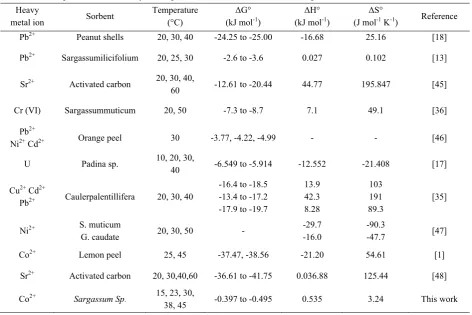
ΔH° and ΔS° from the present study was compared with other metal adsorption reported in previous studies and are compiled in Table 11.
Table 10. Thermodynamic parameters and corresponding correlation coefficient for Co (II) biosorption on Mg-treated Sargassum sp.
Temperature (°C) Thermodynamic parameters and corresponding R
2 value
ΔG° (J/mol) ΔH° (J/mol) ΔS° (J/mol K) R2
15 -397.935862 535.7625 3.239966 0.999
23 -422.706613
30 -445.18927
38 -471.420463
45 -495.217534
Table 11. Comparison of thermodynamic parameters with other metals adsorption.
Heavy
metal ion Sorbent
Temperature (°C)
ΔG°
(kJ mol-1)
ΔH°
(kJ mol-1)
ΔS°
(J mol-1 K-1) Reference
Pb2+ Peanut shells 20, 30, 40 -24.25 to -25.00 -16.68 25.16 [18]
Pb2+ Sargassumilicifolium 20, 25, 30 -2.6 to -3.6 0.027 0.102 [13]
Sr2+ Activated carbon 20, 30, 40,
60 -12.61 to -20.44 44.77 195.847 [45]
Cr (VI) Sargassummuticum 20, 50 -7.3 to -8.7 7.1 49.1 [36]
Pb2+
Ni2+ Cd2+ Orange peel 30 -3.77, -4.22, -4.99 - - [46]
U Padina sp. 10, 20, 30,
40 -6.549 to -5.914 -12.552 -21.408 [17]
Cu2+ Cd2+
Pb2+ Caulerpalentillifera 20, 30, 40
-16.4 to -18.5 -13.4 to -17.2 -17.9 to -19.7
13.9 42.3 8.28
103 191 89.3
[35]
Ni2+ S. muticum
G. caudate 20, 30, 50 -
-29.7 -16.0
-90.3
-47.7 [47]
Co2+ Lemon peel 25, 45 -37.47, -38.56 -21.20 54.61 [1]
Sr2+ Activated carbon 20, 30,40,60 -36.61 to -41.75 0.036.88 125.44 [48]
Co2+ Sargassum Sp. 15, 23, 30,
5. Conclusions
In this study, central composite design (CCD) was used for the RSM in the experimental design and proved to be an efficient method for testing the effect of operating conditions and their interactions on cobalt uptake by the brown algae Sargassum sp. The interactive effects of five independent factors: initial pH of solution, initial concentration cobalt (II), temperature, biosorbent dosage, and biomass treatment on the biosorption capacities were estimated. A reduced quadratic model was obtained to predict the biosorption capacity. ANOVA results confirmed that there was significant agreement between the model and experimental data. The optimum biosorption conditions were determined as Mg-treated biomass, initial pH 7.0, temperature 45◦C, biosorbent dosage 0.1 g/100ml and initial cobalt (II) ion concentration 300 mg/l. At optimum biosorption conditions, the biosorption capacity of Mg-treated biomass for cobalt (II) ions was found to be 80.55 mg/g. The results are best fitted by the Freundlich model. The biosorption of cobalt (II) onto algal biomass followed the pseudo-second-order dynamics well. The calculated thermodynamic parameters (ΔG◦, ΔH◦ and
ΔS◦) showed that the process was feasible,
spontaneous and endothermic at the temperature ranges of 15–45◦C.
Acknowledgment
Special thanks to Dr. S.M. Mousavi and M. Jalaeian for their help in accomplishing this work. The authors are grateful to Stat-Ease, Minneapolis, USA, for the provision of the Design-Expert package.
Nomenclature
b the Langmuir constant (l/mg)
b0, bi
and bij
linear and quadratic interaction coefficients, i and j = 1-5
C metal ion concentration at any time (mg/l)
C0 initial metal ion
concentration(mg/l)
Ceq residual metal ion concentration at equilibrium (mg/l)
C.I. confidence interval (-)
C.V coefficient variation (-)
k adsorption capacity (-)
n biosorption intensity (-)
P.I. prediction interval (-)
q amount of biosorbed metal perg of biosorbentat any time (mg/g)
qeq the amount of biosorbed metal per unit weight of biosorbentat equilibrium(mg/g)
qexp experimental amount of
biosorbed metal per unit weight of biosorbent at equilibrium (mg/g)
qm maximum capacity of biosorbent
qpre predicted amount of biosorbed metal per unit weight of biosorbent at
equilibrium by software(mg/g)
R2 correlation coefficient
R2adj adjusted correlation coefficient
Mads amount of biosorbent (g)
t time (min)
xi independent variable, i=1-5
y response (-)
V volume of the solution (l)
Biosorption of cobalt (II) by Intact and Chemically Modified Brown Algae: Optimization Using Response Surface Methodology and Equilibrium, Dynamics and Thermodynamics Studies
74 Iranian Journal of Chemical Engineering, Vol. 11, No. 2
References
[1] Bhatnagar, A., Minocha, A.K. and Sillanpää, M., "Adsorptive removal of cobalt from aqueous solution by utilizing lemon peel as biosorbent", Biochem. Eng. J., 48(2), 181, (2010). [2] Pahlavanzadeh, H., Keshtkar, A.R.,
Safdari, J. and Abadi, Z., "Biosorption of nickel(II) from aqueous solution by brown algae: Equilibrium, dynamic and thermodynamic studies", J. Hazard. Mater., 175 (1-3), 304, (2010).
[3] Dahiya, S., Tripathi, R.M. and Hegde, A.G., "Biosorption of heavy metals and radionuclide from aqueous solutions by pre-treated arca shell biomass", J. Hazard. Mater., 150(2), 376, (2008). [4] Kalavathy, M.H., Karthikeyan, T.,
Rajgopal, S. and Miranda, L.R., "Kinetic and isotherm studies of Cu(II) adsorption onto H3PO4-activated rubber wood sawdust", J. Colloid. Interf. Sci., 292(2), 354, (2005).
[5] Özer, A., Gürbüz, G., Çalimli, A. and Körbahti, B.K., "Investigation of nickel(II) biosorption on Enteromor-phaprolifera: Optimization using response surface analysis", J. Hazard. Mater., 152(2), 778, (2008).
[6] Gupta, V.K. and Rastogi, A. "Biosorption of lead(II) from aqueous solutions by non-living algal biomass
Oedogonium sp. and Nostoc sp.—A
comparative study", Colloids Surf. B., 64(2), 170, (2008).
[7] Romera, E., González, F., Ballester, A., Blázquez, M. L. and Muñoz, J.A., "Comparative study of biosorption of heavy metals using different types of algae", Bioresour. Technol., 98(17),
3344, (2007).
[8] Davis, T.A., Volesky, B. and Mucci, A., "A review of the biochemistry of heavy metal biosorption by brown algae", Water Res., 37(18), 431, (2003).
[9] Kleinubing S.J., da Silva, E.A., da Silva, M.G.C. and Guibal, E., "Equilibrium of Cu(II) and Ni(II) biosorption by marine alga Sargassumfilipendula in a dynamic system: Competitiveness and selectivity", Bioresour. Technol., 102, 4610, (2011).
[10] Haug, A., "The affinity of some divalent metals to different types of alginates", Acta Chem. Scand., 15, 1794, (1961).
[11] Papageorgiou, S.K., Katsaros, F.K., Kouvelos, E.P., Nolan, J.W., Le Deit, H. and Kanellopoulos, N.K., "Heavy metal sorption by calcium alginate beads from Laminariadigitata", J. Hazard. Mater., 137, 1765, (2006).
[12] Demim, S., Drouiche, N., Aouabed, A., Benayad, T., Couderchet, M. and Semsari, S. "Study of heavy metal removal from heavy metal mixture using the CCD method", J. Ind. Eng. Chem., 20(2), 512, (2014).
[13] Tabaraki, R., Nateghi, A. and Ahmady-Asbchin, S., "Biosorption of lead (II) ions on Sargassumilicifolium: Application of response surface methodology", Intl. biodeter. Biodegr., 93, 145, (2014).
methodology for optimization of lead biosorption in an aqueous solution by Aspergillusniger", J. Hazard. Mater., 154(1–3), 694, (2008).
[15] Montgomery, D.C., Design and analysis of experiments, John Wiley & Sons Co., New York, USA, (2001). [16] Myers, R.H. and Montgomery, D.C.,
Response surface methodology: Process and product optimization using designed experiments, John Wiley & Sons Co., New York, USA, (2002). [17] Khani, M., "Uranium biosorption by
Padina sp. algae biomass: Kinetics and
thermodynamics", Environ. Sci. Pollut. Res., 18(9),1593, (2011).
[18] Taşar, Ş., Kaya, F. and Özer, A., "Biosorption of lead(II) ions from aqueous solution by peanut shells: Equilibrium, thermodynamic and kinetic studies", J. Environ. Chem. Eng., 2(2), 1018, (2014).
[19] Tunç, Ö., Tanacı, H. and Aksu, Z., "Potential use of cotton plant wastes for the removal of Remazol Black B reactive dye", J. Hazard. Mater., 163(1), 187, (2009).
[20] Annadurai, G., Juang, R.S. and Lee, D.J., "Adsorption of heavy metals from water using banana and orange peels", Water Sci. Technol., 47, 185, (2002). [21] Goel, J., Kadirvelu, K., Rajagopal, C.
and Garg, V.K., "Removal of Lead(II) from aqueous solution by adsorption on carbon aerogel using a response surface methodological approach", Ind. Eng. Chem. Res., 44(7), 1987, (2005).
[22] Amani, T., Nosrati, M., Mousavi, S.M. and Kermanshahi, R.K., "Study of syntrophic anaerobic digestion of
volatile fatty acids using enriched cultures at mesophilic conditions", Intern. J. Environ. Sci. Technol., 8, 83, (2011).
[23] Mafi Gholami, R., Mousavi, S.M. and Borghei, S.M., "Process optimization and modeling of heavy metals extraction from a molybdenum rich spent catalyst by Aspergillusniger using response surface methodology", J. Ind. Eng. Chem., 18(1), 218, (2012).
[24] Montazer-Rahmati, M.M., Rabbani, P., Abdolali, A. and Keshtkar, A.R., "Kinetics and equilibrium studies on biosorption of cadmium, lead, and nickel ions from aqueous solutions by intact and chemically modified brown algae", J. Hazard. Mater., 185(1), 401, (2011).
[25] Vijayaraghavan, K., Jegan, J., Palanivelu, K. and Velan, M., "Biosorption of cobalt(II) and nickel(II) by seaweeds: Batch and column studies", Sep. Purif. Technol., 44(1), 53, (2005).
[26] Bishnoi, N.R., Kumar, R., Kumar, S. and Rani, S., "Biosorption of Cr(III) from aqueous solution using algal biomass spirogyra spp.", J. Hazard. Mater., 145(1–2), 142, (2007).
[27] Hatzikioseyian, A., Tsezos, M. and Mavituna, F., "Application of simplified rapid equilibrium models in simulating experimental breakthrough curves from fixed bed biosorption reactors", Hydrometallurgy, 59(2–3), 395, (2001).
Biosorption of cobalt (II) by Intact and Chemically Modified Brown Algae: Optimization Using Response Surface Methodology and Equilibrium, Dynamics and Thermodynamics Studies
76 Iranian Journal of Chemical Engineering, Vol. 11, No. 2
[29] Suhasini, I.P., Sriram, G., Asolekar, S.R. and Sureshkumar, G.K., "Biosorptive removal and recovery of cobalt from aqueous systems", Process. Biochem., 34(3), 239, (1999).
[30] Marešová, J., Pipíška, M., Rozložník, M., Horník, M., Remenárová, L. and Augustín, J., "Cobalt and strontium sorption by moss biosorbent: Modeling of single and binary metal systems", Desalination, 266(1–3), 134, (2011). [31] Sheng, P.X., Ting, Y.P., Chen, J.P. and
Hong, L., "Sorption of lead, copper, cadmium, zinc, and nickel by marine algal biomass: Characterization of biosorptive capacity and investigation of mechanisms", J. Colloid. Interf. Sci., 275(1), 131, (2004).
[32] Ahmadpour, A., Tahmasbi, M., Bastami, T.R. and Besharati, J.A., "Rapid removal of cobalt ion from aqueous solutions by almond green hull", J. Hazard. Mater.,166(2–3), 925, (2009).
[33] Ghorbani, F., Younesi, H.,
Ghasempouri, S.M., Zinatizadeh, A.A., Amini, M. and Daneshi, A., "Application of response surface methodology for optimization of cadmium biosorption in an aqueous solution by Saccharomyces cerevisiae", Chem. Eng. J., 145(2), 267, (2008). [34] Özcan, A.S., Tunali, S., Akar, T. and
Özcan, A., "Biosorption of lead(II) ions onto waste biomass of Phaseolus vulgaris L.: Estimation of the equilibrium, kinetic and thermo-dynamic parameters", Desalination, 244, 188, (2009).
[35] Apiratikul, R., Madacha, M. and
Pavasant, P., "Kinetic and mass transfer analyses of metal biosorption by Caulerpalentil-lifera", Desalination, 278, 303, (2011).
[36] Bermúdez, Y.A., Rico, I.L., Guibal, R.E., de Hoces, M.C. and Martín-Lara, M.A., "Biosorption of hexavalent chromium from aqueous solution by Sargassummuticum brown alga: Application of statistical design for process optimization", Chem. Eng. J., 183, 68, (2012).
[37] Freitas, O., Delerue-Matos, C. and Boaventura, R., "Optimization of Cu(II) biosorption onto Ascophyl-lumnodosum by factorial design methodology", J. Hazard. Mater.,167(1–3), 449, (2009).
[38] Qaiser, S., Saleemi, A. and Mahmood Ahmad, M., "Heavy metal uptake by agro based waste materials", Elec. J. Biotechnol., 10 (3), 409, (2007).
[39] Bulgariu, D. and Bulgariu, L., "Equilibrium and kinetics studies of heavy metal ions biosorption on green algae waste biomass", Bioresour. Technol., 103, 489, (2012).
[40] Özer, A., Gürbüz, G., Çalimli, A. and Körbahti, B.K., "Biosorption of copper(II) ions on Enteromor-phaprolifera: Application of response surface methodology (RSM)", Chem. Eng. J, 146(3), 377, (2009).
Mater.,174(1–3), 623, (2010).
[42] Cruz, C.C.V., da Costa, A.C.A., Henriques, C.A. and Luna, A.S., "Kinetic modeling and equilibrium studies during cadmium biosorption by dead Sargassum sp. biomass", Bioresour. Technol.,91(3), 249, (2004). [43] Sun, X.F., Wang, S.G., Liu, X.W.,
Gong, W.X., Bao, N. and Gao, B.Y., "Competitive biosorption of zinc(II) and cobalt(II) in single- and binary-metal systems by aerobic granules", J. Colloid. Interf. Sci., 324(1–2), 1, (2008).
[44] Khani, M., "Statistical analysis and isotherm study of uranium biosorption by Padina sp. algae biomass", Environ. Sci. Pollut. Res., 18(5), 790, (2011). [45] Kacan, E. and Kütahyalı, C.,
"Adsorption of strontium from aqueous solution using activated carbon produced from textile sewage sludges", J. Anal. Appl. Pyrolysis, 97, 149, (2012)
[46] Feng, N., Guo, X., Liang, S., Zhu, Y., Liu, J., "Biosorption of heavy metals from aqueous solutions by chemically modified orange peel", J. Hazard. Mater.,185, 49, (2011)
[47] Bermúdez, Y.G., Rico, I.L. and Bermúdez, O.G., "Nickel biosorption using Gracilariacaudata and Sargassummuticum", Chem. Eng. J., 166, 122, (2011).