ISSN: 2151-7452
Integrating Sustainability Curriculum into Construction Education: A
Progress Report
James G. Sullivan, Ph.D.
University of Florida, Gainesville
Russell Walters, Ph.D.
University of Florida, Gainesville
Abstract: As sustainable construction continues to increase its market share in the commercial construction realm there is continued discussion regarding providing adequate exposure to sustainable practices in the undergraduate curriculum. Sustainable construction, specifically United States Green Building Council Leadership in Energy and Engineering, places an
emphasis on design integration, professional and industry education, and market transformation – both in products and installation techniques. The question at hand is how to prepare
construction and engineering students for what is quickly becoming the norm for construction in the United States. Previous research has discussed integration of curriculum and has found there are no existing standards in place. This study finds that when sustainability is viewed as integral to high performance design and delivery that course development is more a function of
integration than revision. This paper reviews the progress made since 1998 to present in undergraduate integrated and supplemented education courses in a prominent four year
construction program. The question of accreditation requirements and initial career offerings are also discussed. Integrating sustainability into the curriculum is perceived to enhance the
students’ learning and provide a superior experience.
Keywords: sustainable construction; integrated curriculum; LEED rating system
Introduction
This paper summarizes the continued adaptation and creation of sustainable programs, coursework, and degrees for a School of Building Construction from 1998 to present. This paper’s focus is to summarize efforts within a University, a College, and a single traditional Construction Management (CM) school. The M.E. Rinker, Sr. School of Building Construction at the University of Florida established the first United States Green Building Chapter (USGBC) student chapter in 1998 and has continued to review curriculum content and respond to industry support over the past 15 years i. Programs continue to struggle in comparing their efforts to other institutions and in defining sustainable goals ii, v. This paper provides a possible roadmap of a single institution with regards to pre-requisites, course integration, course creation, and faculty involvement.
Drivers for Sustainability
In 2007, Governor Charlie Crist signed an executive order that all state funded buildings must be in accordance with USGBC LEED for New Construction and Major Renovation (NC) or LEED for Existing Building (EB). In 2008 the Florida Energy Act mandated that all state funded buildings pursue a nationally recognized high-performance green building rating system as approved by the Department of Management Services. LEED and Green Building Initiatives Green Globes are specifically mentioned. In 2010 there were over 600 registered LEED projects in the state of Florida. Preparing our students for these jobsite requirements is essential.
University Facilities Setting
The College of Design, Construction, and Planning established an Office of Sustainability in 2000 to facilitate, support, and analyze sustainability initiatives on campus. In 2001, the university adopted LEED certified criteria for design and construction for all major new construction and renovation projects to deliver high performance and sustainable buildings. In 2003, the University of Florida Facilities, Planning, and Construction (FPC) Office constructed the first USGBC Leadership in Energy and Environmental Design (LEED) Gold building in the State of Florida; the Rinker School of Building Construction was the first such LEED project on campus. In 2006 the Student Senate urged the formation of an Office of Sustainability on a University level. That same year the University President established the Office of Sustainability and hired a Director of the Office of Sustainability to facilitate and manage campus wide goals and directives iii. That year LEED Silver certification became the design and construction goal. This bar was raised in 2009 with Gold now being the certification attempted on each project. By the end of 2009, the USGBC ranked the University of Florida as the number 1 campus for LEED project registrations. Table 1 summarizes the projects by certification or registration level iv. Table 1: LEED Certifications since 2001on University of Florida’s Campus
Certification Level Number of Projects Completed as of December 2012
Platinum 1
Gold 7
Silver 3
Submitted for Certification 5
Total Completed Projects 26
Registered or Planned Projects 30
The great support from FCP has allowed for all design and construction students to tour and interact with LEED projects being built around them over the past ten years. Review of standards and fee curves indicate the University does not pay a premium for these projects relative to the option of building a non-LEED project on campus. Construction management students interact with the project managers, superintendents, and subcontractors working on the projects to discuss LEED parameters and action plans for success. These jobsite tours of over 20 projects have allowed the students to experience first-hand from design and construction
professionals what is necessary to deliver sustainable projects.
Establishing Objectives for Sustainability
Enhancing a curriculum to include sustainability requires that the program outcomes be
evaluated to ensure that the principles of sustainable design are integrated into the material. To accomplish this task as set of educational objectives were established to define what a student should be able to do at the end of a lesson. These objectives must encompass the core principals of sustainability and be specific, measurable, and observable. Table 2 lists the core set of
objectives adapted from a study by Soria, et al.vi that are specific for a construction management program.
Table 2. Learning Objectives for Sustainability
Learning Objectives
1 Develop integrated urban planning.
2 Rehabilitate depressed urban and industrial areas.
3 Reduce and be efficient in the use of land and natural resources. 4 Integrate the sanitation, water residue, and solid waste infrastructures in an environmentally responsible manner. 5 Develop sustainable processes in the construction industry.
6 Promote innovation.
7 Plan and manage efficiently. 8 Be responsible for decisions made.
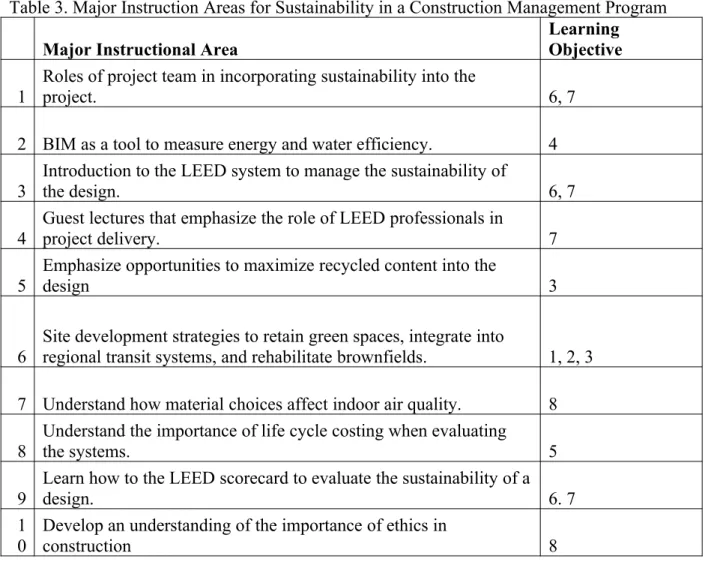
Table 3. Major Instruction Areas for Sustainability in a Construction Management Program
Major Instructional Area
Learning Objective
1
Roles of project team in incorporating sustainability into the
project. 6, 7
2 BIM as a tool to measure energy and water efficiency. 4
3
Introduction to the LEED system to manage the sustainability of
the design. 6, 7
4
Guest lectures that emphasize the role of LEED professionals in
project delivery. 7
5
Emphasize opportunities to maximize recycled content into the
design 3
6
Site development strategies to retain green spaces, integrate into
regional transit systems, and rehabilitate brownfields. 1, 2, 3
7 Understand how material choices affect indoor air quality. 8
8
Understand the importance of life cycle costing when evaluating
the systems. 5
9
Learn how to the LEED scorecard to evaluate the sustainability of a
design. 6. 7
1 0
Develop an understanding of the importance of ethics in
construction 8
Development of a Sustainability Track
The College of Liberal Arts and Sciences has established a Bachelor of Arts in Sustainability Studies. This across-discipline degree places an emphasis on environmental well being, economic welfare and social justice. A focus is also placed on local, national, and global
sustainable initiatives. The courses for this major are set in clusters for which students must pick a select number of courses to complete the requirements for graduation. A review of the courses indicates that very few courses were added by departments across campus to accommodate the ‘sustainable degree.’ Courses such as Environmental Ethics (Cluster A), Conservation of Resources (Cluster B), and Soil, Water, and Land Use (Cluster C) were established courses that were linked under the same program. Each cluster consists of courses that fall under the
umbrella topic but are housed in different schools across campus. This allows the student to self-select and experience courses from several schools or programs.
available Minor in Sustainability and the Built Environment. This degree places more emphasis on the impacts of the built environment and, thus, there is more course work centered in the College of Design, Construction, and Planning. In addition, practicum or studio credits and a capstone project related to sustainability are required.
Integrating Sustainability into the Construction Management Degree
The undergraduate program in construction management has been strategically improved over the last twelve years but the effective change to accommodate sustainable topics has resulted a change in prerequisites, adoption of limited elective courses, integration, and drive of the faculty for the students to have access to material outside of required course work. Through the addition of a prerequisite international sustainability and addition of sustainability modules in other prerequisites students are getting a better understanding of the built environment impacts on the world.
Prerequisites
International Sustainable Development was established as prerequisite to the upper division. The course satisfies the social/behavioral science requirement. The instructor is a building
construction faculty member with a research interest in high performance and low-impact construction. The course focus is on providing resources for the understanding human impacts, limits of design, natural capacity, and social sustainability. The course is currently divided into three broad sections: 1) Ethical and social framework for sustainable decision making, 2) Food and energy limits of a closed global system, and 3) Built environment impacts and potential mitigation processes and systems. This course broadens the concept of sustainable construction for a student into the realm of societal and environmental needs and limits.
Elective Courses
Elective courses consist of related high performance and technology delivery courses. High Performance Green Building was an established elective that covered such topics as life-cycle assessment, life-cycle costing, energy modeling, value engineering, and sustainable rating criteria (e.g., LEED). Building Information Modeling (BIM) is an elective that goes beyond the students’ an exposure to Revit modeling to include HVAC systems and layout concerns. Design Build is a related elective in that most of the project based learning incorporates elements of LEED requirements. Likewise Sustainable Housing is a course that covers housing economics and green home standards. Note that no specific sustainable course has been added to the requirements to graduate.
Integration with Core Undergraduate Classes
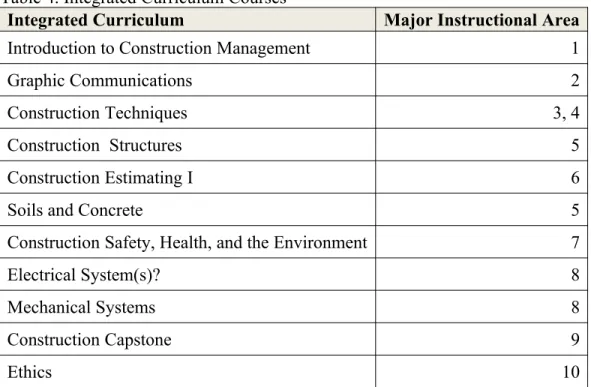
High performance owner directed buildings (i.e., green building) have been integrated
breakdown of courses that integrate sustainable facets into the established course material (not all required courses are listed). Along with the courses is the associated major instructional area. Table 4. Integrated Curriculum Courses
Integrated Curriculum Major Instructional Area
Introduction to Construction Management 1
Graphic Communications 2
Construction Techniques 3, 4
Construction Structures 5
Construction Estimating I 6
Soils and Concrete 5
Construction Safety, Health, and the Environment 7
Electrical System(s)? 8
Mechanical Systems 8
Construction Capstone 9
Ethics 10
Faculty Involvement Outside of Class
Faculty support sustainable endeavors outside the classroom as well. Traditional involvement with regard to this topic is with student competition teams. The LEED team has obviously focused on LEED rating system design and construction requirements and alternative execution costs. Recently however, the Construction Management and Design Build teams’
pre-qualifications and problems have been on LEED certification required projects. LEED is being continually integrated into established competition teams just as it has in the industry.
In addition the faculty provides ‘after hours’ LEED accreditation training to the graduating undergraduate class and other interested students each semester. During this LEED training students have the opportunity to interact with students from other disciplines while focused on the intent and submittal details associated with LEED credits. Table 5 lists the number of students that have attended the training sessions. Passing rate for each section has been above 90% for those who follow through with the testing process while still a student in the program. Table 5: Number of Program Undergraduate Students taking Optional LEED Training
Semester and Year Number of Attendees
Fall 2008 53
Spring 2009 180
Fall 2009 28
Spring 2010 35
Spring 2011 50
Fall 2011 52
Spring 2012 40
Fall 2012 25
Spring 2013 36
In addition faculty have supported and given LEED accreditation training to over 5,000
professional attendees (contractors, architects, and decision makers) since 2004. This continued connection within the state regarding high performance construction has strengthened the perception of the program as addressing and meeting the needs of the industry. It is expected that the graduates from this program have exposure to the LEED rating system. Accreditation during the job interview process has been a determining factor company selecting candidates. Several students have gone on to be the ‘green champion’ within their organization.
Conclusion
While initial concerns of LEED premiums has subsided with increased education of all involved. An understanding that first cost premiums are relative to the project, owner, standards, and certification levels has developed with project experiences. So too has the understanding to integrate sustainable constraints in existing construction management courses. Sustainable design is not unique. All references associated with LEED credits are established industry best practices and continue to be updated as the industry standards evolve. While there is a need to understand the system, submittal, and approval process the core traditional concepts that are involved in designing and building a project remain. This study reflects, if anything, the need for faculty and programs to integrate best practices, or sustainable practices, within the framework of their existing programs while augmenting classes with synergistic technology and
sustainability elective classes that allow for better understanding of building impacts and performances.
i. Kibert, C. (2005). Integrating Sustainability into Construction Programs. ASC Proceedings of the 41st Annual Conference. University of Cincinnati, Ohio, April 6 –
9, 2005.
ii. Tinker, A. & Burt, R. (2004). “Greening” the Construction Curriculum. International Journal of Construction Education and Research, 2004 (1) 26-33.
iii. Univeristy of Florida (2012). “Sustainable UF.” <http://sustainable.U*l.edu/about/> (January 3, 2012).
iv. Univeristy of Florida (2012). “Facilities, Construction, and Planning.”
<http://www.facilities.Ufl.edu/sustain/> (January 3, 2012).
v. Wang, Y. (2009). Sustainability in Construction Education. Journal of Professional Issues in Engineering Education and Practice, 135(1) 21-30.
vi. Soria, B., Bella, Jose, Hernandez, J., Sunen, E., and Diaz, J. (2013). Education for Sustainable Development: Methodology and Application within a Construction Course. Journal of Professional Issues in Engineering Education and Practice,
Jim Sullivan
Russell Walters