Iranian Journal of Chemical Engineering Vol. 12, No. 3 (Summer 2015), IAChE
Copper Catalysts Supported on CeMnO2 for CO Oxidation
in Hydrogen-Rich Gas Streams
N. Hoshyar, A. Irankhah*, M. Jafari
Hydrogen and Fuel Cell Research Laboratory, Chemical Engineering Department, University of Kashan, Kashan, Iran
Abstract
The CeMnO2 supports were prepared via co-precipitation method by ammonia as
precipitating agent. The CuO/CeO2 and CuO/Ce(1-x)MnxO2 (x=0.1, 0.3 and 0.5)
catalysts were synthesized by wet impregnation method. The physicochemical properties of the prepared CuO/Ce(1-x)MnxO2 catalysts were characterized by N2
adsorption-desorption, powder X-ray diffraction (XRD) and programmed H2
temperature reduction (H2-TPR). The effects of Cu and Mn loading were investigated
on the catalytic performance. The findings illustrated that the 7% CuO/Ce0.9Mn0.1O2
catalyst shows high activity for CO-PrOx. The high activity of 7% CuO/Ce0.9Mn0.1O2
catalyst was ascribed to high surface area of the support, synergetic effects of CuO and CeO2 and increases of the mobility of lattice oxygen in ceria by addition of
MnO2. The effects of presence of H2O in the reaction feed stream, oxygen to CO ratio
(λ) and gas hourly space velocity (GHSV) on the catalytic activity of 7% CuO/Ce0.9Mn0.1O2 were evaluated. It was found that the best performance of 7%
CuO/Ce0.9Mn0.1O2 catalyst was obtained at λ=2, GHSV=20000 h-1 and in addition,
the presence of H2O had negative effects on the activity of the catalyst. In the long
term stability test, nearly 100% CO conversion was maintained for 50 h at 120°C with 70-80% CO2 selectivity.
Keywords: Cu/CeMnO2 Catalyst; CO oxidation; PrOx; Hydrogen
1. Introduction
Fuel cells are electrochemical devices, which directly convert fuels chemical energy into electrical energy with high efficiency and low environmental effects. Nowadays, fuel cells are among the main candidates in the development of clean and renewable energies [1]. Although there are various methods for hydrogen production, methane steam
Corresponding author: [email protected]
Among the currently available methods, CO-PrOx is the most cost-effective and efficient approach to reduce CO to the desired level without excessive hydrogen consumption [4]. The main reactions involved in CO-PrOx are as follows:
CO Oxidation: CO + 1/2 O2 → CO2 (1)
H2 Consumption: H2 + 1/2 O2 → H2O (2)
Developed catalysts for CO-PrOx are mainly platinum group metals (Pt, Pd, Ru and Rh) catalysts [3-8,33], gold based catalysts [9-11] and transition metal (Co, Cu, and Mn) based catalysts [12-19,34]. Among them, CuO based on CeO2 catalysts have shown high activity and selectivity for preferential oxidation of CO. Moreover, availability and low cost of ceria supported copper catalyst makes this catalyst a promising candidate to replace the other noble metals and gold. Copper and ceria based catalyst can be synthesized via different methods with a variety of morphologies by using various promoters and with different loading range of metals. Marino et al. synthesized the CuO-CeO2 catalyst via homogeneous thermal decom-position of urea containing different Cu/Ce ratio [20]. CeCu10 catalyst kept constant nearly 90% CO conversion during 24 h of the reaction. Moretti et al. used a micro-crystalline organized meso-porous γ-alumina prepared by template sol-gel method, resulting in, after impregnation with metal salts and subsequent calcination, active
Cu/Ce-based CO-PrOx catalysts with high surface area and a good thermal stability [21]. A Ce20Cu5 catalyst had complete CO conversion at 200°C with 40% CO2 selectivity. Wu et al. prepared the CuO/CeO2 by an improved incipient wetness impregnation method using ammonia as chelating agent [4]. The 10% CuO/CeO2 had high activity and stability for CO-PrOx. In presence of 10% H2O and 15% CO2, 100% CO conversion and 75-85% CO2 selectivity was reported. Pakharukova et al. tested the copper-cerium oxide catalysts supported on monoclinic zirconium oxide and showed that the best performance was obtained for the CuO/CeO2/ZrO2 catalysts containing 5-10 wt% copper [22]. Peng et al. synthesized the 7%CuO/Ce0.9Mn0.1O2-20%Al2O3 catalyst with a T100 temperature of 95–100ᵒC [23]. This catalyst was evaluated for 200 h at 140ᵒC in the presence of 15% CO2 and 10% H2O which exhibited 60% CO conversion and 95% CO2 selectivity.
and presence of H2O in feed composition were investigated to explore the best range of operating conditions for these catalysts.
2. Experimental
2-1. Catalyst preparation
0.1 M homogeneous aqueous solution of cerium nitrate was prepared by solving Ce(NO3)3.6H2O [Fluka, 99.5%] powder in deionized water, then ammonia [NH3, Merck, 25%] was added slowly to reach the desired pH (8-10). The resulting suspension was left to settle for 1-12 h. The precipitate was filtered and washed with deionized water several times. Finally, the ceria cake was dried overnight (in various temperature ranging from 80 to 120°C). The dried precipitate was calcined in different time and temperature (Tc=400-600°C and tc=4-6 h). The Ceria which was synthesized in pH of 10, aged for 6 h, dried at 120°C and calcined in 500°C for 6 h had maximum surface area. The surface area of achieved ceria was 74.45 m2/g, with total pore volume of 0.18 m3/g and average pore diameter of about 9.6 nm.
CeMnO2 samples were synthesized with co-precipitation of the manganese nitrate [Mn(NO3)2.4H2O, Merck, 99.5%] and cerium nitrate in the optimum conditions of CeO2, i.e. pH 10, aging time of 6 h, and calcinations temperature of 500°C for 6 h. Three different values (x=0.1, 0.3 and 0.5) of Mn were synthesized.
The CuO/Ce(1-x)MnxO2 catalysts were prepared by wetness impregnation method using different loadings (5, 7 and 10 wt%) of copper nitrate solution [Cu(NO3)2.3H2O, Merck, 99.5%]. The catalysts were then dried at 120°C for 12 h and calcined at 500°C for 4 h in air.
2-2. Catalyst characterization
The XRD patterns were recorded on an X-ray diffractometer (PAN alytical X’Pert-Pro) using a Cu-Kα monochromatized radiation source and a Ni filter in the range 2θ=20- 80°.
The surface areas (BET), mean pore diameter and total pore volume were determined by nitrogen adsorption at -196°C, using an automated gas adsorption analyzer (Gimini, Micromeritics).
Temperature programmed reduction (TPR) analysis was used for evaluating the reduction properties of prepared catalysts. In the TPR measurement, the fresh catalyst (~100 mg) was exposed to a heat treatment (10°C/min up to 800°C) in a gas flow (30 ml/min) containing a mixture of 10 vol% H2 in Argon. Before the TPR experiment, the samples were degassed under an inert atmosphere at 350°C for 3 h.
2-3. Catalytic activity tests
The CO and O2 conversion were calculated based on the carbon monoxide and oxygen consumption in the reactions as follows:
𝑋𝐶𝑂(%) =
[𝐶𝑂𝑖𝑛]−[𝐶𝑂𝑜𝑢𝑡]
[𝐶𝑂𝑖𝑛] × 100 (1)
𝑋𝑂2(%) =[𝑂2𝑖𝑛]−[𝑂2𝑜𝑢𝑡]
[𝑂2𝑖𝑛] × 100 (2)
The CO2 selectivity of CO oxidation reaction in presence of excess hydrogen was calculated from the oxygen mass balance as follows:
𝑆𝐶𝑂2(%) = 0.5 × ( [𝐶𝑂𝑖𝑛]−[𝐶𝑂𝑜𝑢𝑡]
[𝑂2𝑖𝑛]−[𝑂2𝑜𝑢𝑡]) × 100 (3)
The excess of oxygen factor (λ) is defined as:
𝜆 = 2 ×𝐹𝑂2
𝑖𝑛
𝐹𝐶𝑂𝑖𝑛 (4)
3. Results and discussion
3-1. Catalyst characterization
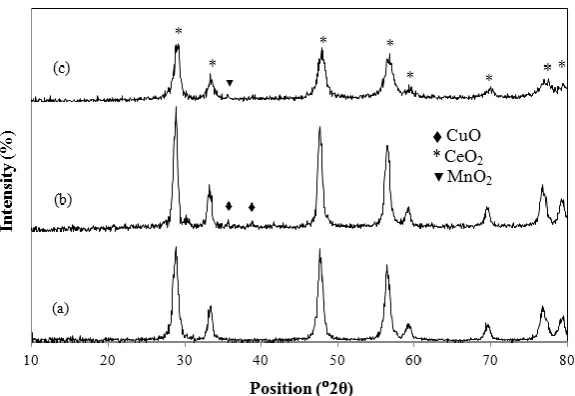
The XRD patterns of CeO2, CuO/CeO2 and CuO/CeMnO2 catalysts are presented in Fig. 1. The crystalline mean particle sizes of ceria have been determined by the X-ray broadening technique employing the Scherrer equation as:
𝑑𝑋𝑅𝐷 = 0.9 𝜆
𝐹𝑊𝐻𝑀 𝑐𝑜𝑠 𝜃 (5)
Where λ is the X-ray wavelength (1.5406 Å), FWHM (in Rad) is the full width at half maximum of the characteristic peak (111) of CeO2 and θ is the diffraction angle for the (111) plane. For ceria, the main characteristic peaks are associated with the Face-Centered Cubic (FCC) fluorite structure. The main peak (2θ=28.8°) corresponds to the (111) reflection of ceria and average calculated crystalline size was 17 nm. The main peak (2θ=35 and 38°) corresponds to the CuO and average calculated crystalline size was 19 nm for 7%CuO/CeO2 and 7%CuO/Ce0.9 Mn0.1O2.
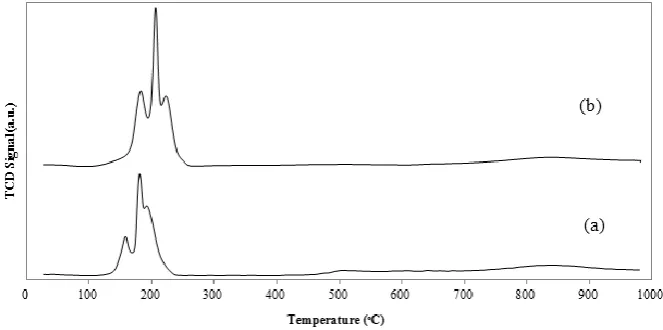
The TPR patterns for 7% CuO/CeO2 and 7% CuO/Ce0.9Mn0.1O2 catalysts are presented in Fig. 2. The 7% CuO/CeO2 profile shows three peaks between temperatures of 150-250°C, suggesting that the first two peaks correspond to the reduction of CuO species while the third peak is ascribed to the reduction of the surface lattice oxygen in CeO2 support.
As reported in the previous literature, CuO species identified in CuO/CeO2 catalysts have been summarized in four types: (1) isolated Cu2+ ions can strongly interact with the support. (2) Weak magnetic associates consist of several Cu2+ ions and these Cu2+ ions have close contact with each other. (3) Small two- and three-dimensional clusters have structures so loose that they have no specific and regular lattice arrangement. (4) Large three-dimensional clusters and bulk CuO phase have characters and properties identical to those of pure CuO powder. Accordingly, it is reasonable to ascribe first peak in the H2-TPR profiles to the first two types (1 and 2) of CuO species, which is highly dispersed and strongly interacted with the support. The third peak is
ascribed to type (3) CuO species, the small clusters with somehow amorphous properties[4,24-27]. The peak, shown at 500-600°C and 800-900°C, is related to reduction of ceria. In 7% CuO/CeMnO2 pattern, it can be seen that the density of third peak is lower than 7% CuO/CeO2, irrespective of peak due to presence of Mn and decline of ceria amount.
3-2. Catalyst activity
3-2-1. Cu and Mn loading effects
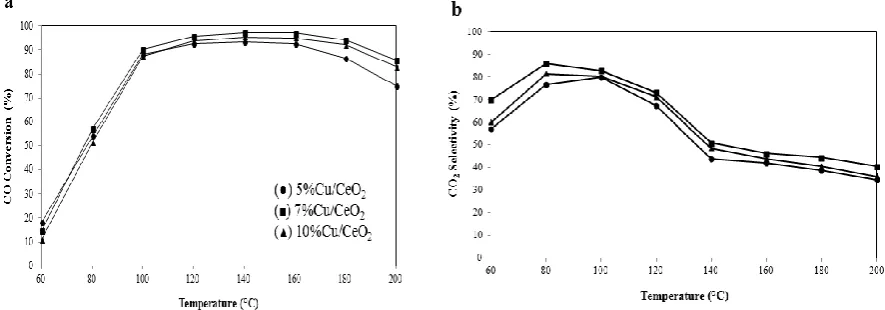
The results of Cu loading variation on CO conversion and CO2 selectivity toward reaction temperature for x% CuO/CeO2 (x=5, 7 and 10 wt%) catalysts are presented in Fig. 3. As can be seen in Fig. 3, 7% CuO/CeO2 catalyst has maximum CO conversion in a wide range, and also CO2 selectivity of this catalyst in lower temperature (<100°C) is more than other catalysts. Therefore, it is obvious that CO oxidation reaction on 7% CuO/CeO2 is the dominant reaction. In the case of copper catalysts supported on ceria, a partial amount of Cu particles has interaction with CeO2 and the remaining is in bulk formation.
Figure 3. Effect of Cu loading on (a) CO conversion and (b) CO2 selectivity as a function of temperature.
Operating conditions: 96% H2, 2% CO, 2% O2, λ=2, GHSV=20000 h-1.
Gamarra et al. reported the CO oxidation on copper oxide species takes place at the interface, while the H2 oxidation occurs mainly on copper oxide species in the form of nanoparticles, which are not necessarily in contact with the support [28]. Furthermore, an increase in the proportion of CuO species in the bulk form may limit the oxidation of CO because of the decreased number of interfacial sites, while the H2 oxidation continues to happen on the rest of the supported particles of copper oxide. Thus, the copper species that interact strongly with the support (Cu-O-Ce) are favorable for preferential oxidation of CO [29-31].
Therefore, Cu loading of catalyst for CO-PrOx process has an optimum value to reach more CO conversion with minimum H2 consumption. Our result showed that 7wt% of Cu is the best content for CuO/CeO2 catalyst in preferential oxidation process.
The effect of Mn loading as support promoter on activity of 7% CuO supported catalysts is shown in Fig. 4. For Ce (1-x)MnxO2, (x=0.1, 0.3 and 0.5) composite, the existence of both Ce4+-Ce3+ and Mn4+-Mn3+ redox couples cause excellent oxygen
storage-release capacity, varying with the Ce/Mn ratio [15,32]. It has been seen that increases of Mn content up to 0.1, decreases CO conversion. Mn species enter ceria lattice and increase the mobility of lattice oxygen which leads to their oxygen reacting, but the advantage of manganese oxide is not as much as ceria, so the amount of Mn should not be so much that the effect of ceria decreases and prevents the contact of copper and ceria. For this reason and due to the catalytic activity diagrams, the best amount of Mn is 0.1.
3-2-2. λ Ratio and GHSV effects
Figure 4. Variation of (a) CO conversion and (b) CO2 selectivity for 7% CuO/Ce(1-x)MnxO2 catalysts with
different Mn loading. Operating conditions: 96% H2, 2% CO, 2% O2, λ=2, GHSV=20000 h-1.
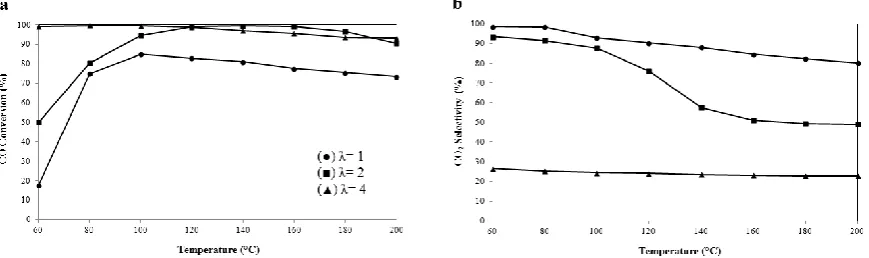
Figure 5. CO-PrOx performance of 7% Cu/Ce0.9Mn0.1O2 catalyst in different λ. Operating
conditions: 96% H2, 2% CO, 2% O2, GHSV=20000 h-1.
as in higher λ ratio, more oxygen is accessible to CO and H2; therefore CO conversion increases and parallel to this the consumption of H2 increases. Therefore, λ ratio should be optimized. In this work, among the range of λ (1≤ λ≤4), the results indicate that λ=2 causes complete conversion of CO in temperature range of 120-200 °C and acceptable CO2 selectivity in CO-PrOx was observed.
GHSV means quantity of feed processing in a specific time over a constant amount of catalyst, so more GHSV values would cause less used catalyst under constant feed processing, which would result in less reactor
volume, and finally a more economic process would be obtained. As shown in Fig. 6, the higher GHSV has less time over the catalyst to achieve adsorption, thus leading to a lower CO conversion and higher CO2 selectivity at a specific temperature. At a GHSV of 30000 h-1 and 70% CO conversion, the CO
2 selectivity is around ~100% which is 10% higher than GHSV of 20000 h-1 and 15% higher than GHSV of 10000 h-1.
Figure 6. CO-PrOx performance of 7% Cu/Ce0.9Mn0.1O2 catalyst in different GHSV.
Operating conditions: 96% H2, 2% CO, 2% O2, λ=2.
H2 oxidation is lower than that of CO oxidation [33].
Totally, GHSV should not be so high to decrease the CO conversion, and so low to decrease the CO2 selectivity. Our results indicated that GHSV of 20000h-1 was appropriate for this catalyst in CO-PrOx.
3-3-3. Effect of H2O
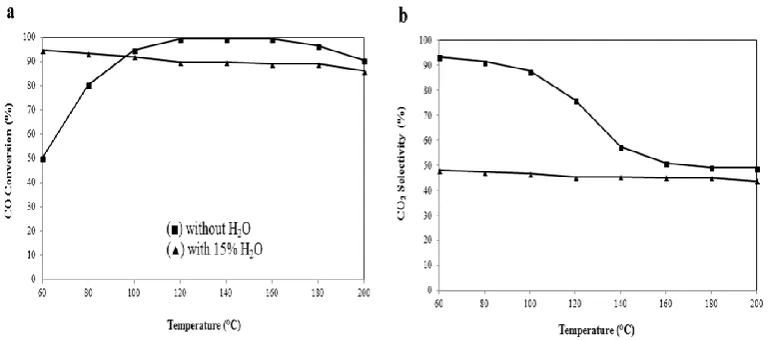
Since the hydrogen rich stream has been produced by WGS, the reaction contains 10-15% H2O. The influence of H2O on the CO-PrOx reaction was investigated. The variation of CO conversion and CO2 selectivity with the reaction temperature over
7%CuO/Ce0.9Mn0.1O2 catalyst in the presence of 15% H2O in feed composition are shown in Fig. 7. It is obvious that the addition of H2O is not favorable for CO-PrOx. When 15% H2O is present in the stream, the complete removal of CO cannot be achieved at tested temperature range, while in the absence of H2O, ~100% CO conversion is obtained at 120°C with 80% CO2 selectivity. Totally, the negative effect of H2O on the catalytic performance is related to the blockage of the adsorbed molecular water on the active sites [13]. As a result, the water must be removed before PrOx reactor.
Figure 7. Effect of H2O on the (a) CO conversion and (b) CO2 selectivity of 7% Cu/Ce0.9Mn0.1O2 catalyst.
3-4. Catalyst stability
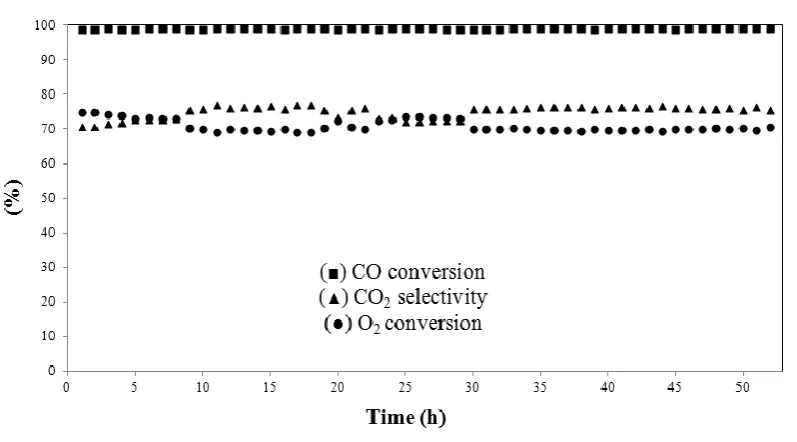
The long-term stability of the 7% CuO/Ce0.9Mn0.1O2 catalyst was evaluated at 120°C during 50 h. Results of CO, O2 conversion and CO2 selectivity are reported in Fig. 8. As shown, during all time of stream and nearly hard condition for reaction,
~100% CO conversion was maintained with 70-80% CO2 selectivity under a GHSV of 20000 h-1 and λ=2. Consequently, it was observed that the 7% CuO/Ce0.9Mn0.1O2 catalyst has high activity and stability in CO-PrOx conditions.
Figure 8. Long-term stability test for CO-PrOx on 7% CuO/Ce0.9Mn0.1O2 catalyst. Operating
conditions: 96% H2, 2% CO, 2% O2, λ=2, GHSV=20000 h-1.
4. Conclusions
The performance for CO-PrOx on the CuO/CeO2 catalysts prepared by wetness impregnation method was investigated. The effects of Cu and Mn loading, λ, GHSV and presence of H2O in feed on the catalytic activity were evaluated. Results indicate that the catalyst with 7% Cu loading and 0.1 Mn loading has been the best performance among the investigated samples. The 7% CuO/Ce0.9Mn0.1O2 catalyst has high activity and stability for CO-PrOx and in wide range of reaction temperature (120-160°C) nearly 100% conversion of CO with appropriate CO2 selectivity was achieved. The presence of H2O has negative effect on catalyst
activity and the best performance was achieved in λ=2 and GHSV=20000 h-1. In the long-term stability test, ~100% CO conversion with 70-80% CO2 selectivity was maintained for 50 h at 120°C.
Acknowledgements
References
[1] Alijani, A. and Irankhah, A., "Effect of Nickel Addition on Ceria‐Supported Platinum Catalysts for Medium Temperature Shift Reaction in Fuel Processors", Chem.
Eng. Technol., 36 (4), 552 (2013).
[2] Irankhah, A. Rahimi, M. and Rezaei, M., "Performance Research on a Methane Compact Reformer Integrated with Catalytic Combustion", Chem. Eng. Technol., 37 (7), 1220 (2014).
[3] Kugai, J. Moriya, T. and Seino, S., "γ-Fe2O3-supported Pt-Cu nanoparticles synthesized by radiolytic process for catalytic CO preferential oxidation", J. App. Catal. A:
General, 406, 43 (2011).
[4] Wu, Z. Zhu, H. and Qin, Z., "CO preferential oxidation in H2-rich stream over a CuO/CeO2 catalyst with high H2O and CO2 tolerance", Fuel, 104, 41 (2013).
[5] Mishra, A. and Prasad, R., "A Review on Preferential Oxidation of Carbon Monoxide in Hydrogen Rich Gases", Bull.
Chem. React. Eng. & Catal., 6, 1 (2011).
[6] Ayastuy, S. J. L. Gonzalez-Marcos, M. P. and Gutierrez, M. A., "Promotion effect of Sn in alumina-supported Pt catalysts for CO-PROX", Catalysis Communications,
12, 895, (2011).
[7] Bideberripe, H. P. Ramallo-Lopez, J. M. and Figuero, S. J. A., "Ge-modified Pt/SiO2 catalysts used in preferential CO oxidation (CO-PROX)", Catalysis
Communications,12, 1280 (2011).
[8] Yang, H. Wang, C. and Li, B., "Doping effects of Ni–MgO on the structure and performance of carbon
nanotube-supported Pt catalysts for preferential oxidation of CO in a H2 stream", J. Appl.
Catal. A: General, 402, 168 (2011).
[9] Desmond, J. W. Zhong, Z. and Luo, "Enhancing preferential oxidation of CO in H2 on Au/Fe2O3 catalyst via combination with APTES/SBA-15 CO2-sorbent", J. Hyd.
Energy, 35, 12724 (2010).
[10] Meng, M., Tu, Y. and Ding, T.,"Effect of synthesis pH and Au loading on the CO preferential oxidation performance of Au/MnO x–CeO2 catalysts prepared with ultrasonic assistance", J. Hyd. Energy, 36, 9139 (2011).
[11] Laguna, O. H. Romero, F. Sarria, M. A. and Centeno, J. A. Odriozola, "Gold supported on metal-doped ceria catalysts (M=Zr, Zn and Fe) for the preferential oxidation of CO (PROX)", Catal. 276, 360 (2010).
[12] Zhang, Q. and Liu, X., "Manganese-promoted cobalt oxide as efficient and stable non-noble metal catalyst for preferential oxidation of CO in H2 stream", J. App. Catal.
B: Environ., 102, 207, (2011).
[13] Chen,Y . Z. Liaw, B .J. Wang, J .M. and Huang, C. T. "Selective removal of CO from hydrogen-rich stream over CuO/CexSn 1-xO2-Al2O3 catalysts", Int. J. Hydrogen
Energy, 33, 2389 (2008).
[14] Araujo, V. D. Bellido, J. D. A. and Bernardi, M. I. B., "CuO-CeO2 catalysts synthesized in one-step: Characterization and PROX performance", J. Hyd. Energy, 37, 5498 (2012).
catalysts for CO preferential oxidation in H2 stream", J. Hyd. Energy, 37, 4774 (2012). [16] Varghese, S. Cutrufello, M. G. and Rombi, E., "CO oxidation and preferential oxidation of CO in the presence of hydrogen over SBA- 15-templated CuO-Co3O4 catalysts", Appl. Catal. A: Gen. 443, 161 (2012).
[17] Yoshida, Y. Mitani, Y. and Itoi, T., "Preferential oxidation of carbon monoxide in hydrogen using zinc oxide photocatalysts promoted and tuned by adsorbed copper ions", Catal., 287, 190 (2012).
[18] Li, X. Quek, X . Y. and Lighart, M., "CO-PROX reactions on copper cerium oxide catalysts prepared by melt infiltration",
App. Catal. B, Environ., 424, 123( 2012).
[19] Fonseca, J. Ferreira, H. and Bion, N., "Cooperative effect between copper and gold on ceria for CO-PROX reaction", Catal.
Today, 180, 34 (2012).
[20] Marino, F. Schonbrod, B. and Moreno, M., "CO preferential oxidation over CuO–CeO2 catalysts synthesized by the urea thermal decomposition method", Catal.
Today, 133, 735 (2008).
[21] Moretti, E. Lenarda, M. and Storaro, L., "Preferential CO oxidation (CO-PROX) over CuO-ZnO/TiO2 catalysts", J. App.
Catal. A: General, 344, 165 (2008)
[22] Pakharukova, V. P. Moroz, M. and Kriventsov, V., "Copper–cerium oxide catalysts supported on monoclinic zirconia: Structural features and catalytic behavior in preferential oxidation of carbon monoxide in hydrogen excess", Appl. Catal. A: Gen. 365, 159 (2009).
[23] Peng, C. T. Lia, H . K. and Liaw, B .J. "Removal of CO in excess hydrogen over CuO/Ce1-xMnxO2 cataysts", Chem. Eng. 172, 452 (2011).
[24] Zhigang L. Renxian Z. and Xiaoming Z., "Preferential oxidation of CO in excess hydrogen over a nanostructured CuO–CeO2 catalyst with high surface areas",
Catal. Commun. 9, 2183 (2008).
[25] Xiaolan T. Baocai Zh., Yong L. Yide X. Qin X. and Wenjie S., "CuO/CeO2 catalysts: Redox features and catalytic behaviors", Appl. Catal. A: Gen. 288, 116 (2005).
[26] Jong-Won, P. Jin-Hyeok, J. Wang-Lai, Y. Heon, J. Ho-Tae, L. Deuk-Ki, L. Yong-Ki, P. and Young-Woo, R., "Activity and characterization of the Co-promoted CuO–CeO2/γ-Al2O3 catalyst for the selective oxidation of CO in excess", Appl. Catal. A: Gen. 274, 25 (2004).
[27] Aboukais, A. Bennani, A. and Lamonier-Dulongpont, C., "Redox behaviour of copper(II) species on CuCe oxide catalysts: electron paramagnetic resonance (EPR)", Colloid. Surf. A.,115, 171(1996). [28] Gamarra, D. Belver, C. and Fernandez-Garcia, M., "Selective CO Oxidation in Excess H2 over Copper−Ceria Catalysts: Identification of Active Entities/Species", Am. Chem. Soc., 129, 12064 (2007).
[29] Avgouropoulos, G. Ioannides, T. and Matralis, H., "Influence of the preparation method on the performance of CuO–CeO2 catalysts for the selective oxidation of CO",
Appl. Catal. B: Environ.,56, 87 (2005).
"Application of CuOx–CeO2 catalysts as selective sensor substrates for detection of CO in H2 fuel", Chem. Commun., 35, 4046 (2008).
[31] Gamarra, D. Munuera, G. and Hungria, A., "Theoretical Study of Catalytic CO Oxidation on (111) Metal Surfaces: Calculating Rate Constants That Account for Tunnel Effect", Phys. Chem., 111, 11026 (2007).
[32] Azalim, S. Franco, M. Brahmi, R. Giraudon, J., "Removal of oxygenated volatile organic compounds by catalytic oxidation over Zr–Ce–Mn catalysts", J.
Hazard. Mater., 188, 422. (2011).
[33] Cominos, V. Hessel, V. and Hofmann, C., "Selective oxidation of carbon monoxide in a hydrogen-rich fuel cell feed using a catalyst coated microstructured reactor", Catal. Today, 110, 140 (2005). [34] Estifaee, P. Haghighi, M.
Mohammadi, N. and Rahmani, F., "CO oxidation over sonochemically synthesized Pd-Cu/Al2O3 nanocatalyst used in hydrogen purification: Effect of Pd loading and ultrasound irradiation time", Ultrasonics
Sonochem., 21 (3), 1155 (2014).
[35] Fattah, Z. Rezaei, M. Biabani-Ravandi, A. and Irankhah, A., "Preparation of Co–MgO mixed oxide nanocatalysts for low temperature CO oxidation: Optimization of preparation conditions", Proc. Saf.