FACTORS EXPLAINING DIFFERENCES IN NSDI DEVELOPMENT STATUS
BETWEEN THE DEVELOPED AND DEVELOPING WORLD
Correspondence Author: Mohammed Oludare Idrees*1 Abdul Rashid M. Shariff2 Vahideh Saeidi3
1*Department of Civil Engineering, Faculty of Engineering, University Putra Malaysia, 43400 UPM,
Serdang, Selangor Darul-Ehsam, Malaysia.
2Geospatial Research Center University Putra Malaysia, 43400 UPM, Serdang, Selangor Darul-Ehsam,
Malaysia.
KEYWORDS
:
NSDI development, spatial data, Assessment models, performance indicators.ABSTRACT
National Spatial Data Infrastructure (NSDI) implementation and development face numerous challenges. Though the motives are the same, NSDI development must run through the developmental policies and national agenda of the respective countries. Differences in regulatory frameworks and national interests affect NSDI implemtation, making comparative assessment of NSDI development of countries a complex process. This paper presents comparative assessment of factors responsible for differences in NSDI implementation development status of four case studies countries; Canada, Switzerland, Malaysia and Nigeria using Key Variable model. The 14 indicators of NSDI components for each country were collected through literature review and the result analysed using qualitative approach. The result shows that there are currently twelve assessment models of which four of them; 1. INSPIRE State of Play, 2. Key variable, 3. Goal-oriented SDI assessment view, and 4. Multi-view SDI Assessment are currently in practice for NSDI development assessment. Further, the study identified 8 key elements of NSDI as critical factors that explain difference in NSDI development status of developed and developing countries. These key elements include (1). Willingness to share data, (2) human capital, (3) capacity building, (4) access mechanism, (5) funding, (6) Social political stability, (7) metadata availability and (8) interoperability. While (1) availability of digital data and (2) SDI awareness are less critical.
INTRODUCTION
The role of SDI is to make available cost-efficient and cost effective spatial information for the common good of the citizens (Rajabifard, 2002). This mission have been pursued using two different models: product-based and process-based models (Loenen, 2006; Masser, 1999; Rajabifard, 2002). Product-process-based model emphasizes on linking data users to databases describing available spatial data products and value-added services within the SDI administrative sphere. This model sees users and producers as key components (Rajabifard, 2002).
On the other hand, process-based model stresses on the channel of communication of knowledge infrastructure and capacity building (Rajabifard, 2002). The underlining philosophy is that collaboration among spatial data community to exchange their dataset will optimize data discovery and access via clearinghouse and metadata directory systems. Loenen (2006) pounders on the need to understand both financial and socio-cultural factors, which are not considered in the first generation SDIs (Masser, 1999), to develop richer and broader conception. This led to the inclusion of institutional arrangement and financial sustainability as additional components to the model of Rajabifard. Most NSDIs are implemented on product-based model, however, some European countries like France, UK and Nothern Ireland (Rajabifard, 2002, pp. 161) adopt the process-based model. Process-based model facilitates management of information assets by communicating SDI concept, rather than mere linkage of available datasets (Loenen, 2006). Loenen & Rij (2008) is of the opinion that blend of the two models will enhance interoperability across different levels of SDI.
Despite the widespread campaign and efforts, the development and implementation of SDI remain imbalanced across the globe (Najar et al., 2006). SDI implementation, hitherto, progresses at varying developmental continuum. This unevenness brings approaches of SDI development and implementation strategies globally into question. In addition, most of the SDIs are still faced with the hurdles of implementation, hence less attention is given to performance evaluation. This paper seeks to (1) examines methods for assessing National Spatial Data Infrastructure (NSDI) development and (2) present factors that explain differences in NSDI development status in developed and developing countries. To do this, we select four federating countries across four continents that implement product-based SDIs. These countries are Canada (North America), Switzerland (Europe), Malaysia (Asia) and Nigeria (Africa) as case studies. According to World Bank Countries development categorization 2012 (data.worldbank.org/country) Canada and Switzerland are developed countries while Malaysia and Nigeria are developing countries. The rest of the paper is organized as follows. Section 2 discusses the concepts of NSDI, explaining the various components. The bases of the research framework is explained section 3 elaborating on the existing NSDI assessment models. Brief description of NSDIs of Canada, Switzerland, Nigeria and Malaysia are presented in section 4, while section 5 presents the discussion of findings. Finally, section 6 draws the curtain with the conclusion.
CONCEPTS AND PRINCIPLES OF SDI
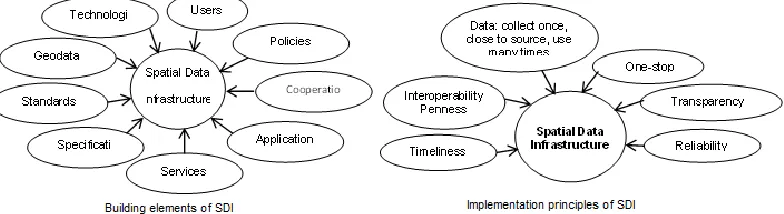
Williamson, 2001). However, the basic idea is that SDI describes the framework in which geospatial science, data, information and related services and applications are made available to the community of users on the internet for the discovery, sharing, use and applications of geospatial data to enhance the socio-economic developments and to support accurate and timely decision making. All SDIs consists of the following basic components: spatial data, access, policy, technology, and standards. Figure 1 describes the components and principles of SDI. Further information on SDI components can be found in Armenakis (2008), Hall (2011), Masser et al. (2008), Masser (2002), Najar et al. (2006), Nedovic-Budic et al. (2011) and Oyugi & Kayode (2012).
Figure 1: SDI building elements and implementation principles (Source: Amenakis, 2008)
Components of SDI
The framework data consists of the fundamental or core data and non-fundamental datasets (Armenakis, 2008). The fundamental data are georeferenced base data layers such as geodetic controls, road networks, hydrographic data, topographic data, cadastral information, administrative boundaries, etc. upon which other non-fundamental thematic data layers like vegetation cover, geological map, population map etc. are aligned. According to Mohammadi et al., (2010) integrating multi-source non-homogeneous data set is one of the main challenges faced by geospatial data users. Data accuracy, updating, and consistency are other issues of major concern looking at the values and vital role of spatial data in SDI.
Technology include the tools and facilities that enable the operations of SDI. The internet and the development of open standard platforms for data exchange and sharing, computer and information/communication technology, data storage (geometric and attribute) encoding, data capturing, processing and the Geographic Information System (GIS) software development facilitates the technological environment upon which the entire SDI revolves (Craig, 2009; Groot, 1997; Masser et al., 2008; O’Dea et al., 2011).
Sound implementation of SDI relies on enabling laws, regulations and policies cutting across the operational spheres of geospatial life cycle and associated elements. The process of data access, sharing, custodianship, partnership, pricing, implementation principles and approaches, and responsibility must be backed by policy statement and enabling laws (Awang & Nordin, 2009; Bishop et al., 2000; Borzacchiello & Craglia, 2012).
Standards are based on information technology, and constitute the link and "glue" to all national spatial data infrastructure components (Masser, 2002). Open Standards provide a common procedure for interoperability and sharing of data across the SDI.Organizations such as the Technical Committee 211 and the Geographic Information/Geomatics of the International Organization of Standards (ISO/TC211), Open Geo-spatial Consortium (OGC) and World Wide Web Consortium (W3C) have developed various standards for data, technology, processing, etc. Likewise each nation develop their own standards but in most cases in compliance with the international standards.
RESEARCH FRAMEWORK: NSDI ASSESSMENT MODELS
The role SDI will play in organizational sense and within the spatial data community differ from country to country. This makes it a little complicated to have a uniform assessment approach that can be used to adequately evaluate the level of performance of SDI implementation. However, extensive body of literatures has proposed approaches for this purpose. The works of Grus et al. (2011), INSPIRE (2011), Kok &Van Loenen (2005), Najar et al. (2006),Yawson, Armah, & Pappoe (2009) and Oyugi & Kayode (2012) are some of the prominent efforts put forward by researchers in SDI domain to compare, define and device scientific means of evaluating SDI performance of different nations. Despite the research efforts, up till this present moment, SDI performance evaluation approaches are still evolving as a matter of academic exercise and experimentation rather than practical application. On this note, one may be tempted to agree with the argument put forward by Kok & Van Loenen (2005) that it will, invariably, be impossible to specify the ideal SDI due to the dynamic changes in SDI development functions and composition.
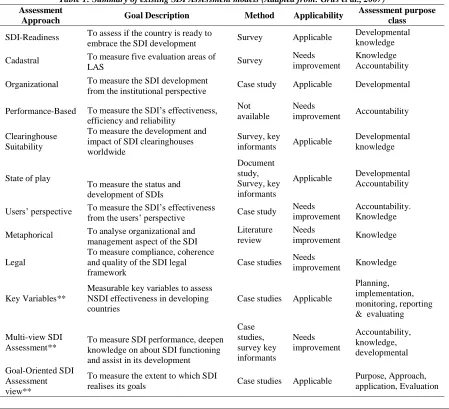
assessment view) has addressed one or at most two of the three purposes: accountability, knowledge and developmental (Grus et al., 2011) and not the entire components.
Table 1: Summary of existing SDI Assessment models (Adapted from: Grus et al., 2007)
Assessment
Approach Goal Description Method Applicability
Assessment purpose class
SDI-Readiness To assess if the country is ready to
embrace the SDI development Survey Applicable
Developmental knowledge
Cadastral To measure five evaluation areas of
LAS Survey
Needs improvement
Knowledge Accountability
Organizational To measure the SDI development
from the institutional perspective Case study Applicable Developmental
Performance-Based To measure the SDI’s effectiveness, efficiency and reliability
Not available
Needs
improvement Accountability
Clearinghouse Suitability
To measure the development and impact of SDI clearinghouses worldwide
Survey, key
informants Applicable
Developmental knowledge
State of play
To measure the status and development of SDIs
Document study, Survey, key informants
Applicable Developmental Accountability
Users’ perspective To measure the SDI’s effectiveness
from the users’ perspective Case study
Needs improvement
Accountability. Knowledge
Metaphorical To analyse organizational and management aspect of the SDI
Literature review
Needs
improvement Knowledge
Legal
To measure compliance, coherence and quality of the SDI legal framework
Case studies Needs
improvement Knowledge
Key Variables**
Measurable key variables to assess NSDI effectiveness in developing countries
Case studies Applicable
Planning, implementation, monitoring, reporting & evaluating
Multi-view SDI
Assessment** To measure SDI performance, deepen knowledge on about SDI functioning and assist in its development
Case studies, survey key informants Needs improvement Accountability, knowledge, developmental Goal-Oriented SDI Assessment view**
To measure the extent to which SDI
realises its goals Case studies Applicable
** indicates additional models to the list provided by Grus et al. (2007)
Kok & Van Loenen (2005) proposed a model based on organizational indicators. The model, named “organizational maturity matrix”, considers leadership, a vision, communication channels and the ability of self-organization as critical indicators. In the authors’ opinion, organizational variable is part of SDI, nonetheless, a part cannot make a whole. The absolute neglect of technical and institutional variables renders the model impotent as an effective tool to assess SDI performance.
Similarly, Grus et al. (2011) favours SDI goal-oriented assessment view model on the bases of the multi-view assessment framework to measure the extent to which SDIs realize their goals. According to the proposed model, goals are divided into four: assessment purpose, assessment approach, application and evaluation, each having some nodal indicators. A point of observation with adopting this model is that, SDI development is not static; the content and functions continually vary, (Grus et al., 2008), hence having predefined goals without consideration for functional changes may not yield a reliable assessment outcome. Again, both Goal-oriented and organizational maturity matrix is limited to qualitative assessment, not exhaustive, and can be subjective.
As evidence of the foregoing, the economic, technical, social and environmental dimensionality of SDI requires devising quantitative assessment criteria that will be holistic and verifiable. On this basis, INSPIRE (2011) and Najar et al., (2006) proposed approach for monitoring and reporting SDI performance using metadata elements: spatial data set, spatial data services, and network services. The advantages of the method is that, performance indicators consider broad integrating channels of SDI quantitatively, and therefore allows computation of conformance test (http://inspire.jrc.ec.europa.eu/index.cfm/pageid/5022). Though exhaustive in coverage than the other models, some challenges hindering the full implementation are yet to be tackled. Issues about the list of data sets (who will and when to establish the list, agreement on relevant data sets, defining the extent of the data set, whether or not to include derived data set in the list), services (how to establish the list of spatial data services and network services), and other trans-boundary issues need to be resolved.
CASE STUDIES
This section present the case studies for the NSDI’s of Canada (Section 4.1), Switzerland (Section 4.2), Nigeria (Section, 4.3) and Malaysia (Section 4.4).
The Canadian Geospatatial Data Infrastructure (CGDI)
CGDI is an open information technology infrastructure that is based upon publicly available standards and specification (Habbane, 2009). CGDI objective is to provide Canadians with on-demand access to geospatial information through an interoperable, standard based network built on a host of data, services and technology suppliers. CGDI goal which is to improve Canadians’ quality of life by enhancing decision making location-based information and technologies accessible and sustainable started in 1992 and developed on a continuous product and community models to what it is today.
Development of CGDI has taken the form of a host of different initiatives, projects, partnerships, and co-operative activities, all working collectively towards a national infrastructure for access to geospatial information in Canada. Like other national spatial data infrastructures, the CGDI formalizes the structure and process for organizing, using and sharing geospatial data and services common to a broad spectrum of applications and users within a country. Access to data and services, data policy, the framework data, technology and standards are five major components common to any spatial data infrastructure. To achieve critical mass accessible data, services and compatible applications, Canada strategically implements cooperative partnership without a centralized administration (Masser, 2002) through Geo Connection.
Geo Connection is a national partnership program led by Natural Resources Canada (NRC) that collaborates and partners with all levels of government, private sectors, NGO’s and international organizations in order to build and evolve the CGDI. Geo Connection is the lead agency saddled with the responsibility of coordinating with other auxiliary bodies for efficient implementation. CGDI is composed of framework data, access network to data and services, policies, technology, and standards (Masser, 2002)
Switzerland Geospatial Data Infrastructure
In 2000 the Swiss Federal Council created an interdepartmental Coordination Group on GIS-matters (GCG). The first task of the GCG was to provide recommendations for strategies concerning GIS, based on users’ needs that it was the basis for a NSDI. The NSDI joins a broad base of stakeholders, the federal administrations with the collaboration and coordination with the private sectors. Launching e-geo.ch program (to coordinate the implementation of NSDI) in 2003, provide a great political support for NSDI and implementation strategy (Vandenbroucke & Dimitrios Biliouris, 2011).
In 2003, the Federal Council of Ministers approved the implementation plan for the geo information strategy developed by the Federal Coordination Center for Geographical Information and GIS (COGIS). The objective of the implementation plan was to establish a national spatial data infrastructure, easy access to geographic data and to make it available to users at low cost. This led to a radical change in the mapping agency (Swisstopo) from the old business focused on maximization of profits to the optimization of benefits for national economic development at the center stage. The e-geo.ch “contact network” initiative was launched in order to bring together the partners who would be needed to establish sustainable NSDI (http://www.swisstopo.admin.ch). Swisstopo holds the responsibility to make geo data available to the public as stated by the Geo information Act (Swisstopo promotes, 2011). The commercial use of official survey and geological data requires a license (Geo information Act SR 510.62, 2009) thus, Swiss NSDI is also a business model oriented.
On the technical side, a key component in the evolution of the Swiss NSDI was the creation of the INTERLIS data description language which is implemented throughout Switzerland. There is a national geoportal (www.geocat.ch) that allows data access, exploration and discovery (www.geocat.ch). Swiss NSDI consists of coordination and organizational issues, legal framework and funding, fundamental data, metadata, network services environmental themes and activities and standards (Vandenbroucke & Dimitrios Biliouris, 2011).
The e-geo.ch is the coordinating body established to implement Swiss NSDI. A steering committee, consisting of 15 representatives from the confederation (COGIS), the cantons (CCGEO), cities and municipalities as well as the Swiss Organization for Geo-Information (SOGI) determines the general direction and the strategies of the program. The NSDI is integrating all public SDIs as well as all other (e.g. private, research) SDI activities. All public and many private institutions, producers and users of spatial data are participating in the SDI (Vandenbroucke & Dimitrios Biliouris, 2011).
The National Geospatial Data Infrastructure (NGDI) of Nigeria
which are vital to the socioeconomic development at the national, state and local levels, by facilitating cooperation and collaboration among geospatial information stakeholders (Onabajonet al., 2005; Oyugi & Kayode, 2012). To achieve these objectives, the National Geo information Policy has provided for the establishment of the NGDI council, committee and subcommittee.
Like every other nations of the world, increasing awareness of the use of geospatial information for decision-making, coupled with the availability of primary datasets from the Nigerian Satellite missions, the country has realized the need to adopt policies to promote greater awareness and public access to standard and coordinated geospatial data production, management and dissemination by all sectoral institutions/agencies through the establishment of a Geospatial Data Clearinghouse at various levels in the country (local, state and federal) and linkages with the private sectors. The components of NGDI are the fundamental datasets, access network, policy, standards and technology. Refer to Akinyede & Agbaje (2003) and Onah (2009) for more information.
The NGDI Project in Nigeria has an administrative/organizational framework that is multidisciplinary, inter-agency and inter-sectoral network of institutions coordinated by the lead agency, the National Space Research and Development Agency (NASRDA) with the mandate to work in close collaboration with the relevant National, State and Local Government Legislative Committees and Geospatial data producers. This arrangement is aimed at removing the institutional barriers that have in the past inhibited geospatial data sharing among the producers and users. The policy provides the coordinating agency the powers to enforce rules and standards. Agbaje (2005) detailed the organizational structure for NGDI management as follows: NGDI Council (Vice President as chairman and Federal Ministry of Science & Technology as secretariat, NGDI committee comprising 27 members drawn across all stakeholders and interest groups, and 6 other sub-committees
The Malaysia Geospatial Data Infrastructure (MyGDI)
MyGDI is an initiative of the government to develop the NGDI for Malaysia to provide accurate geospatial data that promotes a sustainable living environment, economic growth and social progress for all Malaysians. Like every other SDI,MyGDI was established in response to enhancing the awareness about data availability, improve access to geospatial information by facilitating data sharing among participating agencies, encourage wider use of geospatial data at all levels and contributing towards strengthening national development. It provides a basis for spatial data exploration, evaluation and applications for users and data providers within all levels of government, commercial and non-profit sectors, academia and the public (Hanifah, 2007; MyGDI, 2011).
It facilitates online access to data and avoid duplication efforts in spatial data collection. The components of MyGDI include geospatial information, access mechanism, policy/legal framework, resources, standards, research and development (Jamil, 2013).
The initiatives started from the national level and designed to filter down to the state and local levels under the management of MaCGDI (Malaysia Center for Geospatial Data Infrastructure) and the various committees. MaCGDI was formed in 2002 is a center under the Ministry of Natural Resources and Environment (NRE) to facilitate, coordinate and manage spatial data infrastructure through the development of policies, standards, research and development and skilled human resources by providing customer-focused, cost effective and timely delivery of geospatial data (Awang et al, 2009; Hanifah, 2007; MyGDI, 2011).
MyGDI Management structure consists of the National Council, MyGDI National Coordinating Committee (MNCC), MyGDI Framework Technical Committee (MFTC), MyGDI Standard Technical Committee (MSTC), MyGDI Clearinghouse Technical Committee (MCTC), MyGDI State Coordinating Committee (MSCC), and MyGDI State Technical Committee (MSTC) (Jamil, 2013).
Table 2: Status of case studies NSDI components Key variables
SD I C OM P ON E N T
S KEY VA
R
IA
BLES
Developed Developing
C a na d a Sw itzer la nd M a la y si a N ig eri a
Data 1. Availability of digital data Available Available Available Available But not all
People
2. Willingness to share
Yes But not sufficient Yes But not sufficient
No No
3. Human capital Sufficient Sufficient Moderately
sufficient Not sufficient
4. Capacity building Yes Yes Not sufficient Not sufficient
5. SDI awareness Good Good Moderate Moderate
Access
network 6. Access mechanism Yes Yes
Yes But needs improvement
No
Policy 7. Funding Yes Yes Yes
8. Vision Yes Yes Yes Yes
9. Institutional arrangement Yes Yes Yes Yes
10. Leadership Present Present Present Present
11. Socio-political stability Stable Stable Stable Unstable
Standards
12. Metadata (availability) Yes Yes No
But in progress No
13. Interoperability Yes Yes Yes
But not effective No
Others 14. Initiative connected to SDI (country’s activity)
Active global and regional participation
Active global and regional participation
Govt. funding of research and active participation in conferences
Active participation in research and conferences
DISCUSSION
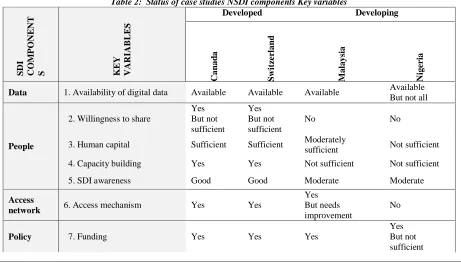
In the previous section, some fundamental concepts and terms within the field of SDI have been defined. Brief description NSDIs of Canada, Switzerland (developed countries), Nigeria and Malaysia (developing countries) was reviewed while the key variables of in each components extracted from literatures are presented in tabular form. Table 2 summarizes the key variables of each components of the respective NSDI with a view to examine factors that explain the differences in NSDI development status of developed and developing countries. Qualitative approach was used indicate availability or non-availability of a variable in affirmative positive and negative statements. At times, mild assertion such as “moderate”, “yes, but not sufficient” etc. are used to indicate progress or some level of accomplishment in the variable in question.
Availability of and access to digital spatial data to support economic, social and environmental development (Loenen, 2006) is the foundation that drives SDI implementation. Comparative assessment of the two categories of countries in this case studies shows a difference. Canada, Switzerland and Malaysia have digital data available (Borzacchiello & Craglia, 2012; Masser, 2002; Vandenbroucke & Dimitrios, 2011). Meanwhile, Malaysia is currently working hard to improve on its digital dataset in terms of the accuracy (Awang & Nordin, 2009). In the case of Nigeria, digital spatial data is available but not all, however progress have been made of recent. The process of converting existing analog data to digital has been completed (Yilma, 2013) and the data is expected to complement digital datasets from Nigeria satellite data.
to share data (Loenen, 2006; MyGDI, 2011; NZGO, 2011; Rajabifard, 2002). The situation is not as critical in the developed countries as it is with developing ones. Awareness of the importance of spatial data in governance and regional collaboration (Act, 2009; Masser et al., 2008) facilitates policies that encourage data sharing. The scenario is contrary in developing countries (particularly Africa and Asia) with political and cultural polarity (Bishop et al., 2000; Oyugi & Kayode, 2012). Multi-cultural societies are generally characterized by power struggles, personalization of spatial data in their custody and sense of insecurity that discourage the culture of data sharing among agencies for the collective benefit of the society.
Human capital development and capacity building are different sides of the same coin. While human capital development emphasizes on well-trained human resources, capacity building considers the number of staff with the necessary skills. The case studies indicate that in both variables the developed countries are well ahead of the developing countries. Looking at the UNESCO 2012 “Report on National Adult Literacy Rate” Canada and Switzerland have 99% literacy level, Malaysia and Nigeria respectively have 93.1% and 61.3% of their population literate. Nevertheless, it may be argued that being literate does not make one spatially informed as described in Figure 2 by Masser et al. (2008).Table 2 corroborates similar trend in human capital development and capacit y building, based on the literacy figure of the respective countries. Bishop et al. (2000) noted that the ability to adopt spatial information technologies in daily routine operations is a distinguishing characteristic of the developed and developing countries. For the developing nations much still need to be done in human capital development and capacity building to improve SDI development (Agbaje, 2005; Eelderink et al., 2008; Grus et al., 2011; Hanifah, 2007; Kufoniyi et al., 2002; Masser, 2002; Mohammadi et al., 2010; Nedovic-Budic et al., 2011; Yawson et al., 2009).
Figure 2: Level of spatial-data users and expertise in society (Source: Masser et al., 2008)
2005; Eelderink et al., 2008; Nwilo & Osanwuta, 2004). This can be done through implementing policies that will encourage and promote the use of spatial information in public and private sectors and other applications that have direct social and economic impact on the people. Even though regional collaborations in America and Europe promote awareness, researchers still advocate for improvement on the use of spatial information for the common good of their citizens (Masser et al., 2008; Vandenbroucke & Dimitrios, 2011).
Access mechanism is one of the vital element of any NSDI (Borzacchiello & Craglia, 2012). The portals of Canada (Wright, 2009) and Switzerland (Swisstopo promotes, 2011) have portals that allow access to digital data. In Malaysia My Geo portal (MyGDI, 2011) provides link to some digital data whereas some other data sets such as topographic data are regarded as classified (Masser, 1999) thereby access to such data are restricted. In the case of Nigeria, portal to access data is not yet available (Akinyede & Agbajeb, 2006; Eelderink et al., 2008). Recent research efforts on web-based maps or web Atlas (O’Dea et al., 2011; Wright, 2009) point to the commitment in developed world to improve on the existing access mechanism.
NSDI implementation is a capital intensive long-time project that requires sustained funding. All NSDIs need secure funding (Eelderink et al., 2008), however, the economic capacity of developing nations (World Bank, 2012) limit the prospect to obtain funding for SDI initiatives. The case studies shows that the governments of Canada and Switzerland provide allocation for their respective NSDI (Kok & van Loenen, 2004; Masser, 2002; NZGO, 2011). In contrast to these two developed countries, the governments of Malaysia and Nigeria provide funds but not enough. Additional funding’s are mobilized locally and through international aids (Agbaje, 2005; Bishop et al., 2000). Funds are usually changed to some other issues considered more pressing than SDI in developing countries.
Vision, institutional arrangement and leadership are relevant key variables in an NSDI development. All the case studies countries indicate the presence of these key variables in their NSDIs (Agbaje, 2005; Awang & Nordin, 2009; Habbane, 2009; Masser, 2002; Oyugi & Kayode, 2012; Vandenbroucke & Dimitrios, 2011). Each of the countries of developed and developing categories in this case studies document long-term SDI development vision. The same applies to agreements in terms of organizational structures and the mantle of leadership. However, a peculiar characteristic in multi-ethnic nations that impedes SDI development is political interference in leadership (Agbaje, 2005; Kufoniyi et al., 2002; MyGDI, 2011). This factor is less pronounced in developed countries.
Metadata provides Information about data relevant to users’ needs such as their sources, quality and other associated content. Clearinghouses are information driven mechanism that passively help users to find this information in Canada and Switzerland (Grus et al., 2011; Nedovic-Budic et al., 2011). Malaysia also have developed this mechanism called MyGDI Explorer (MyGDI, 2011) to support sharing of metadata and services. However, it is still not user-friendly at moment because the process of metadata creation is still on-going. Nigeria is yet to have a functional clearinghouses contrary to the plan reported in Agbaje (2005). Design of clearinghouses gain better ground at regional level than national initiatives (Yilma, 2013). Limited technical capability and difficulty in defining metadata standards are likely factors responsible for this setback (Jamil, 2013; NZGO, 2011).
Interoperability poses great challenges to both developed and developing countries (Armenakis, 2008; Grus et al., 2011; Mohammadi et al., 2010; Nedovic-Budic et al., 2011; Yawson et al., 2009). Ability to sharing data, software and hardware across organizations and users is critical for successful NSDI development. In the case studies, Canada, Switzerland and Malaysia have their NSDIs interoperable while in the case of Nigeria, the case is opposite. Even among the advanved NSDIs, O’Dea et al. (2011) highlights that lack of high quality, standards-compatible metadata and lack of semantic interoperability limits the uses and functionality across board. Wright (2009) report a survey of existing systems and the task before researchers promote code reuse and also facilitate interoperability and data sharing.
All the case studies countries are actively involved in initiatives connected to SDI in their capacity. While Canada and Switzerland are actively involved in research and awareness programmers at global, regional and national levels (Grus et al., 2011; Swisstopo promotes, 2011), Malaysia and Nigeria are active in providing fund for research both at regional levels and national levels and intensifying on capacity building through seminars, workshops and symposia (Awang & Nordin, 2009; Jamil, 2013; Yilma, 2013).
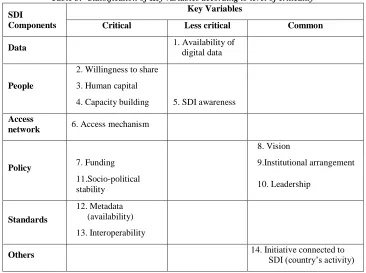
Table 3: Classification of Key variables according to level of criticality
SDI Components
Key Variables
Critical Less critical Common
Data 1. Availability of
digital data
People
2. Willingness to share
3. Human capital
4. Capacity building 5. SDI awareness
Access
network 6. Access mechanism
Policy
8. Vision
7. Funding 9.Institutional arrangement
11.Socio-political
stability 10. Leadership
Standards
12. Metadata (availability)
13. Interoperability
Others 14. Initiative connected to SDI (country’s activity)
CONCLUSION
continue to grow, models are evolving making specifying “ideal” assessment approach a function of purpose for which the assessment is required.
On the question of factors that explain differences in NSDI development status between developed and developing world, the study shows that eight factors: willingness to share data, human capital, capacity building, access mechanism, funding, Social political stability, metadata availability and interoperability highly critical. Whereas the influence of two other factors: availability of digital data and SDI awareness are not much, hence categorized as less critical factors. The remaining four key variables: vision, institutional arrangement, leadership and country specific activities are common to both.
Based on the outcome of this study, NSDIs of Canada and Switzerland (developed countries) are much more advanced than that of Malaysia and Nigeria (developing countries). There is no doubt that if developing countries focus efforts in confronting the challenges of the critical and less critical factors, the status of their NSDIs will definitely improve. We therefore recommend that developing nations leverage on the experience of the “matured” SDI’s to provide a foundation that will facilitate sustained NSDI implementation and development.
REFERENCES
1. Agbaje, G. I. (2005). Nigerian National Geo information Policy and Current steps towards its implementation. In United Nations/Nigeria Workshop on Space Law: Meeting International responsibilities and addressing domestic needs (pp. 1–13). Abuja, Nigeria 21-24 November 2005.
2. Akinyede, J., & Agbajeb, G. (2006). Nigeria’s Satellite Data utilization for sustainable development. In ISPRS Commission VII Mid-term Symposium “Remote Sensing: From Pixels to Processes” (pp. 1–6). Enscheda, the Netherlands, 8-11 May 2006. doi=10.1.1.132.65&rep=rep1&type=pdf
3. Armenakis, C. (2008). Spatial data infrastructures and clearinghouses. In Z. Li, J. Chen, & E. Baltsavias (Eds.), Advances in photogrammetry, remote sensing and spatial information sciences: 2008 ISPRS Congress Book (pp. 325–333). London: 2008 ISPRS Congress Book - Taylor & Francis Group.
4. Awang, A., & Nordin, A. (2009). Geo-spatial data accuracy and its legal implications in the Malaysian context. In Eighteenth United Nations Regional Cartographic Conference for Asia and the Pacific (Vol. 7, pp. 1–9). Bangkok, 26-29 October 2009.
5. Bishop, I., Escobar, F., & Karuppannan, S. (2000). Spatial data infrastructures for cities in developing countries: Lessons from the Bangkok experience. Cities, 17(2), 85–96. doi:10.1.1.140.9093
6. Borzacchiello, M. T., & Craglia, M. (2012). Estimating benefits of Spatial Data Infrastructures: A case study on e-Cadasters. Computers, Environment and Urban Systems. doi:10.1016/j.compenvurbsys.2012.05.004 7. Budhathoki, N. R., Bruce, B. (Chip), & Nedovic-Budic, Z. (2008). Re conceptualizing the role of the user of
spatial data infrastructure. GeoJournal, 72(3-4), 149–160. doi:10.1007/s10708-008-9189-x
8. Craig, W. (2009). Governance of NSDI. esri ArcNews Online. Retrieved January 23, 2014, from
9. Crompvoets, J., & Bregt, A. (2008). Clearinghouse suitability index. In J. Crompvoets, A. Rajabifard, B. van Fernandez Loenen, & T. Delgado (Eds.), A Multi-View Framework to Assess SDIs (pp. 135–144). Space for Geo-Information (RGI), Wageningen University.
10. Delgado, F. T., Lance, K., Buck, M., & Onsrud, H. J. (2005). Assessing an SDI Readiness Index Assessing an SDI Readiness Index. In Proceedings from Pharaohs to Geo informatics, FIG Working Week 2005 and 8th International Conference on Global Spatial Data Infrastructures (GSDI- 8) (pp. 1–10). Cairo, Egypt April 16-21, 2005.
11. Eelderink, L., Crompvoets, J., & Man, W. H. E. De. (2008). towards key variables to assess National Spatial Data Infrastructures (NSDIs) in developing countries. In J. Crompvoets, A. Rajabifard, B. van Loenen, & T. D. Fernandez (Eds.), A Multi-View Framework to Assess Spatial Data Infrastructures (pp. 307–325). Space for Geo-Information (RGI), Wageningen University.
12. Fernandez, T. D., Fernandez, M. D., & Andrade, R. E. (2008). The Spatial Data Infrastructure Readiness model and its worldwide application. In J. Crompvoets, A. Rajabifard, B. van Loenen, & T. D. Fernandez (Eds.), A Multi-View Framework to Assess SDIs (pp. 117–134). Space for Geo-Information (RGI), Wageningen University.
13. Groot, R. (1997). Spatial data infrastructure (SDI) for sustainable land management. ITC Journal, 3(4), 1–8. Retrieved from http://ces.iisc.ernet.in/ energy/HC270799/LM/SUSLUP/Key Speakers/AGroot.pdf
14. Grus, Ł., Castelein, W., Crompvoets, J., Overduin, T., Loenen, B. Van, Groenestijn, A. Van, Bregt, A. K. (2011). An assessment view to evaluate whether Spatial Data Infrastructures meet their goals. Computers, Environment and Urban Systems, 35(3), 217–229. doi:10.1016/ j.compenvurbsys.2010.09.004
15. Habbane, M. (2009). Canadian Geospatial Data Infrastructure Standards for the Public Safety & Security Community. In ISO/TC 211 Standards in Action Workshop (pp. 1–26). Quebec, November 4, 2009. 16. Hanifah, F. A. (2007). Implementing National Spatial Data Infrastructure in Malaysia. Malaysia. Retrieved
from http://www.isotc211.org/Workshop Molde/Presentations/Hanifah-SDI-workshop-Molde2009.pdf
17. INSPIRE. (2011). INSPIRE Monitoring Indicators – Guidelines Document. European Commission - Eurosta. Retrieved December 21, 2013, from
http://inspire.jrc.ec.europa.eu/reports/ImplementingRules/monitoring/INSPIRE_ DT_
MR_Guidelines_140308_v2.pdf.
18. Jamil, H. (2013). Geographic Information Standardization activities in Malaysia. In Seminar on Malaysian Standards for Geographic Information/ Geomatics: Interoperability for mutual development (pp. 1–15). Kuala Lumpur, 30 April, 2013.
19. Kok, B., & van Loenen, B. (2004). How to assess the success of National Spatial Data Infrastructures? Computers, Environment and Urban Systems, 29(6), 699–717. doi:10.1016/j.compenvurbsys.2004.02.001 20. Kufoniyi, O., Bouloucos, T., & Holland, E. (2002). Capacity building in geospatial information production
21. Loenen, B. Van. (2006). Developing geographic information infrastructures. (J. de Jong, J. A. Zevenbergen, P. J. M. van Oosterom, R. W. Wagenaar, A. K. Bregt, H. J. Onsrud, & A. Rajabifard, Eds.) (First., pp. 1– 404). Deft, the Netherlands: Delft University Press.
22. Loenen, B. van, & Rij, E. van. (2008). Assessment of Spatial Data Infrastructures from an Organizational Perspective. In J. Crompvoets, A. Rajabifard, B. van Loenen, & T. D. Fernandez (Eds.), A Multi-View Framework to Assess SDIs (pp. 173–192). Space for Geo-Information (RGI), Wageningen University. 23. Mansourian, A., & Rajabifard, A. (2004). Facilitating disaster management using SDI. Journal of Geospatial
Engineering, 6(1), 1–16. Retrieved from http://csdila.unimelb.edu.au/publication/journals/Facilitating Disaster Management Using SDI.pdf
24. Masser, I. (1999). All shapes and sizes: the first generation of national spatial data infrastructures. International Journal of Geographical Information Science, 13(1), 67–84. doi:10.1080/136588199241463 25. Masser, I. (2002). A comparative analysis of NSDI’s in Australia, Canada and the United States. GINIE:
Geographic Information Network in Europe (pp. 1–55). Sheffield, UK. Retrieved from http://www.ec-gis.org/ginie/doc/SDIComparative_report_Final.pdf
26. Masser, I., Rajabifard, a., & Williamson, I. (2008). Spatially enabling governments through SDI implementation. International Journal of Geographical Information Science, 22(1), 5–20. doi:10.1080/13658810601177751
27. Mohammadi, H., Rajabifard, A., & Williamson, I. P. (2010). Development of an interoperable tool to facilitate spatial data integration in the context of SDI. International Journal of Geographical Information Science, 24(4), 487–505. doi:10.1080/13658810902881903
28. MyGDI. (2011). National Report: National Spatial Data Infrastructure - Malaysia. In 17th Permanent Committee on GIS Infrastructure for Asia & the Pacific (pp. 1–49). Ulaanbaatar, Mongolia, 21-22 July, 2011. 29. Najar, C., Rajabifard, A., Williamson, I., & Giger, C. (2006). A Framework for Comparing Spatial Data Infrastructures. In GSDI-9: Research and Theory in Advancing Spatial Data Infrastructure Concepts (pp. 6– 10). Santiago, Chile, 6-10 November 2006. doi:10.1.1.95.2342
30. Nedovic-Budic, Z., Crompvoets, J., & Georgiadou, Y. (2011). Spatial Data Infrastructures in Context: North and South. (Z. N. ´.-B. ´ & J. C. Y. GEORGIADOU, Eds.). United States: CRC Press, Taylor & Francis Group.
31. Nwilo, P. C., & Osanwuta, D. A. (2004). National Spatial Data Infrastructure for Nigeria – Issues to be considered. In FIG Working Week 2004 (pp. 1–10). Athens, Greece, May 22-27, 2004.
32. NZGO. (2011). Spatial Data Infrastructure Cookbook (pp. 1–70). New Zealand Government.
33. O’Dea, E. K., Dwyer, E., Cummins, V., & Wright, D. J. (2011). Potentials and limitations of Coastal Web Atlases. Journal of Coastal Conservation, 15(4), 607–627. doi:10.1007/s11852-011-0150-7
35. Onah, C. C. (2009). Spatial data infrastructures model for developing countries: A case study of Nigeria. Universidad Jaume. Retrieved from http://run.unl.pt/ handle/10362/2319
36. Oyugi, M. O., & Kayode, A. A. (2012). Comparative Analysis of the Status of National Spatial Data Infrastructure in Nigeria and Kenya. International Journal of Spatial Data Infrastructures Research, 1–29. 37. Presidential Executive Order #12906. (1994). Coordinating Geographic Data Acquisition and Access: The
National Spatial Data Infrastructure (Vol. 59, pp. 1–4). Ny City, USA, USA. Retrieved from
www.archives.gov/federal-register/executive-orders/pdf/12906.pdf
38. Rajabifard, A. (2002). Diffusion of Regional Spatial Data Infrastructures: with particular reference to Asia and the Pacific. University of Melbourne. Retrieved from http://www.csdila.unimelb.edu.au/publication/theses/ Rajabifard_PhD_Thesis.pdf
39. Rajabifard, A., & Williamson, I. (2001). Spatial data infrastructures: concept, SDI hierarchy and future directions. In AURISA 97: Suitability of Internet Technologies for Access, Transmission and Updating Digital Cadastral Databases on the Web (pp. 1–10). doi:10.1.1.9.1919
40. Strain, L., Rajabifard, A., & Williamson, I. (2004). Spatial Data Infrastructure to Facilitate Coastal Zone Management. In Coastal Zone Asia Pacific Conference (pp. 1–6). Brisbane, Australia, 5-9 September, 2004. Retrieved from http://www.csdila.unimelb.edu.au/publication/conferences/SDI to Facilitate Coastal Zone Management.pdf
41. Swiss Act, S. (2009). Federal Act on Geo information. The Federal Assembly of the Swiss Confederation. Retrieved January 27, 2014, from www.admin.ch/ ch/e/rs/5/510.62.en.pdf
42. Swisstopo promotes. (2011). swisstopo promotes: Annual Report 2011. Federal office of Topography swisstopo. Webern. Retrieved December 10, 2012, from http://www.swisstopo.admin.ch/internet/swisstopo/en/commons/ pubteaser/annualreport2011.html
43. Vandenbroucke, D., & Dimitrios Biliouris. (2011). Spatial Data Infrastructures in Switzerland : State of play 2011. Spatial Applications Division K.U.Leuven Research & Development (pp. 1–42). Switzerland. Retrieved from http://inspire.jrc.ec.europa.eu/reports/stateofplay2011/rcr11LIv102.pd
44. Vandenbroucke, D., Janssen, K., & Orshoven1, J. Van. (2008). INSPIRE State of Play: Generic approach to assess the status of NSDIs. In J. Crompvoets, A. Rajabifard, B. van Loenen, & T. D. Fernandez (Eds.), A Multi-View Framework to Assess SDIs (pp. 145–172). Space for Geo-Information (RGI), Wageningen University.
45. World Bank. (2012). Data: Countries and Economies. The World Bank. Retrieved January 27, 2014, from
http://data.worldbank.org/country
46. Wright, D. J. (2009). Spatial Data Infrastructure for Coastal Environment. In X. Yang (Ed.), Remote Sensing and Geospatial Technologies for Coastal Ecosystem Assessment and Management (pp. 91–112). Berlin, Heidelberg: Springer Berlin Heidelberg. doi:10.1007/978-3-540-88183-4