Copyright © The Author(s). All Rights Reserved. Published by American Research Institute for Policy Development DOI: 10.15640/jea.v7n2a10 URL: https://doi.org/10.15640/jea.v7n2a10
Effect of High Molecular Vapors on Strength Cement Systems
Alexander Shishkin
1& Alexandra Shishkina
2Abstract
The influence of surfactants capable of forming micelles on the speed of formation and the obtained value of compressive strength of concrete was investigated. It was found that these micellar solutions of polymer and surfactants without the addition of other substances change the nature of the formation of strength of concrete. The rate of strength formation in the early stages increases due to micellar catalysis of cement hydration. The strength of concrete when added to surfactants forming micelles, reaches 280% of the strength of such concretes without any additives. It has been found that the effect of surfactants on the strength of concrete exceeds the influence of solid nano-modifiers, in particular carbon nano-tubes, silicon microxide and others. When using hydrophobic surfactants as individual concrete modifiers, their amount is 10-4 ... 10-6% by weight of cement. The increase in the strength of concrete at an early age reaches 180%, and at the age of 28 days - 40%. The mechanism of action of modifiers of this type and application is to structure the water due to hydrophobic hydration and the "low dose" effect.
Keywords: concrete, surfactants, nano-modifier, cement, oleate, sodium
1. Background
The output of high-quality, high-strength and especially high-strength concrete is increasing rapidly in the world of concrete and reinforced concrete production every year, and this progress has become an objective reality, driven by significant savings in material and energy resources. Significant scientific advances in the creation of super softener binders of low water demand (HLW), micro-disperse mixtures of surfactants with micro silica, carbon nano-tubes and other nano-materials have allowed to provide concrete with new high quality parameters.
Many authors have proved the effectiveness of using various substances with particles smaller than 100 nm, which are considered nano-additives. Thus, in (Derevyanko 2018, Puharenko 2009), the use of carbon nano-additives made it possible to increase the strength of concrete at the age of 28 days by 30%. In (Tevyashev 2009), it was proved that the use of micro-particles of different metals as nano-additives leads to an increase in concrete strength by 38%, and in (Gamaliy 2009, Maruschak 2019) application of micro silica simultaneously with hyper-plasticizers allows to increase the strength of concrete by 20%.
For all the aforementioned studies, as well as for others where nano-additives were used, surfactants (SAS) were usually used to obtain stable suspensions of nano-additives based on the general laws of colloidal chemistry. This is described quite fully in (Tolmachev 1979, Shishkina 2015), where it is determined that the stability of the vast majority of technical aqueous dispersions of mineral nano-additives is achieved due to the presence in them of emulsifiers - diphilic surfactants. The boundary adsorption of surfactants at the interfacial «nano-additives – water» boundary usually exceeds the critical micelle formation (CMF) of a given surfactant in an aqueous medium. In this case, artificially formed surfactant micelles filled with particles of nano-sized solids (carbon nano-tubes, silica, etc.).
That is, in studies dedicated to determining the effect of nano-additives on concrete strength, nano-additives particles were coated with surfactant molecules. Thus, these molecules, rather than nano-admixtures, are in contact with cement minerals, and as a consequence, the concrete is modified - increasing its strength.
1 Department of Technology of Building Products, Materials and Structures, Kryvyi Rih National University, Kryvyi Rih, Ukraine
E-mail: ([email protected]). Phone: +38-067-569-11-80
Confirmation of this conclusion is the results of studies reported in (Tevyashev 2009, Shishkina 2015), where it is shown that the use of only surfactants of a certain kind as a modifying additive leads to a 50-60% increase in the concrete strength, which is much more than in the case of filled micelles. In these cases, the amount of surfactants is much less than the critical concentration at which the micelles are formed, and, obviously, the physics of the processes that occur can be described by the effect of ultra-low doses (Stid 2007). Hydrophilic surfactants were used in (Tolmachev 1979), the type and amount of which confirmed the conclusion of Academician P.O. Rebinder that hydrophilic surfactants used in small doses lead to increased strength of concrete.
The foregoing shows the ambiguity of the conclusions drawn from the studies that have been conducted, and which requires more detailed studies. The purpose of the study is to determine the effect of surfactants on the compressive strength of cement stone and concrete.
To achieve this goal, the following tasks must be solved:
- Determine the effect of the size of the hydrocarbon radical of the surfactant on the strength of cement stone; - Determine the effect of the amount of hydrophobic surfactant on the strength of concrete;
- To determine the effect of surfactant filled with polymers on the strength of concrete; - To propose the mechanism of action of surfactants in the modification of concrete.
2. Methods
Used in the work Portland cement 42.5 «Heidelberg Cement. Kryvyi Rih» (Ukraine), as a small filler - waste of enrichment of iron ores of the Southern Mining and Processing Plant (Kryvyi Rih, Ukraine), which have a particle size from 0.001 to 0.63 mm. The following were used as the hydrophobic micelle-forming surfactant (MPAR): sodium oleate (Simagchem Corp., China), sodium dodecanoate (Hinreakt, RF), milonaphtha (Novokhim Company, Kharkiv, Ukraine).
Sodium oleate was dissolved in water to a concentration of 0.001. An aqueous solution of sodium oleate in the amount calculated according to the design of the experiment was added to the container with a metered amount of water for mixing concrete. The concrete mixture was prepared in a 25 liter forced mixer. The components were dosed by weight, first mixing the dry components and then adding an aqueous surfactant solution or only water. The mixing time of one mixture was 3 minutes. Control samples with a lateral size of 100 mm were formed on a standard laboratory vibration table with a vibration frequency of 50 Hz and an amplitude of 0.35-0.5 mm. The samples were stored at (293 ± 2)K and relative humidity (95 ± 5)% and determined at different ages, the compressive strength according to the requirements of the standards..
Three series of experiments were conducted. In the first series of experiments conducted on the cement-water system, the effect of the type of surfactants introduced as nano-modifier on the effect of changing the strength of the obtained artificial stone was studied.
3. Results
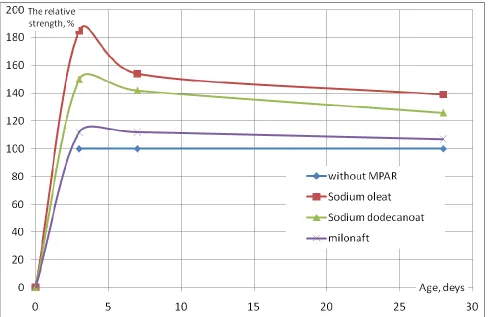
Figure 1. The influence of the type of surfactant on the value of the relative strength of concrete
Secondly, the characteristics of the surfactants used allow us to conclude that the most effective are aliphatic hydrophobic surfactants, which are capable of forming micelles (oleate and dodecanoate sodium) and have the longest hydrocarbon chain (oleate sodium). The presence of the smallest effect of nano-modification of concrete is determined by the use of cyclic surfactant (milonaft).
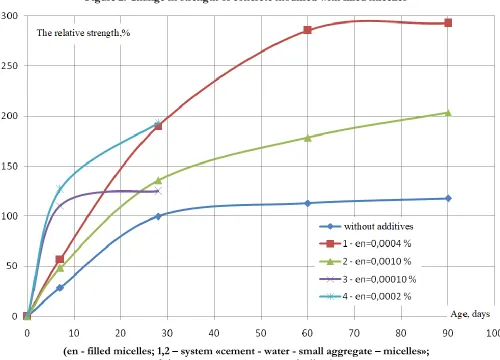
In the second stage of the studies conducted on the «cement – water» system and the system «cement – water – fine-filler», the effect of "classic" filled micelles introduced as nano-modifiers on the strength changes of such concretes was investigated. The first thing to note is the significant increase in the strength of artificial stones obtained as a result of solidification of the systems under study (Figure. 2).
The second thing to note is the low concentration of the filled micelles used and the optimum content of them.
4. Analysis
The effect of the type of hydrophobic surfactant can be explained by the mechanism of hydrophobic interactions in the system "water - hydrophobic surfactant". In general, water is a highly structured fluid with partial preservation of an ice-like tetrahedral openwork structure and the presence of unbound water molecules. The specific structure of water is the cause of hydrophobic interactions between non-polar molecules or radicals in an aqueous medium (solution). The term "hydrophobic interactions" was introduced by Kautzmann (Stid 2007) to describe the mutual attraction of non-polar groups in an aqueous medium.
Figure 2. Change in strength of concrete modified with filled micelles
(en - filled micelles; 1,2 – system «cement - water - small aggregate – micelles»; 3,4 - system «cement-water-micelles»)
These structural changes in water cause a low solubility of hydrocarbons in it, which is associated not with an increase in energy but with a decrease in entropy during dissolution. Hydrophobic hydration is found in the case of complex organic ions and molecules of a number of non-electrolytes. It is caused by the inhibitory action of dissolved particles on the translation motion of water molecules of solution. Unlike hydrophilic, hydrophobic hydration is not a consequence of enhanced interaction of water molecules and solute, but rather arises as a result of enhanced interaction between H2O molecules, thereby facilitating the structuring of free water. The collective movement of
water molecules in the spatial grid seeks to preserve their tetrahedral coordination, which characterizes the ability of water molecules to form an infinite branched cluster. This retains the structural heterogeneity of the hydrogen bond network, which is manifested in the uneven distribution in the space of molecules, the presence of "voids", which in size correspond to the water molecule.
To study the changes in the properties of the obtained aqueous suspensions of nano-modifiers, measurements were made of pH and electrical conductivity. The analysis of the obtained results shows that in a rather narrow range of concentrations of nano-modifiers (10-4 ... 10-6 %) the pH of the suspension of hydrophobic surfactants decreases.
The revealed effect can be explained only by taking into account the change of ionic product of water caused by sorption on the surface of nano-particles of hydrocarbon radicals. In the optimal concentration range (in our case, 10-4
... 10-6 %), a fractal bulk mesh is formed, which occupies the maximum volume in water, and a local change in the
Also, water, which is again formed as a result of a chemical reaction inside the system, will enhance the plasticization of the cement system as a whole. It should be emphasized that increasing the concentration of nano-modifier above a certain threshold leads to a decrease in its sorption capacity, which is caused by its own aggregation of active particles. Hydrophobic interactions are defined by both the Van Der Waals gravity of the non-polar groups themselves and the interactions of these groups with water, which are related to the structure of water. The main point in the theory of hydrophobic interactions, according to Scharage, is the idea that the number of hydrogen bonds, calculated per mole of water, is higher near the hydrocarbon molecule. The small amount of hydrophobic surfactant that leads to the established effect is explained by the theory of low doses (Burlakova E. B. 1994).
Third, the effect of nano-modification is much greater for fine-grained concrete than for the cement-water system. The driving force of the micelle formation process is the positive entropy of the process, which is due to the fact that when dissolved hydrocarbon radicals in the water around them structured areas of ice ("iceberg") water arise, which greatly reduces the small true solubility in the water of the hydrocarbons. An explanation of this effect is possible based on the mechanism of micellar catalysis. Micellar catalysis is the acceleration of chemical reactions in the presence of surfactant micelles, which is caused mainly by a change in the concentration of reactants during the transition of the reagents from solution to micelles.
5. Conclusions
The results of the conducted studies allow us to draw the following conclusions: The effect of surfactants on the compressive strength of concrete exceeds the influence of solid nano-modifiers, in particular carbon nano-tubes, silicon microxide and others. The most effective is the use of aliphatic hydrophobic surfactants capable of forming micelles is as nano-modifiers of concrete. When using aliphatic hydrophobic surfactants, which are able to form micelles as separate modifiers of concrete, their costs are 10-4 ... 10-6 % by weight of cement. At an early age, the
strength of concrete increases by 90%, and at the age of 28 days by 40%. The mechanism of action of modifiers of this type and application is to structure the water due to hydrophobic hydration and the "low dose effect". When using micelles of aliphatic hydrophobic surfactants filled with polymers, their content is 10-4 ... 10-6% by weight of cement. In this case, the strength of concrete at the age of 28 days is increased by 100 ... 200%.The mechanism of action of modifiers of this type and application is consistent with the mechanism of micellar catalysis and the "low dose effect". To increase the strength of concrete at an early age, it is advisable to use aliphatic hydrophobic surfactants as nano-modifiers, and to increase the strength of concrete later - filled micelles derived from aliphatic hydrophobic surfactants...
References
Burlakova E. B. (1994) Effekt sverhmalyih doz. Vestnik rossiyskoy akademii nauk. 64. 425 – 431
Derevyanko V. N., Grishko A. N.,. Moroz V. Yu. (2018) Vliyanie nanodobavok na gidratatsiyu gipsovyih vyazhuschih. Zbornik naukovih prats UkraYinskogo derzhavnogo universitetu zaliznichnogo transportu. 178. 88-97.
Maruschak U.D. (2019) Nanomodifikovani nadshvidkotverdnuchI tsementuyuchI sistemi ta visokofunktsionalni betoni na Yih osnovi. Natsionalniy universitet «Lvivska politehnika». 432.
Gamaliy E.A., Trofimov B.Ya., Kramar L.Ya. (2009) Struktura i svoystva tsementnogo kamnya, s dobavkami mikrokremnezema i polikarboksilatnogo plastifikatora. Vestnik YuUrGU.16.29-35
Puharenko, Yu.V., Aubakirova I.U., Staroverov V.D. (2009) Effektivnost aktivatsii vodyi zatvoreniya uglerodnyimi nanochastitsami. Inzhenerno-stroitelnyiy zhurnal. 1.40-45.
Shishkina A.A. (2015) Vliyanie mitselloobrazuyuschih PAV na svoystva betona. Visnik Odeskoyi derzhavnoyi akademsyi budsvnitstva ta arhsterkturi. 60. 359-364.
Skryishevskiy A.F. (1980) Strukturnyiy analiz zhidkostey i amorfnyih tel. Moscow. Vyisshaya shkola.328. Stid Dzh. V., Etvud Dzh. L. (2007) Supramolekulyarnaya himiya. Moscow. Akademkniga. 479.
Tevyashev, A.D., Shitikov E.S. (2009) O vozmozhnosti upravleniya svoystvami tsementobetonov s pomoschyu nano-modifikatorov. Vostochno-Evropeyskiy zhurnal peredovyih tehnologiy. 4/7 (40).35-40.