Federal Communications Law
Federal Communications Law
Journal
Journal
Volume 56 Issue 1 Article 5
12-2003
Is Federal Preemption Efficient in Cellular Phone Regulation
Is Federal Preemption Efficient in Cellular Phone Regulation
Thomas W. Hazlett
Columbia Institute for Tele-Information
Follow this and additional works at: https://www.repository.law.indiana.edu/fclj
Part of the Administrative Law Commons, Antitrust and Trade Regulation Commons, Communications Law Commons, Jurisdiction Commons, and the Legislation Commons
Recommended Citation Recommended Citation
Hazlett, Thomas W. (2003) "Is Federal Preemption Efficient in Cellular Phone Regulation," Federal Communications Law Journal: Vol. 56 : Iss. 1 , Article 5.
Available at: https://www.repository.law.indiana.edu/fclj/vol56/iss1/5
Thomas W. Hazlett*
I. INTRODUCTION ... 157
II. A BRIEF HISTORY OF THE WIRELESS TELEPHONE INDUSTRY ... 160
III. REGULATION AND THE TRADE-OFFS OF STATE VS. FEDERAL RE G ULATION ... 169
A Econom ic Regulation ... 169
B. The Federalism Debate ... 172
C. State vs. Federal Jurisdiction ... 174
D. Efficient Federal Preemption ... 177
E. Examples of Competition and Preemption ... 182
1. Corporation Charters ... 182
2. Food L abeling ... 183
3. T rucking ... 185
4. B roadband ... 189
FEDERAL COMMUNICATIONS LAW JOURNAL
F. Summary: Characteristic Elements for Preemption ... 192
IV. THE EFFICIENCY OF NATIONAL WIRELESS NETWORKS ... 193
A. Consolidation and Lower Prices ... 193
B. Consolidation and Improvements in Network Quality ... 202
V. FRAGMENTATION AND UNIFORMITY IN THE REGULATION OF W IRELESS PHONE SYSTEMS ... 203
VI. STATE VS. FEDERAL WIRELESS REGULATION: A NATURAL E XPERIM ENT ... 205
A. Federal Preemption and Deregulation of Cellular Rates in 19 9 4 ... 2 0 6 B. Aggregate National Price and Usage Trends ... 211
C. Cross Sectional Analysis of State Rate Regulations ... 214
D. Penetration in Deregulated States After Federal P reem p tion ... 2 15 E. Summary of the Natural Experiment ... 220
V II. C ONCLU SIO N ... 22 1 Appendix 1-Key FCC Findings Regarding Competition, Consolidation, and Regulation of Wireless Telephone N etw orks, 1995-2002 ... 225
Appendix 2-Comments from Investment Analysts on the Efficiency of National W ireless Networks ... 236
Increased regulation of wireless telephone service is being proposed by both federal and state policy makers, raising the question of optimal jurisdiction. The case for decentralization (state rules) is strongest when the economic activity being regulated is localized and market spillovers are relatively small. Alternatively, the case for uniformity (federal rules) becomes more persuasive when externalities dictate that efficiency in one state is closely tied to efficient arrangements in others. In this situation, balkanization becomes disruptive and federalism becomes ineffective as firms conform not to diverse standards, but in the best case scenario, to the most stringent ones. As an empirical matter, wireless telephony exhibits strong economies of scale and scope, and national networks have proven
crucial to industry development. Consolidation of fragmented license areas was, along with new entry, instrumental in reducing rates by seventy-nine percent during the 1993-2002 period.'
I.
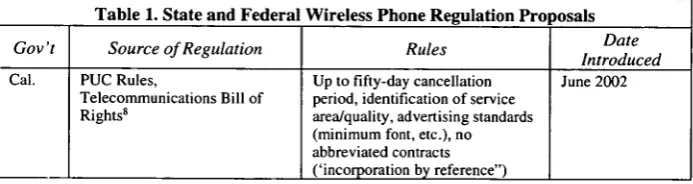
INTRODUCTIONSome states are considering new regulations for wireless telephone service.2 Alternatively, federal legislation has recently been introduced to achieve similar objectives.3 Proposed rules would potentially change marketing practices, alter the information conveyed in newspaper, radio, or TV ads, and stretch the "free trial" periods before "early termination fees" would kick-in (Table 1). The effect on consumers of such measures has been analyzed in previous research.' This paper discusses the policy arguments for determining such service rules on a state-by-state basis versus imposing federal regulatory standards.
Portions of this question have been decided in favor of federal jurisdiction, while other responsibilities have been given to state law. Cellular phone service fundamentally depends on spectrum policies enacted by the federal government. The basic market structure questions-how many firms compete, what technologies they use, questions-how much bandwidth they access, and how they interconnect with other networks-are consequently determined by the Federal Communications Commission ("FCC"). Moreover, the Omnibus Budget Reconciliation Act of 1993 established that "no State or local government shall have any authority to regulate the entry of or the rates charged by any commercial mobile service or any private mobile service."5 This effectively preempted state regulation
1. Average rates fell from $0.57 per minute in 1993 to $0.12 per minute in 2002. See
infra Table 3.
2. Jeffrey Silva, States Get Tougher on Wireless, RCR WIRELESs NEWS, Feb. 10, 2003 at 1.
3. See, e.g., S. 1216, 108th Cong. § 1 (2003); see also Press Release, Senator Charles E. Schumer, Schumer Unveils First Comprehensive Cell Phone User Bill of Rights (Feb. 25, 2003), available at http://schumer.senate.gov/SchumerWebsite/pressroom/press-releases/ PRO1504.html.
4. See Thomas W. Hazlett, Regulating Wireless Phones in California: An Economic Analysis, (Apr. 9, 2003), available at http://www.pacificresearch.org/events/2003/wireless/ HazlettPaper.pdf.
FEDERAL COMMUNICATIONS LAW JOURNAL
of cellular rates with a one-year phase-in, meaning that there has been no federal or state regulation of wireless telephone charges since August, 1994.
In the 1993 federal preemption statute, however, states were left with jurisdiction over "other terms and conditions of commercial mobile services."6 How much regulatory authority this cedes to the states is legally uncertain.7 In equilibrium, it appears clear that there will be some shared responsibilities, with federal jurisdiction for key economic regulations including spectrum-related issues, and state authority over matters that are traditionally decentralized, such as the resolution of contractual disputes in municipal and state courts.
The question addressed in this paper is where, as a matter of public policy, to draw the line regarding the consumer protection regulations currently under consideration. From the perspective of consumer welfare, and assuming a possible role for regulatory standards, would the standards be most efficiently evaluated and applied by the several states or at the federal government level?
Table 1. State and Federal Wireless Phone Regulation Proposals
Gov't Source of Regulation Rules Date
Introduced
Cal. PUC Rules, Up to fifty-day cancellation June 2002 Telecommunications Bill of period, identification of service
Rights8 area/quality, advertising standards (minimum font, etc.), no abbreviated contracts ('incorporation by reference")
THE NATIONAL INFORMATION INFRASTRUCTURE 209 (1995). In addition, federal law preempted states from levying property taxes on wireless phone licenses, 47 U.S.C. § 332(c)(3)(A).
6. 47 U.S.C. § 332(c)(3)(A).
7. For an excellent discussion of these issues, see Leonard J. Kennedy and Heather A. Purcell, Section 332 of the Communications Act of 1934: A Federal Regulatory Framework That Is "Hog Tight, Horse High, and Bull Strong," 50 FED. COMM. L.J. 547 (1998).
8. Cal. Pub. Utils. Comm'n, Telecommunications Bill of Rights, (2003), available at http://www.cpuc.ca.gov/static/Industry/Telco/030723borwooddraftdec.doc. This is a draft of revised and, in some cases, scaled-back proposed regulations. The issues are still under discussion.
9. Cal. Pub. Utils. Comm'n, Order Instituting Rulemaking on the Commission's Own Motion into the Service Quality Standards for All Telecommunications Carriers and Revisions to General Order 133-B, Rulemaking No. 02-12-004, (Dec. 5, 2002), available at http://www.cpuc.ca.gov/word-pdf/rulings/23232.pdf.
10. Cal. S.B. 128, 2003-2004 Gen. Leg. Sess. (Cal. 2003), available at http://www.leginfo.ca.gov/pubfbill/sen/sb_01010150/sb128bill-20030310_amendedsen. pdf.
11. H.F. 2322, 79th Gen. Assem., Reg. Sess. (Iowa 2002), available at http://www.legis.state.ia.us/cgi-bin/Legislation/File-only.pl?FILE=/usr/nshome/docs/GA/ 79GA/Legislation/HF/02300/HF02322/020213.html.
12. S.B. 288, 2003 Leg., 417th Sess. (Md. 2003), available at http://mlis.state.md.us/ 2003rs/bills/sb/sb0288f.rtf.
13. A.B. 889, 2001-2002 Leg., Reg. Sess. (Wis. 2002), available at http://www.legis.state.wi.us/200 1/data/AB-889.pdf.
14. S. 3750, 2003-2004 State Assem., Reg. Sess. (N.Y. 2003), available at http://assembly.state.ny.us/leg/?bn=S03750&sh=t.
15. S. 1216, 108th Cong. § 1 (2003).
16. Rules and Regulations Implementing The Telephone Consumer Protection Act of 1991, Report and Order, 18 F.C.C.R. 14014, paras. 160-172, 29 Comm. Reg.2d (P & F) 830 (2003).
Cal. PUC Rule R 02-12-0049 Government testing of networks December 2002 for quality of service
Cal. Senate Bill 128'" Thirty-day trial period for new February 2003 subscribers
Iowa House File 2322" Limits on contract length, February 2002 enhanced ability to break contract
Md. Senate Bill 28812 Service quality standards, January 2003 regulated disclosure of contract
terms, fourteen-day trial period
Wis. Assembly Bill 889'3 Number portability (phone March 2002 numbers transfer to carrier
selected by subscriber), bundled with emergency service rules
(dropped at end of session)
N.Y. Senate Bill 37504 Disclosure of service area April 2003
U.S. Senate Bill 1216: Disclosure of contract terms in June 2003 Cell Phone Users Bill of uniform format with font size
Rights5 minimum, disclosure of coverage areas, FCC monitoring of network quality, number portability by late
2003
U.S. FCC Docket No. 95-1161 Wireless telephone number July 1996 portability, after several delays,
FEDERAL COMMUNICATIONS LA W JOURNAL
Two broad sets of marketplace evidence help to answer this question, and both suggest that federal jurisdiction is relatively efficient. The first concerns the efficiency of national scope in wireless networks. The economics of wireless telephony suggest that regardless of the jurisdiction selected for rulemaking, diverse local rules will not effectively determine standards. Rather, nationally integrated network operators will choose to conform to those regulations that allow them the best opportunity to offer nationwide service. This undermines incentives for states to create efficent rules. Either such rules will have little practical impact, or they will create large external effects, meaning that they impact consumers and suppliers outside the political jurisdiction where policies are crafted. Such effects are typically discounted in the decisions of policymakers, resulting in rules that are relatively inefficient. The second set of data is derived from a natural experiment involving a 1994 federal preemption of cellular rate regulation by the states. State controls demonstrably failed to lower rates for customers. Nonetheless, strenuous arguments were made at the time by several state regulatory commissions that such controls were efficient and should be permitted to continue. This speaks directly to the effectiveness of state regulation of wireless telephone service.
This paper proceeds as follows: Section II sketches a very brief history of the wireless telephone industry. Section III summarizes the general arguments for and against federal preemption in economic regulation. These include examples from other sectors where diverse state rules are efficient and from where uniform federal standards have proven efficient. Section IV investigates the economics of wireless telephone service, producing the key finding that consolidation of an atomistic licensing grid through mergers and operating agreements has produced efficient national networks. This is the service that consumers have demonstrated a keen interest in purchasing. Section V discusses the importance of national wireless network economies in light of the trade-offs generally associated with regulatory federalism. Section VI examines results from a natural experiment wherein state regulation of cellular telephone rates was preempted in 1994. Section VII concludes that the weight of the evidence argues in favor of substantial federal preemption in wireless telephone regulation.
II. A
BRIEF HISTORY OF THE WIRELESS TELEPHONE INDUSTRYA basic description of the wireless telephone industry will aid in the discussion of regulatory options. Cellular phone service began with the
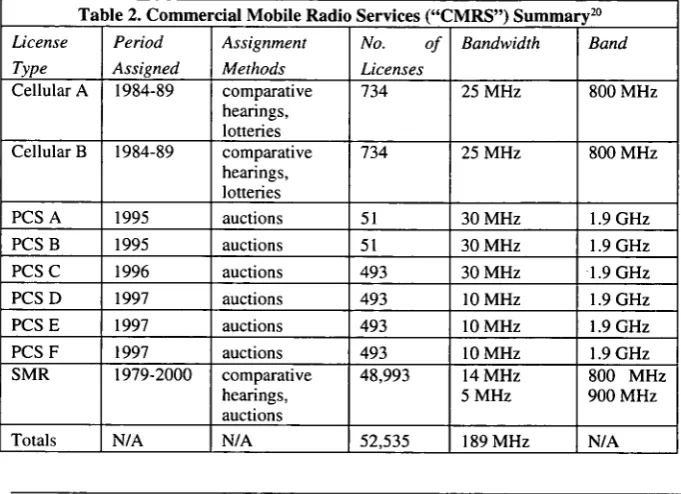
issuance of two competing licenses, mostly by lottery, in each of 306 Metropolitan Service Areas ("MSAs"), between 1984 and 1986, and in 428 Rural Service Areas, between 1988 and 1989.17 This was the result of a rulemaking process formally initiated by the FCC in 1968.18 The long delays involved regulatory debate over many issues, including how many companies should be licensed and how much spectrum should be allocated for use. The FCC, on an assumption of natural monopoly, initially decided to license just one operator but became persuaded that some competition was possible and that licensing two rivals in each service area would still allow for economies of scale to be realized by each. It allocated various increments of bandwidth, finally deciding to allot 25 MHz (about the same used for four television channels) to each license, with the frequencies to be in the UHF band reallocated from TV channels 70-83.9
17. Thomas W. Hazlett & Robert J. Michaels, The Cost of Rent-Seeking: Evidence from Cellular Telephone License Lotteries, 59 S. ECON. J. 425, 427 (1993). Experimental licenses were issued in Chicago and Washington, D.C., where commercial cellular services commenced in 1983. Wireless commercial phone service actually dates to 1946, but the high-power systems had very little capacity. Cellular employs much lower power, yielding reuse of frequencies from cell to cell, and hence provides the capacity for much more traffic. L. KETA Ruiz, TOWARD A COMPETITIVE TELECOMMUNICATION INDUSTRY: SELECTED PAPERS FROM THE 1994 TELECOMMUNICATIONS POLICY RESEARCH CONFERENCE 14-15 (Gerald W. Brock ed., 1995).
18. Land Mobile Use of 806-960 MHz Band, Notice of Inquiry and Notice of Proposed Rulemaking, 14 F.C.C.2d 311 (1968); see also Part 2-Frequency Allocation and Radio Treaty Matters; General Rules and Regulations, 35 Fed. Reg. 8644 (June 4, 1970); GEORGE CALHOUN, DIGITAL CELLULAR RADIO 45-49 (1988).
19. An Inquiry Relative to the Future Use of the Frequency Band 806-960 MHz, First Report and Order and Second Notice of Inquiry, 19 Rad. Reg.2d (P & F) 1663 (1970); see
FEDERAL COMMUNICATIONS LAW JOURNAL
Table 2. Commercial Mobile Radio Services ("CMRS") Summary20 License Period Assignment No. of Bandwidth Band Type Assigned Methods Licenses
Cellular A 1984-89 comparative 734 25 MHz 800 MHz hearings,
lotteries
Cellular B 1984-89 comparative 734 25 MHz 800 MHz hearings,
lotteries
PCS A 1995 auctions 51 30 MHz 1.9 GHz
PCS B 1995 auctions 51 30 MHz 1.9 GHz
PCS C 1996 auctions 493 30 MHz 1.9 GHz
PCS D 1997 auctions 493 10 MHz 1.9 GHz
PCS E 1997 auctions 493 10 MHz 1.9 GHz
PCS F 1997 auctions 493 10 MHz 1.9 GHz
SMR 1979-2000 comparative 48,993 14 MHz 800 MHz
hearings, 5 MHz 900 MHz
auctions
Totals N/A N/A 52,535 189 MHz N/A
20. See Wireless Telecomm. Bureau, FCC, Cellular Market Areas: Metropolitan Statistical Areas and Rural Service Areas, at http://wireless.fcc.gov/auctions/data/maps/ rsamsa.pdf (showing 734 franchise areas) (last visited Dec. 18, 2003); Wireless Telecomm. Bureau, FCC, Licensing, at http://wireless.fcc.gov/services/cellular/1icensing/ (explaining that one "A" and one "B" license were initially authorized in each franchise area, with overlapping licenses for unbuilt sub-areas assigned by competitive bidding) (last modified Oct. 23, 2002); Wireless Telecomm. Bureau, FCC, Auction 4: Broadband PCS A and B Block, Fact Sheet, at http://wireless.fcc.gov/auctions/04/factsheet.html (last modified Sept. 8, 2003); Wireless Telecomm. Bureau, FCC, Auction 5: Broadband PCS C Block, Fact Sheet, at http://wireless.fcc.gov/auctions/05/factsheet.html (last modified Sept. 8, 2003); Wireless Telecomm. Bureau, FCC, Auction 11: Broadband PCS D, E, & F, Fact Sheet at http://wireless.fcc.gov/auctions/l1/factsheet.html (last modified Oct. 6, 2003); Wireless Telecomm Bureau, FCC, Broadcast PCS: Bandplan, at http://wireless.fcc.gov/services/ broadbandpcs/data/bandplan.html (last modified Apr. 11, 2003); Wireless Telecomm. Bureau, FCC, Cellular Services: Bandplans, at http://wireless.fcc.gov/services/cellular/ data/bandplan.html (last modified June 6, 2002). The SMR License Count, which changes daily, was obtained November 10, 2003 by searching the Universal Licensing System, at http://wireless2.fcc.gov/UlsApp/UlsSearch/searchAdvanced.jsp [hereinafter Universal Licensing Sytem].
It should be noted that three of the PCS A and B licenses (102 total) were awarded by pioneer's preference, meaning that auctions were not used. Also, C and F Block PCS licenses were assigned via auctions as noted, but winners of many of the licenses declared bankruptcy. The winner of the largest number of licenses, NextWave, was the subject of bankrupcy litigation until a Supreme Court ruling in early 2003. FCC v. NextWave Personal Comms., 254 F.3d 130 (D.C. Cir. 2001), affd by 537 U.S. 293 (2003).
The potential of wireless telephone service was vastly underestimated. Through the mid-to-late-1980s, prices for actively traded cellular licenses increased almost monotonically. Beginning trades were just $12 "per POP" (price of the license divided by total population in the market area covered by the license), but by 1988, prices exceeded $135.21
By 1990, the aggregate nationwide value of the licenses just in the MSAs (covering about eighty percent of U.S. population) was estimated at close to $80 billion by the U.S. Department of Commerce.2 These large market capitalizations were driven by reinforcing trends within the sector, including strong customer demand for wireless phone service, enhanced network coverage, rapidly falling handset costs, and rapidly increasing handset functionality (including miniaturization and increased battery life).
Prices were much higher than fixed line service, however, and they had exhibited no substantial decline since the initiation of cellular systems.23 The duopoly market structure imposed on the industry had established reasonable service, but it was expensive and extremely fragmented owing to the FCC's 734-market licensing grid. This would change as competition and consolidation dramatically restructured the industry.
Entry was primarily achieved in two regulatory proceedings, the most important being for personal communications services ("PCS"). PCS used smaller cells than traditional cellular systems, as well as digital formats that improved capacity and performance.24 Formally initiated in 1990, the Commission allocated 120 MHz to six new licenses in the 1.9 GHz band. Two licenses (PCS-A and PCS-B) were allocated 30 MHz each and issued in each of 51 Major Trading Areas ("MTAs").25 These licenses were
21. Hazlett & Michaels, supra note 17, at 429.
22. NAT'L TELECOMM. & INFO. ADMIN., U.S. DEP'T OF COMMERCE, U.S. SPECTRUM MANAGEMENT POLICY: AGENDA FOR THE FUTURE D-5 (199 1).
23. "There has been a rapid growth of cellular subscribers, due to reduction in equipment costs, even though service prices have not fallen very much." Ruiz, supra note
17, at 15.
24. DAVID P. REED, PUTING IT ALL TOGETHER: THE COST STRUCTURE OF PERSONAL COMMUNICATIONS SERVICES 18-19, 64 (Office of Plans and Policy, FCC, Working Paper No. 28, 1992), available at http://www.fcc.gov/Bureaus/OPP/working-papers/oppwp28.pdf.
FEDERAL COMMUNICATIONS LAW JOURNAL
auctioned, pursuant to new federal legislation, in 1995.6 Four remaining PCS licenses were assigned in each of 493 Basic Trading Areas ("BTAs").27 PCS-C was allocated 30 MHz, the rest (PCS-D, PCS-E, and PCS-F) were allocated 10 MHz each. Auctions for these licenses were held in 1996 and 1997.28 With simultaneous auctions, PCS bidders could aggregate permits to create regional or national service territories, as Sprint PCS did, for example, in winning licenses covering close to the entire country.
Reg.2d (P & F) 1477 (1993); Redevelopment of Spectrum to Encourage Innovation in the Use of New Telecomm. Techs., 9 F.C.C.R. 1943, 74 Rad. Reg.2d (P & F) 1042 (1994).
26. See Wireless Telecomm. Bureau, FCC, Auction 4: Broadband PCS A and B Block, at http://wireless.fcc.gov/auctions/04/ (last modified July 25, 2003); Press Release, FCC, FCC Grants 99 Licenses for Broadband Personal Communications Services in Major Trading Areas (June 23, 1995), available at http://www.fcc.gov/Bureaus/Wireless/ NewsReleases/1995/nrw15027.txt.
27. See FCC, Wireless Telecomm. Bureau, Auction 22: C, D, E, and F Block Broadband PCS at http://wireless.fcc.gov/auctions/22/factsheet.html (last modified on Oct. 20, 2003).
28. Bankruptcy disputes arose with respect to many PCS-C licenses, and more than eighty percent of these licenses (adjusted for population) were as yet undeployed as of July 1, 2003. See Thomas W. Hazlett and Babette E.L. Boliek, Use of Designated Entity Preferences in Assigning Wireless Licenses, 51 FED. COMM. L.J. 639, 649 (1999); see also Carmen Nobel, Sitting Pretty at Last, EWEEK 26 (June 2, 2003), available at http://www.eweek.com/print-article/0,3668,a=42693,00.asp.
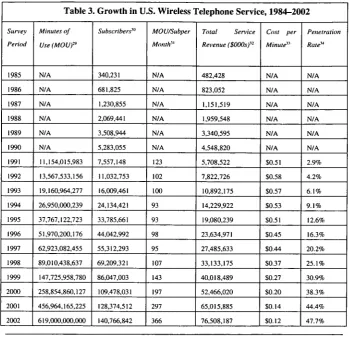
Table 3. Growth in U.S. Wireless Telephone Service, 1984-2002
Survey Minutes of Subscribers0 MOU/Subper Total Service Cost per Penetration Period Use (MOU)2'9 Month" Revenue ($O00s)2 Minute" Rate'
1985 N/A 340,231 N/A 482,428 N/A N/A
1986 N/A 681,825 N/A 823,052 N/A N/A
1987 N/A 1,230,855 N/A 1,151,519 NIA N/A 1988 N/A 2,069,441 N/A 1,959,548 N/A N/A
1989 N/A 3,508,944 N/A 3,340,595 N/A N/A
1990 N/A 5,283,055 N/A 4,548,820 N/A N/A
1991 11,154,015,983 7,557,148 123 5,708,522 $0.51 2.9%
1992 13,567,533,156 11,032,753 102 7,822,726 $0.58 4.2%
1993 19,160,964,277 16,009,461 100 10,892,175 $0.57 6.1%
1994 26,950,000,239 24,134,421 93 14,229,922 $0.53 9.1%
1995 37,767,122,723 33,785,661 93 19,080,239 $0.51 12.6%
1996 51,970,200,176 44,042,992 98 23,634,971 $0.45 16.3%
1997 62,923,082,455 55,312,293 95 27,485,633 $0.44 20.2%
1998 89,010,438,637 69,209,321 107 33,133,175 $0.37 25.1%
1999 147,725,958,780 86,047,003 143 40,018,489 $0.27 30.9%
2000 258,854,860,127 109,478,031 197 52,466,020 $0.20 38.3%
2001 456,964,165,225 128,374,512 297 65,015,885 $0.14 44.4%
2002 619,000,000,000 140,766,842 366 76,508,187 $0.12 47.7%
29. CELLULAR TELECOMM. & INTERNET Ass'N, CTIA's WIRELESS INDUSTRY INDICES SEMI-ANNUAL DATA SURVEY RESULTS: A COMPREHENSIVE REPORT FROM CTIA YEAR-END 2001 RESULTS, AN ANALYSIS OF THE U.S. WIRELESS INDUSTRY 192-93, table 107 (Aug. 2002) [hereinafter CTIA SURVEY].
30. Id. at 33, table 11. The 1984 data includes the number of subscribers as of January 1985. The 1985-2002 data was reported in December of each year.
31. The minutes of use per month were calculated using the data from the CTIA
Survey, dividing the total minutes of use per year by the total number of subscribers. That
figure was then divided by 12.
32. CTIA SURVEY, supra note 29, at 70, table 27. The data representing 1984 in this chart is from the January 1985 data. The 2002 figure is the sum of the June 2002 and December 2002 data.
33. The cost per minute was calculated using data from the CTIA Survey, dividing total service revenue by minutes of use.
FEDERAL COMMUNICATIONS LAW JOURNAL
PCS licensees began constructing competing wireless telephone systems just as Fleet Call, now Nextel, was deploying a nationwide wireless network using Specialized Mobile Radio ("SMR") licenses. The plan actually used licenses for local dispatch services (taxis, pizza delivery, etc.), which by means of a strategic regulatory waiver, were permitted to provide wireless phone competition.3" By accumulating thousands of
licenses for such localized services and creating a national network with the right to offer service to the general public, a new coast-to-coast wireless competitor was created.
35. The entrepreneurial vision driving Nextel was provided by a former FCC attorney, Morgan O'Brien. See Thomas W. Hazlett, The Wireless Craze, the Unlimited Bandwidth
Myth, the Spectrum Auction Faux Pas, and the Punchline to Ronald Coase's "Big Joke": An Essay on Airwave Allocation Policy, 14 HARV. J.L. & TECH. 335, at 426-428 (2001).
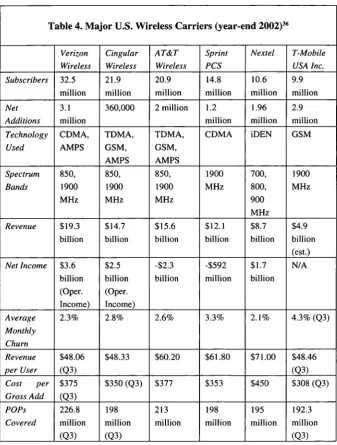
Table 4. Major U.S. Wireless Carriers (year-end 2002)36
Verizon Cingular AT&T Sprint Nextel T-Mobile Wireless Wireless Wireless PCS USA Inc. Subscribers 32.5 21.9 20.9 14.8 10.6 9.9
million million million million million million
Net 3.1 360,000 2 million 1.2 1.96 2.9
Additions million million million million Technology CDMA, TDMA, TDMA, CDMA iDEN GSM
Used AMPS GSM, GSM,
AMPS AMPS
Spectrum 850, 850, 850, 1900 700, 1900
Bands 1900 1900 1900 MHz 800, MHz
MHz MHz MHz 900
MHz
Revenue $19.3 $14.7 $15.6 $12.1 $8.7 $4.9
billion billion billion billion billion billion (est.) Net Income $3.6 $2.5 -$2.3 -$592 $1.7 N/A
billion billion billion million billion (Oper. (Oper.
Income) Income)
Average 2.3% 2.8% 2.6% 3.3% 2.1% 4.3% (Q3) Monthly
Churn
Revenue $48.06 $48.33 $60.20 $61.80 $71.00 $48.46
per User (Q3) (Q3)
Cost per $375 $350 (Q3) $377 $353 $450 $308 (Q3) Gross Add (Q3)
POPs 226.8 198 213 198 195 192.3
Covered million million million million million million
(Q3)
(Q3)
(Q3)FEDERAL COMMUNICATIONS LAW JOURNAL
Ironically, just as entry was deconcentrating the industry, hundreds of mergers were stitching together regional and national networks. These reinforced the roaming agreements and joint ventures that had been launched to create mobile services, giving customers the ability to move with their telephones and yet receive cellular service through far-ranging local connections.37
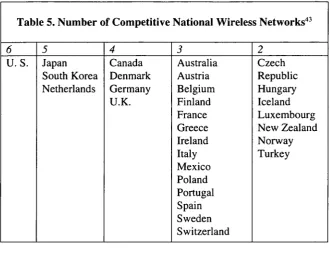
By 2001, when merger activity hit a lull,38 six national networks-AT&T Wireless, Cingular (joint venture of SBC and BellSouth), Nextel, Sprint PCS, T-Mobile (Deutsche Telekom), and Verizon Wireless-emerged dominant, accounting for about eighty-five percent of U.S. subscribers.39 But out of the consolidation arose competition, as no other country supports more competing networks.4" This rivalry has resulted in a sharp decline in wireless telephone charges, with the average price per minute of use declining seventy-nine percent between 1993 and 2002. In response, total minutes of use have increased more than twenty-fold during this period.4 Intense competitive pressure has made profits elusive, a situation investment analysts describe as "Profitless Prosperity,"42 and efficiency gains are apparent.
37. Table 4, supra, lists the networks resulting from these combinations.
38. Ironically, major merger activity in wireless ceased just as the FCC "spectrum cap" was relaxed. The old rule limited operators to licenses allocated no more than 45 MHz in any one market (with only small overlaps exceeding this amount). This prohibited the combination of a cellular license with a PCS-A, PCS-B, or PCS-C license in any given market. The cap was relaxed to 55 MHz in 2001 and abolished in January 2003, although federal antitrust scrutiny remains. See 2000 Biennial Reg. Review Spectrum Aggregation Limits For Commercial Mobile Radio Servs., Notice of Proposed Rulemaking, 16 F.C.C.R. 2763, para. 2, 25 Comm. Reg. (P & F) 2031 (2001).
39. See Craig A. Mallitz & Tahmin 0. Clarke, Legg Mason, The Wireless Industry Scorecard, EQUITY RESEARCH INDUS. ANALYSIS, 4Q 2002, at 70. [hereinafter Wireless
Scorecard, 4Q 2002]. 40. See infra Table 5.
41. See supra Table 3.
42. Simon Flannery et al., Morgan Stanley, 3Q02 Preview: The Song Remains the
Same, WIRELINE TELECOM SERVS. Oct. 16, 2002, at 27.
Table 5. Number of Competitive National Wireless Networks43
6 5 4 3 2
U. S. Japan Canada Australia Czech
South Korea Denmark Austria Republic
Netherlands Germany Belgium Hungary
U.K. Finland Iceland
France Luxembourg
Greece New Zealand
Ireland Norway
Italy Turkey
Mexico Poland Portugal Spain Sweden Switzerland
III.
REGULATION AND THE TRADE-OFFS OFSTATE VS. FEDERAL JURISDICTION
A. Economic Regulation
Government regulation provides two possible forms of protection for consumers, both related to the concept of market failure." The first is to constrain monopoly pricing, countering inefficient distortions from competitive outcomes. When successful, regulation can lower prices and increase output. This increases social welfare by producing greater value for a given complement of labor and capital.
The second general aim of economic regulation is to remedy externality problems. These develop when costs or benefits do not accrue
43. Sean P. Butson & Craig A. Mallitz, Legg Mason, What's Next for Wireless: A
Roadmap for Wireless Investors, EQUITY RESEARCH INDUS. ANALYSIS Jan. 2001, at 30
[hereinafter What's Next for Wireless].
FEDERAL COMMUNICATIONS LAW JOURNAL
to the decision makers who cause them and are external to economic calculations. This results in a misallocation of resources, yielding pollution and various public good problems. This latter situation develops when efficient economic activities fail to take place because payoffs cannot be captured by those who would shoulder the costs of provision. Free-rider problems deny consumers useful products. National defense, pollution abatement, and creative works of art are valuable services that would presumably be underproduced without government policies (including
subsidies and intellectual property rights) to offset free-rider effects.
Regulation, of course, is neither free nor perfect. Market failure, therefore, does not present an automatic case for policy intervention, which is not a deux ex machina. Market failure is necessary in an argument for government regulation, but it is insufficient without a convincing case that regulation will itself produce net consumer benefits.45 Even when market failure has been addressed by, for instance, rate regulation of monopoly cable television systems, policy remedies can prove counterproductive.4 6 The case for regulation fundamentally depends on the likelihood of
increased consumer welfare.
Market power is not a compelling rationale for wireless telephone regulation. Cellular telephone markets were dominated by duopoly licensees, and market power clearly existed.47 But with the emergence of PCS and enhanced specialized mobile radio ("ESMR") competition and the emergence of six strong national networks48 which aggressively rival each other, government regulators have declared the market to be highly competitive. In abolishing the "spectrum cap," effective January 2003, federal regulators certified that market rivalry was effectively protecting consumers from excessive prices.49
45. Charles Wolf, Jr., A Theory of Nonmarket Failure: Framework for Implementation
Analysis, 22 J.L. & ECON. 107 (1979).
46. THOMAS W. HAZLET-r & MATTHEW L. SPITZER, PUBLIC POLICY TOWARD CABLE TELEVISION: THE ECONOMICS OF RATE CONTROLS 208-12 (1997).
47. Thomas W. Hazlett, Market Power in the Cellular Telephone Duopoly 1-2 (Aug. 1993) (paper submitted to the FCC on Behalf of Time Warner Telecommunications)(on file with the Journal).
48. The six networks are: AT&T Wireless, Verizon Wireless, Cingular, Sprint PCS, Nextel, and T-Mobile. See supra note 39 and accompanying text.
49. "Various indicators confirm the presence of meaningful economic competition in markets for CMRS." 2000 Biennial Reg. Review Spectrum Aggregation Limits For Commercial Mobile Radio Servs., Report and Order, 16 F.C.C.R. 22668, para.30 (2001).
The case for efficient government regulation in wireless must point to market failure in the supply of consumer information. Consumers make choices based on their preferences and product expectations. The data on which purchasing decisions are based flows from a variety of sources: experience and research by the consumer, marketing campaigns waged by sellers, reputational capital of sellers, publicity and product evaluations provided by news organizations and third parties, and word of mouth.
In some instances, however, reliable information is underprovided because suppliers are not remunerated for supplying it. Alternative market mechanisms for discovering which products best satisfy preferences are available, but they may leave a gap unfilled. The rationale for government regulation is then to encourage the supply of valuable information that consumers would gladly pay the market cost of providing.5 0
One particularly important rationale for government regulation arises under the externality rubric in the context of fly-by-night operations. When firms supply goods without sinking capital, they may be tempted to cheat on performance. This behavior may include misleading advertising, hidden charges, or the delivery of goods or services that are less valuable than anticipated by the customer.5' In advantageous circumstances for such supply-side opportunism, cheating vendors may be able to escape with profits, as consumers have difficulty in identifying such behavior prepurchase. A legal intervention to improve quality ascertainment, perhaps through means such as direct regulation or binding rules that force
firms to commit irreversible investment capital, may improve efficiency. In wireless telephone service, opportunism is relevant to the regulatory discussion in an interesting way. Wireless network owners commit very substantial resources to establishing infrastructure; these assets will only prove profitable where long-run economic viability is maintained. These sellers are unlikely to fly by night, leaving enormous capital assets behind.52 This makes the argument for regulatory intervention
50. See W. Kip VISCUSI, ET AL., ECONOMICS OF REGULATION AND ANTITRUST (3d ed. 2000) (discussing the arguments for economic regulation).
51. Benjamin Klein & Keith Leffler, The Role of Market Forces in Assuring Contractual Performance, 89 J. POL. ECON. 615 (1981).
FEDERAL COMMUNICATIONS LA W JOURNAL
weaker than in services where market forces do not similarly punish opportunistic behavior by sellers. Yet, this is where the debate over new rules for wireless is occurring. This paper, however, is not concerned with the substantive merits of the arguments for regulation, but with the issue of optimal jurisdiction.
B. The Federalism Debate
Federalism is a system wherein governmental responsibilities occur at multiple levels, with power not being entirely centralized or decentralized. The United States is perceived as a federalist experiment due to its relatively heavy use of overlapping jurisdictions, from mosquito abatement districts to the U.S. Government. The European Union has centralized some important rulemaking authority to regulate economic activity in sovereign states, making it a federalist experiment of a different character.
Federalism has been described as a balancing act, "the approach to governance that seeks to combine unity and diversity."53 The compromise prompts heated debates over where to allocate authority for specific policies. Two famous positions were staked out by Supreme Court Justices Louis Brandeis and Oliver Wendell Holmes. Justice Brandeis celebrated the diversity of state jurisdiction, observing that "[it is one of the happy incidents of the federal system that a single courageous State may, if its citizens choose, serve as a laboratory; and try novel social and economic experiments without risk to the rest of the country."5 4
The reverse angle was captured by Justice Holmes, however, who focused on the importance of rationalizing disparate regulations under unified national law:
I do not think the United States would come to an end if we lost our power to declare an Act of Congress void. I do think the Union would
business model. Hence, the capital value at stake in preserving a reputation in the market for retail services is also likely to be substantial.
53. John Kincaid, Values and Value Tradeoffs in Federalism, PUBLIUS, Spring 1995, at 29, 30.
54. New State Ice Co. v. Liebmann, 285 U.S. 262, 311 (1932) (Brandeis, J., dissenting). This 1932 case concerned an Oklahoma law licensing ice distributors. Brandeis thought it best to let Oklahoma experiment with a rule that restricted competition, but the majority overturned it as economic regulation violating the 14th Amendment's equal protection clause. Cf Michael S. Greve, Laboratories of Democracy: Anatomy of a Metaphor, AEI FEDERALIST OUTLOOK (2001) (analyzing the trade-offs between constitutionalism and federalism in the context of Brandeis's dissent in New State Ice Co.), available at http://www.federalismproject.org/outlook/5-2001 .html.
be imperiled if we could not make that declaration as to the laws of the several States. For one in my place sees how often a local policy prevails with those who are not trained to national views and how often action is taken that embodies what the Commerce Clause was meant to end.55
Across the globe such arguments rage. The formation of the European Union and the restructuring of post-Communist governments have generated heated debate on the extent of local versus national or international authority.6 Decentralization in legal authority is beneficial because it allows diverse rules to spring up, be tested, and adopted according to what appears to work best. Uniformity in rules, on the other hand, offers the efficiencies of standardization.
Economist Barry Weingast writes:
For most of the last 300 years, the richest nation in the world has had a federal structure: the Netherlands from the late 16th through mid-17th century, England from the late 17th or early 18th through the mid-19th century, and the United States from the late 19th century until the late 20th century.57
Weingast argues that the well-developed federal systems found in these economies helped limit politicization of market transactions, spurring wealth creation.58 Historian Paul Johnson finds that America has far more
political jurisdictions than any other country in the world, and he sees this governmental diversity as important in understanding both the political and economic success of the United States.5 9
55. Kennedy & Purcell, supra note 7, at 548 (quoting Oliver Wendell Holmes, Law and
the Court, in COLLECTED LEGAL PAPERS 291, 296 (1920)).
56. John Kincaid observes:
The European Union ... reflects emerging governance issues in a world in which peoples and places have become closely connected by technology, and in which individuals have been made more mobile by that technology, both physically and electronically. The need for international governance arrangements has become more apparent, even while pressures for local self-government by discrete peoples in distinct places have become more strident. Hence, there is the seeming paradox of global integration and regional fragmentation occurring simultaneously.
Kincaid, supra note 53, at 29-30.
57. Barry R. Weingast, The Economic Role of Political Institutions: Market-Preserving Federalism and Economic Development, 11 J.L. ECON. & ORG. 1, 3 (1995).
58. See id.; see also Charles M. Tiebout, A Pure Theory of Local Expenditures, 64 J. POL. ECON. 416 (1956).
FEDERAL COMMUNICATIONS LAW JOURNAL
On the other hand, eliminating state-level trade barriers via federal preemption can create a productive "common market," erasing impediments to efficiency. Constitutional scholar Archibald Cox cites
Gibbons v. Ogden6" as one of the most important Supreme Court decisions
in U.S. history.6 By striking down a New York law monopolizing steamship routes within the state, the Court protected interstate commerce. The Court's decision preempted state regulations that would "hamper the development of one great continentwide, free-trade market," a fundamental condition for America's economic success.62 "Commerce among the
states," Chief Justice John Marshall declared, "cannot stop at the external boundary line of each State. but may be introduced into the interior."63 Weingast's "market-preserving federalism" carefully includes the caveat that local jurisdictions need to be constrained by a "common market... preventing the lower governments from using their regulatory authority to erect trade barriers. ... "64
C. State vs. Federal Jurisdiction
The question of optimal jurisdiction commonly arises in the United States when overlapping regulatory interests are present, as in antitrust law,65 cable television regulation,66 food labeling,67 as well as in wireless
60. Gibbons v. Odgen, 22 U.S. (9 Wheat.) 1 (1824).
61. ARCHIBALD Cox, THE COURT AND THE CONSTITUTION 84-89 (1987). 62. Id. at 85.
63. Id. at 88 (quoting Gibbons, 22 U.S. at 194).
64. Weingast, supra note 57, at 4 (emphasis omitted). Similarly, in outlining the theoretical case for federalism, economist James Buchanan notes:
[In] a genuinely competitive federalism... the central or federal government would be constitutionally restricted in its domain.... Within its assigned sphere, however, the central government would be strong, sufficiently so to allow it to enforce economic freedom or openness over the whole of the territory. The separate states would be prevented, by federal authority, from placing barriers on the free flow of resources and goods across their borders.
James M. Buchanan, Federalism As an Ideal Political Order and an Objective for
Constitutional Reform, PUBLIUS, Spring 1995, at 19, 21.
65. See ROBERT H. HAHN & ANNE LAYNE-FARRAR, FEDERALISM IN ANTITRUST (AEI-Brookings Joint Center for Regulatory Studies, Working Paper No. 02-9, 2002).
66. See Thomas W. Hazlett, Cable Television Rate Deregulation, 3 INT'L J. ECON. Bus. 145 (1996).
67. See Michele M. Bradley, The States' Role in Regulating Food Labeling and Advertising: The Effect of the Nutrition Labeling and Education Act of 1990, 49 FOOD &
DRUG L.J. 649 (1994).
telephony. State regulation is typically better able to regulate when local markets are relatively idiosyncratic, when the benefits of diverse rules are large relative to the costs of non-uniformity, when the rules adopted in one state are largely contained within that jurisdiction, and when state utility commissions (or local franchising agents) are as technically competent as federal regulators.68 For example, local utilities have traditionally been regulated as monopoly franchises by state commissions.
The advantage of differentiation lies in the informational efficiencies local regulators enjoy relative to the advantages of scale economies they sacrifice (or disrupt). Diverse state rules allow for trial and error, allowing different approaches to be tested over time. Yet, conflicting rules and regulations can clog the wheels of commerce, introducing inefficiencies that lower consumer welfare.
The economic analysis of federalism is summarized in a 1997 article in the Journal of Economic Perspectives:
Tiebout (1956) presented the first systematic argument as to how a decentralized federal structure could be used to achieve economic efficiency in the provision of public services.... In the Tiebout economy, most public services are assumed to be congestible and efficiently provided by small communities. Thus, lower-tier governments are given significant policy responsibilities. Households are assumed to be freely mobile; they shop among local jurisdictions for that community which offers their preferred package of services, taxes, and regulations.... It is this variety and the pressure it imposes on the unfavored communities and states which Justice Brandeis most likely had in mind when advocating local and state governments as "laboratories" for the design of public policies. However, when there are significant intercommunity interdependencies (like pure public goods or spillovers), Tiebout's competition among small governments may result in economically inefficient public policies. Potential examples of such inefficiencies include.. .regulation.69
68. For a further discussion of whether state or local regulators are more prone to capture by competing interests, see HAHN & LAYNE-FARRAR, supra note 65.
69. Robert P. Inman & Daniel L. Rubinfeld, Rethinking Federalism, 11 J. EcON. PERSP. 45, 46 (1997) (citations and footnotes omitted) [Hereinafter Inman & Rubinfeld, Rethinking Federalism]. In another paper, Inman and Rubinfeld elaborate on economic research related to public finance:
FEDERAL COMMUNICATIONS LAW JOURNAL
When economic realities dictate that production of goods is efficiently done across jurisdictions (i.e., economies of scale stretch beyond state borders), decentralized regulations lack effective feedback. State regulators have little direct information regarding costs imposed on consumers in other states, and they have little reason to acquire this information. Even assuming that state regulators are well-informed as to costs and benefits within their political jurisdiction, an important externality issue is introduced courtesy of economies of scale (including network effects). As two economists have recently written about state level antitrust policy, "state officials do not face appropriate incentives to represent U.S. consumer interests in an antitrust case that could have national ... ramifications."7 On the same topic, Judge Richard Posner argues that the effect of state antitrust authorities joining cases with nationwide implications is to "lengthen out the original lawsuit, complicate settlement, magnify and protract the uncertainty engendered by the litigation, and increase litigation costs."'"
Law professor Michael McConnell writes that "[E]xternalities present the principal countervailing consideration in favor of centralized government."72 This creates a mismatch between the costs and benefits considered in decision making by smaller units of government. Importantly, it occurs not just when property rights are ill-defined (the Coasian sense of "externality"73), but when economies of scale extend across states. Then the highly complementary nature of supplying consumers in multiple political jurisdictions produces costs and benefits which may largely go unnoticed by regulatory authorities.
competitive city-states. For such agreements we must look to more encompassing political institutions.
Robert P. Inman & Daniel L. Rubinfeld, The Political Economy of Federalism, in PERSPECTIVES ON PUBLIC CHOICE 73, 85-86 (Dennis C. Mueller ed., 1997).
70. HAHN & LAYNE-FARRAR, supra note 65, at 5. Contra Paul Teske, The Role of State Institutions in Mediating Interest Group Influence Over Regulatory Policy (Mar. 14, 2003) (paper submitted for discussion at the Third Annual State Politics Conference), available at http://www.fsu.edu/-statepol/conferences/2003/PaperslTeske.doc.
71. Richard A. Posner, Antitrust in the New Economy, 68 ANTITRUST L.J. 925, 940 (2001).
72. Michael W. McConnell, Federalism: Evaluating the Founders' Design, 54 U. CHI. L. REV. 1484, 1495 (1987).
73. See generally R. H. Coase, The Problem of Social Cost, J.L. & ECON. Oct. 1960, at 1, 1-40 (attributing inefficiencies associated with external costs or benefits to a lack of definition, or enforcement, of property rights).
The key economic issue concerns the costs and benefits of rule diversity. While consumers may have heterogeneous interests that return some informational advantage to state jurisdictions, the lack of coordination with other states can create costs for local consumers that outweigh these advantages. Costs rise when economies of scale are important, as is clearly the case with nationally distributed products. The following analysis discusses preemption issues regarding regulation of nutritional labeling:
In determining when [federal] preemption might be necessary, Professor Susan Bartlett Foote noted that "[iun essence, regulations adopted by individual states are inappropriate when they impose costs on manufacturers by interfering with economies of scale that would otherwise be available in the production of nationally distributed goods." Foote cites state labeling and packaging requirements as examples of state laws that might in some circumstances sufficiently impede the flow of interstate commerce to justify federal preemption.74
D. Efficient Federal Preemption
Selection of the optimal jurisdiction largely reduces to a search for the smallest unit of government (lowest tier) that substantially avoids "beggar thy neighbor" outcomes from decentralized policy making. These results occur when non-uniformity is relatively costly and when the advantages of diverse rules are relatively unimportant. Under such circumstances, several problems can develop with decentralization, most of which are associated with free riding.
74. David F. Welsh, Environmental Marketing and Federal Preemption of State Law: Eliminating the "Gray" Behind the "Green," 81 CAL. L. REV. 991, 1004 (1993)(footnotes omitted). Welsh provides an interesting overview of the question of regulatory preemption generally:
There is no clear-cut policy pronouncement concerning when or why Congress preempts. However, a predominant function of preemption is to invalidate state laws that frustrate the development of necessary, uniform federal laws. Additionally, preemption often acts as a means of stopping states from interfering with the free flow of goods across state lines. In both of these cases, preemption is used to stop states from fractionalizing the country in pursuit of independent, local commercial concerns. As the Supreme Court clearly stated, "a central concern of the Framers ... [was] that in order to succeed, the new Union would have to avoid the tendencies toward economic Balkanization that had plagued relations... among the States under the Articles of Confederation."
FEDERAL COMMUNICATIONS LAW JOURNAL
In public finance, one example involves funding of such public goods as national defense. Because voters tend to prefer low taxes, elected state or local officials do too. If taxpayers in jurisdictions contributing little in taxes cannot be excluded from the defensive services provided by the nation's armed forces, decentralized provision would be predicted to lead to underprovision. This means that citizens would get less investment in national defense than they would be willing to pay, if an effective payment collection mechanism were in place. In the absence of such, local and state officials predictably have incentives to limit taxes in their jurisdiction by free riding on the burdens shouldered elsewhere, a paradigmatic example of a governmental function most efficiently supplied through the central authority.
Ronald McKinnon and Thomas Nechyba develop this idea into a general theory of jurisdiction choice:
Economic theory suggests that the appropriate level of government to provide a given public good critically depends on the degree of spatial nonrivalry of that good. Imagine, for example, the (admittedly absurd) proposition that school districts should provide their own nuclear deterrents against external threats. This would require substantial duplication of investment in nuclear arsenals when the same objective could be met at a significantly lower (per person) cost by the central government (since the same nuclear arsenal can protect both Los Angeles and New York). The national nonrivalry embodied in national public goods thus gives rise to large cost advantages to central governments whose constituents are numerous because the total expense of providing the good is independent of the size of the population.... At the same time, there is no such cost advantage to having the central government provide such goods as local neighborhood parks because the nonrivalry of these goods only extends over a small geographic area.75
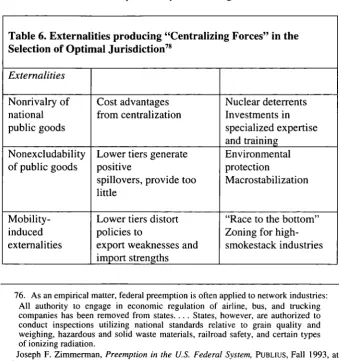
McKinnon and Nechyba lay out a grid for analyzing governmental functions, partially summarized in Table 6. The general argument for centralization in policymaking is economic efficiency. It is important to note that the "spatial nonrivalry" aspect of national defense extends to other domains. While not perfectly "nonrivalrous," network industries that depend on national economies of scale exhibit similar economic
75. Ronald McKinnon & Thomas Nechyba, Competition in Federal Systems: The Role
of Political and Financial Constraints, in THE NEW FEDERALISM: CAN THE STATES BE
TRUSTED? 6-7 (John Ferejohn and Barry R. Weingast eds. 1997).
characteristics.76 Ferejohn and Weingast summarize this point:
Economists conclude that deciding on the best jurisdiction to provide a particular service depends on the characteristics of that service. If a given amount of the service can be provided more cheaply when it is produced for many rather than few citizens (national defense), if the benefits of the service extend over a large geographic area (certain types of pollution control), or if decentralization would lead to "bad" competition among the states or inequitable outcomes across states, these services should be provided by the national government.77
Table 6. Externalities producing "Centralizing Forces" in the
Selection of Optimal Jurisdiction78
Externalities
Nonrivalry of Cost advantages Nuclear deterrents
national from centralization Investments in
public goods specialized expertise
and training Nonexcludability Lower tiers generate Environmental
of public goods positive protection
spillovers, provide too Macrostabilization little
Mobility- Lower tiers distort "Race to the bottom"
induced policies to Zoning for
high-externalities export weaknesses and smokestack industries import strengths
76. As an empirical matter, federal preemption is often applied to network industries: All authority to engage in economic regulation of airline, bus, and trucking companies has been removed from states.... States, however, are authorized to conduct inspections utilizing national standards relative to grain quality and weighing, hazardous and solid waste materials, railroad safety, and certain types of ionizing radiation.
Joseph F. Zimmerman, Preemption in the U.S. Federal System, PuBLIUS, Fall 1993, at 1,6.
77. John. A. Ferejohn & Barry R. Weingast, Introduction to THE NEW FEDERALISM: CAN THE STATES BE TRUSTED?, at vii, xii (1997).
FEDERAL COMMUNICATIONS LAW JOURNAL
In markets where economies of scale or scope are important, it is possible for decentralized policy makers to effectively free-ride on investments undertaken by consumers in other jurisdictions. This occurs when a system is built to serve a large regional or national market, and state or local policymakers impose expensive regulations over a subset of that system. These regulations impose a tax, which may or may not be efficient for local consumers. Given that costs and/or benefits spill over to other jurisdictions, effects of local regulatory decisions will likely escape the attention of policymakers. The pressing issue in considering optimal jurisdiction is that with decentralized authority there will be important implications for consumers in other jurisdictions, and that these costs and benefits are not likely to be accounted for by policymakers. Analogous to a "race to the bottom," state regulators search for rules that will bestow benefits locally while shifting costs to network investments that enable local benefits to be subsidized by users elsewhere.
Suppose a rule is imposed by Idaho regulators mandating that wireless carriers send each Idaho subscriber a monthly statement comparing the customer's billing with what identical service would cost on five other carriers. This "full disclosure" act, let us assume, costs $10 per subscriber per month. Assume that the benefit to customers, however, is just $0.50 per month (meaning that each subscriber would agree to pay just $6.00 per year to receive such a statement). The rule is highly inefficient, imposing costs twenty times the level of benefits. But state regulators may still impose the rule, even under the assumption that Idaho regulators are perfectly loyal to the interests of Idaho residents.
If wireless telephone service is efficiently provided by national networks (as opposed to local systems), and if providing those networks entails the use of standardized national calling plans, then customizing a separate pricing structure for Idaho customers may prove more trouble than it is worth for wireless carriers. Carriers would then provide the monthly statements to Idaho subscribers without a differential charge, and competition would drive these costs to customers in other states. The charges would be imperceptible to users in Idaho or elsewhere. But the incentives thereby created would lead to regulatory free riding across all
states, and costs would accumulate.
infrastructure nationally. The magnitude could be modest, but the direction of change is unambiguous: with higher costs, the value of acquiring subscribers is lower.79 Third, state regulators elsewhere would be tempted to do what Idaho regulators have done, pursuing ways to impose nationwide costs that only benefit in-state subscribers. This results in "beggar thy neighbor" policies which reduce the quality of services for consumers nationwide.
Even with a best-case scenario, inefficiencies arise when the costs imposed on wireless users by regulators in one state spill over to subscribers elsewhere. This would be the case where national network operators chose to comply with the most restrictive rules, a common result when diverse rules are imposed and where services offered in one jurisdiction are highly complementary with services provided elsewhere. This latter condition obtains with economies of scale in production, or with networks which become more valuable to customers as coverage area expands. In food labeling, for instance, states applied diverse regulations prior to federal harmonization under the Nutritional Labeling and Education Act of 1990 ("NLEA").8 ° One study notes, "Because food manufacturers selling to a nationwide market cannot afford to tailor advertising and labeling for particular states, they usually conform with the most restrictive applicable law."'"
The problem is not that ripple effects occur, but that state regulators have no reason to take into account what ripples across state borders. States can overconsume regulation by dumping costs on others, or they can underconsume because benefits are too widely distributed. As a general rule, the lowest level of government that can accurately determine costs and benefits is the jurisdiction logically selected to make regulatory decisions: "[E]conomic federalism prefers the most decentralized structure of government capable of internalizing all economic externalities ... ""
79. The increase in costs is not offset by higher demand, and hence higher prices, for two reasons. First, national pricing is efficient, and the great majority of customers do not receive any benefit from the costs imposed in Idaho. Second, Idaho customers are not willing to pay as much as the regulations cost, such that increased demand would not entirely offset the higher costs even if optimally configured networks served Idaho alone.
80. Nutritional Labeling and Education Act of 1990, Pub. L. No. 101-535, 104 Stat. 2353 (codified as amended in scattered sections of 21 U.S.C.).
81. Bradley, supra note 67, at 653-54.
FEDERAL COMMUNICATIONS LAW JOURNAL
Economic externalities imply that state decision making is ineffective. That is because firms adjust to diverse regulations by conforming to those rules that allow for the best aggregate operations. When integrated national networks are key both to suppliers, who seek scale economies, and to consumers, who desire nationwide coverage, the competition between the states results not in diverse standards but "winner take all"-the "winner" being the state with the most restrictive regulations. In situations where state regulations contradict each other, even this effort to smooth out differences in state laws will be stymied, and the costs of balkanization further increased.
E. Examples of Competition and Preemption
1. Corporation Charters
States compete in the provision of corporate charters. These charters establish default rules for corporate procedures, governing the relationship
between firm shareholders, bondholders, and managers. The rules laid down in state charters can be changed according to the preferences of companies, but the procedures whereby such reforms are enacted take place under the corporate law in effect. In addition, legal enforcement of corporate bylaws is provided in state courts under the precedents established in that state. Hence, the standard charter set forth in law is likely to have the clearest set of precedents to guide corporate decisionmakers.
Perhaps the best known aspect of the state charter competition is that Delaware is the acknowledged leader. "[A]pproximately half of the largest corporations are incorporated in Delaware, and the overwhelming majority of firms changing their state of incorporation move to Delaware."83 The state funds more than twenty percent of its state budget via fees assessed on each share of stock in firms incorporated there." It has achieved this success by offering both a standard framework and a legal system (and voluminous corporate case law), offering incentives for firms to locate their legal residence in Delaware. This is a virtual geographic choice, of course,
83. Roberta Romano, State Competition for Corporate Charters, in THE NEW FEDERALISM: CAN THE STATES BE TRUSTED? 131 (John Ferejohn & Barry R. Weingast eds., 1997).
84. Id. at 132. These data go through 1995.
as incorporation is a legal transaction divorced from where a firm operates physical facilities.
Scholars have taken both sides of the federalism debate with respect to corporate charters. But Roberta Romano concludes: "The best available evidence indicates that, for the most part, the race is for the top and not the bottom in the production of corporate laws."85 The outcome of a competition between the states has been "innovative corporate codes that quickly respond to changing market conditions and firm demands."86 Both efficient and inefficient laws have been passed, but states have often been forced to mimic the efficient statutes, and to abandon the inefficient. Moreover, the lack of choice present in centralized systems does not provide advantages. "[T]he EU harmonization project for corporate laws found that European nations have a panoply of restrictive provisions long eliminated from U.S. codes as unwieldy and unprofitable."87
A key economic aspect of the market for corporate codes is the extreme mobility of resources. Firm operations have no physical connection to firm incorporation. This allows markets to react to state laws without evident externalities.
2. Food Labeling
In the late 1980s, twenty state legislatures considered widely varying bills regulating nutrition labeling. This prompted federal preemption in the NLEA.88 Food manufacturers lobbied for the measure, fearing costly mandates prompted by fifty different standards.89 The Food and Drug Administration, the George H. W. Bush Presidential Administration, and the states originally opposed preemption. Crafting broad rules that garnered general agreement, however, reduced opposition, and the advantages of uniformity tipped the scales in favor of national standards.9"
85. Id. at 149. 86. Id.
87. Id. (citation omitted).
88. Nutrition Labeling and Education Act of 1990, Pub. L. No. 101-535,104 Stat. 2353 (codified as amendment in scattered sections of 21 U.S.C.).
89. See generally David Greenberg & Mary Graham, Improving Communication About New Food Technologies, ISSUES IN SCI. & TECH., Summer 2000, at 42, 42-48.