www.ann-geophys.net/30/661/2012/ doi:10.5194/angeo-30-661-2012
© Author(s) 2012. CC Attribution 3.0 License.
Annales
Geophysicae
Communica
tes
Electron scale structures of thin current sheets in magnetic
reconnection
N. Jain1, A. S. Sharma1, L. M. Zelenyi2, and H. V. Malova2
1Dept. of Astronomy, University of Maryland, College Park, MD, USA 2Institute for Space Research, Moscow, Russia
Correspondence to: N. Jain ([email protected])
Received: 13 October 2011 – Revised: 19 December 2011 – Accepted: 5 January 2012 – Published: 3 April 2012
Abstract. An electron-magnetohydrodynamic model is used
to simulate the structure of an electron scale current sheet during early phase of collisionless magnetic reconnection. The current sheet develops structures, viz. bifurcated, fil-amented and triple-peak structures at different locations in the current sheet. The reversal of the net out-of-plane elec-tric field seen by electrons bifurcates the current sheet in the outflow regions, the individual peaks having scale sizes of a few electron skin depths. Secondary instabilities of the bifur-cated CS lead to its filamentation in the outflow and separa-trix regions while triple-peak structures form at reconnection sites. These structures have implications for the forthcoming NASA/MMS mission designed to resolve electron space and time scales in the magnetosphere.
Keywords. Magnetospheric physics (Magnetotail; Plasma
waves and instabilities) – Space plasma physics (Magnetic reconnection)
1 Introduction
Thin current sheets (CS) with thicknesses∼ion gyro-radius play important roles in the magnetosphere and have been identified by many satellite observations. These deviate sig-nificantly from the well-known Harris sheet and exhibit a va-riety of structures, viz. bifurcated (two peaks separated by a dip) (Runov et al., 2003; Hoshino et al., 1996) and triple peak structure (a central peak accompanied by two weaker side peaks) (Nakamura et al., 2006). Many theories and simula-tions have studied these non-Harris type structures. Hoshino et al. (1996) suggest that bifurcated CS corresponds to the slow shock structure associated with magnetic reconnection. While the ion current dominates in the centre of the magneto-tail CS, a cross-field electron drift at the edges can support a double peaked structure (Asano et al., 2003). The ion current
can bifurcate due to a gradual deterioration of the CS due to non-adiabatic scattering of quasi-trapped particles (Zelenyi et al., 2002).
Recently, current sheets with electron scale (∼electron skin-depth,de=c/ωpe) non-Harris features, viz. bifurcated, triple peak and filamentary structure, have been observed by Cluster spacecraft (Wygant et al., 2005; Nakamura et al., 2006; Mozer et al., 2005). These observations have moti-vated theoretical and simulation studies on the development of the electron scale structures of the current sheets. The lower hybrid drift instability can produce an electrostatic po-tential structure across the sheet leading to an enhancement of the current (over its initial peak value) at the sides of the initial single peak, yielding a bifurcated structure (Daughton et al., 2004). However, this bifurcated structure is different from the one observed by Cluster (Wygant et al., 2005), in which the central dip of the bifurcated sheet reaches almost zero. Another mechanism of bifurcation is the disruption of the central peak caused by the trapping of current-carrying electrons in large amplitude electrostatic oscillations gener-ated by current driven instabilities (Singh et al., 2006). The bifurcated sheets are, however, parallel to each other, in con-trast to the cluster observations which show a diverging ge-ometry. The triple peak structure formed in these simulations has two side peaks at the edges of the central peak, which is different from the observations (Nakamura et al., 2006) in which the side peaks are closer to the central peak and not at the edges.
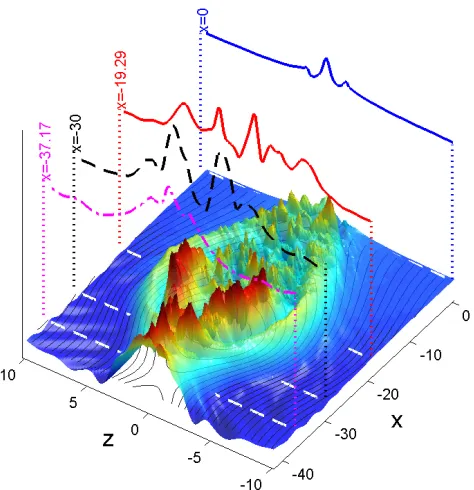
Fig. 1. The current densityJy(coloured surface) and magnetic field lines in the x-z plane. The cuts ofJyalong the white dashed lines on theJy-surface are also shown.
sheets and evolves from an early electron dynamics dom-inated time-dependent phase to a quasi-steady phase. An electron-magnetohydrodynamic (EMHD) model is used to describe the electron-scale processes in the early phase. It is shown that the bifurcation of an electron scale CS is an inherent feature of the reconnection, arising from the associ-ated electron flows and electric field. In the nonlinear stage, the bifurcated CS gets filamented and triple peak structures form at the reconnection sites. All three types of structures are present simultaneously in reconnection.
A direct comparison of these structures with the Cluster observations may not be appropriate as the simulations per-tain to the early stage of reconnection. However, it is pos-sible that the structures, as observed by Cluster, formed in the early stage and then couple to ion scales in the later stage of the evolution retaining their shapes. The early stage elec-tron dynamics and the cross scale coupling is planned to be probed by the forthcoming NASA/MMS mission, and the re-sults presented here have important implications for such ob-servations by providing the spatio-temporal development of the CS structure on electron scale and simultaneous presence of the different kinds of structures at different locations with respect to the reconnection site.
2 EMHD model and structure of electron current sheets
The EMHD model describes the motion of electron fluid in a charge neutralising background of stationary ions and
is suitable for the early stage of reconnection. This model is valid for the space scales< di and time scales< ω−ci1= (eB0/mic)−1, and is represented by the equation (Kingsep et al., 1990)
∂ ∂t(B− ∇
2B)=∇× [v
e×(B− ∇2B)], (1) where ve= −∇ ×B. These equations assume uniform electron density and incompressibility (valid forωce< ωpe, which is usually satisfied in the magnetotail (Wygant et al., 2005)). The displacement current is ignored asωωpe2/ωce. In Eq. (1), the magnetic field is normalised by a typical value B0, length by de, time by ωce−1=(eB0/mec)−1 and veloc-ity by the electron Alfv´en velocveloc-ityvAe=deωce. In EMHD the frozen-in condition of magnetic field breaks down due to electron inertia, which is the dominant non-ideal term in gen-eralised Ohm’s law for scale sizes∼de (Hesse and Winske, 1998).
The simulations are performed in the x-z plane with the equilibrium profilesB0=tanh(z/L)xˆ andJ0= −ve= (1/L)sech2(z/L)yˆ. A CS scaleL=1.0 is used. The bound-ary conditions are periodic alongx (−lx to lx) while per-turbations vanish at the z boundaries (±lz), with lx=60 and lz=30. The grid resolution is 1x=1z=0.15 and time step is 1t=0.01. The simulations are initialised with small amplitude perturbations of the form f (x,z)˜ =
f1exp(−z2/L2)6msin(mπ x/ lx)withf1=0.001.
In the simulations, reconnection takes place at multiple sites with the dominant site at the centre (x=z=0) and other secondary sites at different x-locations along the line z=0. Figure 1 shows a surface plot ofJy along with the magnetic field lines, reconnecting atx=0 (dominant site) andx≈ −37, in the fully nonlinear stage (t=145). The cuts ofJyalongx=0,−19.29,−30 and−37.17 are also shown. The region shown in Fig. 1 is symmetric aroundx=0 and focuses on a small region (−37< x <0 and−10< z <10) between the two reconnection sites atx=0 and x≈ −37 to highlight the main structures inJy. The two outer peaks which extend fromx= −37 tox=0 parallel to the magnetic field separatrices form a pair of bifurcated sheets. In between the two outer peaks, two larger peaks originating from the site atx≈ −37 and extending towardsx >−37 form another pair of bifurcated arms. Many small scale current filaments can be seen on the bifurcated sheets, which run parallel to the separatrices, and in the region between them.
2.1 Bifurcated structure
[image:3.604.311.544.71.373.2]The complicated structure ofJy, shown in Fig. 1, is a fea-ture of the dynamic evolution of reconnection from an initial linear to fully nonlinear stage att=145. The physics of the formation of the bifurcated structure can be studied in detail during the initial linear or weakly nonlinear stage of recon-nection.
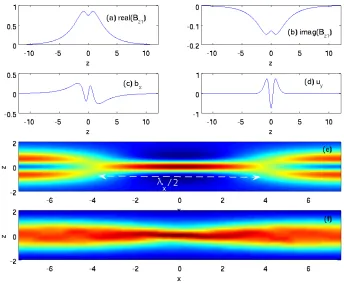
Figure 2a-d show the structures of Jy, vx, vz andEy0= (E+ve×B)y in a smaller region around the central site (x=z=0) in the initial weakly nonlinear stage (att=50) of evolution, dominated by the maximally growing mode. In the outflow regions, the bifurcated sheets have diverging shapes with the outflow jets directed away from the recon-nection site. The normal componentvzin Fig. 2c shows in-flows to the reconnection region and diverging in-flows in the downstream regions. Since the magnetic field is frozen in the flow, the inflow leads to the thinning of the CS in the recon-nection region. The diverging outflows, on the other hand, open up the CS, leading to the diverging shape of the CS in the outflow regions (Rogers et al., 2001). The reduction in the magnitude of Jy in the downstream regions leading to the bifurcation is due to the reversal of the net out-of-plane electric field seen by electrons in the downstream regions, as explained below.
The physical mechanism of the CS bifurcation is governed mainly by the out-of-plane (y) component of the electron momentum equation:
dvy
dt = −[Ey+vzBx−vxBz] (2) The changes in the current density are due to the terms on the right-hand side (RHS), which is the y-component of the to-tal electric fieldE0=E+v
e×Bseen by the electrons. The cuts alongz=0 ofEy0 and various terms on RHS of Eq. (2) contributing toEy0 (Ey,vzBxandvxBz) are shown in Fig. 2e att=50. Near the linez=0, the second term (vzBx) on the RHS is small for all values ofx, sincevz∼0 (by symmetry). The last term (vxBz) on the RHS is small nearx≈0 (it is zero at the reconnection site asBz,vx=0). Therefore, in the vicinity ofx=0, the reconnection electric fieldEyin+ ˆy di-rection (going into the plane of the paper in Fig. 2a–d) accel-erates electrons along− ˆy, leading to an intensification of the current along+ ˆy. Away fromx=0,vxandBzincrease and the Lorentz force termvxBzin Eq. (2) makes finite contribu-tion to the total electric field. The total out-of-plane electric fieldEy0 seen by electrons reverses its direction in the out-flow regions where the nonlinear termvxBzexceedsEy, as shown in Fig. 2e. It can be seen in Fig. 2d thatEy0 is along the equilibrium current in the central region while in the outflow region it is in the opposite direction, resulting in a bifurcation of the current there.
The structures in Fig. 2 form early in the simulation and their features can be understood in detail from the normal modes of the equilibrium, which is tearing unstable
(Cali-Fig. 2. The variables (a) Jy, (b) vx, (c) vz and (d) E0y=
[E+ve×B]yin the initial stage of simulations (t=50). The cuts alongz=0 of Ey0 (magenta), vxBz (black), vzBx (red) and Ey (blue) are shown in (e).
fano et al., 1999). The growth rates and eigen functions of the EMHD tearing mode are obtained from the numerical so-lution of the linearized EMHD eigen-mode equations yield-ing the maximally growyield-ing mode forkxL=0.4⇒λx≈15 for L=1.0. The real and imaginary parts of the corre-sponding eigen function Bz1 are shown in Fig. 3a and b. To obtain two-dimensional structures in real space, we take
˜
Bz(x,z)=bz(z)sin(kxx), where bz(z)=real(Bz1) (shown in Fig. 3a), allowing reconnection of the equilibrium field
Fig. 3. The real (a) and imaginary (b) parts of the eigen function Bz1 and thez-dependence of B˜x(x,z) (c) and v˜y(x,z)(d). The panel (e) shows the structure of the CS when perturbed current densityJ˜y(x,z)= − ˜vy(x,z)is added to the equilibrium current density Jy0=sech2(x/L), while the bottom panel (f) shows the CS structure in the linear stage of the simulations.
as in Fig. 3e, however the bifurcation is not as clearly visi-ble as in the latter. This is due to the perturbations in Fig. 3f being in the linear stage and, thus, have small amplitudes, while in Fig. 3e have amplitudes comparable to the equilib-rium values.
It should be noted that the bifurcation in the linear the-ory is purely due to the reconnection electric fieldEy, as the nonlinear termvxBzis absent. This recognition leads to an understanding of the differences between the lengths of the reconnecting CS in the linear theory and simulations (Jain and Sharma, 2009). ForB˜z∝sin(kxx), Faraday’s law gives
˜
Ey∝cos(kxx) which bifurcates the CS beyond |x|> λx/4 yielding CS length to beλx/2. However, in the simulations the nonlinear termvxBzreverses the direction ofE0ywithin a distance closer thanλx/2, resulting in a length of reconnect-ing CS smaller thanλx/2∼7.5 (Fig. 2a).
In our simulations, the bifurcation of the CS in the down-stream region is a consequence of reconnection facilitated by bulk electron inertia. This is an intrinsic feature of elec-tron scale reconnection (in both linear and nonlinear stages), independent of the non-ideal effects breaking the frozen-in condition and has been observed in PIC simulations also (Daughton et al., 2006; Hesse et al., 1999). The basic origin of the bifurcation in the linear stage is the out-of-plane re-connection electric field (an intrinsic feature of rere-connection)
which, in the nonlinear stage, combines with the Lorentz force arising from the interaction of the electron outflow and the normal component of magnetic field, which are also in-trinsic features of reconnection.
2.2 Multi-peak and filamentary structures
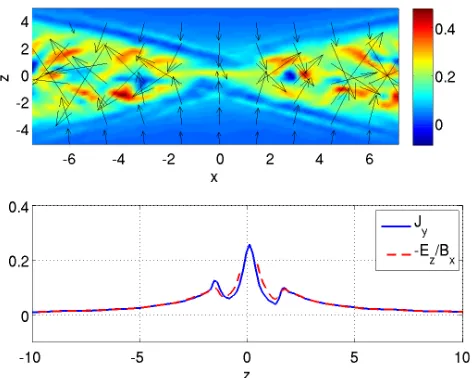
The CS shown in Fig. 1 exhibits more complicated struc-tures, arising from the evolving reconnection. The reconnec-tion at the dominant central site (x=z=0) bifurcates the CS in the associated outflow regions. This leads to the forma-tion of two separate peaks in the outflow regions, connected atz∼0, and appear as the outermost peaks in Fig. 1. The bifurcated current profile is susceptible to current shear in-stabilities (Jain et al., 2004) which not only break the bifur-cated arms of the CS along the separatrices into filaments with scale size ∼de, but also filament the CS in the out-flow region between the separatrices. The filamentation of CS along separatrices is more clearly visible in the top panel of Fig. 4.
[image:4.604.135.479.69.352.2]and, therefore, Ez×Bx drift of electrons gives rise to two positive side peaks inJy. The bottom panel of Fig. 4 shows the cuts ofJyandJy,drift= −Ez/Bxalongx=0. The points nearz=0 have been excluded in plottingJy,driftasBx=0 at z=0. The profiles ofJyandJy,driftmatch very well and the two side peaks inJycoincide with those inJy,drift. A similar match is found for the triple peak structure at the secondary reconnection sites.
A new type of structure with four peaks (two side peaks along with the central region bifurcated into two peaks), seen atx= −30 in Fig. 1, forms due to the presence of the multi-ple reconnection sites with one of them being dominant. The two side peaks in the four-peak structure are the outer peaks in Fig. 1, which are the bifurcated peaks formed due to the reconnection at the central dominant site (x=0). The field lines that reconnect at the dominant site (x=0) reconnect again downstream forming the secondary sites, one of which, shown in Fig. 1, is atx≈ −37 att=145. The reconnection at this secondary site bifurcates the current sheet in the asso-ciated outflow regions and the bifurcated peaks appear as the two inner peaks of the four-peak structure.
3 Discussion and conclusion
The simulation results show that the electron processes in the early phase of collisionless reconnection leads to the com-plex structuring of the electron scale CS. Similar electron scale structures have been observed in the satellite obser-vations, as part of the structures on larger space and time scales. The EMHD simulations presented here represent physics only on electron scale and caution is needed in a di-rect comparison with the observations. However, there are certain similarities in the shapes (not the sizes) of these elec-tron scale structures between the observations and simula-tions, and here we point out these similarities. Motivated by these similarities, it is suggested that the electron scale CS structures begin to take shape in the early stage of re-connection and later couple to ion scales to become part of the larger scale structures. The data from the forthcoming NASA/MMS mission on the electron scale will enable direct comparison with the simulations.
A bifurcated CS with thickness of each sheet∼3−5dewas observed in the magnetotail (Wygant et al., 2005). In addi-tion, the observed profile ofBxhas many step-like structures near the centre of the CS, which corresponds to the multi-peak structure of the CS. The cut ofJy atx= −19.29 in Fig. 1 shows a multi-peak profile of the current sheet with scale sizes of the individual peaks∼1−3de. These features of the CS compare well with the observations. However, it should be noted that the observed thin electron scale current sheet was embedded in a much thicker ion scale CS.
[image:5.604.311.547.69.258.2]A triple peak CS with scale sizes of individual peaks down to∼5de and a gross scale close to one ion skin depth (di) has been observed by Cluster in the magnetotail (Nakamura
Fig. 4. Top panel: current densityJy, shown by the colour, and in-plane electric field vectors (Ex,Ez) by the arrows att=145. Bot-tom panel: cuts ofJyand−Ez/Bx(points nearz=0 excluded as Bx=0 atz=0) alongx=0.
et al., 2006). In our simulations, the triple-peak structure at the dominant site has side peaks at the edges of the cen-tral peak, while at the secondary site the side peaks develop closer to the central peak and its shape resembles the ob-served structure (Nakamura et al., 2006), indicating recon-nection at multiple sites in the magnetotail. The number of the reconnection sites in the system is determined by the number of unstable wavelengths (λ) that can fit in the length of the CS, i.e., by the ratio l/λ, where l is the length of the CS. Since the wavelength of the most unstable mode is generally proportional to the CS thicknessL, the condition for reconnection at multiple sites becomes l/λ∝l/L1, which is readily satisfied in the magnetotail. The scale size
∼10de of the triple peak structure at the secondary site (x≈ −37) is smaller than the one in the Cluster observations (∼di≈40de). The error estimates in these Cluster measure-ments bring the scale size down to 60 % smaller, viz. 16de, which is closer to the case of the simulations.
trajectory of the spacecraft, one or more of the structures can be observed in a single reconnection event. The structures of the CS presented in this work are associated with reconnec-tion and some of the features are consistent with the observa-tions. These results have implications for the NASA/MMS and other missions designed to resolve electron scale struc-tures in Earth’s Magnetosphere.
Unlike most studies of reconnection, which are of its steady state, the results presented here are expected to be more prominent during the initial time dependent phase of reconnection after its onset in an electron scale CS and be-fore ion dynamics become important. The structures formed during this initial phase may be modified by the ion dynam-ics, for example, the triple peak structure may be broadened due to the Hall electric field present over an extended in-flow region in the presence of ion dynamics. As discussed in Sect. 2.1, the bifurcated structure can be understood in terms of the normal modes of the equilibrium and, thus, is expected to persist with some effects due to nonlinearity. The filamen-tary structures, on the other hand, are due to many processes whose time evolution can be influenced significantly by non-linearity and ion dynamics.
Acknowledgements. This work was supported by NSF-GEM postdoc Award No. 1027185 and NASA under Grant No. NNXO7AF42G.
Topical Editor R. Nakamura thanks one anonymous referee for her/his help in evaluating this paper.
References
Asano, Y., Mukai, T., Hoshino, M., Saito, Y., Hayakawa, H., and Nagai, T.: Evolution of the thin current sheet in a sub-storm observed by Geotail, J. Geophys. Res., 108, 1189, doi:10.1029/2002JA009785, 2003.
Califano, F., Prandi, R., Pegoraro, F., and Bulanov, S. V.: Two-dimensional electron magnetohydrodynamic instabilities, Phys. Plasmas, 6, 2332–2339, 1999.
Daughton, W., Lapenta, G., and Ricci, P.: Nonlinear Evolution of the Lower-Hybrid Drift Instability in a Current Sheet, Phys. Rev. Lett., 93, 105004, doi:10.1103/PhysRevLett.93.105004, 2004. Daughton, W., Scudder, J., and Karimabadi, H.: Fully kinetic
sim-ulations of undriven magnetic reconnection with open boundary conditions, Phys. Plasmas, 13, 072101, doi:10.1063/1.2218817, 2006.
Hesse, M. and Winske, D.: Electron dissipation in collisionless magnetic reconnection, J. Geophys. Res., 103, 26479–26486, 1998.
Hesse, M., Schindler, K., Birn, J., and Kuznetsova, M.: The diffu-sion region in collidiffu-sionless magnetic reconnection, Phys. Plas-mas, 6, 1781–1795, 1999.
Hoshino, M., Nishida, A., Mukai, T., Saito, Y., and Yamamoto, T.: Structure of plasma sheet in magnetotail: double-peaked electric current sheet, J. Geophys. Res., 101, 24775–24786, 1996. Jain, N. and Sharma, A. S.: Electron Scale Structures in
Colli-sionless Magnetic Reconnection, Phys. Plasmas, 16, 050704, doi:10.1063/1.3134045, 2009.
Jain, N., Das, A., and Kaw, P.: Kink instability in electron magnetohydrodynamics, Phys. Plasmas, 11, 4390, doi:10.1063/1.1777239, 2004.
Kingsep, A. S., Chukbar, K. V., and Yan’kov, V. V.: Reviews of Plasma Physics, vol. 16, Consultants Bureau, New York, p. 243, 1990.
Mozer, F. S., Bale, S. D., McFadden, J. P., and Torbert, R. B.: New features of electron diffusion regions observed at subsolar mag-netic field reconnection sites, Geophys. Res. Lett., 32, L24102, doi:10.1029/2005GL024092, 2005.
Nakamura, R., Baumjohann, W., Asano, Y., Runov, A., Balogh, A., Owen, C. J., Fazakerley, A. N., Fujimoto, M., Klecker, B., and Reme, H.: Dynamics of thin current sheets associated with magnetotail reconnection, J. Geophys. Res., 111, A11206, doi:10.1029/2006JA011706, 2006.
Rogers, B. N., Denton, R. E., Drake, J. F., and Shay, M. A.: Role of dispersive waves in collisionless magnetic reconnection, Phys. Rev. Lett., 87, 195004, doi:10.1103/PhysRevLett.87.195004, 2001.
Runov, A., Nakamura, R., Baumjohann, W., Treumann, R. A., Zhang, T. L., Volwerk, M., Voros, Z., Balogh, A., Glabmeier, K.-H., Klecker, B., Reme, K.-H., and Kistler, L.: Current sheet structure near magnetic X-line observed by Cluster, Geophys. Res. Lett., 30, 1579, doi:10.1029/2002GL016730, 2003.
Singh, N., Deverapalli, C., and Khazanov, G.: Electrodynamics in a very thin current sheet leading to magnetic reconnection, Non-lin. Processes Geophys., 13, 509–523, doi:10.5194/npg-13-509-2006, 2006.
Wygant, J. R., Cattell, C. A., Lysak, R., Song, Y., Dombeck, J., McFadden, J., Mozer, F. S., Carlson, C. W., Parks, G., Lucek, E. A., Balogh, A., Andre, M., Reme, H., Hesse, M., and Mouikis, C.: Cluster observations of an intense normal com-ponent of the electric field at a thin reconnecting current sheet in the tail and its role in the shock-like acceleration of the ion fluid into the separatrix region, J. Geophys. Res., 110, A09206, doi:10.1029/2004JA010708, 2005.