FOURTH YEAR MATHEMATICS
QUADRATIC FUNCTIONS
MODULE 3: QUADRATIC FUNCTIONS AND THEIR GRAPHS
impose as a condition the payment of royalties.
MODULE 3: QUADRATIC FUNCTIONS AND THEIR GRAPHS
Mind Map
The Mind Map displays the organization and relationship between the concepts and activities in this Learning Guide in a visual form. It is included to provide visual clues on the structure of the guide and to provide an opportunity for you, the teacher, to reorganize the guide to suit your particular context.
Stages of Learning
The following stages have been identified as optimal in this unit. It should be noted that the stages do not represent individual lessons. Rather, they are a series of stages over one or more lessons and indicate the suggested steps in the development of the targeted competencies and in the achievement of the stated objectives.
Assessment
All six Stages of Learning in this Learning Guide may include some advice on possible formative assessment ideas to assist you in determining the effectiveness of that stage on student learning. It can also provide information about whether the learning goals set for that stage have been achieved. Where possible, and if needed, you can use the formative assessment tasks for summative assessment purposes i.e as measures of student performance. It is important that your students know what they will be assessed on.
1. Activating Prior Learning
Background or purpose
For the students to know what a quadratic function is and its different representations, there is a need to activate first what they have learned on linear equations/functions and connect these concepts in quadratic functions.
Strategy
RELAY GAME. This game is a vital addition in teaching Mathematics. This enables the students to learn and develop their mathematical skills together as a team in a fun and interesting way. Using equation relay game, one student will solve an equation and relay his/her answer to the person next to him/her who will then use that solution to completely solve the next equation. The process will continue until the last person in a group has done his/her turn. This strategy aims to enhance students' mathematical/logical intelligences.
Materials
• mechanics of Equation Relay Game and the Equation Sheet on pages 25-26 • clean sheet of paper
• pencil/ballpen
Activity 1: “Equation Relay”
Instructions:
1. Before conducting this game, see to it that the students are seated in their chairs and are divided equally into columns of six.
2. When all are arranged and settled, read to them the mechanics of the game found in Teacher Resource Sheet 1, Equation Relay, on pages 25-26 of this Learning Guide.
3. After which, you may pose these questions:
• What kind of equations are used in our Equation Relay Game? How did you know it? • What if an equation has an exponent of 2? Do you know what is it called?
Formative Assessment
See to it that each one is actively and harmoniously playing the game with their co-group members.
Check the solutions of each group to determine if they correctly answered the different equations. Answer key is provided on page 27 for your reference.
Roundup
Students would have reviewed on linear equations/functions and connected these concepts in quadratic functions.
2. Setting the Context
This stage introduces the students to what will happen in the lessons. The teacher sets the objectives/expectations for the learning experience and an overview how the learning experience will fit into the larger scheme.
Background or purpose
MODULE 3: QUADRATIC FUNCTIONS AND THEIR GRAPHS
Strategy
TRIVIA GAME. A baffling game that requires an accurate response. This aims to develop students' mathematical and visual/spatial intelligences by identifying quadratic equations/functions. This strategy leads them to distinguish quadratic equations/functions from linear
equations/functions.
Materials
• activity sheets (refer to Student Activity 2 on pages 28-30)
Activity 2: “Did you know?”
Instructions:
1. Pose the following questions to the class:
• Do you love to eat banana catsup? Do you know who made the first banana catsup and the pineapple vinegar?
• Do you know who is the Filipino swimmer who won 6 gold medals in the 1991 ASEAN Games?
• Do you know who invented the two-way television telephone and video-phone? Do you believe if I say, he is a Filipino? He also invented an airplane engine that used alcohol as fuel and it was first flown at the Manila International Airport on September 30, 1954.
Stress to them that all of these questions will be answered after they perform the given activity.
2. Organize the class into groups of 5 or 6 and let each group perform the Trivia Game. There are three sets of trivia questions provided under Student Activity 2, Did You Know?, on pages 28-30 of this Learning Guide. You may assign one trivia question to 2 or 3 groups of students.
3. From the given sets of functions and equations, ask them to identify those that are quadratic. While doing this, they will be able to determine the answer to the given trivia question.
Answers to Student Activity 2 – Trivia 1- MARIA OROSA; Trivia 2 – ERIC BUHAIN; Trivia 3 – GREGORIO ZARA – Source: http://inventors.about.com/od/filipinoscientists
4. Then, pose the following questions:
• How can you distinguish quadratic functions from linear functions?
• Why should we know the contributions of these Filipinos in the field of Science & Technology and Sports?
• When can we say that a function is linear? quadratic?
• Do these three Filipinos bring honor to our country? in what way?
Formative Assessment
Ensure the active participation of each student in the completion of their task.
Roundup
3. Learning Activity Sequence
This stage provides the information about the topic and the activities for the students. Students should be encouraged to discover their own information.
Background or purpose
In this stage, different interactive activities are suggested and provided for the students to fully grasp the concepts of quadratic functions and their graphs. At the end, they will be able to:
➢ rewrite a quadratic function in the form f(x) = ax2 + bx + c into f(x) = a(x – h)2 + k and vice
versa
➢ determine the characteristics of the graph of a quadratic function ➢ draw the graph of quadratic function
➢ analyze the effects on the graph of the changes in a, h and k in f(x) = a(x – h)2 + k
Strategies
INTERACTIVE LECTURE. This strategy provides students with a general outline to give them
a framework for thinking about a subject and to structure their note-taking. This type of lecture involves the students by focusing their attention on key words and emphasizes information transfer at the knowledge, recall, and comprehension levels of learning.
COOPERATIVE LEARNING. This strategy incorporated by games, structures or group tasks is
used as a basic tool for group work skills. The activities prepared have definite aims and purposes and should not be seen in isolation but as an overall part of the learning environment. The activities in this strategy encourage the learners to enhance their mathematical/logical intelligences.
Materials
• visual aids • graphing paper • marking pen • masking tape
• manila paper • ruler
• small-sized ball
• acetate or transparent plastic book cover
• graphing board • pencil
• crayon
• activity sheets
Activities
LECTURETTE 1:
Begin this stage by refocusing students' attention on the following equations found in the Trivia Game activity. Others may be puzzled why they were classified as quadratic.
1. x(x + 3) – 5 = 0 2. x(x + 6) = -1 3. x(x – 2) = y 4. (y – 2)(y + 3) = 0
MODULE 3: QUADRATIC FUNCTIONS AND THEIR GRAPHS
After which, ask them to define a quadratic function based on the different examples given.
A quadratic functionis a function defined by
f(x) = ax2+ bx + c, where a, bandcare real
numbers and a ≠0. This is a function which describes a polynomial of degree 2.
REMINDER
A quadratic functionis a function defined by
f(x) = ax2+ bx + c, where a, bandcare real
numbers and a ≠0. This is a function which describes a polynomial of degree 2.
A quadratic functionis a function defined by
f(x) = ax2+ bx + c, where a, bandcare real
numbers and a ≠0. This is a function which describes a polynomial of degree 2.
REMINDER
The domain of the quadratic function is the set of real numbers. The first term, ax2, is the quadratic term, the second term, bx, is the linear term and the last term, c, is the constant term.
Given the sets of ordered pairs, we can determine whether the function represented is linear or quadratic.
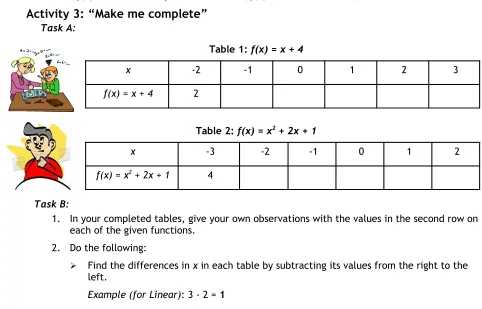
Let us now complete the two tables in Task A to generate sets of ordered pairs. We have a linear function, f(x) = x + 4, and a quadratic function, f(x) = x2 + 2x + 1. Then, do Task B.
Activity 3: “Make me complete”
[image:7.595.59.541.438.747.2]Task A:
Table 1: f(x) = x + 4
x -2 -1 0 1 2 3
f(x) = x + 4 2
Table 2: f(x) = x2 + 2x + 1
x -3 -2 -1 0 1 2
f(x) = x2 + 2x + 1 4
Task B:
1. In your completed tables, give your own observations with the values in the second row on each of the given functions.
2. Do the following:
➢ Find the differences in x in each table by subtracting its values from the right to the
left.
Example (for Linear): 3 - 2 = 1
1. x(x + 3) – 5 = 0 x2 + 3x – 5 = 0
2. x(x + 6) = -1 x2 + 6x = -1
3. x(x - 2) = y x2 - 2x = y
4. (y – 2)(y + 3) = 0 y(y + 3) – 2(y + 3) = 0 y2 + 3y – 2y – 6 = 0
➢ Do the same with the values in f(x). What have you noticed with the differences in the
first function? in the second function?
➢ Continue finding the differences in f(x) in Table 2 and observe the second differences.
Write down your observation/s.
3. Can you now state how the two functions differ in terms of their respective table of values?
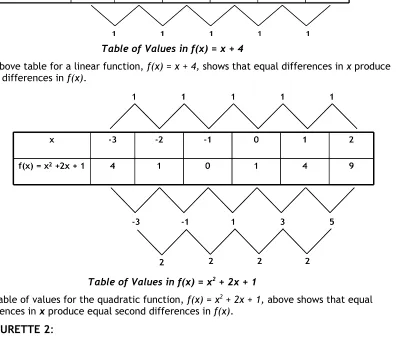
You will be expecting from your students to arrive at the following presentations and conclusions.
7 6 5 4 3 2
f(x) = x + 4
3 2 1 0 -1 -2 x
1 1 1 1 1
1 1 1 1 1
7 6 5 4 3 2
f(x) = x + 4
3 2 1 0 -1 -2 x
1 1 1 1 1
[image:8.595.125.534.311.652.2]1 1 1 1 1
Table of Values in f(x) = x + 4
The above table for a linear function, f(x) = x + 4, shows that equal differences in x produce equal differences in f(x).
9 4 1 0 1 4
f(x) = x2+2x + 1
2 1 0 -1 -2 -3 x
1 1 1 1 1
-3 -1 1 3 5
2 2 2 2 9 4 1 0 1 4
f(x) = x2+2x + 1
2 1 0 -1 -2 -3 x
1 1 1 1 1
-3 -1 1 3 5
2 2
2 2
Table of Values in f(x) = x2 + 2x + 1
The table of values for the quadratic function, f(x) = x2 + 2x + 1, above shows that equal
differences in x produce equal second differences in f(x). LECTURETTE 2:
A quadratic function may be expressed in general or standard form. General form:
Standard form:
The standard form, f(x) = a(x – h)2 + k, is derived from the general form, f(x) = ax2 + bx + c,
where a, h and k are real numbers and a ≠ 0. You may ask the students to show the derivation of the standard form of quadratic equation from its general form by completing the square.
Encourage them first to recall the process of completing the square using any quadratic equation f(x) = ax2 + bx + c
MODULE 3: QUADRATIC FUNCTIONS AND THEIR GRAPHS
to guide them in arriving at the standard form. Cite an example for them to look at. You may introduce this time how to derive f(x) = a(x – h)2 + k from f(x) = ax2 + bx + c.
f(x) = ax2 + bx + c
= a x2 + b
ax + c Factor out a in ax
2 + bx.
= a x2 + b
ax +
+ c - Complete the square.
= a x + b 2a
2 + Simplify.
Therefore, f(x) = a(x – h)2 + k Let h=−b
2a and k =
where h and k are real numbers which are constant terms.
The function, f(x) = ax2 + bx + c, may also be derived from its standard form through the
following process. f(x) = a(x – h)2 + k
= a[(x – h)(x – h)] + k Square the binomial.
= a(x2 – 2hx + h2) + k
= ax2 – 2ahx + ah2 + k Simplify.
= ax2 – 2a −b
2a x + a −b
2a
2 + k Let h=−b
2a . = ax2 + bx + + k
Therefore, f(x) = ax2 + bx + c Let c = + k
Present the following illustrative examples on deriving f(x) = a(x – h)2 + k from the quadratic
function, f(x) = a(x – h)2 + k, and vice versa.
Illustrative Example 1: Change f(x) = 3x2 + 6x – 1 into the form of f(x) = a(x – h)2 + k.
Solution 1: f(x) = 3x2 + 6x – 1
= 3(x2 + 2x) – 1 Factor the first two terms.
= 3(x2 + 2x) – 1 Divide the coefficient of x which is 2 by 2
and that gives 1. Then square the quotient: b
2
2 = 2
2
2 = 1
= 3(x2 + 2x + 1 - 1) – 1 Add and subtract 1 in the enclosed expression.
= 3(x2 + 2x + 1) + 3 (-1) – 1 Complete the square.
= 3(x2 + 2x + 1) - 3 – 1 Remove the product of a and -1 from the
parentheses. b 2
4a2
b 2
4a 4ac - b 2
4a
4ac - b 2
4a
b 2
4a
b 2
Factor and add.
Solution 2: (An option. This might be easy to introduce with your students.) f(x) = 3x2 + 6x – 1 Given.
a = 3; b = 6; c = -1
Solve for h: h = −b 2a
= = Substitute the values of a and b.
Solve for k: k =
= Substitute the values of a, b and c.
= = Solve k.
Substitute the values of a, h and k in the standard form, f(x) = a(x – h)2 + k.
a = 3; h = -1; k = -4 f(x) = a(x – h)2 + k
= 3[x - (-1)]2 + (-4) Substitute and simplify.
Showing the above two-way solutions in deriving f(x) = a(x – h)2 + k from the quadratic function,
f(x) = ax2 + bx + c, provides options to the students as to which of the two methods they prefer
to use in rewriting.
Illustrative Example 2: Change f(x) = -5(x + 2)2 – 4 into the form f(x) = ax2 + bx + c.
Solution: f(x) = -5(x + 2)2 – 4
= -5[(x + 2)(x + 2)] – 4 Expand the binomial. = -5(x2 + 4x + 4) – 4 Multiply the two binomials.
= -5x2 – 20x – 20 – 4 Distributive Property of Multiplication
Addition Property
Activity 4: “Hundreds of Pi's”
Now, challenge your students to perform this next activity in their groups. Ask them to rewrite the given quadratic functions in the form f(x) = ax2 + bx + c into f(x) = a(x – h)2 + k and vice
versa. While completing the activity, they will also discover an important Mathematics fact. Refer to Student Activity 4, Hundreds of Pi's, on page 31.
Answer to the puzzle: WILLIAM SHANKS (Reference: http://www.ualr.edu/lasmoller/pi.html)
f(x) = 3(x + 1)2 - 4
-6
2(3)
-6
6 h = -1
4ac - b 2
4a
4(3)(-1) - (6) 2
4(3) -12 - 36
12
-48
12 k = -4
f(x) = 3(x + 1)2 - 4
MODULE 3: QUADRATIC FUNCTIONS AND THEIR GRAPHS LECTURETTE 3:
Like any linear function, quadratic function can also be graphed. Call to mind how far your students have remembered plotting the points in a Cartesian coordinate plane. Prepare a coordinate plane and ask them to plot the following ordered pairs:
(-8, 6), (0, -4), (7, -3), (-9, 2) and (5, 0)
Now, challenge them to determine the ordered pair of a point and the quadrant where it is located given the following conditions.
1. A point is 6 units to the right and 1 unit down. 2. A point is 5 units to the right and 4 units up. 3. A point is 7 units to the left and 8 units down.
This time, begin presenting the graph of a quadratic function by showing this simple activity. Take a small ball, toss it in the air and catch it with the other hand at the same height. Ask the students to draw the path of the ball.
Sample illustration is shown at the left.
After they sketch the path of the ball, lead them to describe that the curve path they made is a parabola, the smooth curve which is the graph of a quadratic function. Again, the graph of a quadratic function is a parabola. It is a curve like any arc.
Now, ask the students to complete the table of the function, f(x) = x2.
x -2 -1 0 1 2
f(x) = x2
After which, let them plot the ordered pairs in a coordinate plane and trace the graph of f(x) = x2 by connecting the plotted points.
Shown are the completed table and the graph of the function.
It has a line called the axis of symmetry which
divides the graph into two parts such that one-half of the graph is a reflection of the other one-half. In the case of f(x) = x2, the axis of symmetry is
the y-axis.
It has a turning point called the vertex which is
either the lowest point or the highest point of the graph of a quadratic function. In f(x) = x2, the
vertex is the origin, (0, 0).
It has a minimum point when the graph
opens upward and a maximum point when the graph opens downward. Again, f(x) = x2
has a minimum point of (0, 0).
At this point, encourage the students to graph the function, f(x) = -x2, using the same values of x. Afterwards, let them compare its graph with that of f(x) = x2. Ask them to determine the (a) direction of the opening of the graph, (b) axis of symmetry, (c) vertex of the parabola, and (d) minimum or maximum point.
vertex of parabola
axis of symmetry
MODULE 3: QUADRATIC FUNCTIONS AND THEIR GRAPHS Shown are the table and the graph of the function, f(x) = -x2.
The graph of the function, f(x) = -x2,gives the following characteristics:
● direction of opening of the graph: downward ● vertex of the parabola: (0, 0)
● axis of symmetry: y-axis ● maximum point: (0, 0)
The vertex of the parabola is the point where the quadratic function, f(x) = ax2 + bx + c reaches
its maximum point when a < 0 or minimum point when a > 0. The axis of symmetry passes through the vertex. This is exactly the x-coordinate of the vertex of the parabola.
Activity 5: “Graph it!”
Instructions:
1. Let the students perform the next activity found on pages 32-33 under Student Activity 5,
Graph it!
2. Let them complete the tables of values of the quadratic functions given the values of x. Ask them to graph the two functions in one coordinate plane and then, give the characteristics of each parabola. This activity encourages your students to make discoveries that even without graphing, they can simply give the different characteristics of the quadratic functions. 3. Guide them along the process of discovering new information.
LECTURETTE 4:
Given any quadratic functions, the characteristics of their parabolas can easily be determined even without graphing. These can be done when a function is expressed in a standard form, f(x) = a(x – h)2 + k, where a, h and k are real numbers.
x
To understand further, illustrate to them the following examples.
1. Determine the characteristics of the parabola from the quadratic function, f(x) = (x + 2)2 – 1 without sketching the graph.
Solution:
Since the standard form of the quadratic function is f(x) = a(x – h)2 + k, we therefore say that a = 1, h = -2 and k = -1.
From there, the vertex (h, k) of the parabola is (-2, -1). The axis of symmetry passes through the line x = -2, thus x = h. The minimum point is (-2, -1).
2. Determine the characteristics of the parabola of the function, f(x) = 2x2 + 8x + 5, without sketching the graph.
Solution:
You noticed that the given function is expressed in a general form, so we need to rewrite this first into standard form.
f(x) = 2x2 + 8x + 5 ; a = 2; b = 8 and c = 5
Solve for h: h = −b 2a = =
Solve for k: k =
=
=
=
Substitute the values of a, h and k in the standard form, f(x) = a(x – h)2 + k.
a = 2; h = -2 and k = -3
So, we have f(x) = 2[x - (-2)] 2 + (–3) =
direction of the opening of the graph: upward
vertex of parabola: (-2, -3)
axis of symmetry:x = h=−b 2a = -2 minimum point: (-2, -3)
By observation, how will you determine if the opening of the graph is either upward or downward?
-8
2(2)
-8
4 h = -2
4ac - b 2
4a
4(2)(5) - (8) 2
4(2) 40 - 64
8 -24
8 k = -3
MODULE 3: QUADRATIC FUNCTIONS AND THEIR GRAPHS
Any graph of f(x) = ax2 + bx + c crosses the axis. This point of intersection is called
y-intercept. We learned from the linear function that the graph of y = mx + b crosses the y-axis at the point where x = 0. Similarly, the y-intercept can be solved by substituting zero for x in f(x) = ax2 + bx + c. Thus,
f(x) = ax2 + bx + c
f(0) = a(0)2 + b(0) + c
Illustrative Example:
Find the y-intercept of the graph of f(x) = -2x2 + 6x – 7.
Solution:
f(x) = -2x2 + 6x – 7
f(0) = -2(0)2 + 6(0) – 7
= -2(0) + 0 – 7 = 0 + 0 – 7
. So, -7 is the y-intercept of f(x) = -2x2 + 6x – 7.
Ask them to solve mentally the y-intercept of the following quadratic functions. 1. f(x) = -9x2
2. f(x) = 2(x + 1)2 - 3
3. f(x) = -4x2 + 6
4. f(x) = 8x2 – 7x – 6
5. f(x) = 5x2 + 11x + 1
Activity 6: “Do an investigation”
Instructions:
1. Inform the class that the next activity can be of great help for them to easily introduce the effects on the graph of any quadratic function, f(x) = a(x – h)2 + k, when the values of a, h
and k are changed.
2. With the same groups, let them perform this Student Activity 6. Have each group a sheet of graphing paper, manila paper and a marking pen.
3. Then, let them follow the following:
a) In a coordinate plane, draw the graph of f(x) = ax2 when a = 1 and the values of x = -2,
-1, 0, 1 and 2.
Now, draw the graphs of f(x) = x2 + 2 and f(x) = x2 – 3 in the same plane without using the
f(0) = c
b) Make another coordinate plane. Then, draw the graph of f(x) = ax2. Investigate what
happens when you give different values to a (either positive or negative). Source:Mathematical Adventures for Teachers and Students by Wally Green
4. After doing an investigation, let each group present their output and the conjectures they have gathered. Since this is an open investigation, expect that they will present different conjectures.
5. Synthesize the given activity by the following key points.
Activity 7: “Investigate once more”
Instructions:
1. Organize the class into six groups. There are three tasks provided below wherein students will do an investigation on quadratic functions expressed in standard forms. Two different groups may work on the same task.
2. Distribute the graphing paper, manila paper and marking pen. Encourage each group to work together and completely finish investigating after the given time allotment.
3. Then, let them follow the following:
☑On the same coordinate plane, sketch the graphs of the three functions in each task. Describe their movements and write your observations.
TASK A:
MODULE 3: QUADRATIC FUNCTIONS AND THEIR GRAPHS 2. f(x) = (x + 1)2
3. f(x) = (x + 2)2
TASK B:
1. f(x) = x2
2. f(x) = (x - 1)2
3. f(x) = (x - 2)2
TASK C:
1. f(x) = 2x2 + 1
2. f(x) = 2(x + 2)2 + 1
3. f(x) = 2(x - 2)2 + 1
☑The following key points will summarize what the students will discover from their investigations.
Source: Advanced Algebra IV, Trigonometry and Statistics pages 65-67
You can present the above key points clearly and concretely to your students for them to fully comprehend what each essential concept means and how it will be done easily in a graphing paper/board. Below is the procedure.
Prepare the following:
PROCEDURE:
1. Draw a smooth curve or parabola in an acetate or in a 14 m transparent plastic book cover using a permanent marker/pentel pen. This will serve as your constant parabola that represents any quadratic functions.
2. Decide how wide or narrow your parabola is. This depends on the value of a in f(x)= ax2 +
bx + c or in f(x) = a(x – h)2 + k.
3. Prepare a graphing board or a Cartesian coordinate plane in a manila paper. 4. Get ready with your set of functions and start playing with their graphs. Sample
illustrations are shown below for your reference. 5. Make discoveries together with your students. Enjoy!!!
SAMPLE ILLUSTRATIONS
SAMPLE QUADRATIC FUNCTIONS:
1. f(x) = 2x2
2. f(x) = 2x2 + 1
3. f(x) = 2x2 – 1
4. f(x) = 2(x + 3)2
5. f(x) = 2(x + 4)2
MODULE 3: QUADRATIC FUNCTIONS AND THEIR GRAPHS 1. f(x) = 2x2 (vertex: 0, 0) 2. f(x) = 2x2 + 1 (vertex: 0, 1)
3. f(x) = 2x2 – 1 (vertex: 0, -1) 4. f(x) = 2(x + 3)2 (vertex: -3, 0)
5. f(x) = 2(x + 4)2 (vertex: -4, 0)
x
x
x
x
x
y
When you are ready with your materials, start exposing and playing with your students about these discoveries. You can do this through an oral recitation or a game. Provide more quadratic functions and parabolas using different values of a, h and k.
Formative Assessment
The involvement of students in this stage may be assessed from the series of exercises provided for them which address the targeted topics and lessons on quadratic functions.
Check their outputs.
Roundup
Students should have been able to rewrite quadratic function of the form f(x) = ax2 + bx + c into
f(x) = a(x – h)2 + k and vice versa, determine the characteristics of its graph, draw the graph of
any quadratic function and analyze the effects on the graph of the changes in a, h and k in f(x) = a(x – h)2 + k.
4. Check for Understanding of the Topic or Skill
This stage is for teachers to find out how much students have understood before they apply it to other learning experiences.
Background or purpose
The activities suggested in this stage aim to check how far students have gained knowledge on quadratic functions and their graphs. Given a quadratic function, they will determine the characteristics of its graph, solve the y-intercept and sketch its parabola.
Strategy
MATHEMATICS TRAIL. A strategy that challenges the students to trace the trail/path of one quadratic function and the characteristics of its graph. This enhances their acquired skills on the topic and taps as well as their mathematical/logical intelligence.
Materials
• crayons • pencil• activity sheets (refer to Student Activity 8 on pages 34-35)
Activity 8A and 8B: “Direct Thy Quadratic's Path”
Instructions:
1. Reorganize the class into groups of four and let them perform the suggested activities under
Student Activity 8A and 8B, Direct Thy Quadratic's Path, on pages 34-35.
2. Instruct them that they will determine the right trail/path starting from a given quadratic function to its characteristics and graph.
3. Distribute the worksheets one at a time.
4. When they are all finished with the two worksheets, ask them to post their answers on the board for checking.
Formative Assessment
MODULE 3: QUADRATIC FUNCTIONS AND THEIR GRAPHS
Directions: Determine the quadratic functions whose graphs are described below. 1. The graph of f(x) = x2 shifted 3 units upward
2. The graph of f(x) = x2 shifted 7 units downward
3. The graph of f(x) = -4x2 shifted 5 units below the origin
4. The graph of f(x) = x2 shifted 3 units upward
5. The graph of f(x) = 3x2 shifted 8 units upward
6. The graph of f(x) = -2x2 shifted 5 units to left
7. The graph of f(x) = x2 shifted 3 units to the right
8. The graph of f(x) = 3x2 shifted 7 units to the left of the origin
9. The graph of f(x) = 2x2 shifted 3 units to the left and 1 unit downward
10. The graph of f(x) = -3x2 shifted 1 unit to the right and 4 units upward
Answers:
1. f(x) = x2 + 3 6. f(x) = -2(x + 5)2
2. f(x) = x2 – 7 7. f(x) = (x - 3)2
3. f(x) = -4x2 – 5 8. f(x) = 3(x + 7)2
4. f(x) = x2 + 3 9. f(x) = 2(x + 3)2 - 1
5. f(x) = 3x2 + 8 10. f(x) = -3(x – 1)2 + 4
Roundup
Students would have gained confidence in identifying the characteristics of any quadratic
functions expressed either in general or standard forms. Even without solving the table of values, they can also easily graph the functions. They were able to determine the quadratic functions given only the descriptions and positions of the parabolas.
5. Practice and Application
In this stage, students consolidate their learning through independent or guided practice and transfer their learning to new or different situations.
Background or purpose
In this stage, students will explore some real-life applications modeled with a quadratic function and its parabola. Through this activity, they will appreciate the importance of the study of quadratic functions.
Strategies
BRAINSTORMING. This is a strategy used to generate many ideas where students identify
relevant thoughts that connect certain issues.
MODELLING. A strategy which explicitly demonstrates the cognitive processes and skills
required of a learner for a particular task. The suggested activity in this stage which is the standing long jump aims to develop awareness among students on the real-life application of quadratic functions and taps as well their kinesthetic and mathematical intelligences.
Materials
-1 4
-1
• masking tape • tape measure
• chair/armchair or a piece of wood/plywood • graphing paper
Activity 9: “Standing Long Jump”
Instructions:
1. Prior to the activity proper, conduct first a brainstorming activity with your students on some real-life applications that can be modeled with a quadratic function.
2. Ask them to identify things following the shape of a parabola or any sporting events where either an athlete or an object travels through the air and returns to the ground following the same curve.
Examples would be: hitting a golf ball, kicking a football, throwing a basketball to the ring, a platform diving, standing long jump, etc. Note that in each case, there is a movement in different directions:
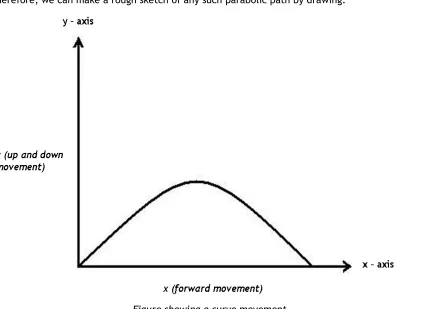
● up and down, and ● forward
[image:22.595.109.533.397.706.2]Therefore, we can make a rough sketch of any such parabolic path by drawing.
Figure showing a curve movement
MODULE 3: QUADRATIC FUNCTIONS AND THEIR GRAPHS
You are going to perform a standing long jump, and then come up with a quadratic function that models the path of the movement. Take note that we need three (3) points or ordered pairs to model the curve. The following points will be used:
● the starting point
● midpoint of jump (apex) – assume that the highest point is halfway through the forward
movement
● ending point
3. After giving this short input, let them go back to their own groups to perform the next task. Let the students discuss the needed measurements indicated in the table and decide the best way to gather the data. The things that need to be measured are:
✔ the length of the jump, and ✔ the height of the jump
4. If everyone is ready, distribute the materials needed and the worksheets under Student Activity 9, Standing Long Jump, found on pages 36-37 of this Learning Guide. You may conduct this activity inside or outside the classroom.
5. Consider the following points during the interactive discussion: ☑Why do we need three (3) data points to model the parabola?
☑As you perform and complete the activity, what additional ideas about quadratic functions/equations and their graphs that you learned?
☑What is the sign of the coefficient a in your parabola? Cite another real-life situation which models a parabola where a is positive.
Formative Assessment
Make sure that everyone is actively and harmoniously collaborating with their co-members as they perform the activity.
Check their outputs.
Roundup
Students would have explored and appreciated the real-life applications modeled with a quadratic function and its parabola.
6. Closure
This stage brings the series of lessons to a formal conclusion. Teachers may refocus the objectives and summarize the learning gained. Teachers can also foreshadow the next set of learning
experiences and make the relevant links.
Background or purpose
The activity in this stage underpins the possible learning extensions of the study of quadratic functions. Students will be playing a game called hopping rabbits using chips or any local materials like bottle caps or tanzan and investigate the hopping movements. In the end, they will realize that out of the game they can generate rules expressed in symbols which is actually a quadratic function.
Strategy
purposes and should not be seen in isolation but as an overall part of the learning environment. The activity suggested here using this strategy encourages the learners to enhance their mathematical, logical and spatial intelligences.
Materials
• activity sheet (refer to Student Activity 10 on page 38) • 10-20 chips or bottle caps (tanzan) to represent rabbits
Activity 10: “Hopping Rabbits”
Instructions:
1. Let the same groups of students work the task provided under Student Activity 10, Hopping Rabbits, on page 38.
2. Emphasize to them that the activity encourages them to generate a rule or an equation from the given challenge. If they have discovered a rule or an equation, ask them to explain and illustrate their findings.
3. Note that one of your expectations from them will be a quadratic equation they have generated or derived from the given challenge which is , where m stands for the number of moves and n is the number of rabbits on each side.
4. After which, you may pose the following questions:
• Were the data you gathered assisted you to draw a rule or an equation? Was there any missing information you need to verify your answers? What should it be?
• Can you cite an importance of studying quadratic functions?
Formative Assessment
Ensure an active involvement of every member in the group task. Check their outputs.
Roundup
Students would have a clearer understanding on quadratic functions and their graphs and ready to explore the properties of quadratic functions.
Teacher Evaluation
(To be completed by the teacher using this Teacher’s Guide) The ways I will evaluate the success of my teaching this unit are: 1.
2. 3.
TEACHER RESOURCE SHEET 1
EQUATION RELAY
Objective:
To demonstrate mastery on finding an unknown variable in an
equation.
MECHANICS:
1. You will be playing an
Equation Relay Game
.
2. Each member in your group/column will solve one equation by finding the
value of its unknown variable.
3. The first player will be given an
Equation Sheet
which contains six different
equations. Five of these have question marks that will be substituted by
constant terms. He/She will then solve the first equation and write his/her
answer on a small sheet of paper.
4. After solving for “
x
”, he/she will pass the
Equation Sheet
together with the
small sheet of paper containing the answer to the second player.
5. The second player will replace the question mark in the second equation
with the number in the sheet of paper and then, solve for “
x
”.
6. The process will continue until the sixth player will solve the sixth equation.
7. After solving the last equation, the last player will raise his/her hand and all
EQUATION SHEET
Equation
1
2x – 7 =21
Equation
2
5x + 9 = ?
Equation
3
-3x + ? = 13
Equation
4
2x + 8 = ?
Equation
5
x + ? = -1
Equation
ANSWER KEY
Answer for
Equation 1
x = 14
Answer for
Equation 2
x = 1
Answer for
Equation 3
x = -4
Answer for
Equation 4
x = -6
Answer for
Equation 5
x = 5
Answer for
STUDENT ACTIVITY 2: DID YOU KNOW?
Directions: From the given set of functions and equations, identify those items that are quadratic. Write “Quadratic” in the third column of the table if the equation is quadratic and “Not” if it is not.
TRIVIA QUESTION # 1
Who made the first banana catsup and the pineapple vinegar?
ITEM NUMBER EQUATIONS/FUNCTIONS QUADRATIC OR NOT LETTER KEY
1 x2 = 0
A
2 5π2 + 2π - 3 E
3 (y – 2) (y + 3) = 0 S
4 f(x) = x2 – 7x +10 O
5 C = πd E
6 y = -5x2 – 2x + 1
R
7 f(x) = x2 - 1 O
8 x(x + 3) – 5 = 0 A
9 P = 2l + 2w N
10 3x – 2x2 = -10
I
11 2 (x + 3)2 = 0
R
12 9x – 20 = x2 A
13 x + y = 5 C
14 A = πr2 M
Now, which of the equations above are quadratic? Write the corresponding item numbers in descending order in the second row of the table that follows and their corresponding Letter Key (refer to the 4th
column of the table) above each item number. The combined letters form an answer to the given trivia question.
STUDENT ACTIVITY 2: DID YOU KNOW?
Directions: From the given set of functions and equations, identify those items that are quadratic. Write “Quadratic” in the third column of the table if the equation is quadratic and “Not” if it is not.
TRIVIA QUESTION # 2
Who is the Filipino swimmer who won 6 gold medals in the 1991 ASEAN Games? ITEM NUMBER EQUATIONS/FUNCTIONS QUADRATIC OR NOT LETTER KEY
1 x2 = 0
N
2 (y – 2) (y + 3) = 0 I
3 5π2 + 2π - 3 L
4 f(x) = x2 – 7x +10
A
5 x(x + 3) – 5 = 0 H
6 y = -5x2 – 2x + 1
U
7 f(x) = x2 - 1 B
8 C = πd A
9 2 (x + 3)2 = 0
C
10 3x – 2x2 = -10 I
11 P = 2l + 2w O
12 9x – 20 = x2 R
13 A = πr2 E
14 x + y = 5 D
Now, which of the equations above are quadratic? Write the corresponding item numbers in descending order in the second row of the table that follows and their corresponding Letter Key (refer to the 4th
column of the table) above each item number. The combined letters form an answer to the given trivia question.
STUDENT ACTIVITY 2
DID YOU KNOW?
Directions: From the given set of functions and equations, identify those items that are quadratic. Write “Quadratic” in the third column of the table if the equation is quadratic and “Not” if it is not.
TRIVIA QUESTION # 3
Who invented the two-way television telephone?
Aside from inventing the video-phone, he also invented the electrical kinetic resistance known as the Zara effect. He also invented an airplane engine which used alcohol as fuel. It was first
flown at the Manila International Airport on September 30, 1954.
ITEM NUMBER EQUATIONS/FUNCTIONS QUADRATIC OR NOT LETTER KEY
1 5π2 + 2π - 3
S
2 2 (x + 3)2 = 0 A
3 (y – 2) (y + 3) = 0 R
4 f(x) = x2 – 7x +10 A
5 C = πd O
6 x2 + y = 5 Z
7 f(x) = x2 - 1 O
8 x(x + 3) – 5 = 0 I
9 P(x) = -3(x – 4)2 + 1 R
10 3x – 2x2 = -10 O
11 (x + 3) + 8 = 0 E
12 9x – 20 = x2 G
13 y = -5x2 – 2x + 1 E
14 A = πr2 R
15 f(x) = -x2 G
Now, which of the equations above are quadratic? Write the corresponding item numbers in descending order in the second row of the table that follows and their corresponding Letter Key (refer to the 4th
column of the table) above each item number. The combined letters form an answer to the given trivia question.
Letter Key
STUDENT ACTIVITY 4
HUNDREDS OF PI'S
Directions: Rewrite each of the quadratic functions in Column A and look for its equivalent function in Column B. Join each pair by connecting the dots with a straight line. Each line will pass through a letter and a number which give the puzzle code. Write the letters in the grid that correspond with the numbers to answer the given question below.
Who calculated the value of pi (
π = 3.1415926535
... up to
707
places),
which was published in
1873
?
COLUMN A COLUMN B
6
7
11
4
9
1
12
10
3
13
5
8
2
8
5
13
3
10
12
1
9
4
11
7
6
2
f(x) = x2 + 8x - 9
f(x)=5x2+ 20x+20
f(x) = (x+4)2 - 3
f(x) = -2x2 –4x- 3
f(x) =7(x – 1)2 +3
f(x) =3x2 +12x+ 7
f(x) = (x – 2)2 - 8
f(x) = -5(x+1)2 +1
f(x) =2x2 -24x+60
f(x) = 2x2-20x+48
f(x) = -3(x+1)2+3
f(x) = 4x2-16x+13
f(x)= -2(x-3)2+15
L
1
S
4
I
3
K
5
H
6
M
7
N
10
A
11
A
12
L
8
W
2
13
9
I
f(x) = x2 - 4x - 4
f(x) =7x2 -14x+10
f(x) =-2(x+1)2 -1
f(x)= -5x2–10x-4
f(x) = 2(x-5)2 - 2
f(x)= -2x2 +12x-3
f(x) = x2 +8x +13
f(x) = 5(x+2)2
f(x) = 4(x-2)2 - 3
f(x) = -3x2 - 6x
f(x) = (x+4)2 -25
f(x)= 2(x-6)2 -12
f(x)= 3(x+2)2 - 5
Place the letter above its corresponding number.
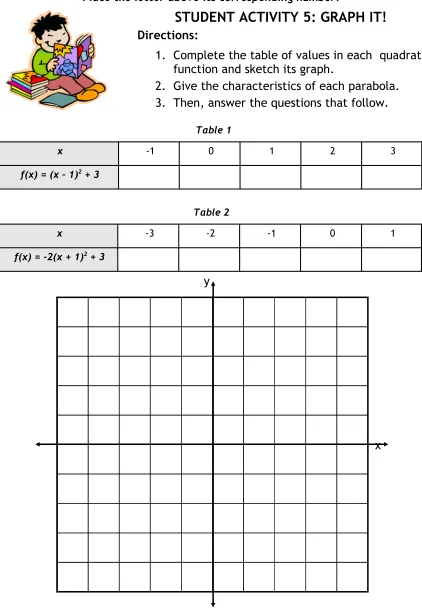
STUDENT ACTIVITY 5: GRAPH IT!
Directions:
1. Complete the table of values in each quadratic
function and sketch its graph.
[image:32.595.86.508.144.755.2]2. Give the characteristics of each parabola.
3. Then, answer the questions that follow.
Table 1
x -1 0 1 2 3
f(x) = (x – 1)2 + 3
Table 2
x -3 -2 -1 0 1
f(x) = -2(x + 1)2 + 3
y
TABLE OF THE CHARACTERISTICS OF PARABOLAS
Characteristics of Parabola f(x) = (x – 1) 2 + 3 f(x) = -2(x + 1)2 + 3
1. direction of opening of the graph
2. axis of symmetry
3. vertex
4. minimum/maximum point
Questions:
1. How did you arrive at the following characteristics of the graphs?
•
direction of opening of the graph
_________________________
______________________________________________________
•
axis of symmetry
_______________________________________
•
vertex of parabola
______________________________________
•
minimum or maximum point
______________________________
______________________________________________________
1. Observe the given functions with their corresponding characteristics you
identified. Without looking at the graph, can you still give the three
characteristics of their respective graphs? How? What will be your clues?
________________________________________________________________
________________________________________________________________
________________________________________________________________
________________________________________________________________
________________________________________________________________
________________________________________________________________
____________________________.
2. Given this function,
f(x) = 3(x – 3)
2- 4
, give the four characteristics of its
parabola without graphing.
STUDENT ACTIVITY 8A
DIRECT THY QUADRATIC'S PATH
WORKSHEET 1
Directions: Given a quadratic function in each item, solve and determine the vertex of its parabola, direction of the opening of the graph, axis of symmetry, y-intercept of the graph and the equivalent function when it is rewritten. Trace the path by connecting the bubbles with a line. Color the bubbles with a crayon. Use one color for every path.
f(x) = 2(x - 5)2
f(x) = -x2 – 6x - 12
f(x) = 3(x – 1)2 + 5
f(x) = x2 + 6x - 2
f(x)= -2(x + 3)2 + 3
1, 5
5, 0
-3, 3
-3, -3
-3, -11
downward
upward
upward
downward
upward
8
-12
-15
50
-2
f(x) = -(x + 3)2 - 3
f(x)=2x2 – 20x + 50
f(x) = 3x2 – 6x + 8
f(x) = (x + 3)2 - 11
f(x)= -2x2 –12x -15
QUADRATIC FUNCTION VERTEX DIRECTION OF PARABOLA AXIS OF SYMMETRY Y - INTERCEPT EQUIVALENT Q.F.
x = -3
x = 1
x = -3
x = 5
STUDENT ACTIVITY 8B
DIRECT THY QUADRATIC'S PATH
WORKSHEET 2 - RIDDLE
Directions: Match the quadratic functions in the first column with their corresponding graphs in the second column without preparing any table of values. Join each pair by connecting the dots with a straight line. Each line will pass through two matching rectangles. The smaller one answers the riddle given inside the bigger rectangle. Have fun!!!
f(x) = -2(x+4)2 - 1
f(x) =
½
x
2f(x) = 2x2 – 4x + 3
f(x) = -(x+4)2 + 3
It has a mouth but it cannot talk.
I bought it and it is costly, but I use
it for hanging only. Neither an animal nora person; It has no feet, but can walk; It
has no mouth, but can talk.
letter
dress
earrings
the world cave
ant
Oh, what a surprise! Oh, what a miracle! It sprouted without a seed, it stood without
a trunk.
COLUMN 1
COLUMN 2
y
y
y
y
STUDENT ACTIVITY 9
STANDING LONG JUMP
Objective: To explore one real-life application of a quadratic function.
Materials: masking tape, tape measure, chair/armchair or a piece of wood/plywood, graphing paper, worksheet
PROCEDURE:
1. Set up a line using a masking tape to represent the x-axis, then mark the starting point. This helps you determine the length and the coordinates of a landing point. 2. To measure the height of a jump, paste and extend a masking tape upward on one leg
of a chair/armchair or a piece of wood/plywood or on a wall. This will be your y-axis. 3. Assign one person to measure the height of a jump and another to determine the length
using a tape measure. Use centimeter (cm) as the unit of measure.
4. To the one who takes charge in measuring the height of a jump, position yourself in such a way that you can approximately determine the height with your line of sight. 5. Gather the data and record them in the table below.
NAME OF MEMBERS IN A GROUP
Coordinates of the starting
point
Apex/height of jump
(in cm)
Ending point/ length of
jump (in cm)
Coordinates of the apex/height
of jump
Coordinates of the length of
jump
INDIVIDUAL TASK:
1. From the data in the table, come up with the following three points:
(0, 0)
starting pointapex/height of jump or vertex of parabola (midpoint of the curve which is halfway through the forward movement)
(x
1, 0)
ending point2. Using a graphing paper, plot the points in a coordinate plane and sketch the graph. 3. Finally, give the four characteristics of the parabola you have drawn.
STUDENT ACTIVITY 10: HOPPING RABBITS
Objective: To generate a rule or an equation to satisfy the given challenge.
Materials: 10-20 chips of two colors or bottle caps (tanzan – 1st half
open side up and 2nd half open side down) to represent 2 different
breeds of rabbits
Situation: Two groups, each having three (3) rabbits meet on a narrow hill trail. Three (3) of them will go in an opposite direction. Their challenge is to swap places using the rules below.
RULES:
Only one rabbit can move at a time. To movemeans to hop over another rabbit or
run/hop forward to an empty space.
Rabbits can hop or run one space forward, never backward.
A rabbit can hop over one incoming rabbit at a time and must land on an empty
space.
DIRECTIONS:
1. Arrange the chips or bottle caps (tanzan) as in the illustration above. Rabbits of the same color/breed go together in one side.
2. Try to make the rabbits swap places or positions. Count the number of moves and record it in the table below. If you are having trouble, try to begin with just two rabbits on each side or even with just one.
3. If you solve for 1, 2 and 3 rabbits on each side, then, make four (4) rabbits on each side swap their positions, then five, six, seven and so on.
4. Again, enter your results in the table up to ten.
No. of rabbits on
each side (n) 1 2 3 4 5 6 7 8 9 10
No. of moves (m)
CHALLENGE:
Predict how many moves are there if n number of rabbits are on each side.
Predict how many moves are there if 100 rabbits are on each side.
For the Teacher:
Translate the information in this Learning Guide into the following matrix to help you prepare your lesson plans.
Stage
1.
Activating Prior Learning
2.
Setting the
Context
3.
Learning
Activity Sequence
4.
Check for
Understanding
5.
Practice and
Application
6.
Closure
Strategies
Activities from the Learning Guide
Extra activities you may wish to include
Materials and planning needed
Estimated time for this Stage