www.biogeosciences.net/9/2195/2012/ doi:10.5194/bg-9-2195-2012
© Author(s) 2012. CC Attribution 3.0 License.
Biogeosciences
Technical Note: Calibration and validation of geophysical
observation models
M. S. Salama1,2, R. Van der Velde1, H. J. van der Woerd3, J. C. Kromkamp2, C. J. M. Philippart4, A. T. Joseph5, P. E. O’Neill5, R. H. Lang6, T. Gish7, P. J. Werdell8,9, and Z. Su1
1Department of Water Resources, ITC, University of Twente, The Netherlands 2Royal Netherlands Institute for Sea Research (NIOZ), Yerseke, The Netherlands 3Institute for Environmental Studies (IVM), VU University, The Netherlands 4Royal Netherlands Institute for Sea Research (NIOZ), The Netherlands
5Hydrological Sciences Branch/614.3, Hydrospheric and Biospheric Sciences Laboratory, NASA/GSFC, USA 6Dept. of Electrical and Computer Engineering, George Washington University, USA
7Hydrology and Remote Sensing Lab, USDA-ARS, USA
8NASA Goddard Space Flight Center, Ocean Ecology Branch Code 614.2, USA 9Science Systems and Applications, Inc., Lanham, USA
Correspondence to: M. S. Salama ([email protected])
Received: 3 November 2011 – Published in Biogeosciences Discuss.: 11 January 2012 Revised: 16 May 2012 – Accepted: 21 May 2012 – Published: 18 June 2012
Abstract. We present a method to calibrate and validate ob-servational models that interrelate remotely sensed energy fluxes to geophysical variables of land and water surfaces. Coincident sets of remote sensing observation of visible and microwave radiations and geophysical data are assembled and subdivided into calibration (Cal) and validation (Val) data sets. Each Cal/Val pair is used to derive the coefficients (from the Cal set) and the accuracy (from the Val set) of the observation model. Combining the results from all Cal/Val pairs provides probability distributions of the model coeffi-cients and model errors. The method is generic and demon-strated using comprehensive matchup sets from two very dif-ferent disciplines: soil moisture and water quality. The re-sults demonstrate that the method provides robust model co-efficients and quantitative measure of the model uncertainty. This approach can be adopted for the calibration/validation of satellite products of land and water surfaces, and the re-sulting uncertainty can be used as input to data assimilation schemes.
1 Introduction
the same probability of occurrence, but provides different re-sults. As such, the selection procedure not only impacts the model’s accuracy, but also the accuracy assessment. On the other hand, the selection of Cal/Val pairs can also be thought of as a stochastic sampling from a known probability distri-bution (e.g. Wang et al., 2005; Salama and Stein, 2009). Such stochastic treatment of matchups within the Cal/Val context has not yet been investigated in the field of Earth observa-tion, but has the advantage of providing a quantitative uncer-tainty measure for both the model coefficients and derived geophysical variables.
In this paper we follow a stochastic approach for selecting Cal/Val sets and demonstrate its use for quantifying uncer-tainty. The proposed approach combines the bootstrapping method of Efron and Tibshirani (1993) with the Jackknife technique (which leaves out one, or more, observation) and adapts the sample size at each iteration. Bootstrapping and Jackknife methods are usually used to provide the standard error of the derived “plug in” estimates (Efron and Tibshi-rani, 1993) and have been employed for validating observa-tion models (e.g. Petus et al., 2010; Melin, 2010; Salama and Su, 2010). However, the combination of bootstrapping with-out replacement with Jackknife sampling and changing the sample size at each iteration is novel and provides not only the accuracy of regressed estimates, but also the underlying probability distribution of regressed estimates and their er-rors.
The developed method samples from a complete matchup set to populate many sets of Cal/Val pairs. Each pair is used to derive the model coefficients and their associated errors, from which the probability distributions of the cal-ibration and validation result is determined. In this paper the method is demonstrated for two data sets: (i) L-band (1.6 GHz) backscatter (σ◦) – soil moisture matchups col-lected during the 2002 OPE3(Optimizing Production Inputs for Economic and Environmental Enhancement) campaign (Joseph et al., 2010a,b), and (ii) matchups of chlorophylla
concentrations and derived absorption coefficients obtained from the NASA bio-Optical Marine Algorithm Data (NO-MAD, version 2a.) (Werdell and Bailey, 2005).
served from a 35◦view angle and the measured soil moisture, hereafter referred to as the OPE3matchups. Theσ◦ observa-tions are corrected for vegetation effects through application of method described in Joseph et al. (2008), which results in the σ◦representative for a bare soil surface. Many studies (e.g. Ulaby et al., 1984; Champaign and Faivre, 1997; Njoku et al., 2002) have demonstrated the following linear relation-ship between soil moisture andσ◦observed under the same land cover conditions:
sm=aσ◦+b, (1)
where sm is the soil moisture content (m3m−3),ais the slope (m3m−3dB−1) representing theσ◦sensitivity to soil mois-ture, andb is the offset (m3m−3) accounting for the base-line effects, such as surface roughness, topography, and land cover. Both theσ◦sensitivity to soil moisture and the base-line effects depend on the sensing configuration (e.g. wave-length, polarization, view angle) as well as the land surface (e.g. surface roughness, land cover, topography).
2.2 Water application – chlorophyllaabsorption The NASA bio-Optical Marine Algorithm Data (NO-MAD, version 2a.) set includes measurements of spectral remote-sensing reflectances, spectral marine absorption and backscattering coefficients, and concentrations of water con-stituents (Werdell and Bailey, 2005). Here, we use only chlorophylla (chl a) measurements derived from high per-formance liquid chromatography (HPLC). The observed ra-diance spectra and matching HPLC-derived chl a concen-tration consist of 424 matches, hereafter referred to as the NOMAD matchups. The general practice is to derive the ab-sorption coefficients from the observed radiance spectra us-ing semi-analytical inversion models (e.g. Van Der Woerd and Pasterkamp, 2008; Maritorena et al., 2002). Lambert-Beer law is then employed to estimate the absorption per unit mass from derived absorption coefficients and measured con-centrations.
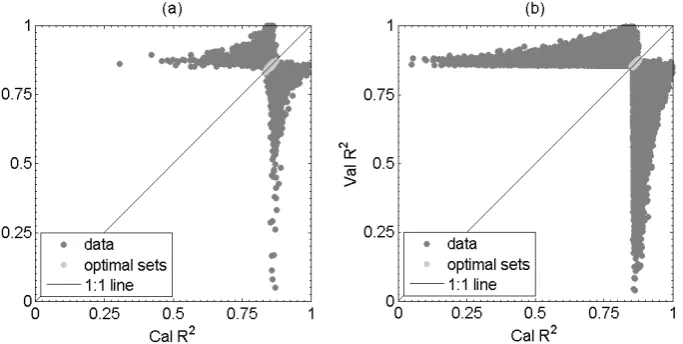
Fig. 1. Determination coefficient, R2, between measured and observed values of (a) soil moisture and (b) chl a absorption coefficient. The solid line is the 1:1 reference line. Light-grey coloured points represent the optimal Cal/Val pairs.
cross entropy method as reported in Salama and Shen (2010). Following the Lambert-Beer law, the absorption coefficient of chl a is described as a linear function of the concentra-tion (D’Sa and Miller, 2005, Eq. 10):
achla(λ0)=a∗chla(λ0)Cchla+δ(λ0) (2) whereachla(λ0)is the absorption coefficient of chl a (m−1) at the wavelengthλ0 (nm);achl∗ a(λ0)is the specific absorp-tion coefficient that describes the absorpabsorp-tion per unit weight (m2mg−1); Cchla is the concentration (mg m−3); δ(λ0) is an offset related to sensor noise, retrieval error ofachla(λ0), (m−1) and the ratio of accessory pigments that are produced in different conditions of growth (nutrients and irradiance), e.g. “xanthine” that acts as sun protection.
The two unknowns in Eq. (2),a∗chla(λ0)andδ(λ0), are es-timated from regressingachla(λ0)versusCchla using linear-regression model. In practice, Eq. (2) could deviate from lin-earity depending on the packaging effect, cell sizes, physiol-ogy and species composition of the phytoplankton commu-nity (Bricaud et al., 1995). For example, the effect of pack-aging on the variability ofachl∗ a(λ0)is smaller in open olig-otrophic oceans than in upwelling regions or coastal areas where larger phytoplankton cells are abundant. Hence, the deviation of Eq. (2) from linearity can then be understood based on the water body investigated. The linearity of Eq. (2) for the used data sets is justified in Sect. 4, Fig. 1b.
3 Method
The method randomly subdivides the data into many sets (or Jackknife samples) of Cal/Val pairs. The Cal set is used to derive the coefficients of the observation model, whereas the Val set is employed to check the accuracy of the model. The results are probability distributions of model coefficients and their prediction uncertainties.
The Cal/Val sets are derived from thenavailable matchups following two rules: (i) both Cal and Val sets must contain at least 7 samples (kmin=7), and (ii) each sample is used once, either for calibration or for validation (i.e. sampling with-out replacement). The minimum sample size, (kmin=7), is selected according to the method of Cohen et al. (2003), to achieve about 35 % error in the derived slope at 95 % of con-fidence. This value, 35 %, corresponds to the desired level of accuracy for satellite-derived Chlaproducts (McClain et al., 2006; Bailey and Werdell, 2006).
The number of Cal/Val pairs is computed as nr=n− 2kmin+1. Now, for each i= [kmin, n−kmin], the method forms a Cal/Val pair by increasing/decreasing the number of data points in the sets (forming the Jackknife sample). The number of possible combinations, npci, for thei-th Cal/Val pair is
npci =
n ki
= n!
ki!(n−ki)!
store them in PDc;
5. Use the new model coefficient to estimate the geophys-ical variables from the Val set;
6. Compute the uncertainty of step 5 and store them in PDv;
7. Increaseki by one and repeat steps 1 to 7.
4 Results and discussions
4.1 Optimal Cal/Val pairs
The determination coefficients,R2, of the Cal set are plotted against those of the Val set in Fig. 1 for all possible combina-tions. The data point position with respect to the x-axis is an indication for the ability of the model to fit the matchups of the Cal set, whereas its position with respect to the y-axis rep-resents the model’s performance in deriving the geophysical variables, here soil moisture and Chl a absorption coefficient (achla(λ0)). Obviously, both the Cal and ValR2depend on the number of data points, reaching their maxima when all data points are included, which suggests for the Cal sets that the used observation models in Eqs. (1) and (2) are indeed linear.
Both OPE3and NOMAD matchups produce a narrow re-gion of Cal/Val pairs, for which the calibrationR2is similar to validationR2, about 0.75–0.85 (light-grey coloured data points in Fig. 1). In other words, within these Cal/Val sub-divisions the model validity and the accuracy assessment are balanced. This region defines the optimal setups for subdivid-ing matchups into Cal/Val sets. The underlysubdivid-ing mechanisms of the data points in this region are investigated further. We found that the optimal Cal/Val sets are obtained when the arithmetic mean,µ, and dispersion,σ, of each set are equal to those of the original data set. As such, the optimal Cal/Val pair satisfies the following condition:
µcal=µval=µdata, AND
σcal=σval=σdata,
(4)
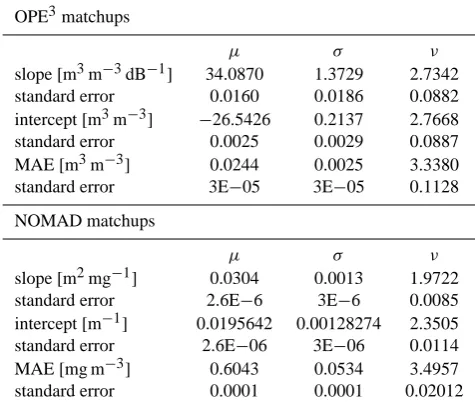
µ σ ν
slope [m2mg−1] 0.0304 0.0013 1.9722 standard error 2.6E−6 3E−6 0.0085 intercept [m−1] 0.0195642 0.00128274 2.3505 standard error 2.6E−06 3E−06 0.0114 MAE [mg m−3] 0.6043 0.0534 3.4957 standard error 0.0001 0.0001 0.02012
where the subscripts “cal”, “val” and “data” are for the cali-bration, validation and original data sets, respectively.
Equation (4) and the equalR2 for both Cal and Val sets (light-grey coloured points in Fig. 1) are the criteria that should be used to determine the sample size of the optimal Cal/Val set.
4.2 The underlying distribution
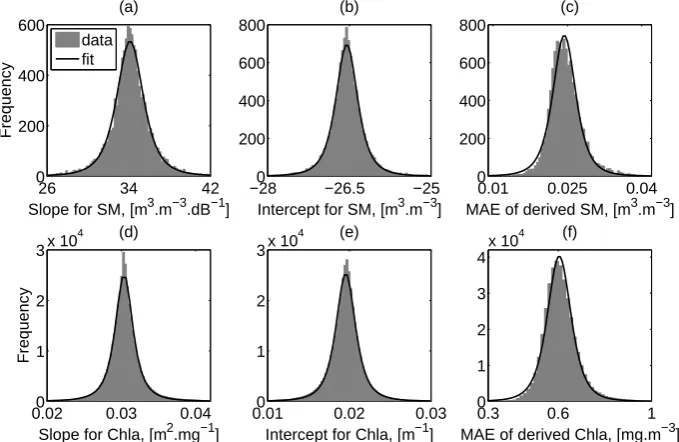
Figure 2 shows the derived probability distributions (PDs) of model coefficients, PDc, and the associated uncertainties, PDv, for the two matchup sets, OPE3and NOMAD. The re-sulting PDs of model coefficients have high kurtosis (acute peak around the mean) values and flat tails, i.e. more prone to outliers. Different values ofkminwere tested (not shown), and the results show that all derived PDs from both data sets (OPE3 and NOMAD matchups) can be described by the t-location-scale probability distribution (the black lines in Fig. 2) of the form (Evans et al., 1993)
f = 0 (0.5ν+0.5) σ√νπ 0 (0.5ν)
"
1+ν−1
x−µ
σ
2#−(0.5ν+0.5)
(5)
[image:4.595.308.546.105.309.2]26 34 42 0
200 400 600
Slope for SM, [m3.m−3.dB−1]
Frequency
(a)
−280 −26.5 −25 200
400 600 800
Intercept for SM, [m3.m−3] (b)
0.01 0.025 0.04 0
200 400 600 800
MAE of derived SM, [m3.m−3] (c)
0.020 0.03 0.04 1
2 3x 10
4
Slope for Chla, [m2.mg−1]
Frequency
(d)
0.010 0.02 0.03 1
2 3x 10
4
Intercept for Chla, [m−1] (e)
0.3 0.6 1 0
1 2 3 4
x 104
MAE of derived Chla, [mg.m−3] (f)
[image:5.595.127.467.63.284.2]data fit
Fig. 2. Derived probability distributions of model coefficients (a, b, d, e) and associated uncertainties (c, f) for the OPE3data (upper panels) and NOMAD matchups (lower panels). The solid lines are the fits by Eq. (5) with coefficients given in Table 1.
The reason for having flat tails in the PDs of Fig. 2 is due to the fact that the accuracy of model coefficients depends on the size of the Cal set. In other words, for a large Cal set we expect to have higher accuracy as most data points are used; however, this makes them also sensitive to outliers in the Val set, because most of the data points have been used to create the Cal set. For a linear observation model, the t-probability density function should, thus, be employed to describe the distributions PDc and PDv, regardless of the original distri-bution of geophysical measurements or remote sensing ob-servations. For example, the NOMAD matchups set has a log-normal distribution, while OPE3is close to uniform dis-tribution (not shown here) for measurements, residuals and observations. Yet, the distribution of derived coefficients fol-lows, for both data sets, Eq. (5). This is basically a con-firmation of previous statistical studies, for example Singh (1988) showed that the normality distribution is not always a valid assumption for linear models, and the t-distribution is broader and therefore better suited. In this regard, having the result of our sampling scheme reproducing the t-distribution is another validation of the correctness of the GeoCalVal. The proposed method reveals the shape of the underlying prob-ability distribution without any a priori assumption on its parameters (e.g. degree of freedom). For non-linear models there is no straightforward theoretical approximation of the expected probability distribution. If we would follow the the-ory, we would have no means to justify our assumption on the underlying probability distribution and its parameters. The only objective approach is by evaluating all possible combi-nation sets as is proposed through the GeoCalVal method.
4.3 Effect of sample size
geophysical measurements (withm > n) and Y is the cor-responding remote sensing observations. Assuming that the fluctuations in the measured quantity, X, and derived model coefficients,8, are uncorrelated, we approximate the second moment using the truncated Taylor series expansion:
σy2=wx2σx2+ n
X
i=1
w2φ
iσ 2
φi (6)
wherewis the partial derivative of Y with respect to the mea-surements X and each model coefficient,φi. The terms,σ2, are the corresponding variances. For the linear modelY= a×X+b, the uncertainty in Eq. (6) becomesσy2=a2σx2+ x2σa2+σb2. The coefficienta and the uncertainties termsσa2
andσb2are quantified from the derived probability distribu-tions of model coefficients, PDc. Measurement uncertainty, σx2, is either assumed (e.g. NOMAD matchups) or estimated from available measurements (e.g. OPE3). In the NOMAD data set, the concentrations of Chl a were estimated using high-performance liquid chromatography (HPLC) method. Many studies (Claustre et al., 2004; Hooker et al., 2005) found that the error in HPLC estimation of Chl a, on aver-age, varies between 7 % and 25 %. On the other hand, each observation site in the OPE3data set contains 21 soil mois-ture measurements. The standard deviation of these measure-ments, per observation, can be used as a proxy forσx. Esti-mated values ofσx,a,σaandσbform the inputs to Eq. (6) to produce the PD, quantifying the uncertainty of each remote sensing observation. This results in a PD of uncertainty per data point that hasPnr
i nuci number of samples, i.e. num-ber of all used combinations. It should, however, be noted that this uncertainty should not be confused with observa-tion errors associated with remote sensing retrievals, which included also other components (e.g. model goodness-of-fit and inversion uncertainty).
5 Conclusions
In this paper we present the GeoCalVal model for an objec-tive selection of calibration/validation data sets to assess the
– GeoCalVal provides an optimal setup for subdividing matchups into Cal/Val sets;
– the coefficients and associated uncertainties of linear observation models follow the t-location scale distribu-tion, i.e. the distribution of their standard variate follows the Student t distribution;
– the derived PDs provide complete information on the variations of model coefficients, their uncertainties and the accuracy of observations, which can be employed in time series analyses and data assimilation schemes; – the optimal Cal/Val sets are obtained when the
arith-metic mean and dispersion of the Cal/Val sets are equal to those of the original data set;
– the presented method is applicable to any data set and can be adjusted to any observation model regardless of the application area, e.g. water quality or surface hy-drology.
Acknowledgements. The authors would like to thank NASA Ocean
Biology Processing Group and individual data contributors for maintaining and updating the SeaBASS database. This work was supported in part by the Earth and Life Sciences (ALW) division of the Netherlands Organization for Scientific Research (NWO), in the framework of the National Programme Sea and Coast Research
– Changing Carrying Capacity, the IN PLACE project.
Edited by: S. W. A. Naqvi
References
Bailey, S. and Werdell, P. J.: A multi-sensor approach for the on-orbit validation of ocean color satellite data products, Remote Sens. Environ., 102, 12–23, 2006.
Bricaud, A., Babin, M., Morel, A., and Claustre, H.: Variability in the Chlorophyll-specific absorption coefficients of naturnal phy-toplankton: analysis and parameterization, J. Geophys. Res., 100, 13321–13332, 1995.
Champaign, I. and Faivre, R.: Sensitivity of the radar signal to soil moisture: variation with incidence angle, frequency, and polar-ization, IEEE T. Geosci. Remote, 35, 781–783, 1997.
Claustre, H., Hooker, S., Van Heukelem, L., Berthon, J., Barlow, R., Ras, J., Sessions, H., Targa, C., Thomas, C. S., Van der Linde, D., and Marty, J.: An intercomparison of HPLC phytoplankton pig-ment methods using in situ samples: application to remote sens-ing and database activities, Mar. Chem., 85, 41–61, 2004. Cohen, J., Cohen, P., West, S. G., and Aiken, L. S.: Applied Multiple
Regression/Correlation Analysis for the Behavioral Sciences, 3rd edn., Lawrence Earlbaum Associates, Mahwah, NJ, 2003. Devlin, M., Barry, J., Mills, D., Gowenc, R., Foden, J., Sivyerb, D.,
and Tett, P.: Relationships between suspended particulate mate-rial, light attenuation and Secchi depth in UK marine waters, Es-tuar. Coast. Shelf S., 79, 429–439, 2008.
D’Sa, E. and Miller, R.: Bio-optical properties of coastalwaters, in: Remote Sensing of Coastal Aquatic Environments, edited by: Miller, R., del Castillo, C., and McKee, B., Springer, Dordrecht, The Netherlands, 129–155, 2005.
Efron, B. and Tibshirani, R.: An introduction to the Bootstrap, 57, Monographs on Statistice and Applied Probability, Chapman & Hall/CRC, 1993.
Entekhabi, D., Njoku, E., O’Neill, P., Kellogg, K., Crow, W., Edel-stein, W., Entin, J., Goodman, S., Jackson, T., Johnson, J., Kim-ball, J., Piepmeier, J., Koster, R., Martin, N., McDonald, K., Moghaddam, M., Moran, S., Reichle, R., Shi, J., Spencer, M., Thurman, S., Tsang, L., and Van Zyl, J.: The Soil Moisture Ac-tive Passive (SMAP) mission, Proc. IEEE, 98, 704–716, 2010. Evans, M., Hastings, N., and Peacock, B.: Statistical Distributions,
2nd Edn., Wiley, New York, 1993.
Hooker, S. B., Van Heukelem, L., Thomas, C. S., Clauster, H., Ras, J., Barlow, R., Sessions, H., Shl¨uter, L., Perl, J., Trees, C., V., S., Head, E., Clementson, L., Fishwick, J., Llewellyn, C., and Aiken, J.: The second SeaWiFS HPLC analysis Round-Robin experiment (SeaHARRE-2), Tech. Rep. 212787, Goddard Space Flight Center, NASA, Greenbelt, Mary-land 20771, 2005.
Joseph, A. T., Van der Velde, R., O’Neill, P. E., Lang, R. H., and Gish, T.: Soil moisture retrieval during a corn growth cycle using L-band (1.6 GHz) radar observations, IEEE T. Geosci. Remote, 46, 2365–237, 2008.
Joseph, A., van der Velde, R., O’Neill, P. E., Choudhury, B. J., Lang, R. H., Kim, E. J., and Gish, T.: L-band brightness temper-ature observations over a corn canopy during the entire growth cycle, Sensors, 10, 6980–7001, 2010a.
Joseph, A., van der Velde, R., O’Neill, P. E., and Lang, R. H.: Ef-fects of corn on C- and L-band radar backscatter: a correction method for soil moisture retrieval, Remote Sens. Environ., 114, 2417–2430, 2010b.
Maritorena, S., Siegel, D., and Peterson, A.: Optimization of a semi-analytical ocean color model for global-scale applications, Appl. Optics, 41, 2705–2714, 2002.
McClain, C., Feldman, G., and Hooker, S. B.: An overview of the SeaWiFS project and strategies for producing a climate research quality global ocean bio-optical time-series, Deep-Sea Res. Pt. II, 51, 5–42, 2004.
McClain, C. R., Feldman, G. C., Hooker, S. B., and Bontempi, P.: Satellite data for ocean biology, biogeochemistry, and climate re-search, EOS Transactions, 87, 337–343, 2006.
M´elin, F.: Global distribution of the random uncertainty associated with satellite-derived chla, IEEE Geoscience and Remote Sens-ing Letters, 7, 220–224, 2010.
Njoku, E., Wilson, W., Yueh, S., Dinardo, S., Li, F., Jackson, T., Lakshmi, V., and Bolten, J.: Observations of soil moisture using a passive and active low-frequency microwave airborne sensor during SGP99, IEEE T. Geosci. Remote, 40, 2659–2673, 2002. Petusa, C., Chustb, G., Gohinc, F., Doxarand, D., Froidefonda, J.
M., and Sagarminagab, Y.: Estimating turbidity and total sus-pended matter in the Adour River plume (South Bay of Biscay) using MODIS 250-m imagery, Cont. Shelf Res., 30, 379–392, 2010.
Reichle, R. H.: Data assimilation methods in the Earth sciences, Adv. Water Resour., 31, 1411–1418, 2008.
Robinson, I.: Measuring The Ocean From Space: The Principle And Methods Of Satellite Oceanography, Chapter 6: Ocean color re-mote sensing, Springer Praxis Books, Berlin, Heidelberg, New York, 2004.
Salama, M. S. and Shen, F.: Stochastic inversion of ocean color data using the cross-entropy method, Opt. Express, 18, 479–499, 2010.
Salama, M. S. and Stein, A.: Error decomposition and estimation of inherent optical properties, Appl. Optics, 48, 4947–4962, 2009. Salama, M. S. and Su, Z.: Bayesian model for matching the
radio-metric measurements of aerospace and field ocean color sensors, Sensors, 10, 7561–7575, 2010.
Salama, M. S., Monbaliu, J., and Coppin, P.: Atmospheric correc-tion of Advanced Very High Resolucorrec-tion Radiometer imagery, Int. J. Remote Sens., 25, 1349–1355, 2004.
Singh, R. S.: Estimation of error variance in linear regression mod-els with errors having multivariate student-t distribution with un-known degrees of freedom, Economic Letters, 27, 47–53, 1988. Ulaby, F. T., Allen, C. T., Eger III, G., and Kanemasu, E.:
Relat-ing the microwave backscatterRelat-ing coefficient to leaf area index, Remote Sens. Environ., 14, 113–133, 1984.
Van Der Woerd, H. and Pasterkamp, R.: Hydropt: a fast and flexi-ble method to retrieve chlorophyll-afrom multispectral satellite observations of optically complex coastal waters, Remote Sens. Environ., 112, 1795–1807, 2008.
Wang, P., Boss, E., and Roesler, C.: Uncertainties of inherent opti-cal properties obtained from semianalytiopti-cal inversions of ocean color, Appl. Optics, 44, 4074–4084, 2005.