Grade III Science
Materials
Module 1 Observable Characteristics
Basic Education Assistance for Mindanao (BEAM) project. Prior approval must be
given by the author(s) or the BEAM Project Management Unit and the source must
be clearly acknowledged.
Mind Map
Assessment
All six Stages of Learning in this Learning Guide may include some advice on possible formative assessment ideas to assist you in determining the effectiveness of that stage on student learning. It can also provide information about whether the learning goals set for that stage have been achieved. Where possible, and if needed, teachers can use the formative assessment tasks for summative assessment purposes i.e as measures of student performance. It is important that your students know what they will be assessed on.
Stages of Learning
The following stages have been identified as optimal in this unit. It should be noted that the stages do not represent individual lessons. Rather, they are a series of stages over one or more lessons and indicate the suggested steps in the development of the targeted competencies and in the achievement of the stated objectives.
1. Activating Prior Learning
This stage aims to engage or focus the learners by asking them to call to mind what they know about the topic and connect it with their past learning. Activities could involve making personal connections.
Background or purpose
Pupils are aware of the materials around them. In this stage, their attention will be focused on naming some materials that they need in order to survive.
Activity: Matter Around Us!
Name of Materials
_____________ ______________ _____________ _____________ ______________ _____________ _____________ ______________ _____________ _____________ ______________ _____________
Strategy: Brainstorming
This is a strategy used for generating many ideas. No criticism is allowed during the process of collecting ideas.
Formative Assessment
Pupils are able to demonstrate their level of understanding through their responses. Class Participation Checklist
Roundup
Everything around us is matter. Living things such as plants and animals and nonliving things such as rocks, soil, water and air are all examples of matter. Matter is anything that occupies space and has mass.
2. Setting the Context
This stage introduces the students to what will happen in the lessons. The teacher sets the objectives/expectations for the learning experience and an overview how the learning experience will fit into the larger scheme.
Background or purpose
Pupils are now aware of some common materials: things around them and those that they need in order to survive. This would lead them to group these materials by identifying and differentiating some characteristics that they already know.
Activity: Amazing Matter!
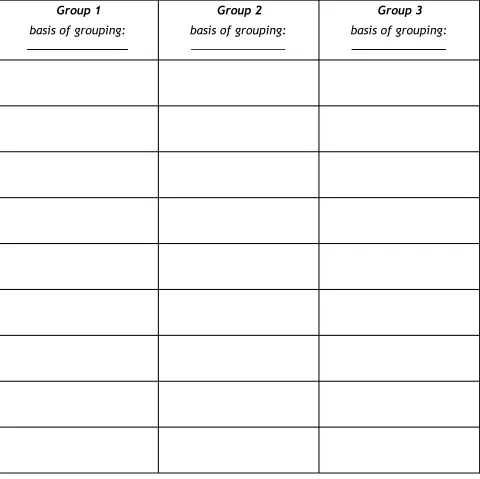
1. Group the pupils into five. Give them pictures needed for the activity e.g. clouds, fire, flower, river, piece of wood, clay, plastic, glass, paper, metal, balloon, candle, glass of water, glass of milk, oil and soft drink. Inform them that those materials listed on the board will be included as well. Ask them to group the materials into three according to their own basis of grouping.
2. Let the pupils record their output on a manila paper (refer to student activity sheet No.1 page13 -Observe Observe Observe).
3. Let them post their work on the wall and ask one representative per group to talk about their output.
4. After they have reported their work, tell them to revisit their output after performing the next stage of learning (Learning Activity Sequence).
Strategy:
Formative Assessment
Pupils are able to demonstrate their level of understanding of some characteristics of common materials. Their performance will be assessed through a rubric.
Roundup
After the presentation of outputs, give emphasis that materials have their own characteristics which can be used as basis for grouping.
3. Learning Activity Sequence
This stage provides the information about the topic and the activities for the students. Students should be encouraged to discover their own information.
Background or purpose
Pupils are already aware of some characteristics of things around them. This will lead them to learn about other characteristics of matter which can be used as basis in differentiating the three phases of matter – solid, liquid, and gas.
Activity 1: It's A Matter of Solids, Liquids and Gases
Each group will be given five minutes to perform the tasks in each learning station. Each learning station should be posted with an enlarged activity sheet, page 14, “Its a Matter of Solids, Liquids and Gases” to provide the needed instructions.
Guide them to record all their observations in the table provided in each station. Give each group a particular color of “star” figures to easily identify their answers (e.g. group 1-red; 2-green; 3-blue; 4-violet;5-pink). Pls refer to Teacher Resource Sheet 7 page 26 for sample colored “star” figures. Let them paste their assigned “colored star figure” next to their answers.
Give a signal every after 5 minutes and guide them to proceed to the next learning station. They will rotate in these stations until they come back to the station where they started.
Before starting with the activity, make sure that certain terms (e.g. definite, indefinite, etc) are unlocked.
Learning Station 1
a. Display solid materials on the table like block of wood, pencil,
eraser, stones etc.
b. Let them describe the shape and the volume (space occupied) of
the objects.
c. After giving their observations, request them to move the objects
across the table.
d. Ask them if they notice any change in the shape and volume of the
objects.
Learning Station 2
a. Prepare 2 empty 100 ml graduated cylinders. Label them with “
A
”
and “
B
” respectively. Fill graduated cylinder “
A
” with 50 ml water.
Display them on the table.
b. Ask the students to observe and describe the shape and volume (in
ml
) of water.
Reminder:
Guide them to read at the lower meniscus
level.
c. After giving their observations, let them pour the total water
content of graduated cylinder “
A
” to the other cylinder “
B
”. Remind
them to perform this activity with care so that not even a drop of
water will be spilled.
d. Ask them to observe and describe the “new” shape and volume of
water inside the graduated cylinder “
B
”.
e. Guide them to record their observations in the table provided.
Learning Station 3
a. Prepare 5 deflated balloons and an inflated balloon.(The quantity of
deflated balloons would vary depending on the number of groups that
will use them.)
b. Ask them to describe the shape and volume (space occupied) of air
inside the inflated balloon.
c. After giving their observations,let them blow air into
one
of the
deflated balloons displayed on the table. Tell them that the purpose
of blowing is just to fill all the spaces inside the balloon. Request
them to tie the inflated balloon.
d. Again, let them describe the shape and volume (space occupied) of
air inside the balloon.
e. Guide them to record their observations in the table provided.
After the activity,assign a group per learning station for the reporting process. The group assigned in each station will share all observations in that particular station.
Instruct the pupils to revisit their outputs in the “Amazing Matter” activity. You may ask this question: “Using the concepts learned in the previous activities, can you reclassify these materials( pictures) in some other way/s? How?”
Activity 2 Lecturette (See attachment No. 3 )
Introduce the concept about the arrangement of molecules in each phase of matter. Show them a molecular model to show how molecules are arranged in each of the three
Activity 3 Simulation (molecular arrangement)
Tell them that in this activity, they will pretend to be particles/molecules of solid, liquid and gas. To invite maximum participation of the students, the number of students to participate in each activity will vary depending on class size.
1. For solid particles:
• Call 12 pupils to come in front of the class and arrange them in 3 rows of 4. • Have them link their arms tightly with each other and tell them that they have to
walk at the same time.
• Starting with their right foot first, they will move to the right altogether with out
unlinking their arms.
• They can also be asked to move to other directions having the same arrangement. • Emphasize that particles/molecules in a solid are arranged and therefore,behave in
the same manner. Solid objects have definite shape and volume because of such behavior.
2. For liquid particles:
• Call another 12 pupils to come in front of the class to represent liquid
particles/molecules.
• Instruct them that instead of using their arms they only have to link their pinkies
together.
• Tell them to move to the right altogether without unlinking their pinkies. Using the
same link, they can also be requested to move in other directions one at a time(forward,backward, left,right).
• Emphasize that particles/molecules of liquid behave in the same manner. Such
behavior enables them to take the shape of the container because their particles/molecules are not closely and strongly held together.
• You may ask the pupils “Why can't we hold water with our bare hands?”
3. For gas particles:
• Call another 12 pupils in front of the class.
• Emphasize that this time they do not have to hold hands, pinkies, or link arms. Ask
them to spread out in the classroom.
• Explain that gas particles/molecules behave in that manner. They take the shape and
volume of their container. Such behavior explains the indefinite shape and volume of gases.
When pupils had performed all of the above activities, you may check their understanding about the key concepts by asking them this suggested question “Which state of matter has the greatest attraction among its molecules—solids, liquids or gases? Why?”.
Activity 4 Find Out Solids!
1. With the same groupings, let the pupils observe some of the solid materials like rocks, gold plated ring, and bottles.
2. Let them compare the characteristics and identify similarities and differences of these materials.
4. Prior to the activity gather some solid materials for them to describe. Give each group colored paper flaglets with the following labels: Blue:soft, Green:hard,
Yellow:smooth and Red:rough. Please refer to Teacher Resource Sheet 7 page 26 for sample colored labeled flaglets.
5. Show the materials one at a time. Ask each group to describe the hardness of the material whether it is soft or hard; and texture whether smooth or rough by raising the appropriate flag. Ask them to identify and write the name the material on the board. Members of the group may take turns in doing the task.
6. The group which identifies the characteristic and the name of the material correctly will be awarded as “winner”.
Activity 5 Find Out Gases!
Let the pupils observe other characteristics of gas.
1. Begin the activity by asking the pupils to put their hands in front of their face about 20cm away. Ask them what they see between their nose and their hands.
2. Instruct the pupils to wave their hands in front of their face and ask them what they feel.
3. Show them a bottle of perfume. With the same grouping, let them predict on what will happen to the air inside the room if the bottle is opened? Ask them to write their answers in an enlarged activity sheet 5 “Let's find out” page 17.
4. After they have written their answers instruct them to post their work on the wall for later reference.
5. Tell the pupils that the bottle will now be opened. Ask them to raise their hands when they observe something. Ask them if their answers are correct. With your guidance, let them write their observations in the activity sheet 5 “Let's find out” page 17.
Activity 6 Find Out Liquids!
Let the pupils observe some characteristics of liquid. 1. The pupils will observe how water flows.
2. In this activity, pour a small amount of water on the table and ask them to describe what happened.
3. After processing their answers, show them a picture of a falls. Ask a representative to describe the picture. Guide them to focus on the characteristic of water.
With their observations, give a summary to clarify ideas and give some additional inputs about the different characteristics of matter.
Tell the pupils to find a pair to discuss what they have learned in the previous activities that they performed. Let them think and discuss with a partner and record what they have shared. Ask them to share their output/observations with the whole group.
Sharing ideas with their classmates would clarify their doubts and would give them additional inputs. They can also easily ask their partners/peers without hesitation or fear.
Strategy
take approximately the same time. It can be used when a teacher decides to do more than two activities to develop a science concept. It is ideal even if the class is big and the materials are limited. It also provides an opportunity for maximum participation of the students.
Pictures/Diagrams can be used as visual prompts in the classroom to increase pupil's understanding of a concept.
Lecturette – a strategy where the teacher engages in a short discussion to brainstorm important concepts focused in the lesson.
Simulation/Games is a strategy that makes use of natural activities like drama for the purpose of exploring ideas, relationship, and situations. In this lesson, the pupils will simulate the behavior of particles/molecules of each phase of matter.
Think, Pair, Share is a strategy where pupils are asked to think about a certain topic and share their ideas with a partner then to the whole group. This strategy allows groups to reach consensus or check understanding.
Formative Assessment
Pupils understanding about the key concepts can now be assessed based on their responses.
Group Participation Checklist
Roundup
Matter has different observable characteristics. Two of these characteristics, shape and volume, may be used to distinguish one from the other.
Solids have other properties like hardness and texture. They may be soft or hard, rough or smooth. Liquids have the ability to flow. We can not hold liquids in our hands. We hold them in bottles and other containers. Gases have the ability to be scattered/diffused over a wider area. These properties can be explained through the arrangement and attraction of particles/molecules in each state of matter.
4. Check for Understanding of the topic or skill
This stage is for teachers to find out how much students have understood before they apply it to other learning experiences.
Background or purpose
Anything we perceive with our senses is matter. Matter comes in different states, each having its own unique characteristics. The concepts gained from the preceding stages will guide them in performing their task in this stage.
Activity
Option 1 Color Me!
• Let the pupils perform the task in Activity Sheet 6 “Color Me!” page 18.
Option 2 Guess What!
• Let the pupils play a guessing game. With the same groupings,tell each group to act
Strategy
Coloring
It is a strategy which involves an activity to let the pupils use their art skills. In this lesson, pupils are asked to identify each state of matter by coloring them.
Simulation/Guessing Game
A task is given for each group to perform and simulate while other groups would take a guess. In this lesson, pupils will simulate the behavior of particles/molecules of the different states of matter while the other groups would guess what the presenters simulated.
Formative Assessment
The groups' performance and outputs show pupils mastery of the concepts focused in the lesson. Learning can be determined from their activity responses.
Roundup
Guide the pupils to realize that each of the three states of matter can be identified through their characteristics (like shape and volume) and particle/molecular behavior.
5. Practice and Application
In this stage, students consolidate their learning through independent or guided practice and transfer their learning to new or different situations.
Background or purpose
Pupils engagement in the different activities performed provided them with knowledge and skills focused in this lesson. In this stage, they will be asked to apply their learning into new but relevant situations to deepen their understanding of the key concepts.
Activity 1 Characterize Me!
Option 1
Prepare and post flash cards with printed observable properties of matter such as DEFINITE SHAPE, INDEFINITE SHAPE, DEFINITE VOLUME, INDEFINITE VOLUME, SMOOTH, ROUGH, HARD, SOFT, CAN FLOW, CAN DIFFUSE and some name of materials such as WATER, BALL, SPONGE, WOOD, AIR, etc. Post them in such a way that the name of the materials will be clustered separately from the observable characteristics. They should be arranged in any order on the board. Have pupils match the materials with their corresponding observable characteristics. Ask them to do the task in 5 minutes. The group which has the most number of correct answers will be declared as a winner.
Option 2
Hold a concrete object in front of the class. Using the knowledge gained from the previous activities, let the pupils give all the observable characteristics as they can. You may conduct this activity as a contest.
Activity 2
Interactive Story Telling
Strategy
Card Clusters is a strategy that involves collecting information or ideas in an organized visual form. In this lesson, some name of materials and their observable characteristics (all printed in flashcards) will be matched.
Brainstorming through Game is a strategy which involves soliciting ideas while engaging learners in a game. In this lesson, observable characteristics of matter will be supplied by the pupils as each object will be shown. The group which will have the highest number of correct answers will be declared as the winner.
Interactive Story Telling is a strategy where sound effects and or movements are used to accompany the mention of a character (object, term, event, etc) or any significant feature in the story being narrated. In this lesson, specific actions will be used to accompany the mention of any phase of matter (solid, liquid, gas) in the story.
6. Closure
This stage brings the series of lessons to a formal conclusion. Teachers may refocus the objectives and summarize the learning gained. Teachers can also foreshadow the next set of learning experiences and make the relevant links.
Background or purpose
With the previous activities, the pupils can now describe and cite some examples of the three states of matter.
Activity
Option 1 What's the Matter!
Ask the pupils to make a three-stanza poem or song that describes the characteristics of the three states of matter.
Option 2 Model making
Let the pupils make a model on the arrangement of molecules for each phase of matter. Ask them to use recycled materials like old news papers, bottle caps or pebbles in constructing the model.
Strategy
Poem Writing is a strategy where pupils are instructed to write a poem based on the concepts that they understood during the lesson. They can describe a thing that fits on the unit discussed.
Model Building is a strategy that involves the creation of models from materials acquired by the builder to demonstrate a particular concept/s. In this lesson, pupils are asked to make a molecular model of solid, liquid and gas.
Formative Assessment
Written output of the pupils serves as assessment. Rubric in assessing poems is found on page 24.
Rubric in assessing a molecular model is found on page 25.
Roundup
definite volume; while gas has no definite shape and no definite volume. It takes up the shape and volume of the container.
The molecules or small particles that make up a solid object are very close to each other. Molecules of liquids are arranged loosely while gas molecules are far apart from each other. These differences in molecular/particle arrangement, and therefore attraction, explains the differences in shape, volume and other observable characteristic of the three states of matter.
Teacher Evaluation
(To be completed by the teacher using this Teacher’s Guide) The ways I will evaluate the success of my teaching this unit are:
Activity Sheet No.1
Observe! Observe! Observe!
Direction:
[image:13.595.59.539.260.739.2]Group the materials given to you according to your own classification. Use the
table for your answers.
Group 1
basis of grouping:
________________
Group 2
basis of grouping:
_______________
Group 3
Activity Sheet No. 2
It's a matter of solids, liquids and gases
Objectives:
To observe and describe the shape and volume(space occupied) of certain objects.
Materials:
block of wood, pencil, eraser, and stones
Procedure:
1. On top of the table are materials such as block of wood, pencil, eraser and
stones.
2. Describe the shape and the volume (space occupied) of the objects.
3. After giving the observations, move the objects across the table. Does any
change happen? Did the shape/volume change?
4. Use the table below to record your answers. Put an assigned
colored star figure
inside the box if it describes the characteristics of the given material. If it does
not, just leave the space blank.
Name of Objects
SHAPE VOLUME Has its own shape
(definite)
Takes the shape of its container
(indefinite)
Has its own volume (definite)
Takes the volume of its
container (indefinite)
Activity Sheet No. 3
It's a matter of solids, liquids and gases
Objectives:
To observe and describe the shape and volume (space occupied) of certain
objects.
Materials:
2 empty graduated cylinders
50 ml Water
Procedure:
1. Observe and describe the shape and volume (in ml) of water in graduated
cylinder “A”. Record your observation in the table below.
2. After giving the observations, pour the total water content of graduated cylinder
“A” to the empty cylinder “B”. Perform this activity with care so that not even a
drop of water will be spilled.
3. Observe and describe the “new” shape and volume of water inside the glass.
4. Use the table below to record your answers. Put an assigned
colored star figure
inside the box if it describes the characteristics of the given material. If it does
not, just leave the space blank.
Name of Objects
SHAPE VOLUME Has its own shape
(definite)
Takes the shape of its container
(indefinite)
Has its own volume (definite)
Takes the volume of its
container (indefinite)
Activity Sheet No. 4
It's a matter of solids, liquids and gases
Objectives:
To observe and describe the shape and volume (space occupied) of certain objects.
Materials:
5 deflated balloons
1 inflated balloon
Procedure:
1. Describe the shape and volume (space occupied) of the air inside the inflated
balloon.
2. After giving the observations, blow air into
one
of the deflated balloons
displayed on the table. Just blow
enough air
to fill all the spaces inside the
balloon. Tie the new inflated balloon.
3. Describe the shape and volume (space occupied) of the air inside the balloon.
4. Use the table below to record your answers. Put an assigned
colored star figure
inside the box if it describes the characteristics of the given material. If it does
not, just leave the space blank.
Name of Objects
SHAPE VOLUME Has its own shape
(definite)
Takes the shape of its container
(indefinite)
Has its own volume (definite)
Takes the volume of its
container (indefinite)
Activity Sheet No. 5
Let's Find Out!
Situation:
Opening a bottle of perfume inside the room.
What do you think will happen if a bottle of perfume will be opened?
________________________________________________________
________________________________________________________
________________________________________________________
After the bottle of perfume has been opened, what did you observe?
___________________________________________________________________
___________________________________________________________________
Activity Sheet 6
Color me!
Color the following objects. For solid=green; liquid=
blue
; gas=yellow
Glossary
Characteristics Physical appearance of the material. Ex. Size, shape, volume,etc.
Gas A phase of matter that has weight but it has neither definite volume nor shape. Its molecules are widely separated so they move around freely, and move at high speeds. Smoke is an example of a gas.
Liquid Liquids will conform to the shape of whatever they are put into. Anything that flows and pours, like water, is a liquid.
A phase of matter that has weight and definite volume but no definite shape. Its molecules are closer to each other and they move around slowly.
Mass Amount of matter an object has.
Matter Anything that occupies space and that has mass. Ex. Pencil, Water, Air, etc.
Meniscus It is a curve in the surface of a liquid, produced in response to the surface of the container or another object.
Molecules A tiny piece of anything.
Particle A tiny piece of anything.
Pinky The little finger farthest from the thumb.
Rough A texture that is not smooth but is irregular and uneven.
Smooth A surface free from roughness or bumps or ridges or irregularities.
Solid A solid is rigid with a fixed shape which stays the same no matter what you put it in. Putting a rock on the table, into a box, into a backpack – it's still the same rock. Anything that you can hold in your hand is a solid.
A phase of matter that has weight, definite shape, and definite volume. Its molecules are very close together and cannot move around.
Texture The feel of a surface; the characteristic appearance of a surface.
Volume The amount of space that an object occupies.
Teacher Resource Sheet 2
Sample Poem
What's the Matter?
By: Martha Ann Cole
What's the Matter?
Can you guess....
It's rocks and trees and all the rest!
It's water and sky and dirt and grass,
It's everything that's in my class!
It's my brand new coat
that keeps me warm,
And all the animals
on a farm!
Matter is every single thing you see
It's everywhere around us
It's YOU and ME!
Matter takes up space and has some weight
It fills our world....
Teacher Resource Sheet 3
Sample Story for Interactive Story Telling
The Wind, the Sun and the Traveler
The Wind and the Sun were arguing which was the stronger. Suddenly
they saw a traveler coming down the road. The Sun said: "
I see a way
to decide our argument. Whichever of us can cause that traveler to
take off his coat shall be regarded as the stronger
”. “
You begin
”
said the sun. So the Sun hide himself behind a cloud and the Wind
began to blow as hard as it could upon the traveler. But the harder the
Wind blew, the more closely did the traveler wrap his coat around him.
At last, the Wind had to give up in despair. Then the Sun came out and
shone in all his glory. The dew upon the flowers and upon the grasses,
the clear waters upon the winding streams and flowing rivers dried up.
Sweat, much sweat, flowed down the cheeks of the traveler who soon
found it too hot to walk on the road with his coat on. The Sun then saw
the old traveler take his coat off.
Teacher Resource Sheet 3
Molecules of Solids are arranged
close to each other. The tiny particles
of a solid are so strongly attached to
one another that no matter where you put
them, the particles stick together. As a result
they do not change the shape.
Molecules of Liquids are
arranged loosely and away from
each other. Their attraction to one another
is not as strong as those of solids. So,
the particles of a liquid tend to move
away from each other. Liquid flows
as you transfer it to another container.
Molecules of Gases flow very
freely. The particles are very far from
each other than in liquids. This
makes molecules of gases spread out
in all directions.
Sour ce: Science & Health 3 By: Milagr os C. Tadeo Pur ificacion N. Mar celino
Teacher Resource Sheet 4
Group Participation Checklist
Group Number:_______
Criteria Rarely
2
Sometimes 3
Usually 4
Almost Always 5
All members participated in
the group activities.
Group members take turns
sharing their ideas and points
of view.
Group members
support/respect each other
while sharing ideas and
points of view.
Group members stay on task.
Teacher Resource Sheet 5
Rubric in Assessing Poem
Poetry
Score
Novice
1-2
Apprentice
3
Veteran
4
Master
5
Ability to
captivate the
reader
Unfocused;
author seems
unsure of
direction
Some focus, but
lacks continuity
Well focused
and interests
reader
throughout
Captivates and
involves the
reader deeply
Ability to
incorporate
concepts from
the lesson
Information
does not relate
to the topic
Some basic
information
relates to the
topic
Basic
information
relates to the
topic
All information
relates to the
topic
Sensory Images
Difficult to
visualize image
Some use of
image
Clear use of
images to
portray ideas
Teacher Resource Sheet 6
Rubric in Assessing the Molecular Model
Excellent
(5)
Good
(4)
Average
(3)
Poor
(1-2)
Displays amazing
detail, unique and
original.
Displays detail,
shows initiative to
develop original
work
Displays some detail,
shows evidence of
some initiative to
develop original
work
Lacks detail, very
little or no initiative
in developing
original work
Displays correct
arrangement of
molecules for the
three phases of
matter
Displays correct
arrangement of
molecules for at
least two phases of
matter
Displays correct
arrangement of
molecules of one of
the three phases of
matter
Displays incorrect
arrangement of
molecules for the
three phases of
matter
Clean design and use
color effectively
Shows initiative to
develop clean design
and apply colors
Shows evidence of
some initiative to
develop clean design
and apply some
colors
Teacher Resource Sheet 7
SAMPLE FLAGS FOR THE ACTIVITY “Let's Find Out – Solids”
(blue) (yellow) (green) (red)
SAMPLE STAR FIGURES FOR THE “ROTATING LEARNING STATION”
ACTIVITY
Group 1 (red)
Group 2 (green)
Group 3 (blue)
Group 4 (violet)
Group 5 (pink)
Stage
1.
Activating Prior
Learning
2.
Setting the
Context
3.
Learning
Activity Sequence
4.
Check for
Understanding
5.
Practice and
Application
6.
Closure
Strategies
Activities from the Learning Guide
Extra activities you may wish to include
Materials and planning needed
Estimated time for this Stage