BASIC EDUCATION ASSISTANCE FOR MINDANAO
LEARNING GUIDE
Year 3- CHEMISTRY
CHANGE, ENERGY AND TIME
COPYRIGHT NOTICE
Section 9 of the Presidential Decree No. 49 provides: “No copyright shall subsist in
any work of the Government of the Philippines. However, prior approval of the
government agency or office within the work is created shall be necessary for
exploitation of such work for profit.” This material has been developed within the
Basic Education Assistance for Mindanao (BEAM) project. Prior approval must be
given by the author(s) or the BEAM Project Management Unit and the source must
be clearly acknowledged.
Information about this Learning Guide
Recommended number of lessons for this Learning Guide: 5
Basic Education Curriculum Competencies
Third Year Science: Appreciate the importance of controlling rates of
reactions in technology.
• Explain the application of Heats of Reactions to commercial and industrial processes.
• Explain how the factors affecting rates of chemical reactions are applied in food preservation, control of fire, pollution, corrosion and materials production.
• Recognize the importance of controlling rates of reactions in technology.
Objectives
• Cite and explain the application of heat from reactions to commercial and industrial processes.
• State and explain how the factors affecting rates of chemical reactions are applied in food preservation, control of fire, pollution, corrosion and materials production.
• Appreciate the importance of controlling rates of reactions in technology.
Essential concepts, knowledge and understandings targeted
• Chemical Reactions involve energy. Energy in the form of heat may be absorbed (endothermic) or released to the environment(exothermic).
• Equilibrium constant expresses the relative concentrations of reactants and products at equilibrium in terms of a quantity.
• Le Chatelier's principle simply states that if an external force called stress is applied on an equilibrium system, the system will respond to any stress by storing the equilibrium. Stress means a change in concentration, volume, or temperature that removes a system from the equilibrium state.
• Every factor that affects reaction rate can be understood relative to Collision Theory. The nature of the reactants determines the orientation of collisions and the amount of energy required to break bonds and form new ones.
• The higher the temperature at which a reaction occurs, the faster the particles will move.
Specific vocabulary introduced
• Catalyst- a substance that effects a chemical reaction without itself being permanently changed.
• Collision theory- a theory that describe reactions in terms of collisions between reacting particles (atoms, molecules, or ions).
• Equilibrium- a state in which a chemical reaction and the reverse reaction are taking place at the same rate.
• Inhibitor-a substance added to a chemical reaction to slow the reaction down.
• Irreversible Reactions-a chemical reaction wherein the products cannot reform the original reactants.
• Rate of Reaction-the rate at which a reaction proceeds, expressed in terms of the increase in the concentration of a product per unit time or the decrease in the concentration of a reactant per unit.
Suggested organizational strategies
• Organize the class by groups.
• Prepare instructional materials ahead of time.
• Prepare the classroom for the activity.
Opportunities for Integration
TLE-Agriculture/HE
• Preservation of Foods English
• Reflective writing and oral reporting Mathematics
• Calculations
Activities in this Learning Guide
Activity 1 Kinetics Jumble
Multiple Intelligences
• Bodily/Kinesthetic,Logical/Mathematical,Visual/Spatial
Skills
• Use information,Seeing patterns,Observation and recall of information
Activity 2 Heat of Reaction
Multiple Intelligences
• Bodily/Kinesthetic,Verbal/Linguistic,Interpersonal
Skills
• Use information,Solve problems using required skills or knowledge,Predict consequences
Activity 3 Polluting The Environment
Multiple Intelligences
• Bodily/Kinesthetic,Interpersonal,Logical/Mathematical
Skills
• Order, group, infer causes,Interpret facts, compare, contrast,Grasp meaning
Activity 4 Kinetically Important
Multiple Intelligences
Skills
• Knowledge of major ideas,Make choices based on reasoned argument,Identification of components
Activity 5 Guava Jelly Making
Multiple Intelligences
• Bodily/Kinesthetic,Interpersonal,Naturalist
Skills
• Relate knowledge from several areas,Organization of parts,Understanding information
Activity 6 Talking Star
Multiple Intelligences
• Verbal/Linguistic,Interpersonal,Intrapersonal
Skills
• Grasp meaning,Recognition of hidden meanings,Verify the value of evidence
Key Assessment Strategies
Outputs Worksheets
Pencil and Paper Test
Mind Map
The Mind Map displays the organization and relationship between the concepts and activities in this Learning Guide in a visual form. It is included to provide visual clues on the structure of the guide and to provide an opportunity for you, the teacher, to reorganize the guide to suit your particular context.
Stages of Learning
The following stages have been identified as optimal in this unit. It should be noted that the stages do not represent individual lessons. Rather, they are a series of stages over one or more lessons and indicate the suggested steps in the development of the targeted competencies and in the achievement of the stated objectives.
Assessment
All six Stages of Learning in this Learning Guide may include some advice on possible formative assessment ideas to assist you in determining the effectiveness of that stage on student learning. It can also provide information about whether the learning goals set for that stage have been achieved. Where possible, and if needed, teachers can use the formative assessment tasks for summative assessment purposes i.e as measures of student performance. It is important that your students know what they will be assessed on.
1. Activating Prior Learning
This stage aims to engage or focus the learners by asking them to call to mind what they know about the topic and connect it with their past learning. Activities could involve making personal connections.
Background or purpose
Strategy
Jumble Puzzle is a word search memory game. The object of the game is to find the answers by encircling the word in the puzzle. The letters may be vertically, horizontally,or diagonally arranged in the puzzle.
This activity can be done in a contest, provided you have incentives to give to the winners. Independent practice
Materials
marking pen, Student Activity Sheet 1, Kinetics Jumble, page 12
Activity
1. This activity can be done in a contest, provided you have provided incentives to the winners.
2. Distribute the Student Activity Sheet 1, Kinetics Jumble page 12 3. Instruct the students to read the questions below the puzzle.
4. If they think of an answer, have them find the words on the puzzle by encircling it. It may form straight line upward, downward, side ward or in diagonal formation. 5. Give them enough time to perform the activity.
6. Checking of outputs. The teacher may give clarifications or further explanations when needed.
Formative Assessment
Outputs may be checked, refer to Teacher Resource Sheet 1, page.14
Roundup
Students should have circled the words/answers to the questions given in the Jumble puzzle They should have recalled some terms and concepts used in studying chemical reactions. Some of the answers are already practical applications of kinetics. These will give them the idea of what the module is all about.
2. Setting the Context
This stage introduces the students to what will happen in the lessons. The teacher sets the objectives/expectations for the learning experience and an overview how the learning experience will fit into the larger scheme.
Background or purpose
During chemical reaction, energy is needed to break the bonds between atoms. As new bond form, energy is produced. Heat of reaction is the difference between the energy required and the energy produced. Chemical reactions happen because of varying Heats of reactions. Heat may be absorbed or released. Many industrial and commercial processes employed the applications of heats of reaction.
Strategy
Laboratory Activity
Materials
Styrofoam cup, 3 large test tubes, thermometer, water,
bleach (5.25 solutions of sodium hypochlorite and sodium sulfate), 3 stoppers, graduated cylinder,
Activity 2 Heat of Reaction
1. Divide the class into 5 working groups.
2. Distribute Student Activity Sheet 2, Heats of Reactions, page 16. 3. Remind them of the safety precautions in dealing with strong acids. 4. Allow them enough time to perform the activity.
5. Collect the Student Activity Sheets.
Formative Assessment
You may check their output.
Roundup
Students should have performed the laboratory activity about Heat of Reactions. They should have calculated the heat of reaction, inferred from the results gathered of the activity, and explained its application to commercial and industrial processes.
3. Learning Activity Sequence
This stage provides the information about the topic and the activities for the students. Students should be encouraged to discover their own information.
Background or purpose
In this stage, students will be engaged in an activity that will vividly illustrate how some factors affect the rate of chemical reactions. Pollution is a chemical reaction which may be accelerated or slowed down. Man could use this knowledge to control pollution.
Strategy
Independent practice
Materials
20 grams each of the food colors (yellow, red, blue, green), styrofoam coffee cups or any similar material (one per student),
water, 20 medicine droppers, big transparent container, 4 pcs 100 mL beakers, tap water, Student Activity Sheet 3, Polluting The Environment, page 21
Activity 3 Polluting The Environment
Advanced preparation:
1. Prepare one big transparent container (e.g. 5-liter mineral water container), Styrofoam coffee cups (enough for each student), 20 medicine droppers. 2. Prepare 4 pcs 100 mL beakers containing 90 mL water each. Weigh 10 grams
each of the food colors (yellow, red, blue, green). Dissolve one food color in each beaker.
Actual demonstration
1. Distribute Activity Sheet 3, Polluting The Environment, page 21.
2. Group the students into 5 but let the students perform the activity individually. They should share the medicine dropper in their group. Make sure that only one medicine dropper will be used for one food color.
3. Read the samples of human activities and clarify the color codes. 4. Give them enough time to perform the activity.
6. Require students to clean up spills on the floor and tables.
Formative Assessment
You may assess the performance of the students using Teacher Resource Sheet 3, Rubric for Group Participation, page 20.
Roundup
Students should have performed the activity and realized how much each one is contributing to global pollution. Catalysts play an important role in speeding chemical reactions of the environment. Awareness of what is going on around us is everybody's concern. They should have mentioned ways on how to help reduce global pollution as a response to saving earth campaigns.
4. Check for Understanding of the Topic or Skill
This stage is for teachers to find out how much students have understood before they apply it to other learning experiences.
Background or purpose
This stage would let the students evaluate factors affecting the rate of chemical reactions and the importance of controlling the rates of chemical reaction. It is hoped that at the end of the activity, they would appreciate the importance of controlling rates of reactions in technology.
Strategy
Group Discussion
Materials
Manila paper, marking pen, Student Activity Sheet 4, page 23
Activity 4 Kinetically Important
1. Divide the class into five groups.
2. Distribute the Student Activity Sheet 4, Kinetically Important, page 23. 3. Let them choose their group reporter.
4. Invite them to study the process involved in the manufacture of the materials given and the table found on the Student Activity Sheet 4, Kinetically Important, page 23.
5. Instruct them to have the following points for discussion:
● Why is an inhibitor/catalyst needed for the chemical reactions given? ● What would be the effect of the absence or a lowered catalyst/inhibitor on
the reactions?
● Why is it important to control rates of reactions especially on food products?
6. Tell the students to write a summary of their discussion in a manila paper for presentation to the class.
Formative Assessment
You may check their outputs,refer to Teachers Resource Sheet 4, Kinetically Important, page 25.
Roundup
Students should have stated the reasons for adding an inhibitor or a catalyst to the chemical reactions given. They should have referred that chemical reactions are
5. Practice and Application
In this stage, students consolidate their learning through independent or guided practice and transfer their learning to new or different situations.
Background or purpose
In this stage, students will be engaged in an activity wherein they could apply their knowledge about the factors affecting rate of chemical reactions in food preservation.
Strategy
Group work
Materials
paring knife or peeler, liquid measuring cups, dry measuring cups, bowl, sauce pan, spoon, 25 medium size ripe guavas, strainer, 3 cups sugar, 1 tbsp corn syrup, Student Activity Sheet 5, Guava Jelly Making, page 27
Activity 5 Guava Jelly Making
Advance preparation
1. Require each group to bring the needed materials for the day: 25 medium-sized ripe guava, 3 cups brown sugar, 3 pcs kalamansi, strainer and corn syrup, sauce pan, ladle, manila paper, marking pen, 1 clean jar with cover
2. Inform the students that they will have a cooking activity the following day. Actual preparation
1. Divide the class into five groups.
2. Distribute the Student Activity Sheet 5, Guava jelly Making, page 27 3. Remind them of the safety precautions when cooking.
4. When done,you may conduct a short discussion about food production and preservation using the information given on page 31.
Formative Assessment
You may check their answers to the questions by referring to Teacher Resource Sheet 5,Guava Jelly Making, page 29. For scoring the output, refer to Teacher Resource Sheet 6, Guava Jelly Making, page 30.
Roundup
Students should have prepared guava jelly. They should have been able to give reasons for food preservation especially for fruits or other produce that are in season. They should have recognized that temperature plays an important role in food preservation and that increasing the temperature would mean more collision thus having a faster reaction. Controlling rates of chemical reaction is a necessity in order to spare materials from decomposition, or increasing productions so as to supply the demand for the product.
6. Closure
This stage brings the series of lessons to a formal conclusion. Teachers may refocus the objectives and summarize the learning gained. Teachers can also foreshadow the next set of learning experiences and make the relevant links.
Background or purpose
Strategy
Starburst - a strategy which generates different perspectives about student's learning. A five-pointed star is used to allow students' ideas to be written and then verbalized through reporting and sharing with the whole class.
Materials
pen, marking pen, manila paper, Student Activity Sheet 6, Talking Star, page 33.
Activity 6 Talking Star
1. Inform them that the title of the activity “Talking Star” refers to the students themselves. They will serve as stars who can share light to others.
2. Distribute the Student Activity Sheet 6, Talking Star, page 33. 3. It will start with independent practice, before grouping.
4. Tell them to write their views or answers to the questions on the spaces found at the star points.
5. Divide the group into 5.
6. Let each student share his/her ideas in the group. Have the common responses written on a manila paper. When done, let them prepare for a group presentation.
Formative Assessment
You may check group participation using Teacher Resource Sheet 7, Rubric for Group performance, page 34.
Roundup
They should have summarized the key concepts about the unit. Give due appreciations for the worthwhile effort and participation of the students. Encourage them to be more participative in future lessons.
Teacher Evaluation
(To be completed by the teacher using this Teacher’s Guide) The ways I will evaluate the success of my teaching this unit are: 1.
BASIC EDUCATION ASSISTANCE FOR MINDANAO YEAR 3- CHEMISTRY
CHANGE, ENERGY AND TIME MODULE 2- APPLIED KINETICS
Student Activity Sheet 1
Kinetics Jumble
Instruction:
1. Read and think of the possible answers to the task described after the puzzle.
2. Find the 10 (answers) in the Jumble puzzle by circling the letters to form words. The letters may be vertically, horizontally or diagonally arranged in the puzzle.
3. On a separate sheet, write your answers to the 10 questions given.
(Suggestion: Transform this into a crossword puzzle (one with numbers and shades) with the given task below serving as their guide)
J K E L M T Q C H D J C G C L S R
G C D T G W T A K L F H H O N S Z
V C O N C E N T R A T I O N R D B
H D E S J K G A Y D B G M V F A R
M F D J K L T L F S H H N E C T F
S G K F E 4H N Y J K F E Y R D R G
H G I E L K T S R E A R G T D R T
M J G N B V D T H E F G R E S A E
W Q R E Y H J M R I I T E R E R X
T Y O R H D I A M O N D K H V C U
L N J G F D E R S T H H M N Y T E
S D G Y H C K L M N I T R O G E N
E W Q A A S D G B M B L P O H Y F
R F B F M J U T G E I K J I O M B
O U R L J A K O L B T F A T T Y O
S U G E N Z Y M E S O L M N G C B
S E S C N M J O Y T R R D G H K O
Identify the following:
1. The resulting product after fixing nitrates in the nodules of legumes.
2. The instrument which allows conversion using a surface coated with a thin layer of metallic catalysts. 3. These substances are also called biological catalysts.
Basic Education Assistance for Mindanao
BASIC EDUCATION ASSISTANCE FOR MINDANAO YEAR 3- CHEMISTRY
CHANGE, ENERGY AND TIME MODULE 2- APPLIED KINETICS
4. A substance that speeds up the rate of a chemical reaction without being used up in the reaction itself. 5. Substances used to slow down a chemical reaction.
6. The measure of how much area of an object is exposed. 7. The effect of increasing the concentration of the reactants. 8. Reveals how much solute is dissolved in a solution.
9. Is generated when more collisions happen.
10. Results when the graphite is compressed at high temperature and pressure.
Source: www.bscience.com
Basic Education Assistance for Mindanao
BASIC EDUCATION ASSISTANCE FOR MINDANAO YEAR 3- CHEMISTRY
CHANGE, ENERGY AND TIME MODULE 2- APPLIED KINETICS
Teacher Resource Sheet 1
Kinetics Jumble
C C
A H O
C O N C E N T R A T I O N
A G V
L H E
Y E R
E S A R T
N T E E
E R I R
R D I A M O N D
G E H
Y C N I T R O G E N
A B
F I
R T
U E N Z Y M E O
S R
Answers:
1.The resulting product after fixing nitrates in the nodules of legumes.-NITROGEN
2. The instrument which allows conversion using a surface coated with a thin layer of metallic catalysts.-CONVERTER
3. These substances are also called biological catalysts.-ENZYMES
4. A substance that speeds up the rate of a chemical reaction without being used up in the reaction itself.-CATALYST
5. Substances used to slow down a chemical reaction.-INHIBITOR
6. The measure of how much area of an object is exposed.-SURFACE AREA
Basic Education Assistance for Mindanao
BASIC EDUCATION ASSISTANCE FOR MINDANAO YEAR 3- CHEMISTRY
CHANGE, ENERGY AND TIME MODULE 2- APPLIED KINETICS
7. The effect of Increasing the concentration of the reactants.-HIGHER/FASTER 8. Reveals how much solute is dissolved in a solution.-CONCENTRATION
9. Is generated when more collisions happen.-ENERGY
10. Results when the graphite is compressed at high temperature and pressure.-DIAMOND
Basic Education Assistance for Mindanao
BASIC EDUCATION ASSISTANCE FOR MINDANAO YEAR 3- CHEMISTRY
CHANGE, ENERGY AND TIME MODULE 2- APPLIED KINETICS
Student Activity 2
Heat of Reaction
Materials:
2 styrofoam cup (one 190 mL capacity, the other 250 mL ), 3 large test tubes,thermometer, water, bleach (5.25 solutions of sodium hydroxide), sodium sulfate, 3 stoppers, graduated cylinder
Procedure:
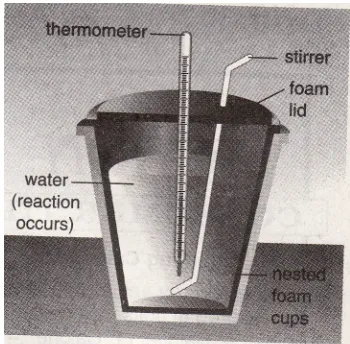
1. Prepare a calorimeter out of two small styrofoam cups by cutting two holes in the bottom of the 190 mL cup. One hole should be just large enough for the large test tube. The other hole is just large enough for the thermometer.
2. Fill the 250 mL cup with water to within ½ cm of the top with the large test tube in the cup.
3. Place the top cup (190 mL) on the calorimeter. It should fit snugly just inside the rim of the bottom of the 250 mL cup. Place the test tube through the hole and set it against the bottom of the calorimeter. Insert the thermometer into the calorimeter.
4. Place 15 mL of bleach (5.25% solution of sodium hypochlorite. NaClO) into the test tube. Measure and record the temperature.
5. Add 15 mL of 0.5M sodium sulfate Na2SO3. Stopper the test tube.
6. Gently swirl the cups to mix the reactants. The mixing transfers the heat to the water evenly.
7. Record the temperature each minute until the temperature reaches a maximum and begins to decrease or reaches a plateau.
8. Remove the test tube and thermometer. Using a graduated cylinder, measure the amount of water in the calorimeter. Also measure the volume of the reaction solution.
Basic Education Assistance for Mindanao
BASIC EDUCATION ASSISTANCE FOR MINDANAO YEAR 3- CHEMISTRY
[image:17.595.209.384.119.291.2]CHANGE, ENERGY AND TIME MODULE 2- APPLIED KINETICS
Table of Temperature Readings
Time, min Temperature, 0C Temperature Difference, (0C)
0 initial
1
2
3
4
5
6
7
8
9
10
11
12
13
14
15
Basic Education Assistance for Mindanao
BASIC EDUCATION ASSISTANCE FOR MINDANAO YEAR 3- CHEMISTRY
CHANGE, ENERGY AND TIME MODULE 2- APPLIED KINETICS
Chemists measure the heat of reactions with calorimeters. The energy, as heat, is absorbed by water in the calorimeter. The difference in the temperature of the water before and after the reaction is used to calculate the heat of reaction. The calorimeter is insulated to prevent heat exchange with the surroundings. The heat of the reaction is then equal to the heat absorbed by water and the calorimeter.
The heat absorbed is calculated by H= mcp t, where m is the mass of water, cp is the specific heat of water, m is the mass of the calorimeter and t is the change in temperature. The product of m and cp is often called the heat capacity. The term heat capacity is also used for the term cp. The heat can be calculated by calculating the heat absorbed by the water. In place of complex calculations, a calibration experiment determines the amount of heat absorbed by the calorimeter is known and can used to calculate the experimental heat of reaction.
Temperature Difference Tf =_____ 0Ci _______0C=_______0C
Water Volume _______mL Reaction Solution Volume_______mL
Heat of Reaction
H= mcp t
H=(______mL+ _____mL) 1g 1.0 calorie X ______ 0C= ______ calories
mL g-0C
Volume Reaction Cp(H2O) T
Water Solution
The 1 g/mL is a conversion factor.
Cp(H2O) equals 1.0 calorie per gram degree.
QUESTIONS:
1. How would ignoring the heat absorbed by the Styrofoam cup, the thermometer and the glass tube affect the value of heat of reaction obtained from calculations?
_________________________________________________________________ _________________________________________________________________
Basic Education Assistance for Mindanao
BASIC EDUCATION ASSISTANCE FOR MINDANAO YEAR 3- CHEMISTRY
CHANGE, ENERGY AND TIME MODULE 2- APPLIED KINETICS
2. Do the reaction solutions actually have the same heat capacity as water? __________________________________________________________________ __________________________________________________________________ 3. What type of reaction occurred?
__________________________________________________________________ __________________________________________________________________
source: http://www.losmedanos.edu/departments/ptech/documents/HeatOfReaction
Basic Education Assistance for Mindanao
BASIC EDUCATION ASSISTANCE FOR MINDANAO YEAR 3- CHEMISTRY
CHANGE, ENERGY AND TIME MODULE 2- APPLIED KINETICS
Teacher Resource Sheet3
Rubric for Group Performance
Needs improvement 1 point Satisfactory Understanding 4 points Good Understanding 7 points Thorough Understanding 10 points
● Works toward
group goals only when
prompted.
● Contributes to
the group only when
prompted.
● Needs
occasional remainders to be sensitive to the feelings of others.
● Participates in
needed changes when prompted and
encouraged.
● Works toward
group goals with occasional prompting.
● Contributes to the
group with occasional prompting.
● Shows sensitivity
to the feelings of others.
● Participates in
needed changes, with occasional prompting.
● Works toward
Group goals without prompting.
● Accept and
fulfills individual role within the group. ● Contributes knowledge, opinions, and skills without prompting. ● Shows sensitivity to the feeling of others.
● Willingly
participates in needed changes.
● Consistently and
actively works towards group goals.
● Is sensitive to
the feelings and learning needs of all group members. ● Willingly accepts and fulfills individual role within the group.
● Consistently and
actively contributes knowledge, opinions and skills. ● Values knowledge, opinion and skills of all group members and encourages their
contribution.
● Helps group
identify necessary changes and encourages group action for change.
Basic Education Assistance for Mindanao
BASIC EDUCATION ASSISTANCE FOR MINDANAO YEAR 3- CHEMISTRY
CHANGE, ENERGY AND TIME MODULE 2- APPLIED KINETICS
Student Activity Sheet 3
Polluting the Environment
Materials:
20g of each food color: blue,green, red, and yellow , styrofoam coffee cups (one per student), 20 medicine droppers,1 big transparent container, 4 pcs 100 mL beaker, tap water
Introduction:
The cup of clean tap water represents clean or unpolluted air. In this activity, you will simulate how clean air gets polluted by different human activities.
Procedure:
1. Add drops of food coloring to each cup to represent the different types of air pollutants described below.
➢Blue- pollutants from consumer products and paints(Volatile Organic Compound, VOCs).
➢Green- pollutants from lawn, garden, and construction machinery (CO, NO2,
PM10-) Particulate matter, SO2 and VOCs).
➢Red- pollutants from cars and trucks (CO, NO2, PM10, SO2, and VOCs)
➢Yellow- pollutants from power plants and industrial processes (CO, NO2, PM10,
SO2 and
VOCs)
2. Human activities
A. You took a bath and got ready for school
Add one drop of blue and one drop of yellow food coloring to your cup if this activity applies to you.
➢Blue - VOCs emitted by soap, shampoo, deodorant, hair spray, perfume, and finger nail polish.
➢Yellow - CO, NO2, PM10, and SO2 emitted by combustion used to heat the water
for the shower. Remember electric water heaters often depend on combustion too, because a lot of power plants burn fossil fuels to generate electricity. B. In coming to school, you took the bus, car or motorcycle.
Add one drop of red food coloring to your cup if this activity applies to you.
➢Red - CO, NO2, PM10, SO2, and VOCs emitted by the engine in your vehicle.
C. At lunch time you bought lunch in the canteen.
Add one drop of yellow food coloring to your cup if this activity applies to you.
➢Yellow - CO, NO2, PM10, SO2, and VOCs emitted when cooking lunch, using
Styrofoam trays and plastic utensils.
D. In going home, you took the bus, car or motorcycle
Add one drop of red food coloring to your cup if this activity applies to you.
➢Red - CO, NO2, PM10, SO2 and VOCs emitted by the engine in your vehicle.
Basic Education Assistance for Mindanao
BASIC EDUCATION ASSISTANCE FOR MINDANAO YEAR 3- CHEMISTRY
CHANGE, ENERGY AND TIME MODULE 2- APPLIED KINETICS
E. In using gasoline-powered machines at home
Add one drop of green food coloring to your cup if this activity applies to you.
➢Green - CO, NO2, PM10, SO2 and VOCs emitted by your lawn mower's engine.
3. Pour your cup to the bigger container.
QUESTIONS:
1. What is your comment on the combined effect of each individual's pollution?. _______________________________________________________________ _______________________________________________________________
2. Look inside your cups. If the air pollution around you were this apparent, would you want to breathe the air? Why?
_______________________________________________________________ _______________________________________________________________
3. What other sources of air pollution, besides those mentioned in this activity, could you think of are being produced in a single day?
_______________________________________________________________ _______________________________________________________________ 4. What could you do to reduce the amount of pollutants released each day?
_______________________________________________________________ _______________________________________________________________
source: http://www.carolina.com/category/teacher+resources/classroom+activities
Basic Education Assistance for Mindanao
BASIC EDUCATION ASSISTANCE FOR MINDANAO YEAR 3- CHEMISTRY
CHANGE, ENERGY AND TIME MODULE 2- APPLIED KINETICS
Student Activity Sheet 4
Kinetically Important
Instruction:
1. Choose a leader who can facilitate the group discussion.
2. Assign a secretary who can take down notes during the discussion.
3. The table is composed of 4 columns, the 2nd and 3rd columns concern catalyst and
inhibitor. Study the reasons why such catalyst/inhibitors wereused to control rates of reactions.
4. Read the following paragraphs.
● TNT- Trinitrotoluene, C6H2(NO2)3CH3 is a yellow-colored solid reagent(reactant in
chemistry) but is best known as a useful explosive material with convenient handling properties. A nitriating mixture of concentrated nitric acid and sulfuric acids is used to nitriate toluene to a mixture of mono and dichlorotoluene isomers with cooling to maintain careful temperature control. The nitrated toluene are separated. Washed with dilute sodium bicarbonate to remove oxide of nitrogen and then carefully nitrated with a mixture of fuming nitric acid and sulfuric acid. Towards the end of the nitration, the mixture is heated on a steam bath. The TNT is separated, washed with dilute solution of sodium sulfide and then recrystallized from alcohol.
http://www.absoluteastronomy.com/topics/trinitrotoluene
● Ammonia is converted to nitric acid in two stages. It is oxidized ( in a sense
“burned” y heating with oxygen in the presence of a catalyst of platinum with 10% rhodium to form nitric oxide and water.
http//www.experiencefestival.com/a/ostwald_process_
● Disulfurized gypsum is used for drying reaction and cement retardant. It can slow
down the hydration of cement, lengthen set time and extend the working life of concrete for long periods without any negative influence on the concrete quality. http//www.alibaba.com/product/gs/245277268/set_retarder.html
● Thiols, ascorbic acid or polyphenols are antioxidants.Antioxidant is a molecule
capable of slowing or preventing the oxidation of other molecules. Oxidation reaction can produce radicals, which start chain reactions that damage cells. Antioxidants terminate these chain reactions by removing free radicals
intermmediate and inhibit the oxidation reactions by being oxidized themselves.
http//enwikipedia.org/wiki/Antioxidant_food
● Ripening of fruits sometimes require the commonly used “Kalburo” with espcially
mangoes. When Calcium carbide or “kalburo”comes in contact with moisture, it
Basic Education Assistance for Mindanao
BASIC EDUCATION ASSISTANCE FOR MINDANAO YEAR 3- CHEMISTRY
CHANGE, ENERGY AND TIME MODULE 2- APPLIED KINETICS
produces acetylene gas, which is quite familiar in reaction to the natural ripening agents produced by fruits known as ethylene.
http://www.dawn.com/2008/06/03/local2.htm
5. State the reasons/explanations why a catalyst or an inhibitor is used. Reasons should be given in complete sentences. You are not required to write a chemical equation, but you may if you like.
6. After the discussion, print the explanations on a manila paper for presentation.
Materials Production Inhibitor Catalyst
Explanations why such catalyst/inhibitor is
used
Synthesis of TNT (Tri-nitro-toluene), an
explosive
Heat
Nitrous oxide manufacturing (laughing
gas)
Hot platinum wire
Cement manufacturing retardant
Food industry antioxidant
Ripening of mangoes
Calcium carbide (Kalburo)
.
Basic Education Assistance for Mindanao
BASIC EDUCATION ASSISTANCE FOR MINDANAO YEAR 3- CHEMISTRY
CHANGE, ENERGY AND TIME MODULE 2- APPLIED KINETICS
Teacher Resource Sheet 4
Kinetically Important
Instruction:
1. Choose a leader who can facilitate the group discussion.
2. Assign a secretary who can take down notes during the discussion.
3. The table is composed of 4 columns, the 2nd and 3rd columns concern catalyst and
inhibitor. Try to study the reasons why such is the catalyst/inhibitors.
● TNT- Trinitrotoluene, C6H2(NO2)3CH3 is a yellow-colored solid reagent(reactant in
chemistry) but is best known as a useful explosive material with convenient handling properties. A nitriating mixture of concentrated nitric acid and sulfuric acids is used to nitriate toluene to a mixture of mono and dichlorotoluene isomers with cooling to maintain careful temperature control. The nitrated toluene are separated. Washed with dilute sodium bicarbonate to remove oxide of nitrogen and then carefully nitrated with a mixture of fuming nitric acid and sulfuric acid. Towards the end of the nitration, the mixture is heated on a steam bath. The TNT is separated, washed with dilute solution of sodium sulfide and then recrystallized from alcohol.
http://www.absoluteastronomy.com/topics/trinitrotoluene
● Ammonia is converted to nitric acid in two stages. It is oxidized ( in a sense
“burned” y heating with oxygen in the presence of a catalyst of platinum with 10% rhodium to form nitric oxide and water.
http//www.experiencefestival.com/a/ostwald_process_
● Disulfurized gypsum is used for drying reaction and cement retardant. It can slow
down the hydration of cement, lengthen set time and extend the working life of concrete for long periods without any negative influence on the concrete quality. http//www.alibaba.com/product/gs/245277268/set_retarder.html
● Thiols, ascorbic acid or polyphenols are antioxidants.Antioxidant is a molecule
capable of slowing or preventing the oxidation of other molecules. Oxidation reaction can produce radicals, which start chain reactions that damage cells. Antioxidants terminate these chain reactions by removing free radicals
intermmediate and inhibit the oxidation reactions by being oxidized themselves.
http//enwikipedia.org/wiki/Antioxidant_food
Basic Education Assistance for Mindanao
BASIC EDUCATION ASSISTANCE FOR MINDANAO YEAR 3- CHEMISTRY
CHANGE, ENERGY AND TIME MODULE 2- APPLIED KINETICS
● Ripening of fruits sometimes require the commonly used “Kalburo” with espcially
mangoes. When Calcium carbide or “kalburo”comes in contact with moisture, it produces acetylene gas, which is quite familiar in reaction to the natural ripening agents produced by fruits known as ethylene.
http://www.dawn.com/2008/06/03/local2.htm
4. Explanations could be in sentences form, it does really require a chemical equation, but you can present otherwise if you like.
5. After the discussion, print the findings on a manila paper for presentation.
Materials Production Inhibitor Catalyst
Explanations why such catalyst/inhibitor is
used.
Synthesis of TNT (Trinitro-toluene), an
explosive
Heat (minimal)
If not properly controlled will cause
explosion.
Nitrous oxide manufacturing (laughing
gas)
Hot platinum wire If without hot platinum wire as catalyst,a different reaction will
be favored.
Cement manufacturing retardant Retardant is added to allow cement to stay soft for a longer time.
Food industry antioxidant Anti-oxidants are added to food to prevent
discoloration and spoiling.
Ripening of mangoes Calcium carbide
(kalburo)
Calcium carbide speeds up ripening process of
green mangoes.
Basic Education Assistance for Mindanao
BASIC EDUCATION ASSISTANCE FOR MINDANAO YEAR 3- CHEMISTRY
CHANGE, ENERGY AND TIME MODULE 2- APPLIED KINETICS
Student Activity Sheet 5
Guava Jelly Making
Materials:
paring knife or peeler, liquid measuring cups, dry measuring cups, bowl, sauce pan, spoon for stirring, 25 medium-sized ripe guavas, strainer , 3 cups sugar, 1 tbsp corn syrup, ladle, manila paper, marking pen, jars with covers
Procedure:
1. Wash 25 medium size ripe guavas carefully.
2. Slice the ripe guavas into halves, remove the crowns and seeds. 3. Boil the sliced ripe guavas in a liter of water in a pot for 20 minutes. 4. Remove the cooked pulp by straining the mixture.
5. Add a little amount of lemon or kalamansi juice to the solution and stir well. 6. Add light corn syrup and mix well. Add 3 cups of sugar all at once. Stir thoroughly. 7. Warm to 1000F or 680C to hasten sugar solution. Keep at this temperature stirring
constantly until it is of the right consistency.
8. Pour into containers with tight lids leaving a head space of ½ inch. Cover and refrigerate or freeze.
Questions:
1.Why do we make jellies?
__________________________________________ __________________________________________
2 What are jellies?
__________________________________________ __________________________________________
3. How are jellies prepared?
__________________________________________ __________________________________________
4. Why is lemon or kalamansi juice added? __________________________________________
Basic Education Assistance for Mindanao
BASIC EDUCATION ASSISTANCE FOR MINDANAO YEAR 3- CHEMISTRY
CHANGE, ENERGY AND TIME MODULE 2- APPLIED KINETICS
__________________________________________ 5. What is the role of heat in the process? __________________________________________ __________________________________________
6. Why is there a need to raise the temperature to 1000F?
___________________________________________ ___________________________________________
Basic Education Assistance for Mindanao
BASIC EDUCATION ASSISTANCE FOR MINDANAO YEAR 3- CHEMISTRY
CHANGE, ENERGY AND TIME MODULE 2- APPLIED KINETICS
Teacher Resource Sheet 5
Guava Jelly Making
1. Why make jellies?
● They add an extra special touch to meals. ● You can take advantage of fruits in season.
● It is a way of preserving foods while still abundant. ● They can be used for gift giving.
2. What are jellies?
● They are fruits preserved using sugar and jellied to some extent. ● It is made from the juice of the fruit only.
● It should be clear and firm enough to hold its shape when unmolded from its container.
3. How are jellies prepared?
● They are prepared from ripe fruits containing abundance of pectin. ● Flesh of fruits containing pectin will be boiled.
● Addition of sugar and kalamansi will be done.
● Cook the mixture to higher temperature to make it a sticky mixture.
4. Why is lemon or kalamansi juice added?
● Addition of lemon or kalamansi juice helps prevent spoilage by serving as preservative.
5. What is the role of heat in the process?
● Heat remove excess water and other substances be out of the pulp of the fruit. ● It also kills bacteria and fungi that possibly reside in the skin and flesh of the fruit.
6. Why is there a need to raise the temperature to 1000F?
● To kill most of the bacteria so that the food will be preserved.
Basic Education Assistance for Mindanao
BASIC EDUCATION ASSISTANCE FOR MINDANAO YEAR 3- CHEMISTRY
CHANGE, ENERGY AND TIME MODULE 2- APPLIED KINETICS
Teacher Resource Sheet 6
Scoring the product (Guava Jelly)
Directions:
1. Assign 3 points - Excellent 2 points - Good
1 point - Needs Improvement
2. Add the points for each category to get the total score. The perfect score is 15 points.
Category Description Score
CLARITY Jelly is clear, not cloudy or opaque.
SHAPE Jelly is firm and compact. It holds its shape when removed from the container; no excessive
weeping or separation.
TEXTURE Jelly is tender, but slightly firm. The consistency is smooth, no
gritty particles or lumps.
FLAVOR Jelly tastes natural, fruitlike, and fresh; free from bitter, scorched,
or caramelized flavor.
COLOR The color is natural and representative of fruit used;
color is bright, there are no browned or scorched areas.
Total Score
Source: http://www.uen.org/lessonplan/preview?LPid=1169
Basic Education Assistance for Mindanao
BASIC EDUCATION ASSISTANCE FOR MINDANAO YEAR 3- CHEMISTRY
CHANGE, ENERGY AND TIME MODULE 2- APPLIED KINETICS
Teacher Resource Sheet 7
Food Production
As world population increases, food becomes a most pressing problem. To help solve the problem, chemist's use their analytic skills to see what living things are made of. They obtain ammonia (NH3) from proteins and, on further breakdown, nitrogen and hydrogen from ammonia.
After analysis, they synthesize and form new products out of nitrogen and hydrogen that improve plant growth. They find that plants grow better when ammonium salt is applied to the soil. Now ammonium fertilizers are described with three numbers. For example a 15-5-10 fertilizer means it contains 15% nitrogen, 5% phosphorus, 10% potassium. What role do these elements play? Nitrogen stimulates upward growth; phosphorus stimulates root and fruit development; while potassium promotes vitality and stamina or the general health condition of the plant. Urea, (NH2)2CO, is another chemical fertilizer that is fed to the soil. Work out the percentage of
nitrogen in NH4Cl, NH4NO3 and (NH2)2CO and you will realize why urea is more popular.
Our farmers should learn the proper use of fertilizers as these are costly. For example, the nature of the soil (weither acidic or neutral) should be known and then adjusted. One observation is that (NH4)2SO4 is acidic when dissolved in water. How do farmers solve this
problem? They put lime or ashes.
You can help your soil get its nitrogen needs by planting legumes, podded plants will contain nitrogen-fixing bacteria in their roots. These bacteria absorb N2 from the air and convert it into
soluble compounds called nitrates. The total available nitrogen content of soils is greatly increased by adding to the soil the dry manure of livestock or poultry.
Another way to provide natural fertilizers to the soil is by making a compost pit in your
backyard. This is a pit where you may throw all kitchen wastes, leaves and other organic wastes, putting at intervals a layer of ashes and soil to promote decomposition.
It is also possible for you to grow plants in artificial cultures- a practice called hydrophonics or soilless gardening.
FOOD PRESERVATION
If you want to have vegetables or fruits even when they are not in season, try preserving them. Tomatoes, mango, santol and guava are easy to preserve. Unfortunately, in preserving food and prolonging its shelf-life, there is a decrease in its nutrient content because of the removal of fibers, vitamins and minerals.
Some chemicals called additives, are added to food not only to prevent spoilage but also to improve their appearance and to give a variety of flavors.
Here is what these additives can do:
1. To make food more attractive and appetizing.
● Agar is added to ice cream to give firmness. ● Carageen is added to milk to make it thick.
● EDTA or ethylenediamine tetraacetic acid is added to soft drinks to prevent over
cloudiness.
● Potassium nitrate is added to meat to give it a golden hew or shade.
2. To give variety of flavors
● Citric acid added to soft drinks gives an acid taste. ● Dextrose added to bread and drinks serves as sweetener.
Basic Education Assistance for Mindanao
BASIC EDUCATION ASSISTANCE FOR MINDANAO YEAR 3- CHEMISTRY
CHANGE, ENERGY AND TIME MODULE 2- APPLIED KINETICS
● Vetsin or monosodium glutamic acid (MSG) enhances the flavor of cream and soups.
3. To preserve food
● Salt on fish (bagoong) or meat (as in tapa) causes the withdrawal of water from the
protoplasm of the organism by osmosis and inactivating the cells.
● Salitre of KNO3 prevents the growth of Clostridium botulinum.
● Vinegar is antiseptic at a concentration of 4%.
4. OTHER EFFECTS
● Some additives may collect in the body, interact with chemicals inside and produce
unexpected results.
● Peanut products should be checked for a poison called aflatoxin. ● Sugar in prolonged curing encourages more bacteria to grow.
● Nitrates used to cure meat form nitrosamines suspected of being carcinogenic agents; so
ascorbates, a salt of Vitamin C, has been suggested as substitute.
● Ascorbic acid, recommended for the prevention and treatment of the common cold, has
also been suggested for the healing of wounds and burns, treatment of back pain, reduction of cardiovascular disease and blood cholesterol. It is antibacterial and has favorable influence on the mental and emotional well being.
Basic Education Assistance for Mindanao
BASIC EDUCATION ASSISTANCE FOR MINDANAO YEAR 3- CHEMISTRY
CHANGE, ENERGY AND TIME MODULE 2- APPLIED KINETICS
Student Activity Sheet 6
Talking Star
What I learned most in the topic? __________________________ __________________________
What I found easy to understand? What I found interesting? _________________________ ____________________________ _________________________ ____________________________
Questions I would like to ask about this topic What I found difficult to understand? ___________________________ _____________________________ ___________________________ _____________________________
Basic Education Assistance for Mindanao
BASIC EDUCATION ASSISTANCE FOR MINDANAO YEAR 3- CHEMISTRY
CHANGE, ENERGY AND TIME MODULE 2- APPLIED KINETICS
Teacher Resource Sheet 7
Rubric for Group Participation
Behavior Beginner 1 point Intermediate 2 points Advanced 3 points Expert 4 points
Fulfills team role
Does not perform any of the assigned
team duties.
Performs a little of the duties.
Performs nearly all duties.
Perform all of the assigned team
duties.
Shares information
Does not relay any information to
teammates.
Relays very little information- some
relates to the topic.
Relays some basic information-most
relates to the topic.
Relays a great deal of information-all
relates to the topic.
Listens to other
teammates Is always talking-never allows anyone else to
speak.
Usually doing most of the talking-rarely allow others
to speak.
Listens but sometimes talks
too much.
Listens and speaks a fair amount.
Cooperates with
teammates Usually argues with team mates. Sometimes argue. Rarely argue. Never argue.
Basic Education Assistance for Mindanao
BASIC EDUCATION ASSISTANCE FOR MINDANAO YEAR 3- CHEMISTRY
CHANGE, ENERGY AND TIME MODULE 2- APPLIED KINETICS
For the Teacher: Translate the information in this Learning Guide into the following matrix to help you prepare your lesson plans.
Stage
1.
Activating Prior Learning
2.
Setting the
Context
3.
Learning
Activity Sequence
4.
Check for
Understanding
5.
Practice and
Application
6.
Closure
Strategies
Activities from the Learning Guide
Extra activities you may wish to include
Materials and planning needed
Estimated time for this Stage
Total time for the Learning Guide Total number of lessons needed for this Learning Guide
Basic Education Assistance for Mindanao