Vol. 48, No. 2, Fall 2016, pp. 65-74(AIJ-MISC)
Please cite this article using:
Mirassadi, S. B., and Tehrani, H. A., 2016. “Partial Eigenvalue Assignment in Discrete-Time Descriptor Systems via Derivative State Feedback”. Amirkabir International Journal of Modeling,
Identification, Simulation and Control, 48(2), pp. 65–74. DOI: 10.22060/miscj.2016.828
URL: http://miscj.aut.ac.ir/article_828.html
*Corresponding Author, Email: [email protected]
Partial Eigenvalue Assignment in Discrete-Time Descriptor
Systems via Derivative State Feedback
S. B. Mirassadi1, H. A. Tehrani2,*
1- Ph.D. Student, Department of Mathematics, Shahrood University of Technology 2- Associate Professor, Department of Mathematics, Shahrood University of Technology
(Received 16 May 2016, Accepted 19 July 2016)
A method for solving the descriptor discrete-time linear system is focused. For it is easily converted into
a standard discrete-time linear system by the definition of a derivative state feedback. Then, a partial
eigenvalue assignment is used to have a stable standard system and obtain the state feedback. In a partial eigenvalue assignment, just a part of the open loop spectrum of the standard linear systems is reassigned while leaving the rest of the spectrum invariant, and for reassigning, similarity transformation is used. Using a partial eigenvalue assignment is easier than using eigenvalue assignment. Because by a partial eigenvalue assignment, the size of matrices and state and input vectors are decreased and stability is kept, as well. The eigenvalues of two closed-loop matrices of the descriptor and standard systems are the inverse of each other. Therefore, the stability in PEVA for the descriptor system is kept by reassign-ing eigenvalue in the unit circle and unchangreassign-ing the remainreassign-ing of eigenvalues in the standard system. Also, concluding remarks and an algorithm proposed to the descriptions will be obvious. At the end, the convergence of state and input vectors in the descriptor system to balance point (zero) are shown by
figures in a numerical example.
KEYWORDS:
Descriptor Discrete-Time System, Derivative State Feedback, Partial Eigenvalue Assignment, Converge to Balance Point
1- I
NTRODUCTION
Descriptor systems that are also called singular systems are more general and precise than a normal model to depict a dynamical physical. Applications
of descriptor systems can be found in various fields such as artificial neuron networks, circuits systems,
chemical processes, economics, biologic, power, modeling of mechanical multibody systems, etc. [6,10,11,20,25,28]
Some of the first fundamental works on
eigenstructure assignment in descriptor linear systems were established in the 1980s by a number of researchers, such as Cobb (1981) [5], Armentano (1984) [1], Fletcher (1986) [9], Ozcaldiran and Lewis (1987) [21].
In recent years, there are many subjects related to these problems like switched descriptor systems and eigenvalue assignment in the state feedback control for uncertain systems [22,27]. Also, Karbassi et al. worked on non-linear state feedback controllers like in [19].
In the available literature on descriptor systems, there are two kinds of stabilization problems for singular systems. One consists of designing a state or output feedback controller in such a way that the closed-loop system is regular, impulse-free, and stable or equivalently admissible. The other is to design a state or output feedback controller in order to make the closed-loop system regular and stable. Concerning the stability analysis and the stabilization problem, a number of approaches assuming or not assuming the regularity of the descriptor system have been proposed in the literature. Let us quote for instance [2,6,26] among those assuming the regularity and [6,26] without assuming the regularity. Furthermore, positivity and stability of linear descriptor systems have been investigated in [13,15] for systems with regular pencils.
Many practical applications such as the design of large and sparse structures, electrical networks, power systems, computer networks, etc., give rise to very large and sparse problems and the conventional numerical methods for EVA problem do not work well. Furthermore, in most of these applications, only a small number of eigenvalues, which are responsible for instability and other undesirable phenomena, need to be reassigned. Clearly, a complete EVA, in case when only a few eigenvalues are bad, does not make sense. These considerations give rise to the partial eigenvalue assignment (PEVA) problem for the linear
control system such that undesirable eigenvalues are reassigned and other eigenvalues unaltered. An
explicit solution to the partial eigenvalue problem
by using one of orthogonality relations between
eigenvectors for matrix polynomial is considered in [23]. The conditions for the existence and uniqueness
of the solution for the single-input problem were given in [24] and for multi-input were presented in [8].
In this paper, a method for finding the solution
of descriptor discrete-time linear systems will be
investigated. Our method is mixed of PEVA, EVA
by similarity transformation and a useful method to convert the descriptor discrete-time linear system into the standard discrete-time linear system. First, the descriptor discrete-time linear system (1) is converted into the standard discrete-time linear system (6) by
the definition of the derivative state feedback (2)
that is calculated by the PEVA method (section 3). The solution of standard discrete-time linear system (6) or equivalently the original system, i.e., the descriptor discrete-time linear system (1) is obtained by PEVA. On the other hand, we need to reassign undesired eigenvalues of open-loop spectrums in a new system with smaller sizes of matrices such that other eigenvalues unchanged. Also, a theorem for
existence and uniqueness of the solution for PEVA
in multi-input is represented. Then, feedback in the previous system (before using PEVA) are obtained by an easy relationship between this feedback and gained feedback by PEVA by (17). It is important to say for reassigning undesired eigenvalues, similarity transformation (section 4) is used that is a simple method with a high accuracy.
As mentioned earlier, it is clear that our method has some advantages in which solving the descriptor
discrete-time linear systems will be easier. The first
advantage is converting descriptor discrete-time linear system into the standard discrete-time linear system because working on standard systems is easier than descriptor systems. EVA has been an applicable
method for finding a solution in standard systems
and their stability, but by PEVA just by reassigning
a part of open-loop matrix spectrum in standard
our method. Therefore, the state and input vectors in the original system, i.e., descriptor discrete-time linear system, converge into balance point which are
displayed by figures in our example. It is worthy to
mention that we do not need some assumptions like not having eigenvalues near zero and some criteria on some vectors and being distinct eigenvalues by orthogonality relations for PEVA in [23] or dealing with full row rank matrices in every performed
algorithm and finding index of Shuffle and Drazin
for descriptor systems in [4,12,14,16] and these are
other excellence of the method in this paper. What is
more, this method can be used for continuous-time
descriptor linear systems by defining a suitable state
feedback.
This paper is organized as follows. Next section,
presents the convergence of the descriptor discrete-time linear system into the standard discrete-discrete-time linear system which both systems have invertible eigenvalues for closed-loop of their matrices. The PEVA problem for obtaining the derivative state feedback is displayed in section 3. Section 4 proposes the similarity transformation to reassign eigenvalues in PEVA. An algorithm and numerical results are presented in sections 5 by an algorithm with all proposed details in its previous sections and
a numerical example with the results of all steps of
the algorithm in it. Also, the convergence of state and input vectors to balance point, i.e. zero, by their
figures are shown. At the final section, concluding
remarks are given.
The following notation will be used: ℜ= the set of real numbers, C/= the set of complex numbers, ℜn×m= the set of n×m real matrices and ℜm=ℜm×1,
AT= the transposed matrix of A, Ω(A)= spectrum of
eigenvalues of the matrix A, In= the unit matrix of size
n.
2- S
TATEMENT OF THE
P
ROBLEM
Consider the descriptor linear time-invariant controllable system of the form as in the following:
(1) where E∈Rn×n with rank(E)≤n, x
k∈Rn is the state vector
and uk∈Rm is input vector. It is assumed that 1≤m≤n, A∈Rn×n and B∈Rn×m are open-loop and input matrices,
respectively. Also x0 is a nonzero definite vector.
Consider the descriptor system (1) with the derivative state feedback:
(2)
The aim is the eigenvalue assignment to design a
derivative state feedback controller matrix producing
a closed-loop system of (1) via feedback (2) with a satisfactory response by shifting p(≤n) controllable poles of L={λ1,λ2,...,λn} from undesirable to desirable locations where λi∈C/ and λi≠0 and are self-conjugate complex numbers for i=1,2,...,n while other
eigenvalues of open-loop matrix remain unchanged,
i.e., PEVA.
To establish the proposed results, consider the following assumptions:
I) rank[E|B]=n, II) rank[A]=n, III) rank[B]=m.
It is clear that if assumption (I) holds, then there
exists F such that [3]:
(3) For F such that (3) holds, then from (2) it follows that (1) can be rewritten like a standard linear system, given by:
(4)
Lemma 2.1: Consider a matrix M∈Rn×n, with rank(M)=n and the eigenvalues equal to [18,19]:
λ1, λ2,..., λn. Then, the eigenvalues of M-1 are the
following: λ1-1, λ
2-1,..., λn-1.
Remark 2.1: Consider that λ=a+bi is an eigenvalue of M, then from Lemma 2.1:
is also an eigenvalue of M-1.
Theorem 2.1: Define the matrices N and M as (5) and suppose (N,M) are controllable:
(5) Also, let F be state feedback matrix, such that
L-1={λ
1-1, λ2-1,..., λn-1} are the eigenvalues of the
closed-loop system
(6)
where λi∈C/ and λi≠0, i=1,2,...,n are arbitrarily assigned. Then for this gained F, the desired spectrum
L={λ1, λ2,..., λn} is the eigenvalues of the controlled system (1) with derivative feedback (2) and also the condition (3) holds.
Proof: Considering that (N,M) are controlled, then
we can find a state feedback matrix F such that the closed-loop of the controlled system with control law (6) given by:
has poles equal to L-1={λ
1-1, λ2-1,..., λn-1}. Now by (5)
note that:
(N+MF)-1=(A-1(E-BF))-1, so (N+MF)-1= (E-BF)-1A
and from (7) and Lemma 2.1, the spectrum L={λ1,
λ2,..., λn} is the eigenvalue of the closed-loop matrix
(E-BF)-1A. Therefore, (3) holds and the eigenvalue of
the closed-loop system (1) and feedback (2) are equal to L={λ1, λ2,..., λn}.
3- P
ARTIAL
E
IGENVALUE
A
SSIGNMENT
(PEVA)
In this section, we will describe a method to
find the feedback F in system (1) by derivative state
feedback (2). At first, some definitions and theorems that we need for the existence and uniqueness
theorem for multi-input and single-input PEVA
problem are proposed. Next, we bring the Existence
and Uniqueness Theorem and its proof and by the description of its proof, the PEVA method is displayed to obtain the derivative feedback F in system (6).
Theorem 3.1. Eigenvector Criterion of controllability [8]. The standard system (6) or,
equivalently, the matrix pair (N,M) is controllable with respect to the eigenvalue λ of N if yHM≠0 for all y≠0 such that yHN=λyH.
Definition 3.1: The standard system (6) or the matrix
pair (N,M) is partially controllable with respect to the subset λ1, λ2,..., λp of the spectrum of N if it is controllable with respect to each of the eigenvalues
λj,j=1,2,...,p [8].
Definition 3.2: The standard system (6) or the
matrix pair (N,M) is completely controllable if it is controllable with respect to every eigenvalue of N [8].
Theorem 3.2: Existence and Uniqueness for
Eigenvalue Assignment Problem [7]. The eigenvalue assignment problem for the pair (N,M) is solvable for any arbitrary set {μ1,μ2,...,μn} if and only if (N,M) is completely controllable. The solution is unique if and only if the system is a single-input system (that is if M is a vector). In the multi-input case, there are
infinitely many solutions, whenever a solution exists.
Theorem 3.3: Existence and Uniqueness for
partial eigenvalue assignment Problem. Consider the pair (N,M) in system (6) and let λ1,λ2,...,λn be the eigenvalue of N∈C/n×n, Λ=diag{λ
1,λ2,...,λp,λp+1,..., λn}, Λ1=diag{λ1,...,λp} and Λ2=diag{λp+1,...,λn} be the diagonal matrices containing the given eigenvalues and the sets {λ1,λ2,...,λp} and {λp+1,λp+2,...,λn} be disjointed. Also, let the eigenvalues λ1,λ2,...,λp to be changed to μ,μ,...,μ and λ ,λ ,...,λ stay invariant.
Now, if the pair (N,M) is partially controllable with respect to the set {λ1,λ2,...,λp} then partial eigenvalue assignment problem for the pair (N,M) solvable for any desired choice of the closed-loop eigenvalues
μ1,μ2,...,μp and vice versa. If the system is a completely controllable single-input system, the solution is
unique and there are infinitely many solutions, in
the multi-input case and single-input case, when the system is not completely controllable and whenever
a solution exists.
Proof: We first prove the necessity. Suppose the pair
(N,M) is not controllable with respect to some λj,
j=1,2,...,p. Then, there exists a vector y≠0 such that
yH(N-λ
jI)=0 and yHM=0. This means that for any F,
we have yH(N+MF-λ
jI)=0, which implies that λj is an
eigenvalue of N+MF for every F, and thus λj cannot be reassigned.
Next, we prove the sufficiency. Considering Λ1
and Λ2, we need to prove that there exists a feedback matrix F which assigns the eigenvalues in Λ1 arbitrarily while keeping all the other eigenvalues unaltered.
Let X={x1,x2,...,xn} and Y={y1,y2,...,yn} be,
respectively, the right and left eigenvector matrix
of N, and let Y1={y1,y2,...,yp}. Since YHX=I and YHNX=diag(Λ
1,Λ2), then the partial controllability of
the pair (N,M) with respect to eigenvalues in Λ1 implies the partial controllability of the pair (diag(Λ1,Λ2),
YHM) with respect to the same eigenvalues. Therefore,
the pair (Λ1,Y1HM) is completely controllable because
{λ1,λ2,...,λp}∩{λp+1,...,λn}=0/.
By Theorem 3.2, there exists a feedback matrix
K (see system (16)) such that the closed-loop matrix
Λ1+Y1HMK has the desired eigenvalues μ
1,μ2,...,μp.
Denote
(8)
Then the eigenvalues of a closed-loop matrix are exactly as required. This is seen as follows:
(9)
The uniqueness of the solution in the single-input
case that is completely controllable and the existence of infinitely many solutions in the multi-input case
follow directly from Theorem 3.2.
To complete the proof, we need to show that
infinitely many solutions to the PEVA problem are
possible when M is a vector (single-input case) and
there exists an uncontrollable eigenvalue λk for some
such that ykHN=λ
kykH and ykHM=0).
Let F be a solution to the partial eigenvalue assignment problem. Denote the left and right
eigenvectors of the closed-loop matrix Nc=N+MF by
Yc and Xc. Clearly ykHN
c=ykH(N+MF)=λkykH and thus yk is also the kth column of Y
c. Let Fβ=βykH, where β is an arbitrary scalar. As in (3.9), we can show that the eigenvalues μ1,...,μp,λp+1,...,λk-1,λk+1,...,λn of Nc
remain unchanged by the application of feedback Fβ. Furthermore, the eigenvalue λk of Nc also remains unchanged by the feedback Fβ, since the pair (Nc,M) is not controllable with respect to λk by the necessity part of this theorem. Thus,
(10)
showing that if F is a solution, so is F+βykH for an
arbitrary β.
Suppose that Ω(N)={λ1,...,λp,λp+1,...,λn} which p
is the number of undesired eigenvalues of Ω(N) for the pair of (N,M) in system (6) and assume the set
S={μ1,...,μp} be closed under complex conjugation
which rank(M)=rank(B)=m≤p. The aim of PEVA problem is to look for the derivative state feedback
F such that:
(11) and also the sets {λ1,...,λp} and {λp+1,...,λn} be disjointed.
This means that finding F which reassigns eigenvalues {λ1,...,λp} arbitrarily while keeping all the other eigenvalues, {λp+1,...,λn}, unaltered.
First, we need to obtain left eigenvector of matrix
N as follows:
(12) Then, we put columns y1,y2,...yp of Y in Y1 that are associated columns by eigenvalues λ1,...,λp. Therefore,
(13)
Now consider the pair of (Λ1,Y1HM) as follows:
(14)
(15)
As a result, the aim is to find feedback K in the
system
(16) such that the eigenvalues of the closed-loop of the system (16) be {μ1,...,μp}. At the end, for finding F in system (6), we have:
(17)
4- S
IMILARITY
T
RANSFORMATION OF
THE
S
TATE
S
PACE
In this section, we describe a method for finding
feedback K in system (16).
Consider the system (16) by defining A1=Λ1∈ℜp×p
and B1=Y1HM∈ℜp×m as follows:
(18)
instead of system (16) and in order to display similarity transformation on it easier.
To obtain the derivative feedback matrix K in system (16), consider the state transformation
(19) where T can be obtained by elementary similarity operations as described in [18,19]. Substituting (19)
into the first relationship of (18) yields
It is noted that the transformation matrix T is invertible. In this way,
(20) are in a compact canonical form known as vector companion form [18,19]:
(21)
Here R0 is a m×p matrix and M0 is an m×m upper
triangular matrix. Note that the Kronecker invariants
of the pair (A1,B1) are regular if the difference between any of them is not greater than one. If Kronecker invariants of the pair of (A1,B1) are regular, then Ã1
and B̃1 are always in the above form [18]. In the case of irregular Kronecker invariants, some rows of Ip-m
in Ã1 are displaced [19]. (For more details about Kronecker invariants, see [17])
The state feedback matrix which assigns all the
eigenvalues to zero for the transformed pair (Ã1,B̃1) is then chosen as:
which results in the primary state feedback matrix for
the pair (A1,B1) defined as:
(23)
The transformed closed-loop matrix
(24) assumes a compact Jordan form with zero eigenvalues
(25)
Theorem 4.1: Let D be a block diagonal matrix in
the form
where each Dj, j=1,2,...,k is either of the form
(to designate the complex conjugate eigenvalues
αj+iβj)
or in the case of real eigenvalues
If such that diagonal matrix D with self-conjugate eigenvalue spectrum is added to the transformed
closed-loop matrix, Γ̃0, then the eigenvalues of the
resulting matrix is the eigenvalues in the spectrum.
Proof: The primary compact Jordan form in the case of regular Kronecker invariants is in the form (25). The sum of Γ̃0 with D has the form:
(26)
and also Is, s=1,2,...,r is the unit matrix of size 2 in
case p-m is even. In case p-m is odd, only one Is takes
the form of a unit matrix of size one.
By expanding det(H̃-λI) along the first row, it is
obvious that the eigenvalues of H̃ are the same as those of D. For the case of irregular Kronecker invariants [19], only some of the unit columns of
Ip-m are displaced, since the unit elements are always below the main diagonal, the proof applies in the same manner.
Therefore, the closed-loop system matrix
(26) becomes (27). Simple elementary similarity
operations can be used to obtain the matrix H̃λ from
H̃ such that
(27)
Thus, the primary feedback matrix K which gives rise to the assignment of eigenvalues {λ1,...,λp} to the system (16) becomes
(28)
5- A
LGORITHM AND
N
UMERICAL
E
XPERIMENT
In this section, we present an algorithm to obtain the solution of system (1) using partial eigenvalue problem in section 3 based on assigning eigenvalue
problem in section 4. Then by an example, we show
the simplicity of our method.
Object: Assign desired eigenvalues {μ1,...,μp} to the
system (16) and find the matrices K such that the spectrum of closed-loop system (1), i.e., (E-BF)-1A in
(3) be {μ1,...,μp,λp+1,...,λn}.
Input: The matrices A, B and E.
Step 1: Calculate matrices N and M from (5).
Step 2: Assign desired eigenvalues {μ1,...,μp} and
find K in system (16).
Step 2.1: Obtain R0, M0 and T-1 of (19), (20) and (21).
Step 2.2: Obtain the state feedback matrix Φ̃ and Φ
by (22) and (23), that assigns zero eigenvalues to pair (Ã1,B̃1) and (A1,B1)=(Λ1,Y1HM) respectively.
Step 2.3: Calculate the transformed closed-loop
matrix Γ̃0 by (24) and (25) which assumes a compact Jordan form with zero eigenvalues.
Step 2.4: Add a diagonal matrix D=diag(μ1,...,μp) for an arbitrarily set of self-conjugate eigenvalues to Γ̃0.
Then, the closed-loop system matrix (25) in step 2.3
becomes H̃ in (26).
Step 2.6: Obtain the primary feedback matrix K
that gives rise to the assignment of eigenvalues
Ω={μ1,...,μp} to system (16) by K=Φ+M0-1R
λT-1 from
Step 3: Calculate the derivative state feedback F in system (16) by (17).
Step 4: Find the solution of the system (1) by putting on step 3 in (4).
Example 5.1: Consider the descriptor system (1) with following matrices which rank(E)=8<9.
Now we bring the results of all steps in the proposed algorithm.
Step 1:
Step 2:
Ω (N) = { - 6 . 6 6 , - 0 . 5 1 ± 1 . 9 2i, 0 , 0 . 2 4 ± 0 . 4 7i,0.72,1.86,3.61}
Therefore, p=4 and by considering
the matrix Φ which assigns zero eigenvalue to the system (16) is obtained as:
and by reassigning {±10,±5} instead of {0,.024+0.47i,0.72}, the matrix feedback K is obtained as:
Step 3: The derivative state feedback matrix F for the system (6) is calculated by:
Now, we have:
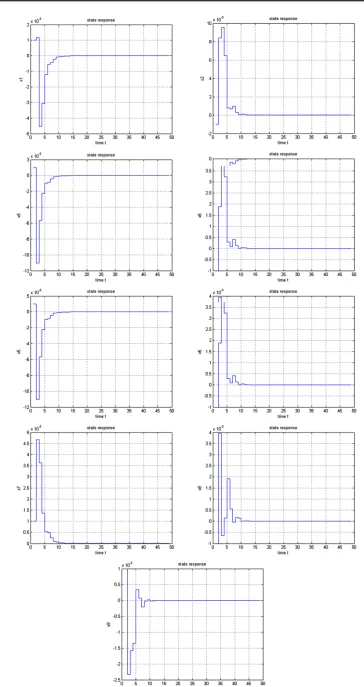
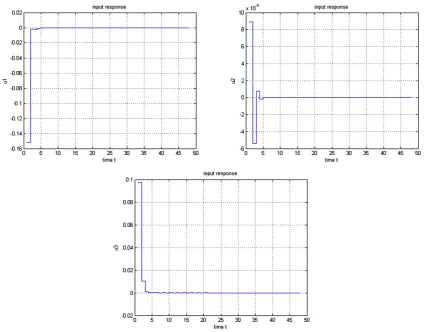
Figs. 1 and 2 show simulation results when
6- C
ONCLUDING
R
EMARKS
A method for finding the solution of descriptor
discrete-time linear system in the form of (1) has been considered. First, by the use of the derivative state feedback (2), a displayed system is converted into a
standard discrete-time linear system (6) and it explains
Fig. 2. Input vector converging into zero in example 5.1
obtain F in (6). Thirdly, the state and input vectors in (1) has been obtained and illustrated by a numerical
example which showed the input and state vectors
convergence to balance point (zero) which is another advantage of our method.
R
EFERENCES
[1] Armentano, V. A.; “Eigenvalue Placement for Generalized Linear Systems,” Systems and Control
Letter, Vol. 4, No. 4, pp. 199–202, 1984.
[2] Bernhard, P.; “On Singular Implicit Linear Dynamical Systems,” SIAM Journal on Control and
Optimization, Vol. 20, No. 5, pp. 612–623, 1982. [3] Bunse-Gerstner, A.; Nichols, N. and Mehrmann, V.; “Regularization of Descriptor Systems by Derivative and Proportional State Feedback,” SIAM
J. Matrix Anal, Vol. 13, No. 1, pp. 46–67, 1992. [4] Campbell, S. L.; Meyer, C. D. and Rose, N. J.; “Applications of the Drazin Inverse to Linear Systems of Differential Equations with Singular
Constant Coefficients,” SIAM Journal on Applied Mathematics, Vol. 31, No. 3, pp. 411–425, 1976.
[5] Cobb, J. D.; “Feedback and Pole Placement in Descriptor Variable Systems,” Int. J. Control, Vol. 33, No. 6, pp. 1135–1146, 1981.
[6] Dai, L.; “Singular Control System,” Lecture Notes in Control and Information Sciences, Springer, Berlin, Vol. 118, 1989.
[7] Datta, B. N.; “Numerical Methods for Linear Control Systems Design and Analysis,” Academic
Press, New York, 2002.
[8] Datta, B. N. and Sarkissian, D. R.; “Partial
Eigenvalue Assignment in Linear Systems: Existence,
Uniqueness and Numerical Solution,” Mathematical Theory of Networks and Systems, Notre Dame, 2002. [9] Fletcher, L. R.; “Eigenstructure Assignment by Output Feedback in Descriptor Systems,” IEE
Proceedings, Vol. 135, No. 4, pp. 302–308, 1988. [10] Gilnther, M. and Rentrop, P.; “Multirate Row-Methods and Latency of Electric Circuits,” Tech. Rep. TUM-M9208, Mathematisches Inst., Technische Univ. MiJnchen, 1992.
Systems with Emergent Collective Computational Abilities,” Proc. Natl. Acad. Sci., USA, Vol. 79, No. 8, pp. 2554–2558, 1982.
[12] Kaczorek, T.; “Checking of the Positivity of
Descriptor Linear Systems by the Use of the Shuffle
Algorithm,” Archives of Control Sciences, Vol. 21, No. 3, pp. 287–298, 2011.
[13] Kaczorek, T.; “Positivity of Descriptor Linear Systems with Regular Pencils,” Archives of Electrical
Engineering, Vol. 61, No. 1, pp. 101–113, 2012. [14] Kaczorek, T.; “Applications of the Drazin Inverse to the Analysis of Descriptor Fractional Discrete-Time Linear Systems with Regular Pencils,”
Int. J. Appl. Math. Comput. Sci., Vol. 23, No. 1, pp. 29–33, 2013.
[15] Kaczorek, T.; “Positivity and Asymptotic Stability of Descriptor Linear Systems with Regular Pencils,” Archives of Control Sciences, Vol. 24, No. 2, pp. 193–205, 2014.
[16] Kaczorek, T.; “Analysis of Descriptor Roesser Model with the use of Drazin Inverse,” Int. J. Appl.
Math. Comput. Sci., Vol. 25, No. 3, pp. 539–546, 2015.
[17] Karbassi, S. M.; “An Algorithm for Minimizing the Norm of State Feedback Controllers in Eigenvalue Assignment,” Computers and Mathematics with Applications, Vol. 41, No. 10, pp. 1317–1326, 2001. [18] Karbassi, S. M. and Bell, D. J.; “Parametric Time-Optimal Control of Linear Discrete-Time Systems by State Feedback-Part 1: Regular Kronecker Invariants,” International Journal of Control, Vol. 57, No. 4, pp. 817–830, 1993.
[19] Karbassi, S. M.; and Bell, D. J.; “Parametric Time-Optimal Control of Linear Discrete-Time Systems by State Feedback-Part 2: Irregular Kronecker Invariants,” International Journal of
Control, Vol. 57, No. 4, pp. 831–883, 1993.
[20] Lewis, F. L.; “A Survey of Linear Singular Systems,” Circuits Systems Signal Process, Vol. 5, No. 1, pp. 3–36, 1986.
[21] Ozcaldiran, K. and Lewis, F. L.; “A Geometric Approach to Eigenstructure Assignment for Singular Systems,” IEEE, Trans. Automatic Control, Vol. 32, No. 7, pp. 626–632, 1987.
[22] Rahimi, M.; Naserpour, A. and Karbassi, S. M.; “Eigenvalue Assignment in State Feedback Control for Uncertain Systems,” Journal of Scientific Research and Development, Vol. 2, No. 1, pp. 73–75, 2015.
[23] Ramadan, M. A. and El-Sayed, E. A.; “Partial Eigenvalue Assignment Problem of High Order Control Systems Using Orthogonality Relations,”
Computers and Mathematics with Applications, Vol. 59, No. 6, pp. 1918–1928, 2010.
[24] Saad, Y.; “Projection and Deflation Methods for
Partial Pole Assignment in Linear State Feedback,”
IEEE Trans. Automat. Control, Vol. 33, No. 3, pp. 290–297, 1988.
[25] Schmidt, T. and Hou, M.; “Bollringgetriebel,”
Internal Rep., Sicherheitstechnische Regelungsund
MeBtechnik, Bergische Univ., GH Wuppertal, Wuppertal, FRG, 1992.
[26] Varga, A.; “On stabilization Methods of Descriptor Systems,” Systems and Control Letters, Vol. 24, No. 2, pp. 133–138, 1995.
[27] Zhai, G. and Xu, X.; “A Unified Approach to
Stability Analysis of Switched Linear Descriptor Systems under Arbitrary Switching,” Int. J. Apple.
Math. Comput. Sci., Vol. 20, No. 2, pp. 249–259, 2010.