DEMOGRAPHIC RESEARCH
A peer-reviewed, open-access journal of population sciences
DEMOGRAPHIC RESEARCH
VOLUME 33, ARTICLE 1, PAGES 1–30
PUBLISHED 1 JULY 2015
http://www.demographic-research.org/Volumes/Vol33/1/ DOI: 10.4054/DemRes.2015.33.1
Research Article
Reproductive behavior following evacuation to
foster care during World War II
Torsten Santavirta
Mikko Myrskyl¨a
c
2015 Torsten Santavirta & Mikko Myrskyl¨a.
1 Introduction 2
1.1 Importance 4
2 Data and measures 5
2.1 Data 5
2.2 Measures 6
2.3 Descriptive analysis 7
3 Estimating the long-term consequences of evacuation on reproductive traits and marriage
out-comes 10
3.1 Conditional means comparison: evacuees versus non-evacuees 10 3.2 Comparing same-sex siblings with discordant evacuee status 11
4 Discussion 15
4.1 Limitations 17
4.2 Conclusions 19
References 21
Reproductive behavior following evacuation to foster care during
World War II
Torsten Santavirta1
Mikko Myrskyl¨a2
Abstract
BACKGROUND
Family disruption and separation form parents during childhood may have long-lasting effects on the child. Previous literature documents associations between separation from parents and cognitive ability, educational attainment, and health, but little is known about effects on subsequent reproductive behavior.
OBJECTIVE
We evaluate the associations between unaccompanied evacuation to foster care and subse-quent marriage and fertility behavior by comparing Finnish children who were evacuated to Swedish foster families during World War II to their non-evacuated siblings.
METHODS
In total, some 49,000 children were evacuated for a period ranging from months to years. We analyze a nationally representative sample of 2,009 evacuees born in 1933–1944 by combining data collected from war time government records with 1950 and 1971 cen-suses and 1971–2011 population registers.
RESULTS
Comparison of evacuated and nonevacuated same-sex siblings suggests no associations between evacuation and the probability of ever marrying, timing of first birth, and com-pleted family size, although some associations are found in na¨ıve means comparisons. This difference in results across models is suggestive of negative selection of evacuee families.
CONCLUSIONS
selection and suggest that some of the adverse outcomes documented in earlier literature could change if selection was accounted for.
1. Introduction
The research during the past few decades on how divorce and bereavement are associ-ated with subsequent life courses has shown strong evidence of compromised early-life transitions (Amato 2010; Kiernan 1992; McLanahan and Bumpass 1988; McLeod 1991). Nevertheless, the consequences of other forms of family disruption for the offspring is an understudied area. From what we already know, it appears to be important for later child outcomes whether family disruption is caused by bereavement, divorce, or parental separation, whether the parents remarry, and whether it is the mother or the father who is absent (Amato 2010; Kiernan 1992; Kendler et al. 2002; Rostila and Saarela 2011). The evidence is however mixed as to which form of parental absence has the most dire consequences and as to which parent’s presence plays a more crucial role for the child, the mother’s or the father’s (Appel et al. 2013; Kiernan 1992; McLanahan and Bumpass 1988; Corak 2001; Lang and Zagorsky 2001).
If the results are mixed concerning parental bereavement and divorce, even less is known about the long-term consequences of temporary separation form parents. This is an important topic, as a large number of children are annually removed from their families either due to abuse and neglect within the family or due to external reasons such as armed conflicts and natural disasters. In the U.S. alone, 400,000 children were estimated to be in foster care in 2012 (AFCARS 2013). In Finland, where our data come from, 11,000 children (approximately 1% of the total population aged below 16) are in foster care, and the annual number of new placements is approximately 4,000 (National Institute for Health and Welfare 2013). Globally, unaccompanied child refugees tend to account for roughly 2–5 percent of each refugee population, and in 2012, alone more than 21,000 children lodged asylum claims (UNHCR 2012). Even though child displacement in the first mentioned context belongs to the domain of child welfare policy while the latter is conventionally associated with refugee policy, both types of policy share the fundamental feature that the child is removed from his/her parents and placed in foster care for an ex ante unknown period of time with the ultimate goal of reunification with the biological parents.
ad-dress the problem of unobserved confounding factors by using a within-sibling design. This design substantially mitigates the problem of confounding, which much of the ex-isting research – relying on means comparisons, and adjusting for observed family char-acteristics – has been unable to resolve.
Our analyses focus on children who were evacuated from Finland to Sweden during WWII, and their siblings. Finland fought two wars against Soviet Union during WWII. During the latter one, which was fought between 1941 and 1944, roughly 49,000 Finnish children from the whole range of socioeconomic backgrounds aged between 1 and 10 years were evacuated to Sweden, and spent on average 2 years in foster families. The evacuations were conducted by a large-scale evacuation scheme with organized logistics on both sides of the border. The Finnish government stated eligibility criteria in 1941 to target the most exposed families. For example, children from displaced households, chil-dren at risk from air raids and chilchil-dren whose fathers had died in war were prioritized. The appendix provides more detail on the evacuation policy; in particular, on the his-torical background, the evacuation from Finland to Sweden, and the placement in foster families in Sweden.
We compare long-term outcomes of evacuees and non-evacuees using unique lon-gitudinal linked data and ask the following question: did family disruption and conse-quential placement in foster care during WWII have an impact on the individuals’ mar-riage patterns and fertility later in life. Specifically, we look at whether the individual ever married, whether the individual divorced (conditional on having married), number of children, age at first childbirth, and the individual’s average interbirth interval. The causal analysis of these questions is nontrivial because of the problem of sorting out the causal effect of evacuation from selection into the evacuation program (Bhrolch´ain 2001). Because evacuees were not drawn randomly from the sending population, na¨ıve means comparisons of evacuee and nonevacuee outcomes are likely to be confounded by se-lection of evacuees. For example, teenage childbearing may have been more common among evacuees than among the nonevacuees because of socioeconomic selection. Girls from working class families – those who are more likely to give birth as teenagers, re-gardless of evacuation – are overrepresented among the female evacuees. Therefore, in the presence of selection, the mean difference in a na¨ıve means comparison in teenage childbearing between evacuees and nonevacuees will be biased upward.
10 percent sample of households drawn from the full 1950 Finnish Census of Population with follow-up of household members in subsequent censuses, beginning at the end of 1970 through 1985 including information on marital status, and data from the Population Register as of 2011 on number of children and their exact birth dates.
We provide the most comprehensive analysis of the impact of foster care on repro-ductive behavior thus far by using high quality population-based data on sibling discor-dance for foster care status and reproductive outcomes over the complete fertile age range of the subjects, and marriage patterns until middle-age. Our results suggest robustness in reproductive behavior as we find no evidence of any important differences in reproduc-tive behavior between the evacuated and non-evacuated siblings. However, our na¨ıve adjusted ordinary least squares (OLS) estimates show a significant negative association between evacuation and age at birth of first child for men, and a positive association be-tween evacuation and the probability of divorce for women. These estimates are likely to be biased, as we find a zero association between evacuation and each of the outcomes in the within-sibling analysis. This finding suggests that negative between-family selec-tion into the evacuee program biases the na¨ıve OLS results. According to our preferred within-siblings results, dramatic war time events that led to separation from parents and placement in foster care in a foreign country did on average not leave marks on family formation or fertility patterns. This is an important finding because when considering the costs and benefits of evacuation to foster care, the benefits might include improved probability of surviving, and our results suggest that, at least in terms of marriage market and fertility outcomes, the costs are low.
1.1 Importance
Children who face family disruption during childhood are found to do worse along many dimensions than their counterparts who grew up in intact families (Gilman et al. 2003; McLanahan and Sandefur 1994). The studies that attempt to document the effect of family disruption net of socioeconomic background on adult outcomes using a within-sibling design do not tell as consistent a story of socioeconomic selection as one might expect. Bj¨orklund and Sundstr¨om (2006) did not find any link between divorce and young adults’ educational attainment, and on a similar note, Powers (2005) found no associa-tion between childhood family structure and the risk of premarital birth among women while holding all sibling-invariant characteristics constant. In contrast, also using within-sibling models, Ermisch and Francesconi (2001) and Gennetian (2005) found, that living in a single-parent household heightened the risk of early childbearing and had a small unfavorable effect on achievement, respectively.
per-spective, the examination of associations between reproductive behavior and the largest possible intervention into a child’s rearing environment, i.e., the separation from one’s biological family and placement in foster care in a foreign country during early child-hood, is intriguing. According to LHT, an early life insult to the child’s well-being might lead the individual to reproduce early in life so as to maximize the probability of leaving descendants (Belsky 2008). Further, Belsky, Steinberg, and Draper (1991) postulate that childhood adversities are associated with adult personality characteristics that are less well adapted to stable pair-bonding.
Pesonen et al. (2008) find, using a local sample of evacuees from Helsinki (n= 396) of the same evacuation program we study, that evacuees had on average earlier menar-che, became parents at a younger age (only men), had more children (only women), and shorter interbirth intervals (only men), than other local children of the same age. The existing evidence on the association between childhood adversities and age at menopause is inconclusive. Allsworth et al. (2004) document the fact that abused children had later menopause than controls, whereas Hardy and Kuh (2005) show that children who face family disruptions due to divorce have twice as high a risk of earlier menopause than the control group. The limitation common to all three aforementioned studies is the prob-lem of confounding in the means comparison; that is, the probprob-lem of finding a credible comparison group. For example, girls from poorer socioeconomic backgrounds are more likely to give birth as teenagers, regardless of experiencing parental divorce or adoption (Lundberg and Plotnick 1995; Duncan et al. 1998; Kearney and Levine 2014).
2. Data and measures
2.1 Data
1970 census through the 1985 census to extract information on marriage patterns4 and to Population Register since 2011 to extract information on the exact birth date of each of the subject’s child. The data records both the mother and the father of the child, so information on parenthood is accurate for both. By use of the Finnish National Archive’s complete register of all children who were evacuated to foster care in Sweden during World War II, we identified 2,245 individuals as having been evacuated to foster care during World War II within our sample.5 We identified all sibling pairs in the sample
by use of the family and household identifiers. The family identifier was also used, in combination with a variable for family status, to link the individuals in the sample to their parents and siblings born before study cohorts in order to construct family background covariates. Of the 71,788 individuals in the sample we dropped the individuals whose family identifier was missing (n = 1, 136) and those who had either died or emigrated before the 1970 census (n= 4, 037). Our analytic sample consists of 66,615 individuals, of which 2,009 are child evacuees.
2.2 Measures
Evacuation (or exposure) is defined as a binary variable obtaining value one if having been evacuated to foster care in Sweden during WW II, according the complete child evacuee register of the Finnish National Archives, and zero otherwise. A caveat to keep in mind throughout the analysis is that by defining exposure this way we are implicitly assuming that siblings remaining with their biological family throughout the war were unaffected by the evacuation of their siblings.
Our outcome variables of interest are: number of children, age at first child birth, average interbirth interval between consecutive two births, having ever married, and being divorced conditional on having been married. Number of children born to the participants by the end of the period of observation in December 2011, age at first childbirth, and interbirth interval (the average interval between all births is calculated only for parents with at least two children), were obtained from the population register. Importantly, our data shows completed fertility, as the individuals were all aged at least 67 by the end of 2011. Marital status was derived from the census records from 1971 through 1985 with 5-year intervals. We thus observe marital patterns over a 15 year period and are able to construct an indicator variable for whether the individual had ever married by 1985 and
4 We used the variable marital status contained in censuses 1970, 1975, 1980, and 1985, to construct the
variables Ever married and Divorced (conditional on having been married).
5The matching procedure of the 1950 census sample to the child evacuee registry of the National Archives
an indicator variable for whether the individual divorced by 1985, conditional on having married before that.
All family background characteristics come from the 1950 census, which (rather for-tunately for the authors), contains important questions with the specific purpose to retro-spectively survey the family conditions before the outbreak of the war, i.e., as of Septem-ber 1, 1939. Father’s socioeconomic status as of 1939 (SES), replaced by mother’s SES if missing, is adjusted for by including class dummies for each class (entrepreneurs as refer-ence category), i.e., white collar workers, blue collar workers, assisting family members, and unemployed or out of labor force. Parental education is adjusted for by including a dummy for whether either the father or the mother had continued their education past primary school. Number of children in the family as of 1939 is calculated based on the birth dates of each child in the family (including those siblings born before 1933, i.e., before the relevant child evacuee cohorts). Native language measures whether the family spoke Swedish or Finnish. Birth order is adjusted for by including an dummy variable for each rank (first born as reference category) and preintervention region of residence is adjusted for by including an dummy variable for county of residence as of September 1, 1939 (the region ceded by the Soviet Union in 1940 (Karelia) is treated as a separate county even though those territories originally belonged to the same county as the part of Karelia that remained on the Finnish side of the border). Duration of evacuation and age at evacuation measured by use of the birth date, date of evacuation and date of return were extracted from the Finnish National Archives.
2.3 Descriptive analysis
Table 1 presents the sample characteristics. Panel A shows that the mean differences in outcomes between evacuees and nonevacuees are small with the exception of fe-male evacuees having markedly higher divorce rates than their nonevacuee counterparts (P < 0.001). Also, evacuee men showed significantly higher divorce rates than their nonevacuee counterparts (P = 0.01). The duration of the average stay in foster care (Panel B) was roughly 22 months for both sexes, and the average age at evacuation was roughly 6.5 years for women and 6.3 years for men.
Table 1: Sample characteristics of a 10 percent sample of 1933–1944 cohorts from the 1950 Finnish Census of Population (those who survived until 1970 included)
Women Men
Characteristic Evacuees Nonevacuees Evacuees Nonevacuees
(n= 910) (n= 31, 355) (n= 1, 099) (n= 33, 251)
Panel A: Outcomes
Married, percent 0.92 0.91 0.92 0.90
(0.27) (0.28) (0.28) (0.30)
Divorced, percent 0.24 0.14 0.16 0.13
(0.43) (0.35) (0.37) (0.34)
Number of children 1.9 1.93 1.86 1.78
(1.40) 1.39 (1.42) (1.37)
Age at first birth, years* 24.08 24.32 26.19 26.70
(4.34) (4.37) (4.72) (4.85)
Mean of child spacing, months† 48.88 48.20 51.16 50.99 (33.25) (31.97) (43.05) (36.29)
Panel B: Evacuation program
Duration of evacuation, years 1.81 1.85
(1.12) (1.15)
Age at evacuation, years 6.49 6.27
(2.59) (2.54)
Panel C: Family background
Socioeconomic status in 1939
Entrepreneur 0.11 0.27 0.11 0.27
(0.32) (0.44) (0.31) (0.44)
White collar worker 0.11 0.09 0.11 0.10
(0.31) (0.29) (0.32) (0.29)
Blue collar worker 0.44 0.30 0.42 0.30
(0.50) (0.46) (0.49) (0.46)
Assisting family member 0.03 0.08 0.03 0.08
(0.16) (0.27) (0.18) (0.27)
Unemployed or out of Labor force 0.31 0.26 0.33 0.25
(0.46) (0.44) (0.47) (0.44)
Parental education 0.07 0.07 0.09 0.07
(0.26) (0.25) (0.29) (0.26)
Number of children in 1940 2.23 1.58 2.29 1.62
(1.44) (1.67) 1.52) (1.69)
Swedish speaking 0.14 0.06 0.14 0.06
(0.35) (0.23) (0.34) (0.24)
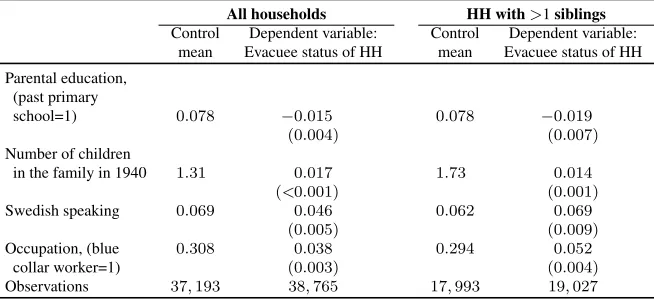
Additional evidence for evacuee selection is provided by regressing an indicator variable for evacuee status of the household against family background characteristics. Table 2 shows evidence of selection of evacuee households. In evacuee households with more than one sibling, the parent with the higher education was 1.9 percentage points (24%) less likely to continue schooling past primary school. Further, evacuee household heads were 6.9 percentage points (111 percent) more likely to be native Swedish speaking and the household head was 5.2 percentage points (18 percent) more likely to hold a blue collar occupation as compared to their counterparts of non-evacuee households.
Table 2: Evidence on evacuee selection: Regressing an indicator variable for
whether evacuees in household (HH) (1 if yes) on family background characteristics
All households HH with>1siblings
Control Dependent variable: Control Dependent variable: mean Evacuee status of HH mean Evacuee status of HH Parental education,
(past primary
school=1) 0.078 −0.015 0.078 −0.019
(0.004) (0.007)
Number of children
in the family in 1940 1.31 0.017 1.73 0.014
(<0.001) (0.001)
Swedish speaking 0.069 0.046 0.062 0.069
(0.005) (0.009)
Occupation, (blue 0.308 0.038 0.294 0.052
collar worker=1) (0.003) (0.004)
Observations 37, 193 38, 765 17, 993 19, 027
Notes: Sample means of background characteristics for the control group of households (HH) without any evecuees and OLS estimates for all HH are reported with robust standard errors of the OLS estimates in parentheses.
Table 3: The average number of children and age at first childbirth of mothers who as children were evacuated – split by age at evacuation
Non-separated
siblings <2yrs 2to<4yrs 4to<7yrs 7to11yrs (n= 418) (n= 18) (n= 141) (n= 243) (n= 358)
Number of children 2.30 (1.22) 1.78 (0.73) 2.10 (1.15) 2.22 (1.09) 2.39 (1.34) Age at first
childbirth 23.90 (4.11) 22.94 (3.54) 23.85 (4.62) 24.07 (4.31) 24.82 (4.31)
Notes: For comparison, both outcomes are reported for mothers, i.e., number of children refers to the average number of children among women who had at least one child. The average number of children for all mothers in the sample(n= 26, 984), was 2.30 and the average age at first childbirth was 24.30. Standard deviations are reported in parentheses.
3. Estimating the long-term consequences of evacuation on
reproductive traits and marriage outcomes
3.1 Conditional means comparison: evacuees versus non-evacuees
Our first approach to exploring the long-term consequences of evacuation is to compare the outcomes of interest of all evacuees to all nonevacuees while conditioning on impor-tant potential confounders. We estimate the following model,
Yi=β0+α(Evacueei) + (Family backgroundi)β1+δcounty+θbirth cohort+εi, (1)
where outcomeY for childiis explained by a binary variable, Evacueei, equal to one if
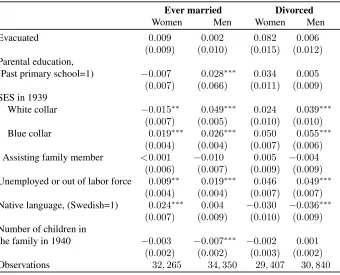
individualiwas evacuated to Sweden during World War II and placed in foster care and with a vector of observable family background covariates (each variable shown in Panel C in Table 1 included). County fixed effects are used so as to compare individuals living in the same county as of 1940, i.e., before the intervention, and birth cohort indicators are used to capture changes in reproductive behavior over time. We use the same model specification for all our five different outcomes (see Panel A in Table 1) and estimate the difference in means between evacuees and non-evacuees using OLS. For our two binary outcomes, ever married and divorced, the OLS translates into a linear probability model. Results are similar when a probit model is used, as shown in Table A1 of the appendix. The standard errors are clustered at the family level in all estimations, to reflect variation in the propensity to evacuate across families.
We estimate equation (1) separately for the male and female subsample, allowing all of the covariates to have different coefficients depending on sex, rather than constraining all differences between sexes to work through the variable of interest (Evacueei), which
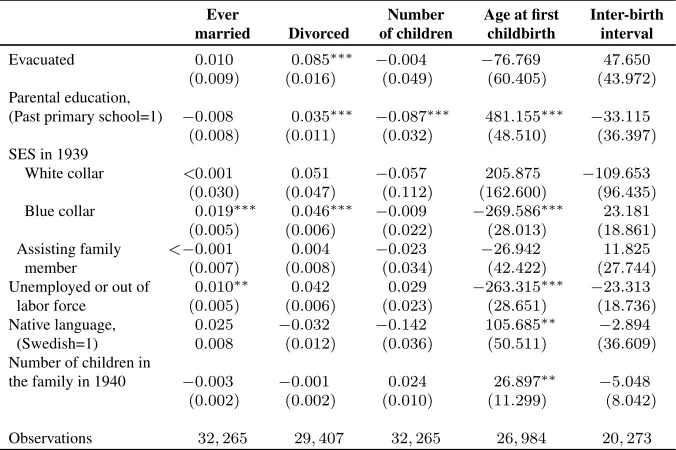
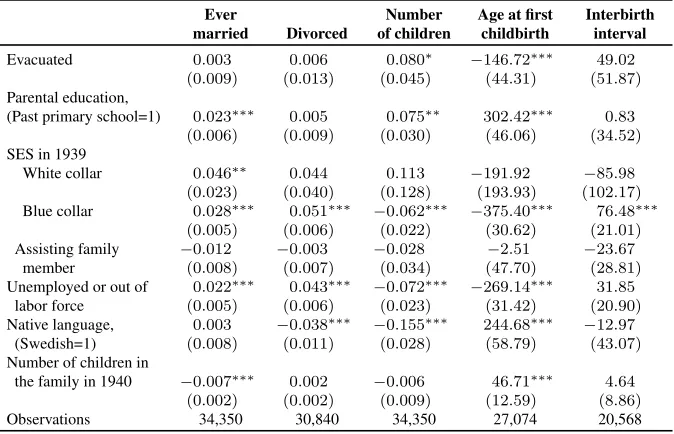
The first row of Table 4 shows that, for women, a significant association is found between evacuation and the probability of divorcing; women who were evacuated to foster care during WWII had an 8.5 percentage points higher probability of having divorced condi-tional on being married than their non-evacuee counterparts. The coefficients of parental education and the indicator for whether parents were blue collar workers are significant in three regressions out of five, whereas native language and number of children in the family in 1940 only played a role for the age at first childbirth. Table 5 presents the same results for men. Evacuated men had their first child on average roughly 5 months earlier than their nonevacuated counterparts. The coefficient of number of children is marginally significant but not substantively meaningful; the evacuated men have an average of 0.08 units larger families than their nonevacuated counterparts.
3.2 Comparing same-sex siblings with discordant evacuee status
If the Finnish policy of evacuating children to foster care was indeed a natural exper-iment, i.e., the evacuees were randomly drawn from the Finnish population of prewar cohorts of children, thenαin equation(1), which is the coefficient reported in the first row of Tables 4 and 5, would be the true causal effect of participation in the evacuation program. However, both anecdotal evidence on the eligibility criteria to the program and empirical evidence (descriptive statistics presented in this study and Santavirta and San-tavirta 2014) suggest that evacuees came from more adverse family backgrounds. Thus, the largest concern when evaluating the long-term consequences of this early life inter-vention is that the associations found are contaminated by confounding bias: children’s family background could affect both the likelihood of being evacuated as well as adult outcomes.
Table 4: Associations between the evacuation to foster care during World War II and subsequent marriage patterns and reproductive traits – women
Ever Number Age at first Inter-birth
married Divorced of children childbirth interval
Evacuated 0.010 0.085∗∗∗ −0.004 −76.769 47.650 (0.009) (0.016) (0.049) (60.405) (43.972) Parental education,
(Past primary school=1) −0.008 0.035∗∗∗ −0.087∗∗∗ 481.155∗∗∗ −33.115 (0.008) (0.011) (0.032) (48.510) (36.397) SES in 1939
White collar <0.001 0.051 −0.057 205.875 −109.653 (0.030) (0.047) (0.112) (162.600) (96.435) Blue collar 0.019∗∗∗ 0.046∗∗∗ −0.009 −269.586∗∗∗ 23.181
(0.005) (0.006) (0.022) (28.013) (18.861) Assisting family <−0.001 0.004 −0.023 −26.942 11.825
member (0.007) (0.008) (0.034) (42.422) (27.744) Unemployed or out of 0.010∗∗ 0.042 0.029 −263.315∗∗∗ −23.313
labor force (0.005) (0.006) (0.023) (28.651) (18.736) Native language, 0.025 −0.032 −0.142 105.685∗∗ −2.894
(Swedish=1) 0.008 (0.012) (0.036) (50.511) (36.609) Number of children in
the family in 1940 −0.003 −0.001 0.024 26.897∗∗ −5.048
(0.002) (0.002) (0.010) (11.299) (8.042)
Observations 32, 265 29, 407 32, 265 26, 984 20, 273
Table 5: Associations between the evacuation to foster care during World War II and marriage patterns and subsequent reproductive traits – men
Ever Number Age at first Interbirth
married Divorced of children childbirth interval
Evacuated 0.003 0.006 0.080∗ −146.72∗∗∗ 49.02 (0.009) (0.013) (0.045) (44.31) (51.87) Parental education,
(Past primary school=1) 0.023∗∗∗ 0.005 0.075∗∗ 302.42∗∗∗ 0.83 (0.006) (0.009) (0.030) (46.06) (34.52) SES in 1939
White collar 0.046∗∗ 0.044 0.113 −191.92 −85.98 (0.023) (0.040) (0.128) (193.93) (102.17) Blue collar 0.028∗∗∗ 0.051∗∗∗ −0.062∗∗∗ −375.40∗∗∗ 76.48∗∗∗
(0.005) (0.006) (0.022) (30.62) (21.01) Assisting family −0.012 −0.003 −0.028 −2.51 −23.67
member (0.008) (0.007) (0.034) (47.70) (28.81) Unemployed or out of 0.022∗∗∗ 0.043∗∗∗ −0.072∗∗∗ −269.14∗∗∗ 31.85
labor force (0.005) (0.006) (0.023) (31.42) (20.90) Native language, 0.003 −0.038∗∗∗ −0.155∗∗∗ 244.68∗∗∗ −12.97
(Swedish=1) (0.008) (0.011) (0.028) (58.79) (43.07) Number of children in
the family in 1940 −0.007∗∗∗ 0.002 −0.006 46.71∗∗∗ 4.64
(0.002) (0.002) (0.009) (12.59) (8.86) Observations 34,350 30,840 34,350 27,074 20,568
Notes: OLS estimates for evacuee status. Standard errors (in parentheses) are clustered at family level. All spec-ifications also include 12 categorical variables for birth order, 20 categorical variables for residence munic-ipality in 1939 and 11 categorical variables for birth cohort. Age at first childbirth and interbirth interval are measured in days.
We consider the following equation in which the individual error term is decomposed into two components,ηj, and,νij :
Yij=βws0 +αws(Evacueeij) + Family backgroundij
βws1 +
δcountyws +θwsbirth cohort+ηj+νij,
whereηj is the component of the error term shared between full siblings living in the
same householdjandνijis the idiosyncratic component specific to each individual.
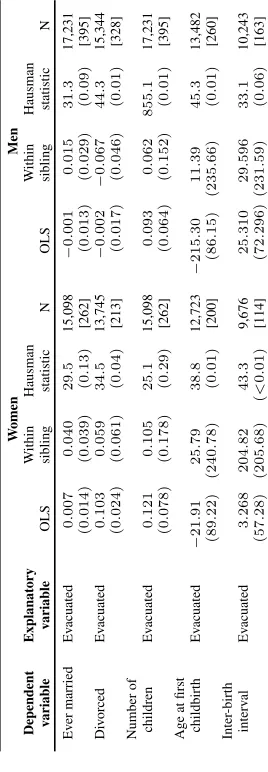
as-association in the within-sibling analysis. We exploit all permutations of sibling pairs in each household. However, a caveat to keep in mind when interpreting the within-sibling results is that evacuees who were singletons (n= 538) and sibling pairs of which both were evacuated do not contribute to the identification ofα(Table A2 in the appendix breaks the sibling pairs into pairs of nonevacuees, pairs discordant for evacuee status and pairs in which both siblings were evacuated). A Hausman test is preformed and reported in Table 6 for each outcome variable, to determine whether OLS is sufficient or whether a within-sibling model is needed (Cameron and Miller 2015).6 If OLS were consistent it
would be preferable, since all the between-family variation in the variables is lost in the within-sibling estimation and sibling-invariant regressors are not identified.
By comparing our na¨ıve OLS estimates of the associations between evacuation and our outcomes(α)and the within-sibling estimate(αws)we can sign the direction of the
unobserved household-specific confounding elements that operate net of observed family characteristics such as parental education and occupation. As for the divorce estimates for women,αws< αsuggests thatαis biased by negative selection of evacuee families, i.e., evacuees differ on average in their outcomes from their nonevacuee counterparts from the same county and cohort due to more adverse family environment as opposed to any effect of evacuation itself. On a similar note, we also find evidence of negative selection bias in the age at first child birth estimates for men(αws> α).Men who were evacuated
as children do not exhibit any difference in reproductive behavior when compared with their same-sex nonevacuee siblings. Taken overall, our within-sibling estimates provide evidence of a zero association between evacuation and family formation, probability of divorce, and reproductive behavior, and that the adverse associations obtained by na¨ıve OLS are contaminated by negative confounding bias.
6We use a cluster-robust version of the Hausman test proposed by Wooldridge (2010, p. 332) implemented in
4. Discussion
We analyzed the long-term impact of being evacuated to foster care in war time on the individuals’ marriage patterns, risk of divorce, and fertility later in life. Prior research on both the same Finnish evacuation program that we analyzed (Pesonen et al. 2008), as well as other studies on family separation, tends to find important negative associa-tions between family separation and later life outcomes (Kiernan 1992; McLanahan and Bumpass 1988; McLeod 1991). An important question regarding these findings is to what extent they represent causal effects. Our na¨ıve OLS regressions that do not account for unobserved confounding elements are consistent with prior research; for example, evac-uated women appear to have an elevated risk of divorce. However, in analyses in which we compare evacuated siblings to their non-evacuated peers, effectively controlling for all unobserved factors shared by the siblings and in particular family background, the pic-ture changes. For each of the family formation and fertility outcomes that we analyze, the within-sibling estimates suggest no differences between the evacuated and non-evacuated. Our analysis was based on large, nationally representative, longitudinal data that possess many features that make them particularly well suited for evaluation of long-term outcomes of the Finnish child evacuee policy. First, linking social security numbers to a random sample of the 1950 census allows for unusually long follow-up periods of the sub-jects – for example, we are able to analyze completed fertility – while at the same time avoiding the problem of potential recall bias that arises when childhood characteristics are retrospectively retrieved. Second, the availability of a family identifier and a variable defining the family ties between each family member in the 1950 census makes the data suited for within-sibling analysis, while also providing family background variables dat-ing back to the period before WWII for the na¨ıve adjusted means comparisons. Third, additional leverage is gained by linking this existing census sample with individual-level war time data from a child evacuee registry.
and Bumpass 1988; McLeod 1991; Pesonen et al. 2008). It is possible that some of the adverse findings would change if unobserved heterogeneity was accounted for.
The results also suggest remarkable robustness in family formation and fertility be-havior, as a dramatic event that took children from their families and placed them in a new country and new family left no marks on subsequent family formation or fertility. Some theories, in particular the life history theory, postulate that early life experiences might influence subsequent family formation and fertility because they change the (real of anticipated) expected survival probabilities and might create incentives to reproduce early. We find no evidence of changing reproductive behavior in response to being evac-uated to foster care. On the other hand, the attachment theory suggests that adverse early life experiences might negatively influence subsequent family formation (Bowlby 1980). Again, we find no evidence of this. It is possible that these mechanisms are weak or not operating at all, or perhaps slightly more unlikely, are both operating but cancel each other.
differences, and among the differences we identify in particular factors suggesting that the historical evacuation of Finnish children may have been more stressful compared to the more recent foster care programs.
4.1 Limitations
Even though the data used in the analysis is of exceptional quality and geared towards the examination of our research question, and the within-sibling design accounts for many shortcomings that are present in comparisons between-families, also these data and design have limitations.
First, our within-sibling analysis is adjusting solely for sibling-invariant aspects of the family background. Thus, the identifying assumption for a causal interpretation of our within-sibling estimate is that exposure, in this case the parental decision to evacu-ate a specific sibling, was uncorrelevacu-ated with unobserved sibling-specific characteristics (Rosenzweig and Wolpin 1995). This is a strong assumption, as the literature documents a range of differences between siblings in a family context that could potentially bias our evacuation estimate. We reduce the amount of unadjusted, child-specific, potential confounding effects by adjusting for the following sibling-specific factors: age and birth order. Birth order is a potential confounder in almost any between-sibling research de-signs dealing with interventions during early life and later-life health, as it has been found to be inversely correlated with education and cognitive ability, and suicide (Black, Dev-ereux, and Salvanes 2005; McCall 1977; Rostila, Saarela, and Kawachi 2014).
Second, it is possible that parents might, after reunification, try to adjust parental investments across siblings so as to compensate for the experience of parental separation or experience of war (whichever was perceived to be more stressful). The literature on postnatal parental investments shows mixed evidence of parental responses; Del Bono, Ermisch, and Francesconi (2012) find evidence in favor of compensating strategies while Bharadwaj, Løken, and Neilson (2013) find no such evidence.
this mitigating effect by stratifying the analysis based on factors that might reflect how likely it is that siblings do or do not influence each other – for example, proximity defined by age or region of residence might be viable stratifying factors – however, our data is not very large to begin with, and such analyses would further reduce our power to detect a signal.
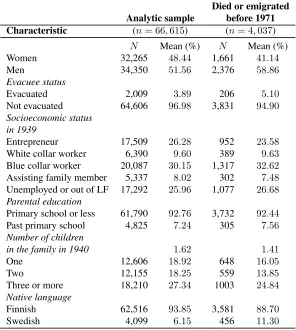
Third, there is attrition between 1950 and 1970 between which years the individuals are not observed. A small proportion of these subjects had died but a more important source of attrition was the mass migration to Sweden in the late 1960s. Table 7 com-pares those lost before 1971 to the analytic sample. The subjects lost were less likely to be women, more likely to be evacuated and to speak Swedish as their native language, although there were small differences in socioeconomic background and parental educa-tion. We cannot however exclude the possibility that attrition may bias the results; attrited individuals may have systematically differed with respect to exposure or outcomes from the individuals included in the analytic sample. If for instance individuals who died or emigrated before 1971 were more likely to participate in the evacuation policy and at the same time more likely to give birth at an early age then we would have observed larger associations between evacuation and early childbearing for the base population.
Table 7: Background characteristics of the analytic sample and of those who died or emigrated before 1971
Died or emigrated
Analytic sample before 1971
Characteristic (n= 66, 615) (n= 4, 037)
N Mean (%) N Mean (%)
Women 32,265 48.44 1,661 41.14
Men 34,350 51.56 2,376 58.86
Evacuee status
Evacuated 2,009 3.89 206 5.10
Not evacuated 64,606 96.98 3,831 94.90
Socioeconomic status in 1939
Entrepreneur 17,509 26.28 952 23.58
White collar worker 6,390 9.60 389 9.63
Blue collar worker 20,087 30.15 1,317 32.62 Assisting family member 5,337 8.02 302 7.48 Unemployed or out of LF 17,292 25.96 1,077 26.68 Parental education
Primary school or less 61,790 92.76 3,732 92.44
Past primary school 4,825 7.24 305 7.56
Number of children
in the family in 1940 1.62 1.41
One 12,606 18.92 648 16.05
Two 12,155 18.25 559 13.85
Three or more 18,210 27.34 1003 24.84
Native language
Finnish 62,516 93.85 3,581 88.70
Swedish 4,099 6.15 456 11.30
4.2 Conclusions
envi-There are many ways to reconcile our null results with the literature that finds asso-ciations between family instability and the child’s subsequent family formation and re-productive behavior (e.g, Kiernan 1992; McLanahan and Bumpass 1988; McLeod 1991; Rostila and Saarela 2011). First, unobserved heterogeneity in some of the earlier stud-ies may bias the reported associations. This interpretation is supported by our finding that in na¨ıve OLS regressions family disruption appears to strongly predict later family formation and fertility behavior, but when unobserved heterogeneity is controlled for via sibling fixed effects approach, the effects vanish.
Second, the left-behind siblings who stayed with their biological parents throughout the war may have been adversly affected by the separation from their siblings. This may bias the evacuation estimates towards zero.
Third, it is possible that the context is critical for the effects. Much of the literature on family disruption and later family formation and fertility behavior comes from Anglo-Saxon countries (Kiernan 1992; McLanahan and Bumpass 1988; McLeod 1991). It is an important but difficult question as to whether the Finnish context might influence the im-pact of family disruption differently than what other contexts might. The decades during which the children we analyzed came of age were characterized by relatively high social mobility, in particular among the lower social classes (Bratsberg et al. 2007; ¨Osterbacka 2001). It is possible that a social context that provides high social mobility provides opportunities that attenuate the effects of family disruption. Further, recent studies by Saarela and Finn¨as (2009, 2012) on other populations in Finland affected by the events of WWII, namely, war veterans and adults internally displaced from areas ceded to the Soviet Union in 1940, find no elevation in long-term mortality rates among the exposed groups compared to their unexposed counterparts.
Fourth, it is also possible that the impact of family disruption does not increase monotonically with how dramatic the event of disruption is. Most studies on family disruption focus on divorce or death of a parent. It is possible that the effect on the child of experiencing parental divorce or parental death is smaller than the war time evacuation to another country. Further research is needed to understand how the nature of family disruption influences the family formation trajectory of the child.
References
Allsworth, J.E., Zierler, S., Lapane, K.L., Krieger, N., Hogan, J.W., and Harlow, B.L. (2004). Longitudinal study of the inception of perimenopause in relation to lifelong history of sexual or physical violence.Journal of Epidemiology and Community Health 58(11): 938–943.doi:10.1136/jech.2003.017160.
Amato, P.R. (2010). Research on Divorce: Continuing Trends and New Devel-opments. Journal of Marriage and Family 72(3): 650–666. doi:10.1111/j.1741-3737.2010.00723.x.
Appel, C.W., Johansen, C., Deltour, I., Frederiksen, K., Hjalgrim, H., Dalton, S.O., Dencker, A., Dige, J., Bøge, P., Rix, B.A., Dyregrov, A., Engelbrekt, P., Helweg, E., Mikkelsen, O.A., Høybye, M.T., and Bidstrup, P.E. (2013) Early Parental Death and Risk of Hospitalization for Affective Disorder in Adulthood.Epidemiology24(4): 608–615.doi:10.1097/EDE.0b013e3182915df8.
Belsky, J. (2008). War, trauma and children’s development: observations from a mod-ern evolutionary perspective.Intmod-ernational Journal of Behavioral Development32(4): 260–271.doi:10.1177/0165025408090969.
Belsky, J., Steinberg, L., and Draper, P. (1991). Childhood Experience, Interpersonal Development, and Reproductive Strategy: An Evolutionary Theory of Socialization. Child Development62(4): 647–670.doi:10.2307/1131166.
Bharadwaj, P., Løken, K.W., and Neilson, C. (2013). Early Life Health Interven-tions and Academic Achievement. American Economic Review 103(5): 1862–91.
doi:10.1257/aer.103.5.1862.
Bhrolch´ain, M.N. (2001). ‘Divorce Effects’ and Causality in the Social Sciences. Euro-pean Sociological Review17(1): 33–57.doi:10.1093/esr/17.1.33.
Bj¨orklund, A. and Sundstr¨om, M. (2006). Parental Separation and Children’s Educational Attainment: A Siblings Analysis on Swedish Register Data.Economica73(292): 605– 624.doi:10.1111/j.1468-0335.2006.00529.x.
Black, S.E., Devereux, P.J., and Salvanes, K.G. (2005). The More the Merrier? The Effect of Family Size and Birth Order on Children’s Education .Quarterly Journal of Economics120(2): 669–700.doi:10.1093/qje/120.2.669.
Bound, J. and Solon, G. (1999). Double trouble: On the value of twins-based esti-mation of returns to schooling. Economics of Education Review 18(2): 169–182.
Bratsberg, B., Røed, K., Raaum, O., Naylor, R., J¨antti, M., Eriksson, T., and ¨ Oster-backa, E. (2007). Nonlinearities in Intergenerational Earnings Mobility: Conse-quences for Cross-Country Comparisons. Economic Journal 117(519): C72–C92.
doi:10.1111/j.1468-0297.2007.02036.x.
Cameron C.A. and Miller D.L. (2015). A practitioner’s guide to cluster-robust inference. Journal of Human Resources.
Corak, M. (2001). Death and Divorce: The Long-Term Consequences of Parental Loss on Adolescents.Journal of Labor Economics19(3): 682–715.doi:10.1086/322078.
Del Bono, E., Ermisch, J., and Francesconi, M. (2012). Intrafamily Resource Allocations: A Dynamic Structural Model of Birth Weight. Journal of Labor Economics30(3): 657–706.doi:10.1086/664831.
Duncan, G., Yeung, W.J., Brooks-Gunn, J., and Smith, J.R. (1998). How Much Does Childhood Poverty Affect the Life Chances of Children? American Sociological Re-view63(3): 406–423.doi:10.2307/2657556.
Ermisch, J.F. and Francesconi, M. (2001). Family structure and children’s achievements. Journal of Population Economics14(2): 249–270.doi:10.1007/s001480000028.
Gennetian, L.A. (2005). One or two parents? Half or step siblings? The effect of family structure on young children’s achievement. Journal of Population Economics18(3): 415–436.doi:10.1007/s00148-004-0215-0.
Gilman, S.E., Kawachi, I., Fitzmaurice, G.M., and Buka, S.L. (2003). Family Disruption in Childhood and Risk of Adult Depression.American Journal of Psychiatry160(5): 939–946.doi:10.1176/appi.ajp.160.5.939.
Hardy, R. and Kuh, D. (2005). Social and environmental conditions across the life course and age at menopause in a British birth cohort study. BJOG: An Interna-tional Journal of Obstetrics & Gynaecology 112(3): 346–354. doi:10.1111/j.1471-0528.2004.00348.x.
International Committee of the Red Cross. Central Tracing Agency and Protection Divi-sion (2004).Inter-Agency Guiding Principles on Unaccompanied and Separated Chil-dren. Geneva: International Committee of the Red Cross, Central Training Agency and Protection Division.
Kav´en, P. (2010). Humanitaarisuuden varjossa: Poliittiset tekij¨at lastensiirroissa Ruot-siin sotiemme aikana ja niiden j¨alkeen. [Ph.D. Thesis]. Helsinki, Finland: University of Helsinki, Faculty of Arts, Dept. of Philosophy, History, Culture and Art Studies. (English summary available at: http://urn.fi/URN:ISBN:978-952-10-6722-8)
Child-bearing.Journal of Human Resources49(1): 1–31.doi:10.1353/jhr.2014.0001.
Kendler K.S., Sheth K., Gardner C.O., and Prescott C.A. (2002). Childhood parental loss and risk for first-onset of major depression and alcohol dependence: the time-decay of risk and sex differences. Psychological Medicine 32(7): 1187–1194.
doi:10.1017/S0033291702006219.
Kiernan, K.E. (1992). The Impact of Family Disruption in Childhood on Tran-sitions Made in Young Adult Life. Population Studies 46(2): 213–234.
doi:10.1080/0032472031000146206.
Lang, K. and Zagorsky, J.L. (2001). Does Growing up with a Parent Absent Really Hurt? Journal of Human Resources36(2): 253–273.doi:10.2307/3069659.
Lehtiranta, L. (1996). Matkalla Kodista Kotiin: Sotalapset Muistelevat. (On the Road from One Home to Another: Recollections by Child Evacuees). Vantaa: Pohjola-Norden.
Lomu, J. (1974).Lastensiirtokomitea ja sen arkisto 1941–1949 (Engl. The Child Evacua-tion Comittee and its Archives 1941-1949). PublicaEvacua-tion Series of the NaEvacua-tional Archives, Finland, 441(5a).
Lundberg, S. and Plotnick, R.D. (1995). Adolescent Premarital Childbearing: Do Economic Incentives Matter? Journal of Labor Economics 13(2): 177–200.
doi:10.1086/298372.
Lyngstad, T.H. and Prskawetz, A. (2010). Do siblings’ fertility decisions influence each other?Demography47(4): 923–934.doi:10.1007/BF03213733.
McCall, R.B. (1977). Childhood IQ’s as Predictors of Adult Educational and Occupa-tional Status.Science197(4302): 482–483.doi:10.1126/science.197.4302.482.
McLanahan, S. and Bumpass, L. (1988). Intergenerational Consequences of Family Dis-ruption.American Journal of Sociology94(1): 130–152.doi:10.1086/228954.
McLanahan, S. and Sandefur, G. (1994).Growing up with a single parent, what hurts, what helps.Cambridge, MA: Harvard University Press.
McLeod, J.D. (1991). Childhood Parental Loss and Adult Depression.Journal of Health and Social Behavior328§9: 205–220.doi:10.2307/2136804.
National Institute for Health and Welfare, Finland. Division for Social Protection. (2013). Child Welfare 2012 – Statistical Report. Official Statistics of Finland.
¨
Scandina-(2008). Reproductive traits following a parent-child separation trauma during child-hood: A natural experiment during World War II.American Journal of Human Biology 20(3): 345–351.doi:10.1002/ajhb.20735.
Powers, D.A. (2005). Effects of family structure on the risk of first premarital birth in the presence of correlated unmeasured family effects.Social Science Research34(3): 511–537.doi:10.1016/j.ssresearch.2004.04.007.
Rosenzweig, M. and Wolpin, K. (1995). Sisters, Siblings, and Mothers: The Effect of Teen-Age Childbearing on Birth Outcomes in a Dynamic Family Context. Economet-rica63(2): 303–326.doi:10.2307/2951628.
Rostila, M. and Saarela, J.M. (2011). Time Does Not Heal All Wounds: Mortality Following the Death of a Parent. Journal of Marriage and Family73(1): 236–49.
doi:10.1111/j.1741-3737.2010.00801.x.
Rostila, M, Saarela, J.M., and Kawachi, I. (2014). Birth Order and Suicide in Adulthood: Evidence From Swedish Population Data.American Journal of Epidemiology179(12): 1450–1457.doi:10.1093/aje/kwu090.
Saarela, J.M. and Finn¨as, F. (2009). Long-term Mortality of War Cohorts: The Case of Finland.European Journal of Population28(1): 1–15. doi:10.1007/s10680-011-9246-x.
Saarela, J.M. and Finn¨as, F. (2012). Forced migration and mortality in the very long term: Did perestroika affect death rates in Finland? Demography46(3): 575–587.
doi:10.1353/dem.0.0069.
Santavirta, N. and Santavirta, T. (2014). Child protection and adult depression: Evaluat-ing the long-term consequences of evacuatEvaluat-ing children to foster care durEvaluat-ing World War II.Health Economics,23(3): 253–278.doi:10.1002/hec.2913.
Schaffer, M.E. and Stillman, S. (2010). xtoverid: Stata module to calculate tests of overidentifying restrictions after xtreg, xtivreg, xtivreg2 and xthtaylor. http://ideas.repec.org/c/boc/bocode/s456779.html
UNHCR. (2012). Global trends: Displacement: The New 21thCentury Challenge. Avail-able at: http://www.unhcr.org/51bacb0f9.html. Accessed October 25, 2013.
U.S. Department of Health and Human Services, Administration for Children and Fam-ilies, Administration on Children, Youth and Families. (2013). The AFCARS Report: Preliminary FY 2012 Estimates as of November 2013. Washington, DC: US Govern-ment Printing Office.
Appendix
The evacuation policy7
Historical background
Finland fought two wars against the Soviet Union between 1939 and 1944 during World War II. Despite Finnish collaboration with the Axis Powers during World War II, Fin-land’s resistance against Stalin’s Red Army received moral support from many Western countries. Food and material aid was received from international organizations and credit was granted by several countries.
In June 1941, a plan for a large scale operation of evacuating Finnish children to Sweden emerged. A nationwide volunteer organization was established in Sweden to attend to the placement of the children, and a large scale network of volunteer foster families was mobilized.8 In Finland, the evacuations were organized by a nationwide or-ganization under the auspices of the Ministry of Social Affairs, relying on the nationwide civilian service logistic infrastructure, including local offices and staff. These two organi-zations designed the evacuation scheme and carried out the major part of the evacuations and placements in foster families made between 1941 and 1945.9
The official motives for a mass evacuation of children were, as stated by the Ministry of Social Affairs, that children who were particularly exposed to the various adversities of war should be given a better rearing environment. At first, each Finnish county was granted a quota of evacuees, but restricting the selection of participants to the stated quo-tas proved difficult as fear for air raids spread among the urban population and food be-came scarce. The original eligibility criteria were the following: 1. children of displaced Karelian families;10 2. children whose fathers were wounded in battle; 3. children who had lost their home in bombings; 4. children whose father’s had died in war or who had lost their parents in bombings. In January 1942, the criteria were expanded to include children from large families, children whose mothers were working full time, and also children who resided in towns that were potential targets for air raids. This latter cri-terion applied, in practice, to most eastern and southern towns of Finland, and therefore
7The chief part of the documents that this section is based on are available in the Files for The Child Evacuation
Scheme during World War II at The National Archives of Finland (NAF). When not specifically mentioned, I refer to Lomu (1974), who constructs a detailed report on the evacuation scheme based on the documents of NAF.
8No financial compensation for accommodating Finnish children was ever promised to the Swedish families.
In other words, the accommodating of evacuees was based purely on philanthropic grounds.
9Most evacuations were made in the winter between 1941 and 1942 and in 1944.
10Being the border region between Finland and the Soviet Union, Karelia was the region most adversely affected
most children from these areas were considered eligible. At first the objective was to send preschoolers. A strict age criterion however was not applied in practice, due, for instance, to the difficulty choose between siblings of various age. Statistics show that roughly half of the children were past school starting age by the time of evacuation.
In total 48,628 children were evacuated to Sweden through the described evacua-tion scheme and roughly an addievacua-tional 20,000 children were sent to Sweden independent from the official evacuation program, to relatives and friends. In total, it is estimated that roughly 65,000 children spent from a couple of months up to five years (on average two years) in foster care in Swedish families during World War II. The total number of evacuees equals the size of one Finnish cohort during the 1930s.
The avacuation from Finland to Sweden
A large organization, called the Evacuation Committee, was set up on the foundations of the existing war time civilian support organization to conduct the evacuations, with the help from numerous volunteers.11 The organization made itself known through nation-wide broadcasting and advertising in local newspapers. Headquarters were established in Helsinki, employing a large administrative staff. The Evacuation Committee set up and funded regional subsidiary offices that were largely run by volunteers, such as lo-cal nurses. After the evacuations began, in September 1941, the county offices were converted into evacuation centers handling the selection process, transportation arrange-ments, documentation, accounting, correspondence between the evacuees and their fami-lies, and advertising of the evacuation scheme in the local media. Absorption centers were set up near the ports of Turku and Vaasa, from whence the evacuees were sent to Sweden by boat and in the border towns of Tornio and Kemi, from where the evacuees crossed the border by railway. All travel expenses were covered by the Evacuation Committee.
Parents who had learned about the evacuation program through mass media or local authorities first filed an application to the local evacuation office. In the application the parents had to account for the reasons for applying to the program and list their status on each of the eligibility criteria. Families with more than one child could opt for including all their children in the application or decide to evacuate only some of their children (this was quite a usual strategy in large families in which malnutrition was a common reason for participation). Even though the family background (eligibility criteria) of each evacuee was well documented through the screening process, neither the child evacuee registry nor historical accounts has much to say about selective behavior within families that evacuated only some of their children; the actual evacuation decision was considered to be a family matter (Kav´en 2010). When the application was approved, a health check at the local hospital followed and an identification document including a photograph was
11The Civilian Service of Finland contributed with an already existing network of volunteers. This organization
issued. The documents were sent to the local evacuation office where the child’s file was put into a queue awaiting information on the region’s quota for the following evacuation round. As soon as the headquarters of the organization gave information of each region’s quota for the next round, the county office gathered the children – according to the ordered date of application approval – to the nearest railway station, from whence they were sent to the absorption centers. The children were not allowed to carry any money, and their ration cards (most grocery products were rationed in Finland during the war) needed to be handed in before departure.12 The children brought with them a franked envelope,
which the foster parents that would be assigned in Sweden were urged to post to the Finnish county office with notification of the child’s arrival and their name and address, to enable correspondence between the biological parents and their child. Upon arrival at the absorption center, a brief health check was conducted and information on the children was entered into an evacuee register. Each child was assigned a running number according to arrival order and given an identification placard to carry around her neck.
Based on the above description of the evacuation, it is plausible that the evacuation created randomness in the order in which the children were transported to Sweden. The strongest argument in favor of random order of evacuation with respect to any background characteristics would be that the children were processed according to a running number upon the arrival at the absorption centers and boarded the vehicle of transportation ac-cordingly.
The placement to foster families in Sweden
In Sweden, the structure of the Placement Committee was virtually a mirror image of the Evacuation Committee on the Finnish side. Its main office was located in Stockholm and each county had its own local organization led by an authorized representative who was in charge of the placement of the children into families. In practice, large local volunteer organizations conducted the major part of the placement operations, and the provincial offices handled registries of children and other administrative issues. Quarantine centers were established in geographically strategic Swedish towns, usually the capital of the county.
equipped children, and all children were washed thoroughly. When leaving the quarantine centers, the children were separated into smaller groups and transported via the county offices, where the group would be re-shuffled into smaller units, to their final destinations. Little is documented about the final stage of the evacuation, that is, the placement in foster families, and thus one is principally referred to anecdotal evidence as recalled or retold by the evacuees.13 Regarding the different stages of the journey until the local
Swedish provincial offices, anecdotal evidence conforms unusually well with the infor-mation in official documents. The final stage of the trip to the eventual placement seems to have been completed in three different ways: 1. when several children arrived at the same time in a community, the distribution of children to foster families would take place at some temporary lodging, e.g. the local parish house or school premises, according to a first-come first-served process,142. in sparsely populated areas, or in areas where only
one family was awaiting a child, the assigned family would receive the child on a bus stop or train station without means to affect the choice of child, 3. in some cases the local ombudsman for the placement committee, often the local priest or school principal, assigned the children to families at their arrival on the train or bus station.
The description of the events during the journey to the final destination suggests that the children were processed anonymously according to the information provided on an identification placard hanging around their neck, i.e., an assigned running number, name and gender, and sorted randomly at several stages of the journey. By the time the children reached the last leg of their transportation, the inequalities in clothing, cleanliness, and nutrition are supposed to have been leveled out, and thus to have made any inference of social background based on appearance difficult.
13We make use of a compilation of 135 short stories of recollections by the evacuees edited by Leila Lehtiranta
(1996).
14Pirkko Bergman, a one time child evacuee, recalls “we (the children) were taken to a room and were told to
Table A–1: Probit estimates: Child evacuation and marriage patterns
Ever married Divorced
Women Men Women Men
Evacuated 0.009 0.002 0.082 0.006
(0.009) (0.010) (0.015) (0.012) Parental education,
(Past primary school=1) −0.007 0.028∗∗∗ 0.034 0.005
(0.007) (0.066) (0.011) (0.009) SES in 1939
White collar −0.015∗∗ 0.049∗∗∗ 0.024 0.039∗∗∗ (0.007) (0.005) (0.010) (0.010)
Blue collar 0.019∗∗∗ 0.026∗∗∗ 0.050 0.055∗∗∗
(0.004) (0.004) (0.007) (0.006) Assisting family member <0.001 −0.010 0.005 −0.004
(0.006) (0.007) (0.009) (0.009) Unemployed or out of labor force 0.009∗∗ 0.019∗∗∗ 0.046 0.049∗∗∗
(0.004) (0.004) (0.007) (0.007) Native language, (Swedish=1) 0.024∗∗∗ 0.004 −0.030 −0.036∗∗∗
(0.007) (0.009) (0.010) (0.009) Number of children in
the family in 1940 −0.003 −0.007∗∗∗ −0.002 0.001 (0.002) (0.002) (0.003) (0.002)
Observations 32, 265 34, 350 29, 407 30, 840
Notes: Marginal effects of probit estimates for evacuee status evaluated at the sample mean of the explanatory variables. Standard errors (in parentheses) are clustered at family level. All specifications also include 12 categorical variables for birth order, 20 categorical variables for residence municipality in 1939 and 11 categorical variables for birth cohort. Age at first childbirth and inter-birth interval are measured in days.
Table A–2: Differences in evacuation status among siblings according to sibship
size
All Two siblings Three siblings Four siblings Five or more (n= 43, 665 (n= 9, 957 (n= 13, 590 (n= 10, 806 siblings (n= Evacuee status pairs) pairs) pairs) pairs) 9, 346pairs) Both non-evacuees 41,790 9,482 12,932 10,341 8,969 Evac. vs. non-evac. 1,321 295 458 348 220
Table 6: Reproductive traits and marriage patterns according to child-evacuee status during WW II – within-sibling analyses
W omen Men Dependent Explanatory W ithin Hausman W ithin Hausman v ariable v ariable OLS sibling statistic N OLS sibling statistic N Ev er married Ev acuated 0.007 0.040 29.5 15,098 − 0.001 0.015 31.3 17,231 (0.014) (0.039) (0.13) [262] (0.013) (0.029) (0.09) [395] Di v orced Ev acuated 0.103 0.059 34.5 13,745 − 0.002 − 0.067 44.3 15,344 (0.024) (0.061) (0.04) [213] (0.017) (0.046) (0.01) [328] Number of children Ev acuated 0.121 0.105 25.1 15,098 0.093 0.062 8 55.1 17,231 (0.078) (0.178) (0.29) [262] (0.064) (0.152) (0.01) [395] Age at first childbirth Ev acuated − 21.91 25.7 9 38.8 12,723 − 215.30 1 1.39 45.3 13,482 (89.22) (240.78) (0.01) [200] (86.15) (235.66) (0.01) [260] Inter -birth interv al Ev acuated 3.268 204.82 43.3 9,676 25.310 29.596 33.1 10,243 (57.28) (205.68) ( < 0.01) [114] (72.296) (231.59) (0.06) [163]