Vehicle Interior Vibration Simulation-a Tool for Engine
Mount Optimization
B.Sakhaei1,2,M Durali2*
1Deprtment of mechanical engineering, Sharif University of Technology, Tehran, Iran. 2 NVH department of Iran Khodro Powertrain Company (IPCO), Tehran, Iran
Abstract
By new advancements in vehicle manufacturing; vehicle quality evaluation and assurance has become a more critical issue. In present work, the vibration transfer path analysis and vibration path ranking of a car interior has been performed. The method is similar to classical multilevel TPA methods but has distinct differences. The method is named VIVS which stands for Vehicle Interior Vibration Simulation. Performance of some tests like chassis dyno test, virtual mass function test and body transfer function test are required in this approach. The accelerations on both sides of the engine mounts are measured on chassis dyno by which the virtual mass and body transfer functions are measured at engine mounts. Using the concept of multilevel TPA, the vibration share from each path is calculated. The overall vibration magnitude at target point is calculated by summing the shares. Path ranking can be done by having the share of each path from overall vibration magnitude. Using this method on a sample vehicle, some modification has been proposed to decrease the vibration at target point, and the side effect of the modifications on the powertrain dynamic behavior has been evaluated. The proposed method needs less analysis time than classical TPA methods and its ability in optimization of vibration magnitude at target points is proven.
Keywords: Vibration, Structure Borne Noise, Transfer paths, Path ranking, Engine mount
1. Introduction
Magnitude of the noise which is perceived by passengers in a vehicle compartment is a key factor to customer satisfaction. The high extent of noise and vibration in the vehicle compartment causes passengers’ fatigue, discomfort and disorder and is hazardous to their health.
Identifying the transfer paths of noise and vibration in a vehicle helps automotive engineers to find the critical paths which transmit more noise and vibration. Each path starts from an active component like engine, continues through the passive component of chassis, and ends up to target points at the passenger position interfaces with humans, like; interior noise, seat vibration, steering wheel or compartment floor vibration [1, 2].
Transfer path analysis (TPA) is a well-known method which can help an engineer to identify the paths and rank them relative to their share in total noise and vibration in vehicle compartment [3].
The first studies on transfer path analysis and assessing the partial contributions refers to 1980.
Bendat et al. studied the coherence functions to find the contribution of different inputs to targets, but this approach was inaccurate when the sources were partially correlated [4, 5].
On late 80's another approach was suggested that assumed a source-system-receiver in calculating the contributions. This approach considered each partial contribution of noise or vibration in target point as a result of input force at interface point multiplied by the system unity response. The partial contributions then were summed together to yield the total response at targets [3].
Decomposing the total noise or vibration to its partial contributions and separating the partial contributions to some FRFs and interface input loads, is the key to identify the root cause of the system weak points and therefore helps to propose the solutions easier [6, 7]. By this definition of TPA, the test procedures of this method are comprised of: identification of interface operational loads at engine mount locations, and estimation of FRFs with excitation tests, (Hammer or shaker tests). Advancements in signal processing and measurement
542 Vehicle Interior Vibration Simulation……
International Journal of Automotive Engineering Vol. 3, Number 4, Dec 2013 techniques, helps in measuring the FRFs more
accurately than before [8, 9].
One more challenging factor that can influence the accuracy of the TPA method is the identification of the interface loads. Several methods have been developed to estimate the interfacial loads via experiments. There are three different methods namely: direct measurement, mount stiffness and matrix inversion [1-3, 6, 10-11].
For direct measurement of the force, the sensor should be installed between the mount and the chassis. This installation in some cases is rather difficult if not impossible [1, 3, 6].
The second method is the mount dynamic stiffness in which the difference between the displacements on both sides of the mounts is related to interfacial loads. The mount stiffness is a fast method, but usually the accurate measurement of mount dynamic stiffness at engine load and temperature is not possible and can only be measured at test labs [6].
The third method is the inverse force identification. In this method the operational loads acting on the mounts are calculated by multiplying the acceleration on the passive side with the pseudo inverse of FRFs between interfacial and target points [1-2, 6].
The main disadvantage of the inverse force identification method is the large number of FRFs that have to be measured with high accuracy. This will make the cost and the time of this method industrially unfeasible [12-15].
Industry is always looking for fast and simple methods. To achieve this, Operational Path Analysis was invented to be used along with Operational Modal Analysis (OMA)[16, 18]. This method has been called with other names like OTPA, CTC, AMM and TPA FORM in some publications. In operational methods, the transfer path analysis and path ranking have higher calculation speed but the accuracy, details of the analysis and causality of the method must be discussed in more details [16, 17].
In 2010 another TPA method named OPAX was introduced by some researchers. This approach uses operational data with a minimum required FRF data of the system. In this method only the FRFs between the inputs and the target point are measured. By using a parametric load model, the input forces of the paths are calculated respectively. Hence the transfer paths will be analyzed and ranked [19, 20]. Although this method has proved its strength in saving time and cost of the measurements, but it has some limitations. [19, 20].
In this research a multilevel TPA similar to multilevel TPA introduced earlier [3] is used,
although distinct difference exists between the two methods. In the present method the interior vibration simulation in a vehicle is done with the help of a chain of transfer functions of the sub systems of the vehicle [21]. The partial contributions of interior vibrations of the vehicle are simulated at compartment floor (on the body floor at passenger position). The contributions then will be added together to acquire the overall vibration level at target point. Like classical TPA methods, the key assumption is linear time invariant behavior for the paths [1-6]. The method is named "VIVS" in this paper which stands for Vehicle Interior Vibration Simulation.
In the first part of the paper the theoretical background of the method and experimental set up has been described. In the second part of the paper, using VIVS method the critical path will be identified and some suggestions will be proposed to improve interior NVH. In the third part of the paper adverse effect of the engine mount modifications on engine dynamic behavior will be discussed.
2. VIVS Method Framework
Vehicle interior vibration magnitude at target points can be a representative of the engine mount vibration isolation quality. It is believed that vibration at vehicle interior target points can be a determining parameter in engine mount optimization. The VIVS method can investigate and rank the vibration transfer paths in a vehicle by measurements like:
-Vibration measurements at path inputs (engine mounts locations, both at engine and body side) and at the target points
-Apparent mass of the engine mounts, by exciting the engine mount location and recording the vibration next to excitation point
-Body transfer function, by impacting the body at engine mounts location and recording the acceleration at target point.
By chain multiplication of the above mentioned transfer functions in input vibration of the engine at engine mount location; the vibration contribution of different paths will be obtained.
Fig. 1 shows a graphical representation of the method. Equation (1) shows the mathematical overview of the method.
In equation(1), aint,j(N f, ) is the acceleration
amplitude of the vehicle interior at a target point at different engine speed N and each frequency f .This parameter is taken as an output of the system
1, 2, ,
int,j( , ) j( ) j( ) 3j( ) engine j,( , )
a N f =H f oH f oH f oa N f
(1)
B.Sakhaei and M.Durali 543
1,j( )
H f is the mount transmissibility function (in
frequency domain f )which is the ratio of the acceleration on engine mount body side to acceleration of the engine mount at engine side, as defined in equation(2) . This gives the ratio of engine mount isolation factor. An engine mount would have better performance for higher isolation factors.
2,j( )
H f
as defined in equation(3)is the ratio of the force to the acceleration of the bodynear the engine mount, therefore it is called the virtual mass of the body .Higher values of this parameter show better body NVH performance.
3,j( )
H f
is the body transfer function in vibration transfer from engine mount location to the vehicle interior target point, equation(4).
arg , 3, , ( ) ( ) ( ) t et j j body j a f H f F f = (4) , ( , ) engine j
a N f
is the acceleration amplitude of the engine at engine mount location at different engine speeds N and each frequency f . This parameter is taken as an input to the system.
The operator "
o
" shows the element by element multiplication of the two vectors or matrices.3. VIVS test scenario
For evaluation of interior vibration in a sedan car compartment, a procedure for interior vibration simulation was applied based on multilevel TPA. The vehicle has a four cylinder engine of 1.7 lit. The engine and the gearbox are installed on the car body by three mounts. Two of the mounts are just rubber and one is a hydraulic mount. The mounts are named as: RH mount, LH mount and Rear mount. The RH mount is a hydraulic mount and LH and Rear mounts are made of rubber. Fig. 2 shows the transverse engine mounting system and also the shape of the mounts.
Fig1.Graphical representation of VIVS method
Fig2.Transverse engine mounting system[22]
, 1,
,
( ) bo dy j
j
en gi ne j
a H f a = (2) , 2, , ( ) ( ) ( ) body j j body j F f H f a f = (3)
544 Vehicle Interior Vibration Simulation……
In this work the transfer functions of apparent mass and body was measured in presence of powertarin on the chassis. In some publication the transfer function has been measured without the engine. Test results show, (the results are not reported) the measurements without the engine caused significant error in calculating the contributions.
The principal directions of measurement are shown in Fig. 3. X axis is aligned with vehicle longitudinal axis, Z axis is perpendicular to ground and Y axis is perpendicular to XZ surface.
Fig. 4 shows the test setup of the vehicle on chassis dyno.Mount transmissibility was measured via a test on the chassis dyno. Two triaxial accelerometers were installed on each sides of every engine mount. The vehicle was then taken under a run up test from 1200 to 5400 rpm on a chassis dyno under full load condition.
The virtual mass transfer function was measured by exciting the mount location on body side and measuring the accelerations in three principal
directions (x, y and z). The force on the engine mount location on the body was applied by an impact hammer. Simultaneously the acceleration on the body near by the engine mount location was measured by the triaxial accelerometer. The force and the acceleration were transferred to frequency domain by an FFT analyser. The Frequency band was selected to 800 Hz as the interior vibration was important. The frequency resolution was set to 0.25 Hz. If there is an interest to study the interior noise, the span frequency can be selected to 3 to 4 kHz. Fig. 5 shows the positions of the excitation point and acceleration measurement on the chassis.
The body transfer function was measured by impacting the engine mount location and measuring the accelerations on the compartment floor with a triaxial accelerometer. The frequency span of the force and the accelerations were set to 800 Hz and frequency resolution to 0.25 Hz. Fig. 6 shows the excitation and measurement points
Fig3.Principal directions of measurements
Fig4.Test set up – a: Vehicle on chassis dyno ,b: Accelerometers positions on both sides of engine mount
B.Sakhaei and M.Durali 545
Fig5.Virtual mass measurement of RH mount: excitation point and accelerometer
Fig6.Body transfer function measurement of RH mount: excitation point and accelerometer
4. Analysis and results
It is assumed that the main sources of vibration excitation to the target points in a chassis dyno run up test are the 3 engine mounts. Considering 3 main transfer directions for each engine mount, there will be 9 transfer paths. Therefore subscript j in H1,j (f) varies from 1 to 9.
The accelerations on engine side are mainly caused by the powertrain. However on the body side they come from suspension and its mounts. Therefore the transmissibility of the mounts can be divided into coherent and non-coherent shares. The coherent shares are directly related to the engine excitation and
it harmonics. To avoid interference of non-coherent shares, the 2nd, 4th, 6th and 8th orders of engine excitations have been considered and transmissibility is calculated only for these orders. As the engine can run up from 1200 to 5400 rpm on chassis dyno, the frequency band of study was limited to the range 40 to 720 Hz. Fig. 7 shows the mount transmissibility of coherent orders of RH mount in three principal directions.
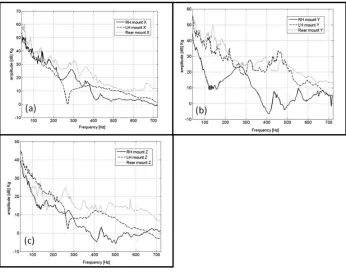
Virtual mass (H2 ,j) for the same mount is shown
in Fig. 8, and the Body transfer function (H3,j) in different directions is shown in Fig. 9.
Having the required data, the share of each path at each frequency can be calculated by equation (5).
546 Vehicle Interior Vibration Simulation……
Fig7.Mount transmissibility of RH mount
Fig8.Virtual mass at RH mount
Fig9.Body transfer function at RH mount
B.Sakhaei and M.Durali 547
Multiplication of mount transmissibility and mount virtual mass will yield the real mount dynamic stiffness (F/a). Measurement of this mount dynamic stiffness in lab conditions cannot be done precisely because real conditions of temperature and preload cannot be applied. The resultant dynamic mount stiffness of RH mount in each three directions are shown in Fig. 10. The overall trend of the mount stiffness shows a decrease with frequency which is typical for rubber mounts.
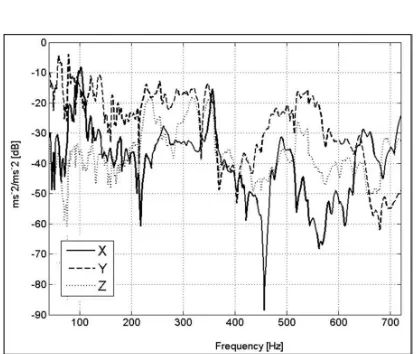
The overall structural transmission frequency response function which results from multiplication of mount transmissibility, mount apparent mass and body transfer function is shown in Fig. 11. It can clearly be seen that overall vibration transmission acts
like a low pass filter diminishing the vibration power at higher frequencies.
By multiplying the overall transfer function to engine vibration spectrum at each engine rpm, the vibrations at target point will be derived.
Fig. 12 shows the overall vibration and the different shares of the three engine mounts. As the graph shows, the maximum share belongs to RH and LH mounts. The rear mount share is small at lower engine speeds but it grows rapidly with engine speed. This can be explained by the behaviour of the stoppers on this engine mount. The stoppers come to action when the mount is compressed more than a certain value. This causes a drastic growth in overall mount stiffness.
Fig10. Dynamic stiffness of RH mount
Fig11. Overall transfer function of RH mount transfer path
548 Vehicle Interior Vibration Simulation……
International Journal of Automotive Engineering Vol. 3, Number 4, Dec 2013
Fig12. Different shares and overall
Fig13. measured and VIVS simulation of vibration at target point
The overall vibration magnitude which is simulated by VIVS and also measured vibration at target point during engine run up are shown in Fig. 13. This result can be used as a verification tool of the method. As it can be seen, there is a good correlation between the VIVS results and the measured vibration magnitudes. Although a general correlation exists between VIVS results and measurements, there are some differences between these two graphs especially at two resonance peaks of 2000 and 2500 rpm. Differences like this come from the assumption of linear body transfer function that has been adopted in this method. This avoids the local damping effect of the target point (sensor location) to be seen.
In the next part of this paper the engine mounting system has been modified related to this baseline condition.
5. Modification to the engine mounting system
a. Adding mass to RH mount
The virtual mass comparisons of different mounts show that the virtual mass of RH mount is significantly lower than the others (Fig. 14).
As a first modification, a concentrated mass is added to RH mount by screwing a steel block of about 1 Kg to engine mount location on the chassis.(Fig. 15)
The operational vibrations, virtual mass and body transfer function were again measured. Fig. 16 shows the different shares of paths due to this modification.
B.Sakhaei and M.Durali 549
Fig14. Virtual mass of different mounts
Fig15. Concentrated mass on RH mount location
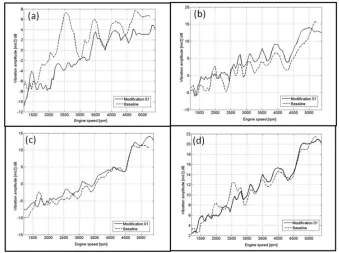
Fig. 17: compares shares of each mount to its baseline after the application of this modification.
As it can be seen the sharp peak behaviour at 2500 rpm has been improved, however some adverse effects are observed at the other two mounts. This shows that vibration energy has moved from RH mount to the other two mounts. Thus the overall amplitude has not changed significantly. This
modification has actually eliminated the peaks at 2000 and 2500 rpm at RH engine mount (Fig. 17-d).
b) Softening the LH mount
Based on the results of Fig. 16, the LH mount vibration share is higher than the two others. Examining the graph of mount dynamic stiffness, it is
550 Vehicle Interior Vibration Simulation……
International Journal of Automotive Engineering Vol. 3, Number 4, Dec 2013 perceived that the dynamic stiffness of this mount
especially in Y direction can be responsible for this high share. Therefore it was proposed to soften the LH mount by reducing the mount dynamic stiffness. To evaluate the idea without mount prototyping; four elastic rubber washers were bounded to the mount
metal base and the assembly was utilized as a softened mount.
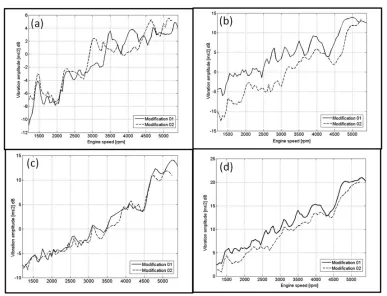
Vehicle interior vibration simulation and the related tests were again performed and the results of Fig. 18 were achieved. The results show the overall calculated vibration level of target point has decreased up to 3 dB in comparison to modification a.
Fig16. Different shares and overall of modification 01
Fig17. Comparison of shares between two cases of with (modification 01) and without concentrated mass (baseline); (a): RH mount, (b): LH mount, (c): Rear mount, (d): Overall
B.Sakhaei and M.Durali 551
Fig18. Comparison of shares between two cases of adding concentrated mass (modification 01) and soft LH mount (modification 02); (a): RH mount, (b): LH mount, (c): Rear mount, (d): Overall
Fig19. Measured vibration at target point comparison between soft LH mount (modification 02) and concentrated mass (modification 01)
Fig. 19 shows the comparison of the measured vibration levels for original and softened LH mount.
The magnitude of softening was evaluated by compression test on both parts. The test showed 20% decrease of static stiffness in X and Y directions and 40% in Z direction.
6. Side effect of the modifications
The modification b seems to be effective in reducing the interior vibration level, but softening of this part can have some side effect on the engine
552 Vehicle Interior Vibration Simulation……
International Journal of Automotive Engineering Vol. 3, Number 4, Dec 2013 dynamic behaviour in rapid manoeuvres. The
movement of the powertrain due to harsh manoeuvres has to be taken in to account to avoid undesirable contact of powertrain and body shells. A model of vehicle including suspension system, powertrain unit and engine mounting system was created in ADAMS view software. The engine c.g. point movements caused by the following manoeuvres were calculated:
Braking First gear move Reverse gear move
Idiot start Left cornering Right cornering Road bump.
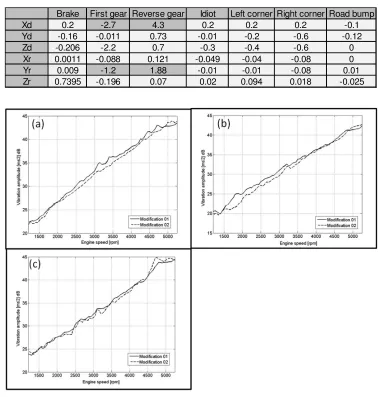
Table (1) shows a comparison between the two cases of engine with original and the softened LH mount. The original case analysis was performed by original engine mount stiffness and the second case was performed with modification 2 on stiffness of gearbox mount.
Table (1): Differences of displacement of the powertrain c.g. in two cases of baseline and modification 02 due to extreme manoeuvres
Fig20. Comparison of vibration amplitudes at engine mount locations on engine between modification a and b cases;
(a): RH mount, (b): LH mount, (c): Rear mount
Brake First gear Reverse gear Idiot Left corner Right corner Road bump
Xd 0.2 -2.7 4.3 0.2 0.2 0.2 -0.1
Yd -0.16 -0.011 0.73 -0.01 -0.2 -0.6 -0.12
Zd -0.206 -2.2 0.7 -0.3 -0.4 -0.6 0
Xr 0.0011 -0.088 0.121 -0.049 -0.04 -0.08 0 Yr 0.009 -1.2 1.88 -0.01 -0.01 -0.08 0.01 Zr 0.7395 -0.196 0.07 0.02 0.094 0.018 -0.025
B.Sakhaei and M.Durali 553
The results show, the maximum difference of c.g. movement of the powertrain occurs in reverse gear condition which is about 5 mm. This magnitude of displacement is not critical for powertrain packaging in the test vehicle and undesirable contact of engine and vehicle body does not occur.
Another side effect check is done regarding the maximum accelerations that the engine components tolerate due to change in mount stiffness. The engine side acceleration is an important factor in accuracy and durability of the electronic components of engine. The engine side acceleration on engine mount locations during engine run up for the two modification (a and b) was also measured and compared.
Fig. 20 shows the comparison of the measured acceleration of different mounts on engine side. As the graphs shows, the engine vibration amplitude at three engine mounts by softening the LH mount (modification b) insignificantly differ from modification a. This results shows that the accelerations on the engine side does not change meaningfully when the stiffness rate of the mount changes. Consequently as an important result it can be said that the mount stiffness has a minor effect on the engine side accelerations. Thus the input accelerations in basic equation of VIVS (equation (1)) is independent of mount stiffness.
7. Conclusion
A tool for vehicle interior vibration simulation has been introduced in detail. The effectiveness of the method on NVH of the vehicle interior and engine mount system optimization has been shown. Compared to the classical TPA methods, the proposed method shows to be stronger and more accurate, while calculation speed and execution simplicity have also been improved. The VIVS method proposed in this paper has the following advantages:
Compared to previous TPA methods, VIVS requires less measurement effort, hence reducing cost and experiment time in industrial applications.
By this TPA method, a complete study can be performed on the responsible NVH transfer functions from engine mount locations to target points. This can help an NVH specialist to investigate the paths in more details and focus on the critical paths.
Mount dynamic stiffness is a valuable data that can be obtained from this method. Measuring this parameter in real temperature and preloading conditions in test labs is not possible.
The method does not have the numerical difficulties of pseudo matrix inversion of some previous methods.
The internal vibrations of the vehicle compartment can be a representative of structural borne noise as the internal vibrations of body shells can produce sound. Thus the results of the VIVS can be used in structural borne noise estimations. Therefore it can avoid expensive structural borne noise tests in anechoic chambers.
From the engine mount optimization point of view, the body vibrations signals are more effective and more noiseless than structural borne signals, because the body vibrations come mainly from the engine mount excitations, but the structural borne signals may be mixed with noise and effects of other parts like dashboard or vehicle trim.
The following topics are planned to be done following this research work:
The assumption of linear time invariance of the paths has to be investigated in detail via in situ measurements supported by the numerical simulations.
The operational measurements were done when only the 3rd gear was engaged. A comprehensive work has to be done to study the effect of different gears on the vibration paths.
Acknowledgement
Authors would like to express their appreciation to Iran Khodro Powertrain Company (IPCO) for its financial and test equipment support of this research work.
554 Vehicle Interior Vibration Simulation……
International Journal of Automotive Engineering Vol. 3, Number 4, Dec 2013 References
[1]. Jassens K, Gajdatsy P, Gielen L, Mas P, Van der Auweraer H. A Novel Transfer Path Analysis Method Delivering a Fast and Accurate Noise Contribution Assessment. SAE, 2009.
[2]. Lee SK. Identification of a vibration transmission path in a vehicle by measuring vibrational power flow. Proceedings of the Institution of Mechanical Engineers, Part D: Journal of Automobile Engineering. 2004; 218: 167-75.
[3]. Auweraer HVd, Mas P, Dom S, Vecchio A, Jassens K, Van de Ponseele P. Transfer Path Analysis in the Critical Path of Vehicle Refinement: The Role of Fast, Hybrid and Operational Path Analysis. SAE2007.
[4]. Bendat JS, Piersol AG. Engineering applications of correlation and spectral analysis. New York, Wiley-Interscience, 1980 315 p. 1980; 1. [5]. Han X, Guo YJ, Zhao YE, Lin ZQ. The
application of power-based transfer path analysis to passenger car structure-borne noise. Proceedings of the Institution of Mechanical Engineers, Part D: Journal of Automobile Engineering. 2008; 222: 2011-23.
[6]. Janssens K, Gajdatsy P, Gielen L, et al. OPAX: A new transfer path analysis method based on parametric load models. Mechanical Systems and Signal Processing. 25: 1321-38.
[7]. 7. Guo R, Qiu S, Yu Q-l, Zhou H, Zhang L-j. Transfer path analysis and control of vehicle structure-borne noise induced by the powertrain. Proceedings of the Institution of Mechanical Engineers, Part D: Journal of Automobile Engineering. 226: 1100-9.
[8]. Verheij JW. Multi-path sound transfer from resiliently mounted shipboard machinery: Experimental methods for analyzing and improving noise control. 1982.
[9]. De Vis D, Hendricx W. Development and integration of an advanced unified approach to structure borne noise analysis. INTER-NOISE and NOISE-CON Congress and Conference Proceedings: Institute of Noise Control Engineering, 1992, p. 561-4.
[10]. Wyckaert K, Augusztinovicz Flp, Sas P. Vibroâ€گacoustical modal analysis: Reciprocity, model symmetry, and model validity. The Journal of the Acoustical Society of America. 1996; 100: 3172.
[11].. Fahy FJ. The vibro-acoustic reciprocity principle and applications to noise control. Acta
Acustica united with Acustica. 1995; 81: 544-58.
[12].Blau M. Indirect measurement of multiple excitation force spectra by FRF matrix inversion: influence of errors in statistical estimates of FRFs and response spectra. Acta Acustica united with Acustica. 1999; 85: 464-79.
[13].Starkey JM, Merrill GL. On the ill-conditioned nature of indirect force-measurement techniques. Journal of Modal Analysis. 1989; 4: 103-8.
[14].Kretineger TJ. Non-parametric force identification from structural response. Soil Dynamic and Earthquake. 1992: 10.
[15].Van der Linden P, Floetke H. Comparing inverse force identification and the mount stiffness force identification methods for noise contribution analysis. Proc 2004 ISMA Conf, Leuven, Belgium2004.
[16].Devriendt P, Sitter GD, Vanlanduit S, Guillaume P. Operational modal analysis in the presence of harmonic excitations by the use of transmissibility measurements. MSSP. 2008. [17].Jassens K, Gajdatsy P, Van der Auweraer H.
Operational Path Analysis: a critical review. LMS: LMS, 2007.
[18].Sitter GD, Deveriendt C, Guillaume P, Pruyt E. Operational transfer path analysis. MSSP. 2008. [19].Jassens K, Gajdatsy P, Gielen L, Mas P, Van
der Auweraer H. A novel path contribution analyis method for test based NVH trouble shooting. LMS, 2009.
[20].Jassens K, Gajdatsy P, Gielen L, Mas P, Van der Auweraer H, Desmet W. A Novel TPA Method Using Parametric Load Models: Validation on Experimental and Industrial Cases. SAE, 2009.
[21]..Alt N, Wiehagen N, Schlitzer MW. Interior noise simulation for improved vehicle sound. Proceedings of the SAE. 2001; 1.
[22].Brown J.C., Robertson J.A, Motor vehicle structures: Concepts and fundamentals, Butter worth Heinemann, 2002