
The External Determinants of Inflation:
The Case of Iran
Abdolnaser Hemmati1, Leili Niakan2, Vida Varahrami*3
Received: 2017, August 15 Accepted: 2017, October 22
Abstract
he study of determining the factors affecting inflation or consumer price index has been conducted by many macroeconomic economists nationally as well as internationally. In this paper, we assess the external determinants of inflation dynamics in Iran. For this purpose, we use an OLS single equation model and a vector error correction model (VECM). Results of the analysis reveal that money supply, exchange rate, import price index and intensification of sanctions are contributed in raising general price index in the long run. Long-run elasticity of inflation with respect to money supply, exchange rate, effective tariff and import price index are 0.25, 0.118, 0.087 and 0.71. Moreover, in every year that the severity of sanctions has increased, inflation increases with amount of 0.084 (or 8.4%).Results of OLS single equation model show that only 21% of the domestic inflation variance in short run is explained by the independent variables. Iran's inflation is driven mostly by exchange rate (with one season lag) and effective tariff (with two seasons lag).
In the short run, the coefficient of error correction term is -0.13 suggesting 13 percent annual adjustment towards long run equilibrium. General Price index of last year and unit price of imported goods of two years before are found to be positively related with general price index. Keywords: Inflation, External Determinants, Exchange Rate, Effective Tariff.
JEL Classification: E31, E52, E58. 1. Introduction
Inflation means continuous rise in general price level of the economy. Inflation is process in which the price index is rising and money is
1. Faculty of Economics, University of Tehran, Tehran, Iran ([email protected]). 2. Insurance Research Center, Tehran, Iran ([email protected]).
3. Faculty of Economics, Shahid Beheshti University, Tehran, Iran (Corresponding Author: [email protected]).
losing its value. The issue of inflation takes primary importance in Iran as the rising inflation has far reaching economic and social implications. Due to higher price level, people need more money to make day to day transactions and every consumer have to carry more money with them as value of money declines.
The determinants of inflation can be split into two main categories: external and domestic factors. This paper assesses the external determinants of inflation dynamics in Iran using an OLS single equation model and a vector error correction model. In these models, various regressions are performed to obtain the benchmark regression for short term representation. The period assessed is first quarter 1999- fourth quarter 2014, highlighting the evolution of inflation under sanction external shock in a framework of monetary policy regime.
At follow, in part2 literature review, in part3 methodology and data, in part4 results and in part5 conclusion are presented.
2. Literature Review
Study of determining the factors affecting inflation or consumer price index has been conducted by many macroeconomic economists nationally as well as internationally. These all are different from each other either from country to country, sample size, time period or from selection of variables. Iran has had a high and volatile rate of inflation in recent years. Almost all of recent studies which are done about determinants of inflation in Iran are concentrated in internal factors and often few numbers of external factors are brought with them. No study was concentrated on external determinants of inflation specifically till now in Iran.
In general, it can be said that the literature in the field of measuring inflation dynamics is wealthy and various. There are many studies that examine inflation determinants in developing countries. For example, Arratibel et al. (2002) examined inflation dynamics in EU between 1990 and 2001 with respect to determinants of "dual inflation" and estimated inflation rates for tradable and non-tradable goods.
The issue of Iranian inflation dynamics is also present in various studies;
relationship between inflation and its determinants for periods from 1959 to 2002 used Vector Auto Regressive method with spread lags. Results showed that production, import price index, liquidity and exchange rate are the variables affecting inflation in the Iranian economy. The model estimates the long run effects of a percentage change in each of these variables on the general price level equal to -0.37, 0.5, 0.34 and 0.27.
Esmaeelzadeh (2005) investigated the relation between investment and inflation. His test results indicated that the relationship between import and export with inflation is positive, and investment and inflation have a negative relation.
Hoseininasab and Gholizadeh (2010) analyzed relationship between inflation and fiscal factors with emphasis on the role of the budget deficit over the period of 1352 to 1386. Results of this study suggested that fiscal factors such as revenues of oil export and the budget deficit are caused inflation increase, while economic growth is partly caused inflation inhibition.
Shakeri et al. (2015) investigated the determinants of inflation in the period 1960- 2011 and used from autoregressive model (VAR). In this study due to the structure of the Iranian economy, the mark-up index is derived and its growth along with liquidity growth, nominal exchange rate growth and productivity growth are used in the model. The results of Granger causality test show one-way causal relationship between the three variables of mark-up growth, exchange rates growth and labor productivity growth in one hand and inflation on the other hand, as well as two-way causal relationship between money growth and inflation. Also impuls response functions confirm a negative relationship between labor productivity growth and inflation. Moreover, based on the analysis of impulse response functions of three variables of mark-up growth, liquidity growth and exchange rate growth, they are positively correlated with inflation. Variance decomposition showed that each of the variables of inflation, mark-up growth and labor productivity growth in the short-term and respectively with the shares of 45, 29 and 25 percent, have the highest explanation on inflation forecast variance.
A Markova switching model has been used for modeling and estimating inflation. Results indicated that Inflation has two regimes of high and low inflation. The probability of staying in high inflation regime is about 0.65 and the probability of staying in low inflation regime is 0.94. Also, the probability of transition from high inflation regime to low inflation regime is about 0.35. Furthermore, the probability of transition from low inflation regime to high inflation regime is about 0.06. Also, Unemployment has a significant negative impact on inflation in high inflation regime that indicates the existence of Philips-Curve in this regime. Finally, the growth of money supply and the first lag of inflation have a significant positive impact on inflation.
In other countries, Almounsor (2010) studied the underlying determinants of inflation dynamics in Yemen using a single equation model, a SVAR model and a VECM model. His findings showed that international price shocks, exchange rate depreciation, domestic demand shocks, and monetary innovations explain much of the variation in inflation.
Bogdan and Iulian (2012) suggested that inflation in Romania is driven mainly by international price shocks (harmonized CPI of EU-25 countries), and EUR/RON exchange rate depreciation has a small influence on domestic inflation. In the short run, the effect of international oil price was significant.
Chavoshzadeh Tafti (2012) measured and analyzed the determinants of inflation in Islamic Republic of Iran. After briefly reviewing the theoretical background, she used Johansen and Juselius maximum likelihood method, purpose, Impulse Response Functions (IRF) and Forecast Error variance Decomposition (FEVD). Results showed that response of the consumer price index (CPI) to shock in GDP is too weak and response of CPI to shocks in import price index and liquidity is initially positive.
3. Methodology and Data
In this paper, we try to assess the main external determinants of inflation dynamics in Iran. For this purpose, the data series of general price level as dependent variable, the data series of exchange rate (number of rials per dollar), effective tariff (the ratio of import tax to total import for goods), the unit price of imported goods (the value of import to volume of import), import price index, dummy variable for intensification of sanctions as independent variables are used. To increase the robustness of our model, we use M2 monetary aggregate (intermediate money supply) as a control variable. This empirical analysis uses quarterly data from 1999 to 2014and controls for exogenous shocks. We will use data series from the Central Bank of Iran and Iran Trade Promotion Organization Statistics databases.
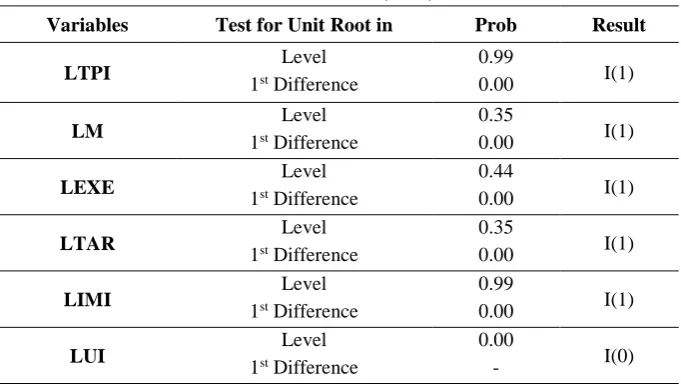
All data series are transformed as natural logarithms. We test the data with the ADF unit root test and results show that all the series (except the unit price of imported goods) are first order integrated. Consequently, their first differences are stationary and there is a long run relation between them.
Table 1: Unit Root Test (ADF) Results
Variables Test for Unit Root in Prob Result
LTPI Level
1st Difference
0.99
0.00 I(1)
LM Level
1st Difference
0.35
0.00 I(1)
LEXE Level
1st Difference
0.44
0.00 I(1)
LTAR Level
1st Difference
0.35
0.00 I(1)
LIMI Level
1st Difference
0.99
0.00 I(1)
LUI Level
1st Difference
0.00
- I(0)
3.1 OLS Single Equation Model
regression techniques. In this model, various regressions are performed to reach the benchmark regression with the best fit and predictability. Using OLS regressions, study relates inflation to a set of independent variables in short term as follows:
Δp= α + 𝛽0 Δxt + 𝜙 z + εt (1)
Where Δpis the first difference of the CPI, x is a vector of independent time-varying variables, z is a set of binary variables controlling for exogenous shocks, and ε is error term. In this model, coefficients are interpreted as elasticity.
The long term relation between inflation and other integrated variables is expressed as follows:
p= α + 𝛽0 xt + 𝛽1 z + εt (2)
Then, we base our research on below models: Long Term Model:
ltpi= α + β1 lm + β2 lexe + β3 ltar + β4 limi + β5sa + εt (3)
Short Term Model:
dltpi= α + β1 dlm + β2 dlexe + β3 dltar + β4 dlui + β5sa + εt (4)
where "d" is the difference operator, "ltpi" is the natural logarithm of general price index, "lexe" is the natural logarithm of exchange rate, "lm" is the natural logarithm of money supply, "limi" is the natural logarithm of import price index, "ltar" is the natural logarithm of effective tariff, "lui" is the natural logarithm of the unit price of imported goods, and "sa" is a dummy variable controlling for intensification of sanctions that takes the value of one for 2010-2012 period.
3.2 Vector Error Correction Model (VECM)
A vector error correction model is a restricted vector autoregressive (VAR) designed for use with non-stationary series that are known to be co-integrated. It may be tested for co-integration using an estimated VAR object.
so that it restricts the long run behavior of the endogenous variables to converge to their co-integrating relationships while allowing for short run adjustment dynamics. The co-integration term is known as the error correction term (speed of adjustment) since the deviation from long run equilibrium is corrected gradually through a series of partial short run adjustments. Short run equation is given as below:
𝛥𝑙𝑡𝑝𝑖 = 𝑎0+ ∑𝑞𝑗=1𝑎1𝛥𝑙𝑡𝑝𝑖𝑡−𝑗+ ∑𝑞𝑗=0𝑎2𝛥𝑙𝑚𝑡−𝑗+ ∑𝑞𝑗=0𝑎3𝛥𝑙𝑒𝑥𝑒𝑡−𝑗+
∑𝑞𝑗=0𝑎4𝛥𝑙𝑡𝑎𝑟𝑡−𝑗+ ∑𝑞𝑗=0𝑎5𝛥𝑙𝑢𝑖𝑡−𝑗+ ∑𝑗=0𝑞 𝑎6𝛥𝑙𝑖𝑚𝑖𝑡−𝑗+ ∑𝑞𝑗=0𝑎7𝛥𝑠𝑎 + 𝛹𝐸𝐶𝑀𝑡−1+ 𝜀𝑡 (5)
Where, Δ is difference operator, q is chosen lag length, a’s are parameters, Ψ is error correction term or speed of adjustment term (calculated from long run results) and ε is error term.
4. Results
4.1 Results for OLS Single Equation Model
Results of equation (3) estimation, long term model estimation, are shown as below:
ltpi= -3.11 + 0.25 lm + 0.118 lexe + 0.087 ltar +0.71limi+ 0.084 sa (6) (-3.11) (5.2) (1.73) (1.605) (6.38) (3.09) R2=0.94
Prob (F-statistic) = 0.00
Estimation results show that there is a meaningful long-run relationship between variables in the model. Values in parentheses represent the t-student statistics. It is noted that the estimated coefficients except coefficient of natural logarithm of effective tariff are significant at least at the 10 percent level of confidence. Based on the values of coefficients, it can be said that long-run elasticity of inflation with respect to money supply, exchange rate, effective tariff and import price index are 0.25, .118, 0.087 and 0.71. Moreover, in every year that the severity of sanctions has increased, inflation increases with amount of 0.084 (or 8.4%).
ltpit= 0.034 + -0.076lmt-1 + 0.024lexet-1 + 0.015ltart-2 + -0.017luit-1
+ 0.01 sa (7) (13.45) (-1.5) (1.78) (1.63) (-1.64) (1.6) R2 = 0.62
Values in parenthesis are the t-student statistics, t-1 states one season lag and t-2 states two seasons lag. Results of equation (7) show that only 21% of the domestic inflation variance in short run is explained by the independent variables. Iran's inflation is driven mostly by exchange rate (with one season lag) and effective tariff (with two seasons lag). A 1 percent increase in exchange rate and effective tariff are followed by a 2.4 and 1.5 percent increase of the next season and two seasons later domestic inflation.
The outcomes of the single equation model show that Iran’s inflation in short run is driven mostly by national (internal) factors and external factors can explain it only partially. But external factors have plausible explanation for inflation in long run.
4.2 Results for Vector Error Correction Model (VECM)
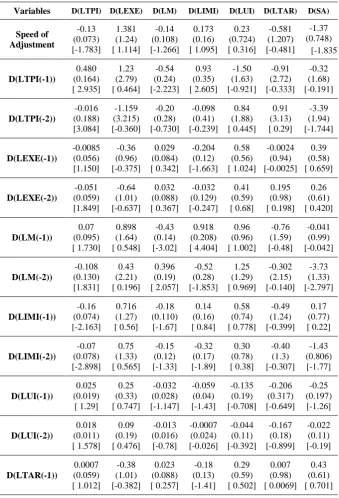
Table 2 discusses the short run results using vector error correction model. Values without brackets are short run coefficients, values in round brackets are showing standard errors and square brackets are denoting t – statistics. The most important thing in the short run results is speed of adjustment term. It shows that how much time would be taken by the economy to reach at long run equilibrium. Negative sign of speed of adjustment term shows that the economy will converge towards long run equilibrium after taking 13 percent annually adjustments in the short run and the value of coefficient is statistically significant.
exerting negative influence on import price index of current year. Money supply and general price index of last year have positive, significant effect on import price index of current year.
Table 2: Vector Error Correction Short Run Results
Variables D(LTPI) D(LEXE) D(LM) D(LIMI) D(LUI) D(LTAR) D(SA)
Variables D(LTPI) D(LEXE) D(LM) D(LIMI) D(LUI) D(LTAR) D(SA) D(LTAR(-2)) -0.033 (0.06) [-1.55] -0.68 (1.03) [-0.657] 0.039 (0.07) [ 0.43] -0.04 (0.13) [-0.34] 0.60 (0.60) [ 0.99] 0.20 (1.004) [ 0.197] 0.23 (0.63) [ 0.363] D(SA(-1)) 0.003 (0.016) [ 1.144] -0.034 (0.22) [-0.126] -0.015 (0.023) [-0.64] 0.006 (0.034) [ 0.17] 0.037 (0.16) [ 0.235] 0.038 (0.26) [ 0.146] -0.06 (0.16) [-0.39] D(SA(-2)) 0.001 (0.015) [ 2.069] -0.039 (0.26) [-0.15] -0.02 (0.02) [-0.86] 0.014 (0.03) [ 0.44] 0.18 (0.15) [ 1.19] 0.039 (0.25) [ 0.15] -0.011 (0.16) [-0.07] CONSTANT 0.028 (0.015) [ 1.837] -0.069 (0.25) [-0.27] 0.096 (0.02) [ 4.387] -0.019 (0.032) [-0.58] -0.14 (0.15) [-0.92] 0.076 (0.25) [ 0.306] 0.40 (0.15) [ 2.615] R2 Adj-R2 F-Statistic 0.51 0.292 2.32 0.95 0.315 0.232 0.59 0.41 3.23 0.68 0.54 4.78 0.44 0.48 1.72 0.62 0.36 0.146 0.25 0.38 0.750 5. Conclusions
This paper carries out long run as well as short run estimates of external factors influencing general price index (inflation) in Iran. Results of the analysis reveal that money supply, exchange rate, import price index and intensification of sanctions are contributed in raising general price index in the long run.
Long-run elasticity of inflation with respect to money supply, exchange rate, effective tariff and import price index are 0.25, .118, 0.087 and 0.71. Moreover, in every year that the severity of sanctions has increased, inflation increases with amount of 0.084 (or 8.4%).
Results of OLS single equation model show that only 21% of the domestic inflation variance in short run is explained by independent variables. Iran's inflation is driven mostly by exchange rate (with one season lag) and effective tariff (with two seasons lag). A 1 percent increase in exchange rate and effective tariff are followed by a 2.4 and 1.5 percent increase of the next season and two seasons later domestic inflation.
References
Almounsor, A. (2011). Inflation Dynamics in Yemen: An Empirical Analysis. IMF Working Papers, Retrieved from
https://www.imf.org/external/pubs/ft/wp/2010/wp10144.pdf.
Arratibel, O., Rodriguez-Palenzuela, D., & Thimann, C. (2011). Inflation Dynamics and Dual
Inflation in Accession Countries: A New Keynesian Perspective.
SSRN E-Library, Retrived from zentral-
bank.eu/pub/pdf/scpwps/ecbwp132.pdf.
Bashawir, A., Mahyudin, E., & Manickam, N. (2017). Determinants of Factors that Affecting Inflation in Malaysia Rabiul Islam.
International Journal of Economics and Financial, 7, 355-364.
Bogdan, C., & Iulian, I. (2012). External Factors Influence on Inflation: The Case of Romania. European Social Fund. Retrieved from https://core.ac.uk/download/pdf/6272850.pdf
ChavoshzadehTafti, F. (2012). Determinants of Inflation in Islamic Republic of Iran. International Journal of Business and Social Science, 3, Retrieved from
ijbssnet.com/journals/Vol_3_No_6_Special_Issue_March_2012/24.pdf.
Esmaeelzadeh, M. (2005). Study the Total Investment Effects on Inflation in Iranian Economy. Journal of Economic Research, 8, 12-15.
Hoseininasab, E., &Gholizadeh, R. (2010). Assessing Fiscal Roots of Inflation in Iran (with Emphasis on Budget Deficit. Journal of
Economic Research, 5, 20-25.
Masoodi, F., & Tashkini, A. (2005). Experimental Analysis of Inflation in Iranian Economy. Quarterly Journal of Commerce, 36, Retrieved from
Mohammadi, M., & Heidarpour, E. (2017). Modeling Inflation in Iran: Markov Switching Approach. International Journal of Economic
Papers, 2, Retrieved from www.rwi-
essen.de/media/content/pages/.../ruhr-economic-papers/rep_17_710.pdf.
![Oxidation of cyclic amines by molybdenum(II) and tungsten(II) halocarbonyls, [M(CO)4X2]2 (M = Mo, W; X = Cl, Br)](data:image/gif;base64,R0lGODlhAQABAIAAAP///wAAACH5BAEAAAAALAAAAAABAAEAAAICRAEAOw==)