ECONOMICS & MARKETING
Improving Cotton Returns Using Nematicides
in Northwestern Florida Fields Infested with Root-Knot Nematode
David J. Zimet, John L. Smith,* Robert A. Kinloch and James R. Rich
INTERPRETIVE SUMMARY
Cotton is a major agronomic crop in the northern tier of counties in Florida. The southern root-knot nematode is found in 61% of Florida cotton fields. This pest can be managed by nematicides, crop rotation, or a combination of the two. Rotation out of cotton is not feasible for many growers because of fixed cost constraints (equipment) and lower returns from other crops. For the many who monoculture cotton, nematicides are the only viable management option. Nematicides currently recommended by the University of Florida are aldicarb and 1,3-D. The objective of this research was to determine optimum application rates for the two nematicides on the basis of lint yield increase and partial net return.
Four field experiments to determine lint yield increases and economic returns at four rates of 1,3-D and five rates of aldicarb were conducted over a 3-yr period in four separate northwest Florida locations. Crops were managed in accordance to best management practices published by the University of Florida Extension Program. Phorate was added to the 1,3-D tests and non-treated checks for thrips management at a rate of 0.67 kg a.i. ha-1 (kilogram
active ingredient per hectare). Aldicarb functions as its own thrips-control agent. For all rates of both nematicides, cotton lint yields were numerically greater than the non-treated checks. The mean lint yield increase for all rates of 1,3-D was 216 kg ha-1
or 45%. The mean lint yield increase for aldicarb was 91 kg ha-1 or 18.5%. Mean lint yields increased
with increasing application rates of 1,3-D up to an application rate of 48 kg a.i. ha-1. Mean lint yields of
the different aldicarb rates were all numerically
larger than the non-treated checks but only a few were significant at P & 0.05.
Economic benefits of the two nematicides were substantially different for their respective optimum application rates. Partial net returns of 1,3-D increased up to an application rate of 42 kg a.i. ha-1
($183) and declined thereafter. Net returns declined at greater application rates because of increased costs of 1,3-D. Partial net returns at the different aldicarb rates increased to a maximum of $83 ha-1
for the 1.18 kg a.i. ha-1 rate and then declined for the
same reasons.
ABSTRACT
The root-knot nematode (Meloidogyne incognita) is a serious pest of cotton (Gossypium hirsutum L.), occurring in 61% of all of Florida’s cotton fields. It can be managed by crop rotation, the use of nematicides, or a combination of both practices. Crop rotation is not an option for many growers because of the relatively low prices of other agronomic crops, leaving nematicides as the only viable pest-management option. The objective of this research was to determine the optimum application rate of each of the two nematicides-1,3-D (1,3-dichloropropene) and aldicarb {2-methy l-2-(methy lthio)propanal O-[(methylamino)carbonyl]oxime}-recommended for use in Florida cotton with respect to lint yield increase and economic return associated with the use of nematicides to improve lint yields (partial net return). Lint yields and partial net returns were evaluated on cotton grown in root-knot nematode-infested loamy sand soils in northwestern Florida at four separate test sites. Varying application rates of the nematicides were tested at each site and compared with a non-treated check. Both nematicides had numerically greater lint yields and partial net returns relative to the non-treated checks. Both lint yield and partial net return were increased more by 1,3-D than by aldicarb,. These data indicate the need for a grower to evaluate the use of nematicides for improving economic returns and increasing lint yield.
U
pland cotton (Gossypium hirsutum L.) is a major agronomic crop in the northern tier of counties in Florida with an estimated harvest of 37,000 ha in 2000 (USDA-FASS, 2001). The D.J. Zimet, J.L. Smith, and J.R. Rich, Univ. of Florida,southern root-knot nematode (Meloidogyne
incognita [Kofoid & White] Chitwood) is found in
61% of Florida cotton fields (Kinloch and Sprenkel, 1994). This pest is managed by nematicides, rotation, or a combination of the two practices since nematode-resistant cultivars are not agronomically adapted to Florida (Kinloch and Rich, 2000). Rotation out of cotton is not feasible for many growers because of fixed cost constraints associated with equipment and lower returns from other agronomic crops, leaving nematicides as the only viable management option for growers who monoculture cotton. The two primary nematicides used and recommended in Florida are 1,3-D and aldicarb (Kinloch and Rich, 2000). Nematicide recommendations for root-knot nematode management in Florida cotton include single chisel row applications of 1,3-D at 32 kg a.i. ha-1 or 10- to
15-cm-wide banded applications of aldicarb at 1.18 kg a.i. ha-1. These recommendations are based solely
upon improvement in cotton yield in fields infested with M. incognita. Data concerning the value of economic returns of nematicides are lacking. This study was conducted to determine the best economic value for growers using 1,3-D and aldicarb. Incremental costs per kilogram of increased lint yield due to nematicide addition, net returns per kilogram of increased lint yield, and partial net returns per hectare were calculated for the different treatments (Boehlje and Eidman, 1984). The optimum treatment rate, based on partial net return, was calculated for each nematicide.
MATERIALS AND METHODS
A 3-yr nematicide study involving four separate test sites, all in typical commercial fields naturally infested with Meloidogyne incognita was conducted on a loamy, siliceous, thermic Grossarenic Paleudults soil (USDA-NRCS, 2001) in northwest Florida. Three of the sites were in loamy sands (82% sand, 8% silt, 6% clay) in Santa Rosa County with the fourth site in a loamy sand (85% sand, 6% silt, 9% clay) in Jackson County. Four rates of 1,3-D and five rates of aldicarb were used in these tests. Each treatment was replicated five times in the Jackson County 1995 test and six times in the other three tests. The trials included replicated plots of non-treated checks.
The 1,3-D treatments were applied to randomized plots. The fumigant was applied to a depth of 30 cm via a single chisel using application rates of 16, 32, 48, and 64 kg a.i. ha-1 14 to 17 d
prior to planting. Phorate {O,O-diethyl S-[(ethylthio)methyl] phosphorodithioate} was added to all 1,3-D treatments, including the related non-treated checks, at a rate of 0.67 kg a.i. ha-1 to
manage thrips [Frankliniella occidentalis (Pergande)and F. fusca (Hinds)]. The cost of phorate was $18.23 ha-1 and the application cost was
assumed to be zero since phorate was applied at planting. Lint yield increases, incremental cost calculations, and partial net returns were calculated for 1,3-D treatment rates.
Granular aldicarb was incorporated on a 25-cm-wide band over the open seed furrow at planting using application rates of 0.5, 1.01, 1.18, 1.51, and 2.02 kg a.i. ha-1. Aldicarb application cost was
assumed to be negligible since it was applied at planting. Because aldicarb functions as a thrips-management agent, additional thrips control was not required. Lint yield increases, incremental cost calculations, and partial net returns were calculated for aldicarb treatment rates.
‘Chembrand 407’ cotton was grown in 1995 and ‘Delta Pine 5415 RR’ cotton was grown in 1996 and 1997. In 1995, planting and harvest dates were 25 April and 20 November, respectively, at the Jackson County site and 15 May and 14 November for the 1995 test at the Santa Rosa site. Planting and harvest dates for the 1996 and 1997 tests at the Santa Rosa site were 6 June and 14 November 1996 and 6 May and 20 November 1997, respectively. Soil fertility, weed control, and insect management at all sites were as recommended for the area (Sprenkel, 1995). Seed cotton was harvested from entire plots and lint yield was estimated to be 40%. Information on responses of nematode populations to nematicide treatments are reported elsewhere (Kinloch and Rich, 1998).
application rate of the nematicide plus the cost per application divided by the lint yield increase. Phorate was added at a rate of 0.67 kg a.i. ha-1 to manage
thrips in all of the 1,3-D treatments including the non-treated check. Because phorate was added to the non-treated check, it was not considered as an incremental cost when comparing among 1,3-D treatments only. Phorate cost was considered an incremental cost for 1,3-D when 1,3-D and aldicarb were compared for cost effectiveness because aldicarb requires no thrips-control agent. Net return per kilogram increase is the price per kilogram increase ($1.32 kg-1 for purposes of this analysis)
minus the cost per kilogram increase. Partial net return is the additional return from incremental lint yield due to the treatment effect. It is defined as the net return per kilogram increase in lint yield multiplied by the lint yield increase associated with a given application rate. All partial net returns are expressed on a per-hectare (ha-1) basis.
RESULTS AND DISCUSSION
1,3-D Rates
Mean lint yield increases for the 1,3-D treatments were significantly greater than the non-treated check in the 1995 Jackson County and 1996 and 1997 Santa Rosa County tests (Kinloch and Rich, 2000). The 1995 Santa Rosa test showed no
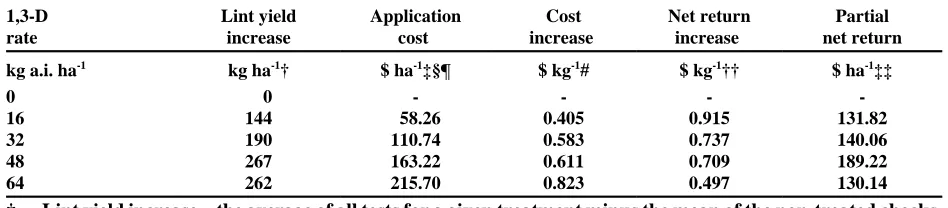
significant yield differences relative to the non-treated check for any of the 1,3-D application rates, however, all of the 1,3-D treatments had a higher numerical lint yield than the non-treated check. Mean lint yield increased by 144 kg ha-1 for the 16 kg a.i.
ha-1 and by 267 kg ha-1 for the 48 kg a.i. ha-1 for the
1,3-D treatments (Table 1). The 64 kg a.i. ha-1
treatment did not show any incremental lint yield increase.
Calculated economic values for 1,3-D included average increase in lint yield, cost per kilogram of incremental lint yield, net return per kilogram increase in lint yield, and partial net return per hectare for each 1,3-D application rate relative to the non-treated check (Table 1). The 48 kg a.i. ha-1
treatment exhibited the highest lint yield, as well as the greatest partial net return (Table 1). The best curve estimate of partial net returns and application rate of 1,3-D was quadratic (SPSS, 1998). The curve suggests that the optimum application rate of 1,3-D is in the range of 38 to 48 kg a.i. ha-1. The
optimum application rate was determined by differentiating the quadratic equation (Allen, 1938) shown in Fig. 1, setting the derivative equal to zero, and then solving for the 1,3-D rate that gave the maximum partial net return. The maximum lint yield increase using this approach was calculated to be 42.4 kg a.i. ha-1of 1,3-D. This rate is somewhat
higher than the 32 kg a.i. ha-1rate recommended in
Florida(Kinloch and Rich, 2000).
Table 1. Increases in lint yield, 1,3-D cost, cost per kilogram, net return per kilogram, and partial net return on cotton grown at different rates of 1,3-D in Meloidogyne incognita-infested soils.
1,3-D rate
Lint yield increase
Application cost
Cost increase
Net return increase
Partial net return
kg a.i. ha-1
kg ha-1
† $ ha-1
द $ kg-1
# $ kg-1
†† $ ha-1
‡‡
0 0 - - -
-16 144 58.26 0.405 0.915 131.82
32 190 110.74 0.583 0.737 140.06
48 267 163.22 0.611 0.709 189.22
64 262 215.70 0.823 0.497 130.14
† Lint yield increase = the average of all tests for a given treatment minus the mean of the non-treated checks. ‡ 1,3-D cost per kilogram = $3.28.
§ 1,3-D is added 14-17 d prior to planting with an application cost of $5.78 ha-1
.
¶ 1,3-D cost increase = 1,3-D cost × 1,3-D treatment rate + 1,3-D application cost. (Phorate was not considered part of the 1,3-D cost increase since it was added to the non-treated check, as well as to each treatment.) # Cost per kilogram increase ($) = application cost increase/lint yield increase.
†† Net return per kilogram increase = $1.32 minus cost per kilogram increase (assumes cotton price of $1.32 kg-1
.)
Fig. 1. A chart of partial net return per hectare at different application rates of 1,3-D. The chart contains the observed partial returns versus rates of addition, as well as a projected quadratic best fit of the observed results.
Fig. 2. Partial net returns per hectare at different application rates of aldicarb. The chart contains the observed partial returns versus rates of addition, as well as a projected quadratic best fit of the observed results.
Aldicarb Rates
Cotton lint yield increase was significantly greater than the non-treated check for the 1.5 kg a.i. ha-1aldicarb rate in the 1997 Santa Rosa County test
(Kinloch and Rich, 1998). The 1995 Jackson County and the 1995 and 1996 Santa Rosa County tests showed no significant increases relative to the non-treated check for any of the aldicarb application rates. Although the lint yield increases relative to the non-treated check were not statistically significant, there were increases in lint yield for all aldicarb
application rates, with the 1.18 kg a.i. ha-1
demonstrating the greatest increase.
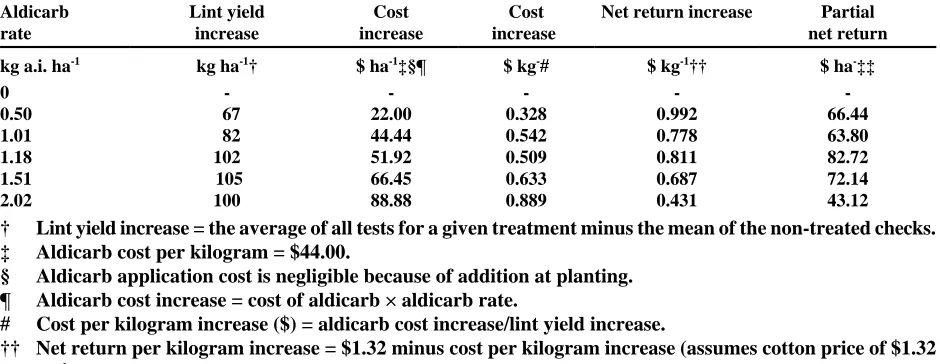
Positive net returns were found for all application rates of aldicarb, with the 1.18 kg a.i. ha-1 application rate having the largest partial net
return at $82.72 ha-1 (Table 2). However, the 0.5 kg
a.i. ha-1 application rate has the lowest cost increase
and thus the highest partial net return per unit of lint yield increase. The curve fit of partial returns relative to aldicarb application rate (SPSS, 1998) is shown in Fig. 2. Like the 1,3-D estimated curve, the curve fit of lint yield and aldicarb rates is quadratic.
Table 2. Increases in lint yield, aldicarb cost, cost per kilogram, net return per kilogram, and partial net return on cotton grown with different rates of aldicarb in Meloidogyne incognita-infested soils.
Aldicarb rate
Lint yield increase
Cost increase
Cost increase
Net return increase Partial
net return
kg a.i. ha-1
kg ha-1
† $ ha-1
द $ kg
-# $ kg-1
†† $ ha
-‡‡
0 - - - -
-0.50 67 22.00 0.328 0.992 66.44
1.01 82 44.44 0.542 0.778 63.80
1.18 102 51.92 0.509 0.811 82.72
1.51 105 66.45 0.633 0.687 72.14
2.02 100 88.88 0.889 0.431 43.12
† Lint yield increase = the average of all tests for a given treatment minus the mean of the non-treated checks. ‡ Aldicarb cost per kilogram = $44.00.
§ Aldicarb application cost is negligible because of addition at planting. ¶ Aldicarb cost increase = cost of aldicarb × aldicarb rate.
# Cost per kilogram increase ($) = aldicarb cost increase/lint yield increase.
†† Net return per kilogram increase = $1.32 minus cost per kilogram increase (assumes cotton price of $1.32 kg-1
).
Differentiation of the curve (Allen, 1938) indicates the optimum aldicarb addition rate is 1.18 kg a.i. ha-1, the rate recommended in Florida (Kinloch and
Rich, 2000).
1,3-D and Aldicarb Comparisons
The additional benefit of thrips management associated with aldicarb must be taken into account in order to compare costs and returns on an equivalent basis. The per-hectare cost of phorate ($18.23) to manage thrips was added to the cost of 1,3-D in Table 3. Costs and returns of 1,3-D rates in Table 3 reflect the additional cost of phorate used to place the two nematicides on an equivalent benefit basis.
CONCLUSIONS
Comparison of lint yield increases, application costs, cost per unit increase, and net returns for 1,3-D with phorate and aldicarb alone show that application costs are substantially higher for 1,3-D with phorate than for aldicarb, adding $76 to $234 ha-1 to the cost (Table 3). The increased lint yield
realized from using 1,3-D, however, more than offsets the higher costs. Partial returns for 1,3-D ranged from $114 to $171 ha-1with the greatest
partial return associated with the 48 kg a.i. ha-1
application rate. The use of a thrips-management agent less costly than phorate may improve the partial net returns of 1,3-D.
Aldicarb had significantly lower chemical costs, $22 to $89 ha-1, but lint yield increases were much
less and partial net returns ranging from $43 to $83 ha-1 were substantially lower than the 1,3-D +
phorate partial net returns. The best partial return of the various aldicarb treatments was associated with the 1.18 kg a.i. ha-1 application rate. Partial net
returns for both nematicides showed that 1,3-D with phorate yields superior partial net returns to aldicarb in all cases (Table 3).
Partial net returns and lint yield increases clearly favor the use of 1,3-D combined with phorate over aldicarb to manage M. incognita in northwest Florida. Further work needs to be performed to reconcile the current 1,3-D recommended treatment rate of 32 kg a.i. ha-1 (Kinloch and Rich, 2000) with
the 48 kg a.i. ha-1 rate that showed the maximum
partial net returns.
ACKNOWLEDGMENTS
Supported in part by Florida grower checkoff funds administered by Cotton Incorporated, Raleigh,
Table 3. A comparison of increases in lint yield, nematicide cost, and partial net return per hectare for different rates of 1,3-D and aldicarb on cotton grown in a Meloidogyne incognita-infested soil.
Nematicide Application
rate
Yield increase
Application cost increase
Revenue increase
Partial net return
kg a.i. ha-1
kg ha-1
$ ha-1
$ ha-1
¶ $ ha-1
#
1,3-D †‡ 0 - - -
-1,3-D 16 144 76.49 190.08 113.59
1,3-D 32 190 128.97 250.80 121.83
1,3_D 48 267 181.45 352.44 170.99
1,3-D 64 262 233.93 345.84 111.91
Aldicarb § 0 - - -
-Aldicarb 0.50 67 22.00 88.44 66.44
Aldicarb 1.01 82 44.44 108.24 63.80
Aldicarb 1.18 102 51.92 134.64 82.72
Aldicarb 1.51 105 66.45 138.60 72.16
Aldicarb 2.02 100 88.88 132.00 43.12
† The cost of phorate ($18.23 ha-1) was added to 1,3-D application costs from Table 1 for thrips management in
order to match aldicarb’s thrips-management benefits.
‡ 1,3-D cost increase = 1,3-D cost ($3.28) × 1,3-D treatment rate + 1,3-D application rate ($5.78) + phorate cost ($18.23).
§ Aldicarb cost increase = cost of aldicarb ($44.00 kg-1) × aldicarb rate.
¶ Revenue increase = $1.32 kg-1 × lint yield increase.
NC, and by the Florida Agricultural Experiment Station.
REFERENCES
Allen, R.G.D. 1938. Mathematical analysis for economists. p. 141. St. Martins Press, New York, NY.
Boehlje, M.D., and V.R. Eidman. 1984. Farm management. p. 237-238. John Wiley and Sons. New York, NY.
Kinloch, R.A., and J.R. Rich. 1998. Responses of cotton yield and Meloidogyne incognita soil populations to soil applications of aldicarb and 1,3-D in Florida. J. Nematol. 30:639-642.
Kinloch, R.A., and J.R. Rich. 2000. Florida cotton nematode management guide. North Florida Res. Ext. Ctr. Ext. Rep. 2000-05. Univ. Florida. Jay, FL.
Kinloch, R.A., and R.K. Sprenkel. 1994. Plant-parasitic nematodes associated with cotton in Florida. J. Nematol. Suppl. 26:749-752.
Sprenkel, R.K. 1995. Cotton production guidelines. North Florida Res. Ext. Ctr, Quincy Extension Report 95-1. Univ. Florida Coop. Ext. Serv., Quincy, FL.
SPSS. 1998. SPSS Base Applications Program. SPSS, Chicago, IL.
United States Department of Agriculture-Florida Agricultural Statistics Service. 2001. USDA-FASS, Orlando, FL. Available at http://www.nass.usda.gov/fl/rtoc0cr.htm.