Strojniški vestnik - Journal of Mechanical Engineering 53(2007)3, 186-192 UDK - UDC 621.822.7:534.64:621.391
Kratki znanstveni prispevek - Short scientific paper (1.03)
Iskanje okvar ležajev z uporabo Meyerjevih algoritmov
Bearing-Fault Detection Using the Meyer-Wavelet-Packets Algorithm
Mohammad Hossein Kahaei - M. Torbatian - Javad Poshtan (Iran University o f Science and Technology, Tehran)
Pri mnogih uporabah j e bila uspešno upoštevana omejitvena lastnost valčni paket (VP) pri časovno-frekvenčni analizi. V tem prispevku raziskujemo novo metodo iskanja okvar ležajev na osnovi VP z uporabo Meyerjevega filtra, tako dobimo Meyerjev algoritem (MVP). Predlagani MVP algoritem smo ocenili za
simulirane signale in signale v dejanskem času. Z upoštevanjem tega smo uporabili učinkovito metodo za
skrajšanje preračunov algoritma. Tako j e algoritem primernejši za sprotno odkrivanje okvar ležajev in zato učinkovit način za obdelavo signalov nihanj in drugih mehanskih sistemov.
© 2007 Strojniški vestnik. Vse pravice pridržane.
(Ključne besede: napake na ležajih, odkrivanje napak, algoritmi, vibracijski signali)
The localization property o f wavelet packets in a time-frequency analysis has been successfully considered in many applications. In this paper, a new method o f bearing-fault detection is investigated using a WP basis with the Meyer filter leading to the M eyer wavelet packets (MWPs) algorithm. The proposed MWP algorithm is evaluated fo r simulated and real-time signals. In this respect, an efficient method is used to greatly reduce the algorithm's computations. This makes the algorithm more suitable fo r the online detection offailures in bearings, and also an effective candidate fo r the processing o f vibration signals in other mechanical systems.
© 2007 Journal o f Mechanical Engineering. All rights reserved.
(Keywords: bearing fault detection, MWP, algorithms, vibration signals)
0 INTRODUCTION
A ball bearing consists o f an inner race, an outer race and a num ber o f rolling balls, as shown in Fig. 1 [1], Normally, the metal fatigue produced between the above elements yields some mechanical vibrations, which in time lead to bearing damage and increases in the m a ch in e’s noise level. The contamination, corrosion, improper installation, and lubrication o f bearings can effectively speed up the damage rate [2].
B e a rin g fa ilu re s m ay be d e te c te d by analyzing v ibration signals, w hich contain the machine’s dynamic information [3]. This is performed by inspecting the characteristic frequencies o f the defect computed from the bearing dimensions and shaft’s rotating speed as [2]:
B a ll D ia m e te r
( d )
P itc h D ia m e te r (D )
O )
/ • = -
J‘ 2
f - K
J o 2
1 + — cos(a)
\ - —c°s(a)
1-f r
f r
_
2Ì— c o s ta )
}
(1)
(
2
)(3),
where (V shows the number o f balls, f is the shaft’s rotating speed, a denotes the contact angle o f the balls and races, f v f t and express, respectively, the frequencies o f the defective ball, the inner race, and the outer race, and d and D are the balls and pitch diameters, as illustrated in Fig. 1.
Vibration signals measured on the machine’s surface are normally embedded in background noise, and therefore, high-precision techniques should be established for detecting and/or diagnosing machine failures. C onsistent w ith o ther findings in the literature, to resolve the frequency content o f a signal using the short-time Fourier transform, a sufficient data record is required. It is well known, however, that when the latter technique is applied to a large number o f samples, the time localization is lost. This becomes m ore significant for non-steady signals when the detection o f transients and movements (containing drift, trends, abrupt changes, etc.) is required. The ineffectiveness o f this algorithm in such cases may lead to poor results and wrong conclusions.
The use o f wavelet packets has recently been considered for analyzing bearing defects, using coif4 wavelets [4]. The capability o f this technique in concentrating on a desired portion o f the frequency content o f a signal in the time-frequency domain has received increasing attention in different applications. In this paper, a Meyer-packet-wavelets algorithm is
proposed for bearing-fault detection. Accordingly, an effective technique is designed based on the relevant WP tree to reduce the number o f computations. The outline o f the paper is as follows. In Section 2, a brief review o f wavelet packets and the M eyer filter is presented. In Section 3, the proposed wavelet-packet algorithm is described for bearing fault detection and is evaluated using the simulated and real-time data. In Section 4, a method is considered for reducing the required computations, and the conclusions are presented in Section 5.
1 WAVELET PACKETS
Assume that the quadrature mirror lowpass
and highpass filters o f an orthogonal wavelet are,
respectively, given by h(n) and g(n). The wavelet- packet coefficients are then defined by subsampling the convolutions o f d'j (n) with h(-2n) andg(-2n) as [5]:
dj?i(n) = df(n)*h(-2n)
d % \n ) = d j(n )* g (-2 h ) (4)>
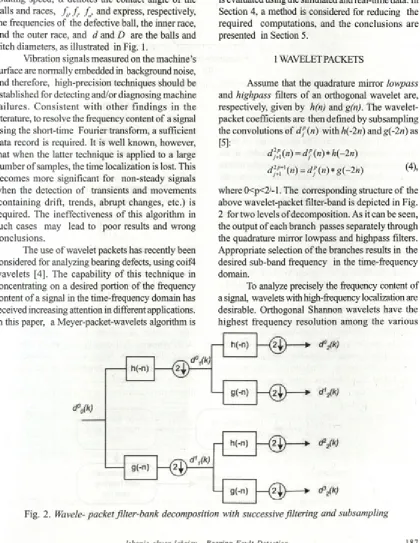
where 0<p<2j-l. The corresponding structure o f the above wavelet-packet filter-band is depicted in Fig. 2 for two levels o f decomposition. As it can be seen, the output o f each branch passes separately through the quadrature mirror lowpass and highpass filters. Appropriate selection o f the branches results in the desired sub-band frequency in the time-frequency domain.
To analyze precisely the frequency content o f a signal, wavelets with high-frequency localization are desirable. Orthogonal Shannon wavelets have the highest frequency resolution among the various
d°o(k)
h(-n)
d »
h(-n) — (2J }
-g(-n) —(2^)---►
g(-n) — ( g ) d\(k)
r - h(-n)
L 9(-n )
-
0
-d Vk)
d*2(k)
d 3 } ( k )
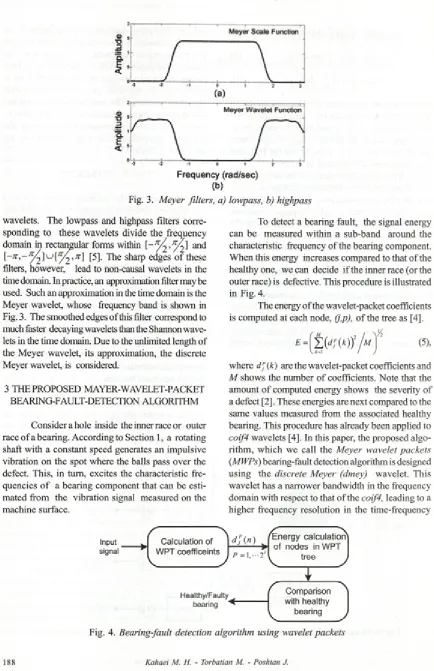
Fig. 3. Meyer filters, a) lowpass, b) highpass
wavelets. The lowpass and highpass filters corre sponding to these wavelets divide the frequency domain in rectangular forms within [ - 1/ and
\~ K ,-nfi ^ y j \ 7Y ^ ,n \ [5], The sharp edges o f these
filters, however, lead to non-causal wavelets in the time domain. In practice, an approximation filter may be used. Such an approximation in the time domain is the Meyer wavelet, whose frequency band is shown in Fig. 3. The smoothed edges o f this filter correspond to much faster decaying wavelets than the Shannon wave lets in the time domain. Due to the unlimited length of the M eyer wavelet, its approximation, the discrete Meyer wavelet, is considered.
3 THE PROPOSED MAYER-WAVELET-PACKET BEARING-FAULT-DETECTION ALGORITHM
Consider a hole inside the inner race or outer race o f a bearing. According to Section 1, a rotating shaft with a constant speed generates an impulsive vibration on the spot where the balls pass over the defect. This, in turn, excites the characteristic fre quencies o f a bearing component that can be esti mated from the vibration signal measured on the machine surface.
To detect a bearing fault, the signal energy can be measured within a sub-band around the characteristic frequency o f the bearing component. W hen this energy increases compared to that o f the healthy one, we can decide if the inner race (or the outer race) is defective. This procedure is illustrated in Fig. 4.
The energy o f the wavelet-packet coefficients is computed at each node, (j,p), o f the tree as [4],
£ = ( l {d>(k))2 /m ^ 2 (5),
where d? (k) are the wavelet-packet coefficients and
M shows the number o f coefficients. Note that the amount o f computed energy shows the severity o f a defect [2], These energies are next compared to the same values measured from the associated healthy bearing. This procedure has already been applied to
coif4 wavelets [4], In this paper, the proposed algo
rithm , which we call the Meyer wavelet packets
(MWPs) bearing-fault detection algorithm is designed using the discrete Meyer (dmey) wavelet. This wavelet has a narrower bandwidth in the frequency domain with respect to that o f the coif4, leading to a higher frequency resolution in the time-frequency
Input signal
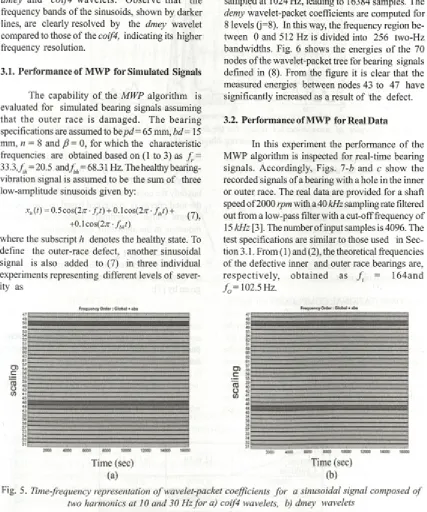
domain. To present this, Fig. 5 shows the amplitudes o f the corresponding wavelet-packet coefficients for an input signal composed o f two sinusoids at 10
and 30 Hz as.
x(t) = sin(2^10t)+sin(2^30t) (6). T h is sig n a l is sam p led at 64 H z and decomposed to the level o f J=5 by utilizing the
dmey and coif4 w avelets. O bserve th at the frequency bands o f the sinusoids, shown by darker lines, are clearly resolved by the dmey wavelet compared to those o f the coif4, indicating its higher frequency resolution.
3.1. Performance of MWP for Simulated Signals
The capability o f the MWP algorithm is evaluated for simulated bearing signals assuming that the o u te r race is dam aged. The bearing specifications are assumed to bep d = 65 mm, bd= 15 mm, n = 8 and ß = 0 , for which the characteristic frequencies are obtained based on (1 to 3) as f = 33.3, f.h = 20.5 and/M = 68.31 Hz. The healthy bearing- vibration signal is assumed to be the sum o f three low-amplitude sinusoids given by:
x h (t) = 0.5 cos(2;r • f rt) + 0.1 cos(27r ■ f / ) + ^ + 0 .1 c o s(2 n -f j )
where the subscript h denotes the healthy state. To define the outer-race defect, another sinusoidal signal is also added to (7) in three individual experiments representing different levels o f sever ity as
xd, (0 = xh(t) + 0,5cos(2n.fjt)
xdf t ) = xh{t) + cos(2n.fot) (8),
xdl (0 = xh (/) + 2 cos(2 n.'ft)
where the subscript d indicates the signal o f the defective bearing. A white Gaussian noise with zero- mean and a variance o f 0.01 is also added to the signal as the background noise. The signals are sampled at 1024 Hz, leading to 16384 samples. The
demy wavelet-packet coefficients are computed for 8 levels 0=8). In this way, the frequency region be tween 0 and 512 Hz is divided into 256 two-Hz bandwidths. Fig. 6 shows the energies o f the 70 nodes o f the wavelet-packet tree for bearing signals defined in (8). From the figure it is clear that the measured energies between nodes 43 to 47 have significantly increased as a result o f the defect.
3.2. Performance of MWP for Real Data
In this experiment the performance o f the MWP algorithm is inspected for real-time bearing signals. A ccordingly, Figs, 1-b and c show the recorded signals o f a bearing with a hole in the inner or outer race. The real data are provided for a shaft speed o f 2000 tpm with a 40 kHz sampling rate filtered out from a low-pass filter with a cut-off frequency o f 15 kHz[ 3], The number o f input samples is 4096. The test specifications are similar to those used in Sec tion 3.1. From ( 1 ) and (2), the theoretical frequencies o f the defective inner and outer race bearings are, re sp e c tiv e ly , o b ta in e d as f = 164and
f = 102.5 Hz.
Fr*Sju*ney O rè « : Glefei! * abs
(a)
f r tq in n e r On*« : GMmì * ab«
10000 »2000 1«00 140X»
Time (see)
(b)
Fig. 6. Energies o f wavelet-packet nodes fo r the three simulated signals o f a presumably defective bearing based on (8)
The wavelet-packet coefficients o f these signals are computed using the dmey wavelet to the level o f j=12. As a result, the frequency band between 0 and 20 kHz is divided into 4096 sub-bands o f 4.88 Hz.
The corresponding defect frequencies are then given by the nodes betw een 12 and 50 or 12 and 31 for the inner or outer races, respectively. Table 1 presents the measured energies o f the healthy and defective signals for the m entioned sub-bands. The respective increase o f the energy in each case clearly shows the presence o f a fault.
4 COMPUTATIONAL COMPLEXITY OF MWP
To find a defect, our inspection may only be concentrated around the defect characteristic fre quency that is known, a priori. This starts with the determination o f the corresponding path and nodes o f the w avelet-packet tree towards the defect frequency. The schematic diagram o f such a proce dure is depicted in Fig. 8, wherein the thick line represents a typical path o f the wavelet-packet
tree towards an assumed defect frequency with 3 levels o f decomposition (j=3). In this way there is no need to compute all the wavelet packet coefficients, but only the coefficients o f the specified path. Next, the total energy is computed based on these coef ficients, which accordingly leads to an extensive reduction in the algorithm computations.
In general, for a signal o f length N, the number o f real additions, Aadd, and multiplications, A , o f a wavelet-packet tree for the decomposition level o f J with the quadrature-mirror filter o f order M is given by [7]:
Aaää = Amul = M x J x N (9).
U sing the specified path o f the w avelet-p a c k e t tre e m en tio n e d above, th e n u m b er o f computations reduces to [7]:
1 - y j (10),
which is 1/2J o f that given by (9).
Table 1. Energies o f the dmey wavelet-packet coefficients fo r the bearing signals
Nodes B earin g^ ^ ^ ^ Condition
12 to 50 12 to 31
Healthy 0.0439 0.0987
1 Inner-race defected 0.0779 0.0380
T im e (s e c )
Fig. 7. Real-data bearing signals fo r a) healthy, b) defective inner race, and c) defective outer race
Fig. 8. A wavelet-packet tree with a typical specified path (thick line) towards the defect frequency
5 CONCLUSIONS
In this paper a new bearing-fault detection algorithm, which we called the MWP algorithm, was proposed, based on the dmey wavelet-packet coef ficients. This algorithm gives a higher resolution when detecting bearing defects compared to that o f
the coif4 wavelet; however, it requires more compu
tations. To resolve the latter problem, an efficient technique was designed by considering a specific path o f the wavelet-packet tree towards the defect frequency. The number o f computations was then reduced by a factor o f twice the number o f decom position levels. This, as a consequence, made the proposed MWP algorithm more appropriate for the online processing o f bearing-fault detection.
6 REFERENCES
[1] Eren L., Devany J. (2001) Motor bearing damage detection via wavelet analysis o f the starting current transient. IEEE Instrumentation and Measurement Technology Conference, Budapest, 21-23 May 2001. [2] R. R. Schoen, T. G. Habetler, F. Kamran, R. G. Bartheld (1995) Motor bearing damage detection using stator
current monitoring, IEEE Trans, on Industry Applications, 31(1995), pp. 1274-9.
[4] Eren, L., Devany, J. (2002) Bearing damage detection via Wavelet Packet. IEEE Instrumentation and
Measurement Technology Conference, Anchorange, USA, 21-23 May 2002.
[5] Mallat, S. (1998) A wavelet tour o f signal processing, Academic press.
[6] Barber, A. (2002) Handbook o f noise and vibration control, Elsevier, Advanced Technology.
[7] Guo, H. (1995) Theory and application o f the shift-invariant, time-varying and undecimated Wavelet Transform, M aster’s Thesis, Rice University, Houston, USA.
A uthors’ Address:
Prof. Dr. Mohammad Hossein Kahaei M. Torbatian
Prof. Dr. Javad Poshtan Department o f Electrical Eng. Iran University o f Science & Technology, Tehran, Iran kahaei@iust. ac. ir [email protected] jposhtan@ iust.ac.ir
Prejeto:
Received: 21.4.2004
Sprejeto:
Accepted: 25.10.2006