in the population sciences published by the Max Planck Institute for Demographic Research Konrad-Zuse Str. 1, D-18057 Rostock · GERMANY www.demographic-research.org
DEMOGRAPHIC RESEARCH
VOLUME 22, ARTICLE 11, PAGES 237-288
PUBLISHED 03 MARCH 2010
http://www.demographic-research.org/Volumes/Vol22/11/ DOI: 10.4054/DemRes.2010.22.11
Research Article
Reporting on first sexual experience:
The importance of interviewer-respondent
interaction
Michelle Poulin
This publication is part of the proposed Special Collection “HIV/AIDS in sub-Saharan Africa”, edited by Susan Watkins, Jere Behrman, Hans-Peter Kohler, and Simona Bignami-Van Assche.
© 2010 Michelle Poulin.
This open-access work is published under the terms of the Creative Commons Attribution NonCommercial License 2.0 Germany, which permits use, reproduction & distribution in any medium for non-commercial purposes, provided the original author(s) and source are given credit.
1 Introduction 238
2 Background 239
2.1 Problems with sexual behavior data collected from large-scale surveys
239
2.2 Interviewer-respondent interaction and the creation of data 242 2.3 Sex before marriage in contemporary Malawi 243
2.4 Analytic procedure 244
3 The setting and data 245
3.1 Overview 245
3.2 Collecting data with in-depth interviews 248 3.3 Measuring first sex in the survey and in the in-depth interviews 251 3.4 Defining an inconsistent reporter 252
4 Results 254
4.1 Comparing inconsistent and consistent reporters 254 4.2 Interviewer-respondent interaction, and interview mode 260 4.2.1 The in-depth interview as a flexible interview 260 4.2.2 The in-depth interview as a reciprocal exchange 263
5 Discussion and conclusions 266
6 Acknowledgements 268
References 270
Reporting on first sexual experience:
The importance of interviewer-respondent interaction
Michelle Poulin1
Abstract
Survey methodologists typically seek to improve data on sensitive topics by standardizing surveys and avoiding the use of human interviewers. This study uses data collected from 90 never-married young adults in rural Malawi to compare reports on first sexual encounters between a standard survey and an in-depth interview. A significant fraction of young women who claimed in the survey to have never been sexually active affirmed sexual experience during the in-depth interview, fielded shortly thereafter. Two elements of the in-depth interview, flexibility and reciprocal exchange, foster trust and more truthful reporting. The findings contradict the long-standing presumption that face-to-face interviews are inherently threatening when the topic is sex.
1 Population Studies & Training Center, Brown University, 68 Waterman Street, Providence, RI, 02912 USA.
1. Introduction
Across a range of social groups, people hesitate when asked about the most intimate area of their lives – their sexual behavior – and will often report on it inaccurately. In closed populations in the United States, for instance, men’s and women’s reports on their number of sexual partners should match, and yet, because either men overreport, women underreport, or both misreport, they do not (Brewer et al. 2000; Laumann et al. 1994; Smith 1992). Rosenbaum (2006) found that in a sample of adolescents who reported having had sex in an initial interview and later took virginity oaths, 28% claimed to be virgins in a follow-up interview. In sub-Saharan Africa, the location of the current research, Mensch and colleagues (2008a) and Plummer and colleagues (2004) found that a significant number of women who stated they had never had intercourse tested positive for HIV (see also Gallo et al. 2007; Minnis et al. 2009). At the population level, several studies found a weak correlation between reported sexual behavior and HIV prevalence (Brewer et al. 2003; Buvé et al. 2001; Glynn et al. 2001; Potterat, Gisselquist, and Brody 2004).
Discrepancies like these have led to a skepticism among analysts about the quality of sex survey data, and to a search for better ways to collect such information than the standard, face-to-face interview is thought capable (e.g., Dare and Cleland 1994; Durant and Carey 2002; Hewett et al. 2008; Meekers 1993; Palen et al. 2008). In developed countries, modes that avoid face-to-face interaction, such as telephone interviews, self-administered questionnaires, and self-assisted computer interviews, usually produce superior data on sexual behavior (Gribble et al. 1999; Newman et al. 2002; Rogers et al. 2005 Tourangeau and Smith 1996; Turner et al. 1998a). In developing countries, a growing number of studies has assessed bias in sexual behavior data (Gregson et al. 2002, 2004; Jaya, Hindin, and Ahmed 2008; Palen et al. 2008). Of these, the techniques evaluated have most often mimicked the self-administered designs developed in the West, such as paper format, or computer assisted (e.g., Jaspan et al. 2007; Le et al. 2006). The overall findings from these studies are uneven, and, in settings where people are rarely exposed to truncated question and answer sessions, or who are unfamiliar with computers, it is unclear whether the self-administered modes are in fact better. Moreover, as the AIDS pandemic continues in many low income populations, the need to follow trends in sexual behavior remains important. Yet, how to best collect large-scale data on sexual behavior is still not well understood. Identifying a superior method of data collection is also a practical matter—using more expensive means may not be necessary if a simpler version will do.
extended conversation between respondent and interviewer. I draw on a study conducted in rural Malawi in 2004, in poor communities where few women and men complete high school, and where AIDS has been an epidemic for at least two decades. Respondents participated in both interview modes, resulting in a rare set of nested data. I use the conversations from in-depth interviews to convey the situational dynamics within which sexual behavior is talked about, and, in so doing, suggest how reporting on sexual behavior is influenced by the interaction between an interviewer and a respondent.This inquiry does not attempt to replicate the thorough studies by cognitive psychologists and others of respondent memory and recall, comprehension of survey questions, and other generators of measurement error (Biemer 2004; Krosnick 1999; Tourangeau, Rips, and Rasinski 2000; Weisberg, Krosnick, and Bowen 1996). This study instead builds on the scholarship on low motivation in survey research (Dykema and Schaeffer 2000; Tourangeau 2004), socially desirable responding (Brener, Billy, and Grady 2003; Presser and Stinson 1998), and interaction between survey respondent and interviewer (Maynard and Schaeffer 2002; Schaeffer 2002; Schober and Conrad 1997; Suchman and Jordan 1990). The findings indicate that when young people misreport on their sexual behavior, they do not do so as much from “response error” as from active attempts to manage their identities.
2. Background
2.1 Problems with sexual behavior data collected from large-scale surveys
Researchers have long questioned the validity of data about sensitive behavior generated from self-reports (Aquilino 1994; Aquilino and Lo Sciuto 1990; Dare and Cleland 1994; James et al. 1991; Lau, Tsui, and Wang 2003; Mensch, Hewett, and Erulkar 2003; O’Sullivan 2008; Padian et al. 1995; Rose et al. 2009). Many have attributed the problem to “social desirability” bias, a type of bias produced when respondents inflate behavior or attitudes to meet those they think ideal (by either the interviewer or the community), or when respondents underreport behaviors that are not (e.g., Ballard 1992; Bradburn 1983; Connell and Dowsett 1992; Crowne and Marlowe 1960; Leite and Beretvas 2005; Presser and Stinson 1998; Turner et al. 2009; Zenilman et al. 1995).2 Social desirability bias is thought to be particularly problematic when the
subject matter is sensitive or potentially transgressive. Several studies show interviewers can hamper the interview, because many people would rather not tell
private, possibly embarrassing, information to a stranger in a formal setting (Aquilino, Wright, and Supple 2000; Couper et al. 2003; Lee and Renzetti 1990; Tourangeau and Smith 1996; Wight 1999). Men in the United States, for example, have underreported the extent to which they visit sex workers (Brewer et al. 2008). The typical methodological response to social desirability bias has been to remove the human interviewer from the data collection process.
A number of randomized experiments have compared face-to-face interviews with audio or video computer-assisted self-interviewing (CASI) methods, which do not require users to respond to potentially sensitive questions asked by another person (Hewett, Mensch, and Erulkar 2004; Mensch et al. 2008a; Metzger et al. 2000; Morrison-Beedy, Carey, and Tu 2006; Newman et al. 2002; Turner et al. 1998a, 1998b). Most evaluations of CASI techniques have been conducted in the United States, where respondents are accustomed to formal interactions with strangers, such as sales clerks and government officials, and with electronic technology, and have worked to good effect. In settings without these characteristics, the results of CASI studies are mixed — audio-CASI, in particular, has performed well in some cases, but has often under-performed (Jaya, Hindin, and Ahmed 2008; Le et al. 2006; Mensch, Hewett, and Erulkar 2003; Mensch et al. 2008b; Potdar and Koenig 2005; Simões et al. 2006; van de Wijert et al. 2000). The results from these studies also suggest that some questions about sexual behavior are more sensitive than others: In Kenya and Malawi, audio-CASI produced higher reports of sex with strangers and teachers, but there were no differences when the measure was about first sex (Mensch et al. 2008a).3
By removing the human interviewer, CASI methods eradicate interviewer error. Question wording and order are automated and therefore uniform. This follows the assumption that data collection in face-to-face surveys should be as asocial and structured as possible (Aquilino, Wright, and Supple 2000; Fowler and Mangione 1990). Survey interviewers are trained to ask questions phrased to elicit brief --ideally one-word --responses, in the order set on the questionnaire. Deviations from this approach are thought to introduce variability across survey interactions and increase bias in the resulting data. No matter how scripted the approach may be, however, the reporting on sensitive topics remains problematic, presumably because of a respondent's embarrassment when faced with another person.
Much of the literature on standard, face-to-face survey interviews recognizes the interaction between an interviewer and a respondent as necessarily social and dynamic, one in which the interviewer's role varies and the respondent is a key player (Beatty and Willis 2007; Presser et al. 2004; Willis 2005). Goffman (1959) showed that people actively manage social situations to promote favorable impressions of themselves to themselves. The survey interview is a situated, social activity in which the interviewer
becomes the recipient of an identity that the respondent produces, reproduces, and articulates (Alexander and Wiley 1992). In other words, what a respondent chooses to tell (or not to tell) an interviewer is interwoven with the specific identity she tries to create or uphold in the interview. Some identities will be better suited to the interview than others. Which identity—for example, an upstanding citizen who joins social groups or a demure school girl—is perceived by the respondent as ideal is revealed either immediately, through dialogue and other interactional cues, or as the interview progresses (Bleek 1987; Cicourel 1974).4 In addition, the interaction is influenced by
characteristics specific to that interview—such as the match between respondent and interviewer on demographic characteristics (Caraël 1995; Catania et al. 1990; Dare and Cleland 1994; Gersovitz et al. 1998; Nnko et al. 2004; Obermeyer 2005),5 as well as
expectations the interviewer and/or the respondent brings to their joint interaction (Anderson et al. 1988; Hyman 1954; Lauritsen and Swicegood 1997; Maynard et al. 2002; Sudman and Bradburn 1974; Sudman et al. 1977).6
4 Shared, local understanding provides people with guidelines about how to think and act, and a respondent brings this knowledge to the interview (Sewell 1992; Swidler 1986). Such guidelines may be contested or uncertain—for example, when a person is conflicted about whether it is really okay to have sex outside of marriage. People are forced to confront these ambiguities – and their notion of self – when they are asked about these behaviors or events (Callero 2003). Schaeffer and Presser (2003) noted that a face-to-face survey contains qualities like those of day-to-day interaction because “social and conversational norms as well as processes of comprehension, memory, and the like are imported into the interview from the situations in which they were learned and practiced” (Schaeffer and Presser 2003:65; see also Cicourel 1974). In other words, the dialogue and interaction in an interview between two strangers is similar to dialogue and interaction between two strangers in other circumstances.
5 Using data from the Demographic and Health Surveys to document trends in age at first sex across several countries in Africa, Zaba et al. (2004) stated, “The fact that different patterns are observed for different countries suggests that a variety of reporting errors may occur with different prominence” (p. ii30). Mensch, Hewett, and Erulkar (2003) noted large differences in levels of reported premarital sex among women in surveys across countries. In Kenya, 26% of never-married women reported premarital sexual activity (Kiragu and Zabin 1993, 1995). In Tanzania, Matasha et al. (1998) found that 63% of never-married women affirmed having been sexually active, while a strikingly low 14% of young women was reported by Boohene and colleagues from data collected in Harare, Zimbabwe (Boohene et al. 1991; see Mensch, Hewett, and Erulkar 2003 for a more complete review). It is not possible to know whether these differences are a function of accompanying variation across countries, or whether people report differently across place.
2.2 Interviewer-respondent interaction and the creation of data
When the interaction between respondent and interviewer is recognized as a primary component in data creation, the standard approach to enhancing data quality is inadequate. An alternative approach keeps the face-to-face interview, but attempts to improve survey reporting by refining the structure of a questionnaire, or by enhancing interviewer training in techniques of building rapport with respondents (Luke et al. 2009). In Kenya, Weinreb (2006) has shown that interviewers who were from the same communities as respondents (“insider-interviewers”) produced better data than those who were from other communities (“stranger-interviewers”). Because insider-interviewers had an incisive grasp of local knowledge that stranger-insider-interviewers lacked, insider-interviewers reduced the social distance between themselves and respondents, and in turn elicited respondents’ trust and more truthful reporting.7 This finding
suggests that in places where a formal interview with a stranger seems peculiar, data quality may be enhanced by developing interviewers’ rapport skills.
In this spirit, in-depth interviews are used by researchers when the goal is to encourage respondents to talk, with their interviewer, at great length (Bozon 2006; Daly 2007; Elliot 2005). In-depth interviews grant respondents some control over the direction of the interview, thus creating an opportunity for the respondent to reveal new information about herself or about social arrangements in their community, information that was previously unknown to either the interviewer or to the researcher directing the study (Blee and Taylor 2002; Coast et al. 2007; Ezra and Mchakulu 2007; Fricke 1997; Knodel 1997; Meekers and Calves 2003; Mosoetsa 2005; Nyanzi et al. 2004). It was through extended dialogue that Johnson-Hanks (2002, 2006) learned that Cameroonian women practice periodic abstinence not only for its effectiveness in avoiding pregnancy, but also because it grants them an honorable identity. Yet, by encouraging talk, researchers also learn from silences. A study of reproductive decision-making in Zimbabwe and Senegal, for example, found that while women in Zimbabwe raised the issue of AIDS spontaneously and with great concern, in Senegal respondents rarely mentioned the disease, a finding that led researchers into new directions (Le Grand et al. 2003; Randall and Koppenhaver 2004; see also Greenhalgh 1995).
In this article, I compare data on sexual behavior created by standard survey interactions with data created by in-depth interview. The in-depth interviewer aims to replicate the characteristics of a normal conversation in rural Malawi. The interviewer is encouraged to engage with the respondent, to allow her to speak in her own words, and to permit her to be loquacious rather than laconic. Although broad topics are set
beforehand, the interviewer and respondent decide on their order, allowing both to relax, and to adapt flexibly to the unpredictable twists and turns of ordinary social interactions. I adopted this approach in response to the particular setting of rural Malawi, where people are relatively unaccustomed to formal interactions and to disclosing their private sexual behavior to strangers.
2.3 Sex before marriage in contemporary Malawi
Foucault recognized that sexuality is not only self-determined, but is also socially produced. People evaluate their sexuality and accompanying sexual behavior by comparing it to the standards of the societies or smaller communities in which they live (Foucault 1979). In rural Malawi, people are uncertain about the propriety of premarital sex. In times past, a romantic relationship between two young people was often permissible, as long as it was not made public. In contemporary Malawi, an entrenched AIDS epidemic has altered the meaning of sex and intimacy, the effect of which has been to move sex outside of marriage into a deeply moral realm. Even adult women and men seen chatting can be the subject of much gossip (Watkins 2004). At the same time, Malawians still recognize the joys and necessities of sex, and the possibility of total abstention for coming-of-age young people is questioned by both young people themselves and elders alike. In some instances, intimate encounters before marriage remain acceptable, as long as discretion is used. Evidence for this is found by, in some parts of Malawi, the presence of goweros, small, mud-based structures built apart from the main dwelling units, used mainly for sleeping by unmarried young women and men, but also for trysts.8 Romantic relationships, however, must never be flaunted, and
should they discover their daughters or nieces are sexually involved, many parents will force their end. Young men are given more license than are women --especially once they begin to earn small amounts of money and are expected to support others less fortunate, including female partners (Poulin 2006; Swidler and Watkins 2007. See also Haram 1995 and Wight et al. 2006 in Tanzania).
To complicate matters, international organizations and local governments are modifying the acceptable forms of sex and intimacy, as young people – and especially young women – are exposed to a barrage of AIDS-prevention campaign messages on the benefits of abstinence before marriage (Parikh 2005; Stewart 2001). Along with the fact that premarital sex among boys is more acceptable, this means that the social costs
of reporting on sexual behavior for young women will be higher than for men.9 We
should therefore expect that women and men will report on first sex differently in the survey, with women underreporting more than men (see also Curtis and Sutherland 2004).
2.4 Analytic procedure
The analyses proceed as follows. I first construct a measure of inconsistent reporting across interview modes on “ever had sex,” and compare respondents across reporting type on socio-economic and demographic characteristics, and characteristics of interaction between respondent and interviewer. Using a logit model, I then investigate whether survey interviewer-respondent interaction is associated with inconsistent reporting, net of controls for socio-economic and demographic characteristics.10
Because I hypothesize that the effects of interview mode differ for women and men, in all models I include a dummy for women. Finally, I use conversations from the in-depth interviews to discover how sexual behavior is talked about. Two key mechanisms through which face-to-face interviews influence reporting and misreporting on sexual behavior in this setting are identified and discussed.
I find that for some young people, talking about significant events, such as having sex for the first time, is wrapped up with ideas about what constitutes good behavior. Because identities are presented, and may be modified, within the research setting, these findings provide insight into how cognition and selfhood influence response bias. Many studies on interviewer effects document how the mismatch between respondents and interviewers on demographic characteristics (such as sex or age) undermines resulting data (Axinn 1991; Becker, Feyisetan, and Makinwa-Adebusoye 1995; see also Leahey 2008). Although worthwhile, such an emphasis has inadvertently sidelined considerations about how respondent-interviewer interaction may generate better data, or make the data worse.
9 Throughout sub-Saharan Africa, as age at first marriage for women has been increasing age at first sex remains largely unchanged, suggesting that women’s sexual debut is now more likely to prior to marriage (Mensch, Grant, and Blanc 2006). In many parts of the sub-continent, adolescence is marked by a transition into sexual activity prior to marriage (Gage-Brandon and Meekers 1993; Zaba et al. 2004).
3. The setting and data
3.1 Overview
The data in this article come from a wider study, the Malawi Diffusion and Ideational Change Project (MDICP). The MDICP is a joint collaboration between researchers from the Population Studies Center at the University of Pennsylvania and the University of Malawi’s College of Medicine and Chancellor College.11 The project
collects panel data in the three administrative regions of rural Malawi (Balaka, Mchinji, Rumphi) and was designed to investigate the role of social networks on HIV risk and related behavior. The MDICP’s first round of data collection occurred in 1998 and included a sample of 2,640 ever-married women and spouses in 125 villages across the three study sites. In 2004, the third wave of data collection, the project added 1,001 young women and men aged 15-24 to the 1998 cohort of ever-married respondents.
That same year, I lived in Malawi in order to conduct a study of the sociology of intimate relationships, at the time when women and men first enter marriage in a setting with high HIV prevalence. Because I was interested in a description of such relationships, and the meanings young people attribute to them, I chose to use in-depth interviews as my primary method of data collection. To select respondents, I drew a random sample from the MDICP 2004 youth survey respondents. Completed in-depth interviews were obtained for 141 married and unmarried women and men in two of three MDICP study sites, Rumphi (North) and Balaka (South), in November and December 2004, approximately four months after the survey interviews were completed.12
The analyses in the present study focus on the reporting of first sex. The sample is therefore restricted to those who were never-married, and who participated in both interview modes. The MDICP completed 452 surveys in the North and the South for never-married respondents in 2004, a response rate of 88.3%.13 The qualitative sample
consisted of 110 never-married men.14 A total of 90 respondents (33 women and 57
11 http//:www.malawi.pop.upenn.edu
.
12 This project was funded by a Dissertation Improvement Grant from the National Science Foundation, (# SES-0503350), support from the University of Pennsylvania’s Population Studies Center, and from the Department of Sociology at Boston University. Two districts, North and South, were selected for the qualitative study mainly because they differed greatly on several socio-economic and demographic dimensions, making it possible to examine how the broad context affects such micro-situations as intimate relationships. Moreover, 141 respondents is a large sample for a qualitative study, and collecting more in-depth interviews from a third site would have been a poor use of resources (Poulin 2006).
13 The total number of never-married respondents sampled in these two regions was 512.
men) completed both a survey and an in-depth interview.15 The larger number of men is
attributable to the MDICP’s over-sampling of never-married people aged 15-24; because women marry at a younger age than men (18 and 23 respectively), a random sample of the unmarried will consist of more men than women.
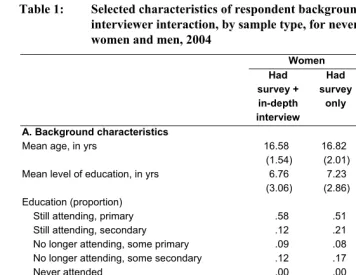
Panel A in Table 1 compares background characteristics for respondents who completed both a survey and an depth interview, and those not selected for an in-depth interview and thus interviewed by survey only. The two groups match well on all characteristics, including age, education, household wealth, and mortality. Mean age of women interviewed by survey only, for instance, is 16.8 years, compared to 16.6 years for those participating in both interviews. Measures of education are roughly comparable by sample type. At the time of the study, most respondents in both sample types were still attending school, and although few women and men had completed only primary education (8 years), very few had never attended.
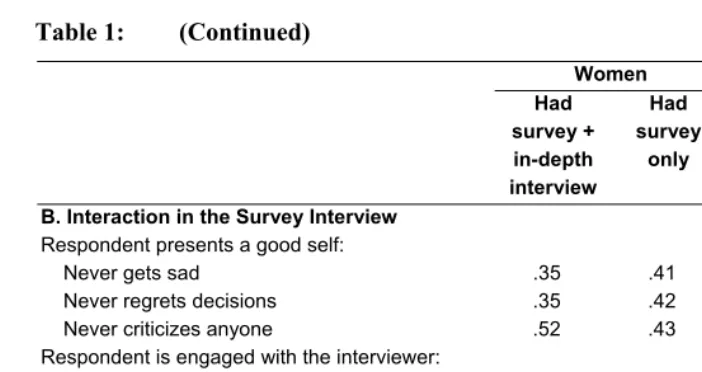
Means for several measures of respondent-interviewer interaction in the survey setting are presented in Panel B. The first three items come from a larger set of questions in the Marlowe-Crowne Social Desirability Scale (Ballard 1992; Barger 2002; Crowne and Marlowe 1960; Leite and Beretvas 2005); they were piloted and determined appropriate in this setting. Respondents scored a “1” upon agreeing with each of the following three statements: (a) “I never regret my decisions,” (b) “I never get sad,” and (c) “I never criticize other people.” Higher scores reflect a situation in the survey interview where respondents wanted to present a positive impression of themselves to the interviewer; presumably, few people never experience sadness, and few people are never critical of another person. Although men and women did not significantly differ in their levels of agreement for the statements “I never get sad,” and “I never regret my decisions,” more women than men told an interviewer they never criticize anyone (t=-2.56; p=.01).
The second respondent-interviewer interaction construct in Panel B measures a respondent’s level of engagement with her survey interviewer. At the end of the survey interview, each interviewer recorded “how cooperative” the respondent was during the interview. Interviewers could score a respondent as Bad, Average, Good, or Very Good. Because only 2 out of 90 respondents received a score of Bad, these 2 respondents were included with those in the next level, Average. The distribution across the three levels—Average, Good, and Very Good—is approximately normal for both women and men, with Good as the modal level for both sexes. More women than men, however, scored Average, indicating that more women were less engaged in the survey interview.
Finally, I considered the match between a respondent and an interviewer by sex, coded as “1” if yes, and “0” otherwise. Less than one quarter of female respondents had an interviewer who was female.16
Table 1: Selected characteristics of respondent background, and
respondent-interviewer interaction, by sample type, for never-married Malawian women and men, 2004
Women Men
Had survey + in-depth interview
Had survey
only
Had survey + in-depth interview
Had survey
only
A. Background characteristics
Mean age, in yrs 16.58 16.82 18.04 18.40
(1.54) (2.01) (2.58) (2.67)
Mean level of education, in yrs 6.76 7.23 6.84 7.11
(3.06) (2.86) (2.96) (2.80) Education (proportion)
Still attending, primary .58 .51 .47 .44
Still attending, secondary .12 .21 .18 .18
No longer attending, some primary .09 .08 .04 .12
No longer attending, some secondary .12 .17 .16 .26
Never attended .00 .00 .04 .01
Household wealth
Bricks that are fire-burnt (vs. mud or sun-dried) .45 .50 .46 .50
Metal/sisal sheet roof (vs. thatch) .24 .31 .23 .24
Asset index (0-6 scale) 3.27 3.40 2.63 3.33
(1.64) (1.54) (1.73) (1.26)
Household mortality
Maternal orphan .10 .08 .08 .14
Had death in household, last 3 years .39 .39 .31 .29
Table 1: (Continued)
Women Men
Had survey + in-depth interview
Had survey
only
Had survey + in-depth interview
Had survey
only
B. Interaction in the Survey Interview
Respondent presents a good self:
Never gets sad .35 .41 .37 .36
Never regrets decisions .35 .42 .51 .48
Never criticizes anyone .52 .43 .33 .35
Respondent is engaged with the interviewer:
Average cooperation .24 .24 .15 .20
Good cooperation .41 .42 .54 .46
Very Good cooperation .34 .34 .31 .34
Interviewer-Respondent, Same Sex .23 .22 .63 .59
Total 33 130 57 232
Notes: Data come from MDICP 2004 sample in two districts in rural areas, Rumphi District in the North, and Balaka District in the South. Values in 'Had Survey Only' are for surveyed respondents not sampled for the in-depth interview (N=130 for girls; N=232 for boys). Standard deviations are noted in parentheses below scores for age, years of education, and asset index. Numbers in bold are significantly different based on a two-sample t-test equality of means at the .10 level.
3.2 Collecting data with in-depth interviews
Because I am not fluent in any of Malawi’s several local languages, I trained two teams of interviewers to conduct in-depth interviews, one from the Yao- and Chewa-speaking region in the South and the other from the Tumbuka-speaking region in the North.17 Each team comprised two women and two men, all local high-school graduates, who were, on average, three years older than respondents. Selected interviewers had very good or excellent written and conversational skills, and did not become visibly nervous when discussing sensitive issues.18 I also worked with a Malawian research assistant
17 I opt not to use the vague term qualitative interview, preferring instead in-depth interview, as it better captures the type of qualitative data I collected. Axinn and Pearce (2006) contend that the term less-structured interview best describes these interviews, given their observation that portions of a standardized questionnaire can also be in-depth. Although the interviews to which I refer are indeed less-structured, I prefer to keep with the more conventional depth interview-for ease of recognition, and also because I was interested in an in-depth understanding of a number of topics.
with several years of field experience, who not only helped me with translation, supervision, and field logistics, but also offered valuable insider information on many aspects of young Malawians' lives.
Several components of a good in-depth interview were covered during training, including: (1) establishing ease before delving into sensitive topics; (2) asking follow-up or clarification questions (or probing), while avoiding an aggressive approach; and (3) building upon initially established rapport throughout the interview (Bernard 2006; Taylor and Bogdan 1998).19 Interviewers also practiced questioning and conversational
techniques with each other during the training.
Interviewers used a loosely structured, in-depth interview guide. Topics included in the guide were based on five months of prior field experience that included a pilot study conducted over two months (see Poulin 2006). The guide consisted of six broad topics, including two central to these analyses: (1) the formation and dissolution of intimate, sexual relationships, including whether and how they formed and dissolved, and (2) the characteristics of intimate partners and of relationships. The in-depth interviews were intended to mirror a typical conversation among peers in this age group (Bernard 2006). Respondents were also encouraged to talk about the topics for as long as they wished, and interviewers developed techniques for exhausting a topic-as long as the respondent was willing. An interviewer would say to a respondent, for instance, “Tell me all about the first time you received a love proposal. Who proposed to you, and how did it happen?” The interviewer would take cues from the response to ask further questions, such as “How long ago were you proposed?” and “How did you respond?”
To create a relaxed environment, trained interviewers could decide the order of the six topics. Tape recorders were not used — for those unfamiliar with recording devices,
do this by first introducing themselves, then by asking the young person whether they could chat for a few minutes about their some concerns they might have about their life, further explaining they were part of a research project. All approached youth obliged, and the ensuing conversations lasted between 20 and 30 minutes. Potential interviewers broached the topic of intimate relationships in this exercise, in order for me to gauge how comfortable they were when discussing such a subject. Immediately following the conversation, the interviewers would reconstruct the conversation by writing it into a lined notebook. This exercise permitted me to determine how good they were at facilitating conversation, how much detail they could recall, and how adept they were at reconstructing the conversation in written English.
like many people in rural Malawi, the machine could be a source of discomfort.20
Instead, interviewers took notes. Immediately following each interview, the interviewer found a secluded place to sit and write, either next to their place of transport or under a tree, and, with the aid of their notes, reconstructed the entire interview into a lined notebook. Although all interviews were conducted in the respondents’ native languages—either Chiyao or Chichewa in the South, or Chitumbuka in the North—the reconstructed interviews were written in English, but often included phrases in the local language, accompanied by the English translation.21
Several steps were taken to sharpen interviewing and note-taking skills. During the first two days of field work, interviewers conducted one interview per day instead of the typical two. Although role-playing during training proved valuable, good interviewing skills comes from real interviewing experience, and it was thus important that interviewers learn as they went. Interviewers then exchanged, read, and critiqued each others’ written interviews during these initial days, providing comments and discussing with each other any holes or discrepancies. Last, each interviewer narrated back her conversation with a respondent to me, the research assistant or another interviewer, or, on occasion, to several of us. During this process, those listening to the narration could seek clarification from the interviewer as she reported a respondent’s story, thereby alerting the interviewer to places where she might have probed.
Narrating back recently completed interviews had the important advantage of collective engagement in the learning process, thereby reaching shared understandings of specific questions asked, local idioms used, and appropriate translations of concepts in local languages. Interviewers occasionally returned to a respondent’s home for a “call back,” to augment under-developed interviews or to clarify statements that were confusing. Call backs became rare after the first four days of interviews, providing me
20 To gauge respondents’ reactions to taped conversations, six interviews were recorded digitally. Unfortunately, two of the recorded interviews were inaudible. Interviewers reported that of the remaining four, two respondents had some discomfort as a result of the recorder, while two did not. One interviewer described his impressions in some detail in his notebook: “The respondent was open even though he feared that the message will be disclosed to many because of the recorder, and I believe that is why he was lowering his voice when speaking. There was a little bit [of] noise from the house where the other family members had stayed but all the same the interview was interesting.With the use of that recorder the respondent wasn’t all that comfortable, i.e. in giving the information about friends and himself. But as time went on he forgot about it and he started to pump in more ideas that I have written in the story. To my own opinion I think the use of the recorder makes the respondent to feel uncomfortable and I would rather go for the interview without it.” It is of course possible that the interviewers themselves (and not the respondents) were uncomfortable with using the recorders. Even if this were the case, however, the resulting data would still be compromised, and I thus decided to forego recording the in-depth interviews with an audio device.
with the reassurance that the initial days of interviewing had been sufficient for interviewers to develop a sense of when the level of detail for each topic was saturated, to the extent the respondent was willing (see also Watkins and Swidler 2009).22
Although interviewers could not jot down everything said during the interviews, they could recall a surprising amount—the conversations and narratives recorded in the notebooks were detailed and each interview filled several pages. Relying on notes, of course, limits the precision with which the interviews could be recorded. I was able to mitigate much of the potential loss by reading each written interview immediately upon completion. This allowed for an expedient clarification of any confusion with the translation or with uncertainties about the meaning of particular sentences or words. The immediacy with which I initiated the verification process improved the interviewers’ ability, and motivation, to remember certain details and thus made it easier for me to address any areas of concern. The interviewers could then take the notebook back and edit the text where necessary. The resulting collection of interviews is detailed and rich; the interviews averaged one-and-a-half hours, and the average length of the typed transcripts is 8 single-spaced pages and ranges between 4 and 18 pages.23
3.3 Measuring first sex in the survey and in the in-depth interviews
Each handwritten transcript was first typed, next transferred to the software program NVivo 7, and then coded along several themes.24 In this article I focus on one theme,
the transition to sexual debut. Whether respondents had ever had sex was asked in both interview modes, permitting a comparison. In addition, experiencing sexual intercourse for the first time in a person’s life is a significant event for many people, including in rural Malawi. Other types of information, such as whether a person attended school or their number of siblings, are not usually subject to a similar withholding in this
22 During this early period, the completed interviews from six of the eight interviewers lacked sufficient detail, mainly because of inadequate probing. A respondent would answer “yes” or “no” to a posed question, which the starter interviewer would take as sufficient, and, rather than ask follow-up questions, would instead move to the next topic. At other times, a respondent may have given vague or inconsistent answers. 23 Several of these interviews can be found at
population. Using this question is methodologically valuable, since it permits identifying the relative merit of differing data collection modes.
The survey asked two sequential questions to determine whether each respondent had ever had sex. The English translation of the first question began with, “As you know, sometimes young women have sex with young men.” And then, “What about you, have you yourself ever had sex with anyone?” If a respondent said “No,” a follow-up question asked: “You haven’t even had sex with a boyfriend or an expected spouse?” Five of those initially responding “No” said “Yes” when prodded by this second question. These responses form the dichotomous measure “Had Sex” among survey respondents. 25 Respondents were scored 1 if they reported having had sex, and 0 if not.
Creating a Had Sex measure from the in-depth interviews required me to carefully analyze respondents’ sexual histories. When they spoke about whether or not they had had sex, many respondents were persistent. Others, however, initially asserted that they had never had intercourse in their lifetime, only to recant that statement later in the conversation. It was therefore important for me to read each transcript in its entirety. After identifying those respondents who reported having had sex in the in-depth interviews, I linked these reports of “Had Sex” with respondents’ reports on “Had Sex” from the survey. Each person has two data points on reported sex, a survey response and a response from an in-depth interview.
3.4 Defining an inconsistent reporter
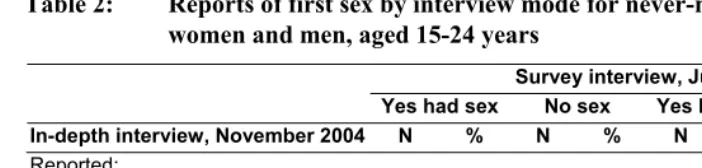
Table 2 shows responses to whether Had Sex by interview mode. Most respondents gave the same answer in the survey and in the in-depth interview. More men, however, were concordant than women (82.5% versus 60.6%, respectively). Most who gave discrepant responses reported in the “no-yes” direction, where a respondent first said to a survey interviewer they had never sex but in the subsequent in-depth interview stated they had. A handful of women and men fall into the “yes-no” sequence (N=6), where they were coded in the survey as having had sex, but told the in-depth interviewers they had not.
Table 2: Reports of first sex by interview mode for never-married young women and men, aged 15-24 years
Survey interview, July 2004
Yes had sex No sex Yes had sex No sex In-depth interview, November 2004 N % N % N % N %
Reported:
Yes had sex 38 66.7 7 12.3 11 33.3 10 30.3
No sex 3 5.2 9 15.8 3 9.1 9 27.3
Total Men = 57 (100.0%) Women = 33 (100.0%)
Notes: Of the 10 women reporting no sex in the survey interview but yes sex in the in-depth interview, 8 predated their time of first sex to a date prior to the survey interview. Of the 7 men with this same discordant reporting sequence, 4 predated their time of first sex to a date prior to the survey interview. These 8 women and 4 men, plus the 6 women and men who said yes sex
in the survey then no sex in the in-depth interview, are inconsistent reporters.
I created a measure of inconsistent reporting using the information in Table 2. Because a “yes-no” sequence is temporally illogical (it is not possible to transition from a state of having had sex to never having had it), these six women and men are categorized as inconsistent. For those in the “no-yes” sequence, I first needed to know whether a respondent had transitioned to first sex during the lag between the survey and the in-depth interview, which was, on average, four months; the survey was administered in July-August 2004 and the in-depth interviews were conducted in November-December 2004. If she had, a no-yes sequence would be a consistent report. To establish the timing of first sex, I analyzed all transcripts for respondents with a no-yes sequence by reading each one twice, looking for and noting when a sexual relationship began. Although I was unable to pinpoint their exact date of first sex, the narratives are sufficiently detailed to know whether a respondent first had sex during the lag or well before the survey.
information to approximate it with confidence. I coded this respondent as a consistent reporter, to be conservative.26
The no-yes reporters who placed the timing of their first sexual encounter before July 2004 probably did first have sex prior to July 2004, and did not err because of poor recall (Fenton et al. 2001; Saltzman et al. 1987). Most in this category identified the timing of first sex as several months prior to July 2004. One woman placed the timing of her sexual debut approximately two years before the survey.
When respondents in the yes-yes sequence first had sex was also documented, to determine whether the consistent reporters really were consistent, and to check for the robustness of the measure of inconsistent reporters. I analyzed the textual data for all 11 women in this category. For the men, I randomly selected 10 respondents (about 25%). Nearly all male and female yes-yes respondents dated their initial sexual encounters at a time prior to July 2004, showing the consistent reporters were consistent.
Thus defined, inconsistent reporters comprise 20% of the total sample (11 women and 7 men), with 8 women and 4 men reporting in the no-yes direction. (Notes from these results are presented in the Appendix; no-yes discordant women are presented in Panel A, men in Panel B. Yes-yes women and men are presented in Panels C and D, respectively.)
4. Results
4.1 Comparing inconsistent and consistent reporters
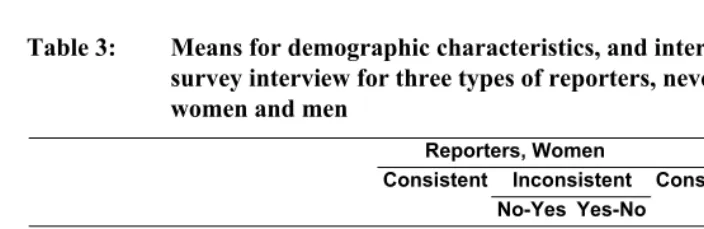
Table 3 presents means for characteristics that may be correlated with the reporting of first sex for young women and men. Two demographic characteristics are used, age and years of education completed. A young woman without much education, for example, might conceal from an interviewer, a person with a secondary-school education and on a higher social rung, her recent sexual encounter with her new boyfriend, for fear of being criticized. Two measures of interaction in the survey interview, presentation of a good self and level of engagement, are also considered. Three types of reporters are used: (1) consistent reporters, (2) those in the no-yes sequence, and (3) those in the yes-no sequence. Despite the small totals, patterns are evident.
Compared to consistent reporters, inconsistent reporters are younger and have fewer years of formal education. For the most part, this pattern holds for both yes-no and no-yes reporters. Mean years of education are substantially lower among the yes-no
women and men, even compared to the no-yes reporters. This may explain the illogical reversal in reporting. These respondents may have misunderstood the questioning about sex, and in one case, the interviewer noted that the respondent had a difficult time understanding the questions. In another yes-no case, the in-depth interview was disrupted by the respondent’s father (see Appendix).27
Inconsistent and consistent reporters also differ by measures of interaction in the survey interview. Compared to those consistent, yes-no and no-yes inconsistent women and men generally scored higher on presentation of a good self, and scored lower on level of engagement.
Table 3: Means for demographic characteristics, and interaction in the
survey interview for three types of reporters, never-married women and men
Reporters, Women Reporters, Men Consistent Inconsistent Consistent Inconsistent
No-Yes Yes-No No-Yes Yes-No
Demographic Characteristics
Age 16.9 16.3 16.0 18.2 16.4 17.7
Years education 7.5 6.0 3.7 6.8 6.8 5.3
Interaction in the Survey Interview
Respondent presents a good self (0-3) 0.7 1.8 2.3 1.0 1.4 0.3
Level of engagement (0-2) 1.3 0.9 1.0 1.2 0.8 0.0
Totals 22 8 3 50 4 3
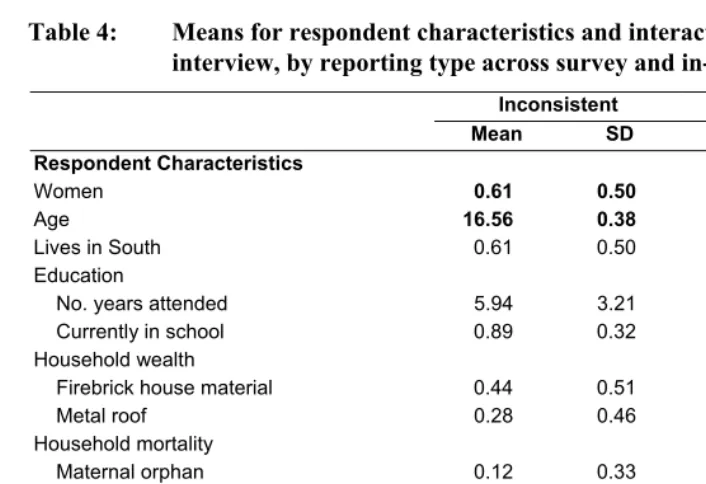
Table 4 presents means for socio-economic and demographic characteristics, and interaction in the survey interview for inconsistent and consistent reporters. To improve statistical power while testing for significant differences between groups, the no-yes and the yes-no reporters were pooled.28 The set of respondent characteristics from the
demographic characteristics of Table 3 were expanded and included sex, age, two measures of education, two measures of wealth, and household-level mortality. Also considered is whether reporters who were inconsistent about sex tended to misreport in
27 During their in-depth interviews, the remaining woman and the 3 men in the yes-no category said
general, even about less sensitive topics. A verifiable measure was used. Survey interviewers ask respondents whether their household had a pit latrine. After the survey interview was complete, the interviewer checked whether the household did have a pit latrine, and recorded it. The point was to verify the accuracy with which the respondent reported. Those whose reports did not match interviewers’ observations were scored “1,” and those concordant were scored “0.”
Table 4 shows that compared to men, women were significantly more likely to report inconsistently (t=-2.46; p=.016). Younger respondents were also more likely to be inconsistent (t=1.93; p=.056). None of the other background characteristics, including educational attainment, current in-school status, household wealth, or household mortality, differ significantly by reporting type.29 Misreporting on the
presence of a pit latrine is not correlated with inconsistent reporting on first sex. Response switchers differed by measures of interaction in the survey interview. Those who were inconsistent scored higher on the presentation of a good self scale. Additional analyses (not shown) demonstrated that of the three items comprising this scale, the effect was largely driven by the “never critical of others” measure. At the same time, inconsistent respondents were less engaged over the course of their interviews (according to the interviewers), suggesting some reluctance to engage with their questioners, and further indicating their desire to protect certain information from being revealed. Finally, an interviewer’s sex, relative to a respondent’s, was uncorrelated with inconsistent reporting.
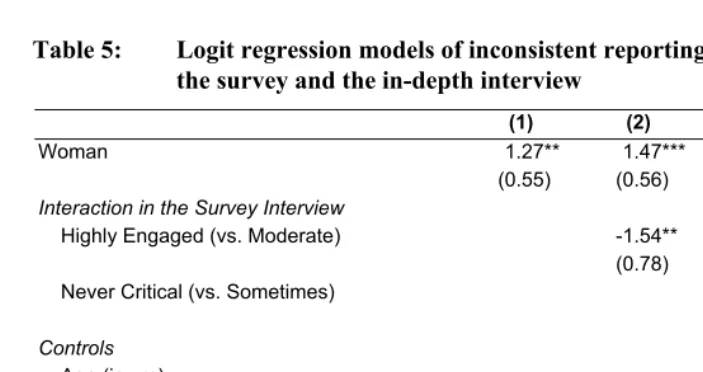
Coefficients with robust standard errors from logit models that formally tested these relationships are presented in Table 5. Model 1 shows the bivariate relationship between being a woman and inconsistent reporting. Two measures of interaction in the survey found significant in Table 4 were added separately, and are shown in Models 2 and 3. For ease of interpretation, the level of engagement scale was collapsed into a dichotomous measure, where those who were very good cooperators during the survey interview were scored “1” and are highly engaged, and those who were good or average collapsed into “0,” and are moderately engaged.30 Presentation of a good self is
measured with a dichotomous measure, never critical of others, versus sometimes.
29 A composite measure of wealth, which added the number of assets in a household (oxcart, pit latrine, bicycle, radio, lamp, and a bed), was also tested. The composite measure is not ideal, given the sample size. Still, this measure of wealth was not significantly different across the two groups. I also tested for having a house made of sun-burnt firebricks (of lower quality than having a house made of fire-burnt bricks), which was not significantly different across the two groups. Other cut-off points for level of educational attainment (dummies for six years completion and for eight years completion) were tested but found not to be correlated with reporting inconsistency.
Model 4 includes the female effect, the two survey interaction measures, plus controls for age and education, both in years.
Table 4: Means for respondent characteristics and interaction in the survey
interview, by reporting type across survey and in-depth interview
Inconsistent Consistent
Mean SD Mean SD Respondent Characteristics
Women 0.61 0.50 0.31 0.47
Age 16.56 0.38 17.74 0.29
Lives in South 0.61 0.50 0.51 0.50
Education
No. years attended 5.94 3.21 7.03 2.91
Currently in school 0.89 0.32 0.75 0.44
Household wealth
Firebrick house material 0.44 0.51 0.46 0.50
Metal roof 0.28 0.46 0.22 0.42
Household mortality
Maternal orphan 0.12 0.33 0.08 0.27
Household member died in past 3 years 0.29 0.47 0.35 0.48
Inconsistent about pit latrine 0.06 0.06 0.16 0.05
Interaction in the Survey Interview
Respondent presents a good self (0-3) 1.44 1.04 0.94 0.98
Respondent’s level of engagement (0-2) 0.89 0.58 1.19 0.62
Respondent-interviewer, same sex (0-1) 0.41 0.12 0.49 0.06
Total 18 72
Notes: Type in boldface indicates mean scores significantly different based on t-test equality of means. Significance for women significant at .05 level. Significance for mean age, presents a good self, and level of engagement significant at the .10 level.
Although the effect of being highly engaged in the survey contributes to the overall model fit, a Wald test showed that the combined effects of being female and never critical was statistically significant and were the strongest contributors (χ2(df=2)=6.50;
Prob > χ2=.038).31
Table 5: Logit regression models of inconsistent reporting of first sex between
the survey and the in-depth interview
(1) (2) (3) (4)
Woman 1.27** 1.47*** 1.04** 1.10*
(0.55) (0.56) (0.51) (0.59)
Interaction in the Survey Interview
Highly Engaged (vs. Moderate) -1.54** -1.53**
(0.78) (0.73)
Never Critical (vs. Sometimes) 1.00** 0.94*
(0.50) (0.53)
Controls
Age (in yrs) -0.12
(0.16)
Education (in yrs) -0.05
(0.13)
Log Likelihood -42.24 -39.97 -40.68 -37.71
Pseudo R-squared 0.06 0.11 0.10 0.16
Observations 90 90 90 90
Notes: *** p<0.01, ** p<0.05, * p<0.1.Robust standard errors in parentheses.
Data come from 90 never-married young women and men who participated in a survey interview and in an in-depth interview in rural Malawi in 2004. The dependent variable is a dichotomous measure of being an inconsistent reporter. Respondents are scored 1 if they switched responses to the question about whether they had ever had sex across interview modes. The following controls were also tested but did not lead to substantively different results (i.e. a substantial change in the relationships between being a woman, measures of the interaction in the survey interview, and the probability of inconsistent reporting): Age in its quadratic form, two measures of wealth—an asset index and having a metal roof (versus thatch)—being in school, and region.
Post-estimate simulations from Model 4 in Table 5 are presented in Table 6. Although the numbers in each cell are small and thus should be viewed with caution, the probabilities are informative and aid interpretation (Long and Freese 2005). The simulations are presented separately for women and men. The outcome is the probability of being an inconsistent reporter. The two independent variables comprising interaction in the survey setting are considered: highly engaged during the survey interview, which contrasts with moderately engaged, and those who reported being never critical of others, which contrasts with those who reported being sometimes critical. Each scenario sets age and education at the mean, by sex.
Among women, the predicted probabilities varied widely across categories, ranging from .09 to .53. Women who were highly engaged in the survey interview had relatively low probabilities of inconsistent reporting, although, even within this category, women who reported being never critical of others had a predicted probability of .20. The highest probability is found among women who were moderately engaged in the survey interview and who stated that they were never critical of others, .53. Although they varied in a pattern that is similar to women’s, men’s overall predicted probabilities were much lower. Men who were highly engaged in the survey interview, but agreed they were never critical of others, for example, had a predicted probability of .06, a difference of .14. Among women and men moderately engaged in the survey interview and who reported being never critical of others, the difference between the predicted probabilities is .29.
Table 6: Simulation of the probability that a never-married person reports on
first sex inconsistently, by respondent-interviewer interaction in the survey interview
Highly Engaged in the Survey Interview
Moderately Engaged in the Survey Interview Never Critical
of Others
Sometimes Critical of Others
Never Critical of Others
Sometimes Critical of Others
Women .20 .09 .53 .31
Men .06 .03 .24 .11
4.2 Interviewer-respondent interaction, and interview mode
If the results from Tables 5 and 6 suggest that respondent-interviewer interaction influences reporting, is it possible to determine why? If some respondents report inconsistently, can we know which response is accurate? To address these questions, I analyzed lengthy sexual histories from the in-depth interviews. Because the multivariate analyses showed that the female effect was strong, in what follows I focus on women.
The dialogue between interviewers and respondents in the in-depth interviews unfolded differently among consistent and inconsistent reporters. Those consistent were engaged throughout their conversation with the in-depth interviewer, including when the subject was on sex, and would tell stories about specific people like friends, for example, and joke and laugh with the interviewer. Most of the inconsistent reporters, however, were not immediately willing to talk about personal topics, including sex. Initially, these women gave brief, one-word answers, but over the course of the conversation, eventually became more talkative and confiding. These interviews highlight two components unique to an in-depth interview — flexibility and reciprocity — that facilitated disclosure about the more intimate details of their lives with complete strangers.
4.2.1 The in-depth interview as a flexible interview
Proponents of in-depth interviews emphasize its flexibility. The content, the length of time spent on a topic, and the direction of the interview are malleable. Its flexible nature enables interviewers to repeat questions, to seek clarification should answers be ambiguous, and to resolve responses when they conflict. Importantly, in-depth interviewers make extensive use of probing techniques to build upon a respondent’s statements throughout the conversation. Because respondents can be asked to clarify confusing answers or to elaborate on a point that would go unquestioned in a standard survey, the accounts generated by a flexible approach to interviewing are likely to be more accurate, especially when the topics are sensitive.
The following excerpt illustrates.32 In it, the interviewer asks the respondent about
her best friend, and then moves to the weightier topic of her “boyfriend.” At first, the respondent tells the interviewer she has never had sex. In response, the interviewer (I)
reverts back to the subject of the respondent’s (R) friend just named, Teema, asking the respondent whether Teema had ever had sex.33
I: Do you have a best girl friend?
R: Yes.
I: Who is she?
R: She is Teema and she is in standard four as I am.
I: What about your friend Teema, did she do well in class?
R: Yes, but not so very, average I mean.
I: [Smiling] Do you have a boyfriend?
R: No, I don’t have one.
I: Did you have one in the past?
R: No.
I: What about your friend Teema, did she have a boyfriend?
R: Yes.
I: How do you manage to chat with a friend who has a boyfriend, while you don’t have [one], and take her as your best friend?
R: [Laughing] We chat without problems because we always talk of school, not boyfriends.
The interviewer was able to re-direct the conversation and return to newly learned information about the friend, Teema. The interviewer then gently prodded by again asking about boyfriends and sex. Subsequently, the respondent revealed that she did indeed have a boyfriend:
I: Tell me the truth. As stated, these things are kept secretly. Nobody knows your answers, even your parents.
R: [Agreeing and smiling] I had sex with only one boy.
I: Who was that boy?
R: He was Raffiq.
The interview’s loose structure allowed talk to be unencumbered by a circumscribed sequence. In this case, the interviewer asks two additional questions following the first question on the sensitive topic that the respondent did not receive well initially (Schober and Conrad 1997). Following these two questions, the interviewer returned to the sensitive topic.
The respondent revealed detailed information about Raffiq (not shown), and continued to talk about her second, and most recent boyfriend, Abdul. By asking questions that directly built upon information about the first boyfriend, Raffiq, the interviewer retrieved specific details about Abdul and where they met to have sex:
I: (She said she found another [boyfriend] while she was 14 years that was soon after Raffiq.) Why did you find another soon after Raffiq since your parents told you not to do it again?
R: It was because the new boy lived in another village and I thought my mother would not notice.
I: Who was that boy?
R: He was Abdul and is 13 yrs old and in std 3 while I was in std 4 and 14 yrs old.
I: Is he a Moslem ?
R: Yes.
I: What is so special with Moslems, since your first boyfriend was also a
Moslem.
R: There is nothing special. It just happened that I meet them. ... and because I just wanted to replace Raffiq and Abdul lived in another village.
I: Where did you meet in order to have sex ?
R: We live in different villages but the villages are closer, so I started playing hide and seek in Abdul’s village for the sake of having sex with him.
I: Did your parents allow you to play in another village at night?
R: Yes, girls and boys of close villages play together. It happens that three or four villages play on the same night and we choose which village to go to.
The in-depth interviewer may subtly challenge respondents suspected of withholding information, or who give contradictory explanations. In the following excerpt, the interviewer is suspicious of a respondent’s claim that she had not had intercourse with her male suitor, because the respondent had said she had “visited” him, which, in this context, means a sexual encounter was likely to have occurred, and because the respondent said she had received money from the man, an act that signals a sexual relationship:
I: Last time, you told me that your boyfriend gave you money, but [said] you never have sex [with him]. I want to know, why did he keep on giving you money?
R: Because he loves me and he wanted me to accept sex one day if he asked.
R: I visited him during afternoon hours [to have sex], and made sure to go back home before darkness falls.
The next excerpt shows how the in-depth interview allows a respondent to tell her interviewer a complete story—how it was that her boyfriend “proposed,” what it was they talked about when they were together, and how they came to first have intercourse. In the excerpt that follows, the respondent describes how she had been proposed:
I: What about him, where did you first see each other?
R: We were learning at the same school at Ndithu Community Day Secondary School. When he was in Form 4, I was in Form 2. He proposed to me when he was writing his Malawi School Certificate of Education examination. What happened is that he sent a friend to tell me. The friend called me and told me that his friend wanted me to be his girlfriend. I was very surprised and I asked him which friend of his was that. He answered that it was him [my chibwenzi]. I told him to tell the one who sent him that I have refused. I didn’t want to indulge myself in any relationship. He [the one who was sent] convinced me that his friend loved me but I still refused. That day he went and the other day he [the one who wanted me] came and called me. I was in class that time and there was no teacher. When I went he asked me to give him his response. I asked him what his friend told him, but he said that his friend told him nothing. I told him that I didn’t want to be his girlfriend. He asked me why and I told him that I was not interested to indulge myself in any relationship, as I had told his friend.
Although this woman did not accept this young man’s proposal, it demonstrates how, given an appropriate conversational context, individuals confess the intimate details of their lives.
4.2.2 The in-depth interview as a reciprocal exchange
in a negotiated exchange, the latter characterized by binding agreements, and the type most survey interviews embody—e.g., “you give me two hours of your time and many details of your life, as well as your ideas and what you know, and I will give you two bars of soap and a thank you for your time.”
Soap and an expression of thanks may not be a sufficient gift for some respondents, especially when survey interviews take two hours and ask detailed questions about the most intimate areas of life. Moreover, risk and uncertainty may remain high, even with assurances of confidentiality, because they are attached to the giver of the assurances, whom the respondent may not trust. What might be needed instead is not an object, but rather personal, exclusive information—a secret divulged by the interviewer herself.
Several transcripts showed how trust could be fostered when interviewers gave something the respondent perceived to be of equal value, effectively reducing the respondent’s transaction costs (Molm et al. 2007). One interviewer, Mary, noted she thought a respondent, Andosyaga, was “lying,” when she told Mary that she had had a relationship with a young man but that it was not sexual; Mary went on to say that the Andosyaga “failed to explain clearly.” Mary decides to reveal information about her own boyfriend, in turn generating trust:
I: Then I told her that I have a boyfriend who loves me and gives me money, what I did in turn is to accept his will of having sex. Thereafter I told her to be comfortable when explaining and say only the truth as the information I collected from will be kept secret as I told her at the [beginning] of interview there.
R: [Laughing] We had sex only two times. The young man lived in the nearby village and his father had a grocery at the trading centre. When the young man went to his father’s grocery he passed through the road near my home. We greeted each other. One day he called me and asked to visit his house. I accepted and visited him.
I: There he proposed [to you] by saying I want you?
R: He answered “I want to have sex with you.” I refused by saying “I don’t want.” The young man said that I love you please let us have sex, then I accepted. That was the [beginning] of the relationship.
I: Why did you lie at first?
R: [Laughing] I’m shy. If it had been that you never talked about your boyfriend I wouldn’t tell you all.
Because interviewers were from nearby communities, they could capitalize on common understandings about what promotes intimacy between two strangers, thereby increasing women’s propensity to trust them (Barnes 1994; Collins 2004). In Malawi, most women, young and old, have a “best friend,” a confidante with whom they share the more intimate details of their lives, to the exclusion of others. Often an interviewer began an interview by encouraging a respondent to think of the conversation they were about to have as if she were going to have it with her best friend.
This altered the environment in which the questions were asked, and created a social tie between interviewer and respondent, and, in effect, assuaged any worries a young woman may have had about the kind of self-performance she should enact. In the preceding quote, the interviewer demonstrates empathy about what it is like to have an intimate partner, who, she says, “loves me and gives me money.” The interviewer showed that she experiences something that the respondent might also experience. Or, as another interviewer began the conversation about sex, “Sometimes it happens that you have sex with someone not because he is a partner, but you just love each other on that same point, so how about you?” Here the interviewer’s attempt to reduce the social distance between herself and the respondent makes it socially acceptable for the respondent to provide an alternative (and more honest) narrative regarding sexual behavior.