in the population sciences published by the Max Planck Institute for Demographic Research Konrad-Zuse Str. 1, D-18057 Rostock · GERMANY www.demographic-research.org
DEMOGRAPHIC RESEARCH
VOLUME 20, ARTICLE 13, PAGES 279-312
PUBLISHED 20 MARCH 2009
http://www.demographic-research.org/Volumes/Vol20/13/ DOI: 10.4054/DemRes.2009.20.13
Descriptive Finding
Dispensing with marriage:
Marital and partnership trends in rural
KwaZulu-Natal, South Africa 2000-2006
Victoria Hosegood
Nuala McGrath
Tom Moultrie
© 2009 Victoria Hosegood, Nuala McGrath & Tom Moultrie.
This open-access work is published under the terms of the Creative Commons Attribution NonCommercial License 2.0 Germany, which permits use, reproduction & distribution in any medium for non-commercial purposes, provided the original author(s) and source are given credit.
1 Introduction 280
2 Marriage and partnering in South Africa: A review of the literature 281 2.1 Influence of apartheid-era policies and labour migration 281 2.2 Overview of the legal and traditional context of marriage in South
Africa
283
2.3 Marriage and childbearing in KwaZulu-Natal, South Africa 283 2.4 Data format and availability 261
3 Data and methods 285
3.1 Study area 285
3.2 The Africa Centre Demographic Surveillance System 286
4 Results 288
4.1 Marriage patterns 288
4.2 Polygamous marriages 292
4.3 Age at first marriage 292
4.4 Partnership patterns 293
4.5 Household and residential arrangements of partners 294 4.6 Consistency of reporting of marriage data in ACDIS 297
5 Conclusions 298
6 Acknowledgements 301
References 302
Dispensing with marriage:
Marital and partnership trends in rural
KwaZulu-Natal, South Africa 2000-2006
Victoria Hosegood 1
Nuala McGrath 2
Tom Moultrie 3
Abstract
This paper describes marriage and partnership patterns and trends in rural KwaZulu-Natal, South Africa from 2000-2006. The study is based on longitudinal, population-based data collected by the Africa Centre demographic surveillance system. We consider whether the high rates of non-marriage among Africans in South Africa reported in the 1980s were reversed following the political transformation underway by the 1990s. Our findings show that marriage has continued to decline with a small increase in cohabitation among unmarried couples, particularly in more urbanised areas. Comparing surveillance and census data, we highlight problems with the use of the ‘living together’ marital status category in a highly mobile population.
1 Department of Epidemiology & Population Health, London School of Hygiene and Tropical Medicine, UK. Africa Centre for Health and Population Studies, University of KwaZulu-Natal, South Africa.
E-mail: [email protected]
2 Department of Epidemiology & Population Health, London School of Hygiene and Tropical Medicine, UK. Africa Centre for Health and Population Studies, University of KwaZulu-Natal, South Africa.
1. Introduction
By the 1980s, when retrospective analyses of African censuses and fertility surveys showed that changes in nuptiality were occurring in many sub-Saharan countries, marriage patterns in South Africa were already exceptional (Harwood-Lejeune 2000; Lesthaeghe & Jolly 1995; Van de Walle 1993). The mean age of marriage for men (28.0 years) was higher than all other regions in Africa, and that of women (23.2 years) was one of the highest (Locoh 1988). In seeking to document and explain the early and advanced decline in African marriage in South Africa, authors have paid particular attention to the profound and lasting influences of apartheid policies. In the 1990s, it was unclear if, and how, the anticipated increase in political, social, and economic opportunities for Africans resulting from political change would affect family life. Taken in their entirety, contemporary tribal, religious, and legislative structure and processes are favourable towards marriage and seek to promote it as the preferred family institution. The action by the country’s first post-apartheid government to formulate a new marriage act that sought to recognise and legitimise the plural religious and ethnic marriage traditions in the country exemplifies strong social norms about the positive value of marriage. Would political change lead to a reversal in the movement away from universal marriage? However, at the same time as political transformation, South Africa started to experience a rapid and severe HIV epidemic further complicating predictions of future trends in marriage. Any impact of HIV and AIDS on marriage, re-marriage, and widowhood would occur in tandem with other social and economic changes affecting people’s decisions about family formation (Heuveline 2004).
This paper describes contemporary patterns and trends in marriage and partnering in rural KwaZulu-Natal. The descriptive findings are a starting point for further research on this subject. They fill a gap in the South Africa marriage and household literature, and provide a platform for exploring causative factors. The paper is structured as follows. We first review the literature relating to marriage in South Africa, with a specific focus on Zulu marriage traditions. We then describe the ACDIS data used in the study and provide background information about the study population and area. We present population trends in patterns of marriage and partnerships, and describe the household and residential arrangements of partners. In the appendix, we present a detailed comparison of marital data from ACDIS with the 2001 South African census data from the same province.
2. Marriage and partnering in South Africa: A review of the
literature
2.1 Influence of apartheid-era policies and labour migration
Of the many reasons that have been suggested for the decline in marriage and increases in marital instability among African South Africans, most relate directly or indirectly to the oppressive social and political structures and processes created during the apartheid-era. The labour migration system created during the apartheid-era has been a profound force of instability and change in African family life. An extensive literature documents the effects of government policies on labour migration, restrictions of free movement, and the creation of tribal homelands placed on family building, living and care arrangements, and livelihoods (see for example, Jones 1992; Mayer 1980; Murray 1980, 1981, 1985; Spiegel 1980; Spiegel, Watson, and Wilkinson 1996).
The effect of men’s absence from the rural family home, the formidable challenges faced by families in urban areas, and the high levels of female participation in the labour market has been shown to exacerbate the poor quality of gender relationships in South Africa (Moore 1994). Migration of both men and women created separate spheres of living, where the different social, physical, and cultural worlds inhabited by the couple were incompatible or even threatening to each other (Preston-Whyte 1993). In this context, migrant men and women took other partners and formed second families at the places where they worked. Women entered the labour force in large numbers and were able to provide for themselves and their children with or without the support of male partners (Bozzoli 1991). One outcome of this separation was the increase in the instability of marriages, not merely because of physical separation, but by altering the roles of husbands and wives.
2.2 Overview of the legal and traditional context of marriage in South Africa
The post-apartheid Recognition of Customary Marriages Act, Act 12 of 1998 was a
radical attempt to recognise the diversity of cultural and religious traditions in South Africa, at the same time as increasing the role of the state in protecting the rights of women within marriage, particularly with regards to children and property (Chambers 2000; Posel 1995). The 1998 Recognition of Customary Marriages Act permitted marriages solemnised only through customary or traditional laws to be recognised as legal marriages. Whereas previously, only Natal (now KwaZulu-Natal) had permitted, or rather compelled, Africans to register customary unions (Posel 1995). The 1998 Act, which came in to effect in 2000, declared that all customary unions could be considered as legal marriages provided that criteria relating to consent and community of property are met, and that the marriage is registered (Budlender, Chobokoane, and Simelane 2005). The 1998 Marriages Act also recognised polygamous unions. Polygamy is synonymous with polygyny in South Africa given the exceedingly rare occurrences of polyandry. Budlender, Chobokoane, and Simelane (2005) suggest that the rate of polygamy reported in surveys and the South African Census may be over-estimated due to a social desirability bias, leading respondents to report additional non-marital partners as ‘wives’.
2.3 Marriage and childbearing in KwaZulu-Natal, South Africa
cost of bridewealth and a tacit acceptance of extra-marital fertility (Burman and Preston-Whyte 1992; Burman and van der Werff 1993; Goody 1973).
The economic, religious, political, and legal circumstances which have given rise to contemporary patterns of marriage in KwaZulu-Natal are complex. The abutting of Western and African ideologies, traditions, and political power has been a story of incorporation and opposition. So-called ‘Bantu marriages’ were thought by many administrators and civic leaders to be a ‘great evil’ and a cause of family and social degeneration (Posel 1995). The legacy of the early Natal administrators is that they co-opted and codified bridewealth. While historically the amount of bridewealth was negotiated by the families involved and was rarely paid in full before marriage took place, the Natal code subjected Zulu women to a fixed, and very high bridewealth of eleven head of cattle or their equivalent value (Burman and van der Werff 1993; de Haas 1987; Preston-Whyte 1993). From Union in 1910 to the first democratic elections in 1994, successive national administrations sought to gain control over the diverse ‘traditional’ or ‘customary’ marriage practices (McClendon 2008). African marriage was subject to the parallel legal systems created for Africans based on codifying an assortment of contemporary and historical indigenous customary laws. In contrast, several indigenous marriage customs were eschewed by Christian missionaries and later the established Christian congregations in South Africa, which strongly proscribed against polygyny and the levirate (widow inheritance). In Natal, the Natal Code of Black Law (1967) altered the requirements for consent, bridewealth and divorce (see description in Cassim 1981). It was not until the new South African Marriages Act (1998) that all marriage systems were recognized as equal. Customary marriages that comply with the provisions of the act are now considered as valid marriages.
Specific features of the Zulu marriage and childbearing tradition may make marriage more vulnerable than in other population and language groups. Many authors have noted the exceptionally high price of Zulu bridewealth. Called ilobolo in Zulu, it involves a payment or transfer of property from the groom’s family to the bride’s family. The cost and complexity of the marriage process increases when families follow, as most do, both the traditional Zulu and Christian marriage ceremonies and rites. Traditional paternity claims require a man to either marry the child’s mother or pay ‘damages’ to her family. It has been argued that the existence of the second option encouraged men to avoid the higher costs and obligations of marriage whilst claiming their children (Hunter 2006). In the 1980s and 1990s, despite the context of economic disadvantage and high unemployment, 70% of Zulu-speaking respondents thought that the custom of ilobolo would survive, twice the proportion of Xhosa-speakers, another large ethnic group in South Africa (Burman and van der Werff 1993).
Preston-Whyte and Zondi (1992) noted: ‘There is a sense in which the value placed upon children is so high for many people that marriage is, in some contexts, quite irrelevant to the bearing of a child. This is not to suggest that in general marriage is not regarded as the appropriate arena for birth. It is. But failing marriage, children have a value in themselves which cannot be gainsaid.’ However, this intrinsic value has not stopped fertility among African South Africans from falling steadily over the last forty years (Moultrie and Timæus 2003). While fertility data for Africans in KwaZulu-Natal are not available for the 1970s or 1980s, by the time of the 1996 census, fertility among Africans in KwaZulu-Natal was 3.7 children per woman. Five years later, in 2001, fertility in the same group was 3.2 children per woman (Moultrie and Dorrington 2004). The decline is primarily driven by long birth intervals and high rates (at least by regional standards) of contraceptive use. Although life-time fertility is lower in unmarried women, extra-marital fertility is nonetheless very high, and fertility differentials by marital status are small (Moultrie and Timæus 2001). The severe HIV epidemic in KwaZulu-Natal has not been shown to be a main determinant of aggregate fertility decline. A recent study using longitudinal population-based data in rural KwaZulu-Natal (ACDIS data) suggests that fertility in or up to 2005 may have in fact stalled (Moultrie et al. 2008).
3. Data and methods
3.1 Study area
the economically active, is high (39% of people aged 15–65 years in 2001) (Case and
Ardington 2004). Rural areas of KwaZulu-Natal have very high levels of HIV
prevalence and as yet there is no evidence of a decline in incidence (Bärnighausen et al. 2007; Dorrington et al. 2006; Welz et al. 2007). HIV prevalence in the surveillance area has reached high levels in the antenatal population (38% in 2005) (Rice et al. 2007), and 22% in the general population in 2003/4 (prevalence among resident women aged 15-49 years and men aged 15-54 years) (Welz et al. 2007).
3.2 The Africa Centre Demographic Surveillance System
Started in 2000, the surveillance population includes approximately 86,000 people who are members of around 11,000 households (Tanser et al. 2007). Demographic data on individuals and households in the surveillance area are collected twice annually, and information on births, deaths, changes in marital status, and migration is updated at each round. To reflect the complexity of living arrangements in South Africa, data are collected on both resident and non-resident household members, and the system allows individuals to be reported as members of multiple households (Hosegood, Benzler, and Solarsh 2005; Hosegood and Timæus 2005). The level of participation by households in ACDIS is high - around 99% in each round.
Marriage and partnership data are collected for all adult household members (resident and non-resident members) during bi-annual household visits. Information is provided by each adult member if present, or by a proxy household respondent. Data collected during the previous household visit are pre-printed on the questionnaire, then checked and updated. The questions, codes, and explanatory notes can be accessed at:
www.africacentre.ac.za. Briefly stated, the marital status on the day of the visit is
recorded for all men and women 18 years or older using a detailed hierarchical coding system. For currently married respondents, information is recorded about whether the marriage has been registered. For couples married by a marriage officer (for example, at a registry office or by a religious leader) registration is automatic. Information is also collected about monogamous and polygamous marriages. Those not currently married are asked whether they have ever been married (widowed, divorced) or are engaged to be married.
involving proxy respondents. A hierarchy is used to code people with multiple concurrent relationships. Currently married people are assigned as having a marital partner and are not asked about regular or casual partners. For unmarried people, a regular partner is preferentially recorded over any concurrent casual partner(s). While information about concurrent partners would provide a more complete understanding of partnering, the collection of such personal and potentially sensitive data is not considered appropriate during routine household visits given that data may be collected from proxy respondents.
Further information is recorded about conjugal relationships i.e. marital or regular partnerships in which both partners are members (resident or non-resident) of the same household. In such cases, the male partner is linked to the female partner, the date of when the relationship started is recorded, and the continuation or dissolution of conjugal relationships is updated at each subsequent visit. These relationship-dyads can be linked to other information about the partners including residential status, employment, and parental relationship to children in the household.
The approach to collecting marriage, partnership, and conjugal relationship data has remained unchanged in all the data collection rounds. From round 4, the marital codes were expanded slightly to increase the level of detail about marriage registration. Additional self-reported marital and partnership data are available for the sub-sample of adults participating in annual, linked HIV and sexual behaviour surveys. During the HIV and sexual behaviour survey interview data are collected that are either more sensitive, e.g. the characteristics of recent sexual partners and the number of life-time sexual partners; or are reliably known only by the individual themselves e.g. age at marriage or age at first sex. In this paper we concentrate on data collected by the routine household surveillance and use linked survey data only when comparing self and proxy reports of marital and partnership status, and age at first marriage.
4. Results
4.1 Marriage patterns
This section describes the characteristics and trends in marriage over fifteen rounds of household surveillance data from 2000-2006. There has been a continued decline in marriage between 2000 and 2006 in the ACDIS population. Figure 1 presents the proportion ever married by age and sex in the first and last years of available data, 2000 and 2006. ACDIS being an open cohort means that the populations in 2000 and 2006 are not identical. The trend by year (not shown) is a small but consistent reduction in the proportion ever married by age and sex for both sexes. There is no discernable marital change in older men aged 50 years and older.
Figure 1: Distribution of ever marriage by sex and age, ACDIS 2000 and 2006
0 10 20 30 40 50 60 70 80 90 100
18-24 25-29 30-34 35-39 40-44 45-49 50-54 55-59 60+
%
ev
er
mar
ri
ed w
ithi
n ag
e gr
oup
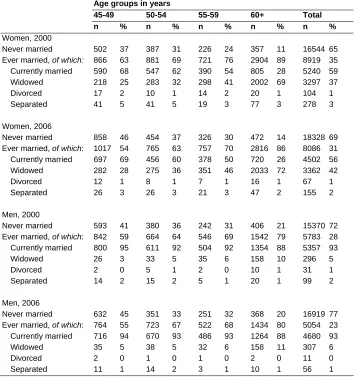
The reduction in the proportion of married adults in reproductive ages is being largely driven by non-marriage rather than widowhood or divorce despite increasing young adult mortality. Table 1 presents the age-specific marital status among those reported to be currently married in 2000 and 2006. While the proportion of adults that have ever been married has fallen in each age group between 2000 and 2006 (with the exception of men aged 50-54 and 60+ years), the distribution of marital types (currently married, widowed, divorced, and separated) among those ever married has not substantially changed. A more substantial increase in the proportion of widows/widowers in younger age-groups was expected given the high level of AIDS mortality. In a period where antiretroviral treatment was not available in public health facilities, the impact of adult mortality on the rate of widowhood may be masked by the subsequent death of widowed spouses, as well as by re-marriage.
Few adults are reported as divorced or separated, the proportion not rising above five percent in any age group. The low rate of divorce in the ACDIS population likely reflects the high proportion of marriages contracted through customary rites. Prior to 1998, marriages contracted under the Customary Marriage Act could be dissolved by a tribal court. However, in practice this was rarely done given the complexity of the marriage process and attendant payments between families, barriers to litigation by women, and traditional customs that allowed men to take additional wives. We might also expect an under-reporting of divorce, particularly in families whose faith tradition does not permit divorce.
Table 1: Distribution of marital status by age and sex, ACDIS 2000 and 2006
Age groups in years
18-24 25-29 30-34 35-39 40-44 n % n % n % n % n %
Women, 2000
Never married 6173 99 3709 89 2390 73 1677 62 1123 49
Ever married, of which: 62 1 422 11 864 27 1024 38 1175 51
Currently married 56 90 387 92 754 87 830 81 881 75
Widowed 3 5 26 6 86 10 143 14 238 20
Divorced 0 0 2 0 6 1 20 2 15 1
Separated 3 5 7 2 18 2 31 3 41 3
Women, 2006
Never married 6974 99 3781 93 2672 82 1616 65 1175 55
Ever married, of which: 61 1 272 7 598 18 852 35 948 45
Currently married 59 97 263 97 534 89 698 82 697 74
Widowed 2 3 9 3 60 10 132 15 218 23
Divorced 0 0 0 0 4 1 8 1 12 1
Separated 0 0 0 0 0 0 14 2 21 2
Men, 2000
Never married 5486 100 3504 98 2240 85 1544 66 975 52
Ever married, of which: 6 0 84 2 409 15 804 34 886 48
Currently married 4 67 81 96 393 96 773 96 837 94
Widowed 1 17 2 2 7 2 12 1 22 2
Divorced 0 0 0 0 2 0 6 1 4 0
Separated 1 17 1 1 7 2 13 2 23 3
Men, 2006
Never married 6712 100 3708 99 2508 91 1442 73 947 56
Ever married, of which: 6 0 54 1 252 9 544 27 755 44
Currently married 4 67 49 91 249 99 523 96 719 95
Widowed 1 17 5 9 1 0 13 2 24 3
Divorced 0 0 0 0 0 0 0 0 5 1
Table 1: (Continued)
Age groups in years
45-49 50-54 55-59 60+ Total n % n % n % n % n %
Women, 2000
Never married 502 37 387 31 226 24 357 11 16544 65
Ever married, of which: 866 63 881 69 721 76 2904 89 8919 35
Currently married 590 68 547 62 390 54 805 28 5240 59
Widowed 218 25 283 32 298 41 2002 69 3297 37
Divorced 17 2 10 1 14 2 20 1 104 1
Separated 41 5 41 5 19 3 77 3 278 3
Women, 2006
Never married 858 46 454 37 326 30 472 14 18328 69
Ever married, of which: 1017 54 765 63 757 70 2816 86 8086 31
Currently married 697 69 456 60 378 50 720 26 4502 56
Widowed 282 28 275 36 351 46 2033 72 3362 42
Divorced 12 1 8 1 7 1 16 1 67 1
Separated 26 3 26 3 21 3 47 2 155 2
Men, 2000
Never married 593 41 380 36 242 31 406 21 15370 72
Ever married, of which: 842 59 664 64 546 69 1542 79 5783 28
Currently married 800 95 611 92 504 92 1354 88 5357 93
Widowed 26 3 33 5 35 6 158 10 296 5
Divorced 2 0 5 1 2 0 10 1 31 1
Separated 14 2 15 2 5 1 20 1 99 2
Men, 2006
Never married 632 45 351 33 251 32 368 20 16919 77
Ever married, of which: 764 55 723 67 522 68 1434 80 5054 23
Currently married 716 94 670 93 486 93 1264 88 4680 93
Widowed 35 5 38 5 32 6 158 11 307 6
Divorced 2 0 1 0 1 0 2 0 11 0
4.2 Polygamous marriages
Although there is a tradition of polygamous marriage in Zulu society (de Haas 1984), the majority of marriages in ACDIS 2000-2006 were reported to be monogamous. Polygamous marriages constitute 12% of all marriages in women and 14% in men in 2006. The level of polygamy is higher than that found in the 1998 South African DHS (KwaZulu-Natal sub-sample) where 7% of married African women reported that their husbands have other wives. Polygamous marriages are, as expected, highest in the oldest age group. In ACDIS, 25% of all currently married women and 29% of currently married men aged 60 years and older in 2006 are in polygamous marriages. The prevalence of polygamy is declining across all age groups though it remains higher than in the country as a whole, bolstered in part by the influence of the Shembe religion in the province, an African-initiated religion that both permits, and favourably views, polygamous marriages (Krige 1965). The majority of households are not expected to report polygamously married members given that they follow religious traditions that do not permit polygamous marriages. However, in qualitative research conducted in the same area, we have occasionally observed men reporting non-marital partners as additional ‘wives’. While the majority of marriages in the ACDIS population are now civilly registered, the opposite is true of polygamous marriages despite provision being made for such marriages in the Marriage Act. Only 30% of women whose husbands have other wives are in registered marriages. The low rate of polygamous marriage registration may reflect a disinclination on the part of some groups to engage with statutory regulatory systems in general; but may also be influenced by the higher prevalence of polygamous marriages among older people.
4.3 Age at first marriage
4.4 Partnership patterns
Low rates of marriage in the ACDIS population are offset by high rates of non-marital partnerships. The age-specific patterns of non-marital partnerships in 2000 and 2006 are shown in Figure 2. The pattern of non-marital regular partnerships has maintained the same general age-specific pattern but has risen year to year between 2000 and 2006. By 2006, the majority of unmarried women (63%) and men (63%) 18 years and older are reported to have had a regular partner or casual partner. The proportion of younger adults reporting having a casual partner(s) fell by half between 2000 and 2006. It would be rash to use these data in isolation as evidence of a substantive change in casual sexual partners given that it might also arise from an increasing avoidance of reporting ‘casual’ partners (desirability bias).
Figure 2: Partnership patterns by age and sex, ACDIS population
2000 and 2006 1
0 20 40 60 80 100
18- 24 25- 29 30- 34 35-39 40-44 45-49 50- 54 55- 59 60+
Marit al Regular non-marit al Casual No par t ner
0 20 40 60 80 100
18- 24 25- 29 30- 34 35-39 40-44 45-49 50-54 55- 59 60+
Marit al Regular non-marit al Casual No par t ner
0 20 40 60 80 100
18-24 25-29 30-34 35-39 40-44 45-49 50-54 55-59 60+
Mar i tal Regul ar non-mar i tal Casual No par tner
0 20 40 60 80 100
18- 24 25- 29 30- 34 35- 39 40-44 45- 49 50- 54 55-59 60+
Mar it al Regular non- mar it al Casual No par t ner
1 At each routine household visit, ACDIS records one partnership pattern for each person. A hierarchy is used to code people with
4.5 Household and residential arrangements of partners
The very high level of migration in this part of South Africa creates a context in which many married couples live apart. Therefore, cohabitation is one, but not the only, indicator of social connectedness between partners. In ACIDS, cohabitation arrangements are recorded separately from the indicator that the couple are in a ‘conjugal relationship’, meaning that both partners are considered to be a member of the same household (regardless of whether they are resident or non-resident). A diverse set of arrangements may exist. A married couple may be considered to be members of the same household even though one spouse is working and living elsewhere. Unmarried partners may not be reported as members of each other’s rural household even though they co-habit in the place to which they migrate for work. Table 2 shows the proportion of conjugal relationships for all resident women and men reporting a marital or non-marital relationship in 2006. Amongst the youngest age group, few partners are considered to be a member of the same household. Although older people are more likely to have a conjugal partner, the proportion is still less than half even amongst women and men aged 30-34 years. In the lower section of Table 2, we present more detailed data on social and residential arrangements by marital status in women. We do not present the data about the partner’s residential status for men given that it is complicated by polygamous relationships.
Table 2: Distribution of conjugal relationship in women by marital status, partnership status and male partner’s co-residency (number and percentage). ACDIS, 2006
Age groups in years
18-24 25-29 30-34 35-39 40-45 45-49 50-54 55-59 60+ all ages
Marital or partnership pattern n n n n n n n n n n
(%) (%) (%) (%) (%) (%) (%) (%) (%) (%)
Number of resident women (total) 3889 1907 1704 1524 1458 1436 1002 943 3044 16907 Number of resident women with a marital
or regular partner 2462 1699 1478 1275 1128 1002 589 474 823 10930 Of women with a marital or regular
partner 1:
Proportion with a conjugal partner (resident or non-resident)
155 (6.30) 358 (21.07) 558 (37.75) 709 (55.61) 721 (63.92) 739 (73.75) 440 (74.70) 357 (75.32) 586 (71.20) 4623 (42.30) Proportion of conjugal unions with a
resident male partner 2
100 (67.57) 229 (66.76) 325 (60.30) 420 (60.43) 438 (61.60) 472 (64.92) 297 (68.91) 244 (69.12) 491 (84.80) 3016 (66.64) Of married women only:
Proportion with a conjugal partner (resident or non-resident)
15 (57.69) 114 (86.36) 282 (83.19) 471 (86.58) 511 (85.74) 542 (87.14) 354 (86.34) 298 (84.66) 516 (75.00) 3103 (83.66) Proportion of conjugal unions with a
resident male partner
11 (78.57) 68 (60.71) 168 (60.43) 260 (55.91) 288 (56.80) 334 (62.08) 234 (66.86) 207 (69.70) 437 (85.35) 2007 (65.31) Of women in an unmarried regular
partnership only:
Proportion with a conjugal partner (resident or non-resident)
140 (5.75) 244 (15.57) 276 (24.23) 238 (32.56) 210 (39.47) 197 (51.84) 86 (48.04) 59 (48.36) 70 (51.85) 1520 (21.05) Proportion of conjugal unions with a
resident male partner
89 (66.42) 161 (69.70) 157 (60.15) 160 (69.57) 150 (72.53) 138 (73.02) 63 (77.78) 37 (66.07) 54 (80.60) 1009 (69.44) Of women in an unmarried regular
partnership only (by residence) Proportion with a conjugal partner (resident or non-resident) among women resident in a peri-urban or urban area 64 (7.87) 119 (19.77) 125 (26.48) 93 (30.49) 99 (40.08) 75 (50.68) 34 (50.75) 17 (39.53) 27 (39.53) 653 (23.75)
Proportion with a conjugal partner (resident or non-resident) among women resident in a rural area
76 (4.68) 125 (12.95) 151 (22.64) 145 (34.04) 111 (38.95) 122 (52.59) 52 (46.43) 42 (53.16) 43 (51.81) 867 (19.39)
1 In ACDIS, a conjugal relationship can only be recorded for adults (>15 years old) reported to be currently in a marital or regular
partnership. We have restricted the sample presented in this table to people aged 18 years and older for consistency with marital status. There are very few non-marital conjugal relationships reported for people less than 18 years of age.
2
In understanding changes in family formation and building, parenting and economic livelihoods, it is important to know whether the increasing proportion of non-marital unions are different in terms of their residential arrangements to the non-marital unions they are replacing. Amongst those couples considered to have a social connection (conjugal relationship), cohabitation is actually more common among unmarried than among married couples in all age groups except 18-24 years (Table 2). Co-residence may enhance the perception that an unmarried couple has formed their own household, whereas for married couples, social recognition is a function of their marriage regardless of their cohabitation. Overall, in ACDIS since 2000, the proportion of women in a marital or regular partnership whose partner is a member of the same household has declined from 55%, to 51% in 2003, and 42% in 2006.
Table 3: Distribution of never marriage and non-marital conjugal relationships in resident women by area and age (number and percentage), ACDIS, 2006
Age groups in years
18-24 25-29 30-34 35-39 40-45 45-49 50-54 55-59 60+ all ages
Marital or partnership pattern n n n n n n n n n n
(%) (%) (%) (%) (%) (%) (%) (%) (%) (%)
Of women resident in peri-urban or urban areas1:
Proportion never married2 1293
(98.78) 708 (93.04) 570 (76.31) 376 (56.97) 307 (49.68) 241 (49.69) 130 (41.40) 116 (36.36) 186 (23.11) 3927 (65.25) Of women resident in a rural area:
Proportion never married 2648 (98.92) 1085 (92.26) 766 (78.56) 499 (56.64) 363 (42.41) 320 (33.23) 198 (28.49) 135 (21.57) 233 (10.34) 6247 (56.26) Of women in an unmarried regular
partnership and resident in a peri-urban or urban area:
Proportion with a conjugal partner (resident or non-resident)3
64 (7.87) 119 (19.77) 125 (26.48) 93 (30.49) 99 (40.08) 75 (50.68) 34 (50.75) 17 (39.53) 27 (39.53) 653 (23.75) Of women in an unmarried regular
partnership and resident in a rural area: Proportion with a conjugal partner (resident or non-resident)
76 (4.68) 125 (12.95) 151 (22.64) 145 (34.04) 111 (38.95) 122 (52.59) 52 (46.43) 42 (53.16) 43 (51.81) 867 (19.39)
1 An urban homestead lies within the municipal authority boundaries; a peri-urban area is classified by ACIDS on the basis of a
population density of more than 400 people per km2.
2
The difference between the proportions of resident women never married in the two types of area was statistically significant (chi-squared test value p<0.05) for all age groups 40+ years and older.
3
The difference between the proportions of resident unmarried women with a conjugal partner in the two types of area was statistically significant (chi-squared test value p<0.05) for the youngest age-groups (18-24 and 25-29 years) only.
4.6 Consistency of reporting of marriage data in ACDIS
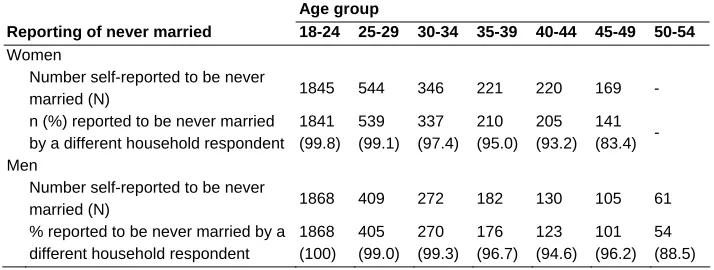
married is high. Only in the oldest age groups (45-49 years in women, 50-54 years in men) is there more than a 10% difference, thereby supporting our contention that the data demonstrate consistency in the way that marital data is operationalised in ACDIS, and that there is no evidence of substantive social desirability bias in reports of marriage in this population. Of women self-reporting as never married, but not reported as such by household respondents, roughly equal numbers had been reported to be currently married or widows. For never married men (by self report) where there is a difference in household report, almost all were reported to be currently married.
The younger age group in the general health survey makes it less valuable as a way of comparing reports of widowhood. Only three men in the general health survey reported being widowers. Among women in the survey, widowhood reports agreed for 78% in 35-39 years, 86% in 40-44 years, and 88% in 45-49 years.
Table 4: Agreement between self-reports of never married with report by
household respondent other than self, by age and sex. ACDIS, 2005 1
Age group
Reporting of never married 18-24 25-29 30-34 35-39 40-44 45-49 50-54
Women
Number self-reported to be never
married (N) 1845 544 346 221 220 169 -
n (%) reported to be never married by a different household respondent
1841 (99.8)
539 (99.1)
337 (97.4)
210 (95.0)
205 (93.2)
141
(83.4) -
Men
Number self-reported to be never
married (N) 1868 409 272 182 130 105 61
% reported to be never married by a different household respondent
1868 (100)
405 (99.0)
270 (99.3)
176 (96.7)
123 (94.6)
101 (96.2)
54 (88.5)
1 Self-reported martial status obtained from the ACDIS general health survey in 2005 (women 15-49 years, men 15-54 years).
Household respondent (i.e. not self) report of marital status from routine ACDIS visit in round 2, 2005.
5. Conclusions
childbearing in many families reduce marriage as a necessary entry to parenting. The factors ranged against marriage appear to foster cautiousness in starting, and a lack of haste in finishing, the marriage process. Waiting for the ‘right’ time to marry, means waiting for the right partner as well as more education, work, income, housing etc. For many young adults in rural KwaZulu-Natal, the desired constellation of circumstances does not, it seems, come in to line. A scenario in which, while there are many hurdles placed in the way, marriage is not completely ruled out fits closely with ethnographic studies that show that even while rates of marriage are low, marriage remains a highly prized life-event - one that is desired and anticipated by young adults (Preston-Whyte and Zondi 1992).
However, while we have highlighted the continued declines in marriage, it would be misleading to suggest that marriage is moribund in this population. In the study population, around half of all women and men 45 years and older have been married. A
large number of couples continue to embark upon the process of ilobolo or become
engaged, going on to marry in both traditional and civil ceremonies. As we show, those marrying, marry late, with a median age of first marriage of 25 years in women and 31 years in men. Data on trends in the age at first marriage are not yet available for this population. There have also been changes in the way that marriages are contracted. The proportion of married women and men choosing to register their marriages also rose from 72% in 2002 to 76% in 2006, registration being most popular among recently wed couples.
The difference in the distribution of marital and partnership patterns observed between women resident urban/peri-urban and rural areas in some age groups suggests that aggregate population data, even in a relatively small, predominantly rural area, may mask heterogeneity between communities. For older women, it is not possible with the available data to determine whether these differences are due to the long-term community-level influences on marriage or result from selective migration of women with these marital and partnership characteristics to or from particular areas. In younger cohorts, longitudinal analyses of community-level correlates of partnership formation, marriage and migration warrants further investigation.
It has been suggested that African marriage and childbearing patterns in South Africa, particularly in KwaZulu-Natal, have come to closely resemble those of the Caribbean in terms of low rates of marriage, high rates of extra-marital childbearing, and a high proportion of female-headed households (Preston-Whyte 1988; Van de Walle 1993). However, in 2000, the ACDIS data showed that only 7% of never married women headed their own households and only one-third lived in a household headed by a woman. A second key difference between the two regions relates to migration. Although co-residential conjugal unions are the basis of family organisation in most parts of the world, many people in KwaZulu-Natal will not experience extensive periods of cohabitation with their married or unmarried partners. Qualitative research conducted in the study population suggests that the extent to which their separate households are inter-connected may have an important role in shaping the quality, stability and future evolution of non-conjugal relationships (Hosegood et al. 2007). However, the ability to consistently link and update relationships between households is limited in a large population-based survey.
imagination, as well as creates overlapping marital status categories. However, based on the experience of ACDIS, we do not agree with commentators who have suggested that, because marriage in Africa is frequently a long process rather than a single event, surveys should use a longer set of questions ascertaining which stage among many a person has reached (see for example, (Meekers 1992; Speizer 1995). Whilst this kind of detail can be important in ethnographic research, we feel that in population surveys and censuses respondent-reported marital status, particularly when self-reported, remains the most appropriate classification.
The analysis described in this paper provides a first description of marriage and partnership patterns and trends in this population. Further studies are needed; for example, to understand the determinants and dynamics of marriage and partnership in this study population using analyses of individual life-courses rather than repeated cross-sectional data. The data also can be used to explore the role of marital and non-marital partnerships in determining HIV transmission dynamics and risk. While these are beyond the scope of this paper, we have demonstrated several important strengths of the detailed, longitudinal, population-based data collected by ACDIS for research on marriage and cohabitation.
6. Acknowledgements
The population-based HIV survey and Africa Centre Demographic Information System (ACDIS) were supported by The Wellcome Trust, UK grants no. 65377 and no. 50535 to the Africa Centre for Health and Population Studies; and grants to Hosegood
(GR082599MA) and McGrath (WT083495MA). We thank the ACDIS staff and the
References
Bärnighausen, T., Hosegood, V., Timæus, I.M., and Newell, M. (2007). The socioeconomic determinants of HIV incidence: a population-based study in rural South Africa. AIDS 21(Suppl 7): S29-S38.
Bozzoli, B. (1991). The Meaning of Informal Work: Some Women's Stories. In:
Preston-Whyte, E. and Rogerson, C. (eds.) South African Informal Economy.
Cape Town: Oxford University Press.
Budlender, D., Chobokoane, N., and Simelane, S. (2005). Marriage patterns in South
Africa: methodological and substantive issues. Southern African Journal of
Demography 9(1): 1-26.
Burman, S. and Preston-Whyte, E. (1992). Assessing illegitimacy in South Africa. In:
Burman, S. and Preston-Whyte, E. (eds.) Questionable Issue: Ilegitimacy in
South Africa. Cape Town: Oxford University Press.
Burman, S. and van der Werff, N. (1993). Rethinking customary law on bridewealth.
Social Dynamics 19(2): 111-127. doi:10.1080/02533959308458554
Case, A. and Ardington, C. (2004). Socioeconomic Factors. Population Studies
working group (ed.). Mtubatuba: Africa Centre for Health and Population Studies monograph.
Cassim, N.A. (1981). Some reflections on the Natal Code. Journal of African Law
25(2): 131-135.
Chambers, D.L. (2000). Civilizing the natives: Marriage in post-apartheid South Africa.
Daedalus 129(4): 101-124.
Crankshaw, O. (1993). A simple questionnaire survey method for studying migration
and residential displacement in informal settlements in South Africa. SA
Sociological Review 6(1): 52-66.
de Haas, M. (1984). Changing Patterns of Black Marriage and Divorce in Durban. [PhD thesis]. Durban: Department of Social Anthropology, Faculty of Social Science, University of Natal.
de Haas, M. (1987). Is there anything more to say about lobolo? African Studies 46(1): 33-35.
Research, South African Medical Research Council and Actuarial Society of South Africa report.
Gluckman, M. (1950). Kinship and Marriage among the Lozi of Northern Rhodesia and
the Zulu of Natal. In: Radcliffe-Brown, A.R. and Forde, D. (eds.) African
Systems of Kinship and Marriage. London: Routledge and Kegan Paul: 166-206. Goody, J. (1973). Bridewealth and dowry. London: Cambridge University Press. Harwood-Lejeune, A. (2000). Rising age at marriage and fertility in Southern and
Eastern Africa. European Journal of Population 17: 261-280.
doi:10.1023/A:1011845127339
Heuveline, P. (2004). Impact of the HIV epidemic on population and household
structure: the dynamics and evidence to date. AIDS 18(Suppl. 2): S45-S53.
doi:10.1097/00002030-200406002-00006
Hosegood, V., Benzler, J., and Solarsh, G. (2005). Population mobility and household dynamics in rural South Africa: implications for demographic and health research. Southern African Journal of Demography 10(1&2): 43-67.
Hosegood, V. and Preston-Whyte, E. (2002). Marriage and partnership patterns in
rural KwaZulu Natal. Paper presented at the Population Association of America Conference, Atlanta, USA, May 8-11.
Hosegood, V., McGrath, N., Herbst, K., and Timæus, I.M. (2004). The impact of adult mortality on household dissolution and migration in rural South Africa. AIDS
18(11): 1585-1590. doi:10.1097/01.aids.0000131360.37210.92
Hosegood, V., Preston-Whyte, E., Busza, J., Moitse, S., and Timæus, I.M. (2007). Revealing the full extent of households' experience of HIV and AIDS in rural
South Africa. Social Science and Medicine 65: 1249-1259.
doi:10.1016/j.socscimed.2007.05.002
Hosegood, V. and Timæus, I.M. (2005). Household Composition and Dynamics in KwaZulu Natal, South Africa: Mirroring Social Reality in Longitudinal Data Collection. In: van der Walle, E. (ed.) African Households: an exploration of census data. New York: M.E. Sharpe Inc.: 58-77.
Hunter, M. (2006). Fathers without amandla: Zulu-speaking men and fatherhood In:
Jones, S. (1992). Children on the move: parenting, mobility, and birth-status among
migrants. In: Burman, S. and Preston-Whyte, E. (eds.) Questionable Issue:
Illegitimacy in South Africa. Cape Town: Oxford University Press: 247-281. Jones, S. (1993). Assaulting Childhood. Children's Experiences of Migrancy and Hostel
Life in South Africa. Johannesburg: Witwatersrand University Press.
Krige, E.J. (1965.). The Social System of the Zulus. Pietermaritzburg: Shuter and Shooter.
Lesthaeghe, R. and Jolly, C. (1995). The start of the sub-Saharan fertility transition:
some answers and many questions. Journal of International Development 7:
25-45. doi:10.1002/jid.3380070103
Locoh, T. (1988). Evolution of the Family in Africa. In: van de Walle, E.,
Sala-Diakanda, M.D., and Ohadike, P.O. (eds.) The State of African Demography.
Liege: IUSSP: 47-65.
Maharaj, B. (1992). The 'Spatial' Impress of the Central and Local States: The Group
Areas Act in Durban. In: Smith, D.M. (ed.) The Apartheid City and Beyond:
Urbanization and Social Change in South Africa. London and New York: Routledge.
Mayer, P. (1980). Black Villagers in an Industrial Society. Anthropological
Perspectives on Labour Migration in South Africa. Cape Town: Oxford University Press.
McClendon, T. (2008). Generating Change, Engendering Tradition. Rural Dynamics and the Limits of Zuluness in Colonial Natal. In: Carton, B. Laband, J. and Sithole, J. (eds.) Zulu Identities: Being Zulu, Past and Present. Durban: UKZN Press: 281-289.
Meekers, D. (1992). The process of marriage in African societies: a multiple indicator
approach. Population and Development Review 18(1): 61-78.
doi:10.2307/1971859
Mkhize, N. (2006). African traditions and the social, economic and moral dimensions of fatherhood. In: Morrell, R. and Richter, L. (eds.) Baba: Men and Fatherhood in South Africa. Cape Town: HSRC Press: 183-198.
Montgomery, C., Hosegood, V., Busza, J., and Timaeus, I.M. (2005). Men's involvement in the South African family: Engendering change in the AIDS era.
Social Science and Medicine 62(10): 2411-2419.
Moore, H.L. (1994). Households and gender in a South African bantustan, a comment.
African Studies 53(1): 137-142.
Morrell, R. (2006). Fathers, fatherhood and masculinity in South Africa. In: Morrell, R. and Richter, L. (eds.) Baba: Men and Fatherhood in South Africa. Cape Town: HSRC Press: 13-25.
Morrell, R. and Richter, L. (2006). Introduction. In: Morrell, R. and Richter, L. (eds.)
Baba: Men and Fatherhood in South Africa. Cape Town: HSRC Press: 1-9. Moultrie, T.A. and Dorrington, R. (2004). Estimation of fertility from the 2001 South
Africa Census data. Cape Town: Centre for Actuarial Research report.
Moultrie, T.A., Hosegood, V., McGrath, N.M., Hill, C., Herbst, K., and Newell, M. (2008). Refining the Criteria for Stalled Fertility Declines: An Application to
Rural KwaZulu-Natal, South Africa, 1990-2005. Studies in Family Planning
39(1): 39-48. doi:10.1111/j.1728-4465.2008.00149.x
Moultrie, T.A. and Timæus, I.M. (2001). Fertility and living arrangements in South
Africa. Journal of Southern African Studies 27(2): 207-223.
doi:10.1080/03057070120049930
Moultrie, T.A. and Timæus, I.M. (2003). The South African fertility decline: evidence
from two censuses and a Demographic and Health Survey. Population Studies
57(3): 265-283. doi:10.1080/0032472032000137808
Murray, C. (1980). Migrant labour and changing family structure in the rural periphery
of Southern Africa. Journal of Southern African Studies, 6(2): 139-156.
doi:10.1080/03057078008708011
Murray, C. (1981). Families Divided: the Impact of Migration in Lesotho. Cambridge: Cambridge University Press.
Murray, C. (1985). Class and the developmental cycle: household strategies of survival in the rural periphery of Southern Africa. In: Guyer, J.I. and Peters, P.E. (eds.)
Conceptualizing the household: issues of theory, method, and application.
Unpublished workshop report: 14-21.
Muthwa, S.W. (1995). Economic Survival Strategies of Female-headed Households: The Case of Soweto, South Africa. [PhD thesis]. London: School of Oriental and African Studies, University of London.
Nnko, S., Boerma, J. T., Urassa, M., Mwaluko, G., and Zaba, B. (2004). Secretive females or swaggering males? An assessment of the quality of sexual partnership reporting in rural Tanzania. Social Science and Medicine, 59(2), 299-310.
Pauw, B.A. (1963). The Second Generation: A Study of the Family among Urbanized
Bantu in East London. Cape Town: Oxford University Press.
Posel, D. (1995). State, power and gender: conflict over the registration of African
customary marriage in South Africa c.1910-1970. Journal of Historical
Sociology 8(3): 223-256. doi:10.1111/j.1467-6443.1995.tb00088.x
Preston-Whyte, E. (1974). Kinship and marriage. In: Hammond-Tooke, W. (ed.) The
Bantu-speaking peoples of southern Africa. London and Boston: Routledge and Kegan Paul.
Preston-Whyte, E. (1978). Families without marriage: a Zulu case study. In: Argyle, J. and Preston-Whyte, E. (eds.) Social System and Tradition in Southern Africa. Essays in Honour of Eileen Krige. Cape Town: Oxford University Press: 55-85. Preston-Whyte, E. (1988). Women-headed households and development: the relevance
of cross-cultural models for research on black women in southern Africa.
Africanus 18: 58-76.
Preston-Whyte, E. (1993). Women who are not married: fertility, 'illegitimacy', and the nature of households and domestic groups among single African women in Durban. South African Journal of Sociology 24(3): 63-71.
Preston-Whyte, E. and Zondi, M. (1992). Assessing illegitimacy in South Africa. In:
Burman, S. and Preston-Whyte, E. (eds.) Questionable Issue: Illegitimacy in
South Africa. Cape Town: Oxford University Press.
Ramphele, M. (1993). A Bed Called Home: Life in the Migrant Labour Hostels of Cape Town. Cape Town and Johannesburg: David Phillip.
Rice, B.D., Bätzing-Feigenbaum, J., Hosegood, V., Tanser, F., Hill, C., Bärnighausen, T., Herbst, K., Welt, T., and Newell, M. (2007). Population and antenatal-based HIV prevalence estimates in a high contracepting female population in rural South Africa. BMC Public Health 7(160). doi:10.1186/1471-2458-7-160
Russell, M. (2003). Understanding black households: the problem. Social Dynamics
29(2): 5-47.
Speizer, I. S. (1995). A marriage trichotomy and its applications. Demography 32(4): 533-542. doi:10.2307/2061673
Spiegel, A. (1980). Rural differentiation and the diffusion of migrant labour remittances
in Lesotho. In: Mayer, P. (ed.) Black villagers in an industrial society.
Anthropological perspectives on labour migration in South Africa. Cape Town: Oxford University Press: 109-168.
Spiegel, A., Watson, V., and Wilkinson, P. (1996). Domestic diversity and fluidity among some African households in Greater Cape Town. Social Dynamics 22(1): 7-30.
Statistics South Africa (2000). Marriages and divorce, 1997. Statistical release P0307. Pretoria: Statistics South Africa.
Tanser, F., Hosegood, V., Bärnighausen, T., Herbst, K., Nyirenda, M., Muhwava, W., Newell, C., Viljoen, J., Mutevedzi, T., and Newell, M. (2007). Cohort Profile: Africa Centre Demographic Information System (ACDIS) and population-based
HIV survey. International Journal of Epidemiology 37(5): 956 - 962.
doi:10.1093/ije/dym211
Townsend, N., Madhavan, S., and Garey, A.I. (2006). Father presence in rural South Africa: historical changes and life-course patterns. International Journal of Sociology of the Family 32(2): 173-190.
Udjo, E. (2001). Marital patterns and fertility in South Africa: the evidence from the 1996 population census. Poster presented in IUSSP XXIV International Population Conference, San Salvadore, Brazil, August 18-24 2001.
Van de Walle, E. (1993). Recent trends in marriage ages. In: Foote, K.A., and Hill,
K.H. and Martine, L.G. (eds.) Demographic Change in sub-Saharan Africa.
Washington, D.C.: National Research Council, National Academy Press.
van der Vliet, V. (1984). Staying single: a strategy against poverty. SALDRU paper No 116. Cape Town: University of Cape Town.
van der Vliet, V. (1991). Traditional husbands, modern wives? Constructing marriages in a South African township. African Studies 50(1-2): 219-241.
Welz, T., Hosegood, V,. Jaffar, S., Batzing-Feigenbaum, J., Herbst, K., and Newell, M. (2007). Continued very high prevalence of HIV infection in rural KwaZulu-Natal, South Africa: a population-based longitudinal study. AIDS 21: 1467-1472.
doi:10.1097/QAD.0b013e3280ef6af2
Wilson, M. (1969). Changes in social structure in Southern Africa: the relevance of kinship studies to the historian. In: Thompson, L. (ed.) African Societies in Southern Africa. London: Heinemann.
Ziehl, S.C. (1999). Marriage - a dying institution? Evidence from the 1996 South
Appendix
Comparison of ACDIS data with other survey and census data
Census data is a commonly used source of marriage and partnership data in South Africa. Examination of the trends and patterns reported by ACDIS relative to data for rural KwaZulu-Natal from the censuses allows us to consider the effect of different data collection strategies on reported marriage patterns. One might postulate that longitudinal surveys obtain more accurate reports than cross-sectional surveys and censuses for a number of reasons. With strong positive social norms about marriage, social desirability can be a reason for reporting bias in one-off interviews. Respondents and/or interviewers may be expected to over-report marital unions, for example, a parent of a co-habiting woman with young children may feel more comfortable reporting that their daughter is married; or an interviewer may assume that older respondents must have been or are married rather than asking them directly. In contrast, longitudinal studies can potentially obtain a more accurate view of respondents’ social and legal situations. In addition, ACDIS has more scope to collect more information about aspects of marriage and partnerships than is possible in a national census.
The direct comparison of these two sources of data is not straight forward. The main challenge is that recent South African censuses, as well as several other national surveys, blur the concept of ‘marriage’ and ‘cohabitation’, whereas these phenomena are distinguished in ACDIS. The 2001 Census uses the following marital status categories: never married, married civil/religious, married traditional/customary, polygamously married, living together as unmarried partners, widow/widower, and divorced. However, ‘living together’ is not in reality a marital state but rather a description given to unmarried relationships based on perceptions about the nature of their relationship and residential arrangements. Understanding the use of this term in South Africa is complicated by high residential mobility and separation of couples due to labour migration. Thus, depending on how the term is translated and understood, an unmarried woman in a long-term conjugal relationship might describe herself as ‘living together’ even though her partner works and lives elsewhere. Given the lack of a hierarchical set of categories it is also unclear whether people would select the ‘living together’ classification over those related to their marital status such as saying that they are widowed, divorced or never married.
separated) are classified as ‘living together’ if their partner is a member of the same household (i.e. has a conjugal relationship), regardless of whether their partner is cohabiting or not. Recode-2 emphasises the co-residency dimension and classifies women as ‘living together’ if they are not currently married and have a resident conjugal partner. We do not show a similar comparison for men because of the complexity introduced by polygamous unions. The 10% sample of the Census sample does not permit the exclusion of polygamous men. However, from the ACDIS data we know that their living arrangements can be very complex involving multiple conjugal partners in the same or different households, thus creating more uncertainty about how to simulate the Census data in men.
Marital status from the 2001 Census and ACDIS 2000 are shown in Figures 3a-c. The level and pattern of never married are remarkably similar in both sources providing strong evidence that non-marriage has become entrenched in rural KwaZulu-Natal. It also suggests that reporting of non-marriage is consistent across different types of survey design, as well as being robust despite the lack of specific instructions about the question to enumerators in the 2001 Census. Whilst someone who has married may be unsure about whether to report their current or past status, someone who is never married need only choose between ‘never married’ and the ‘living together’ category.
Figure 3: Age-specific marital patterns in women 20 years and older1 from
a) the 2001 South African Census for rural KwaZulu Natal,
b) ACDIS 2000 using Re-code 12,
c) ACDIS 2000 using Re-code 23
a) 2001 South African Census data
0% 20% 40% 60% 80% 100%
18-24
25-29
30-34
35-39
40-44
45-49
50-54
55-59 60+
Figure 3: (Cont.) Age-specific marital patterns in women 20 years and older
b) ACDIS 2000 Re-code-1
0% 20% 40% 60% 80% 100%
20-24
25-2 9
30-34
35-39
40-44
45-49
50-54
55-59 60+
Never married Married Living together Widow ed Divorced/separated
c) ACDIS 2000 Recode-2
0% 20% 40% 60% 80% 100%
20-24
25-2 9
30-34
35-39
40-44
45-49
50-54
55-59 60+
Never married Married Living together Widow ed Divorced/separated
Notes:
1
The 10% sample of the 1996 Census is available only in five-year age groups.
2 Recode-1 classifies women resident in the second round of ACDIS (2000) as ‘living together’ providing that they are not currently
married (never married, widowed, divorced and separated), and their partner was a member of the same household (resident or non-resident).
3
The proportion ‘living together’ is more closely approximated in ACDIS by selecting only women whose non-marital conjugal partners are co-resident (Re-code-2). Thus, the Census obscures the existence of some 10% of young couples who whilst being recognised as being members of the same household have one of them living somewhere else. This raises the question about the appropriateness of translating the term ‘living together’ from high income countries to a South African context with high residential mobility.