Article
1
Smart Systems Implementation in UK Food
2
Manufacturing Companies – A Sustainability
3
Perspective
4
Andrew Thomas 1*, Claire Haven-Tang 1, Richard Barton 1, Rachel Mason-Jones 1, Mark Francis 1,
5
Paul Byard 2,*
6
1 Cardiff School of Management, Cardiff Metropolitan University; [email protected],
chaven-7
[email protected], [email protected], [email protected]
8
2 Engineering Employers Federation, Wales; [email protected]
9
* Correspondence: [email protected] ; Tel.: 02920205233
10
11
12
Abstract: The UK food industry faces significant challenges to remain sustainable. With major
13
challenges such as Brexit on the horizon, companies can no longer rely on a low labour cost
14
workforce to maintain low production costs and achieve economic sustainability. Smart Systems
15
(SS) is being seen as an approach towards achieving significant improvements in both economic and
16
environmental sustainability. However, there is little evidence to indicate whether UK food
17
companies are prepared for the implementation of such systems. The purpose of this research is to
18
explore the applicability of Smart Systems in UK food manufacturing companies and, to identify
19
the key priority areas and improvement levers for the implementation of such systems. A
20
triangulated primary research approach is adopted and includes a questionnaire, follow up
21
interviews and visits to thirty-two food manufacturing companies in the UK. The questionnaire and
22
interviews are guided by the development of a unique measuring instrument created by the authors
23
that is focusses upon SS technologies and systems. This paper makes an original contribution in that
24
it is one of few academic studies to explore the implementation of SS in the industry and, provides
25
a new perspective on the key drivers and inhibitors around its implementation. Findings suggest
26
that the current turbulence in the industry could be bringing food companies closer to the adoption
27
of such systems, hence it is a good time to define and develop the optimum SS implementation
28
strategy.
29
Keywords: Food Manufacturing; Digital hub; Sustainability Profile; Smart Systems; Survey
30
31
1. Introduction
32
The UK’s food sector is complex and highly dynamic in nature. The demands placed upon the
33
manufacturing system through short life products and raw materials, more demanding retailers and
34
end users, increased levels of legislation and regulation has resulted in organisations needing to
35
respond on multiple levels and on a range of different issues in order to achieve economic and
36
environmental sustainability [1]. In some cases, these pressures have resulted in the sector becoming
37
increasingly isolated from other manufacturing sectors as they deal with their own specific problems
38
[2]. The resulting problem of this isolation is that many food manufacturing companies are not
39
necessarily aware of the advances in manufacturing technologies and systems being developed and
40
applied throughout the wider manufacturing industry. This in turn can lead to the creation of an
41
environment where the food manufacturing industry may be left behind when it comes to adopting
42
and benefitting from new and advanced manufacturing technologies [3].
43
Isolation of the sector, and further isolation of individual problems and symptoms at a business
44
unit level, threatens the economic sustainability of food manufacturing companies and the sector as
45
a whole. Major retailers offer these food manufacturing companies the greatest potential for increased
46
sales, job creation and efficiency of production. However, this has to be reconciled with the demands
47
of reduced profit margins and increased costs associated with higher volume requirements [4, 5].
48
In order to cope with these business pressures, other manufacturing and production sectors have
49
placed increasing focus upon the development and advancement of technology driven
50
manufacturing systems such as; Smart Factories, Smart Systems and, Industry 4.0 (I.E. 4.0). These
51
systems are often known collectively as Smart Systems (SS). Recent years have seen step change
52
improvements in terms of Smart Systems’ capability, reduced cost of technology, and wider
53
accessibility of the skills and knowledge required to implement them. Therefore, it is possible to
54
articulate the current challenge within the UK food manufacturing industry in terms of two distinct
55
objectives aimed at overcoming their isolation and, align their businesses towards Smart Systems
56
implementation. These objectives are:
57
1. Through the development and application of a SS/Sustainability profiling tool in to 32 food
58
manufacturing companies, to understand the current expertise and identify the technological
59
priorities of the UK food manufacturing companies when considering the implementation of
60
Smart Systems
61
2. To propose a conceptual system architecture for effective SS implementation
62
Evidently, effective implementation is the key to success, and learning from experience in
63
implementing other business improvement practices and paradigms shows that there is no single
64
prescriptive implementation guide to fit every company. So, this paper takes an important early view
65
of enablers and potential barriers to success and presents them in context of an implementation
66
framework to be easily leveraged across both the UK and international food sector in order to
67
minimize the learning curve costs and timescales.
68
69
2. Literature Review
70
UK food manufacturers are highly aware of the need to operate within visible supply chains.
71
Smart Systems provide this essential link in that it the technologies and systems enable improved
72
level of traceability right through the manufacturing chain where machines are interconnected and
73
archiving data can be done automatically [8]. Alongside this, environmental tracking can be better
74
achieved as well as monitoring energy usage so that optimising energy consumption profiles can be
75
achieved. In the whole, the likely result of the adoption of SS in the food manufacturing sector will
76
result in improved machine performance, optimised maintenance and reduced costs [8,14,15]. This
77
should then provide new opportunities for companies to win new customers and retain existing ones.
78
It is also likely to create new revenue streams in the form of value adding services and, allow seamless
79
connectivity with upstream and downstream supply chain partners [8].
80
The industrial trend towards the adoption of Smart Systems is based largely on the perceived
81
positive benefits that cyber connected, automated systems can bring to industry and in meeting the
82
sustainability agenda such as; improved efficiency, greater customisation, improved quality and
83
reduced waste and enhanced economic sustainability [6]. For instance, Bonilla et al [7] link four
84
different business scenarios (deployment, operation and technologies, integration and compliance)
85
with sustainable development goals. From these scenarios, their analysis resulted in a number of
86
positive and negative sustainability impacts being identified when related to the basic production
87
inputs and outputs flows (raw material, energy and information consumption and product and waste
88
disposal). Therefore, further work is required in the form of a more detailed literature analysis of how
89
SS and the issues of how SS can meet the sustainability agenda is required. Section 2.1 develops this
90
work.
91
2.1 Smart Systems – A Literature Review
94
Smart Systems (SS) can be defined as the employment of manufacturing and communication
95
technologies to allow higher levels of interconnectivity, leading to greater communication between
96
machines and decentralised/local processing of data [8]. SS embraces a wide range of technologies,
97
including Radio Frequency Identification (RFID), Near Field Communication (NFC), Wi-Fi, Cellular
98
and Bluetooth all linked to networks that normally use the Internet as a form of communication [9,
99
10]. SS technologies offer many benefits that link to the key sustainability dimensions, including the
100
ability to improve food traceability, reduce food waste and increase efficiencies in transport and
101
handling of food products and in turn contributing directly to addressing both economic and
102
environmental sustainability challenges [10,11]. On a wider scale, virtualization of supply chains
103
using SS technologies enables companies to optimise supply chain operations and characterise the
104
dynamic nature of operations [11]. Virtualisation also enhances the opportunity to apply innovations
105
and improvements in supply chains and, to subsequently plan, and assess these innovations without
106
affecting the manufacturing system. It also enables innovative thinking amongst staff and the
107
promotion of the view of what new and innovative technologies can do to enhance productivity and
108
product innovation [12] as well as addressing the economic sustainability challenges. Today the
109
technology is highly reliable, relatively cheap, and based on international standards that promote
110
easy communication between different device’s tags and systems [9]. A further and more detailed
111
literature review of Smart Systems, the technologies and its impact on the sustainability dimensions
112
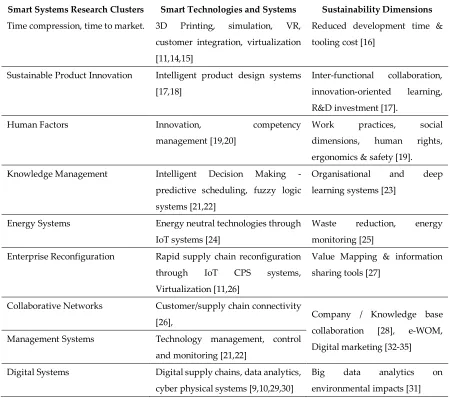
is shown in Table 1.
113
Table 1 – Literature Analysis of Smart Systems
114
115
2.2 Smart Systems – Analysis of Literature
116
Smart Systems Research Clusters Smart Technologies and Systems Sustainability Dimensions
Time compression, time to market. 3D Printing, simulation, VR, customer integration, virtualization [11,14,15]
Reduced development time & tooling cost [16]
Sustainable Product Innovation Intelligent product design systems [17,18]
Inter-functional collaboration, innovation-oriented learning, R&D investment [17].
Human Factors Innovation, competency
management [19,20]
Work practices, social dimensions, human rights, ergonomics & safety [19]. Knowledge Management Intelligent Decision Making -
predictive scheduling, fuzzy logic systems [21,22]
Organisational and deep learning systems [23]
Energy Systems Energy neutral technologies through IoT systems [24]
Waste reduction, energy monitoring [25]
Enterprise Reconfiguration Rapid supply chain reconfiguration through IoT CPS systems, Virtualization [11,26]
Value Mapping & information sharing tools [27]
Collaborative Networks Customer/supply chain connectivity
[26], Company / Knowledge base
collaboration [28], e-WOM, Digital marketing [32-35] Management Systems Technology management, control
and monitoring [21,22]
Digital Systems Digital supply chains, data analytics, cyber physical systems [9,10,29,30]
Through undertaking a literature analysis of academic articles that focus on Smart Systems and
117
their connectivity to sustainability, it is possible to identify nine key smart system clusters that have
118
emerged from the work and are shown in Table 1. The analysis has further identified the key SS
119
technologies and systems as well as the connectivity between SS and the sustainability dimensions.
120
This analysis suggests that the development of SS technologies and systems are at an advanced stage
121
of development and, the connection between the sustainability dimensions means that the move
122
towards the employment of SS in industry is likely to impact greatly (and positively) on improving
123
sustainability of companies especially in the economic and environmental sustainability dimensions.
124
Furthermore, this literature analysis as well as supporting evidence such as [8] suggests that the food
125
industry is ideally placed to benefit from adopting SS. The continuous demand to maintain and often
126
reduce costs in the food industry means that companies have to continuously innovate and develop
127
more efficient manufacturing systems as well as seeking to innovate the product in order to maintain
128
cost levels. SS is likely to be seen as a significant opportunity for companies to potentially stabilise
129
productivity and improve output both in terms of cost reduction and quality consistency [8,36].
130
Greater flexibility offered by SS will enable product volume mix to be achieved with greater levels of
131
consistency and efficiency. In many cases, bespoke manufacturing can be achieved as well as the
132
capacity to rapidly change to differing customer demands as a result of such technologies and
133
systems [9].
134
So, if the food manufacturing industry is ideally placed to take advantage of SS, then why is the
135
industry slow to pick up on the concept and implement such systems? The traditional barriers
136
towards the implementation of Advanced Manufacturing Technologies in the past have focused
137
upon the high cost of technology and limited capability of the existing workforce to operate and
138
develop the technologies [13]. However, with the emergence of relatively inexpensive internet-based
139
technologies and systems, why are these barriers still relevant today? The research question for this
140
study is therefore: “what are the current capabilities and priorities of the UK food manufacturing industry to
141
meet the requirements of Smart Systems implementation?”.
142
As a result of the adoption of SS, food companies will need to focus on a different knowledge
143
skillset and, will therefore need to recruit, upskill, and keep staff capable of maintaining these highly
144
complicated business operations [37,38]. However, evidence suggests that UK Food companies may
145
not be fully aware of the benefits that SS can bring [18,39]. It therefore seems that the food industry
146
in general, lacks the knowledge and understanding of the need to implement new and sometimes
147
advanced technologies in to their business [41,42].
148
In summary, the benefits that SS can bring are appreciated by many industrialists and academics
149
alike. Improved product traceability, (including traceability in the food recall system, [43].
150
Productivity throughput, shorter processing times and improved consistency of product quality are
151
all seen as positive elements of SS implementation. The falling cost of technologies as well as the
152
ubiquitous nature of internet connectivity combined with relatively powerful computing equipment
153
raises the question as to whether the traditional impediments of technology cost and worker skills
154
are still seen as major barriers or, whether these issues remain perceptions based on a previous era of
155
manufacturing.
156
In order to further understand these issues identified from this literature analysis, the authors
157
undertook a small-scale survey of thirty-two UK food manufacturing companies of various sizes with
158
the aim of identifying the level of awareness of SS within their companies and, to also identify the
159
dynamics around technology adoption. Using the SS clusters and technologies and systems identified
160
from this literature analysis as the main guide to the development of the survey tool, the authors
161
undertook the survey to identify some baseline information of how industry leaders are viewing SS
162
adoption in their companies.
163
164
3. Research Method and Survey Design
165
A triangulated research approach was employed consisting of the following stages:
166
1. Analysis of secondary research obtained from academic sources.
167
3. Follow-up interviews with MDs and Managers from the small-scale pilot study (stage 2
169
research study).
170
The stage one research process required the development of an appropriate SS profiling tool that
171
could be used to measure specific responses from the companies but also to act as a point of reference
172
for discussion around SS implementation. The authors developed a sustainability profiling tool
173
primarily based on the work from the literature analysis previously undertaken and. on further
174
literature around manufacturing challenges and SS systems [44-48]. The profiling tool is shown in
175
Table 3. The tool utilises the SS research clusters, SS technologies and sustainability dimensions that
176
were highlighted from the literature review and detailed in Table 1 of this paper to form the main
177
body of the tool.
178
Companies were selected by the research team based on the definition of a food manufacturing
179
company, that of “being primarily concerned in converting raw ingredients and products in to food products
180
and, identified as mass production/high volume companies employing high volume manufacturing systems and
181
configurations” [40]. One hundred and thirty requests were issued electronically to food
182
manufacturing companies asking the M.Ds of each company to take part in the survey. Thirty-two
183
companies responded agreeing to undertake the survey. Table 2 shows the companies and food
184
sectors who responded to the survey and, the size of each company measured in terms of the number
185
of employees employed. The companies involved in the stage 2 study are marked in square brackets.
186
187
Table 2 – Companies and Sectors Responding to Survey – Stage 1 Stage 2 [ ]
188
Sectors Companies
per sector
Employees 10-50
Employees 50-150
Employees 150-200
Packaging & Logistics 4 [3] 1 [1] 3 [2]
General Drink 2 [1] 2 [1]
Wines, Beers, Spirits 5 [2] 3 [1] 2 [1]
Ready meals & processed foods 5 [4] 2 [2] 3 [2]
Cheese & Dairy 4 [3] 2 [2] 2 [1]
Bread, Bakery & Snacks 10 [5] 6 [4] 3 [1] 1
Biscuits, cake, chocolate 2 [2] 1 [1] 1 [1]
Totals 32 [20] 18 [11] 10 [6] 4 [3]
189
During the profiling stage, each company was contacted and, a time arranged for a member of
190
the research team to visit the company. The initial stage of the study involved a member of the
191
research team meeting with the MD of each company to discuss the sustainability profiling. The
192
profiling stage involved a discussion about each strategic driver, explaining what each of the drivers
193
and associated technologies meant in order to ensure that there was a common understanding about
194
the meaning of each driver. The research member in discussion with the MD then completed the
195
profiling exercise. This score was then validated by the researcher undertaking a detailed
196
observational study of the systems and technologies employed within the company. A short
197
moderation session followed the observation and interview with the MD to ensure that consensus
198
was achieved on each driver and dimension that was scored.
199
Scores were placed against each strategic driver and associated indicative technology and
200
initially focussed upon the current level of expertise the MD believed that their company had against
201
the eighteen technology/systems dimensions highlighted. The second stage of scoring required the
202
MD to prioritise each dimension based on a two-year planning horizon (i.e. where they thought their
203
company needed to be to meet the demands of their industry). This profiling allowed the team to
204
determine the current state of operational excellence and also, the strategic intent of each company
205
in meeting the SS requirements. The gap between current state and the aspirational level 2 years in
206
to the future provides the basis of discussion in stage 2 of the research study.
207
Table 3 – Sustainability Profiling Input Sheet.
210
211
Smart Systems
Sustainability
Clusters
Smart Technology
Areas
Average
Current
Level of
Expertise
Average
2 Yr
Priority
Score
Gap
Frequency
(Current Expertise)
1 2 3 4 5
Time
Compression,
Time to Market
(Ec)
V1 Customer Integration with product development process
4.3 4.75 0.5 0 1 2 15 14
V2 Application of time
compression technologies 3.85 4.5 0.7 0 1 11 12 8
Sustainable
Product
Innovation (Ec)
V3 Robust NPD/I systems 4.4 4.65 0.3 0 0 1 16 15
V4 Intelligent &
Customised products 3.95 4.45 0.5 0 2 8 12 10
Human Factors
(Ec/En)
V5 R+D Systems /
Co-Innovation/creativity 3.45 4.25 0.8 3 4 8 9 8
V6 Competency
management 3.1 4.75 1.7 5 6 7 7 7
Knowledge
Management
(Ec/En)
V7 Organisational
Learning systems 1.9 4.75 2.9 14 10 5 3 0
V8 Intelligent decision
making systems 4.15 4.75 0.6 0 0 8 12 12
Energy Systems
(En)
V9 Waste Reduction
Systems 4.3 4.85 0.6 0 0 3 17 12
V10 Energy neutral
production systems 3.6 5 1.4 3 2 8 11 8
Enterprise
Reconfiguration
(Ec/En)
V11 Information Sharing
Systems 2.55 4.4 1.9 8 9 7 5 3
V12 Rapid Supply Chain
Reconfiguration 3.8 4.25 0.5 0 2 11 11 8
Collaborative
Networks
(Ec/En)
V13 Customer and Supply
Chain Collaboration 3.4 4.1 0.7 2 6 8 9 7
V14 Company / University
Collaboration 2.3 4.9 2.6 7 14 8 2 1
Management
Systems (Ec/En)
V15 Manufacturing Fitness 4.05 4.4 0.4 0 0 9 13 10
V16 Technology
Management Systems 4.2 4.6 0.4 0 0 5 16 11
Digital Systems
(Ec/En)
V17 Digitally Connected
Supply Chains 1.6 4.85 3.3 16 13 2 1 0
V18 Data analytics &
Production Analytics 1.55 4.65 3.1 16 15 1 0 0
Following the profiling exercise, the researchers moved to the Stage 2 research study. The
212
Managing Directors and Senior Management of twenty companies from the original survey group
213
agreed to be interviewed further through unstructured face-to-face interviews. The aim of these
214
interviews was to discuss further the responses provided from the Stage 1 study and, to understand
215
the complex nature of the priority areas highlighted by the surveyed food manufacturing companies.
216
217
4. Results of the Survey and Interviews
218
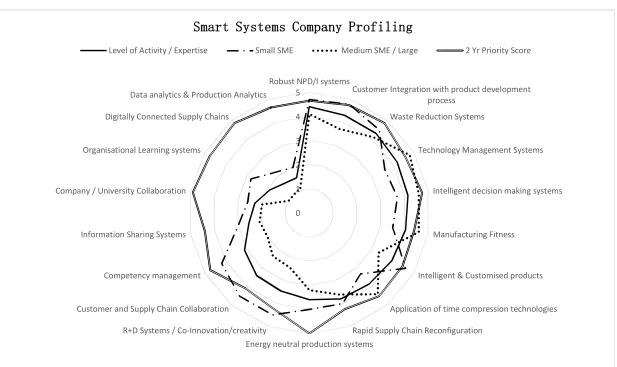
A synopsis of the stage 1 sustainability profiling results is shown in this section of work. Table
219
3 shows an average score of the thirty-two food manufacturing companies on their assessment of
220
their current technological expertise and also, their two-year technology priority score. Furthermore,
221
the table also shows a frequency analysis which profiles the score each company provided against
222
each technology area. This enabled the researchers to understand the relative level of expertise each
223
company had in relation to the technology areas. Figure 1 focusses specifically upon the sample
224
group’s average current expertise profile in ranked order. Taking the top four criteria from this figure
225
shows that; the companies new product development and introduction capabilities along with their
226
customer integration, waste reduction and, technology management expertise was considered strong
227
and well developed. Where the companies scored less well were in the lower four criteria namely;
228
knowledge base collaboration, organizational learning, digital connectedness and, data analytics.
229
Figure 1 also shows the average two-year priority scores offered by the sample group of companies.
230
The two-year priority profile is a measure of what the companies considered as the key technologies
231
and systems that need to be in place in order for the companies to remain competitive over the
232
medium strategic planning horizon. The figure shows that the top four priority areas to focus on are:
233
energy neutral production systems; competency management; digitally connected supply chains and,
234
university/company collaboration. The four criteria of lower concern are; supply chain
235
reconfiguration, customer and supplier collaboration, information sharing and, R+D & Innovation.
236
237
4.1. Analysis of Results (stage 1 study)
238
The findings of the stage 1 survey are shown on Figure 1. The figure represents the current
239
overall scores from all 32 food manufacturers as well as the scores split between the small-SMEs (18
240
companies) and the Medium SME / Large companies (14 companies). The figure also shows the
2-241
year priority profile for the 32 companies. The overall findings of the current scores were not
242
particularly surprising. Food manufacturing companies have traditionally developed strong NPD/I
243
systems that involve close collaboration with customers. Likewise, the management of their current
244
manufacturing systems and technologies as well as developing robust waste reduction systems is
245
well known. Likewise, areas that receive less attention such as collaboration with knowledge bases
246
and lack of understanding of digital connectivity and data analytics is also well known within the
247
industry. Therefore, the common issues found within the wider food manufacturing industry are
248
accurately reflected within this smaller sample group.
249
Analysis of the two-year technology priorities showed that companies were very aspirational in
250
implementing and developing state of the art technologies and systems. In particular, the focus on
251
reducing energy consumption and moving towards energy neutral manufacturing systems is
252
interesting since companies felt that their waste reduction strategies were relatively well advanced
253
but, company energy reduction strategies needed further work and development. Of further interest
254
was the identification of the priority to have ‘digitally connected supply chains’. Although seen as a
255
strategic priority, the companies did not see themselves having the current expertise (or knew where
256
to access the expertise) in order to move towards this priority area. This issue links strongly with the
257
disparity seen between the current overall lack of development in the areas of competency
258
management, knowledge management and University/company collaboration. However, the
259
companies did see that these areas were critical for meeting their future strategic intent as there was
260
a clear lack of understanding amongst the surveyed companies that in order to move to the adoption
261
of Smart Systems, there needed to be a greater development of staff and, further collaboration with
262
Smart Systems experts that are very likely to exist outside the food industry. The external drivers
263
equipment etc as they saw the threat of significant external change as being greater than the internal
265
resistance that had been previously seen. Further analysis of the data identified that the small-SME
266
(10-50 employees) performed better on the whole in the deployment and application of internet and
267
smart systems technologies and were better aligned to meeting the social, environmental and
268
economic sustainability dimensions. Although their technologies and systems lacked the
269
sophistication of the larger companies, the application of internet and cyber physical systems
270
pertaining to their own production operations were better developed. This particular issue was
271
further developed in the Stage 2 research study. A particularly well-developed area amongst the
272
small-SME companies is the development of excellent supply chain collaboration practices developed
273
between customer and supplier delivered through internet technologies (internet and social media
274
platforms).
275
Through the development of closer collaboration within the supply chain, small SMEs benefitted
276
from greater oppprtuniies to develop more customised products and services through co-creativity
277
of new products and innovative solutions to particular production issues thus creating a virtuous
278
circle for these companies. A particular strength of the medium to large companies was their ability
279
to manage their technologies and to operate lean production systems as well as utilizing time
280
compression technologies such as automated production systems, simulation of new production
281
layouts for new product introduction etc. However, whilst these technologies are utilized and well
282
developed, their overall connectivity to Cyber Physical Systems (CPS) which provide the connection
283
to become Smart Systems is missing in all companies surveyed.
284
Therefore, two distinct patterns emerge from this study that emphasis the difference in attitudes
285
between small SMEs and the medium SMEs and larger companies. Smaller SMEs use less
286
sophisticated technology but utilize their systems to better effect, linking their technologies to both
287
customer and supplier in more of a tradition Smart Systems approach whereas, medium sized SMEs
288
and larger companies employ more sophisticated technologies but, they lack the interconnectivity
289
and CPS technologies to turn their technology in to Smart Systems. The next section of the paper will
290
focus on Stage 2 of the research programme and involves undertaking further and more in-depth
291
interviews with the MDs and senior managers of 20 companies (who participated in the stage 1
292
research programme). The aim was to attempt to understand further the issues around SS
293
development within their companies and to highlight the drivers and barriers around SS
294
implementation.
295
296
4.2 Analysis of Results (stage 2 study)
297
Responses obtained from the companies can be grouped in two strategic themes namely;
298
company strategy and manufacturing strategy.
299
Company Strategy: The findings of the Stage 1 phase of the study showed that the companies saw
300
the investment in SS technologies and systems were critical to the survival of their respective
301
companies. The driver for implementing such systems over the next two years was however, driven
302
by the concerns over the rise in labour costs that was driven in turn by major political changes around
303
Brexit and the actual and potential loss of highly skilled European workers. Most companies
304
commented on the issue that they had lost on average 30% of their skilled workforce due to the threat
305
of Brexit and, had previously gone through the pain of training and developing local workers but,
306
had largely failed to retain that workforce. The potential quality problems emanating from the need
307
to employ new staff was also seen as a potential future concern. Therefore, with the potential need to
308
employ new and inexperienced staff in a post-Brexit era, company directors now saw the switch to
309
SS and its associated technologies more realistic considering that a significant change in company
310
strategy was needed to respond to the potential political change.
311
A secondary finding from the interviews highlighted an important issue around future worker
312
recruitment and retention in that companies in general envisaged the adoption of SS would enhance
313
the image of the industry towards being one that was more sophisticated in nature, more
314
environmentally friendly and a more exciting and challenging industry to work in. It was envisaged
315
workers would be drawn to the industry thus reducing the concerns over attracting talent in to the
317
industry.
318
Manufacturing Strategy: In order to remain competitive and therefore economically sustainable,
319
the primary focus of development within the medium sized SMEs and larger companies was on the
320
continual improvement of manufacturing performance whereas most small SMEs focussed upon
321
innovation and new product development as a means towards maintaining competitive advantage.
322
Therefore, as can be expected, the type SS and associated technologies different considerably (i.e. the
323
need for highly automated and connected SS for larger manufacturing focussed food manufacturers
324
compared to the more internet connected social media oriented smaller SMEs where new products
325
and ideas are identified through closer connectivity with their consumer).
326
The drive for automated manufacturing SS within the larger companies was driven by their
327
focus on the continuous improvement of manufacturing capacity and capability. This was primarily
328
down to the issue that the companies surveyed were mainly food processors and had little
329
responsibility for product development. Most MDs saw this as a major concern for future
330
sustainability and, believed that having responsibility for new product development would enable
331
the company to have longer term viability.
332
In discussions with the MDs of the smaller SMEs who had a greater focus on smaller production
333
volumes but greater involvement in the design, development and introduction of new food products,
334
it was clear that their respective manufacturing strategies did not involve expanding their businesses
335
to cater for any significant increase in manufacturing demand, preferring to collaborate with larger
336
manufacturers and to outsource responsibility for production if demand dictated. Therefore, smaller
337
SMEs were more likely to seek collaborative solutions with other companies. However, this was not
338
the case with larger food manufacturers who sought to deal with production issues such as new
339
product development etc by themselves rather than de-risk the NPD process through supply chain
340
collaboration with smaller but more expert companies. Therefore, one of the barriers towards larger
341
companies failing to invest in NPD systems and thus to remain and manufacturing only plants was
342
the perceived costs of investment and the risk of failure.
343
344
5. Discussion
345
Company respondents identified the continuing pressure on their companies to continually
346
innovate but also, to reduce production costs and increase production yield in order to remain
347
economically sustainable. As a result of these pressures, most saw the need to acquire a greater level
348
of automation [49]. Most responses from medium to large companies was to move towards ‘lights
349
out manufacture’ and 24:7 manufacturing and this would rely heavily upon automated systems and
350
technologies. Many large-scale manufacturing facilities already operate partially automated systems.
351
However, the shift towards web based, integrated and automated systems which will ensure
352
productive yield in increased and product quality becomes consistent and repeatable had not yet
353
been made.
354
The SS technologies and systems that are seen as crucial for implementing in to company
355
facilities are highlighted as: Big data and knowledge-based automation: in collecting, analysing and
356
making sense of a wide range of production data and semantic data from multimedia / social media
357
[50] allowing companies to understand customer preferences and personalise products. Smart
358
Systems: The immediate application of Smart Technologies and systems to enable businesses to
359
optimize production and also resource management and energy minimization throughout the supply
360
chain [51,10]. Advanced and autonomous systems: moving routine food manufacturing operations such
361
as food preparation and cleaning activities in to autonomous and near-autonomous activities through
362
the use of computer vision, sensors including GPS, and remote-control algorithms [52]. Cloud
363
computing Computerised food manufacturing execution systems: working in real time to enable the control
364
of multiple elements including enhancing productivity, supply chain management, collaboration,
365
367
368
Figure 1 –Analysis of Current and Future Profiles in Ranked Order.
369
0 1 2 3 4 5
Robust NPD/I systems
Customer Integration with product development process
Waste Reduction Systems
Technology Management Systems
Intelligent decision making systems
Manufacturing Fitness
Intelligent & Customised products
Application of time compression technologies
Rapid Supply Chain Reconfiguration Energy neutral production systems
R+D Systems / Co-Innovation/creativity Customer and Supply Chain Collaboration
Competency management Information Sharing Systems Company / University Collaboration
Organisational Learning systems Digitally Connected Supply Chains
Data analytics & Production Analytics
Smart Systems Company Profiling
New management approaches for Smart Systems: The demands around ensuring security and
370
reliability of food availability requires serious changes in the way food manufacturing functions are
371
managed. Improving distribution, increasing productivity, and reducing waste though a range of
372
initiatives such as enhancing food supply, better network planning of outlets and distribution to
373
maximise efficiency and improve resilience, multiple use of crops/waste streams and novel processes
374
to minimise water and energy requirements, are all key issues requiring new management paradigms
375
to effectively manage the complexity of such systems [55]. These issues can be further enhanced
376
through managing Smart Systems through Cloud management, Big Data Analytics and intelligent
377
decision-making systems [56]. Allied to these issues is the need for New skills and Knowledge Bases:
378
future knowledge generation and though leadership that will enable the development of “digital
379
thinking” so that companies manage the process in a new way and allow for quicker and more
380
accurate decision making [57,58].
381
Whist many of these technologies and systems will be focussed upon the large food
382
manufacturing companies and secondary production providers (such as packaging, logistics and
383
warehousing etc), more elementary yet critical technologies and systems are required by the small
384
food suppliers. The respondents from the small food companies surveyed identified that developing
385
a sound knowledge around digital marketing and e-Word of Mouth (e-WoM) [32-35] [43] is in much
386
demand in order to ensure that smaller companies achieve greater visibility with a wider range of
387
customers and more immediate feedback from clients in order to remain at the forefront of the
388
product development process[59]. Allied to this issue is the enhancement of a company’s use of Social
389
Media systems to include correct website development with enhanced capabilities around order
390
making, payments and special product requests. Key to the enhancement of SME capabilities in the
391
need to establish strong strategic alliances with other companies (food or otherwise) to reduce costs
392
of shipping and logistics for instance. Using other company logistics provision in order to sell
one-393
off products and services which would be otherwise prohibitive to do by the SME.
394
SS can create many opportunities for companies both large and small. Many barriers can exist
395
that prevent companies from adopting such technologies. The usual limitations around cost, worker
396
skills and knowledge are standard impediments that can be dealt with through suitable support
397
mechanisms but, it is likely to take time to achieve. SS should not be the realm of the larger companies
398
only. SMEs have the opportunity to adopt internet based and Smart technologies thus enabling them
399
to continue to operate in this increasingly pressurized environment.
400
401
6. Future Development of Smart Systems for Food Manufacturing Companies
402
The features described above have been explored in depth by the authors referenced. However,
403
it is useful at this point to bring these together in terms of the wider framework of smart system
404
benefits. Therefore, this section of the paper addresses the second objective of the research, that of to
405
propose a conceptual system architecture for effective SS implementation. One such approach towards
406
identifying the range of SS technologies that can be applied within companies can be through the
407
“digital compass” [43]. The company shown in Figure 2 aligns the eight basic value drivers and 26
408
practical SS levers. Further analysis of the compass shows that the technologies can be further
409
divided into two sections namely; the ‘responsive’ drivers and enablers which can be described as
410
broadly operations based and delivering principally internally focused benefit, and ‘proactive’
411
drivers and enablers which are broadly externally focused on aligning capabilities with customers’
412
needs. These segments of the digital compass align themselves closely with the SS and
413
Sustainability drivers shown in Table 1. As discussed in the results section, the perceived preference
414
and focus of the companies on process and operational improvements will lead them to the
right-415
hand side of the compass, while companies need to maintain market agility and responsiveness to
416
new opportunities directs them towards left of the compass. Clearly, the two are not mutually
417
exclusive, and management teams will often desire a mix-and- match model, but this work clearly
418
shows that by clarifying the future vision, companies can select appropriate segments of smart system
419
utilization rather than be forced into an expensive “across the board” business transformation.
420
At the outset of this work it was acknowledged there is no single prescriptive guide or model to
421
possible time and smallest implementation cost. But it is an important step in creating any
423
implementation strategy to recognize known standards and system capabilities to deliver required
424
benefits. In addition, the results of the survey, especially the stage 2 interviews, reveal that the
425
challenges around attraction and retention of human resources with the specialist skills required are
426
common to both categories of company. This suggests a similar starting point for smart system
427
implementation strategies, which then diverge according to the relevant mix and match of drivers,
428
and implementation levers, selected from around the digital compass. Fine tuning the model for
429
strategy selection requires further work to dissect the skills and system architecture required
430
according to the levers to be employed, but this is very achievable in this specific sector where
431
regulatory requirements and common process steps have driven some level of standard capability
432
(and in turn the aspect of isolation that is hindering ongoing development). This phase of analysis
433
also highlights the importance of creating a decision point to drive strategy formulation and focus on
434
both specific benefit, and core competencies, for effective smart system implementation. Achieving
435
this focus will help overcome the industry’s perception of implementation costs and skill
436
development.
437
438
439
Figure 2 –Digital Compass [43] .
440
441
6.1. Towards the Implementation of Smart Systems
442
Implementing an effective strategy requires an alignment of all the variables explored in this
443
study. This third and final phase to the study recognises that, as in any process, the strategy
444
definition process can be simply shown in terms of the inputs, outputs and controls that effect the
445
process itself: This paper has considered these variables, with a view to identifying the greatest
446
opportunity for food producers to exploit the potential of SS and to link these to their appropriate
447
sustainability dimensions. By engaging with the initial thirty-two companies food manufacturing
448
companies, the business drivers were well articulated and split between internal and external forces.
449
“Proactive” drivers Broadly externally focused technologies
Then the academic and vocational data sources were examined to understand the key enabling
450
factors, the core supply chain requirements and the traditional improvement paradigms such as lean
451
manufacturing and how they are used to drive traditional productivity gains. Finally, the split
452
between proactive and responsive improvement levers utilized by smart systems has been
453
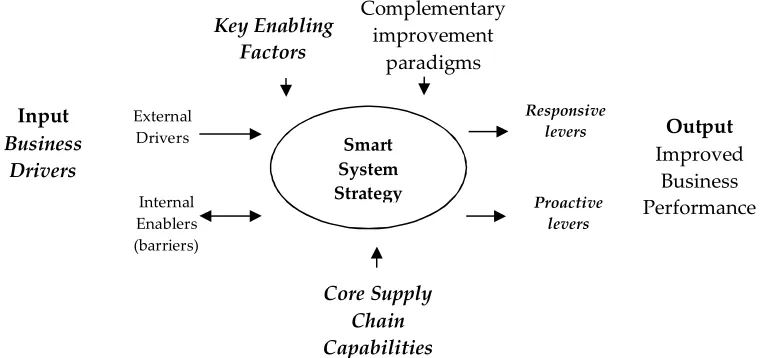
considered, especially with regard to the projected benefits. Figure 3 shows a schematic of the SS
454
implementation framework. The diagram shows the required inputs in to the system. These consist
455
of enablers, drivers, factors and capabilities that are needed for the correct implementation of the SS
456
strategy. The resulting outputs of the framework show the proactive and response levers that lead to
457
improved business performance. The following section details the drivers, inputs and outputs of the
458
framework.
459
460
Figure 3 – Schematic of the Smart Systems Implementation Framework.
461
462
Business drivers: External drivers including political and environmental factors, changing
463
workforce demographics, and changing customer requirements. Internal dimensions such as
464
attraction and retention of staff, training in requisite skills, and system implementation costs.
465
Key enabling factors: Including: Big data and knowledge based automation; (2) Smart Systems; (3)
466
Advanced Robotics; (4) Cloud based systems; (5) new management paradigms and, (6) new skills
467
and knowledge bases. Lean, Agility and six sigma improvement paradigms drive both the
468
improvement culture and affect the human factors.
469
Core supply chain capabilities: virtual enterprises, digital marketing and, virtual supply chain
470
environments focusing upon ICT and web technologies by partnering/outsourcing companies [59].
471
Increase the transparency of operations through to the supply chain in order to achieve greater food
472
security and reliability [60]. Sustainability / resource efficiency: resource and energy efficiency, waste
473
management, recycling [47]. ICT - Networked business processes. Implementing technologies to
474
share design information, and product development information. Cyber security systems and the
475
security of food product and process data to ensure UK food companies protect their product data
476
[61].
477
Proactive / outwardly facing smart system levers : Innovation tools, marketing tools and a capability
478
to exploit new opportunities in high-value added products or niche-market products as a strategy for
479
growth [8]. ICT capability to share information particularly design through product life cycle; which
480
will help customers to access this data before any purchase commitments [62]. Open collaboration
481
activities between food companies operating in a trusted and truly collaborative environment will be
482
key to developing and sustaining food manufacturing systems especially in small food
483
manufacturing companies [61].
484
Smart System Strategy
Output Improved
Business Performance Input
Business Drivers
Core Supply Chain Capabilities Key Enabling
Factors
External Drivers
Responsive levers
Internal Enablers (barriers)
Proactive levers Complementary
Responsive / inwardly facing smart system levers : Rapid configuration of food manufacturing systems
485
to be able to ramp up production or, reduce productive capacity where required. This will not only
486
need flexible manufacturing systems but also flexible working contracts and people. High volume,
487
low variety versus low volume, higher variety will be the likely feature of food producers in the UK
488
[62]. Technology developments for automation, process control, flexible machine control and,
489
enhancing safety aspects in food manufacturing including, new manufacturing technologies,
490
integration of technologies, novel structures and techniques [63].
491
492
7. Conclusions
493
Food Manufacturing Companies in the UK face many challenges and opportunities to achieve
494
economic sustainability. One such opportunity is through the application and implementation of
495
Smart Systems. This study has attempted to develop an understanding of the attitudes and priorities
496
of FMCs to the adoption of SS. Through the application of a new measuring tool developed in this
497
paper, the research team has been able to profile a range of small, medium and large scale food
498
manufacturing companies and to determine the strategic drivers and challenges that these companies
499
have in the implementation of SS. Therefore, the initial contribution of this paper is to propose the
500
development of a unique measuring tool for assessing a company’s preparedness and its operational
501
and strategic capabilities towards the adoption of SS technologies and systems. Through the use of
502
this profiling tool and the adoption of the two-stage research approach, the research team has been
503
able to identify a complex range of differing company demand and pressures that means a one size
504
fits all strategy for supporting such companies is going to be largely ineffective and costly [46].
505
From a theoretical viewpoint, this study contributes to the emerging literature on the
506
relationship between food companies and their motivations towards implementing SS and its
507
connection to the dimensions of sustainable production by contrasting the effect of the external and
508
internal pressures and drivers in FMCs [46]. More specifically, the work provides for a more
509
qualitative understanding and clarification with regard to opportunities and challenges that are
510
considered relevant for SS implementation and value creation within the food production industry.
511
In this study, the issue of a company’s preparedness for SS was examined based on both external
512
and internal drivers. The study showed that external drivers are currently more important than
513
internal drivers in moving towards the implementation of SS in these food manufacturing companies.
514
The external drivers such as future political changes and, the associated potential loss of low-labour
515
cost workforce is driving larger food manufacturing companies towards the implementation of
516
responsive Smart Systems. The smaller food producers are focussed on more proactive tools,
517
including how the SS can successfully be used to improve efficiencies on small batch manufacturing,
518
time to market, and promotion of the company on a much wider scale than it currently does.
519
Interestingly, companies see that these external drivers outweigh the internal issues such as training,
520
costs etc and seem willing to overcome these internal barriers as the external drivers seems to be
521
greater than the internal resistance previously seen. Furthermore, simultaneous approach to the issue
522
of implementing Smart technologies in the UK food sector regarding internal and external drivers is
523
another feature of this study because in most previous studies the issue of Smart technology
524
implementation is studied from the internal perspective (training, cost, etc. as being barriers towards
525
implementation). Dividing these drivers into internal and external drivers was the main characteristic
526
of this study that led to different results.
527
The major limitation of this study is the limited sample size obtained for the stage 1 survey and
528
stage 2 interviews. Whilst the total response level of 32 companies enabled the research team to
529
identify a number of key themes around Smart Systems within the food manufacturing industry, the
530
work cannot be considered to have any statistical significance and therefore the outputs of the study
531
are to be considered with this limitation in mind. A more comprehensive survey is now underway
532
and the outputs of the study should provide additional contextual information around the findings
533
of this study has initiated a further and more detailed survey questionnaire and a semi-structured
535
interview programme for the next phase of this under-researched area.
536
537
538
Author Contributions: “conceptualization, AT and CHT.; methodology, RB and MF.; validation, RMJ and PB.;
539
formal analysis, AT.; investigation, PB.; resources, RMJ.; data curation, MF.; writing—original draft preparation,
540
CHT.; writing—review and editing, AT.; visualization, CHT.
541
Acknowledgements: Dedicated to the memory of Dr Richard Barton
542
Funding: No funding as received for this research
543
Conflicts of Interest: “The authors declare no conflict of interest.”
544
545
References
546
1. Food and Drink Research Network, (2013) “Ensuring Sustainable Employment and Competitiveness in The
547
EU Food and Drink Industry: Meeting the Challenges of the Labour Market”.
548
http://www.fooddrinkeurope.eu/uploads/publications_documents/Final_Report.pdf. Accessed
549
01/08/2017
550
2. WRAP (2015) “Water Minimisation in the Food and Drink Industry”,
551
http://www.wrap.org.uk/sites/files/wrap/Water%20Minimisation%20in%20FD%20Industry.pdf Accessed
552
20/01/2018
553
3. Vision for Innovation in Food and Drink Manufacturing, A Food and Drink Federation Publication, 2014
554
4. Food and Drink Federation (2017) “A New UK-EU Relationship: Priorities for the food and drink
555
manufacturing industry”. https://www.fdf.org.uk/priorities-eu-manifesto.aspx. Accessed 04/04/2017
556
5. Gunasekaran S “Automation of Food Processing” Food Engineering Vol 4, 2013
557
5 Nagy J., Olah, J., Erdei, E., Mate, D., Popp, J (2018) “The Role and Impact of Industry 4.0 and the Internet
558
of Things on the Business Strategy of the Value Chain—The Case of Hungary”, Sustainability Vol:10, Iss:
559
3491; pp 1-25. doi:10.3390/su10103491
560
6 Bonilla S.H, Silva H.R., Terra da Silva, M., Gonçalves, R.F., Sacomano, J.B (2018) “Industry 4.0 and
561
Sustainability Implications: A Scenario-Based Analysis of the Impacts and Challenges, Sustainability” Vol
562
10, Iss 3740; pp 1-24 doi:10.3390/su10103740
563
7 Food Processing (2017) “Industry 4.0 in the Food and Beverage industry” Food Processing,
564
http://www.fponthenet.net/article/97392/Industry-4-0-in-the-Food-and-Beverage-industry.aspx .
565
Accessed 06/04/2017
566
8 Food Science and Technology (2017) “How will the Smart Systems Impact the Food Industry?”. The journal
567
of the Institute of Food Science and Technology.
http://fstjournal.org/features/how-will-internet-things-568
impact-food-industry Accessed, 31/07/2017.
569
9 Xiaorong Z., Fan H., Zhu H., Fu Z., Zhu H. (2015) “The Design of the Smart Systems Solution for Food
570
Supply Chains”, 5th International Conference on Education, Management, Information and Medicine
571
(EMIM 2015)
572
10 Verdouw C.N., Wolfert J., Beulens A.J.M., Rialland A (2016) “Virtualization of food supply chains with the
573
Smart Systems” Journal of Food Engineering Vol 176, Iss12, pp 128-136
574
11 Cagliano, R., Caniato, F. F. A., & Worley, C. G. (2016). A pathway towards truly sustainable food supply
575
chains: Balancing motivation, strategy, and impact. In Organizing Supply Chain Processes for Sustainable
576
Innovation in the Agri-Food Industry, 22, 287–318. https://doi.org/10.1108/ose
577
12 EU Commission Survey (2016) “An analysis of drivers, barriers and readiness factors of EU companies for
578
13 Simutech “Industry 4.0: How the Food Industry Must Adapt to Survive”, Simutech Whitepaper, Accessed
580
01/08/2017
581
14 Zawadzki P., Zywicki K (2016) “Smart Product Design and Production Control For Effective Mass
582
Customization in The Industry 4.0 Concept”, Management and Production Engineering Review. 7,3, pp.
583
105–112
584
15 Ardito, L., Petruzzelli A.M.,Panniello,U., Garavelli,A.C (2018) "Towards Industry 4.0: Mapping
585
digital technologies for supply chain management-marketing integration", Business Process
586
Management Journal, https://doi.org/10.1108/BPMJ-04-2017-0088
587
16 Pusavec, F., Kramar D., Krainik P., Kopac, K. (2010) “Transitioning to sustainable production – part II:
588
evaluation of sustainable machining technologies”, Journal of Cleaner Production, 18,12, pp1211,1221
589
17 Fleith de Medeiros J., Ribeiro, J.L.D., Cortimiglia M.N, (2014) “Success factors for environmentally
590
sustainable product innovation: a systematic literature review” Journal of Cleaner Production, 65, pp
76-591
86
592
18 Vezzoli E.M.C (2003) “A strategic design approach to develop sustainable product service systems:
593
examples taken from the ‘environmentally friendly innovation’ Italian prize” Journal of Cleaner
594
Production, 11, 8 ,pp 851-857
595
19 Jasiulewicz-Kaczmarek M., Saniuk A., 2015, Human factor in Sustainable Manufacturing, Editors:M.
596
Antona, C. Stephanidis , Universal Access in Human-Computer Interaction. Access to the Human
597
Environment and Culture, LNCS Vol. 9178 , pp.444 – 455, DOI 10.1007/978-3319-20687-5_43
598
20 Mrugalska B., Arezes P.M., Safety Requirements for Machinery in Practice, In: Arezes, P.M., Baptista, J.S.,
599
Barroso, M.P. et al. (eds.), pp. 97-101, Occupational Safety and Hygiene. 9th International Symposium on
600
Occupational Safety and Hygiene (SHO), Guimaraes, 14-15 February 2013. London: Taylor and Francis
601
Group, 2013
602
21 Sobaszek L., Gola A., Swic A “Predictive Scheduling as a Part of Intelligent Job Scheduling System”,
603
Intelligent Systems in Production Engineering and Maintenance – ISPEM 2017. Proceedings of the First
604
International Conference on Intelligent Systems in Production Engineering and Maintenance ISPEM 2017
605
pp.358-367.
606
22 Gola A., Klosowski, G “Application of Fuzzy Logic and Genetic Algorithms in Automated Works
607
Transport Organization”, International Symposium on Distributed Computing and Artificial Intelligence,
608
2018, pp 29-36
609
23 Edwards, M.G (2009) "An integrative metatheory for organisational learning and sustainability in
610
turbulent times", The Learning Organization, Vol. 16 Issue: 3, pp.189-207,
611
https://doi.org/10.1108/09696470910949926
612
24 Shrouf F., Ordieres J., Miragliotta G “Smart factories in Industry 4.0: A review of the concept and of energy
613
management approached in production based on the Internet of Things paradigm”, IEEE International
614
Conference on Industrial Engineering and Engineering Management (2014) Malaysia. DOI:
615
10.1109/IEEM.2014.7058728
616
25 Tu,M., Lim M.K., Yang, M.F (2018) "IoT-based production logistics and supply chain system – Part
617
2: IoT-based cyber-physical system: a framework and evaluation", Industrial Management & Data
618
Systems, Vol. 118 Issue: 1, pp.96-125, https://doi.org/10.1108/IMDS-11-2016-0504
619
26 Bocken N., Short S., Rana P., Evans S, (2013) "A value mapping tool for sustainable business
620
modelling", Corporate Governance, Vol. 13 Issue: 5, pp.482-497,
![Table 2 – Companies and Sectors Responding to Survey – Stage 1 Stage 2 [ ]](https://thumb-us.123doks.com/thumbv2/123dok_us/8006548.1330448/5.595.77.508.344.483/table-companies-sectors-responding-survey-stage-stage.webp)
![Figure 2 –Digital Compass [43] .](https://thumb-us.123doks.com/thumbv2/123dok_us/8006548.1330448/12.595.87.501.296.642/figure-digital-compass.webp)