NEW APPROACH TO STUDY THE IGNITION PROCESSES OF ORGANIC
COAL-WATER FUELS IN AN OXIDIZER FLOW
T.R. Valiullin1, М.А. Dmitrienko 1, a, P.А. Strizhak1
National Research Tomsk Polytechnic University, 634050 Tomsk, Russian
Abstract. To converge the conditions of organic water-coal fuel composition combustion in the typical power equipment we developed a new approach and installed an experimental setup, eliminating the traditional fixing the fuel droplets on the thermocouples or rods. Specialized cone-shaped chamber was used to implement the process of lingering of organic water-coal fuel droplets. Necessary and sufficient conditions for the lingering of organic water-coal fuel droplets were es-tablished. We determined the parameters of the system (droplet size of 0.4-0.6 mm, temperatures 823-903 K and the ve-locity of the oxidizer flow 1.5-6 m/s) at which the droplets were consistently ignited in the process of lingering. Mini-mum temperatures and ignition delay times of organic water-coal fuel droplets based on brown coal, used motor, turbine, transformer oils, kerosene, gasoline and water were defined.
1 Introduction
Currently, there are several approaches [1–4] for studying the features of the initiation of the stable combustion of coal-water fuel (CWF) compositions. As the most typical one can regard the injection of CWF droplets in the combustion chamber or the model-ing high-temperature channels on the junction of low-inertia thermocouple [1–3], wire [4], quartz rod [4], atomization of CWF using specialized atomizers [5], the use of simplified models of the conjugate heat transfer [6], simulation by applying specialized software packages (for example, Ansys or CWF) [7].
Unfortunately, each of these approaches has some specific restrictions. In particular, at hanging the CWF droplets [1–4] on the wires, thermocouple or rods, an element used as a carrier of the droplet in the combustion device influences quite significantly on the persistence of the ignition. Applying the models of conjugate heat transfer [6] allows us to study the features of CWF droplet ignition only on an example of single droplet or a small group of them. In the specialized software packages (for example, Ansys, Fluent, CWF) [7] a group of the droplets can be researched, but it is difficult to establish the typical stages of initialization of combustion. Therefore, one needs a new approach to study the combustion processes of CWF eliminating the dedicated limita-tions. It seems appropriate to create a specialized chamber for lingering of fuel droplets. At the same time from the analysis [8] from the economic and environmental points of view, it is important to develop the technologies of combustion not only CWF, but also organic coal-water fuels, that is, with the addition of a liquid fuel component. Numerous statistical data [9] have shown that the amount of such combustible components from among of used motor, transformer and turbine oils are very high. And the dy-namics of their growth is considerable. At that, the problems of their effective utilization are actual.
Researches [10, 11] have shown that a stable ignition of group of coals can be occurred at low temperatures (600-800 K, that is substantially lower than assumed ones in power systems). It is interesting to analyze the possible conditions of lingering and igni-tion of OCWF droplets at such temperatures of oxidizer.
To solve the problems of studying the ignition of lingering droplets of organic coal-water suspensions it is ought to use special-ized software packages that let to perform a continuous tracking of moving objects. Studies [12, 13] have shown that Tema Auto-motive can be applied as a such software application.
The purpose of this work – experimental determination of necessary and sufficient conditions of lingering and subsequent igni-tion of OCWF droplets.
2 Experimental
procedure
The brown coal of grade B2 (particle size is 100 μm), used motor, turbine, transformer oils and water was used as the main components for the preparation of organic coal-water fuels. On the basis of these components we prepared four compositions of OCWF by the homogenizer MPW-324. For each composition, mixing the components was made in established ratios (Table. 1).
a
Corresponding author: [email protected] C
Table. 1. The ratios of the components of organic coal-water mixtures.
Number of composition The ratio of the mass concentrations of the components Composition№ 1 Brown coal 50 %, motor oil 10 %, water 40 % Composition№ 2 Brown coal 40 %, turbine oil 10 %, water 50 % Composition№ 3 Brown coal 40 %, transformer oil 10 %, water 50 % Composition№ 4 Brown coal 40 %, motor oil 10 %, water 50 % Composition№ 5 Brown coal 40 %, gasoline 10 %, water 50 % Composition№ 6 Brown coal 40 %, kerosene 10 %, water 50 %
At the first stage, the components were weighed with the analytical scales ViBRA HT 84RCE. Then, the components were added into the vessel of homogenizer (capacity 0.25 l) for mixing. The duration of the process of mixing the composition was 10 minutes.
Fig. 1 shows the scheme of experimental setup destined for the study of integral characteristics of the ignition and burning of the lingering droplets of OCWF.
Figure 1. Scheme of experimental setup:1– blower;2– air-heater;3– remote control;4– module of power and control of the coordinate mech-anism;5– coordinate mechanism;6– specialized cone-shaped quartz glass chamber;7– high-speed video camera;8–nichrome thread;9– the droplet of fuel composition;10–a cutting element (needle tip);11– metal hollow rods;12– weighing system;13– personal computer;14– corrugated thermally insulated channels;15– digital temperature gauge (complete with a chromel-alumel thermocouple);16– exhaust ventila-tion.
Airflow of predetermined temperature Tg was formed using a blower1 and the air-heater 2 and directed into a cone-shaped
chamber 6 made of quartz glass. The control of temperature in the chamber (on the axis of symmetry) was performed using a chromel-alumel thermocouple (temperature measurement range 273-1373 K, systematic error of ± 3 K, the rate of response not
more than 3 seconds) 15 installed in the technological hole in the side surface of the chamber.
To ensure the droplet lingering in the chamber (after its discharge from the thread) with the help of the frequency converter, the consumption and the velocity of the oxidizer flow was varied. Chamber dimensions (internal diameter and height of the cylin-drical central part – 0.264 m and 0.025 m; height of input and output cone-shaped parts – 0 .2 m and 0.05 m, and their maximum and minimum inner diameters – 0.264 m and 0.086 m) provided the lingering of liquid composite fuel droplets for a time until the completion of the combustion process.
By carrying out the experiments the parameters were registered: temperatures (Tg) and velocities (Vg) of oxidizer; dimensions (Rd) and the mass (md) of OCWF droplets; the time of droplet injection into the chamber to discharge (τm); the delay time of the ignition (τd) and complete combustion (τc) of the droplet. Times τdand τcwere controlled using the specialized algorithms of soft-ware Tema Automotive, allowing us to determine the characteristic color rendition –the intensity of the luminescence of the gen-erated fuel particle sample (in the process of ignition and combustion) when continuous tracking of the control object. Thus, with using the monochrome black and white high-speed video camera and related software (Tema Automotive) in the registration area we exhibited a gradient of the color rendition that corresponds to the conditions under which a sample of fuel burnt (by the color model “RGB”255 it was assumed that white color corresponded to the luminescence (burning) of the sample–range of “RGB”
220-255; 0 –black). In the software package Tema Automotive, this parameter was called as“Threshold”. On this basis, the delay time of ignition (τd) was an interval from the moment of droplet injection in the chamber up to achieving the “Threshold”level 220, and the time of complete combustion (τc) of OCWF droplet was the period from the droplet injection in the chamber up to reduce the parameter “Threshold”less than the characteristic limited level of 220.
To control the legitimacy of the use of the color model “RGB” (definition of time τdand τc), additional experiments were con-ducted, during which a temperature (Td) in the droplet was recorded. For this purpose, droplet of fuel composition was generated and injected into the chamber at the junction of low-inertia thermoelectric (platinum–platinum-rhodium, the measuring tempera-ture range 273-1873 K, the systematic error of ± 1 K, the rate of response not more than 1 second, the diameter of the junction about 0.1 mm) converter (instead of ceramic tip). Measured temperature in the dropletTdprovided the opportunity to monitor the implementation of common criteria of ignition and complete combustion of the fuel composition. In line with the conclusions [14, 15] as a criteria for sustainable ignition (for the considered system) we used: the simultaneous fulfillment of the inequality Td>Tg; achieving the rate of change Tdnot less 10 K/s. The combustion process was considered as a completed one when the temperature Tdwas corresponded toTg.
3 Results
and
discussion
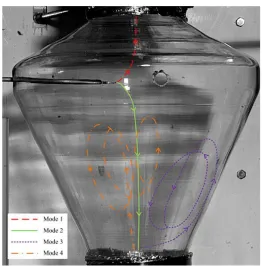
Figure 2. Videogram with modes of lingering of drop of fuel (for the conditions under which droplets are lingering and igniting).
part of the chamber. Implementation of the fourth regime was considered as an ideal one. At this regime the droplet lingering was carried out in the area, located near the axis of symmetry of the chamber.
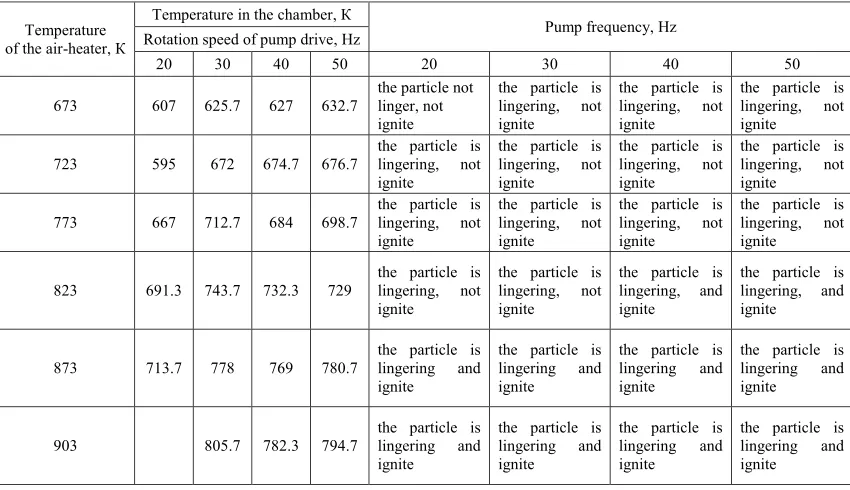
In the result of varying the temperature in the cone (607–806 K) and the rotation speed of pump drive (20–50 Hz), during the experiments, the conditions were determined. Under these conditions, the OCWF droplets did not linger and not ignited; lingered, but not ignited; lingered and ignition. Table 2 shows the conditions of lingering and the ignition for OCWF droplets based on brown coal and the used motor oil (brown coal 50%, motor oil 10%, water 40%).
Ignition of the particle of OCWF occurred at a temperature of 823 K (at a temperature less than 823 K the particle did not ignite). When a rotation speed of pump drive was 20-30 Hz, the air flow rate was not enough to ensure the equable particle lingering in the chamber. When the maximum rotation speed of pump drive was 50 Hz, the air flow rate in the chamber was too high and the particle passed in a corrugated insulated channel 14. As the minimum parameters, which provided equable lingering of fuel particle and its ignition, we taken the temperature in the chamber equal to 823 K, and the rotation speed of pump drive of 40 Hz.
Table. 2. Conditions of lingering and ignition for OCWF droplets based on brown coal and used motor oil.
Temperature of the air-heater,К
Temperature in the chamber,К
Pump frequency, Hz Rotation speed of pump drive, Hz
20 30 40 50 20 30 40 50
673 607 625.7 627 632.7
the particle not linger, not ignite
the particle is lingering, not ignite
the particle is lingering, not ignite
the particle is lingering, not ignite
723 595 672 674.7 676.7
the particle is lingering, not ignite
the particle is lingering, not ignite
the particle is lingering, not ignite
the particle is lingering, not ignite
773 667 712.7 684 698.7
the particle is lingering, not ignite
the particle is lingering, not ignite
the particle is lingering, not ignite
the particle is lingering, not ignite
823 691.3 743.7 732.3 729
the particle is lingering, not ignite
the particle is lingering, not ignite
the particle is lingering, and ignite
the particle is lingering, and ignite
873 713.7 778 769 780.7
the particle is lingering and ignite
the particle is lingering and ignite
the particle is lingering and ignite
the particle is lingering and ignite
903 805.7 782.3 794.7
the particle is lingering and ignite
the particle is lingering and ignite
the particle is lingering and ignite
a
с
d
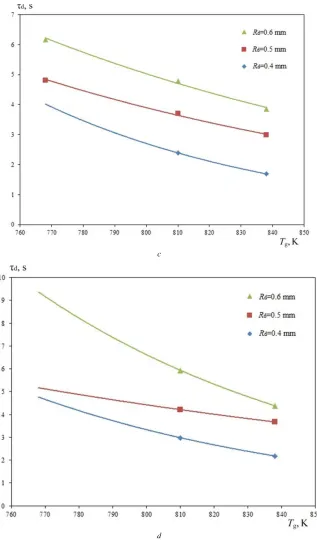
The experimental dependences presented in Fig. 3 has a nonlinear character. It is seen that with increasing the oxidizer temperature Tg there is a decrease of the values of the ignition delay times τd. This is due to that fact that the dependencies of thermal decomposition velocities of the organic mass of coal, vaporization of liquid combustible (oil) and non-combustible (water) components, gas-phase ignition of the volatile and heterogeneous ignition of the coke residue from the temperature usually has the exponential form.
Increasing the size of organic coal-water suspension droplets Rd also leads to increase in the inertia of ignition process. This can be explained by the fact that the component characterizing the inert heating of fuel composition provides the dominant influ-ence on the ignition delay times τd.
In comparing the delay times of ignition of OCWF droplets with the addition of various liquid fuel components (used motor, turbine, transformer oils, kerosene and gasoline), one can conclude that the smallest values of the ignition delay times of all the studying compounds are observed for particles on the basis of brown coal and kerosene and they were within the range of 1.7-6.2 s. The highest values of the ignition delay times are observed for the composition based on brown coal and gasoline and they are within the range of 2.2-9.4 s.
4 Conclusion
The developed approach in distinction from known ones allows determining the integral characteristics of the ignition processes of the organic coal-water fuel droplets in the oxidizer flow (excluding the influence of heat sink or additional inflow from the ele-ment on which the droplet is injected in the oxidizer medium – for example, rod, wire, thermocouple and other). The experimental results and their comparison with the data of previous experiments illustrates that the delay times of ignition can be significantly lower when the droplets are lingering (similar to the combustion chambers) than the data presented in the works [3, 4]. As a con-sequence, it is advisable to extend the approach on the organic coal-water fuels and coal-water fuels with prevalent component compositions.
This work supported by the Russian Science Foundation, project 15–19–10003.
References
1. Gajewski W., Kijo-Kleczkowska A., Leszczynski J., Fuel, 88 (2), 221 (2009) 2. Kijo-Kleczkowska A., Fuel, 90 (2), 865 (2011)
3. Glushkov D.O., Strizhak P.A., Vershinina K.Yu, Matec Web of Conference, 23, 01063 (2015)
4. Chebochakova D.A., Glushkov D.O., Lyakhovskaya O.E., Sukhanov S.V., Matec Web of Conference (23), 01045 (2015) 5. A.P. Burdukov, V.I. Popov, T.S. Yusupov, M.Yu. Chernetskiy, K. Hanjalić, Fuel, 122, 103 (2014)
6. Kuznetsov G.V., Salomatov V.V., Syrodoy S.V., Combustion, Explosion, and Shock Waves, 51 (4), 409 (2015) 7. Atal A., Levendis Y.A., Combust. Flame,98 (4), 326 (1994)
8. G. S. Khodakov, E. G. Gorlov, and G. S. Golovin, Solid Fuel Chem.,40, 19 (2006) 9. A.E. Kontorovich, M.I. Epov, L.V. Eder, Russian Geology and Geophysics, 55, 534 (2014) 10. Glushkov D.O., Kuznetsov G.V., Strizhak P.A, Solid Fuel Chem.,49 (2), 73 (2015)
11. Glushkov D.O., Kuznetsov G.V., Strizhak P.A., Russian Journal of Physical Chemistry B,9 (2), 242 (2015) 12. Glushkov D.O., Strizhak P.A., Vysokomornaya O.V., Thermal Science,19 (1), 285 (2015)
13. Kuznetsov G.V., Piskunov M.V., Strizhak P.A., Int. J. Heat Mass Transfer, 92, 360 (2016) 14. Q. He, D. Xie, R. Xu, T. Wang, B. Hu, Fuel, 159, 40 (2015)