IJEDR1504105
International Journal of Engineering Development and Research (www.ijedr.org)614
Prominence of Reactive Routing Protocols with
Increasing Packet Send Rate in NS2
1Sanjeev Kumar Jain, 2Prof. Sourabh Jain, 3Prof. Shivendu Dubey 1M. Tech. Student, 2 Assistant. Professor, 3Assistant. Professor
Department of Computer Science & Engineering
Gyan Ganga Institute of Technology & Sciences, Jablapur, India
________________________________________________________________________________________________________
Abstract - A mobile ad hoc network (MANET) is a collection of wireless mobile nodes forming a dynamic network Topology without the aid of any existing network infrastructure or centralized administration. Each node participating in the network acts as a host and as a router , means they have to forward packets and identify route as well. Despite the considerable simulation works, still more investigation is required in the performance evaluation of routing protocols for multimedia traffic especially Constant Bit Rate (CBR). In this paper, we will conduct a number of simulations for the performance evaluation of popular routing protocols of MANET, named AODV and DSR, for CBR traffic by changing the number of nodes and packet send rate. We will investigate the performance of AODV and DSR using four metrics- Packet Delivery Ratio, Average End-to-End Delay, number of Drop Packets and Average Throughput.
Keywords - MANET, CBR, AODV, DSR
_______________________________________________________________________________________________________
I. INTRODUCTION
A Mobile Ad hoc Networks (MANET) represents a system of wireless mobile nodes that move arbitrarily and dynamically self-organize in to autonomous and temporary network topologies, allowing people and devices to seamlessly communicate without any pre-existing communication architecture. Such infrastructure less networks are usually needed in battlefields, disaster areas, and meetings, because of their capability of handling node failures and fast topology changes. The most important characteristics are dynamic topology, where nodes can change position quite frequently, so we require such routing protocol that quickly adapts to topology changes.
Normal routing protocol, which works well in fixed networks does not show same performance in Mobile ad-hoc Networks. In MANET routing protocols should be more dynamic so that they quickly respond to topological changes [1]. A number of protocols have been developed to accomplish this task.
Routing paths in MANET potentially contain multiple hops, and each node has the responsibility to act as router [2]. Routing in MANET has been a challenging task because of high degree of node mobility. MANET routing protocol must have the following characteristics:
1) Keep the routing table up-to-date and reasonably small, 2) Select the best route for given destination and
3) Converge within an exchange of a small amount of messages [3].
Pouranik et. al. [4] has studied performance evaluation of two routing protocols of MANET under data send rate. In which they compare the performance of AODV and DSDV with CBR traffic. In present paper, we have compared two reactive routing protocols (AODV and DSR) using CBR traffic with increasing packet send rate. The PDR, Average End to End delay, Average Throughput and number of Drop packets has been evaluated as the parameter metrics.
This paper is organized in five sections. Section 2 gives brief description of studied routing protocols. Section 3 describes simulation environment and performance metrics. Simulation results are discussed in section 4. Section 5 describes our conclusion and future scope.
II. DESCRIPTION OF MANET ROUTING PROTOCOLS
Description of routing protocols AODV and DSR in brief are as follows:
AODV (Ad-hoc On demand Distance Vector)
IJEDR1504105
International Journal of Engineering Development and Research (www.ijedr.org)615
topological changes in the network and updating only the hosts that may be affected by the change, using the RRER message. The Hello messages, which are responsible for the route maintenance, are also limited so that they do not create unnecessary overhead in the network. The AODV protocol is a loop free and avoids the counting to infinity problem, which were typical to the classical distance vector routing protocols, by the usage of the sequence numbers [6].DSR (Dynamic Source Routing)
Dynamic Source Routing Protocol is a reactive routing protocol and is called on demand routing protocol [5]. It is a source routing protocol that is why it is a simple and an efficient protocol. It can be used in multi hop wireless ad hoc networks. The DSR network is totally self-organizing and self-configuring. The protocols is just compose of two mechanisms i.e. route discovery and route maintenance.
The DSR regularly updates its route cache for the sake of new available easy routes. If some new available routes were found the node will directs the packet to that route. The packet has to know about the route direction. So the information about the route was set in the packet to reach its destination from its sender. This information was kept in the packet to avoid periodic findings it has the capability to find out its route by this way. DSR has two basic mechanisms for its operation i.e. route discovery and route maintenance. In route discovery, it has two messages i.e. route request (RREQ) and route reply (RREP). When a node wishes to send a message to a specific destination, it broadcast the RREQ packet in the network. The neighbor nodes in the broadcast range receive this RREQ message and add their own address and again rebroadcast it in the network. This RREQ message if reached to the destination, so that is the route to the specific destination. In the case if the message did not reached to the destination then the node which received the RREQ packet will look that previously a route used for the specific destination or not.
Each node maintains its route cache which is kept in the memory for the discovered route. The node will check its route cache for the desired destination before rebroadcasting the RREQ message. By maintaining the route cache at every node in the network, it reduces the memory overhead which is generated by the route discovery procedure. If a route is found in that node route cache then it will not rebroadcast the RREQ in the whole network. So it will forward the RREQ message to the destination node. The first message reached to the destination has full information about the route. That node will send a RREP packet to the sender having complete route information.
The DSR protocol [7] is composed of following two mechanisms which work together to allow the discovery as well as the maintenance of source routes in the ad hoc network:
Route Discovery is a mechanism in which a node S which is wishing to send a packet to a destination node D obtains a source route to D. The route Discovery is used only when S tries to send a packet to D but does not already know a route to D.
Route Maintenance is another mechanism by which a node S is capable to detect, while using a source route to D, while the network topology has been changed such that it can no longer utilize its route to D as a link along with the route no longer works. When Route Maintenance specifies a source route has been broken, S can attempt to employ any other route which happens to know to D, or may invoke the Route Discovery again to discover a new route. The Route Maintenance is used only when S is really sending packets to D.
Route Discovery as well as Route Maintenance each operates completely on demand. Particularly, unlike other protocols, DSR does not require periodic packets of any kind at any level within the network. For example, the DSR does not employ any kind of periodic routing advertisement, the link status sensing or neighbor detection packets, and it does not rely on all these functions from any underlying protocols within the network. This completely on-demand behavior as well as the lack of periodic activity simply allows the number of overhead packets to scale all the way down to zero, in case when all nodes are about stationary with respect to each other and all the routes required for current communication have already been discovered.
As all the nodes begin to move more or as the communication patterns change, routing packet overhead of DSR routinely scales to only which needed to track various routes currently in use. In response to a single Route Discovery, a node may learn as well as cache multiple routes to any destination. This permits the reaction to several routing changes to be much more rapid as a node having multiple routes to a destination may try another cached route in case the one it has been using should not succeed. The caching of numerous routes also avoids the overhead of requirement to perform a novel Route Discovery every time a route in use breaks. The operation of Route Discovery as well as Route Maintenance in DSR, are designed to allocate uni-directional links as well as asymmetric routes to be easily supported. In wireless networks, it is probable that a link between any two nodes may not work similarly well in both directions, due to differing antenna or the propagation patterns or various sources of interference. DSR allows different uni-directional links to be used when essential, hence improving overall performance as well as the network connectivity in the system [7]. DSR also supports an internetworking between different types of wireless networks and allowing the source route to be composed of hops over a grouping of any types of networks available. For instance, a number of nodes in the ad hoc network may have only short-range radios, even as other nodes have both short-range as well as long-range radios; a combination of all these nodes jointly can be considered by DSR as a single ad hoc network. Additionally, the routing of DSR has been incorporated into standard Internet routing, where a “gateway” node connected to the Internet also makes participation in the ad hoc network routing protocols and has been integrated into Mobile IP routing.
III. SIMULATION ENVIRONMENT
IJEDR1504105
International Journal of Engineering Development and Research (www.ijedr.org)616
Table 1: Basic Simulation ScenarioParameter Value
No. of nodes 10, 30, 50
Send Rate 64kb, 128kb and 256kb
Traffic Type CBR
Packet Size 512byte
Routing Protocol AODV, DSR
Area 800m X 800m
Network Interface WirelessPhy
MAC Type 802.11
3.1. Performance Metrics
In present performance metrics, that we have been used for performance evaluation of ad-hoc network protocols. The following metrics are applied to comparing the protocol performance. These metrics are suggested by MANET working group for routing protocol evaluation [10].
Average Throughput: The sum of the data packets generated by every source, counted by k bit/s.
Average End to End Delay: This includes all possible delays caused by buffering during routing discovery latency, queuing at the interface queue, and retransmission delays at the MAC, propagation and transfer times.
Packet Delivery Ratio: The ratio between the number of data packets originated by the "application layer" CBR sources and the number of data packets received by the CBR sink at the final destination [11].
Number of Drop Packets: The number of the data packets originated by the sources failure to deliver to the destination.
IV. RESULTS
The following evaluation has been measured with increasing send rate:
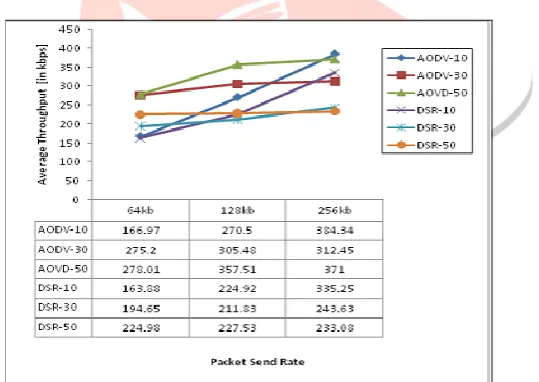
The Average Throughput in AODV and DSR protocols with increasing node and packet send rate under CBR traffic is shown in the following figure:
Figure1: Average Throughput in AODV and DSR with Packet Send Rate
Figure 1 shows that, Average Throughput is increases in both AODV and DSR protocols with increasing packet send rate. The Average Throughput of AODV protocol is better than the DSR protocol in all the cases. Thus in terms of Average Throughput, AODV protocol well performs over the DSR protocol with increasing Packet Send Rate.
IJEDR1504105
International Journal of Engineering Development and Research (www.ijedr.org)617
Figure 2: Packet Delivery Ratio (PDR) in AODV and DSR with Packet Send RateFigure 3: Average End-to-End Delay in AODV and DSR with Packet Send Rate
The Average End-to-End Delay in AODV and DSR protocols with increasing node and packet send rate under CBR traffic is shown in the figure 6.3. The Average End-to-End Delay in AODV increases, while in DSR decreases with less number of nodes with increasing send rate. . The Average End-to-End Delay in both the protocols AODV and DSR increases with 30 nodes and decreases with 50 nodes. As the Packet Send Rate progresses, the AODV protocol well perform over DSR protocol in terms of Average End-to-End delay.
IJEDR1504105
International Journal of Engineering Development and Research (www.ijedr.org)618
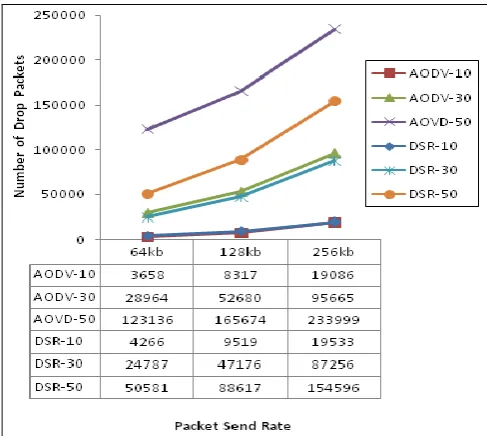
Figure 4: Number of Drop Packets in AODV and DSR with Packet Send RateV. CONCLUSION AND FUTURE SCOPE
The simulation results indicate that AODV protocol perform well over DSR protocol in terms of parameter Average Throughput, PDR, Average End-to-End Delay and number of Drop Packets with increasing Packet Send Rate. These results state that when Packet Send Rate is increases, it can increase the Average Throughput with both AODV and DSR routing protocols, thus high send rate is beneficial. In case of parameter metrics PDR, Average End-to-End Delay and number of Drop Packets, the performance is decreased with increasing Packet Send Rate. In future attempt will be made to analyze and evaluate the other routing protocols performance under various scenarios for higher Packet Send Rate.
VI. REFERENCES
[1] N. H. Vaidya, "Mobile Ad hoc networks routing, mac and transport issues," Proceedings of the IEEE Inter- national Conference on Computer Communication INFOCOM, 2004.
[2] Royer and Toh, “A Review of Current Routing Protocols for Ad Hoc Mobile Wireless Networks”, IEEE Personal Communications, pp. 46-55, April 1999.
[3] L. Breslau, D. Estrin, K. Fall, S. Floyd, J. Heidemann, A. Helmy, P. Huang, S. McCanne, K. Varadhan, Y. Xu, and H. Yu, "Advances in network simulation," IEEE Computer, vol. 33, pp. 59-67, May 2000.
[4] Pouranik et. al., “Send Rate based Evaluation for various MANET Routing Protocols in NS2”, International Journal of Computing and Technology, Vol. 1, Issue 1, Feb 2014, pp. 153-156.
[5] C. Perkins, and E. Royer, "Ad-hoc on-demand distance vector routing," Proceedings of the 2nd IEEE Workshop on Mobile Computing Systems and Applications (WMCSA1999), pp. 90-100, Feb. 1999.
[6] Charles E. Perkins, Elizabeth M. Royer and S. Das, Ad-Hoc on Demand Distance Vector Routing (AODV), Draftietfmanet-aodv-05.txt, March 2000.
[7] B. Johnson, D. A. Maltz, Yih-Chun Hu and Jorjeta G. Jetcheva, “The Dynamic Source Routing for Mobile Adhoc Wireless Networks”, http://www.ietf.org/internetdrafts/ draft- ietf-manet-dsr-09.txt, IETF Internet draft May 2007.
[8] Network Simulator, ns-2, http://www.isi.edu/nsnam/-ns/
[9] Fan Bai, Ahmed Helmy, “A Framework to Systematically Analyze the Impact of Mobility on Performance of Routing Protocols for Ad Hoc networks," IEEE INFOCOM 2003.
[10] L. Layuan, Y. Peiyan, and L. Chunlin, "Performance evaluation and simulations of routing protocols in Ad hoc networks," Computer Communications, vol. 30, pp. 1890-1998, 2007.