Cluster Thomas-Ehrman Shift in
10Be–
10C
Makoto Ito
Department of Pure and Applied Physics, Kansai University, 3-3-35 Yamate-cho, Suita, Osaka 564-8680, Japan
Abstract
Coulomb shift of the 10Be and 10C nuclei, which can be nicely described by the α + α + N + N four-body degrees of freedom, is investigated by the microscopic cluster model. The Coulomb shift is prominent for the non S-wave configurations, while the shift is sup-pressed for the S-wave dominant configurations, which have the well-developedαcluster structure. This result can be interpreted in terms of the so-called Thomas-Ehrman shift, which is originally discussed in the Coulomb shift of the17O–17F systems.
1
Introduction
In light neutron-excess systems, many kinds of molecular structures are discussed from the viewpoint of the clustering phenomena. In particular, much attention has been concentrated on Be isotopes from the theoretical and experimental approaches. The Be isotopes can be considered as typical examples of two-center superdeformed systems which build on anα+αrotor of 8Be. Various cluster structures are generated by the coupling the twoα degrees of freedom and the single particle motion of the excess neutrons, and the structures are analogous to the so-called chemical-bonding structure in molecular systems.
On the contrary, in their highly-excited states, recent experiments revealed the existence of the interesting resonant states, which dominantly decay into the4,6,8He fragments [2, 3]. These resonances are interpreted in terms of the ionic or atomic configurations ofxHe + yHe, in which neutrons are trapped in one of the α cores and generates the exchange force [4, 5].
The systematic studies of the chemical-bonding structure identified in Be isotopes is very interesting. One of the systematic studies is the analysis of the mirror systems, and the Coulomb shift in the proton-rich side is an interesting research subject. For example, a typical example of the Coulomb phenomena is known as the so-called Thomas-Ehrman shift (TES), which was originally discussed in the mirror systems, such as the 17O and 17F nuclei [6]. In the16O core plus one nucleon model, the Coulomb shift in17F = 16O + P is exceptionally suppressed for the S-wave orbit although the Coulomb shift occurs uniformly for other non S-wave orbits. The S-wave proton can escape from the Coulomb repulsion because of no centrifugal barrier, which tends to confine the wave function inside of the Coulomb barrier.
One of the characteristic features in cluster structure is the spatial exten-sion, which involves the S-wave dominance. In the covalent configurations, for example, the σ+ orbit with a large mixture of the S-wave component enhance the α clustering, while two nuclei dominantly perform the S-wave relative motion in the atomic or ionic configurations. These cluster picture strongly suggests that the development of the clustering involves the sup-pression of the Coulomb shift. In this report, the Coulomb shift of10Be–10C is investigated, which are typical example of the nuclear chemical-bonding systems [5].
We apply the generalized two-center cluster model (GTCM) [4, 5] to
10Be (= α+α + 2N) and10C (=α +α+ 2P). This model is available to
handle the formations of the covalent MOs and the ionic or atomic structures
in a unified manner. Therefore, the Coulomb shift can be discussed in
connection to the structural changes from the low-lying covalent structures to the highly-excited atomic structure.
2
Framework
are given by the{ΦJmπK(S)}, where,
ΦJmπK(S) = PˆKJπA
⎧ ⎨
⎩ψL(α)ψR(α)
2
j=1
ϕj(mj) ⎫ ⎬ ⎭ S
. (1)
The α-clusters at the left (L) and right (R) side center are shown byψi(α) (i = L, R), and they are placed with a relative distance parameter of S, which is the generator coordinate [7]. The internal structure of theαclusters are expressed by the (0s)4 configurations of the harmonic oscillator (HO). The single-particle wave function for the valence nucleons localized around the α clusters is given by an atomic orbital (AO) ϕ(mj), which is labeled by the AO indices of mj = (pk, i, τ). Here, pk (k = x, y, z) means the 0p -orbitals aroundi-th core (i=LorR) with the spinτ (=↑or↓). In Eq. (1), m represents a set of AOs for the valence nucleons, m=(m1, m2). The intrinsic basis functions with the full anti-symmetrization A are projected to the eigenstate of the total spinJ, its intrinsic angular projection K, and the total parityπ by the projection operator ˆPKJπ.
The total wave function is finally given by taking the superposition over
S,mand K as
ˆ
ΨJνπ = dS
m,K
CmνK(S) ΦJmπK(S) . (2)
The coefficients for theν-th eigenstate,CmνK(S), are determined by solving a coupled-channel GCM (Generator Coordinate Method) equation [7]. In the present calculation, we consider all the possible 0p atomic-orbit config-urations, which lseads to the complete formation of the covalent, ionic, and atomic configurations around two α cores.
As for the nucleon-nucleon (NN) interaction, we use the Volkov No.2 [8] and the G3RS [9] for the central and spin-orbit parts, respectively. In10Be, the parameters in the interactions and the size parameter of HO are the same as those applied in the analysis of 10,12Be [4, 5]. On the contrary, the NN interactions are slightly modified in 10C so as to reproduce the α +
6Be threshold energy. The majorana parameter (M) in10C is increased by
about 20 % in comparison to the parameter in 10Be.
3
Results
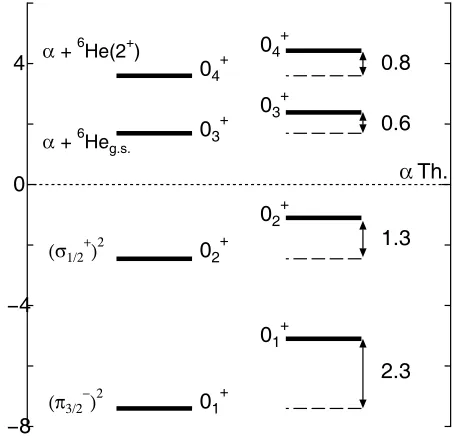
Figure 1 shows the energy levels of10Be (left levels) and10C (right levels). In the individual spectra, the lowest four 0+ levels are plotted. The dominant components of the 0+1 and 0+2 states are the molecular orbit configuration of (π−3/2)2 and (σ+1/2)2, respectively, in which two valence nucleons performed the single particle motion around twoαcores. On the contrary, the unbound 0+3 and 0+4 states have the atomic configurations of theα+6Heg.s. and α+
6He(2+), respectively.
8 4 0 4
01 + 02
+ 03
+ 04
+
01 + 02+ 03
+ 04+
S
V
2.3 1.3 0.6 0.8
D+ 6Heg.s. D+ 6He(2+)
DTh.
Figure 1: Energy levels of the10Be (left levels) and10C (right levels) nuclei. The
αthreshold is set to be zero energy. In the10C spectra, the corresponding levels to
10Be are plotted by the dashed line. The numbers attached to the levels show the
energies of the Coulomb shifts. The Coulomb shifts are shown in units of MeV.
proton-rich side, the 10C nucleus.
On the contrary, the Coulomb shift of the 0+2 state is 1.3 MeV, which is smaller than the shift of the ground 0+1 state, 2.3 MeV. The reduction of the shift for 0+2 is due to the spatially extended structure of theσ1+/2 orbit, which has a large mixture of the S-wave component. The large mixing of the S-wave component in the valence orbit leads to the enhancement of theα-α clustering. Since the repulsive effect of the Coulomb interaction is reduced in the spatially extended configuration, the Coulomb shift for the 0+2 state is suppressed in comparison to the shift for the 0+1 state.
Moreover, the Coulomb shifts for the 0+3 and 0+4 states are suppressed much more, which are 0.6 MeV and 0.8 MeV, respectively. This reduction is generated by the well-developed binary cluster structures ofα+6He, which makes it possible to escape from the Coulomb repulsion. In the 0+3 state, the
α and 6Heg.s. perform the S-wave relative motion, while the α + 6He(2+) with the D-wave relative motion is a main component in the 0+4 state. Since the S-wave component is predominant in 0+3, its Coulomb shift is suppressed in comparison to the 0+4 state.
In all the spectra, the Coulomb shift is reduced for the S-wave dominant states (0+2 and 0+3), while the shift is enhanced for the respective non S-wave states (0+1 and 0+4). Therefore, these suppressed Coulomb shift for the S-wave states are basically same as the Thomas-Ehrman Shift, which was originally discussed in the 17O and 17F systems [6]. The Coulomb suppression in10Be and 10C, which are shown in Fig. 1, correspond to the extension of the Thomas-Ehrman Shift to the cluster degrees of freedom, which is induced by theα +α + 2N structure.
4
Summary and discussion
We have applied the generalized two-center cluster model to the mirror systems, such as 10Be = α + α + 2N and 10C = α + α + 2P, and dis-cussed the Coulomb shift in the lowest four 0+ states. The present calcula-tion predicts the suppression of the Coulomb shift for the S-wave dominant state, which is generated by the development of the α clustering. Thus, the suppressed Coulomb shift presented here should be called the “Cluster Thomas-Ehrman Shift”, which corresponds to the extension of the tradi-tional Thomas-Ehrman Shift on the single particle motion.
developed α +6Heg.s. structure, is not a sharp resonant states but a broad continuum-like state, while the 0+4 state is a resonance. This result is con-sistent to the recent experiment of the 6He scattering by the α target [10]. Therefore, the Coulomb shift in the continuum states should be carefully discussed by employing the scattering boundary condition. The calculation with the scattering boundary condition is now underway.
Furthermore, the present calculation also predicts the asymmetry in the monopole transition from 0+1 to 0+2; specifically, the 0+1 → 0+2 strength in
10C is about twice as large as the respective strength in 10Be. Due to the
suppression of the Coulomb shift for the 0+2 state, the excitation energy of 0+2 in 10C is reduced in comparison to the respective excitation energy in
10Be. This reduction leads to the enhancement of the monopole transition
in 10C. The detailed analysis of the monopole transitions will be shown in forthcoming papers.
References
[1] N. Itagaki and S. Okabe, Phys. Rev. C61, 044306 (2000), and references therein.
[2] A. Saito et al., Mod. Phys. Lett. A 25 1858 (2010), and references therein.
[3] Z. H. Yang, et al., Phys. Rev. Lett. 112, 162501 (2014), and references therein.
[4] M. Ito, Phys. Rev. C85, 044308 (2012); M. Ito and K. Ikeda, Rep. Prog. Phys. 77,096301 (2014).
[5] M. Ito, Phys. Lett. B636, 293 (2006)
[6] Bohr A and Mottelson B R 1969 Nuclear Structure vol I (New York: Benjamin) p 320.
[7] H. Horiuchi, Suppl. Prog. Theor. Phys.62, 90 (1977).
[8] A. B. Volkov, Nucl. Phys.74, 33 (1965).
[9] N. Yamaguchi, T. Kasahara, S. Nagata, and Y. Akaishi, Prog. Theor. Phys. 62, 1018 (1979).