Performance Evaluation of Strength
Properties of Concrete by Using
Waste Foundry Sand
Manjunatha M1, Rakshith Kumar Shetty2, Akshay N.K3, Jeevan H4
Assistant Professor, Department of Civil Engineering, NMAM Institute of Technology, Nitte, Karnataka, India1
Assistant Professor, Department of Civil Engineering, NMAM Institute of Technology, Nitte, Karnataka, India 2
Assistant Professor, Department of Civil Engineering, NMAM Institute of Technology, Nitte, Karnataka, India3
Assistant Professor, Department of Civil Engineering, National Institute of Engineering, Mysuru, Karnataka, India4
ABSTRACT: Concrete is used worldwide due to development of infrastructure. The natural sand is not sufficiently available for construction activities and its cost increasing day by day due to huge demand. In this experiment, Waste Foundry Sand (WFS) is used as alternative to Natural Sand in concrete by replacing up to 50%. The effects on environment and disposal problem can be minimised by using WFS in concrete structure. The research work is carried out to study the mechanical properties such as compressive strength, split tensile strength and flexural strength of the concrete specimen by partial replacement of natural sand with WFS up to 50% replacement and compared with referral mix. A total of six concrete mix proportion (NC, Mix 1-10%, Mix 2-20%, Mix 3- 30%, Mix 4-40%, Mix 5-50%) with and without WFS were made. The compression test, split tensile strength test and flexural strength test were carried out to assess the strength properties of hardened concrete at the age of 7 days and 28 days. The test result shows that the compressive strength of cubes is maximum at 20% WFS after that it decreases. The split tensile strength and flexural strength increases as percentage of WFS increases.
KEYWORDS:Waste foundry sand, Compressive strength, Split tensile strength, Flexural strength, Workability, Aggregate.
I. INTRODUCTION
Concrete is a heterogeneous material made primarily with four ingredients namely cement, coarse aggregates, fine aggregates, water and chemical admixture. The combination of these materials in desired proportion gives rise to a hydration reaction which is responsible for the strength gain in concrete. The natural river sand is not available in plenty to meet the demand due to imposed ban to extract from river bed. For these alternative fine materials is used in concrete to fulfill the demand and save the natural resources. Metal industries use foundry sand which is uniform sized, high quality silica sand that is bound to form a mould for casting of ferrous and non-ferrous metal finer sand than normal sand is used in metal casting process. The burnt sand after the casting process of metal is reuse for many times but when it cannot be longer used it is removed from foundry as a waste for disposal known as “Waste Foundry Sand”. Use of waste foundry sand as a partial replacement or total replacement by fine aggregate in concrete leads in production of economic, light weight and high strength concrete [4].
II. LITERATURE REVIEW
sand and it was maximum at 15% replacement after that it decreases, the split tensile strength is maximum at 10% replacement. Partial replacement of the Portland cement with Pozzocrete P60 and Partial replacement of fine aggregate with used foundry sand improve strength [3]. Shubham S. Amritkar et al. [4] has investigated that the compressivestrength increases as percentage of waste foundry sand increases and maximum at 15% replacement, the flexural strength is found to be marginally increase with increase in waste foundry sand.
The early-age strength of concrete mixtures with UFS was lower compared with the reference mixture without used foundry sand. All non-air-entrained concrete mixtures containing up to 45% used foundry sand achieved compressive strengths comparable to the control mixture at later ages. All non-air entrained concrete mixtures made with and without used foundry sand exhibited compressive strength appropriate for manufacture of high-quality, structural-grade concrete [5]. Khuram Rashid et al. [6] were observed by experimental investigation that the strength loss in UFS concrete mixtures was due to presence of anti-binder in the form of very fine powder of carbon and clay in the UFS, which resulted in lack of contacts between the aggregates and cement paste. In [7], the author has concluded that the strength development in geo-polymer concrete can be improved by maintaining the quality of fly ash, binder-to-aggregate ratio, molarity of the activator solution, fine aggregate type, curing conditions. Smit M. Kacha et al. [8] has been concluded that workability of concrete decreases as the percentage of foundry sand content increase, because of very fine particles. The compressive strength decrease in cementitious materials is due to the presence of binder in foundry sand. The binder, composed by a very fine powder of carbon and clay, causes a loose of contactsand links between the cement paste and the aggregate as pointed out in [9].
III. SCOPE OF RESEARCH
These research work has taken up to investigate the strength properties by partially incorporating Waste Foundry Sand in concrete mixture and compare the results with referral mix. The Waste Foundry Sand is collected from LAMINA FOUNDRIES, near Nitte, Karkala, Karnataka, India. The physical& chemical properties of sand, its effect on Compressive Strength, Flexural Strength and Split Tensile Strength is looked upon.
The objective of the present research work is:
1. To study the physical properties of concrete with various percentage of WFS. 2. To study the performance of WFS in concrete mixture.
3. To study the mechanical properties such as compressive strength, flexural strength and split tensile strength with WFS.
IV. EXPERIMENTAL PROGRAM
The properties of various materials used in concrete (M25) are discussed in this section:
A. CEMENT:
The cement in concrete used as a binding material which starts setting after the addition of water. The cement plays vital role in concrete material to attain required strength and durability. The UltraTech Portland Pozzolanic Cement (PPC) is used and it conforms to IS: 8112-1989.
Table I: Physical Properties of Cement
SL. No. Characteristics Values obtained Standard value
1. Normal consistency (%) 32 -
2. Initial setting time (minutes) 55 Not less than 30
B. COARSE AGGREGATE:
The crushed stone aggregates of 20mm and 10mm size obtained from local quarry site were used for the research work. The specific gravity of the coarse aggregates were found to be 2.73. The water absorption values obtained for the aggregates is 0.5%.
C. NATURAL SAND
The fine aggregate used for the present research work was locally procured and conformed to grading zone II as per IS: 383-1970.
Table II: Properties of Natural Sand
Sl. No. Characteristics Value
1. Type Natural
2. Specific gravity 2.67
3. Water absorption 1.02%
4. Fineness modulus 3.66
5. Grading zone Zone II
Table III: Sieve Analysis of Natural Sand
Sl.
No.
Sieve
size
(mm)
Mass
Retained
(gms)
%
Retained
Cum. %
Retained % Passing
As per
IS:383-1970
Zone-II
1. 4.75 28.27 2.84 2.84 97.16 90-100
2. 2.38 31.55 3.17 6.01 93.99 75-100
3. 1.18 137.5 13.85 19.86 80.14 55-90
4. 0.600 296 29.82 49.68 50.32 35-59
5. 0.300 390 39.30 88.98 11.62 8-30
6. 0.150 105.14 10.59 99.57 0.43 0-10
7. 0.075 2.35 0.235 99.80 0.2 -
D. WASTE FOUNDRY SAND:
Metal industries use sand casting in which moulds are made of uniform sized, clean, high silica sand. After the casting process foundries recycle and reuse the sand several times but after sometimes it is discarded from the foundries known as waste foundry sand. Its harmful effect on environment and disposal problem can be minimized if it is used in concrete structures in replacement of natural sand. The waste foundry sand was brought from Lamina Industry, Nitte, Karkala, taluk, Karnataka.
Fig 2: Waste Foundry Sand
E. WATER:
Water is the most important constituent of a concrete mass which enables bonding between cementatious materials and the aggregates and also helps in the hydration of cement which is the most important phenomenon in gaining strength. Potable water which is free from salts and impurities is used for mixing and also curing purposes
.
F. MIX DESIGN:
The concrete mix is designed based on IS: 10262-2009. The mix proportions for the concrete as determined were
1:2.09:2.67 with water to cement ratio of 0.45. The Conplast SP430 (G) super plasticizer complies with IS: 9103-1999 were used and water content reduced up to 10%. The table IV, shows the quantity of constituent materials for each mix designation.
Fig 1: Particle Size Distribution- Natural Sand
0 20 40 60 80 100 120
0.01 0.1 1 10
P
e
r
c
e
n
tage
P
as
si
n
g
Sieve Size
Particle Size Distribution curve- Natural Sand
Table IV: Mix Proportion for M25 Grade Concrete as per IS 10262:2009
Mix
Designation W/C C
Kg/m3
FA
kg/m3
CA
(10mm)
Kg/m3
CA
(20mm)
Kg/m3
WFS
Kg/m3 W
Kg/m3 SP
Kg/m3
NC(0%) 0.45 393 824 420 630 0 177 2.36
Mix-1(10%) 0.45 393 741.6 420 630 82.4 177 2.36
Mix-2(20%) 0.45 393 659.2 420 630 164.8 177 2.36
Mix-3(30%) 0.45 393 576.8 420 630 247.2 177 2.36
Mix-4(40%) 0.45 393 494.4 420 630 329.6 177 2.36
Mix-5(50%) 0.45 393 412 420 630 412 177 2.36
NOTE:C-CEMENT,CA-COARSE AGGREGATE,FA-FINE AGGREGATE,W-WATER,SP-SUPER PLASTICIZER
V. METHODOLOGY AND DISCUSSION
The arrived quantity of concrete materials were weighed and mixed thoroughly in concrete mixer till the homogeneous mix achieved. The casted cubes of 150 mm size, cylinder of 150 mm. diameter and 300mm. length and beams of 150x150x750mm has compacted on vibrating table. Thirty Six cubes, Thirty Six cylinders and Thirty Six beams withvarying percentage of waste foundry sand was used for laboratory investigation. The Compressive Strength, Splitting Tensile and Flexural Strength of concrete specimen was tested on hardened concrete at 7 and 28 days.
A. COMPRESSIVE STRENGTH TEST:
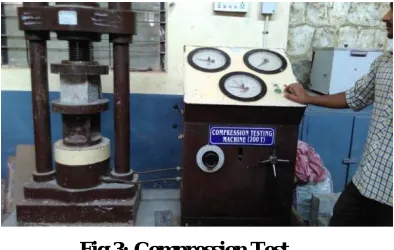
The compression test was carried out on compressive strength testing machine 200MT capacity. After curing periods, the hardened concrete specimens were tested for 7days and 28days. The results of various percentage of WFS concrete specimen was compared with referral mix.
Fig 3: Compression Test
B. SPLIT TENSILE STRENGTH:
Fig 4: Split Tensile Test
C. FLEXURAL STRENGTH:
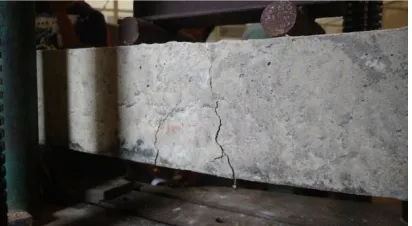
The beams were tested for flexural strength after curing periods for 7days and 28days on flexural testing machine 40MT capacity under two point loading.
Fig 5: Flexural Strength Test
D. OBSERVATION:
The following graphs shows the test results on the hardened concrete for 7days and 28days:
Table V: Compressive Strength of M25 Grade Concrete
Mix Notation Compressive strength N/mm 2
7days 28days
NC (0%) 23 30.1
Mix-1(10%) 24.8 31
Mix-2 (20%) 27 32.2
Mix-3 (30%) 15 15.8
Mix-4 (40%) 8 8.9
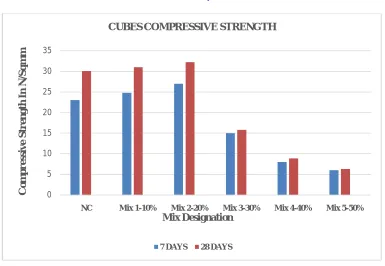
Fig 6: Shows the Cubes Compressive Strength of M25 Grade with various percentage of WFS
From the experimental investigation, it can observed that the compressive strength of concrete cubes specimen is maximum at 20% replacement of natural sand with waste foundry sand. The compressive strength of concrete cubes specimen decreases at 30%, 40% and 50% WFS. The least compressive strength of concrete specimen is at 50% replacement of natural sand with WFS. The graph clearly indicates that up to 20%, the natural sand can be replaced with WFS to produce concrete for construction of framed structure for commercial and residential purposes.
Table VI: Split Tensile Strength of M25 Grade Concrete
0 5 10 15 20 25 30 35
NC Mix 1-10% Mix 2-20% Mix 3-30% Mix 4-40% Mix 5-50%
C
o
m
p
r
e
ss
iv
e
S
tr
e
n
gth
I
n
N
/S
q
m
m
Mix Designation
CUBES COMPRESSIVE STRENGTH
7 DAYS 28 DAYS
Mix Notation Split Tensile strength N/mm 2
7days 28days
NC (0%) 2.5 3.3
Mix-1(10%) 2.9 3.6
Mix-2 (20%) 3.1 3.9
Mix-3 (30%) 3.8 4.2
Mix-4 (40%) 4.7 4.9
Fig 7: Shows Split Tensile Strength of Cylinder Specimen of M25 Grade with various percentage of WFS
Based on the experimental work, it can be observed that the split tensile strength of concrete specimen is increasing as the percentage of WFS is increased up to 50%. The split tensile strength of concrete specimen is maximum at 50% replacement of natural sand with WFS. The maximum split tensile strength of concrete specimen is 5.1N/mm2 .
Table VII: Flexural Strength of M25 Grade Concrete
0 1 2 3 4 5
NC (0%) Mix-1(10%) Mix-2 (20%) Mix-3 (30%) Mix-4 (40%) Mix-5 (50%)
C
o
m
p
r
e
ss
iv
e
S
tr
e
n
gth
i
n
N
/s
q
m
m
Mix Designation SPLIT TENSILE STRENGTH
7 DAYS 28 7DAYS
Mix Notation Flexural strength N/mm 2
7days 28days
NC (0%) 3.9 4.2
Mix-1(10%) 3.93 4.3
Mix-2 (20%) 3.98 4.3
Mix-3 (30%) 4.1 4.47
Mix-4 (40%) 4.1 4.5
Based on the experimental work, it can be observed that the flexural strength of beam specimen is increasing as the percentage of WFS is increased up to 50%. The flexural strength of beam specimen is maximum at 40% and 50% replacement of natural sand with WFS. The maximum flexural strength of beam specimen is 4.5N/mm2 .
VI. CONCLUSION
Based on the experimental results, the following conclusion were drawn regarding the strength properties and behaviour of concrete on partial replacement of fine aggregate by waste foundry sand:
1) The compressive strength of concrete specimen is maximum at 20% replacement of natural sand with WFS.
2) At higher replacement levels of 30%, 40%, 50%, the compressive strength decreases considerably when compared with referral mix.
3) The concrete specimen with 50% WFS shows least compressive strength at all curing periods.
4) The concrete specimen with 50% WFS has maximum split tensile strength and increases as the percentage of WFS increases.
5) The flexural strength of beam specimen is maximum at 50% WFS and increases as the percentage of WFS increases.
VII. ACKNOWLEDGEMENT
The authors are thankful to Prof. Srinath Shetty K. (H.O.D), Prof. J.K.Lokesh (Lab in charge), Lamina Foundries, Nitte,
Fig 8: Shows Flexural Strength of Beam Specimen of M25 grade with various percentage of WFS 0
1 2 3 4 5
NC (0%) Mix-1(10%) Mix-2 (20%) Mix-3 (30%) Mix-4 (40%) Mix-5 (50%)
C
o
m
p
r
e
ss
iv
e
S
tr
e
n
gth
i
n
N
/s
q
m
m
Mix Designation
BEAM FLEXURAL STRENGTH
REFERENCES
[1] PathariyaSaraswati C, RanaJaykrushna K, Shah Palas A, Mehta Jay G, Patel Ankit N “Application of Waste Foundry Sand for Evolution of Low-cost Concrete”, International Journal of Engineering Trends and Technology, Vol.4, Issue 10, pp.4281-4286, 2013.
[2] Ravindra N. Patil, Praveen. R. Mehetre, Kailash T. Phalak “Cement Concrete Properties Incorporating Waste Foundry Sand.” International Journal of Emerging Trends in Technology, vol. 2, Issue 01, pp.221–225, 2015.
[3] Dushyant R. Bhimani, Jayesh Kumar Pitroda, Jaydev J. Bhavsar “ Effect of Used Foundry Sand and Pozzocrete Partial Replacement with Fine
Aggregate and Cement in Concrete”, International Journal Of Innovative Technology and Exploring Engineering, vol. 2, Issue 04, pp.116-120, 2013.
[4] Shubham S. Amritkar, Sanket N. Chandak, Sagar S. Patil, Rahul A. Jadhav, “Effect of Waste Foundry Sand on the Mechanical Properties of
Concrete with Artificial Sand as Fine Aggregate”,International Journal of Engineering Research & Technology, vol. 4, Issue 04, pp.390-393 2015.
[5] Tarun R. Naik, Rudolph N. Kraus; Bruce W. Ramme, and FethullahCanpolat, “Effects of Fly Ash and Foundry Sand on Performance of Architectural Precast Concrete”, Journal of Materials in Civil Engineering, Vol.24, Issue 07, pp.851-859, 2012.
[6] Khuram Rashid, Muhammad Akram Tahir, Sana Nazir,“Evaluation of Concrete Compressive Strength by incorporating Used Foundry Sand”, American Journal of Engineering Research, Vol.03, Issue 2, pp.109-116, 2014.
[7] Kewal, “Foundry Sand Based Geopolymer Concrete”, International Research Journal of Engineering and Technology, Vol 2, Issue 05, pp. 491-496, 2015.
[8] Smit M. Kacha, Abhay V. Nakum, Ankur C. Bhogayata “Use of Used Foundry Sand in Concrete: A State of Art Review”, International [9] Journal of Research in Engineering and Technology, Vol. 3, Issue 2, pp.586-589, 2014.
[10] SaveriaMonosi, Daniela Sani and Francesca Tittarelli, “Used Foundry Sand in Cement Mortars and Concrete Production”, The Open Waste Management Journal, Vol.3, pp.18-25, 2010.
BIOGRAPHY
Prof.Rakshith Kumar Shetty was born in 1988 in Kundapura City. He received his Bachelor of Engineering degree in Civil Engineering from the NMAM Institute of Technology, Nitte,Visvesvaraya Technological University, Belagaviin 2011. In 2013 he received his Master's Degree in Structural Engineering from MIT, Manipal University. He joined NMAM Institute of Technology, Nitte as a faculty where he is Assistant Professor of Civil Engineering Department with a total experience of 3 years in field of Research, Consultancy and Education. He has published papers in National and International conference.
Prof.Akshay N K., was born in 1990 in Mandya City. He received his Bachelor of Engineering degree in Civil Engineering from the Government College of Engineering, Ramanagara,Visvesvaraya Technological University, Belagaviin 2011. In 2013 he received his Master's Degree in Structural Engineering from PES college of Engineering,Mandya, Visvesvaraya TechnologicalUniversity, Belagavi. He joined NMAM Institute of Technology, Nitte as a faculty where he is Assistant Professor of Civil Engineering Department with a total experience of 3 years in field of Research, Consultancy and Education. He has published Prof.Rakshith Kumar Shetty was born in 1988 in Kundapura City. He received his Bachelor of Engineering degree in Civil Engineering from the NMAM Institute of Technology, Nitte,Visvesvaraya Technological University, Belagaviin 2011. In 2013 he received his Master's Degree in Structural Engineering from MIT, Manipal University. He joined NMAM Institute of Technology, Nitte as a faculty where he is Assistant Professor of Civil Engineering Department with a total experience of 3 years in field of Research, Consultancy and Education. He has published papers in National and International conference.
Prof.Jeevan H., was born in 1982 in Bengaluru City. He received his Bachelor of Engineering degree in Environmental Engineering from the Vidyavardhaka College of Engineering, Mysuru,Visvesvaraya Technological University, Belagaviin 2004. In 2011, he received his Master's Degree in Environmental Engineering from SJCE college of Engineering,Mysuru, Visvesvaraya TechnologicalUniversity, Belagavi. He joined