Evidence for Interaction of
Schizophyllum commune
Y Mating-Type Proteins
in Vivo
C. Ian Robertson,* Alexander McMahon Kende,
†Kurt Toenjes,
‡Charles P. Novotny
‡and Robert C. Ullrich*
,§,1*Cell and Molecular Biology Program,†Program in Biological Sciences,‡Department of Microbiology and Molecular Genetics and §Department of Botany and Agricultural Biochemistry, University of Vermont, Burlington, Vermont 05405
Received September 26, 2001 Accepted for publication January 14, 2002
ABSTRACT
The A␣mating-type locus ofSchizophyllum communeregulates sexual development and contains the code for two proteins, Y and Z, which are thought to form a complex and function as a transcription factor. Import of these proteins into the nucleus may be an essential step in A␣-regulated sexual development. The Y proteins contain a bipartite basic sequence, which is an excellent candidate for a nuclear localization sequence (NLS), while Z proteins contain no such sequence. Here we describe experiments in which deletions were made in the putative NLS sequence of Y4. We show that this putative NLS is essential to the function of the Y protein and capable of mislocalizing green fluorescent protein (GFP) to the nucleus inSaccharomyces cerevisiae. Further, we describe genetic experiments that demonstrate the first Y-Y protein interactionsin vivo. These results are consistent with our previously postulated hypothesis that the Y-Z complex is likely to be of a higher order than dimer.
I
N the basidiomycete fungus Schizophyllum commune, (Wuet al.1996;Yueet al.1997).In vitroprotein affinity fusion of homokaryotic mycelia with different mat- assays have shown that protein interactions occur be-ing types leads to sexual development. This develop- tween bothnon-self(e.g.,Y4-Z5,Y4-Y5, andZ5-Z4) and ment consists of two developmental pathways, A and B, self (e.g., Y4-Z4, Y4-Y4, and Z5-Z5) combinations of Y that together constitute formation of the fertile dikar- and Z proteins (Asadaet al.1997).yon (Kniep 1920; Papazian 1951; Raper 1966). The Current dogma suggests that the Y and Z proteins
A-pathway may be activated by either of two functionally function as transcription factors; however, there is no redundant genetic switches termed the A␣and Aloci. direct evidence to support this. If the dogma is correct, The B-pathway is controlled by another redundant pair Y and Z must be transported from the site of translation of genetic switches, the B␣and Bloci. There are 9 A␣ in the cytoplasm into the nucleus. Evidence for nuclear mating types and 32 Amating types in the worldwide localization would be informative to our studies of A␣ -population ofS. commune(Raperet al.1960;Stamberg regulated development. Several types of amino acid
mo-andKoltin 1973). Previous work has shown that the tifs are thought to mediate transport of proteins into A␣locus contains two divergently transcribed genes,Y the nucleus (Garcia-Bustoset al. 1991;Boulikas1994;
andZ, which encode mating-type proteins (Stankiset Nigg1997). The bipartite nuclear localization sequence
al. 1992). Each A␣ locus encodes a unique Y and a (NLS) has been shown to consist of two predominantly
unique Z (e.g., the A␣4 locus contains the Y4 and Z4 basic sequences separated by a predominantly nonbasic
genes) except A␣1, which has aY1gene but noZgene. spacer of three to eight amino acids; this class of NLS Activation of the A-pathway by A␣occurs through the sequences is found in many transcription factors
includ-interaction of Y and Z proteins from different mating ing v-Jun, c-Fos, CREB, GCN4, and NF-E2 (Boulikas
types (non-selfpairs,e.g.,Y4-Z5). Y proteins contain an 1994). Visual inspection of the A␣ protein sequences
essential homeodomain, and Z proteins contain a shows a bipartite basic sequence at approximately the
nonessential homeodomain-like motif (Luoet al.1994). same location within each A␣Y protein; however, no
Y and Z proteins contain other motifs associated with NLS-like sequence has been found within Z. This
sug-transcription factors (Stankiset al. 1992) andself-nonself gests that transport of Z into the nucleus may represent
recognition determinants termed specificity regions a regulation point in the A-pathway signal transduction
cascade. Regulation of the nuclear entry of signaling proteins has been the subject of considerable study.
Published posthumously, this article is dedicated to Alexander McMa- Masking and unmasking of NLSs is one proposed mech-hon Kende, a promising young researcher who died prematurely.
anism for such regulation (Nigg1990). Another
pro-1Corresponding author:Room 326, Marsh Life Science Bldg.,
Univer-posed mechanism is piggybacked transport such as that sity of Vermont, Burlington, VT 05405.
E-mail: [email protected] thought to occur between TFIIE-␣and TFIIE-(
TABLE 1
kas 1994). In the basidiomycete Coprinus cinereus,
evi-dence shows that complex formation between two mat- S. communehomokaryotic strains and genotypes
ing-type proteins (one lacking an identifiable NLS) used in this study
affects import of the two into nuclei in an onion skin
heterologous test system (Spitet al.1998). Mating type
Auxotrophic
An important physical characteristic of Y and Z
regula-Strains A␣ A B␣ B markers
tion of the A developmental pathway is thein vivostate
18-20 ⌬ 1 2 2 ade2b
of the Y and Z proteins. Development requires Y and Z
18-24 ⌬ 1 3 2 ade2b
proteins of different mating types within a common
21-29 ⌬, Y4a 1 2 2
cytoplasm. It may seem intuitive to this system of
combi-21-30 ⌬, Y4a 1 2 2
natorial control that these two proteins participate to- 21-31 ⌬, Y4NLS1/2
⌬a 1 2 2
gether in a protein complex. Despite the fact that pro- 21-32 ⌬, Y4NLS1/2
⌬a 1 2 2
tein affinity assays demonstrate the formation of Y-Z 21-63 ⌬, Z6a 1 3 2
21-64 ⌬, Z6a 1 3 2
protein complexesin vitro(as well as other combinations
21-65 ⌬, Z6a 1 3 2
of Y and Z proteins;Asadaet al. 1997), there is no direct
21-66 ⌬, Z6a 1 3 2
evidence for such complexes in vivo. Eukaryotic gene
21-71 ⌬, Z5a 1 3 2
expression is mediated in many instances by complexes
21-72 ⌬,Z5a 1 3 2
containing combinations of proteins,i.e., by combinato- 21-73 ⌬,Z5a 1 3 2
rial control. Combinatorial control allows individual 21-74 ⌬,Z5a 1 3 2
proteins to participate in multiple regulatory activities, 21-75 ⌬, Y4⌬NLSa 1 2 2
21-76 ⌬, Y4⌬NLSa 1 2 2
thus allowing the complex regulatory networks found
21-77 ⌬, Y4⌬NLSa 1 2 2
in eukaryotes (Wolberger 1999). Among proteins of
21-78 ⌬, Y4⌬NLSa 1 2 2
the leucine zipper family of transcription factors,
homo-21-79 ⌬,Y4⌬NLSa 1 2 2
and heterodimerization of proteins (e.g., Fos and Jun) 21-85 ⌬,Y4
⌬NLS1/2a 1 2 2
provide a means by which complex cascades of events 21-86 ⌬, Y4⌬
NLS1/2a 1 2 2
can be regulated by a modest set of proteins (Karin 21-87 ⌬, Y4⌬NLS1/2a 1 2 2
21-88 ⌬, Y4⌬NLS1/2a 1 2 2
andHunter1995). Similar combinatorial regulation is
21-89 ⌬, Y4⌬NLS1/2a 1 2 2
seen in the regulation of yeast mating-type events by
19-2 1 1 1 1
complexes formed by the ␣2 protein homeodomain
T29 2 1 3 2 ura1, trp1b
with MATa1 and MCM1. DNA-bound regulatory pro- T22 3 1 2 2 ura1, trp1b
teins have also been found associated in higher-order T33 3 1 4 7⬘ ura1, trp1b
complexes; e.g., mammalian PBX and MEIS proteins T2 4 1 3 2 ura1, trp1b
T34 5 1 1 1 ura1, trp1b
form trimeric complexes with HOXD4, HOXD9, and
T30 6 1 3 2 trp1b
HOXD10 proteins (Shanmugam et al. 1999), and in
T35 7 1 4 7⬘ ura1, trp1b
zebrafish, pbx4, meis3, and hox1b form trimeric
com-T31 8 1 3 2 ura1, trp1b
plexes (Vlachakiset al.2000). T32 9 1 3 2
ura1, trp1b Here we describe experiments that demonstrate the
aGenes inserted by transformation. presence of a bipartite NLS in Y proteins. Cytological
bade2 mutant for a gene of unidentified function in the
experiments show that this sequence from S. commune
adenine biosynthetic pathway (Froeligeret al. 1987); ura1
is capable of mislocalizing green fluorescent protein mutant for orotidine-5⬘-phosphate decarboxylase (DiRussoet (GFP) to the nucleus inSaccharomyces cerevisiae. Genetic al. 1983); and trp1 mutant for indole-3-glycerol phosphate
synthetase (Mun˜ oz-Rivaset al.1986).
analysis shows the NLS sequence to play an essential role in sexual development; the implication is that the essential NLS functions to direct Y protein to the
nu-myces cerevisiaestrain RAK21 (Akadaet al.1996) was the gift
cleus in Schizophyllum. Further, the genetic
experi-of J. Kurjan.
ments demonstrate that Y proteins form complexes with Construction of plasmids deleted for part or all of theY4 one anotherin vivo; however, whether this interaction putative NLS:Full-length cDNA of the wild-typeY4gene (Yue
et al.1997) was cloned into plasmid pALTER (Promega,
Madi-is present along with Z protein in the complex that
son, WI) and used as a substrate for mutagenesis. Deletions
activates A-regulated development is yet to be
deter-were made in the putative NLS sequence of the Y4 gene
mined.
(nucleotides 7196–7279; nucleotide positions specified in this article correspond to the genomic sequence positions of Gen-Bank accession no. M80822) by site-directed mutagenesis us-ing an Altered Sites II mutagenesis kit (Promega). Primers MATERIALS AND METHODS
(Life Technologies) synthesized to make the NLS deletions
Strains:Homokaryotic strains of S. communeused in this were as follows: in pY4⌬1/2NLS, 5⬘CAGAGGAAGGCGCTGGCCTC
study are listed in Table 1. Escherichia coli strain XL1-Blue GAGGTCGCAA 3⬘deletes nucleotides 7196–7238; in pY4NLS1/2⌬,
5⬘ ATCGCCCGGGCCGAGGAGGAGAAGCAGGCGAA 3⬘
Saccharo-Figure 1.—Construction of GFP-containing plas-mids. (A) Plasmids pY4-GFP and pY4⌬NLS-GFP differ only
by the presence or absence of the NLS code (only pY4-GFP is shown). They were constructed using pTef1Y4 and pTef1Y4⌬NLS. Plasmid
pTef1Y4 was created for ex-periments not described in this article. Plasmid pTef1Y4 contains the S. commune TEF1(translation elongation factor 1) promoter fused to the 5⬘ end of Y4 cDNA in pALTER; pTef1Y4⌬NLSis
iden-tical to pTef1Y4 except that the entire Y4 NLS was de-leted by the methods (see materials and methods) used to delete the NLS in the construction of pY4⌬NLS.
TwoSpeI sites were created in pTef1Y4 and pTef1Y4⌬NLS
using a Quickchange mu-tagenesis kit (Stratagene). Complementary pairs of primers were used as fol-lows: 5⬘CGAGATCTTGTGCGAACTAGTTTACTGACA 3⬘ and its complement bind in the TEF1 promoter 36 bp 5⬘of theY4
start ATG, and 5⬘TCCGTTGCCTCTACTAGTTCGCTGCCCGCGCGA 3⬘and its complement bind withinY4at A␣4 nucleotide
7359. The resulting 2.2-kbSpeI fragment, which encodes amino acids 1–677 of Y4 and 36 bp of the TEF1 promoter, was recovered from pTef1Y4 and ligated to theSpeI site located at the 5⬘end of the GFP gene and immediately downstream of the yeast MET25 promoter in the yeast 2plasmid p415 MET25 to yield plasmid pY4-GFP. TheSpeI fragment from pTef1Y4⌬NLSwas ligated similarly
to obtain the fusion to GFP in pY4⌬NLS-GFP. (B) Plasmid pNLS-GFP was produced as follows. A Quickchange mutagenesis kit
(Stratagene) was used to introduce twoNheI sites in pY4-GFP at A␣4 nucleotides 5036 and 7172 using the following complementary
primer pairs: 5⬘ATGGCAGAGCTGCTAGCCTGCCTGCAGAGC 3⬘and its complement bound at nucleotide 5025 and 5⬘ATGCAT TGGCTAGCTTCAAATCGGCTCGGGCC 3⬘and its complement bound at nucleotide 7164. The resultingNheI fragment containing the code for amino acids 5–617 of the Y4 protein was excised from the modified GFP. Ligation of the remainder of pY4-GFP leaves the coding region for amino acids 1–4 fused and in frame to that for amino acids 618–677, which in turn are fused and in frame to the 5⬘end of the GFP sequence.
letes nucleotides 7238–7279; and in pY4⌬NLS, 5⬘ ATCGCCCG amino acids 624–651. The construction of pNLS-GFP is shown
in Figure 1B. GGCCGAGGCCTCGAGGTCGCAAC 3⬘ deletes nucleotides
7196–7279. The resulting plasmids, pY4⌬1/2NLS, pY4NLS1/2⌬, and Transformation ofS. communeand analysis of transformants:
Transformation was performed by methods previously de-pY4⌬NLS, contain deletions of the first half of the NLS, second
half of the NLS, and the entire NLS, respectively. In each scribed (Froeligeret al. 1987;Spechtet al. 1988). Protoplasts derived from strain T33 (trp1) were transformed with 2.5g case, the deletion was designed to conserve the reading frame
of the protein. Each product was confirmed by sequencing of plasmid containing wild-type or mutantY4andTRP1. Trans-formants were selected for Trp⫹phenotype on CYM medium and a 2.8-kbBamHI fragment of the deleted gene was used
to replace the wild-type fragment of theY4gene in plasmid (Spechtet al. 1988). Cotransformation of protoplasts derived from strain 18-20 and 18-24 used 2.5g of plasmid containing pY4T. Plasmid pY4T is pALTER into which the entireY4and
TRP1genes, including their promoters, have been cloned. theADE2gene (Froeligeret al.1987) and 10g of plasmid containing wild-type or mutantY4. ADE2 transformants were The resulting constructs were transformed intoS. commune
protoplasts and analyzed for function by mating tests as de- selected on the ammonium phosphate minimal medium of EpsteinandMiles(1966). To determine the mating types scribed below.
Construction of plasmids to test mislocalization of GFP in or developmental activity of the transformants, each was paired with a series of appropriate tester strains on CYM
me-yeast:Plasmids pY4-GFP and pY4⌬NLS-GFP contain gene fusions
ofY4or mutantY4to the gene encoding GFP (Figure 1A). dium for 3 days at 30⬚and then examined microscopically for developmental state. All recipient strains contained the A1 They were created to test the ability of theY4NLS to misdirect
the nonnuclear GFP protein to the nucleus in yeast. Plasmid locus, and all tester strains used contained A1 and B␣and/ or Bmating types different from the recipient strain. In each pNLS-GFP was created to test the ability of the Y4 NLS to
mislocalize GFP to the yeast nucleus in a construct containing case the matings depended on the presence of functional Y4 protein to activate the A-pathway.
minimal surrounding Y4 sequences, namely, in Y4 amino acids
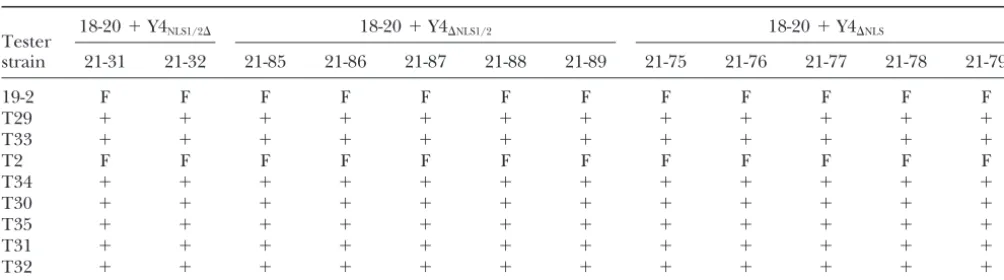
TABLE 2
Mating test results: transformants of A␣⌬strain 18-20 containing various Y4 NLS deletions paired with tester strains
18-20⫹Y4NLS1/2⌬ 18-20⫹Y4⌬NLS1/2 18-20⫹Y4⌬NLS
Tester
strain 21-31 21-32 21-85 21-86 21-87 21-88 21-89 21-75 21-76 21-77 21-78 21-79
19-2 F F F F F F F F F F F F
T29 ⫹ ⫹ ⫹ ⫹ ⫹ ⫹ ⫹ ⫹ ⫹ ⫹ ⫹ ⫹
T33 ⫹ ⫹ ⫹ ⫹ ⫹ ⫹ ⫹ ⫹ ⫹ ⫹ ⫹ ⫹
T2 F F F F F F F F F F F F
T34 ⫹ ⫹ ⫹ ⫹ ⫹ ⫹ ⫹ ⫹ ⫹ ⫹ ⫹ ⫹
T30 ⫹ ⫹ ⫹ ⫹ ⫹ ⫹ ⫹ ⫹ ⫹ ⫹ ⫹ ⫹
T35 ⫹ ⫹ ⫹ ⫹ ⫹ ⫹ ⫹ ⫹ ⫹ ⫹ ⫹ ⫹
T31 ⫹ ⫹ ⫹ ⫹ ⫹ ⫹ ⫹ ⫹ ⫹ ⫹ ⫹ ⫹
T32 ⫹ ⫹ ⫹ ⫹ ⫹ ⫹ ⫹ ⫹ ⫹ ⫹ ⫹ ⫹
F, flat morphology.
and B␣and/or Bactivate both the A- and B-pathways and NLS deletion constructs in Y4 transformants activate produce dikaryotic cells with plentiful aerial hyphae and lat- the A-pathway in pairings with strain T22.
eral cellular appendages termed “clamp connections” at every
Testing the Y4-NLS deletion constructs for loss of
septum of the hyphae. Clamp connections can be visualized
function in strains deleted for A␣: The deletion
con-with a light microscope at ⫻200 magnification. In contrast,
matings between strains identical at A␣and/or A, but differ- structs were tested further as follows. Strain 18-20, a
ent at B␣and/or B, produce mycelia with a different mor- strain from which the A␣ locus has been deleted by phology, hyphae with short, perpendicular branches, few ae- gene replacement (A␣⌬ A1 B␣2 B2;Robertson et rial hyphae, and no clamp connections. This morphology is
al.1996), was cotransformed separately with one of the
termed the “flat” phenotype. T33 cells transformed with
wild-Y4 deletions and a plasmid containing ADE2. In each
type Y4show full and normal dikaryotic development when
paired with T22. A deletion that causes a loss ofY4function case 25 ADE2 transformants were selected on
ammo-would result in the flat phenotype. nium phosphate minimal medium and each was paired
Growth and fluorescence microscopy of yeast cells:Yeast with tester strain T33 to distinguish the
Y4
trans-were transformed as described byShermanet al.(1986). Yeast
formants. These transformants are listed in Table 1 as
strain RAK21 was grown at 23⬚to mid-log phase in synthetic
strains deleted for A␣and transformed withY4deleted
complete media lacking methionine and leucine. Fresh wet
mounts of cells stained with 4⬘6-diamidino-2-phenylindole for part or all of the putative NLS. These transformants
(DAPI) by methods previously described (Pringleet al.1989) were screened for Y4 function by pairing them with a were viewed on a Nikon E400 fluorescent microscope using
series of tester strains. Each tester strain contained one
an Omega XF06 optical filter cube. An Omega XF100 optical
of the nine A␣mating types, A1, and B␣and/or B
filter cube was used to visualize cells expressing GFP. Images
differing from recipient strain 18-20. All matings
de-were obtained on a cooled CCD camera and analyzed with
Adobe Photoshop 5.0. pend on functional Y4 protein to activate the A-pathway.
Again, surprisingly, these mating tests showed that trans-formants carrying any of the mutantY4genes were able
RESULTS to activate A-regulated development. Only strains 19-2
and T2 failed to activate development (Table 2). The Testing the Y4-NLS deletion constructs for loss of
lack of development in the transformants paired with function in wild-type strains: Recipient strain T33 was
the strain 19-2 is expected because strain 19-2 is an A␣1 transformed separately with plasmids containing theY4
strain; thus it lacks a Z gene and both Y and Z are
gene with a deletion of the putative NLS (pY4⌬1/2NLS,
required in the fusion cell for mating-type activity. Strain pY4NLS1/2⌬, and pY4⌬NLS). In each case 25 Trp⫹
trans-T2 is an A␣4 strain, and therefore is self with the Y4
formants were selected on CYM medium and paired
constructs. This experiment shows thatY4deleted part with tester strain T22. Strains T33 (A␣3 A1 B␣4 B7⬘)
or all of its NLS functions normally in pairings with and T22 (A␣3 A1 B␣2 B2) contain identical genes
wild-type strains. at the A␣ and A loci and differing genes at the B␣
Testing the Y4 deletions in pairs of strains deleted and Bloci. Therefore, in pairings ofY4transformants
for A␣Y: Our in vitroprotein affinity studies of Y and of T33 with T22, activation of the A-pathway depends on
Z show that each Y and Z protein interacts with every the presence of functionalY4in the T33 transformants. In
other Y and Z protein (Asadaet al. 1997). Therefore pairings of transformants containing pY4⌬1/2NLS, pY4NLS1/2⌬,
we considered the possibility that protein interactions or pY4⌬NLSwith tester strain T22, several transformants
support complementation of the Y4 NLS mutants above. (8, 9, and 14 of each 25 Trp⫹ transformants,
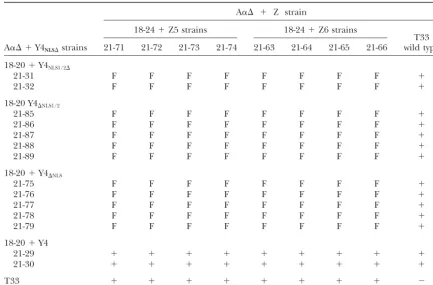
dele-TABLE 3
Mating test results: transformants of A␣⌬strain 18-24 containingZ5orZ6paired with transformants of A␣⌬ strain 18-20 containing various Y4 NLS deletions
A␣⌬ ⫹ Z strain
18-24⫹Z5 strains 18-24⫹Z6 strains
T33 A␣⌬ ⫹Y4NLS⌬strains 21-71 21-72 21-73 21-74 21-63 21-64 21-65 21-66 wild type
18-20⫹Y4NLS1/2⌬
21-31 F F F F F F F F ⫹
21-32 F F F F F F F F ⫹
18-20 Y4⌬NLS1/2
21-85 F F F F F F F F ⫹
21-86 F F F F F F F F ⫹
21-87 F F F F F F F F ⫹
21-88 F F F F F F F F ⫹
21-89 F F F F F F F F ⫹
18-20⫹Y4⌬NLS
21-75 F F F F F F F F ⫹
21-76 F F F F F F F F ⫹
21-77 F F F F F F F F ⫹
21-78 F F F F F F F F ⫹
21-79 F F F F F F F F ⫹
18-20⫹Y4
21-29 ⫹ ⫹ ⫹ ⫹ ⫹ ⫹ ⫹ ⫹ ⫹
21-30 ⫹ ⫹ ⫹ ⫹ ⫹ ⫹ ⫹ ⫹ ⫹
T33 ⫹ ⫹ ⫹ ⫹ ⫹ ⫹ ⫹ ⫹ ⫺
Positive controls using strains 21-20, 21-30, and T33 are also shown. F, flat morphology.
tion constructs in backgrounds devoid of wild-type Y formed into yeast cells. Both sets of yeast transformants show fluorescence of GFP from the cytoplasm, but not proteins. Appropriate tester strains (21-71 to 21-74 or
21-63 to 21-66) containing a compatibleZ5orZ6gene, the nucleus. To test the effect of the putative NLS in a smaller construct containing minimal Y4 sequence respectively, but noYgene (Table 1) were created by
cotransformation of A␣⌬strain 18-24 withZ5orZ6and surrounding the NLS, we used a third plasmid,
pNLS-GFP, with amino acids 5–617 of Y4 deleted from
pY4-ADE2.Twenty-five Ade⫹colonies from each
transforma-tion were selected on ammonium phosphate minimal GFP. These amino acids lie between the N terminus
and the NLS in Y4. Yeast transformants containing the medium and the presence ofZ5(orZ6) was confirmed
by pairings with strain T22. The strains shown to contain pNLS-GFP construction fluoresce from the nucleus.
The same transformants stained with DAPI show that
Z5orZ6were paired with strains containing either of the
Y4-NLS deletion constructs (Table 3). In every pairing a the regions of fluorescence from DAPI correspond to those from GFP (Figure 2). This experiment shows that flat reaction was obtained. These results differ from those
obtained by pairingY4-NLS deletion transformants with the Y4 NLS is sufficient to misdirect a nonnuclear pro-tein to the nucleus in yeast.
tester strains containing a wild-type Y gene (Table 2 or the original T33 transformants paired with tester T22).
The NLS deletion constructs ofY4 are complemented
DISCUSSION
by the presence of wild-type Y protein of any mating
type, but do not function in the absence of another Y It should not surprise us that the S. communeY
pro-teins, which contain a homeodomain and regulate com-protein.
Testing the function of the putative Y4 NLS in yeast plex development, would also possess a nuclear localiza-tion sequence. Furthermore, on the basis of other motifs sufficiency experiments: The putative NLS of Y4 was
tested for function in a sufficiency experiment. A por- common to Y or Z we infer that the Y-Z complex func-tions as a transcription factor and, as such, may be ex-tion of Y4 containing the NLS was cloned in front of
the gene coding GFP as described in materials and pected to be imported into the nucleus.
This study has shown that the bipartite sequence of
trans-Figure 3.—(A) Comparison of deduced polypeptides of putative NLS sequences from Y1, Y3, Y4, Y5, and Y6. The most C-terminal amino acid residue in each NLS is specified to the right of each NLS sequence. (B) Consensus sequence of the putative NLS for the five Y proteins shown in A.⫹, positively charged residue; B, basic amino acid; amino acids according to the single letter code.
mately the same position in each Y protein in spite of the generally poor amino acid homology found between
Figure 2.—Nuclear localization of fluorescence from
pNLS-GFP in yeast. Fluorescence from both DAPI and GFP the Y proteins. In contrast, inspection of the predicted are shown. (A) Yeast cells transformed with pNLS-GFP or (B) amino acid sequence of each studied Z gene, i.e.,Z3, pGFP. Note that in A fluorescence from DAPI and GFP are
Z4,Z5, andZ6, shows no candidates for basic NLS
se-coincident and located in the nucleus. In B, fluorescence
quences. The absence of an identifiable NLS in Z
pro-from DAPI (nuclear) is not coincident with that pro-from GFP
teins is not totally unexpected given that Y and Z protein
(cytoplasmic).
interaction is essential to activation of A␣-regulated de-velopment (Stankiset al. 1992) and Y and Z have been shown to interact in protein affinity assays in vitro
basic amino acids found in Y proteins is essential to the
(Asadaet al. 1997). Furthermore, not all known tran-function of those proteins. Cells containing a single form
scription factors contain an identifiable NLS; it is of mutant Y4 protein, missing either half of the NLS or
thought likely that these nuclear proteins gain entry all of it, brought together via matings with cells devoid
into the nucleus by formation of a complex linking of Y protein, but containing Z5 or Z6 protein, failed to
them to a protein that contains an NLS, e.g., TFIIE-␣ activate the A-regulated developmental pathway.
and TFIIE-(Boulikas 1994). In fact, inC. cinereus a Lacking a reporter system that we can use in
Schizophyl-pair of bipartite NLS motifs have been identified in the lum, we turned to GFP and its expression in yeast cells.
HD1 class of mating-type proteins and, similarly to the GFP is not a nuclear protein and is not normally
im-ported into the nucleus. Our first fusions, which linked case in S. commune, no NLS motif has been found in the HD2 class of proteins (Tymonet al. 1992).
677 amino acids of nearly full-length Y4 to GFP, failed
to mislocalize to the nucleus, perhaps because of the Ourin vitroprotein affinity studies show that Y binds with both Y and Z and Z similarly binds with both Y and sheer bulk and folding of the fusion protein.
Neverthe-less, fusion proteins in which the Y4 NLS with minimal Z (Asadaet al.1997). All of these protein interactions occur regardless of the mating types involved (i.e.,self
surrounding sequence was fused to GFP were localized
to the nucleus ofS. cerevisiae. A similar observation was ornon-self). In the present genetic study the Y4 mutants that had essential NLS sequences deleted are comple-made by Spit et al. (1998) for C. cinereus where the
NLS from an HD1 mating-type protein was fused to the mented by the NLS of wild-type Y proteins when present
in the matings. The simplest explanation of this result bacterialuidAgene and expressed in onion epidermal
cells; the fusion protein was targeted to the nucleus in is that multiple Y proteins are involved in a protein complex by which the wild-type Y transports the mutant the onion cells.
The presence of an NLS motif in the Y proteins and Y protein into the nucleus. In this context the mutant
protein can participate in protein complex formation the absence of such a motif in the Z proteins suggest
that Y and Z form a complex in the cytoplasm that is necessary to activate development by interacting with
the Z protein of a different mating type. Because Y-Z transported into the nucleus by virtue of the Y NLS. We
examined the predicted amino acid sequence for each interaction is the basis for activating development
(Specht et al. 1992) we postulate that Z also is most of the five A␣Y genes that our lab has cloned and
stud-ied, i.e., Y1, Y3, Y4, Y5, and Y6. The predicted amino likely part of the same protein complex, but we do not yet have proof for this. The proposed mechanism of acid sequences of each contain two predominantly basic
approxi-genes encodes a homeodomain essential for A␣regulated devel-self and/or non-devel-self Y proteins, as well as devel-self and/or
opment. Mol. Gen. Genet.244:318–324.
non-self Z proteins (Asadaet al. 1997). Could it be that Mun˜ oz-Rivas, A., C. A. Specht, R. C. UllrichandC. P. Novotny, 1986 Isolation of the DNA sequence coding indole-3-glycerol only non-self Y and Z proteins bind together in complex
phosphate synthetase and phosphoribosylanthrilate isomerase of formation with sufficient tenacity to allow Z protein
Schizophyllum commune.Curr. Genet.10:909–913.
to be transported into the nucleus, thus providing a Nigg, E. A., 1990 Mechanisms of signal transduction to the cell nucleus. Adv. Cancer Res.55:271–310.
mechanism underlying the specificity behavior of the
Nigg, E. A., 1997 Nucleocytoplasmic transport: signals, mechanisms
A␣mating-type proteins? and regulation. Nature
386:779–787.
Our experiments are the first demonstration of Y-Y Papazian, H. P., 1951 The incompatibility factors and a related gene in Schizophyllum commune. Genetics36:441–459.
protein interactions in vivo. We paired strains
con-Pringle, J. R., R. A. Preston, A. E. M. Adams, T. Stearns and taining Y4 deleted for the NLS: (1) with strains con- D. G. Drubin, 1989 Fluorescence microscopy methods for yeast. taining a wild-type Y or (2) with strains containing no Methods Cell Biol.31:357–435.
Raper, J. R., 1966 Genetics of Sexuality in Higher Fungi. Ronald Press, other Y. In the former, A-regulated development
oc-New York.
curred, whereas no development occurred in the latter. Raper, J. R., M. G. BaxterandA. H. Ellingboe, 1960 The genetic Because the presence or absence of wild-type Y was the structure of the incompatibility factors of Schizophyllum
com-mune: the A factor. Proc. Natl. Acad. Sci. USA46:833–842. single genetic difference distinguishing the results we
Robertson, C. I., K. A. Bartholomew, C. P. NovotnyandR. C.
conclude that Y-Y protein interactions occurin vivoas Ulrich, 1996 Deletion of theSchizophyllum communeA␣locus: we had demonstratedin vitro(Asadaet al. 1997). This the roles of A␣Y and Z mating-type genes. Genetics144:1437–
1444. result is also consistent with our previously postulated
Shanmugam, K., N. C. Green, I. Rambaldi, H. U. Saragoviand hypothesis that the Y-Z complex in Schizophyllum is M. S. Featherstone, 1999 PBX and MEIS as non-DNA-binding likely to be higher order than dimer (Asadaet al. 1997). partners in trimeric complexes with HOX proteins. Mol. Cell.
Biol.19:7577–7588.
Thank you to Janet Kurjan and Douglas Johnson for yeast strain Sherman, F., G. R. Finkand J. B. Hicks, 1986 Methods in Yeast RAK 21 and yeast plasmid p415 MET25 GFP8A, respectively. This Genetics Laboratory Manual. Cold Spring Harbor Laboratory Press, research was supported by the Lucille P. Markey Charitable Trust and Cold Spring Harbor, NY.
Specht, C. A., A. Mun˜ oz-Rivas, C. P. NovotnyandR. C. Ullrich, a grant from the National Institutes of Health (GM-34023).
1988 Transformation ofSchizophyllum commune: an analysis of parameters for improving transformation frequencies. Exp. My-col.12:357–366.
Specht, C. A., M. M. Stankis, L. Giasson, C. P. NovotnyandR. C.
LITERATURE CITED
Ullrich, 1992 Functional analysis of the homeodomain related proteins of the A␣locus of Schizophyllum commune.Proc. Natl.
Akada, R., L. Kallal, D. I. JohnsonandJ. Kurjan, 1996 Genetic
Acad. Sci. USA89:7174–7178. relationships between the G protein␥complex, Ste5p Ste20p
Spit, A., R. H. Hyland, E. J. C. MellorandL. A. Casselton, 1998 and Cdc42p: investigation of the effector roles in the yeast
phero-A role for heterodimerization in nuclear localization of a homeo-mone response pathway. Genetics143:103–117.
domain protein. Proc. Natl. Acad. Sci. USA95:6228–6233.
Asada, Y., C. Yue, J. Wu, G.-P. Shen, C. P. Novotny et al.,
Stamberg, J., andY. Koltin, 1973 The organization of the incom-1997 Schizophyllum communeA␣mating-type proteins, Y and Z,
patibility factors in higher fungi: the effect of structure and sym-form complexes in all combinationsin vitro.Genetics147:117–
metry on breeding. Heredity30:15–26. 123.
Stankis, M. M., C. A. Specht, H. Yang, L. Giasson, R. C. Ullrich Boulikas, T., 1994 Putative nuclear localization signals (NLS) in
et al., 1992 The A␣mating locus ofSchizophyllum commune en-protein transcription factors. J. Cell. Biochem.55:32–58.
codes two dissimilar, multi allelic homeodomain proteins. Proc.
DiRusso, C., C. P. NovotnyandR. C. Ullrich, 1983 Orotidylate
Natl. Acad. Sci. USA89:7169–7173. decarboxylase activity inSchizophyllum commune.Exp. Mycol.7:
Tymon, A. M., U. Ku¨ es, W. V. J. RichardsonandL. A. Casselton, 90–93.
1992 A fungal mating type protein that regulates sexual and
Epstein, E., andP. G. Miles, 1966 Identification of indirubin as a
asexual development contains a POU-related domain. EMBO J. pigment produced by mutant cultures of the fungusSchizophyllum
11:1805–1813. commune.Bot. Mag.79:566–571.
Vlachakis, N., D. EllstromandC. G. Sagarstrom, 2000 A novel
Froeliger, E., A. M.Mun˜ oz-Rivas, C. A.Specht, R. C.Ullrichand Pbx family member expressed during early zebrafish embryogen-C. P.Novotny, 1987 The isolation of specific genes from the esis forms trimeric complexes with Meis3 and Hoxb1b. Dev. Dyn. basidiomyceteSchizophyllum commune. Curr. Genet.12:547–554. 217:109–119.
Garcia-Bustos, J., J. HeitmanandM. N. Hall, 1991 Nuclear pro- Wolberger, C., 1999 Multiprotein-DNA complexes in transcrip-tein localization. Biochim. Biophys. Acta1071:83–101. tional regulation. Annu. Rev. Biophys. Biomol. Struct.28:29–56.
Karin, M., and T.Hunter, 1995 Transcriptional control by protein Wu, J., R. C. UllrichandC. P. Novotny, 1996 Regions in the Z5 phosphorylation: signal transmission from the cell surface to the mating gene of Schizophyllum commune involved in Y-Z binding nucleus. Curr. Biol.5:747–757. and recognition. Mol. Gen. Genet.252:739–745.
Kniep, H., 1920 Uber morpologische und physiologische Geschlech- Yue, C., M. Osier, C. P. NovotnyandR. C. Ullrich, 1997 The tsdifferenzierung (Untersuchungen an Basidiomyzeeten). Verh. specificity determinant of Y mating type proteins ofSchizophyllum Phys. Med. Ges. Wurzberg46:1–18. communeis also necessary for Y-Z binding. Genetics145:253–260.
Luo, Y., R. C. UllrichandC. P. Novotny, 1994 Only one of the